Introduction
In recent years, considerable attention has been paid to the synthesis of biheterocyclic com-pounds that play a significant role in many phar-macological, biological activities, therapeutic effect and plant growth [1-7]. Antimicrobial activities of some new biheterocyclic compounds were reported recently [5]. Antibacterial activi-ties of biheterocyclic compounds are much better than that of heterocyclic [8]. Biheterocyclic com-pounds act as a powerful chelating agent, forming stable coordination polymers, complexes with various transition metals, trace elements,
lan-thanide(III), uranium(VI) and thorium(VI) ions [9-12] Based on spectral and thermal studies, a coordination number of seven was proposed for niobium(V) complexes with biheterocyclic lig-and [13]. Six-coordination octahedral structures for some transition metal ions complexes of biheterocyclic ligands were determined by mag-netic susceptibility measurements, and infrared and electronic spectral data [14].
In 1999, the synthesis of the bihetero-cyclic compounds of interest, Bis(4-amino-5-mercapto-1,2,4-triazol-3-yl) alkanes, (BATs) were first reported [7] by P. F. Xu et al. The char-acteristic structure of the BATs (i.e. BAT1, BAT2, www.scielo.br/eq
www.ecletica.iq.unesp.br
Volume 33, número 3, 2008
Biheterocyclic ligands: synthesis, characterization and
coordinating properties of
bis(4-amino-5-mercapto-1,2,4-triazol-3-yl) alkanes with transition metal ions and their
thermokinetic and biological studies
H. M. Al-Maydama*, T. E. Y. Al-Ansi, Y. M. Jamil and A. H. Ali
Chemistry Deparment, Faculty of science, Sana’a University P.O. Box 12286 Sana’a Republic of Yemen
Abstract: The Co(II), Ni(II) and Cu(II) metal ions complexes of Bis(4-amino-5-mercapto-1,2,4-tria-zol-3-yl) alkanes (BATs) have been prepared and characterized by elemental analysis, conductivity measurements infrared, magnetic susceptibility, the electronic spectral data and thermal studies. Based on spectral and magnetic results, the ligands are tetradentate coordinating through the N and S-atoms of BATs; six-coordinated octahedral or distorted octahedral and some times four-coordinated square planar were proposed for these complexes. Activation energies computed for the thermal decomposi-tion steps were compared. The ligands and their metal complexes were tested in vitro for their biolog-ical effects. Their activities against two gram-positive, two gram-negative bacteria and two fungal species were found to vary from moderate to very strong.
BAT3 and BAT4) is apparent in the existence of the sulfur of thione and nitrogen of amino groups on both sides of a molecule. This makes the com-pounds (BATs) electron-rich ligands. However, literature survey has revealed that no attempt has been made to study the complexes of some tran-sition metal ions with the above mentioned ligand compounds. It is a thought of interest to study the synthesis and characterization of the Co(II), Ni(II) and Cu(II) complexes of BATs ligands. The processes of thermal degradation of these metal complexes have been investigated by ther-moanalytical (TG, DTG) and Coats-Redfern inte-gral method [15] has been used to determine the associated kinetic parameters for the successive steps in the decomposition sequence.
Some literatures [16-18] indicated that in some transition metal complexes with heterocyclic or biheterocyclic are biologically more active than the free ligands. Therefore, the biological activities of the ligands BATs and their metal complexes of the Co(II), Ni(II) and Cu(II) are tested against four strains of bacteria (i.e. two gram-positive and two gram-negative bacteria) and against two fungal species. The effect of the methylene group number between two heterocyclic rings on the biological activity [19] is considered.
Experimental Materials
All chemicals, solvents, indicators, metal(II) chlorides, and starting materials required and used as appropriate, were commercially avail-able from BDH and Aldrich chemical Co.
Synthesis of the ligands
The ligands 1,1 bis(4-amino-5-mercapto-1,2,4-triazol-3-yl)methane (BAT1), 1,2 bis(4-amino-5-mercapto-1,2,4-triazol-3-yl)ethane
(BAT2), 1,3 bis(4-amino-5-mercapto-1,2,4-tria-zol-3-yl)propane(BAT3) and1,4 bis(4-amino-5-mercapto-1,2,4-triazol-3-yl)butane (BAT4) were prepared and purified according to the procedures reported in the literature [7]. All the prepared lig-ands collected after recrystallization show single spots on their thin layer chromatography with sat-isfactory Rf values. These ligands are stable in
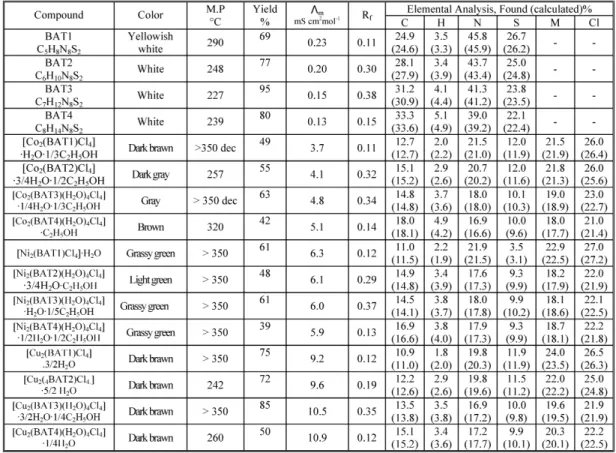
atmospheric conditions, insoluble in water, com-pletely soluble in dimethylformamide (DMF) and dimethylsulphoxide (DMSO) and partially solu-ble in ethanol, acetone and carbon tetrachloride. The elemental data and physical properties of these ligands are given in Table (1). The chemical structures of the ligands of interest under investi-gation are:
When
n = 1: 1,1 bis(4-amino-5-mercapto-1,2,4-triazol-3-yl)methane (BAT1)
n = 2: 1,2 bis(4-amino-5-mercapto-1,2,4-triazol-3-yl)ethane (BAT2)
n = 3: 1,3 bis(4-amino-5-mercapto-1,2,4-triazol-3-yl)propane (BAT3)
n = 4: 1,4 bis(4-amino-5-mercapto-1,2,4-triazol-3-yl)butane (BAT4)
Preparation of the complexes
For metal ion of Co(II), Ni(II) and Cu(II), complexes with the various ligands of interest (BAT1, BAT2, BAT3 and BAT4) were synthe-sized and collected pure after recrystallization.
In general, 0.01 mol of each ligand (BAT1=2.44 g, BAT2=2.58 g, BAT3=2.72 g and BAT4=2.86 g) was dissolved warm in 100 ml ethanol by warming up the solution. As 1: 2 mole ratio was adopted, a 0.02 mol metal chloride (CoCl2.6H2O=4.758 g, NiCl2.6H2O=4.754 g and CuCl2.2H2O= 3.4108 g) in 50 ml ethanol was added dropwise to the 0.01 mol ligand solution. The solution mixture was refluxed (3-4 hours) until precipitation occurred. The precipitates obtained were filtered off and recrystallized from ethanol and their yield percent are given in Table 1.
Chemical and physical measurements
nitro-gen and sulfur analysis were determined micro-analytically using a Vario EL Fab. CHNS Nr.11042023 instrument. Thin Layer Chromatography (TLC) was carried out on Silica Gel GF254plates (mn-kieselgel G., 0.2 mm thick-ness) with a 3:1 v/v ethylacetate / petroleum ether solution as eluent. The plates were scanned under ultraviolet light 254 nm lamp [21].
The molar conductance of 10-3 M solu-tions of the ligands and their metal complexes in DMF solvent were measured on a HACH con-ductivity meter model sens ion 5. All the meas-urements were taken at room temperature on freshly prepared solutions.
The electronic spectra of the ligands and their complexes were recorded in nujol mulls in the range 200-1100 nm on a Perkin Elmer Lambda 35 UV/Vis spectrometer. IR spectra of these com-pounds were recorded on Shimadzu DR-8001 infrared spectrophotometer in KBr pellets.
Magnetic susceptibility measurements of the solid complexes were carried out at room temperature using a Johnson Metthey and Sherwood magnetic susceptibility balance, and the data collected were processed in accordance with an earlier report [22]. Diamagnetic correc-tions were carried out using standard Pascal’s constants.
Thermogravimetric Analysis (TGA) experiment was conducted using TGA-50H ther-mal analyzers. All experiments were performed using a single use top loading platinum sample pan under nitrogen atmosphere at a flow rate of 30 ml/min and a 10°C/min heating rate in the temperature range 25-800°C. The data were extracted from the TG curves for each decompo-sition step with the assistance of the DTG curves and hence kinetic parameters of decomposition were evaluated using the Coats-Redfern method [15], as appropriate.
Biological screening
The ligands and their metal complexes were tested for their antimicrobial activity against four species of bacteria (Staphylococcus aureus, Streptococcus pyogenes, Haemophilus influenzae,
Pseudomonas aeruginosa),and two fungal species (Aspergillus flavus and Candida albicans) using filter paper disc method [23].The diameters of inhi-bition zones (mm) were measured at the end of an incubation period of 24 hours at 37 °C for bacteria, and 4 days at 28 °C for fungi. Discs saturated with DMSO are used as solvent control. Ampicillin 25 µg/ml was used as a reference substance for bacte-ria and 30 µg/ml Mycostatin for fungi [6, 21].
Results and discussion
Table 1 compares the elemental analysis, molar conductance and some other physical prop-erties of the BATs ligands and their metals com-plexes under investigation. The prepared metals complexes show single spots on their thin layer chromatography with satisfactory Rf values (Table 1), indicating their purity [24]. All the complexes
are colored, quite stable in atmospheric conditions and insoluble in water and ethanol, but most of them are partially soluble in acetone, Chloroform, Carbon tetrachloride, DMF and DMSO. Most of the complexes have high melting points (>350°C) and do not melt but decompose at higher tempera-ture. However, few of them melt and their melting points appear at the 242-320°C range.
The proposed empirical formulae of the complexes are in good agreement with the stoi-chiometry of 2:1, metal : ligand concluded from their analytical data (Table 1) and the thermogravi-metric analysis results (Tables 4 and 5). The molar conductance values (Table 1) of 10-3M solutions in DMF solvent are in the range of 3.7-10.9 mS cm2mol-1, indicating a non-electrolytic behavior of these metal complexes and clearly suggest the coor-dination of the anions with the metal ions [25]. The ligands and their metal ions complexes are charac-terized by elemental analysis, molar conductance, IR spectra, electronic spectra, magnetic susceptibility and with assistance of thermal analysis (Tables 1-5).
Infrared spectra studies
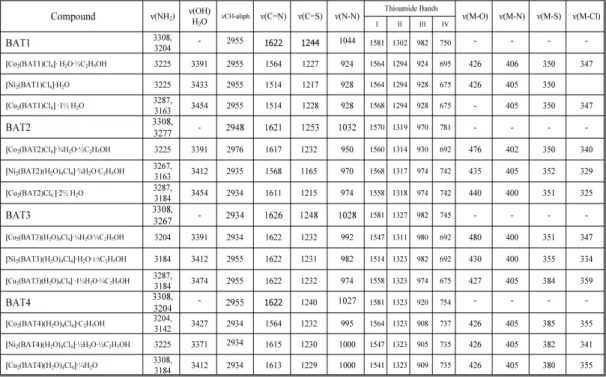
Table 2 shows the significant IR
tion bands of the BATs ligands and their twelve complexes. The IR spectra of BAT1, BAT2, BAT3 and BAT4 accord with the literature [7]. A broad IR band in the range 3142-3474 cm-1in the complexes is attributed to the overlapping vibra-tion of νNH(NH2) with that of νOH(H2O) of coordinated water [26]. Coordinated water shows metal-oxygen ν(M-O) stretching vibration in the 426-480 cm-1[27].
The appearance of the four thioamide bands (IIV) at 1570 1581, 1302 1327, 920 -982 and 745 - 781 cm-1[27], refutes the presence of the bands in the 2400-2600 cm-1regions and at 606 cm-1due to ν(SH) and ν(C-S), respectively [28] confirming that the ligands of BATs exist mainly in the thione form [5].These four thioamide bands of the ligands are compared with those of their complexes in Table 2, indicating the shift due to complexation. The bands at 1240-1253 cm-1in the spectra of the ligands assigned to ν(C=S) is lowered by 8-88 cm-1in the spectra of the complexes, indicating involvement of thione groups sulfur in the coordination. This leads to new bands in the region 350-385 cm-1tentatively assigned to M-S vibration [27].
The shift to lower frequency of the amino group by 20-124 cm-1may suggest the participa-tion of the nitrogen atom in the complexaparticipa-tion. The bands at 1027-1044 cm-1due to ν(N-N) in the free ligands are shifted to lower frequencies
by 27-120 cm-1in the complexes formation spec-tra [29], confirming the coordination through the nitrogen atoms . In addition, the shift in ν(C=N), for C=N being adjacent to N-N in the molecular structure, is to lower frequency by 4-108 cm-1 [13]. Coordination through the amino groups nitrogen is consistent with new bands in the 400-406 cm-1, assignable to the ν(M-N) vibration [23, 27, 30]. The new band at the low frequency 325-359 cm-1is assigned to ν(M-Cl). The above find-ings indicate the tetradentate (N and S donor atoms) nature of ligands, enhancing the coordina-tion of two metal ions with one ligand molecule.
Electronic and magnetic studies
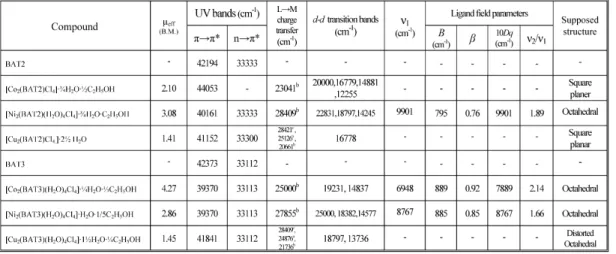
Table 3 compares the magnetic moments, electronic spectral data and ligand field parame-ters of the Co(II), Ni(II) and Cu(II) complexes with the ligands of BATs. The electronic spec-trum of the ligands BAT2 and BAT3 exhibit their two absorption maxima in the ranges 42194 -33333 cm-1 and 42373-33112 cm-1, assignable to
π→π* (K-band) and n→π* (R-band) transitions [27], respectively, (Table 3).
From the electronic spectra and magnetic moment data the structures and geometries of these Co(II), Ni(II) and Cu(II) complexes are identified and interpreted, as illustrated in struc-tures I and II and given in Table (3). The elec-tronic spectrum of the Co(II) complexes,
[Co2(BAT3)(H2O)4Cl4]·1/4H2O·1/3C2H5OH is indicated by the absorption bands at 19231 cm-1 and 14837 cm-1due to the 4T
1g→4T1g(P) (ν3) and 4T
1g→ 4A2g (ν2) transitions [31], respectively, suggesting octahedral geometry (structure I).
Due to instrumental limitation, the values of ν2 and ν3obtained from the electronic spectra are used to calculate the third transition, 4T
1g→4T2g(F) (ν1) band by the equations used for the d7 system [32] and found to be 6948 cm-1. From these transition bands the ligands field parameters (Table 3) calculated for the Co(II) complex of BAT3 ligand are B= 889 cm-1, β= 0.92, 10Dq= 7889 cm-1and ν
2/ν1 = 2.14 , respec-tively. Reduction of the B value of the free ion from 971 cm-1to 889 cm-1 (i.e. βfrom 1 to 0.92) on the complexation indicates the covalent char-acter of metal-to-ligand bonds [33]. The lower is the value the greater is the covalency.
The Co(II) complexes, [Co2(BAT3) (H2O)4Cl4]·1/4H2O·1/3C2H5OH] and Co2(BAT4) (H2O)4Cl4]·C2H5OH have magnetic moments of 4.27 and 4.82 B.M., respectively, which lie in the range reported [34] for an octahedral geometry around the Co(II) ion (structure I). However, the subnormal magnetic moments of the Co(II) chelates reflect a behavior of the binuclear com-plexes [30]. The 4.27 B.M. value is lower than that previously reported [35]. However, magnetic moments lower than 4.80 B.M for the octahedral Co(II) complexes has been observed [36]. The anomalous magnetic moment suggests a low-symmetry around the cobalt (II) ion [37]. Moreover, the gray and brown colors of the com-plexes are in good agreement with those reported for octahedral Co(II) complexes [33].
The observed charge transfer band record-ed for the complex of BAT3 at 25,000 cm-1 is mainly due to S→Co [27, 32]. This charge trans-fer transitions probably from the π-orbitals of the donor atoms to the metal ion. The UV bands, π→
π* and n→π*, of the ligand most likely moves to lower energy on complexation [29].
The other Co(II) complexes, [Co2(BAT1) Cl4]·H2O·1/3C2H5OH and
[Co2(BAT2)Cl4]·3/4H2O·1/2C2H5OH have a magnetic moments (2.67 and 2.10 B.M, respec-tively) which fall in the region reported for one unpaired electron existing in both square-planer
and low spin octahedral geometries [27]. The absence of octahedral characteristic bands spectra excludes the low spin octahedral configuration, whereas the existence of a broad band at 20,000 cm-1 in the [Co
2(BAT2)Cl4]·3/4H2O·1/2C2H5OH electronic spectrum may suggest a square-planer geometry (structure II). Also, the existence of the three bands at 12,255, 14,881 and 16,779 cm-1 confirms the proposed geometry [27, 32]. These observations together with the magnetic moment value (2.10 B.M.) support the presence of a square planar environment around the cobalt (II) ion [32].
Structure I
Structure II
Nickel(II) complexes
reported [34] for an octahedral geometry around the Ni(II) ion with a 3A
2gground term (structure I). The nickel (II) complexes, [Ni2(BAT2) (H2O)4Cl4]·3/4H2O·C2H5OH and [Ni2(BAT3) (H2O)4Cl4]·H2O·1/5C2H5OH, electronic spectra indicate two absorption bands in the regions 22831-25000 and 14577-18797 cm-1 for ν
3 and ν2 transitions [ 3A
2g→ 3T1g(P) (ν3) and 3A2g→ 3T
1g(F) (ν2)] and the third ν1 transition [3A2g→ 3T
2g (ν1)] band is estimated (8767-9901cm-1) using equations for the d8 system [32]. These transitions suggest an octahedral geometry (struc-ture I) for Ni (II) complex [31].
The ligand field parameters: (B =795-885 cm-1, β= 0.76-0.85, 10Dq= 8767-9901 cm-1and ν2/ν1 = 1.66-1.89) worked out for this complex (Table 3) lie in the same range as reported for an octahedral structure around Ni(II) ions [32]. Reduction of the B value of the free ion from 1041 cm-1to 795-885 cm-1 due to complex for-mation indicates the covalent character of metal-to-ligand bonds [33]. The green color of this complex is an additional evidence for an octahe-dral structure [27].
The [Ni2(BAT1)Cl4]·H2O complex is dia-magnetic, which factually supports (structure II) square-planar geometry [30]. The commonly square-planar Ni(II) complexes are orange or red but a few have purple or green colors [32].
Copper(II) complexes
The complexes [Cu2(BAT3) (H2O)4Cl4]· 3/2H2O·1/4C2H5OH and [Cu2(BAT4)(H2O)4Cl4]· 1/4H2O possess magnetic moments (1.45 and 1.58 B.M., respectively) found to be within the range reported for the d9-system containing one unpaired electron [38], and assignable to a dis-torted octahedral geometry (structure I). The dark brown color of these complexes supports the pro-posed geometry [38].
The electronic spectrum of [Cu2(BAT3) (H2O)4Cl4]·3/2H2O·1/4C2H5OH, show weak shoulders at 18,797 cm-1and 13,736 cm-1. These bands are due to 2B
1g→2Egand 2B1g→2A1g transi-tions in a distorted octahedral geometry [30, 32]. The broadness of the observed band may be due to Jahn-Teller effect [39], which enhances the distor-tion of the octahedral geometry.
The magnetic moments of the [Cu2(BAT1) Cl4]·3/2H2O and [Cu2(4BAT2)Cl4.]·5/2 H2O com-plexes are 1.85 and 1.41 B.M., respectively. These values lie in the range reported [39] for a square-planar geometry (structure II). The lower value of µeff(1.45, 1.58 and 1.41 B.M.) than that calculated (1.73B.M.) for one unpaired electron is normal and expected if binuclear complexes are considered [30]. Thus, in general a decrease in the magnetic moment below the spin-only value (1.73B.M.) may be attributed to molecular association taking place to form bi-or poly nuclear molecules [40]. Little changes in the ligands bands (π→π* and n→π*) energies are detected on complexation [29]. It is proved that the bands observed at 20661 and 21736 cm-1are assigned to S→Cu(II) transition [27], and that at 28421 and 28409 cm-1may be assigned to d→π* [41].
Thermal analysis
Tables 4 and 5 compare the characteristic thermal and kinetic parameters determined for each step in the decomposition sequence of the complexes. It can be seen clearly (Tables 4 and 5) that the mass losses (∆m%) obtained from the TG curves and that calculated for the corresponding molecule or molecules are in good agreement as is the case for all of these complexes. However, as the compositions of the final decomposition products (i.e. final residues) are not proved, ill-defined final states are considered for the thermal decomposition of these six complexes. The inte-gral method used is the Coats-Redfern equation [15] for reaction order n ≠1, which when lin-earised for a correctly chosen n yields the activa-tion energy from the slope;
where: α= fraction of weight loss, T = tempera-ture (K), n = order of reaction, Z = pre-exponen-tial factor, R = molar gas constant, Ea= activation energy and q = heating rate.
(Tf) and maximum rate (TDTG) temperatures of mass loss are given in Tables 4 and 5. The ligands BAT2 and BAT3 start losing 43% and 49% of their masses in two rapid and consecutive steps in the 130-414°C range, followed by slow and con-tinuous bleeding of 41.5% and 29.8% mass loss-es in the 262-800°C range with 15.5% and 21.2% residual mass at the end of the reaction (800°C), respectively. In the two apparent consecutive-steps, the strongly sharp peaks (TDTG) at 249°C and 324°C due to the rapid and consecutive 19%
and 24% mass losses with activation energies 234 kJ mol-1 and 201 kJ mol-1 observed for the BAT2 ligand are more or less comparable with that at 230°C and 295°C with 19% and 30% mass loss-es and activation energiloss-es of 186 kJ mol-1 and 184 kJ mol-1 observed for BAT3 ligand.
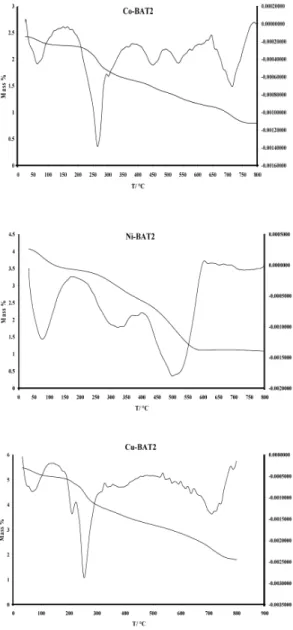
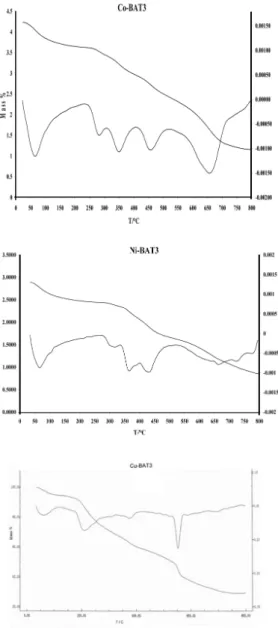
The TG/DTG curves of the metal-com-plexes in Figures 2 and 3 reveal that with over-lapping steps being various, three, four or five steps in the sequential decomposition of BAT2 and BAT3 metal-complexes are observed. The
first decomposition steps of both ligands com-plexes between 23-275°C with mass losses rang-ing from 5.60 to 15.70% correspond to the co-evolution of solvent with various number of adsorbed or/and coordinated water molecules (cal. 5.70-15.80%), and as a result broad peaks either due to peaks overlapping or a gradual
extending end (Tf) is observed. The correspon-ding activation energy values of these steps range between 53 to 94 kJ mol-1.
The second-step of decomposition in the 112-400°C range indicates the mass losses between 5.57 and 27.70% may be due to either the release of various ratio of coordinated water molecules
together with chloride atoms or various number of chloride atoms (cal. 5.62-27.38%). These second-steps show overlapping second-steps of either a very rapid or a gradual mass loss with activation energy falls in the 53-198 kJ mol-1range.
The third-step of these complexes occurs at the 315-608°C range with a gradual mass loss ranging from 10.60 to 35.30%. This corresponds to either the release of two chloride atoms, one chlo-ride atom along with various percent of backbone components or various percent of backbone com-ponents (cal. 10.70 to 35.29%) with activation energies between 109-282 kJ mol-1. The third-step (400-608°C) is an end of reaction step for the decomposition of Ni-BAT2 complex leaving a 27.90% mass loss that is in consistent with the final product (cal. 28.04%) of an ill-defined final state. The fourth-step at the 414-648°C range is assigned to the removal of one chloride atom along with 15.5% of the backbone components (found 12.60%, cal. 12.50%), one chloride atom along with 16.2% of the backbone components (found 12.63%, cal. 12.61%) and 23% of the backbone components (found 10.80%, cal. 10.70%) in the decomposition process of Co-BAT3, Ni-BAT3 and Co-BAT2 complexes with activation energy of 233, 314 and 237 kJ mol-1, respectively.
Figure 1. The TG and DTG thermograms of the BAT2 and BAT3 ligands in nitrogen at the heating of 10°C min-1.
In the contrary, this fourth-step in the 499-800°C range is the end of decomposition of Cu-BAT2 and Cu-BAT3 complexes for eliminating the remaining 52% (found 23.40%, cal. 23.50%) and 58% (found 24.20%, cal. 24.22%) of the backbone components with the deposition of ill-defined final residues 32.70% (cal. 32.10%) and 28.80% (cal. 28.70%) at the end of the reactions, respectively. Their activation energies found to
be 98 and 242 kJ mol-1, respectively. It is found that the release of the coordinated water mole-cules and chloride atoms fairly accord with liter-ature [42, 43].
However, in the fifth-step of the 526-800°C range, the Co-BAT2, Co-BAT3 and Ni-BAT3 decompose completely by losing the remaining 28% (found 13.0%, cal 13.0%), 67.5%
Figure 3. The TG and DTG thermograms of the Co, Ni and Cu complexes with BAT3 ligand in nitrogen at the heating of 10°C min-1.
(found 29.40%, cal 29.50%) and 59% (found 25.60%, cal 25.50%) of their backbone compo-nents with the deposition of ill-defined final products 33.20% (cal. 33.40%), 26.30% (cal. 26.10%) and 29.30% (cal. 29.17%), and the asso-ciated activation energies are 316, 141 and 170 kJ mol-1, respectively.
It can be concluded that the thermal decomposition of these six complexes is of a variety of degrees of similarity (Table 4 and 5). For instant, the first, second and third steps in the sequential decomposition of the square-planar complexes of Co-BAT2 and Cu-BAT2 are of very close thermal and kinetic parameters. This is, maybe, due to similar nature of decomposition process, i.e. similar mechanism and kinetics of the decomposition reaction that took place in the first three steps of the Co-BAT2 and Cu-BAT2 complexes. Acceptable similarities in the thermal and kinetic parameters are observed for the five steps in the decomposition sequence of the Co-BAT3 and Ni-Co-BAT3 octahedral complexes. However, this is inconsistent with the thermal decomposition of the octahedral complexes of Ni-BAT2 and Cu-BAT3 with their three and four steps in the decomposition process.
Biological activity
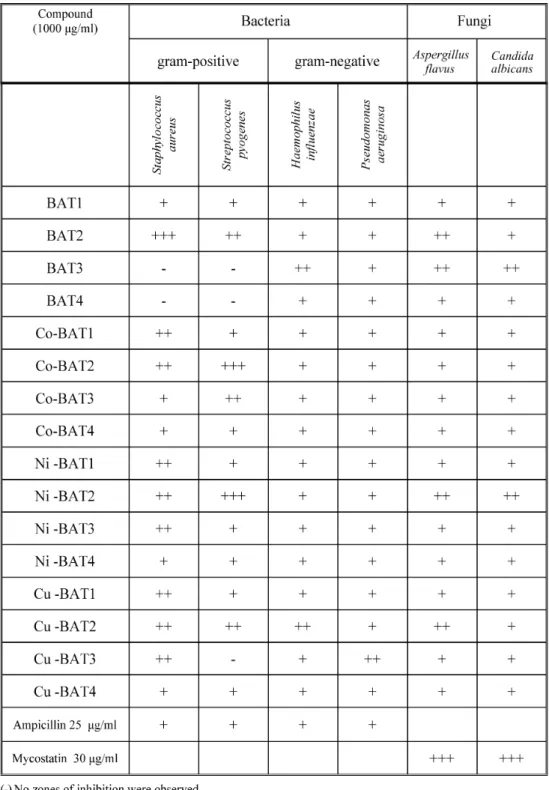
The ligands BAT1, BAT2, BAT3 and BAT4 under investigation and their Co(II) Ni(II) and Cu(II) complexes were screened in vitro for their antibacterial activity against four strains of bacteria, i.e. two gram-positive bacteria (Staphylococcus aureus, Streptococcus pyo-genes) and two gram-negative bacteria (Haemophilus influenzae, Pseudomonas aerugi-nosa), and two fungal species (Aspergillus flavus
and Candida albicans). Discs saturated with DMSO solvent, which show no zone of inhibi-tion (-) were used as control and the results of the antibacterial and antifungal activities were sum-marized in Table 6.
tive bacteria and only for the complex Cu-BAT3 against Streptococcus pyogene. The highest activity observed is for the BAT2 against
Staphylococcus aureus and for the Co(II) and Ni(II) complexes of BAT2 towards Streptococcus pyogene. Apart from the above-mentioned lig-ands and complexes, the remaining liglig-ands and metal complexes exhibit moderate to high anti-bacterial activity.
Apart from the ligands and metal complex-es that posscomplex-ess a high activity againstAspergillus flavusand Candida albicans, all the rest of the lig-ands and the complexes exhibit moderate antifun-gal activities against the fungi tested.
It has been reported [16-18] that complex-es of some heterocyclic ligands with transition metals increase their biological activities. This can be seen relatively more in the higher activity of the metals complexes towards Staphylococcus aureus than the free ligands, but slightly less against Streptococcus pyogene. In contrast, increasing the number of methylene groups between two heterocyclic rings may decrease the antibacterial activity of these compounds [19]. Close examination of the antibacterial activity of the ligands and their metal complexes reveals that the ligand BAT4 with the highest methylene groups and its metal complexes possess the low-est antibacterial activity against gram-positive bacteria than the others.
Conclusion
Based on the analytical data and the TGA results, the formulae and the stoichiometry of the prepared BATs ligands and their Co( II) , Ni(II) and Cu(II) metal complexes are suggested. The IR spectral studies indicate neutral tetradentate behavior of the ligands coordinating through the amine group nitrogen and thione form sulphur. The molar conductance values show the non-electrolytic nature of the complexes. The spectral and magnetic results reveal an octahedral geome-try (structure I) for some of the complexes and a square-planer (structure II) for the others.
Generally, the metal-complexes of a par-ticular ligand with various metals exhibit various thermal decomposition behavior, and the kinetic
parameters for the successive steps in the decom-position sequence are determined. The inconsis-tent biological activities observed again the four strains of bacteria and the two fungal species reflect various degrees effect nature of these metal-complexes.
Received May 15 2008 Accepted August 26 2008
References
[1] D.-K. Kim, J. Kim, and H.-J. Park, Bioorganic & Medicinal Chemistry Letters. 14(10) (2004) 2401.
[2] B. Modzelewska-Banachiewicz, J. Banachiewicz, A. Chodkowska, E. Jagiello-Wojtowicz, and L. Mazur, European Journal of Medicinal Chemistry. 39(10) (2004) 873. [3] L. Tian, Y. Sun, H. Li, et al, Journal of Inorganic Biochemistry. 99(8) (2005) 1646.
[4] J. Liu, L. Li, H. Dai, Z. Liu, and J. Fang, Journal of Organometallic Chemistry. 691(12) (2006) 2686.
[5] M. Serdar, N. Gumrukcuoglu, S. Alpay Karaoglu and N. Demirbas, Turk J Chem. 31 (2007) 315.
[6] N. Demirbas, A. Demirbas, S. A. Karaoglu and E. Celik, ARKIVOC. I (2005) 75.
[7] P. F. Xu, X. W. Sun, L. M. .Zhang and Z. Y. Zhang, J. Chem. Research (S). (1999) 170.
[8] Z. Y. Zhang, X. Chen, L. L. Wei and Z. L. Ma, Chemical Research in Chinese Universities. 2 (1991) 129.
[9] X. Zhu, Y. M. Zhang, B. L. Li and Y. Zhang, Journal of Coordination Chemistry. 59(5) (2006) 513.
[10] P. Thakur, V. Chakravortty and K. C. Dash , Polyhedron. 16(9) (1997) 1417.
[11] K. C. Rout, R. R. Mohanty, S. Jena and K. C. Dash, Polyhedron. 15(56) (1996) 1023.
[12] J. A. Joule, K. Nills, G. F. Smith, Heterocyclic Chemistry, Chapman and Hall, London, 3rd edn., 1995.
[13] K.B. Gudasi, P. B. Maravalli and T. R. Goudar, J. Serb. Chem. Soc. 70(4) (2005) 643.
[14] T. A. Khan and Shahjahan, Synthesis and Reactivity in Inorganic, Metal-Organic, and Nano-Metal Chemistry. 31(6) (2001) 1023.
[15] A. W. Coats and J. P. Redfern, “Kinetic parameters from thermogravimetric” Nature. 201 (1964) 68.
[16] A. E. Liberta and D. X. West, BioMetal, 5(2) (1992) 121. [17] E. Rodriguez-Fernandez, J. L. Manzano, J. J. Benito, R. Hermosa, E. .Monte, J..J. Criado, Journal of Inorganic Biochemistry, 99(8) (2005) 1558.
[18] G. K. Zahariou, E. Gavrielatos, I. M. Kalogeras, G. Athanasellis, A. Vassilikou-Dova, O. Igglessi-Markopoulou, J. Markopoulos, Radiation Effects and Defects in Solids. 157(6-12) (2002) 1057.
[19] K. Zamani, K. Faghihi, M.S, Mehranjani, Pol. J. Pharmacol.55 (2003) 1111.
[20] A.I. Vogel “A Text Book of Quantitative Inorganic Analysis” Longmans, London ,1961.
[23] R. R. Amin, A. T. Al-Subaie, B. A. El-Gamal, A.M. Mahasneh and I.S. Al-Naimi, Journal of the Medica Research Institute. 22(1) (2001) 1.
[24] A. A. El-Asmy, M. E. Khalifa, and M. M. Hassanian, Synth. React. Inorg. Met.-Org. Chem., 31(10) (2001) 1787. [25] M. Arshad, Saeed-ur-Rehman, S. A. Khan, K. Masud, N. Arshad and Abdul Ghni, Thermochimica Acta. 364 (2000) 143.
[26] K. S. Siddiqi, R. I. Kureshy, N. H. Hkan, S. Tabassum And S. A. A. Zaidi, Inorganic Chimica Acta. 151(2) (1988) 95.
[27] N. M. El-Metwally, I. M. Gabr, A. A. El-Asmy, A.A. Abou-Hussen, Transition Metal Chemistry. 31 (2006) 71. [28] A. A. El-Asmy, M. A. Morsi and A. A. El-Shafei, Transition Met. Chem. 11 (1986) 494.
[29] Y. Zhang, W. Ruan, X. Zhao, H. Wang and Z. Zhu, Polyhedron. 22(12) (2003) 1535.
[30] N. M. El-Metwally, A. A. El-Asmy, A.A. Abou-Hussen, International Journal of Pure & Applied Chemistry. 1(1) (2006) 75.
[31] A. A. El-Asmy, M. E Khalifa, T. H. Rakha, M. M. Hassanian, A. M. Abdallah, Chem. Pharm. Bull.,48 (2000) 41.
[32] A. B. P. Lever, “Inorganic Electronic Spectroscopyî, Elsevier, Amsterdam, 1968.
[33] A. A. El-Asmy , Synth. react. Inorg. Met.-Org. Chem.. 17 (1987) 399.
[34] N. C. Saha, R. J. Butcher, S. Chaudhuri and N. Saha, Polyhedron.22(3) (2003) 383.
[35] A. A. El-Asmy, T.Y. Al-Ansi, M..Mounir and S. A. Ashour, Synth. React. Inorg. Met.-Org. Chem. 19(4) (1989) 309.
[36] G. G. Mohamed, M. .M. Omar, A. M. M. Hindy, Spectrochimica Acta. (A 62) (2005) 1140.
[37] A. A. El-Asmy, Ph D thesis. Faculty of Science, Mansoura University, Egypt, 1981.
[38] N. M. El-Metwally, I. M. Gabr, A. M. Shallaby And A. A. El-Asmy, Journal of Coordination Chemistry. 58(13) (2005) 1145.
[39] G. A. A. Al-Hazmi, M. S. El-Shahawi, I. M. Gabr And A. A. El-Asmy, Journal of Coordination Chemistry. 58(8) (2005) 713.
[40] F.A. El-Saied, M.I. Ayad, R.M. Issa and S.A. Aly, , Polish J. Chem., Inorganic Chemistry. 75 (2001) 773.
[41] A. A. El-Asmy, T. Y. Al-Ansi, R. R. Amin, M. F. El Shahat, Trans. Metal Chem. 15 (1990) 12.
[42] H. Maydama, A. El-shekeil M. A. Khalid and A. Al-Karbouly, Ecl. Quim., Sao Paulo. 31(1) (2006) 45.