BENIGN FOCAL EPILEPSY OF CHILDHOOD
WITH CENTROTEMPORAL SPIKES (BECTS)
Clinical characteristics of seizures
according to age at first seizure
Carmen Silvia M.G. Miziara
1, Maria Luiza G. Manreza
2ABSTRACT - BECTS is characterized by the presence of simple partial motor seizures in the face and/or oropharynx, with or without sensory symptoms and often with secondary generalization. These seizures tend to occur more often during sleep or drowsiness. According to some authors, generalized seizures prevail over other types particularly among children aged five or less. The purpose of this study is to determine the characteristics of the first epileptic episode among children with BECTS, grouped by age as of their first epileptic seizure, as well as to analyze how such seizures change over the course of clinical evolution. A total of 61 children were examined, 16 of whom below the age of 5 and 45 above. With regard to the first and recurrent epileptic episodes, our final assessment showed that partial seizures occurred more frequently than generalized tonic-clonic seizures in both groups. Although no conclusive relation could be established between the type of partial seizure (i.e. simple versus complex) and the children’s age as of their first epileptic episode, it was possible to correlate the type of epileptic seizure with their clinical evolution, in which case simple partial seizures proved to be more frequent than complex partial seizures. It should be noted that the number of children under the age of five was relatively small, which evinces the need for further studies. It should also be borne in mind that the reported frequency of generalized seizures in these children’s first epileptic episode may be due to their parents’ lack of attention and familiarity with this pathology and their attendant difficulty in characterizing its clinical symptoms.
KEY WORDS: childhood benign focal epilepsy with centrotemporal spikes, orofacial epileptic seizure, nocturnal epileptic seizure, oropharyngeal epileptic seizure, rolandic epilepsy.
Epilepsia focal benigna da infância com ponta centrotemporal (EBIPCT): características clínicas de acordo Epilepsia focal benigna da infância com ponta centrotemporal (EBIPCT): características clínicas de acordo Epilepsia focal benigna da infância com ponta centrotemporal (EBIPCT): características clínicas de acordo Epilepsia focal benigna da infância com ponta centrotemporal (EBIPCT): características clínicas de acordo Epilepsia focal benigna da infância com ponta centrotemporal (EBIPCT): características clínicas de acordo com a idade na primeira crise epiléptica
com a idade na primeira crise epiléptica com a idade na primeira crise epiléptica com a idade na primeira crise epiléptica com a idade na primeira crise epiléptica
RESUMO - EBIPCT é caracterizada pela presença de crises focais motoras simples envolvendo a musculatura da face e da orofaringe, com ou sem sintomas sensitivos e, muitas vezes com generalização secundária. Estas crises epilépticas tendem a ocorrer durante o sono ou a sonolência. Alguns autores referem o predomínio de crises generalizadas, especialmente nas crianças com menos de 5 anos de idade. O objetivo deste estudo é avaliar a característica da primeira crise epiléptica em crianças com EBIPCT com ponta centrotemporal de acordo com a idade no primeiro episódio epiléptico, assim como estudar as transformações das crises epilépticas durante a evolução clínica. Foram avaliadas 61 crianças, sendo 16 menores de 5 anos de idade e 45 maiores. Em relação à primeira crise epiléptica e a recorrência, a avaliação final mostrou nos dois grupos uma frequência maior de crise parcial. No entanto, não foi possível verificar uma relação entre o tipo da primeira crise parcial (simples ou complexa) de acordo com a idade da criança na época deste evento, mas sim uma variação do tipo de crise epiléptica com a evolução clínica, quando foi observado predomínio de crise parcial simples em relação à crise parcial complexa. Deve-se observar que o número de crianças menores que 5 anos foi pequeno, mostrando a necessidade de estudos mais amplos. Questiona-se, ainda, se a frequência de crises generalizadas no primeiro episódio apresentado pela criança não seria devido a dificuldade de caracterização das manifestações clínicas pelos pais ainda pouco atentos e familiarizados com a patologia.
PALAVRAS-CHAVE: epilepsia focal benigna da infância com ponta centrotemporal, crise epiléptica orofacial, crise epiléptica noturna, crise epiléptica orofaríngea, epilepsia rolândica
Department of Neurology, Clinicas Hospital, University of São Paulo, São Paulo SP, Brazil: 1MD, Child Neurology Post Graduate Student; 2MD, PhD, Medical Supervisor for the Child Neurology Service.
Received 5 September 2001, received in final form 2 February 2002. Accepted 4 February 2002.
Benign focal epilepsy of childhood with centro-temporal spikes (BECTS), also known as rolandic epi-lepsy, is the most common and widely studied form of all benign childhood epilepsies1. It accounts for
24% of all epilepsies among children aged five to fourteen2, and for 16.5% of such disorders among
chil-dren under fifteen years of age3. The initial age of
seizures ranges from three to thirteen years, peak-ing at seven to eight years4. Nocturnal seizures
occur-ring among children with no neurological or cogni-tive disorders after they fall asleep or upon awaken-ing are quite typical5, 6. Gender prevalence in this
form of epilepsy is 60% males and 40% females7. In
1989, BECTS was classified as an age-dependent par-tial idiopathic epilepsy, namely a genetic focal epi-lepsy without defined structural wounds, yet with excellent prognosis8. The remission of seizures takes
place spontaneously during the teen years9.
BECTS is a relatively well-defined disorder, with ty-pical clinical and electroencephalographic (EEG) fea-tures. The symptoms observed during the fits may vary considerably from child to child and, in some cases, from one episode to another9. Clinically, it is
characterized by simple partial seizures (SPS), includ-ing motor, hemifacial and rapid spasms that gener-ally occur during sleep. In addition, such SPS may be accompanied by sensory symptoms. With regard to its EEG features, BECTS is characterized by sudden, high-voltage centrotemporal spikes, often followed by sleep-activated slow waves tending to spread out or shift from side to side. These spikes are unilateral in about 60% of all cases and bilateral in about 40%. They may be mono- or even multifocal5,10,11. However,
background activity remains normal. The fact that BECTS seizures often involve facial and oropharyn-geal muscles suggests that epileptic discharges origi-nate from the inferior rolandic cortex, bilaterally to rolando’s fissure and in juxtaposition to Sylvius’ fis-sure12, 13. The presence of motor symptoms or upper
limb sensitivity in some children during such seizures will depend on the involvement of the higher rolan-dic area. According to some authors, BECTS features, particularly those of clinical nature, change from one age group to another. Beaussart and Loiseau claim that very young children with BECTS show a higher incidence of generalized hemiepilepsy, which rarely changes sides or progresses into secondary general-ized epilepsy5-7.
The objective of this study was to analyze the clinical characteristics of the first epileptic seizure among children with BECTS below or above the age of five, as well as how such features change over the course of clinical evolution.
METHOD
Throughout 1999 and 2000, the Child Neurology De-partment of Clinicas Hospital, assisted by the medical fac-ulty of the University of São Paulo (USP), evaluated 61 children who had been diagnosed with BECTS according to the clinical and EEG features of this disorder. The sub-jects were separated into two groups according to the age at which the symptoms had first occurred. Group 1 included 16 children who had had their first epileptic seizu-re at age five or under, and Group 2 comprised 45 chil-dren whose first epileptic episode had occurred after the age of five.
Data were collected through informal interviews with the subjects’ mothers and then checked for accuracy by means of extensive questionnaires designed to ensure that no earlier episodes had been overlooked. Further interviews were carried out with other family members who had wit-nessed such episodes, in order to verify the data gathered in the previous steps. Finally, the subjects themselves were interviewed to determine their sensitivity to the symptoms reported during the episodes.
The following criteria were presented to clarify our characterization of partial crises:
1. Simple focal seizure with oropharyngeal involvement: consciousness is not impaired and the child responds to external stimuli during the seizure; unilateral clo-nus often accompanied by commissural twitches or tonic contractions causing the mouth to be lopsided. 2. Simple focal seizures involving the hands: alteration of motor signals in the muscular system or the pres-ence of clonic twitches; hypersensitivity, and particu-larly a tingling sensation.
Determining the exact location of the discharges helps to classify epileptic seizures and to rule out the possibility of structural wounds. The following procedures were car-ried out:
1. EEG during sleep and wakefulness monitoring accord-ing to the international system 10-20;
2. Computerized tomography and/or magnetic resonance imaging;
3. Single photon emission computed tomography.
Seizures were classified according to the specifications of the International League Against Epilepsy4 and
para-metric tests were used for statistical data evaluation.
RESULTS
Our evaluation of the 61 subjects indicated a pre-dominance of seizures among males (Table 1) and during sleep monitoring (Table 2).
consisted of 16 children under the age of 5 years, while Group 2 comprised 45 children aged 5 years or older.
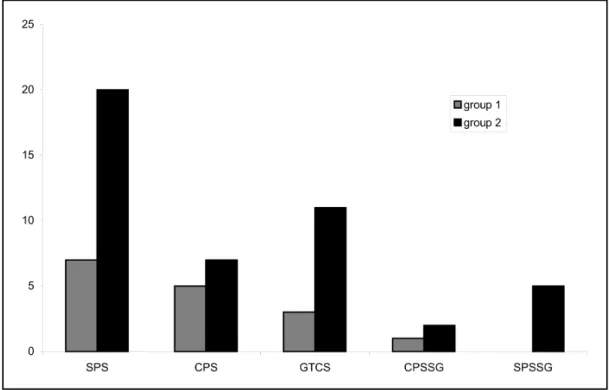
Our analysis of the characteristics of the first epi-leptic phase in all the children showed a predomi-nance of partial seizures (PS). Among these, there was a higher frequency of simple partial seizures (SPS) (Fig 1).
Our evaluation of the characteristics of the first epileptic phases in both Group 1 and Group 2 sho-wed a higher frequency of SPS. In relation to the
children’s age at the time of their first seizure, no statistically significant differences were found be-tween Groups 1 and 2 (p>0.5) (Fig 2).
Six children from Group 1 and 15 from Group 2 showed changes in the characteristics of their epi-leptic seizures over the course of clinical evolution. The difference between the two groups was not sta-tistically significant (p>0.5). It should be pointed out that one child from Group 1 and four children from Group 2 experienced only one seizure. An analysis of the changes in epileptic seizure type during the
Table 1. Distrubuition according to gender.
Gender Nº %
Masculine 34 55.75
Feminine 27 44.25
Table 2. Frequency of epileptic seizures during monitoring or sleep.
Nº %
Sleep 46 75.4
Wakefulness 15 24.6
Table 3. Distribuition of patients according to age at the first epileptic seizure.
Age (years) Nº % %
Accumulated
< 3 5 8.20 8.20
3 – < 5 11 18.04 26.23
5 – < 7 18 29.50 55.74
7 – < 9 19 31.15 86.89
9 – < 11 7 11.47 98.36
11 - < 13 1 1.64 100
Fig 1. Distribuition of different types of epileptic seizures in total of 61 children.
clinical evolution of children in Group 1 revealed that GTCS gave way to CPS, while all the four cases of com-plex partial seizure (CPS) evolved to SPS (Table 4).
As for Group 2, it was possible to evaluate the changes in epileptic seizures in 15 children during the course of their clinical evolution, for these sub-jects experienced recurrent episodes. Most of the children with initial GTCS (4 out of 5) evolved to SPS (Table 5).
All patients demonstrated centrotemporal spikes activated by sleep in their EEGs. The focus was on the right side for 26 patients, and on the left side for 25 patients. In the remaining 10 patients, the discharges occurred independently bilaterally.
DISCUSSION
Epileptic seizures in patients with BECTS are usu-ally described in literature as SPS involving facial and oropharyngeal muscular tone, as well as brief and not too frequent. Other types of seizure may occur less frequently. For some authors, however, this stan-dard varies according to the age at which seizures occur, whereby generalized seizures or generalized hemiepilepsies would be more frequently observed among children under 5 years of age.
In this study, PS and GTCS were found to be sta-tistically similar in terms of frequency between
chil-Fig 2. Distribuition of different types of seizures according to the age.
SPS, simple partial seizure; CPS, complex partial seizure; GTCS, generalized tonic-clonic seizure; CPSSG, complex partial seizure with secondary generalization; SPSSG, simple partial seizure with secondary generalization.
Table 4. Changes in the type of epilepsy seizure during the clini-cal evolution of children from Group 1 (Total: 6 patients)
Characteristics Change in Nº
of 1st seizure characteristics
CPS SPS 4
CPS GTCS 1
GTCS CPS 1
SPS, simple partial seizure: CPS, complex partial seizure; GTCS, general-ized tonic-clonic seizure.
Table 5. Change in the type of epileptic seizure during the clinical evolution of children from Group 2.
Characteristics Change in Nº
of 1st seizure characteristics
CPS SPS 5
GTCS SPS 4
SPS➔GTCS SPS 2
GTCS SPS➔GTCS 1
SPS➔GTCS GTCS 1
CPS➔GTCS CPS 1
SPS CPS 1
other point to bear in mind is that most references to GTCS were made in relation to first seizures, when the subjects’ parents knew little or nothing about the features of this disorder,
REFERENCES
1. Loiseau P, Duché P. Benign rolandic epilepsy. In Chauvel P, Delgado-Escueta A V, et al. (eds). Advances in Neurology Vol 57. New York: Raven Press, 1992;411-417.
2. Commission on Classification and Terminology of the International League Against Epilepsy. Proposal for revised clinical and electrogra-phic classification of epileptic seizures. Epilepsia 1981;22:498-501. 3. Blom S, Heijbel J, Bergfors PG. Benign epilepsy with centrotemporal
foci: prevalenceand follow-up study of 40 patients. Epilepsia 1972; 13:609-619.
4. Cavazzutti GB. Epidemiology of different types of epilepsy in school age children of Modena, Italy. Epilepsia 1980;2:57-62.
5. Beaussart M. Benign epilepsy of children with rolandic (centrotemporal) paroxysmal foci: a clinical entity. Study of 221 cases. Epilepsia 1972; 13:795-811.
6. Lerman P. Benign partial epilepsy with centrotemporal spikes. In Roger J, Dravet CH, Bureau M, et al. (eds). Epileptic syndromes in infancy, childhood and adolescence. London: John Libbey, 1985;150-158. 7. Lerman P. Benign partial epilepsy with centrotemporal spikes. In Roger
J, Dravet C, Bureau M, et al. (eds). Epileptic syndromes in infancy, child-hood and adolescence. London: John Libbey,1985;189-200.
8. Commission on Classification and Terminology of the International League Against Epilepsy. Proposal for revised classification of epilep-sies and epileptic syndromes.Epilepsia 1989; 30: 389-399.
9. Loiseau P, Duche B, Cohadon S. The prognosis of benign localized epi-lepsy in early childhood. Epiepi-lepsy Res 1992;6(Suppl):75-81. 10. Dravet C. Benign epilepsy with centrotemporal spikes: do we know all
about it? In Wolf P (ed). Epileptic seizures and syndromes. London: John Libbey, 1994;231-240.
11. Lerman P. Benign childhood epilepsy with centro-temporal spikes (BECT). In: Engel J Jr, Pedley TA (eds). Epilepsy: a comprehensive text-book. Philadelphia: Lippincott-Raven Publishiers, 1997;2307-2314. 12. Holmes GL, Wong PK. Topographical analysis of the centrotemporal
discharges in benign rolandic epilepsy of childhood. Epilepsia 1984; 25:705-711.
13. Loiseau P, Beaussart M. The seizures of benign childhood epilepsy with rolandic paroxysmal discharges. Epilepsia 1973;14:381-389.
dren above and below 5 years of age. It appears that age has no influence on clinical evolution, for one change was noted in standard epileptic seizures in about one third of the children, regardless of the age group analyzed. Our findings indicate a clear predominance of PS in relation to GTCS. It is impor-tant to emphasize that the seizures described as GTCS could be PS (simple or complex) with second-ary generalization, principally among children un-der the age of five.
In Group1, one child with GTCS evolved to CPS and four with CPS evolved to SPS, whereas only one with CPS changed to GTCS. In Group 2, four of the five children with GTCS evolved to SPS. A closer study showed that all the twenty children with SPS during the initial phase maintained this standard over the course of their clinical evolution. Our results dem-onstrate a high incidence of SPS among children with BECTS, regardless of their initial symptoms. Further-more, the predominance of SPS in both groups dur-ing the evolution seems to strengthen the hypoth-esis that the determining factor behind standard epileptic seizures among children with BECTS is their clinical evolution rather than age.