DOI: 10.1590/0004-282X20130193 ARTICLE
ADHD in idiopathic epilepsy
TDAH em epilepsia idiopática
Marcos H. C. Duran, Catarina A. Guimarães, Maria Augusta Montenegro, Marina L. Neri, Marilisa M. Guerreiro
ADHD is three to ive times more common in people with epilepsy than in the normal population1,2. It occurs in 14-31% of children with epilepsy3,4. It seems that the severity of
epi-lepsy enhances the predisposition for having ADHD, since co-morbidity is described in both benign and refractory child-hood epilepsy1,5-7. Inattentive ADHD is appointed as the most
common subtype in epileptic patients4,6-8.
Etiology, duration of epilepsy, seizure frequency, seizu-re control, and the use of antiepileptic drugs aseizu-re important varia bles related to neuropsychological and behavioural problems in patients with epilepsy and ADHD. It seems that patients with idiopathic epilepsy presenting with few sei-zures or who are seizure-free with monotherapy have a low frequency of neuropsychological and behavioral problems8-12.
Epileptiform discharges, particularly during the active phase
of the epilepsy, are also an important variable when neuro-psychology and behavior are concerned6,8,11.
he correlation between the variables of epilepsy and ADHD has not yet been fully elucidated. his study aims to verify the occurrence of ADHD symptoms in a group of pa-tients with idiopathic epilepsy and the relationship between clinical variables, electroencephalogram (EEG), treatment, and psychosocial and behavioral changes.
METHODS
his is a cross-sectional study. We interviewed 60 patients who were diagnosed with idiopathic epilepsy according to the ILAE criteria13. Patients were followed at the Childhood
Departamento de Neurologia, Universidade Estadual de Campinas, Campinas SP, Brazil.
Correspondence:Marilisa M. Guerreiro; Department of Neurology - FCM - Unicamp; Rua Tessalia Vieira de Camargo 126; 13083-887 Campinas SP - Brasil; E-mail: [email protected]
Conflict of interest:There is no conflict of interest to declare. ABSTRACT
Our aim was to clarify the correlation of attention deficit hyperactivity disorder (ADHD) with epilepsy and behavior problems. This was a cross-sectional study. Sixty children with idiopathic epilepsy were interviewed using the MTA-SNAP IV Teacher and Parent Rating Scale, Vineland Adaptive Behavior Scales and Conners’ Rating Scales. We used the chi-square test to analyze the correlation of epilepsy variables in patients with and without ADHD with a significance level of 0.05. Eight patients had ADHD symptoms (13%), seven had the inattentive ADHD subtype and only three had behavioral problems. When epileptic patients with and without ADHD symptoms were compared we found no significant difference in regard to epilepsy variables. All patients were controlled and 43% were either without AED or undergoing withdrawal. Our study revealed a low comorbidity of ADHD symptoms and epilepsy due to low interference of seizures and drug treatment on the comorbid condition. Keywords: epilepsy, ADHD, childhood, psychosocial aspects, behavior.
RESUMO
Nosso objetivo foi clarificar a correlação entre transtorno do déficit de atenção (TDAH) com epilepsia e problemas comportamentais. Este foi um estudo transversal. Sessenta crianças com epilepsia idiopática foram entrevistadas com a Escala para Pais e Professores MTA-SNAP IV, Escala de Comportamento Adaptativo Vineland e Escala Conners. Utilizamos o teste do qui-quadrado para analisar a correlação das variá-veis de epilepsia em pacientes com e sem TDAH com um nível de significância de 0,05. Oito pacientes apresentaram sintomas de TDAH (13%), sete tiveram o subtipo inatento e três deles tinham problemas comportamentais. Quando os pacientes epilépticos com e sem TDAH foram comparados, não encontramos diferença significativa em relação às variáveis de epilepsia. Todos os pacientes estavam controlados e 43% deles estavam sem medicação ou em retirada da droga. O nosso estudo mostrou baixa comorbidade entre epilepsia e TDAH devido à baixa interferência de crises e tratamento na condição comórbida.
Outpatient Clinic of our University Hospital. his study was approved by the Ethical Committee of our institution (proto-col 309/2009).
Patients and/or their guardians were invited to sign an informed consent form. he interview was based on a ques-tionnaire asking for detailed characterization of the epileptic seizures, personal histories and morbidities, including pre-vious ADHD symptoms. Patients underwent a clinical and neurological exam.
Seizure frequency was classiied as: sporadic (less than one or one seizure a month), frequent (from one to four seizures a month) and very frequent (more than four seizures a month)14.
he following tests were applied: to investigate ADHD symptoms15 we utilized the MTA-SNAP IV Teacher and Parent Rating Scale16 to assess inattention, hyperactivity and
impulsi-vity symptoms; the Conners’ Parent Rating Scale Revised Long Version17 to assess behavioral problems, including
inatten-tion, impulsivity and hyperactivity; and, the Vineland Adaptive Behavior Scale18 to assess abilities in communication, daily
ac-tivities and sociability. In patients with ADHD symptoms, the Wechsler Intelligence Scale for Children - WISC III19 - was
ad-ministered by an experienced professional.
Every patient underwent a digital EEG, with electrodes positioned according to the International 10-20 system, in resting position, during wakefulness and spontaneous sleep, in hyperventilation, and with intermittent photic stimula-tion. he visual analysis of the EEG sought to characterize the background activity and, when epileptiform discharges occurred, analyze the morphology, amplitude and duration, location, laterality and, when bilateral, the synchrony, dis-tribution and frequency. he indings were categorized as: (1) normal during wakefulness, drowsiness and/or sleep; (2) abnormal with non-epileptiform disturbance: focal or generalized slow waves in the theta or delta range; (3) ab-normal with focal epileptiform discharges: spikes or focal
sharp waves or spikeslow wave; (4) abnormal with generali -zed epileptiform discharges: spikes or focal sharp waves or spike-slow wave; (5) abnormal with both epileptiform and non- epileptiform disturbances.
We used the chi-square test to analyze the correlation of epilepsy variables (age at seizure onset, epileptic syndrome, type of seizure, seizure frequency, period without seizures and abnormalities in the EEG) in patients with and without ADHD symptoms. We used a signiicance level of 0.05.
RESULTS
Between September of 2008 and September of 2009, we assessed 60 patients diagnosed with idiopathic epilepsy, with age between six and 16 years of age (M=6.42±2.6), and half of them were girls. Brain MRIs were normal in all patients.
Benign epilepsy of childhood with centrotemporal spikes was the most frequent epileptic syndrome, occurring in 31 pa-tients (51.6%). he age at seizure onset varied between one and 14 years (M=6.41±2.5). he distribution of patients in regard to epileptic syndrome, occurrence of ADHD symptoms, sex and age at seizure onset are presented in Table 1. Most of our pa-tients (44=73.3%) received the diagnosis of epilepsy within the past ive years (M=4.7±2.2). Most of our patients had focal sei-zures (44=73.3%). he distribution of patients in regard to epi-lepsy duration and seizure type is presented in Table 2. Most of our patients (32=53.3%) were seizure-free for more than two years and, of those, 26 patients were either without antiepilep-tic drug treatment or undergoing withdrawal.
Eight patients had ADHD symptoms (13.3%). Seven of these eight patients were girls. No patient had IQ scores un-der 79 (M=97.6±8.3). Benign childhood epilepsy with cen-trotemporal spikes occurred in ive of the eight patients with ADHD symptoms. Five out of patients were not on
Table 1. Distribution of patients in regard to epileptic syndrome, the occurrence symptoms of ADHD, gender and age at seizure onset.
Epilepsy syndrome (n/%)
Symptoms of ADHD (SNAP IV /DSM IV)
Gender Age at seizure onset (years)
Male Female < 6 6 to 11 > 11
n % n % n % n % n % n %
BECT (31/51.6) 5 62.5 17 28.3 14 23.3 17 28.3 14 23.3 – –
CAE (10/16.6 ) 2 25 6 10 4 6.6 6 10 4 6.6 – –
LCOE (8/13.2) 1 12.5 3 5 5 8.3 3 5 5 8.3 – –
JME (4/6.6) – – 3 5 1 1.6 – – – – 4 6.4
PS (3/5) – – – – 3 5 3 5 – – – –
ADNFLE (2/3.3) – – – – 2 3.3 – – 2 3.3 – –
EGTCSA (1/1.6) – – 1 1.6 – – – – 1 1.6 – –
JAE (1/1.6) – – – – 1 1.6 – – – – 1 1.6
Total (60/100) 8 100 30 50 30 50 29 48.3 26 43.3 5 8.4
Among the patients with ADHD symptoms, the current EEG was normal in four patients, abnormal with focal epi lep-tiform activity in four and abnormal with generalized epilep-tiform activity in one.
When epileptic patients with ADHD symptoms were compared with epileptic patients without ADHD we found no signiicant diference in regard to age at seizure on-set (p=0.073), epileptic syndrome (p=0.924), type of seizure (p=0.909), seizure frequency (p=0.871), period without sei-zures (p=0.202) and abnormalities in the EEG.
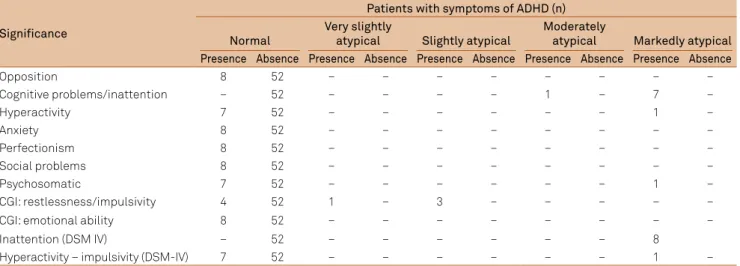
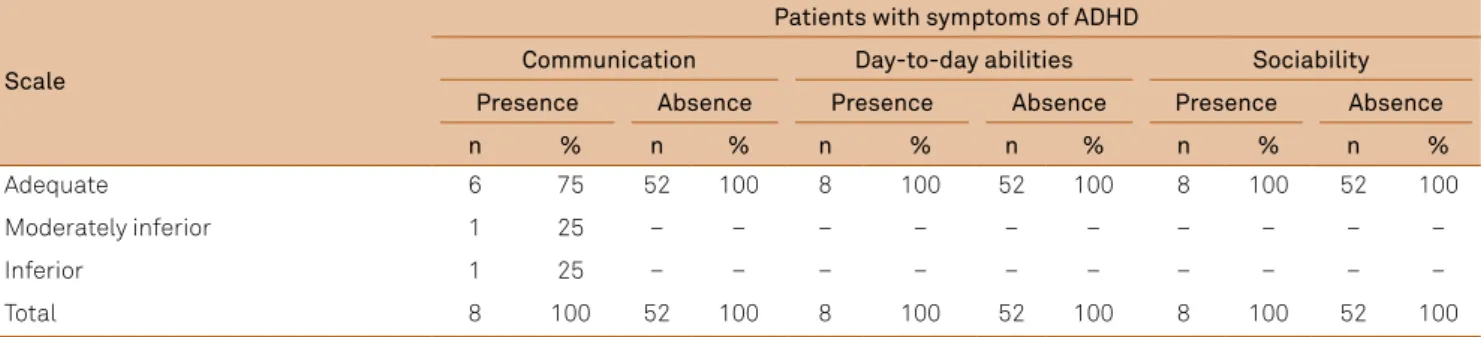
Seven patients presented with the inattentive ADHD sub-type on the Conners’ Scale. One patient with ADHD symp-toms also showed psychosomatic alterations on the Conners’ Scale. he distribution of behavioral problems in the patients according to the Conners’ Rating Scale is presented in Table 4. Most patients with ADHD symptoms (75%) did not have problems on the Vineland Adaptive Behavioral Scale. he two patients with low scores on the communication domain of the scale were the same ones who did not have a passing grade at school. he distribution of patients according to the Vineland Adaptive Behavior Scale is presented in Table 5.
Table 2. Distribution of patients in regard to epilepsy duration and seizure type.
Characteristics Frequency
n %
Epilepsy duration (years)
< 1 – –
1-5 28 46.7
> 5 32 53.3
Seizure type
Focal 44 73.3
Generalized 16 26.7
Table 3. Distribution of patients in regard to the seizure-free period, seizure frequency, use of antiepileptic drugs, current EEG and the occurrence symptoms of ADHD.
Seizure free (months) Seizure frequency Use of antiepileptic drugs **Current EEG
Symptoms of ADHD
≥24 ≥12 <12 *Sporadic *Frequent *Very
Frequent None Monotherapy Polytherapy
**1 **2 **3
n (%) n (%) n (%) n (%) n (%) n (%) n (%) n (%) n (%) n (%) n (%) n (%)
Presence 5 (8.3) 3 (5) - (-) 4 (6.6) 2 (3.3) 2 (3.3) 4 (6.6) 3 (5) 1 (1.6) 4 (6.6) 4 (6.6) - (-) Absence 27 (45) 11 (18.4) 14 (23.4) 30 (50) 8 (13.3) 14 (23.5) 11 (18.4) 36 (60) 5 (8.4) 26 (43.3) 20 (33.3) 6 (10) Total (%) 32 (53.3) 14 (23.4) 14 (23.4) 34 (56.7) 10 (16.6) 16 (26.7) 16 (26,7) 38 (63.3) 6 (10) 30 (50) 24 (40) 6 (10)
*Sporadic: less than one or one seizure a month; frequent from one to four seizures a month; very frequent more than four seizures a month; **1: normal during
wakefulness, drowsiness and/or sleep; 2: abnormal with focal epileptiforme discharges: spikes or focal sharp waves or spike-slow wave; 3: abnormal with generalized epileptiforme discharges: spikes or focal sharp waves or spike-slow wave; EEG: electroencephalogram; ADHD: attention deficit hyperactivity disorder.
Table 4. Distribution of patients in regard to behavioral problems on the Conners’ Scale.
Significance
Patients with symptoms of ADHD (n)
Normal
Very slightly
atypical Slightly atypical
Moderately
atypical Markedly atypical Presence Absence Presence Absence Presence Absence Presence Absence Presence Absence
Opposition 8 52 – – – – – – – –
Cognitive problems/inattention – 52 – – – – 1 – 7 –
Hyperactivity 7 52 – – – – – – 1 –
Anxiety 8 52 – – – – – – – –
Perfectionism 8 52 – – – – – – – –
Social problems 8 52 – – – – – – – –
Psychosomatic 7 52 – – – – – – 1 –
CGI: restlessness/impulsivity 4 52 1 – 3 – – – – –
CGI: emotional ability 8 52 – – – – – – – –
Inattention (DSM IV) – 52 – – – – – – 8
Hyperactivity – impulsivity (DSM-IV) 7 52 – – – – – – 1 –
CGI: Conner’s Global Index; ADHD: attention deficit hyperactivity disorder.
antiepileptic drugs at the time of the assessment, whereas most patients without ADHD (68.4%) were on antiepileptic drugs (Table 3). All patients with ADHD symptoms were sei-zure-free in the past year.
DISCUSSION
In this study the occurrence of ADHD symptoms among our patients was 13%, which is similar to other studies3,20,21.
However, it is less than that described by Hermann et al.4
who found an occurrence of ADHD symptoms in 31.5% of patients with idiopathic epilepsy. he authors included pa-tients with diagnosis of epilepsy within the past 12 months; we might wonder that at least some of them were still in the active phase of the disease. Nevertheless, the majority of our patients had been diagnosed with epilepsy within the past ive years, most of them were seizure-free for more than two years, and almost half of our patients were either wi thout antiepileptic drug treatment or undergoing withdrawal. herefore, we consider that our results relect cleaner data with less interference of seizures and drug treatment on the presence of the comorbid condition.
Our results showed that ADHD symptoms occur more frequently in girls with epilepsy than in boys and most of our patients with ADHD symptoms it into the inattentive subtype. Our data are in keeping with the indings of other authors4,7 and point to the fact that there is a diference
bet ween ADHD features in patients with and without epi-lepsy, as ADHD in patients without epilepsy occur mostly in boys and the most common form is the hyperactive-im-pulsive subtype1,22,23.
Our study found that most of our patients did not have adaptive behavioral changes. Seven of our eight patients with ADHD symptoms did not present with any other behavioral abnormalities measured on the Conners’ Rating Scale; this was also the case with the 52 patients without symptoms of ADHD. Besides, most of our patients with ADHD symptoms did not present with abnormalities in the adaptive beha vior measured on the Vineland Scale; neither did the patients without symptoms of ADHD, which is distinct from the re-sults described by others4,6,7,24. his discrepancy between our
study and others’ is probably due to the diferent inclusion criteria, because we included only patients with idiopathic
epileptic syndromes and other authors included patients with all types of epilepsy6, recently-diagnosed epilepsy4 or
even uncontrolled patients6,24. Our indings match with other
studies that show that infrequent seizures and well-control-led patients on monotherapy are important variables to pre-dict lower rates of ADHD symptoms and behavioral abnor-malities8,10. Moreover, we did not ind a positive correlation
between clinical epilepsy variables and the occurrence of ADHD symptoms as described by others8-12. his is probably
due to the benignity of our sample.
Behavioral problems, such as depression and anxiety, are important comorbid conditions when patients with ADHD without epilepsy are considered25,26. In our study most of the
patients did not have behavior problems or adaptive beha-vioral changes, reinforcing that there is a diference between ADHD features in patients with and without epilepsy.
he presence of epileptiform activity was not found to be correlated with the occurrence of ADHD symptoms. here are many studies that analyze the relationship between epi-leptiform activity and patients with ADHD9,27,28.
he concern about the impact of epilepsy on cognitive development has been longstanding. It is well known that seizure itself and antiepileptic drugs may jeopardize cogni-tion. Several reports, however, demonstrate that ADHD symptoms are present even before the onset of epilepsy1,29,30.
he inding that half of our patients with ADHD symptoms were well controlled without antiepileptic drug suggests that ADHD symptoms may occur in epileptic patients in-dependent of active seizures or treatment. Moreover, more recent studies have shown that structural abnormalities and cognitive development are present in children with new onset epilepsy, suggesting pre-existing abnormalities in brain development30-32.
To summarize, our data reinforce the idea that the brain of epileptic patients may harbor subtle abnormalities which are responsible for ADHD symptoms and epilepsy. his study also points to the existing diference between the ADHD fea-tures in patients with and without epilepsy.
Table 5. Distribution of patients according to the Vineland Adaptive Behavior Scale.
Scale
Patients with symptoms of ADHD
Communication Day-to-day abilities Sociability
Presence Absence Presence Absence Presence Absence
n % n % n % n % n % n %
Adequate 6 75 52 100 8 100 52 100 8 100 52 100
Moderately inferior 1 25 – – – – – – – – – –
Inferior 1 25 – – – – – – – – – –
Total 8 100 52 100 8 100 52 100 8 100 52 100
References
1. Hesdorffer DC, Ludvigsson P, Olafsson E, Gudmundsson G, Kjartansson O, Hauser WA. ADHD as a risk factor for incident unprovoked seizures and epilepsy in children. Arch Gen Psychiatry 2004;61:731-736.
2. Aldenkamp AP, Arzimanoglou A, Reijs R, Van Mil S. Optimizing therapy of seizures in children and adolescents with ADHD. Neurology 2006;67(Suppl4):S49-S51.
3. Williams J, Griebel ML, Dykman RA. Neuropsychological patterns in pediatric epilepsy. Seizure 1998;7:223-228.
4. Hermann B, Jones J, Dabbs K, et al. The frequency, complications and aetiology of ADHD in new onset paediatric epilepsy. Brain 2007;130:3135-3148.
5. Slick DJ, Lautzenhiser A, Sherman EMS, Eyrl K. Frequency of scale elevations and factor structure of the Behavioral Rating Inventory of Executive Function (BRIEF) in children and adolescents with intractable epilepsy. Child Neuropsychol 2006;12:181-189.
6. Sherman EMS, Slick DJ, Connolly MB, Eyrl KL. ADHD, neurological correlates and health-related quality of life in severe pediatric epilepsy. Epilepsia 2007;48:1083-1091.
7. Dunn DW, Austin JK, Harezlak J, Ambrosius, WT. ADHD and epilepsy in childhood. Dev Med Child Neurol 2003;45:50-54.
8. Kaufmann R, Goldberg-Stern H, Shuper A. Attention-deficit disorders and epilepsy in childhood: incidence, causative relations and treatment possibilities. J Child Neurol 2009; 24:727-733.
9. Shubert R. Attention deficit disorder and epilepsy. Pediatr Neurol 2005;32:1-10.
10. Borgatti R, Piccinelli P, Montirosso R, et al. Study of attentional processes in children with idiopathic epilepsy by Conners’ Continuous Performance Test. J Child Neurol 2004; 19:509-515.
11. Fonseca LC, Tedrus GAS, Oliveira EDP, Ximenes VL. Benign childhood epilepsy with centrotempral spikes: word and pseudoword discrimination. Arq Neuropsiquiatr 2009; 67:450-456.
12. Caplan R, Siddarth P, Stahl L, et al. Childhood absence epilepsy: behavioral, cognitive, and linguistic comorbidities. Epilepsia 2008;49:1838–1846.
13. Commission on Classification and Terminology of the International League Against Epilepsy Revised terminology and concepts for organization of seizures and epilepsies. Epilepsia 2010;51:676-685.
14. Reis de Campos CJ, Castro Menezes DB, Silva DF. Conceitos gerais, classificações e epidemiologia: arquivos da coordenadoria de saúde mental do Estado de São Paulo, Franco da Rocha. Manual Epilepsias São Paulo 1986:15-47.
15. American Psychiatric Association. Transtorno de déficit de atenção/ Hiperatividade In: Manual diagnóstico e estatístico de transtornos mentais (DSM IV-TR). Porto Alegre: Artmed; 2002:112-119.
16. Mattos P, Serra-Pinheiro MA, Rohde LA, Pinto D. Apresentação de uma versão em português para uso no Brasil do instrumento MTA-SNAP-IV de avaliação de sintomas de transtorno do déficit de atenção/
hiperatividade e sintomas de transtorno desafiador e de oposição. Rev Psiquiatr 2006;28:290-297.
17. Conners CK. Conners’ Rating Scales – Revised. Technical Manual. Toronto: MHS; 2000.
18. Sparrow SS, Balla DA, Cicchetti DV. Vineland Adaptive Behavior Scales. Minnesota: American Guidance Service; 1984.
19. Nascimento E. Escala de Inteligência de Wechsler – III. São Paulo: Casa do Psicólogo; 2000.
20. Davies S, Heyman I, Goodman R. A population survey of mental health problems in children with epilepsy. Dev Med Child Neurol 2003;45:292-295.
21. Rodenburg R, Stams GJ, Meijer AM, Aldenkamp AP, Dekovic M.
Psychopathology in children with epilepsy: a meta-analysis. J Pediatr Psychol 2005;30:453-468.
22. Polanczyk G, Jensen P. Epidemiologic considerations in attention deficit hyperactivity disorder: a review and update. Child Adolesc Psychiatr Clin N Am 2008;17:245-260.
23. Kieling C, Goncalves RRF, Tannock R, Castellanos FX. Neurobiology of attention deficit hyperactivity disorder. Child Adolesc Psychiatr Clin N Am 2008;17:285-307.
24. Fastenau PS, Shen J, Dunn DW, Austin JK. Academic underachievement among children with epilepsy proportion exceeding psychometric criteria for learning disability and associated risk factors. Learn Disabil 2008;41:195-207.
25. Biederman J, Monuteaux MC, Kendrick E, Klein KL, Faraone SV. The CBCL as a screen for psychiatric comorbidity in paediatric patients with ADHD. Arch Dis Child 2005; 90:1010-1015.
26. Short E, Fairchild L, Findling RL, Manos MJ. Developmental and subtypes differences in behavioral assets and problems in children diagnosed with ADHD. J Atten Disord2007; 11:28-36.
27. Richer LP, Shevell MI, Rosenblatt BR. Epileptiform abnormalities in children with attention-deficit-hyperactivity. Pediatr Neurol 2002;26:125-129.
28. Loo SK, Barkley RA. Clinical utility of EEG in attention deficit hyperactivity disorder Appl Neuropsychol 2005;12:64-76.
29. Berg AT, Vickrey BG, Testa FM, Levy SR, Shinnar S, DiMario F. Behavior and social competency in idiopathic and cryptogenic childhood epilepsy. Dev Med Child Neurol 2007;49:487-492.
30. Hermann BP, Jones J, Sheth R, Seidenberg M. Cognitive and magnetic resonance volumetric abnormalities in new-onset pediatric epilepsy. Semin Pediatr Neurol 2007;14:173-180.
31. Hermann BP, Jones JE, Sheth R, et al. Growing up with epilepsy: a two-year investigation of cognitive development in children with new onset epilepsy. Epilepsia 2008;49:1847-1858.