1M estranda, Setor de M apeamento Cerebral e Integração Sensório-M otora, Instituto de Psiquiatria (IPUB), Universidade Federal do Rio de Janeiro Rio de Janeiro RJ, Brazil UFRJ;2D.Sc. em Engenharia Biomédica, COPPE, UFRJ;3Professor Adjunto III Doutor, Coordenador do Setor de Mapeamento Cerebral e Integração Sensório-M otora, IPUB, UFRJ;4Professor Doutor, Escola de Educação Física e Desportos (EEFD), UFRJ;5Professor Adjunto II PhD, Escola de Educação Física e Desportos (EEFD), Setor de M apeamento Cerebral e Integração Sensório-M otora, IPUB, UFRJ; Professor Pesquisador, Universidade Castelo Branco (PROCIM H-UCB). Received 3 September 2003, received in final form 15 December 2003. Accepted 13 January 2004.
Dra. Andréa Camaz Deslandes - Instituto de Psiquiatria (IPUB), Setor de Neuroimagem Funcional, UFRJ - Avenida Venceslau Brás 71 Fundos - 22290-140 Rio de Janeiro RJ - Brasil. E-mail: [email protected]
EFFECTS OF CAFFEINE ON VISUAL EVOKED POTENTIAL (P300)
AND NEUROM OTOR PERFORM ANCE
Andréa Camaz Deslandes
1, Heloisa Veiga
1, M aurício Cagy
2, Roberto Piedade
3, Fernando Pompeu
4, Pedro
Ribeiro
5ABSTRACT - The stimulant effects of caffeine on cognitive performance have been widely investigated. The visual evoked poten-tial, specially the P300 component, has been used in studies that explain the stimulant mechanisms of caffeine through neurophys-iological methods. In this context, the present study aimed to investigate electrophysneurophys-iological changes (P300 latency) and modifi-cation of cognitive and motor performance produced by caffeine. Fifteen healthy volunteers, 9 women and 6 men (26 ± 5 years, 67 ± 12.5 kg) were submitted three times to the following procedure: electroencefalographic recording, Word Color Stroop Test, and visual discrimination task. Subjects took a gelatin caffeine capsule (400 mg) or a placebo (P1 and P2), in a randomized, crossover, double-blind design. A one-factor ANOVA and Tukey’ post hoc test were used to compare dependent variables on the C, P1 and P2 moments. The statistical analyses indicated a non-significant decrease in reaction time, Stroop execution time and latency at Cz on the caffeine moment when compared to the others. Moreover, a non-significant increase in Stroop raw score and latency at Pz could be observed.The only significant result was found at Fz.These findings suggest that the positive tendency of caffeine to improve cognitive performance is probably associated with changes in the frontal cortex, a widely recognized attention area.
KEY WORDS: P300, caffeine, neuromotor performance.
Efeitos da ingestão de cafeína no potencial evocado visual (p300) e no desempenho neuromotor
RESUMO - Os efeitos estimulantes da cafeína no desempenho cognitivo vêm sendo amplamente investigados. O potencial evoca-do visual (P300) tem sievoca-do empregaevoca-do em estuevoca-dos recentes que buscam elucidar os mecanismos excitatórios da cafeína através de métodos neurofisiológicos. Neste contexto, o presente estudo objetivou examinar as variações geradas pela cafeína em respostas eletrofisiológicas (latência do P300) e determinar modificações no desempenho cognitivo e motor. Para tanto, 15 indivíduos hígi-dos, sendo 9 mulheres e 6 homens (26 ± 5 anos, 67 ± 12,5 kg) foram submetidos por três vezes à seguinte rotina: aquisição de sinais eletroencefalográficos,Word Color Stroop Test e tarefa de discriminação visual. Foi administrada uma cápsula gelatinosa de 400 mg de cafeína ou de placebo (P1 e P2) em um desenho randomizado duplo-cego cruzado. Foi empregada a ANOVA com um fator e post hoc de Tukey - HSD para a comparação das variáveis nos momentos C, P1 e P2. O momento cafeína apresentou redução não significativa no tempo de reação, no tempo de execução do Stroop e na latência em Cz. Observou-se também aumento não significativo no escore bruto do Stroop e na latência em Pz. O único resultado significativo encontrado foi na latência em Fz. Assim, pode-se concluir que a tendência favorável à ingestão de cafeína na melhora das respostas cognitivas pode estar relacionada a mudanças em regiões específicas do cérebro, como o córtex frontal, área amplamente relacionada com os processos de atenção.
PALAVRAS-CHAVE: P300, cafeína, desempenho neuromotor.
Caffeine, a 1,3,7-trimethylxanthine, is an acknow ledged central nervous system (CNS) stimulant. It is a widely used psy-choactive substance, and part of many soft drinks. Although the effects of caffeine on cognitive performance have been sub-ject of numerous experiments, the findings are still not
conclu-sive1-4. In this sense, the mechanisms of caffeine’s ergogenic
efficien-cy, and perception of energy5. Caffeine has also been
associ-ated with improvement in motor performance4,6,7.Although the
greater implications of these effects are unclear, psychomotor improvement was observed in reaction time, hand steadiness, tapping rate and locomotor activity. M oreover, an increase in motor activity and tapping rate, and shorter simple and choice reaction times w ere observed w ith low doses of caffeine. In this context, caffeine can be regarded as a neuromotor mod-ulator.
Changes in brain states brought about by caffeine are manifested in the spontaneous background electroencephalo-gram (EEG). Topographical quantitative EEG (qEEG) measures provide a neurophysiological assessment of brain activity cor-related w ith behavior. Through a detailed examination of the EEG, it was possible to note that the presentation of a stim-ulus causes alterations in cerebral activity. Such alterations are named evoked potentials (EP)8. EEG and EP measures have been
used clinically for many years. Specifically, the event-related potentials (ERP) have been used as biological markers in exper-iments that try to assess brain information processing.The P300 is the most frequently analyzed ERP component and is con-sidered a cognitive component associated to decision-ma-king processes. It reflects neuroelectric activity related to cog-nitive processes such as attention allocation and activation of immediate memory. P300 is measured by the quantification of its amplitude (µV) and latency (ms)8,9. It has been
suggest-ed that P300 latency is negatively correlatsuggest-ed w ith mental function in normal subjects, i.e., shorter latencies indicate a superior cognitive performance. In this context, this evoked potential component reflects CNS activity related to cognitive operations and helps to discriminate the effects of stimulant drugs on brain activity. Recent studies also investigated cog-nitive function and motor control through changes in P300 latency and amplitude10-16.
Several investigations have examined the effects of caf-feine on cognitive and motor function, in an attempt to elu-cidate possible mechanisms involved. Recent experiments show ed a significant increase on psychomotor performance in subjects w ho ingested caffeine w hen compared to place-bo15,17,18. Caffeine’s behavioral effects have been
document-ed in a number of laboratories, as w ell as improvements on attention, mood and vigor tasks. M oreover, a decrease on reaction time and changes on P300 latency15,19and
ampli-tude18have been associated with the modulator effects of
caf-feine. Nevertheless, worldwide labs have presented contradic-tory results and different experimental procedures. The most proeminent results w ere found on specific conditions, such as fatigue, sleep deprivation, w ithdrawal and hypoglycemia. Polich and Kok8also suggest that P300/caffeine effects are
influ-enced by the individual’s arousal level. Given these inconsis-tencies, the mechanisms involved in the effects of caffeine on event-related potentials have not been clarified. In this con-text, the aim of this study was to determine the CNS profile
of caffeine intake on the EEG (P300 latency) and neuromotor functions (reaction time and attention demands) in normal sub-jects w ith control experimental procedures.
M ETHOD
Subjects - The sample consisted of 15 individuals, 6 male and 9 female, w ith ages varying betw een 21 and 38 years (26 ± 5 years), w eighing betw een 51 and 88 kg (67 ± 12.5 kg), and having a caf-feine or cafcaf-feine-containing beverage consumption of less than four cups per day. All subjects w ere healthy, free of cognitive deficits and w ere not making use of any psychoactive or psychotropic substance at the time of the test. To assure that subjects did not present any impairment of their physical and mental health, and to identify and exclude from the experiment any subjects w ho could contaminate future results, a questionnaire was applied. The questionnaire also aimed to identify possible P300 biological determinants, such as food intake, body temperature, fatigue, drugs, among others.The sub-jects w ere not allow ed to smoke or to consume alcohololic or caf-feine-containing beverages 10 hours prior to and during the test. Subjects signed a consent form, w here the experimental condition was thoroughly described. The experiment was submitted to the Psychiatric Institute’s ethics committee for approval.
Study design and procedures - The subjects received 400 mg gel-atin capsules (caffeine or glucose) on three different occasions under a randomized, double-blind, crossover study. The procedures consist-ed of a three-day treatment: tw o placebos and one caffeine. All sub-jects w ere familiarized w ith the experimental tasks. The procedures w ere standardized in the follow ing routine: electroencephalograph-ic recording, administration of the Word Color Stroop Test and visu-al evoked potentivisu-al. EEG was recorded 30 min after ingestion of caf-feine and placebo.
Eletroencephalogram recording - Subjects were seated comfort-ably in a sound and light-attenuated room, w hile 5 minutes of eyes-closed alert/resting and 5 minutes of eyes-open EEG data w ere col-lected from the 19 monopolar electrodes sites. International 10 / 20 System (referred to linked earlobes) for electrode placement was used w ith a Braintech-3000 (EM SA-M edical Instruments, Brazil). All electrode impedances w ere kept below 5 kΩ. The signal was ampli-fied w ith a gain of circa 22,000. The EEG signals w ere acquired betw een 0.01 and 50 Hz. Eye-movement (EOG) artifact was moni-tored w ith a bipolar electrode montage using tw o 9-mm diameter electrodes attached superior to and on the external canthus of the right eye. The EEG signal was analogically filtered betw een 0.1 Hz (high-pass) and 32 Hz (low -pass), and sampled at 240 Hz. The soft-w are ERP Acquisit ion, developed at t he Brain M apping and Sensorimotor Integration Lab, was employed w ith the follow ing dig-ital filters: Notch (60 Hz), high-pass of 0.3 Hz and low -pass of 25 Hz. Visual inspection was employed for detection and elimination of artifacts.
name of a color and second, to name the printed color of a w orld denoting a different color (color-w ord interference). Subjects w ere asked to perform the task as quickly and as accurately as possible. The Stroop color-naming task is a classic paradigm that elegantly illus-trates important concepts such as automaticity and interference20.The criteria analyzed w ere execution time and raw score (number of cor-rect answ ers).
Event-related potential recordings - During the visual task, lights w ere turned off for subjects to concentrate exclusively on the mon-itor screen. A 15” monmon-itor was placed in front of the volunteer. The visual stimulus was presented on the monitor by the ERP acquisition software, developed in Delphi 5.0 (Inprise Co.). Event-related poten-tials w ere recorded from the Fz, Cz and Pz electrode sites. The task employed the oddball paradigm. In this paradigm, tw o stimuli are presented randomly, w ith one occurring relatively infrequently. Subjects were asked to discriminate target (infrequent) from non-tar-get or standard stimuli (frequent). In the present experiment, tarnon-tar-get stimuli w ere represented by a square and non-target stimuli by a cir-cle. Subjects w ere instructed to respond as quickly as possible to the target stimulus by pressing a button in a joystick (M odel Quick Shot-Crystal CS4281).The P300 was identified as the largest positive-going peak amplitude of the waveform w ithin a time w indow of 250-500 ms, in relation to a pre-stimulus baseline. The baseline was defined as the mean voltage over 120 ms before the onset of the stimulus. Each subject was submitted to one block of 100 trials. In other words, the square was presented 100 times in each block. The stimulus appeared on the screen for 0.75 seconds, w ith the same time inter-val betw een stimuli.
Reaction time - Reaction time was used as an index of individ-uals’ motor performance. Volunteers w ere responded to the target stimulus by pressing a button in a joystick The joystick was used to measure individuals’ reaction time at each trial. Reaction times were subsequently averaged to yield a final value for each subject. M issed stimuli w ere not considered. Although reaction time is independent from ERP measures, it was used to verify subjects’ alertness during the task.
Statistical analysis - Data were expressed as mean ± sd. A sta-tistical analysis software (SPSS for Window s) was used. Specifically, a one-way Anova (p < 0.05) was performed to compare the three conditions: treatment (C) and tw o placebos (P1 and P2). A T-test was subsequently used to compare P1 and C.
RESULTS
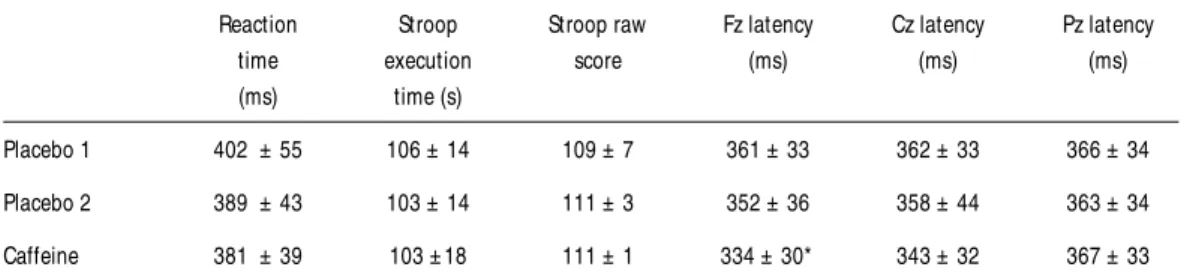
Reaction time - The statistical analyses indicated a
non-significant shortening in reaction time, as show n in Table 1.
EEG (visual evoked potential - P300)- Caffeine
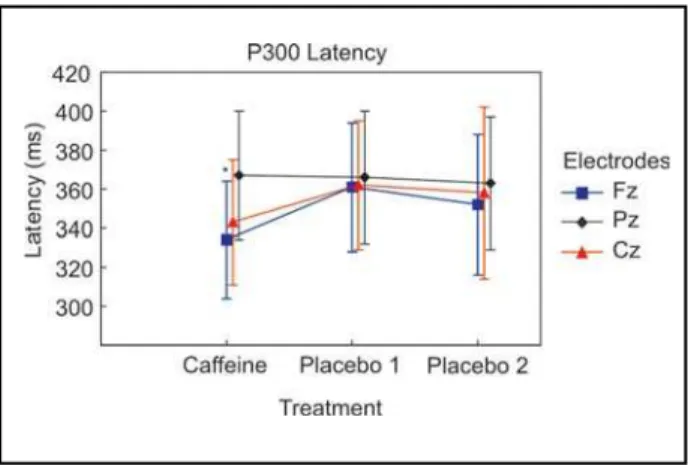
significant-ly shortened P300 latency at Fz (p< 0.05). A similar trend was observed at Cz, although statistical significance was not reached. M oreover, a non-significant increase at Pz was observed (Table 1). P300 latency at Fz, Cz and Pz are given in Figure 1. Specifically at Fz, P300 latency is shorter and ampli-tude is higher in the caffeine condition when compared to placebo control. ERP images are show n by Independent Component Analyses (ICA) (Fig 2).
Stroop test - Stroop execution time (SET) and Stroop Raw
Score (SRS) values w ere compared among placebo 1, place-bo 2, and caffeine conditions. SET reduced on P2 and C. SRS increased on P2 and C. Nevertheless, the observed differences w ere not statistically significant (Table 1).
DISCUSSION
The present study investigated the effects of caffeine on neuropsychomotor performance through the Stroop test, reac-tion time and P300 latency. These findings suggest positive effects of caffeine ingestion on P300, particularly in the frontal lobe. P300 latency on Fz (frontal electrode) was significantly shorter w hen caffeine was administered, as compared to placebo. It is known that frontal lobe activity is related to atten-tional demands21,22. Caffeine is considered a modulator of
such processes, acting primarily as an antagonist of adeno-sine receptors in the brain5,23,24. On special conditions, i.e.,
sleep-deprivation or fatigue, adenosine action increases and the stimulant effects of caffeine are potentialized. Polich25
report-ed that the influence of caffeine on neurophysiological respons-es is related to the individual’s alertnrespons-ess. Depending on the experimental conditions, caffeine ingestion w ill produce dif-ferent effects on P300 latency. Reeves et al.19 observed a
shortening of P300 latency but no changes in P300 amplitude w ith 13 caffeine-user subjects, submitted to four days of caf-feine-deprivation. Recently, investigators observed
hypo-Table 1. Descriptive statistic analyses (mean ± sd) of cognitive and neuromotor performance variables on P1, P2 and caffeine con-ditions.
Reaction Stroop Stroop raw Fz latency Cz latency Pz latency
time execution score (ms) (ms) (ms)
(ms) time (s)
Placebo 1 402 ± 55 106 ± 14 109 ± 7 361 ± 33 362 ± 33 366 ± 34
Placebo 2 389 ± 43 103 ± 14 111 ± 3 352 ± 36 358 ± 44 363 ± 34
Caffeine 381 ± 39 103 ± 18 111 ± 1 334 ± 30* 343 ± 32 367 ± 33
Fig 2. P300 plotted by Independent Component Analysis (ICA). A) ERP images of visual discrimination task (oddball), recorded at frontal electrode (Fz) of one subject on placebo (left) and caffeine (right) conditions, respectively. The average of all trials is shown for each ERP image (P300). (B) ERP waveforms and scalp current distributions on different latencies (340, 360 and 380 ms) for the same individual.
glycemia in normal26and diabetic13subjects through changes
in P300 outcomes. In these studies, a decrease in amplitude and a delay in latency, in relation to low concentrations of plas-matic glucose, w ere observed. How ever, w hen caffeine was administered, there was a significant shortening of P300 la-tency. This response was associated w ith an increase of glu-cose usage by the brain and a decrease in cerebral artery blood flow velocity (from 64 to 49 cm/s)26. The degree of task
difficulty seems to influence the effects of caffeine. Kawamura et al.18observed that, depending on stimulus modality
(odd-ball or single tone), P300 amplitude and reaction time w ould yield different results w hen 500 mg of caffeine was admin-istered.
M oreover, the present findings indicated an improvement Fig 1. Latency means and s.d. for Fz, Cz and Pz electrode sites in the P1, P2
trend on cognitive performance, through Stroop raw score and execution time, without any significant difference. Future stud-ies, w ith a larger sample, are necessary to reach statistically significant results. Studies that employed this cognitive test along w ith caffeine ingestion presented conflicting results. Edwards et al.27 did not observe significant differences in
Stroop performance w hen administering 125-250 mg of caf-feine. Patat et al.17contradicted these findings by show ing a
significant improvement in Stroop performance in individuals w ho took 600 mg of caffeine. It must be stressed that, in our experiment, 400 mg of caffeine was used. Our results in reac-tion time point out to a greater shortening between P1 and C. However, these results were not statistically significant. Seidl et al.15elaborated a nighttime experimental condition, and observed
a lengthening of reaction time and P300 latency by the end of the test (midnight) in the placebo group, and maintenance of these variables in the caffeine group. Feinstein28, investigating
the effects of practice on attention tests, observed a general improvement on the P2 that could be explained by practice. Ne-vertheless differences were not statistically significant.
In summary, the present study showed a positive effect of caffeine ingestion on cognitive performance, through P300 latency shortening in the frontal cortex. This result indicates an improvement of cortical activity.This mechanism is probably ex-plained by its effects on central adenosine receptors.Adenosine is believed to be an inhibitory neuromodulator of the CNS with sedative-like properties. Caffeine appears to block the actions of endogenous adenosine at the adenosine A1receptor subtype by occupying those sites, and therefore, having a stimulant effect on certain types of behavior. However, future studies are needed to investigate the specific mechanisms responsible for these results. Experiments that aim to explain caffeine’s contri-bution on cognitive and motor performance improvement on specials conditions must always be made in comparison to con-trol groups. Caffeine usage may affect cerebral functioning more profoundly than has been previously suspected29. Other
studies are necessary to try to investigate the influence of this psychoactive substance in CNS function. Studies with shorter latency potentials (P100, N100, P200 e N200) and qEEG will con-tribute to an enhanced understanding of the neurophysiologi-cal processes involving caffeine ingestion.
REFERENCES
1. Shapkin S. Effect of caffeine on cognitive function and psychophysio-logical status in man. Fiziol Chelovek 2002;28:144-150.
2. Perod A, Roberts A, McKinney W. Caffeine can affect velocity in the middle cerebral artery during hyperventilation, hypoventilation, and thinking: a transcranial Doppler study. J Neuroimaging 2000;10:33-38. 3. Sawynok J, Yaksh L. Caffeine as an analgesic adjuvant: a review of phar-macology and mechanisms of action. Pharmacol Rev 1993;45:43-85. 4. Lieberman H, Tharion W, Shukitt-Hale B, Speckman K, Tulley R. Effects
of caffeine, sleep loss, and stress on cognitive performance and mood
during U. S. Navy Seal training. Psychopharmacology (Berl)
2002;164:250-261.
5. Lieberman H. The effects of ginseng, ephedrine and caffeine on
cogni-tive performance, mood and energy. Nutr Rev 2001;59:91-102.
6. Magill RA, Waters WF, Bray GA, et al. Effects of tyrosine, phentermine, caffeine D-amphetamine, and placebo on cognitive and motor perform-ance deficits during sleep deprivation. Nutr Neurosci 2003;6:237-246. 7. Johnson-Kohnson M, Kritz-Silverstein D, Barrett-Connor E, Morton D.
Coffe comsumption and cognitive function among older adults. Amer J Epidemiol, 2002;156:842-850.
8. Polich J, Kok A. Cognitive and biological determinants of P300: an integrative review. Biol Psychol 1995;41:103-146.
9. Polich J. Neuropsychology of P3a and P3b: a theoretical overview. In. Arikan K, Moore N (eds.). Advances in electrophysiology in clinical prac-tice and research. Kjellberg: Wheaton IL, 2002; in press.
10. Kugler C, Petter J, Taghavy A, et al. Dynamics of cognitive brain dysfunc-tion in patients with cirrhotic liver disease: an event- releated P300 poten-tial perspective. Eletroencephalogr Clin Neurophisiol 1994;91:33-41. 11. Yagi Y, Coburn K, Ester K, Arruda J. Effects of aerobic exercise and
gen-der on visual and auditory P300, reaction time and accurancy. Eur J Appl Phisiol Occup Phisiol 1999;80:402-408
12. Bennigngton J, Polich J. Comparison of P300 from passive and active tasks for auditory and visual stimuli. Int J Psychophysiol 1999;34:171-177. 13. Debrah K, Sherwin R, Murphy J, Kerr D. Effects of caffeine on
recog-nition of and physiological responses to hipoglycaemia in insulin-dependent diabetes. Lancet,1996;347:19-24.
14. Jones E, Giger-Mateeva V, Reits D, Rielmslag F, Liberov B, Spekrijse H. Visual event-related potentials in cirrhotic patients without overt encephalopathy: the effects of flumazenil. Metab Brain Dis 2001;16:43-53. 15. Seild R, Peryl A, Nicham R, Hauser E. A taurine and caffeine-contain-ing drink stimulates cognitive performance and well-becaffeine-contain-ing. Amino Acids 2000;19:635-642.
16. Polich J, Herbst K. P300 as a clinical assay: rationale, evaluation, and findings. Internat Psychophysiol 2000;38:3-19.
17. Patat A, Rosenzweiig P, Enslen M, et al. Effects of a new slow release formulation of caffeine on EEG, psycomotor and cognityive functions in sleep-deprived subjects. Hum Psychopharmacol 2000;15:153-170. 18. Kawamura N, Maeda H, Nakamura J, Morita K, Nakazaa Y. Effects of
caffeine on event-related potentials: comparison of oddball with sin-gle-tone paradigms. Psychiatr Clin Neurosci 1996;50:217-221. 19. Reeves R, Struve F, Patrick G. The effects of caffeine withdrawal on
cog-nitive P300 auditory and visual evoked potentials. Clin Eletroence-phalogr 1999;30:24-27.
20. Jensen A, Rohwer W. The Stroop Color-word test: a review. Acta Psychol (Amst) 1965;25:36-93.
21. Zalla T, Pradat-Diehl P, Sirigu A. Perception of action boundaries in patients with frontal lobe damage. Neuropsychologia 2003;41:1619-1627. 22. Astafiev S V, Shulman G L, Stanley CM, Snyder AZ, Van Essen DC, Corbetta M. Functional organization of human intraparietal and frontal cortex for attending, looking, and poiting. J Neurosci 2003;23:4689-4699. 23. James E J. Caffeine & health, San Diego, Academic Press, 1991. 24. Chou CC, Vickroy TW. Antagonism of adenosine receptors by caffeine
metabolites in equine forebrain tissues. Amer Veter Res,2003;64:216-224. 25. Polich J. P300 in clinical applications. In: Niedermeyer E, Lopes da Silva F (eds.) Electroencephalography: basic principles, clinical applications and related fields 4.Ed. Baltimore: Urban & Schwarzenberg 1999;1073-1091. 26. Kerr D, Sherwin R, Pavalkis F, et al. Effect of caffeine on the recogni-tion of and responses to hypoglycemia in humans Ann Intern Med 1993;119:799-804.
27. Edward S, Brice C, Craig C, Penri-Jones R. Effects of caffeine, practice,
and mode of presentation on Stroop task performance. Pharmacol
Bioch Behav 1996;54:309-315.
28. Feinsten C, Brown R, Ron M. Effects of practice of serial tests of atten-tion in healthy subjects. J Clin Exp Neuropsychol 1994;16:436-447. 29. Siepmann M, Kirch W. Effects of caffeine on topographic quantitative