489
SURVIVAL PROBABILITIES OF FIRST AND SECOND CLUTCHES OF
BLACKBIRD (TURDUS MERULA) IN AN URBAN ENVIRONMENT
KORNÉLIA KURUCZ, HELÉNA KALLENBERGER, CSILLA SZIGETIand J. J. PURGER
Department of Animal Ecology, Institute of Biology, Faculty of Sciences, University of Pécs, H-7624 Pécs, Hungary Abstract – The breeding success of blackbirds was investigated in April and June 2008 and 2009 in the Botanical Garden of the University of Pécs, with a total of 50 artificial nests at each of the four sessions (with 1 quail egg and 1 plasticine egg placed in every nest). In all four study periods of the two years, 2 nests (4%) were destroyed by predators. Six nests (12%, of the nests) were not discovered in either of the cases. The survival probability of artificial nests was greater in April than in June (both years), but the difference was significant only in 2008. Nests placed into a curtain of ivy (Hedera helix) on a wall were located higher up than those in bushes, yet their predation rates were quite similar. The predation values of quail vs. plasticine eggs did not differ in 2008. In the year 2009, however, significantly more quail eggs were discovered (mostly removed), than plasticine eggs. Marks that were left on plasticine eggs originated mostly from small mammals and small-bodied birds, but the disappearance of a large number of quail and plasticine eggs was probably caused by larger birds, primarily jays.
Keywords: Artificial nest, predation, quail, plasticine, Botanical garden, Pécs, Hungary
UDC 598.288.5:591.5
INTRODUCTION
Being one of the most common city birds, black-birds (Turdus merula) raise two or even three clut-ches a year (Ludvig et al., 1995, Cramp, 1998). As revealed by our investigations performed in 2006-2007, altogether 43 bird species occurred in the cca. 4.5 ha of the Botanical Garden of the University of Pécs (Pécs, Hungary). Of these, 18 species were nesting in the area, and the most frequent one was the blackbird. It appeared from our surveys that the number of blackbirds was highest in May, decreased gradually through June and July, and the lowest numbers were observed in August. It may be that the increase observed in May was partly caused by young birds from the first clutch, but why did such an increase not occur after the second clutch as well? As the breeding season proceeds, predation pressure on blackbirds generally increases (Ludvig et al., 1995), which may be associated with the degree of nest concealment and predator activity (Wysocki, 2005). Nest predation is one of the most important influencing factors of breeding success
(Skutch, 1949, Ricklefs, 1969, Martin 1995, Yanes-Suárez, 1997). Artificial nest experiments (Bayne and Hobson, 1999, Major and Kendal, 1996) carried out to investigate predation rates and to identify potential predators are useful because such experi-ments are unobtrusive to the real nests and the in-cubating birds.
Our aim has been to analyze, with the help of artificial nests placed throughout the Botanical Gar-den, the survival probabilities of nests in the first and second blackbird clutches. We have also been looking for an answer to the question whether or not the location of the nests influences the tion rate, and what animals the actual nest preda-tors are.
METHODS
Fig. 1.Boundary garden wall overgrown by ivy, with chopped plant material (Photo: J. J. Purger).
Fig. 2.Blackbird nest built on a wire mesh (Photo: J. J. Purger).
the onset of the second nesting, on 9th June. The experiment was repeated one year later in the same periods. In spring 2009, mulched plant material was deposited in a heap against the wall bordering the garden (Fig. 1), making the nests positioned here more exposed to predators, and possibly calling attention to the location of the nests. The nests were made of small-gauge wire mesh cut into 15×15 cm squares (Yahner et al., 1989). The mesh nest frames were affixed to vegetation using wires and were lined with leaf litter and dry grass collected in situ
(Wilson et al., 1998, Bayne and Hobson, 1999). Altogether 28 artificial nests were placed in the ivy (Hedera helix) growth covering the garden wall at heights of 183.4 ± 50.01 cm (average ± SD). Another set of 28 artificial nests were put on deciduous and evergreen shrubs at heights of 123.4 ± 51.79 cm.
Nests positioned along the garden wall were located significantly higher up than those installed in bushes (t = 4.17, df = 48, p < 0.001). For the evaluation of data, 25 nests were considered from each of the two pools. The reason for this was that in both years the blackbirds sometimes chose to build their nests quite near an artificial nest, more-over it also happened that they used the installed wire mesh as a nest base (Fig. 2). These artificial nests were excluded from the experiment, even retrospectively, so that our regular surveys would not disturb the breeding birds. One quail egg and one plasticine egg was placed in each of the
experi-mental nests, which were then monitored for 2 weeks, a period similar in duration to blackbird incubation (Cramp, 1998, Haraszthy, 1998). Chec-king was performed always on the same route, between 16.00-17.00, on days 1, 2, 4, 7 and 14 after the setting up of the experiment and no further interventions were made. A nest was considered to
be predated when eggs were either damaged or missing (Bayne et al., 1997). Plasticine eggs were used for the identification of nest predators, as plasticine preserves tooth and beak imprints left behind by them (Major, 1991, Cresswell, 1997, Bayne et al., 1997, Báldi, 1999, Niehaus et al., 2003, Trnka et al., 2008). For statistical analysis contin-gency tables were used (Zar, 1999). In cases when the degree of freedom equaled 1 (df = 1), the Yates correction for continuity was applied. Results are presented as mean ± standard deviation. The t-test
for comparing the means was two-tailed. A minimum probability level of p < 0.05 was accepted for all the statistics.
RESULTS
Fig. 3.Predation rates in April and June 2008 and 2009 (black
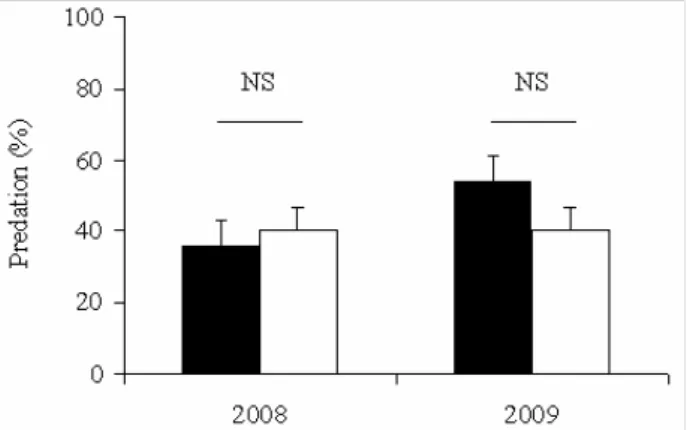
bars – April, white bars – June). Fig. 4. Predation rates revealed for nests in wall-creeping ivy (black bars) and in bushes (white bars).
values (χ2 = 2.12 df = 2, NS). In April and June 15 nests (30%) could not be found, 23 nests (46%) were found only in one of the months, and 12 nests (24%) were robbed in both of the months. Throughout the four breeding seasons of the two years only 2 nests (i.e. 4%) were robbed by preda-tors in all four cases. Six nests (12%), remained un-discovered in all four periods.
For both of the study years, the number of artificial nests discovered and depredated was high-er in June than in April (Fig. 3), but this diffhigh-erence was significant only in 2008 (χ2 = 5.92 df = 1, p < 0.05), whereas it was not significant in 2009 (χ2 = 0.34 df = 1, NS).
Nests that were positioned along the garden boundary wall were located significantly higher up than those placed in bushes, yet there was no significant difference between the predation rates of the two pools of artificial nests either in 2008 (χ2 = 0.03 df = 1, NS), or in 2009 (χ2 = 0.76 df = 1 NS) (Fig. 4). While in 2008 the number of bush nests that were damaged was somewhat higher than that of damaged nests on the wall, in 2009 this turned around and a higher predation rate was recorded for nests located in the ivy. Predation of the nests in the ivy was significantly higher in 2009 than in 2008 (χ2 = 4.5 df = 1, p < 0.05).
No significant differences were revealed bet-ween predation of the nests in the ivy creeping on the wall and those placed in bushes either in April
2008 (χ2 = 0.36 df = 1, NS) and June 2008 (χ2 = 0.00 df = 1, NS) or in April 2009 (χ2 = 1.71 df = 1, NS) and June 2009 (χ2 = 0.04 df = 1, NS).
There was no significant difference between the predation of quail and plasticine eggs in 2008 (χ2 = 0.19 df = 1, NS). In 2009, however, the number of quail eggs damaged (mostly removed) was much higher than that of plasticine eggs (χ2 = 24.45 df = 1, p < 0.001).
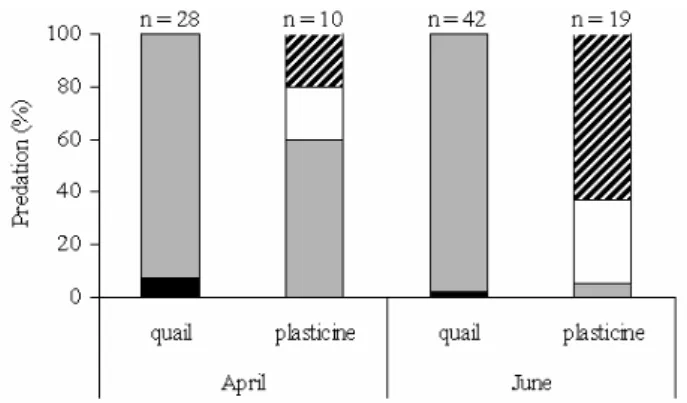
Both in April 2008 and April 2009, 7.14% of the total number of predated quail eggs (28%) were left in the nest, and 92.86% disappeared. This was similar (χ2 = 0.13 df = 1, NS) to what was recorded for June, when 2.4% of the predated (42%) quail eggs were broken up by predators, whereas the remaining 97.6% were removed (Fig. 5.).
In the month of April of both years, nearly 20% of the total predated (10%) plasticine eggs were discovered by small mammals, another 20% by so-me sort of smaller bird, whereas 60% disappeared. In June (χ2 = 10.97 df = 2, p < 0.05) only 5% of the predated (19%) plasticine eggs were removed, and predation by small mammals (32%) and smaller birds (63%) increased (Fig. 5).
DISCUSSION
Fig. 5. Proportions of broken and removed eggs, and the distribution of predators of plasticine eggs (2008-2009), April and June. Black bars – broken; grey bars – removed (disappeared) from the nest; white bars – marks left by small mammal predators; hatched bars – marks left by small bird predators.
remained intact. Re-used nests that are less exposed to predators and provide better protection ensure greater breeding success than new nests (Wysocki, 2004). Blackbirds living in cities and parks start breeding earlier than their conspecifics living in original habitats (Partecke et al., 2005). Early black-bird nests have increased survival probability which is due to the fact that predators at this stage have not shifted to nest predation as a resource (Ludvig et al., 1995). Also, in the Botanical garden of the University of Pécs, the first nests are built as early as April. Our results show that the survival probabili-ties of artificial nests built in April are greater than those of nests built in June. It is difficult to assess the degree of disturbance in an urban environment, because it also affects the predators living in the sa-me environsa-ment as the nests (Jokimäki and Huhta, 2000, Liebezeit et al., 2009). In our case, the increa-sed predation pressure could be cauincrea-sed by changes in the habitat.
As revealed by earlier studies, the predation of real blackbird nests depends on how high up the nests are located (Møller, 1988, Ludvig et al., 1995), although Wysocki (2004) presented results that contradict this view. According to Van Heezik et al., (2008), the predation of artificial nests does not
1993, Rangen et al., 2000). Nests in bushes are usually predated by birds (Nour et al., 1993, Söder-ström et al., 1998, Fazekas and Báldi, 2000). During our investigations, it was probably jays (Garrulus glandarius) that were responsible for losses and for the damage to a considerable amount of quail and plasticine eggs. The density of jays in the botanical garden was found to be around 0.4 pairs/ha in the studied years. Although they apparently do not exhibit particular search strategies for finding nests (Vigallon and Marzluff, 2005), they are important predators whose relative abundance correlates with the predation of the artificial nests (Luginbuhl et al., 2001). Our studies have shown that for blackbirds living in urban environments the first breeding in the season is more successful, irrespective of the location of the nests, although this can be influenced considerably by disturbance factors.
Acknowledgments - We would like to thank András
Báldi for the useful comments on the manuscript and Balázs Trócsányi for translation.
REFERENCES
Bayne, E. M., Hobson,K. A., and P. Fargey (1997).Predation on
artificial nests in relation to forest type: contrasting the use of quail and plasticine eggs. Ecography 20, 233-239.
Bayne, E. M., and K. A. Hobson (1999). Do clay eggs attract
predators to artificial nests? J. Field Ornithol. 70, 1-7.
Báldi, A. (1999). A fészekaljpredáció jelentősége, valamint
kísérletes vizsgálatának előnyei, hátrányai és módszertana. Ornis Hung. 8-9, 39-55.
Cramp, S. (1998). The Complete Birds of the Western
Cresswell, W. (1997). Nest predation rates and nest detectability in different stages of breeding in blackbirds Turdus merula. J. Avian Biol. 28,296-302.
Fazekas, A., and A. Báldi (2000). A szegélyhatás és az
énekes-madarak fészekaljpredációjának kísérletes vizgálata a Tököli Parkerdőben. Ornis Hung. 10,41-48.
Haraszthy, L. (1998). Magyarország madarai. 441 pp.
Mező-gazda kiadó, Budapest, (in hungarian)
Jokimäki, J., and E. Huhta (2000). Artificial nest predation and
abundance of birds along an urban gradient. Condor
102 (4), 838-847.
Liebezeit, J. R., Kendall, S. J., Brown, S., Johnson, C. B., Martin, P., McDonald, T. L., Payer, D. C., Rea, C. L., Streever, B.,
Wildman, A. M., and S. Zack (2009). Influence of
hu-man development and predators on nest survival of tundra birds, Arctic Coastal Plain, Alaska. Ecol. Appl. 19 (6), 1628-1644.
Ludvig, É., Vanicsek L., Török, J., and T. Csörgő (1995). The effect
of nest-height on the seasonal pattern of breeding success in Blackbirds Turdus merula. Ardea 83 (2), 411-418.
Luginbuhl, J. M., Marzluff, J. M., Bradley, J. E., Raphael, M. G.,
and D. E. Varland (2001).Corvid survey techniques and
the relationship between corvid relative abundance and nest predation. J. Field Ornithol. 72 (4), 556-572.
Major, R. E. (1991). Identification of nest predators by
photography, dummy eggs, and adhesive tape. Auk 108, 190-196.
Major, R. E., and C. E. Kendal (1996). The contribution of
artificial nest experiments to understanding avian reproductive success: a review of methods and conclusions. Ibis 138, 298-307.
Martin, T. E. (1995). Avian life history evolution in relation to
nest sites, nest predation, and food. Ecol. Monogr. 65 (1), 101-127.
Møller, A. P. (1988). Nest predation and nest site choise in
passerine birds in habitat patches of different size: a study of magpies and blackbirds. Oikos 53 (2), 215-221.
Niehaus, A. C., Heard, S. B., Hendrix, S. D., and S. L. Hillis
(2003). Measurine edge effects on nest predation in forest fragments: Do finch and quail eggs tell different stories? Am. Midl. Nat. 149, 335-343.
Nour, N., Matthysen, E., and A. A. Dhondt (1993). Artificial
nest predation and habitat fragmentation: different trends in bird and mammal predators. Ecography 16 (2), 111-116.
Partecke, J., Van’t Hof, T. J., and E. Gwinner (2005).Underlying
physiological control of reproduction in urban and forest-dwelling European blackbirds Turdus merula. J.
Avian Biol. 36 (4), 295-305.
Purger, J. J., Mészáros, L. A., and D. Purger(2004). Predation on
artificial nests in post-mining recultivated area and forest edge: contrasting the use of plasticine and quail eggs. Ecol. Eng. 22 (3),209-212.
Rangen, S. A., Clark, R. G., and K. A. Hobson (2000). Visual and
olfactory attributes of artificial nests. Auk 117 (1), 136-146.
Ricklefs, R. E. (1969). An analysis of nesting mortality in birds.
Smithsonian Contrib. Zool. 9, 1-48.
Skutch, A. F. (1949). Do tropical birds rear as many young as
they can nourish? Ibis 91, 430-455.
Söderström, B., Pärt, T., and J. Rydèn (1998). Different nest
predator faunas and nest predation risk on ground and shrub nests at forest ecotones: an experiment and a review. Oecologia 117,108-118.
Trnka, A., Prokop, P., and P. Batáry (2008). Dummy birds in
artificial nest studies: an experiment with Red-backed Shrike Lanius collurio. Bird Study 55, 329-331.
Van Heezik, Y., Ludwig, K., Whitwell, S., and I. G. McLean
(2008).Nest survival of birds in an urban environment in New Zealand. New Zeal. J. Ecol. 32 (2), 155-165.
Vigallon, S. M., and J. M. Marzluff (2005).In nest predation by
Steller’s Jays (Cyanocitta stelleri) incidental or the result of a specialized search strategy? Auk 122 (1), 36-49.
Wilson, G. R., Brittingham,M. C., and L. J. Goodrich (1998).
How well do artificial nests estimate success of real nests? Condor 100, 357-364.
Wysocki, D. (2004). Nest re-use by Blackbirds – the way for safe
breeding? Acta Ornithol. 39 (2), 164-168.
Wysocki, D. (2005). Nest site selection int he urban population
of Blackbirds Turdus merula in Szczecin (NW Poland).
Acta Ornithol. 40 (1), 61-69.
Yahner, R. H., Morrell, T. E., and J. S. Rachael (1989). Effects of
edge contrast on depredation of artificial avian nests. J.
Wildl. Manage. 53 (4), 1135-1138.
Yanes, M., and F. Suárez (1997). Nest predation and
reproductive traits in small passerines: a comparative approach. Acta Oecol. 18 (4), 413-426.
Zar, J. H. (1999). Biostatistical analysis. 4th, 468-469. Prentice