ISSN 0104-6632 Printed in Brazil
www.abeq.org.br/bjche
Vol. 30, No. 04, pp. 801 - 809, October - December, 2013
*To whom correspondence should be addressed
Brazilian Journal
of Chemical
Engineering
HYDRODYNAMIC AND ABSORPTION STUDIES
OF CARBON DIOXIDE ABSORPTION
IN AQUEOUS AMIDE SOLUTIONS USING
A BUBBLE COLUMN CONTACTOR
A. Blanco, A. García-Abuín, D. Gómez-Díaz
*and J. M. Navaza
PF&PT research team, Department of Chemical Engineering, ETSE, University of Santiago de Compostela, Rúa Lope Gómez de Marzoa, Santiago de Compostela, E-15782, Galicia, Spain.
E-mail: [email protected]
(Submitted: August 3, 2012 ; Revised: November 27, 2012 ; Accepted: December 30, 2012)
Abstract - The present work analyses the carbon dioxide absorption process in aqueous n-alkylpyrrolidones solutions, from the point of view of hydrodynamic studies as well as mass transfer, using a bubble column contactor. An analysis of the influence of solute concentration and gas flow-rate is complemented by the study of the effect caused by the alkyl group on the hydrodynamics and mass transfer. The presence of this kind of substance produces a decrease in mass transfer rate, but on the basis of interfacial area and mass transfer coefficient values, ethyl-2-pyrrolidine (EP) shows suitable characteristics to replace methyl-2-pyrrolidine (MP) in gas separation processes due to its lower safety problems.
Keywords: Absorption; Alkyl-pyrrolidone; Bubble column; Interfacial area; Mass transfer coefficient.
INTRODUCTION
In the last years, acidic gas separation in indus-trial streams has been commonly performed by gas-liquid absorption using different types of contactors. This kind of separation can be done using physical solvents such as water, methanol (Rectisol process) or 1-methyl-2-pyrrolidone (Lurgi’s Purisol process), or by a gas-liquid chemical reaction (reactive absorp-tion) for example: potassium carbonate (Benfield process), -monoethanolamine (Girbotol process), Sulfolan + diisopropanolamine (Shell’s Sulfinol process) (Kohl and Nielsen, 1997) or amine blends (Bonenfant et al., 2007; Bishnoi and Rochelle, 2002).
Being more specific, the Purisol process, that em-ploys 1-methyl-2-pyrrolidone as solvent, was first applied to natural gas sweetening; however, this pro-cedure has shown higher importance in other processes such as in the hydrogen purification process. These
caused by these solvents on the absorption process in bubbling equipment, analyzing the hydrodynamic and the mass transfer processes. 1-Methyl-2-pyrroli-done has very negative hazard characteristics (irrita-tion of skin, eyes and respiratory tract and also may damage the unborn child) in comparison with the other amides used in present research work. Also, 1-methyl-2-pyrrolidone is a candidate included in the European Chemical Agency (ECHA) list of Substances of Very High Concern (SVHC). Cyclic amides have shown interesting characteristics as high density, high boiling point and high polarity solvents, which allow their usability at an industrial level (Noll et al., 1996). Also, their high solubility in water allows the use of this kind of substance in a wide range of industrial and laboratory operations. On the other hand, the excellent thermal and chemi-cal stability are other interesting characteristics for the use of this kind of substance as solvent.
In present work the gas-liquid contactor was a bubble column because this kind of equipment shows an effective behaviour with a simple construc-tion and operaconstruc-tion (Stoyan et al., 2007). This device generally has excellent heat and mass transfer charac-teristics, little maintenance and low operating costs (Kantarci et al., 2005). Important variables must be taken into account working with bubble columns: gas hold-up, bubble characteristics (size, shape, rise velocity, contamination) (Lage, 1999), flow regime, mass transfer, etc (Martínez and Casas, 2012). Different studies (Darmana et al., 2005; Cents et al., 2004) indicate that several phenomena influence these variables: chemical reaction, mass transfer and fluid flow. Thus, all of these must be taken into account to model, simulate and scale-up absorption processes in bubble columns.
MATERIALS AND METHODS
2-Pyrrolidone, P (CAS number: 616-45-5), 1-methyl-2-pyrrolidone, MP (CAS number: 872-50-4) and 1-ethyl-2-pyrrolidone, EP (CAS number: 2687-91-4) were supplied by Fluka with a purity ≥ 99% for 2-pyrrolidinone, and ≥98% for the other alkyl-pyr-rolidones. Commercial grade carbon dioxide of 99.998% purity, supplied by Carburos Metálicos, was also used as gas phase in this work.
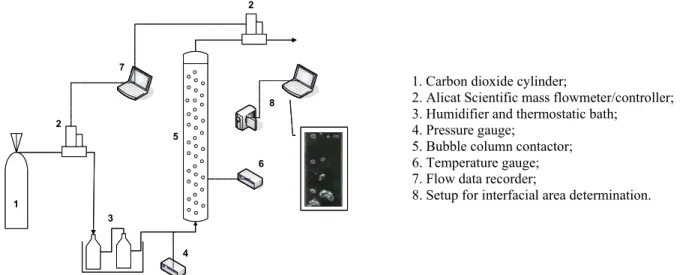
The gas-liquid contactor employed in the hydro-dynamics and gas absorption studies performed in the present work was a square bubble column (6 cm×6 cm×110 cm) with a liquid volume of 3 litres (see Figure 1). The gas sparger was a glass capillary with only one orifice to produce a small number of bubbles. The bubble diameter was measured using a photographic method based on images taken along the bubble column using the experimental procedure described in a previous work (Gómez-Díaz et al., 2008). Carbon dioxide mass transfer from the gas phase to the liquid one was studied on the basis of the difference between inlet and outlet gas flow-rate in the bubble contactor. The gas phase is put in contact with pure water to saturate the gas and to remove the resistance to the mass transfer of water from the liquid to the gas phase. The gas flow-rate fed to the bubble column was measured and con-trolled with two mass flow controllers (Alicat Scientific). The mass flow controllers employed in the present study for the gas flow-rate and the pres-sures were calibrated by the supplier for pure carbon dioxide streams. The operation regime employed in the absorption experiments was continuous in relation to the gas phase and batch regarding the absorbent liquid.
1
3
4
6 8
5 2
7
2
1
3
4
6 8
5 2
7
2
1
3
4
6 8
5 2
7
2
1. Carbon dioxide cylinder;
2. Alicat Scientific mass flowmeter/controller; 3. Humidifier and thermostatic bath;
4. Pressure gauge;
5. Bubble column contactor; 6. Temperature gauge; 7. Flow data recorder;
8. Setup for interfacial area determination.
Brazilian Journal of Chemical Engineering Vol. 30, No. 04, pp. 801 - 809, October - December, 2013 RESULTS AND DISCUSSION
Gas-Liquid Interfacial Area
An example of the photographs used to obtain the abovementioned bubble size distribution is shown in Figure 2. We can also observe in this figure the influence caused by the presence of one solute (methyl-2-pyrrolidone, MP) on the bubble size. Pho-tographs indicate that, for aqueous solutions of MP, an increase of solute concentration in the liquid phase could produce a decrease in the bubble size because an increase in the number of bubbles is clearly observed. This behaviour is inconsistent with the fact that an increase in the value of MP concen-tration produces an increase in the liquid phase viscosity (George and Sastry, 2004). The increase in this physical property usually produces an increase in the bubble size (Gómez-Díaz et al., 2009a), but the concentration range used in this work did not produce large changes in liquid phase viscosity. On the other hand, the presence of this kind of substance also produces important changes in other physical properties that could cause an important influence on the bubbles size produced in the contactor. For this kind of substance, the effect caused by small con-centrations on the surface tension value (García-Abuín et al., 2008) indicates a behaviour similar to aqueous surfactant solutions (Gómez-Díaz et al., 2007). This behaviour comprises a dramatic decrease in the surface tension value with the addition of very low solute quantities, caused by the accumulation of this kind of molecule at the gas-liquid interface. When surfactants are present in the liquid phase, there is a difference with the present experimental systems because the surfactant concentration range does not influence the liquid viscosity (Gómez-Díaz et al., 2007). In relation to the previously analysed effect of surface tension on the bubble diameter (Sardeing et al., 2006), a decrease in this physical property produces a decrease in the bubbles size, in agreement with the behaviour shown in Figure 2.
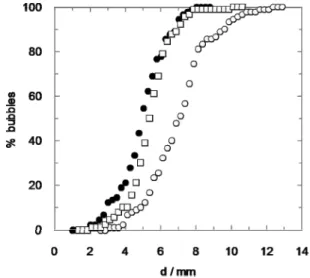
The bubble images processing (photographs shown in Figure 2, for instance) provides the bubble size distribution under the different experimental condi-tions. An example of the results obtained for bubble size distribution produced in the bubble contactor is shown in Figure 3. This figure shows that, under certain operational conditions, the use of aqueous solutions of P produces more bubbles for all the diameter ranges than in the case of aqueous solutions of MP and EP. In relation to gas hold-up, a similar be-haviour was found for different solutes, the most important parameter being bubble diameter.
CMP = 0.1 M CMP = 0.3 M CMP = 0.5 M
CMP = 0.1 M CMP = 0.3 M CMP = 0.5 M
Figure 2: Bubble contactor photographs using aqueous MP solutions. Ug = 0.0014 m·s-1.
Figure 3: Influence of alkyl-pyrrolidone type on the bubble size distribution. Ug = 0.0014 m·s-1. CP = 0.5
mol·L-1. ({) P; (z) MP; ( ) EP.
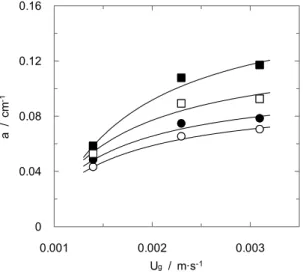
interfa-cial area). At the same time, an increase in superfiinterfa-cial gas velocity produces an increase in the bubble size, but this fact has a negative influence on the gas-liquid interfacial area. Taking into account the data shown in Figure 4, the influence of gas hold-up is higher for low superficial gas velocities, and an important increase in the interfacial area is observed from 18 to 30 L·h-1; however, when higher values of this variable are fed into the bubble column, the negative influence of the bubble size compensates the positive effect from gas hold-up.
Ug / m·s-1
0.001 0.002 0.003
a
/
c
m
-1
0 0.04 0.08 0.12 0.16
Figure 4: Influence of superficial gas velocity on the gas-liquid specific interfacial area. Aqueous solutions of MP: ({) CMP = 0 M; (z) CMP = 0.1 M;
( ) CMP = 0.3 M; () CMP = 0.5 M.
On the other hand, in relation to the influence of the liquid phase composition (MP concentration in Figure 4), the observed behaviour was an increase in the value of the gas-liquid interfacial area when MP concentration increases in the liquid phase. This be-haviour is related to the previous discussion about the photographs shown in Figure 2, and the influence of physical properties on the bubble size. The conclusion reached in Figure 2 indicates that an increase in the MP concentration produces a decrease in the bubble diameter. This fact is in agreement with the data calculated for the gas-liquid interfacial area, shown in Figure 4. This behaviour is due to the important decrease in the surface tension value when the MP concentration increases in the liquid phase (García-Abuín et al., 2008). This phenomenon pro-duces a decrease in bubble size that has been confirmed in different studies (Gómez-Díaz et al., 2008; Painmanakul et al., 2005). The effect caused by the surface tension is higher than the possible influence of viscosity (increase in bubble diameter) due to the concentration ranges, because the
com-position used in this work has a higher influence on surface tension than on viscosity (George and Sastry, 2004; García-Abuín et al., 2008).
In relation to the influence of gas-flow-rate on the interfacial area value, the behaviour observed is similar to that in Figure 4. But the influence of solute concentration on the interfacial area indicates signifi-cant differences, as shown in Figure 5. Thus, for aqueous solutions of MP and EP, an increase in the value of the gas-liquid interfacial area is observed when the MP and EP concentration increases in the liquid phase, due to the reduction in bubble diameter caused by the decrease in surface tension. For aque-ous P solutions, the behaviour consists of the absence of an influence of solute concentration, obtaining a constant value of gas-liquid interfacial area. This be-haviour could be due to the fact that the presence of P causes a smaller decrease in surface tension value than that caused by the other alkyl-pyrrolidones (García-Abuín et al., 2008). The influence of viscos-ity could then inhibit the effect caused by surface tension for aqueous P solutions. The experimental data corresponding to the interfacial area indicate that the alkyl-substituted pyrrolidones show a similar behaviour in relation to the hydrodynamic parame-ters analysed in this study, with clear differences for aqueous P solutions that could affect the global mass transfer process. Taking into account the experimen-tal results corresponding to interfacial area, aqueous solutions of P do not show good characteristics as a MP substitute. On the other hand, aqueous EP tions show a behaviour similar to aqueous MP solu-tions and, for this reason, the better safety charac-teristics make EP a suitable substitute.
C / mol·L-1
0 0.2 0.4 0.6
a
/ c
m
-1
0 0.05 0.1 0.15
Figure 5: Influence of alkyl-pyrrolidone type and concentration on the specific interfacial area. Ug =
Brazilian Journal of Chemical Engineering Vol. 30, No. 04, pp. 801 - 809, October - December, 2013 Mass Transfer Coefficient
The present work also includes studies of the process of carbon dioxide mass transfer to aqueous solutions of alkyl-pyrrolidones. Both parameters are important to understand the absorption process of this gas in these aqueous solutions. As a preliminary step, different studies have been carried out in order to determine the kind of absorption (physical or chemical) that takes place in the systems analysed in this work. This previous study is necessary since, in research works developed by our research team, the reaction between carbon dioxide and pyrrolidine (García-Abuín et al. 2011) was detected. Due to the similar chemical structure and the presence of an amino group, it was necessary confirm the absorp-tion type for each system. These studies were developed using an experimental procedure previ-ously described (García-Abuín et al. 2011). The ex-perimental results showed that all the alkyl-pyrroli-done aqueous solutions produce physical absorption, with the inhibition of the chemical reaction by the presence of the ketone group, that reduces the elec-tron density on the amino group. This fact avoids the reaction between carbon dioxide and the amino group.
Figure 6: Experimental data fitting using Equation (1). Ug = 0.0014 m·s-1. () CP = 0 (water), ( ) CP = 0.1 M.
Physical absorption experiments were performed using the same bubbling contactor used in the previous section (hydrodynamic studies) to put both phases in contact, under the different experimental conditions (type of solute, concentration of solute and gas flow-rate), and the volumetric mass transfer coefficient (kL·a) was calculated using the integrated
form of Equation (1). Figure 6 shows that the slope of the plot is higher for the experiment in the absence of P, in comparison with the presence.
L dC
K a (C * C)
dt = ⋅ ⋅ − (1)
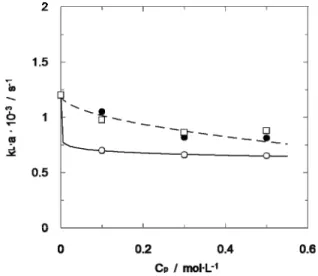
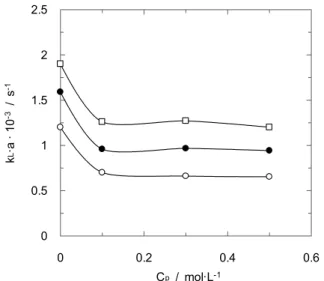
Figure 7 shows that an increase in solute con-centration always produces a decrease in the value of the volumetric mass transfer coefficient. However, this decrease is more important for aqueous solutions of P, mainly at low solute concentration in the liquid phase. This behaviour is in agreement with the previ-ous studies performed in this work, since a lower value was previously observed for the specific gas-liquid interfacial area (parameter included in the volumetric mass transfer coefficient) for aqueous solutions of P than for solutions of MP and EP.
Taking into account the observed behaviour for systems with MP and EP in the previous section: an increase in the concentration of these substances in the liquid phase produces an increase in the interfa-cial area value, but Figure 6 shows a decrease in the value of the volumetric mass transfer coefficient (the opposite behaviour to interfacial area). This behaviour implies that the effect caused by the presence of this kind of substance on the mass transfer coefficient (kL) is more important than the corresponding
influ-ence on the gas-liquid interfacial area.
Figure 7: Influence of alkyl-pyrrolidone type and concentration on the volumetric mass transfer coeffi-cient. Ug = 0.0014 m·s-1. ({) P; (z) MP; ( ) EP.
mass transfer coefficient caused by the increase in the gas-liquid interfacial area, due to the superficial gas velocity (see previous section and Figure 4). The increase in the superficial gas velocity could also produce an increase in the value of the mass transfer coefficient (Hashemia et al. 2009), but certain studies have shown a lack of influence of this variable on this parameter (Gómez-Díaz et al., 2006; Vasconcelos et al., 2003).
Cp / mol·L-1
0 0.2 0.4 0.6
k
L·a
·
1
0
-3
/
s
-1
0 0.5 1 1.5 2 2.5
Figure 8: Influence of superficial gas velocity and P concentration on the volumetric mass transfer coefficient. ({) Ug = 0.0014 m·s-1; (z) Ug = 0.0023
m·s-1; ( ) Ug = 0.0031 m·s-1.
Taking into account that the volumetric mass transfer coefficient and the gas-liquid interfacial area were determined in the present work under different operational conditions, the mass transfer coefficient could be calculated as the quotient between the volumetric mass transfer coefficient and the specific interfacial area. Let us then analyse the effect of experimental variables (type of solute and concentra-tion, and superficial gas velocity) on mass transfer, removing the influence caused by the interfacial area. Figure 9 shows an example of the calculated results for the mass transfer coefficient. These results indicate once again a difference between the be-haviour for aqueous solutions of P in relation to that of MP and EP aqueous solutions. In all cases, a similar behaviour, previously commented for the volumetric coefficient, is observed: a decrease in the mass transfer coefficient for all systems when the solute concentration increases, but with a higher de-crease in this coefficient at low P concentration. For this system (aqueous solutions of P), a constant value of the mass transfer coefficient is reached; however, for aqueous solutions of MP and EP, a continuous
decrease is observed in all the composition range. The same behaviour was observed for the other gas flow-rates employed in the present work (see Figure 10). At low amide concentration, P aqueous solu-tions take values for the mass transfer coefficient lower than for MP and EP solutions. This fact is due to a better bubbling distribution in these last systems because it produces a better turbulence in the liquid phase, increasing the mass transfer rate.
C / mol·L-1
0 0.2 0.4 0.6
k
L ·
1
0
-2 /
c
m
· s
-1
0 1 2 3 4
Figure 9: Influence of alkyl-pyrrolidone type and concentration on the mass transfer coefficient. Ug =
0.0014 m·s-1. ({) P; (z) MP; ( ) EP.
Cp / mol·L-1
0 0.2 0.4 0.6
k
L · 1
0
-2
/ c
m
· s
-1
0 1 2 3 4
Figure 10: Influence of alkyl-pyrrolidone type and concentration on the mass transfer coefficient. Ug =
0.0031 m·s-1. ({) P; (z) MP; ( ) EP.
Brazilian Journal of Chemical Engineering Vol. 30, No. 04, pp. 801 - 809, October - December, 2013 accumulate molecules at the gas-liquid interface,
as can be observed in the surface tension values (García-Abuín et al., 2008). The presence of mole-cules in the gas-liquid interface generally causes a decrease in the mass transfer rate due to an increase in transport resistance because the gas diffusivity near to the interface is reduced (Jamnongwong et al. 2010). The accumulation of a compound at a gas-liquid interface can be analysed on the basis of adsorption isotherms (Sardeing et al., 2006). Previ-ous studies that analysed this kind of system in gas-liquid absorption have employed the Langmuir isotherm to evaluate the accumulation of molecules at the gas-liquid interface (Sardeing et al., 2006).
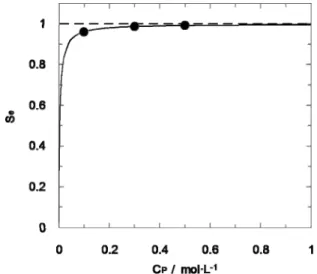
Figure 11: Surface coverage ratio for P aqueous
solutions. Full circles show the coverage of the gas-liquid surface at the compositions employed in present work.
The accumulation of P molecules at the interface is shown in Figure 10, that indicates the degree of accumulation on the basis of the Se parameter
(sur-face coverage ratio), where Se = 1 indicates the
maxi-mum accumulation and Se = 0 indicates a free
gas-liquid surface (Hebrard et al. 2009). The solute con-centrations employed in the present work produce accumulation degrees near to saturation (see Figure 11) and hence an important number of molecules are located at the gas-liquid interface. The procedure of accumulation at the gas-liquid interface commonly produces a reduction in the value of the mass transfer coefficient (Vasconcelos et al., 2003; Hebrard et al., 2009; Gómez-Díaz et al., 2009b). Different studies that use surfactants (compounds that tend to accumu-late at the interface), have concluded that the accu-mulation of molecules at the gas-liquid interface also
reduce the liquid renewal at the interface, and then produces a decrease in the mass transfer rate. At the same time, for the systems employed in this work (aqueous solutions of alkyl-pyrrolidones), the increase in the solute concentration near the interface produces an increase in the viscosity value (George and Sastry, 2004; Blanco et al., 2010). An increase in viscosity produces a decrease in the gas diffusivity in the liquid phase, and this effect causes a decrease in the mass transfer rate. Thus, the accumulation of these substances at the gas-liquid interface is responsible for the reduction in the value of the mass transfer coefficient because it increases the resistance to mass transfer.
purification that use MP, taking into account the fact that EP shows lower risk characteristics than MP.
CONCLUSIONS
The use of pyrrolidones in aqueous solution in absorption produces important changes in the gas-liquid interfacial area in the majority of cases caused by the influence of this kind of substance on bubble size. More specifically, the use of MP and EP in aqueous solutions produces an important decrease in the bubble diameter, producing an enhancement of interfacial area between the gas and liquid phases. On the other hand, P does not produce this kind of change because the decrease caused by pyrrolidones in surface tension is lower for P. Also, the presence of P produces a higher increase in the liquid phase viscosity than MP and EP.
In relation to mass transfer, the presence of all amides used in the present work produces a decrease in the mass transfer coefficient with a larger effect caused by P. The decrease in the mass transfer coefficient is due to the trend of these substances to accumulate at the gas-liquid interface, increasing the viscosity near to the interface, which produces an increase in the resistance to mass transfer. This effect is higher for aqueous solutions of P due to the important effect of this solute on viscosity.
On the basis of the present results, EP is a suitable substitute for MP in separation processes since aqueous solutions of EP show a similar absorp-tion rate but do not have the hazardous characteris-tics of aqueous MP solutions.
Though the presence of MP in the present study produces a decrease in the mass transfer rate, it is used as an industrial scale process for gas purifica-tion. The bubble column used in the present work, as well as the concentration range, produced a decrease in the value of the mass transfer coefficient in comparison with pure water. Overall, the experimen-tal results show a similar behaviour for MP and EP aqueous solutions and for this reason EP is a suitable substitute of MP.
ACKNOWLEDGEMENT
The authors thank the Consellería de Economía e Industria of Galicia regional government (Xunta de Galicia) for funding the research through the research project 10MDS265021PR. Diego Gómez-Díaz gratefully acknowledges the Ministerio de Innovación y Ciencia of Spain for the support under a “Ramón y Cajal” position.
NOMENCLATURE
a specific interfacial area m2·m-3
C CO2 concentration mol·L-1
C* CO2 concentration at
equilibrium
mol·L-1
CP,CMP,
CEP
pyrrolidone concentration mol·L-1
d equivalent sphere diameter mm
kL liquid mass transfer
coefficient
cm·s-1
kL·a volumetric liquid mass
transfer coefficient
s-1
Ug Superficial gas velocity L·h-1
Se surface coverage ratio (-)
t operation time s
REFERENCES
Bishnoi, S. and Rochelle, G. T., Absorption of carbon dioxide in aqueous piperazine / methyldi-ethanolamine. AIChE J., n. 48, p. 2788-2799 (2002). Blanco, A., García-Abuín, A., Gómez-Díaz, D.,
Navaza, J. M. and Vidal-Tato, I., Influence of temperature and composition upon density, vis-cosity, speed of sound, and refractive index of aqueous solutions of 1-ethyl-2-pyrrolidinone. J. Chem. Eng. Data, n. 55, p. 962-965 (2010). Bonenfant, D., Mimeault, M. and Hausler, R.,
Esti-mation of the CO2 absorption capacities in aqueous
2-(2-aminoethylamino)ethanol and its blends with
MDEA and TEA in the presence of SO2. Ind.
Eng. Chem. Res., n. 46, p. 8968-8971 (2007). Calderbank, P. H. and Moo-Young, M. B., The
continuous phase heat and mass transfer proper-ties of dispersions. Chem. Eng, Sci., n. 16, p. 39-54 (1961).
Cents, A. H. G., Brilman, D. W. F., Versteeg, G. F., Wijnstra, P. J., Regtien, P. P. L., Measuring bubble, drop and particle sizes in multiphase systems with ultrasound. AIChE J., n. 50, p. 2750-2762 (2004). Darmana, D., Deen, N. G., Kuipers, J. A. M., Detailed
modeling of hydrodynamics, mass transfer and chemical reactions in a bubble column using a discrete bubble model. Chem. Eng. Sci., n. 60, p. 3383-3404 (2005).
García-Abuín, A., Gómez-Díaz, D., Navaza, J. M. and Vidal-Tato, I., Surface tension of aqueous solutions of short n-alkyl-2-pyrrolidinones. J. Chem. Eng. Data, n. 53, p. 2671-2674 (2008).
Brazilian Journal of Chemical Engineering Vol. 30, No. 04, pp. 801 - 809, October - December, 2013 AIChE J., n. 57, p. 2244-2250 (2011).
George, J. and Sastry, N. V., Densities, viscosities, speeds of sound, and relative permittivities for water + cyclic amides (2-pyrrolidinone, 1-methyl-2-pyrrolidinone, and 1-vinyl-2-pyrrolidinone) at different temperatures. J. Chem. Eng. Data, n. 49, p. 235-242 (2004).
Gómez-Díaz, D., Navaza, J. M., Sanjurjo, B. and Vázquez-Orgeira, L., Carbon dioxide absorption in glucosamine aqueous solutions. Chem. Eng. J., n. 122, p. 81-86 (2006).
Gómez-Díaz, D., Navaza, J. M. and Sanjurjo, B., Density, kinematic viscosity, speed of sound, and surface tension of tetradecyl and octadecyl trimethyl ammonium bromide aqueous solutions. J. Chem. Eng. Data, n. 52, p. 2091-2093 (2007).
Gómez-Díaz, D., Navaza, J. M. and Sanjurjo, B., Interfacial area evaluation in a bubble column in the presence of a surface-active substance: Com-parison of methods. Chem. Eng. J., n. 144, p. 379-385 (2008).
Gómez-Díaz, D., Navaza, J. M., Quintáns-Riveiro, L. C. and Sanjurjo, B., Gas Absorption in bubble column using a non-Newtonian liquid phase. Chem. Eng. J., n. 146, p. 16-21 (2009a).
Gómez-Díaz, D., Gomes, N., Teixeira, J. A. and Belo, I., Oxygen mass transfer to emulsions in a bubble column contactor. Chem. Eng. J., n. 152, p. 354-360 (2009b).
Hashemia, S., Macchia, A. and Servio, P., Gas–liquid mass transfer in a slurry bubble column operated at gas hydrate forming conditions. Chem. Eng. Sci., n. 64, p. 3709-3716 (2009).
Hebrard, G., Zeng, J. and Loubiere, K., Effect of surfactants on liquid side mass transfer coeffi-cients: A new insight. Chem. Eng. J., n. 148, p. 132-138 (2009).
Higbie, R., The rate of absorption of a pure gas into a still liquid during a short time exposure. Trans. Inst. Chem. Eng., n. 31, p. 365-389 (1935). Jamnongwong, M., Loubiere, K., Dietrich, N., Hébrard,
G., Experimental study of oxygen diffusion coefficients in clean water containing salt, glucose or surfactant: Consequences on the liquid-side mass transfer coefficients. Chem. Eng. J., n. 165, p. 758-768 (2010).
Kantarci, N., Borak, F., Ulgen, K. O., Bubble column reactors. Process Biochem., n. 40, p. 2263-2283 (2005).
Kohl, A. and Nielsen, R., Gas Purification. Fifth Ed.
Gulf Publishing Company, Houston (1997). Krishn, R. and van Baten, J. M., Mass transfer in
bubble columns, Catal. Today, n. 79-80, p. 67-75 (2003).
Lage, P. L. C., Conservation of bubble size distribu-tion during gas reactive absorpdistribu-tion in bubble column reactors. Braz. J. Chem. Eng., n. 4, p. 339-349 (1999).
Martínez, I. and Casas, P. A., Simple model for CO2
absorption in a bubbling water column. Braz. J. Chem. Eng., n.1, p. 107-111 (2012).)
Nedeltchev, S., Jordan, U., Schumpe, A., Correction of the penetration theory based on mass-transfer data from bubble columns operated in the homogeneous regime under high pressure. Chem. Eng. Sci., n. 62, p. 6263-6273 (2007).
Noll, O., Fischer, K. and Gmehling, J., Vapor-liquid equilibria and enthalpies of mixing for the binary system water + N-methyl-2-pyrrolidone in the temperature range 80-140 °C. J. Chem. Eng. Data, n. 41, p. 1434-1438 (1996).
Painmanakul, P., Loubière, K., Hébrard, G., Mietton-Peuchot, M. and Roustan, M., Effect of surfac-tants on liquid-side mass transfer coefficients. Chem. Eng. Sci., n. 60, p. 6480-6491 (2005). Sardeing, R., Painmanakul, P. and Hébrard, G.,
Effect of surfactants on liquid-side mass transfer coefficients in gas–liquid systems: A first step to modelling. Chem. Eng. Sci., n. 61, p. 6249-6260 (2006).
Schütz, M., Daun, M., Weinspach, P.-M., Krumbeck, M. and Hein, K. R. G., Study on the CO2-Recovery
from an ICGCC-Plant. En. Conv. Manag., n. 33, p. 357-363 (1992).
Supap, T., Idem, R., Tontiwachwuthikul, P. and Saiwan, C., Kinetics of sulphur dioxide- and oxygen-induced degradation of aqueous monoethanolamine solution during CO2 absorption from power plant
flue gas streams. Int. J. Greenhouse Gas Cont., n. 3, p. 133-142 (2009).
Vasconcelos, J. M. T., Rodrigues, J. M. L., Orvalho, S. C. P., Alves, S. S., Mendes, R. L. and Reis, A., Effect of contaminants on mass transfer coeffi-cients in bubble column and airlift contactors. Chem. Eng. Sci., n. 58, p. 1431-1440 (2003). Yang, W., Wang, J., Wang, T. and Jin, Y.,