*e-mail: [email protected]
Dual-Curing, Self-Adhesive Resin Cement: Influence of the Polymerization
Modes on the Degree of Conversion and Microhardness
Luis Claudio Mendesa,*, Irma Cunha Matosb, Mauro Sayão Mirandab, Marcia Regina Benzia
a
Centro de Tecnologia, Instituto de Macromoléculas Professora Eloisa Masno – IMA,
Universidade Federal do Rio de Janeiro – UFRJ, Bloco J, PO Box 68525,
Av. Horácio Macedo, 2030, CEP 21941-598, Rio de Janeiro, RJ, Brazil
b
Departamento de Dentística, Escola de Dentística,
Universidade do Estado do Rio de Janeiro – UERJ, Rio de Janeiro, RJ, Brazil
Received: October 30, 2009; Revised: March 15, 2010
RelyXTM Unicem, dual-curing self-adhesive resin cement, was tested in order to evaluate the degree of
conversion (DC) and Vickers microhardness (VMH). The specimens were prepared into 4 groups (GR). For GR1, the specimens were irradiated with 500 mW.cm–2 during 20 seconds while for GR3 the same intensity was used but
the irradiation time was 40 seconds. The GR2 followed the same polymerization mode of the GR1 but a ceramic disk was applied as a light barrier. For the last group, only the chemical polymerization was carried out. The DC and VMH were measured immediately after the irradiation time and again after 24 hours. Dual-polymerization (light and chemical polymerization) showed higher DC and VMH than the chemical polymerization (dark cure). The presence of a ceramic disk did not affect the DC but reduced the VMH. Increasing the exposure to light, the DC remained almost constant whereas the VMH raised slightly indicating that the VMH is quite dependent on the incident energy. Additionally, the powder/liquid portions of the cement were also characterized. The TG showed that the solid fraction was constituted of 96% of inorganic matter and 4% of vinyl-silane, a coupling agent. Regarding the liquid part, it was found that 84% was related to the mixture of monomers. The SEM revealed that the size particle of the inorganic fillers were between 400 and 11.000 nm. Factors such as energy density, size and distribution of inorganic fillers and the low effectiveness of the chemical cure contributed to the low values of the DC and VMH.
Keywords: dual-curing cement, self-adhesive cement, degree of conversion, vickers microhardness
1. Introduction
The use of restoration cements has been growing jointly with the increase of ceramics and composite resins for repairing teeth. Although these materials show high mechanical strength and remarkable esthetic appeal, the filling of the tooth cavity requires multiple steps and consumes a lot of time1. Self-adhesive resin
cements have been developed to eliminate pre-treatment steps such as etching, priming and bonding when compared to multi-step composite cements. However, they need clinical and in vitro studies in the long-term, dimensional stability, their risks and benefits and so on. An important aspect to be considered is the monomer’s degree of conversion which affects the physico-chemical properties including strength, stiffness, water absorption, biocompatibility as well as color stability. Post-operative sensitivity has also been reported as a possible consequence of inadequate polymerization of the resin cement2-13. The
use of dual-curing resin cements intends to combine chemical and light-polymerization and at the same time allowing polymerization to take place in deeper areas of the tooth cavity applying shorter light irradiation time. Several studies reported that when photoactivation is omitted i.e. dark-curing took place and the material was unable to attain a high degree of monomer conversion14-24. Indeed, the degree
of polymerization is still influenced when a light barrier simulating a porcelain indirect restoration is placed between the light source and
the cement. Several studies showed adverse effects on the degree of conversion and microhardness of the dual-curing and light-polymerized resin cements with the increase of the thickness of the light barrier material25-31.
The purpose of this study was to evaluate the degree of conversion and microhardness of one commercial dual-curing self-adhesive resin cement, named RelyXTM, polymerized using different protocols,
considering the polymerization mode, irradiation time and the use of a ceramic disk as a light barrier. Additionally, the powder/ liquid portions of the cement were characterized in order to help the evaluation of the cement’s behavior with regard to the polymerization conditions.
2. Experimental
2.1. Material and sample preparation
Cylindrical specimens (0.5 mm height and 8.0 mm diameter) were prepared in a Teflon® mold with RelyX Unicem Aplicap
(shade A2, 3M® ESPE Dental Products, St Paul, MN, USA). The
simulating a porcelain indirect restoration.
For Group 1 (GR1), the specimen preparation followed strictly the manufacturer’s instructions by placing the resin cement into the mold, covered with a Mylar strip and a microscope glass slide. After that, the cement was polymerized using a light curing unit (Optilux 400, Demetron, Kerr Corp, Orange, CA,USA) with 500 mW.cm–2 of light intensity, with an irradiation time of
20 seconds.
The specimens of Group 2 (GR2) were polymerized under the same conditions but the microscope glass slide was replaced by a ceramic disk in order to simulate a porcelain indirect restoration. The specimens of Group 3 (GR3) were obtained under the same conditions as those of Group 2 but the irradiation time was higher (40 seconds) with the purpose of assessing its influence on the degree of polymerization.
For Group 4 (GR4), the cement was inserted into the mold and then put into a light-proof box, kept for five minutes, then for 24 hours in order to ensure only chemical/dark curing took place, as the maker had suggested. For both reaction times, the degree of conversion and microhardness were measured.
2.2. Fourier transform infrared spectroscopy (FT-IR)
The degree of conversion was measured using Varian equipment model Excalibur 3100 equipped with an attenuated total reflectance assembly, with 100 scans and 4 cm-1 of resolution.
The calculation of the degree of conversion was based on the ratio between the absorbances at 1637 and 1610 cm-1, according
to the previous work32. The results represented the average of five
measurements.
2.3. Vickers microhardness (VHM)
Hardness is a general term which describes a combination of properties, such as the resistance to penetration, abrasion and scratching. It is an important parameter concerning the mastication and teeth’ cleaning and they are the reasons for it large application in physical characterization of dental restoration. The Vickers microhardness test was carried out with a Carl Zeiss® Neophot
2 microdurometer, with load of 0.1 Kgf for 30 seconds. The results represented the average of five measurements.
2.4. Thermogravimetry (TG)
The thermogravimetry was carried out in a TA thermogravimetric analyzer model Q500 in the range of 30 – 700 °C, at 10 °C/min, under nitrogen atmosphere.
2.5.
13C and
31P nuclear magnetic resonance (NMR)
The nuclear magnetic resonance of carbon-13 (13C NMR) of
the solid and liquid portions of the cement was performed in Varian equipment model Mercury 300, at a frequency of 75.4 MHz. The portions were dissolved in deutered chloroform, analyzed at 25 °C, in order to estimate the chemical composition of the cement32.
The nuclear magnetic resonance of phosphorus 31(31P NMR)
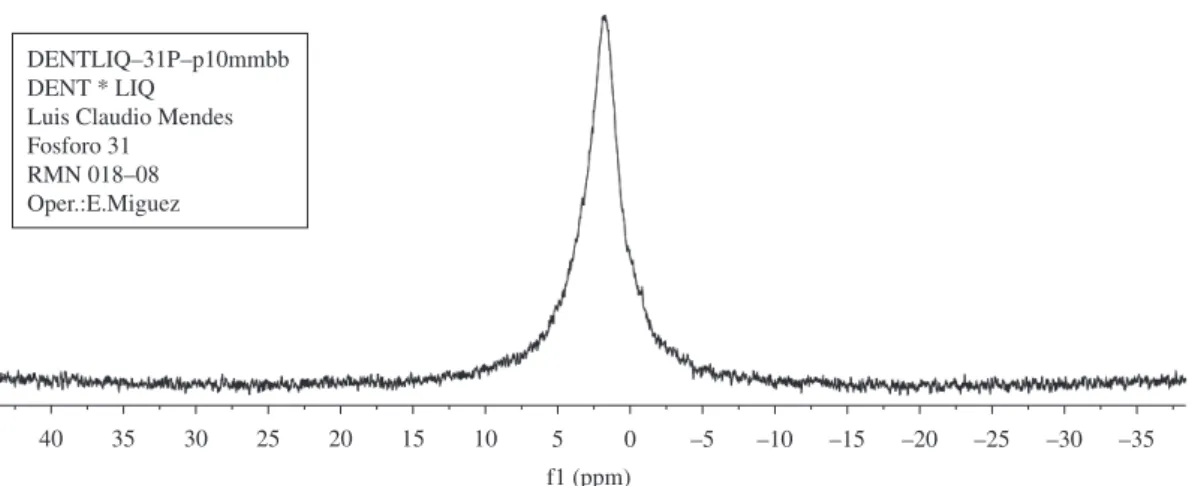
was also used to confirm the presence of combined phosphorus in the liquid portion of the cement.
3. Results and Discussion
3.1. Fourier transform infrared spectroscopy (FT-IR)
The solid portion of the cement indicated infrared absorptions at 1100 – 1000 and 800 cm–1 which were attributed to Si-O-C,
S i-O-Si and Si-OH linkages. These absorptions are related to the presence of silica as one of the fillers and possibly vinyl-silane, used as a coating of the fillers in this portion, in view of the increase in the interfacial adhesion between the organic and inorganic phases. Relating to the liquid phase, the infrared absorptions were noticed at 1716, 1637, 1620, 1582 and 1510 cm–1 and in the interval between
1300 – 1000 and 900 – 650 cm–1. These are related to the symetric
and assymetric stretching of the ester carbonyl, double linkage of the vinyl monomer and stretching and bending of the C = C and C – H links of the aromatic ring. Thus, the liquid phase seems to contain monomers of the unsaturated ester type, and considering the absorptions with reference to the aromatic ring, one may conclude that the monomer Bisphenol-A diglycidylether methacrylate – Bis-GMA, usually employed as the main vinylic monomer in the formulation of dental restoration composites, is one of the monomers employed in the formulation of the cement33-35.
3.2.
13C and
31P nuclear magnetic resonance (NMR)
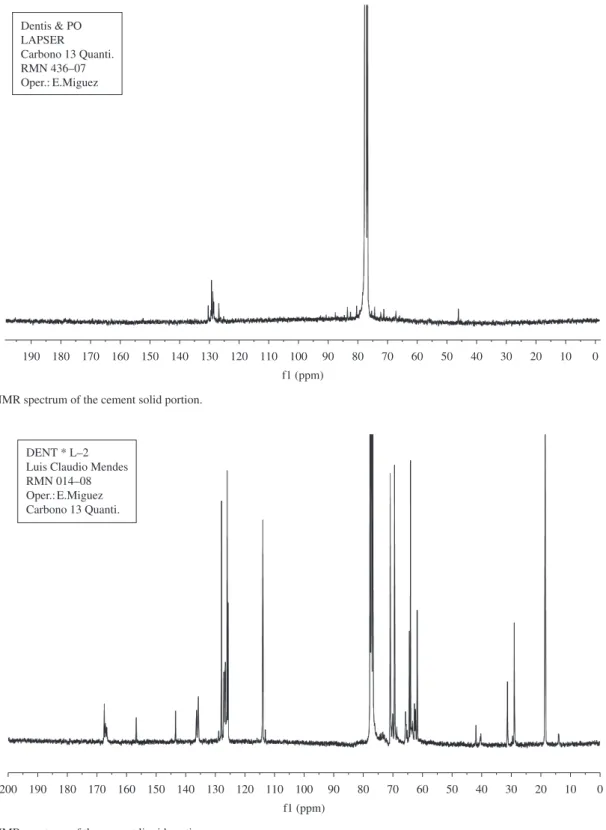
In Figures 1 and 2, respectively present the nuclear magnetic resonance spectra of carbon-13 of the solid and liquid portions of the cement. In Table 1 are listed the main chemical displacements. In relation to the solid fraction, the chemical displacements could be attributed to the unsaturated carbon-carbon linkage and would correspond to vinyl-silane, confirming the FT-IR results. With reference to the liquid phase, the 13C NMR revealed inumerous
chemical displacementes. Comparing it with spectra of known samples of monomers usually employed in dental composite formulae, it was verified that the displacements – 18.0; 30.9; 41.5; 61.9; 65.3; 113.6; 126.2; 126.4; 127.5; 136.0; 156.4; 166.3 and 167.2 ppm – would be related to the monomer Bis-GMA while those at 18.0; 63.7; 125.6; 136.0 and 166.8 ppm characterize the presence of the monomer triethyleneglycol dimethacrylate – TEGDMA. The relative percentual of each monomer was calculated considering the peak areas of chemical displacements at 65.3 ppm (Bis-GMA) and 63.7 ppm (TEGDMA), according to the previously described procedure32. Thus, the monomeric fraction of the liquid fraction of
the cement is 18.6% of Bis-GMA and 81.4% of TEGDMA. The higher amount of TEGDMA, almost 4 times higher than Bis-GMA, plays a role as diluent owing to its low viscosity33-34. Thus, a greater
quantity of diluent in the monomeric composition aimed to facilitate the diffusion of monomers in the reactional medium and permit their penetration in deeper areas of the tooth cavity.
Figure 1. 13C NMR spectrum of the cement solid portion.
Figure 2. 13C NMR spectrum of the cement liquid portion.
3.3. Thermogravimetry (TG)
Thermogravimetry indicated that the solid fraction constituted 96% of the inorganic volume and 4% of the organic material which was related to vinyl-silane, used as a coating with the view of improving the interfacial adhesion of the composite. Regarding the liquid fraction, the mass loss was 84% further revealing an incombustable portion of 16% which could be related to the phosphorus pentoxide residue and incomplete burning of organic material due to the non-oxidizing nitrogen atmosphere.
Table 1. 13C NMR chemical displacements of the cement solid and liquid portions.
Portion Chemical displacement (ppm)
Solid 46.1; 126-130
Liquid 13.6; 18.0; 28.5; 30.9; 39.9; 41.5; 61.4; 61.9; 62.1; 62.3; 63.0; 63.7; 64.1; 64.8; 65.3; 68.2; 69.0; 69.7; 112.7; 113.6;
3.4. Scanning electron microscopy (SEM)
A photomicrograph of the test specimen, after polymerization (Figure 4), indicated there is a great variation of size and form of the particles of the inorganic portion. Particle size varied between 0.4 – 11.2 microns (400 – 11.200 nm).
3.5. Degree of conversion (DC)
In Table 2 are listed the degree of conversion for the different groups. The specimens polymerized in the presence of light showed values of DC almost 4 times superior to that of the group whose polymerization occurred in the absence of light. After 24 hours, it was verified that the test specimens polymerized by light had an increase in the degree of conversion of around 10% while for those polymerized chemically an increase of around 150% was observed. Although being a considerable percentage, the DC value was lower (~60%) to those observed for GR1, GR2 and GR3. Regarding the presence of the ceramic disk and the increase in light exposure time on the cement, it appears these did not influence the degree of conversion.
3.6. Vickers microhardness
In Table 3 are listed the Vickers microhardness values of the different groups. It was observed that this property was greatly dependent on the polymerization conditions. With respect to the test specimens of groups GR1, GR2 and GR3, the VMH values varied due to the ceramic disk and with light exposure time. After 24 hours,
the VMH values were around twice as high to those determined at the end of light irradiation. It was not possible to measure the VMH of group GR4 after five minutes reaction time because the composite was not sufficiently rigid. Although the test specimens of GR4 resulted in an average value of DC inferior to those activated by light, the average of microhardness was in the same order of magnitude after 24 hours of reaction.
The presence of a ceramic disk influenced the microhardness of the composite. Lesser values of this property were found for groups GR2 and GR3 in relation to GR1 (glass slide). The average VMH value of group GR3 was sharply superior to group GR2, indicating that increase of light exposure time also affected this property. Although it did not alter the DC value, the presence of the ceramic disk significantly reduced the VMH, indicating that this property is very dependent on the quantity of incident light in the polymerization system. Thus, microhardness is related as much to the DC as to the degree of crosslinking.
With the light irradiation, the initiation step occurs instantaneously due to the production of free radicals. The propagation step proceeds
Figure 3. 31P NMR spectrum of the cement liquid portion.
Table 2. Degree of conversion of the different specimen groups.
Group Degree of conversion (%) Polymerization
mode
Immediately after light exposition
24 hours after light exposition
GR1 light-curing 29.6 ±4.0 32.6 ±3.0 GR2 light-curing 27.1 ±2.4 28.9 ±3.9 GR3 light-curing 28.2 ±3.6 32.3 ±4.0 - - After 5 minutes After 24 hours GR4 dark-curing 7.9 ±2.4 20.4 ±4.9
Table 3. Vickers microhardness of the different specimen groups.
Group Vickers microhardness
Polymerization mode
Immediately after light exposition
24 hours after light exposition
GR1 light-curing 8.0 ± 1.8 14.9 ±2.3 GR2 light-curing 4.8 ± 0.1 9.1 ±1.6 GR3 light-curing 6.5 ± 2.5 11.4 ±2.0
- - After 5 minutes After 24 hours
GR4 dark-curing - 10.7 ±0.9
and there is an increase of the viscosity of the composite making difficult the monomer diffusion to the propagation centers of the polymeric chain. This is one of the reasons that could be attributed to the low values of the DC and VHM. Further factors such as energy density (light intensity × exposition time), size and distribution of the inorganic fillers could be also considered. Braga, Ozyesil, Santos Jr. and Rasetto7-8, 17, 20 reported that the increase of the energy density led
to the increase of the DC in their studies on dual resin cements. In fact, Kumbuloglu et al.16 mentioned that 56% of DC was achieved when
32 J.cm–2 of the energy density was applied to dual-curing cement.
The energy density irradiated to the RelyXTM was 10 and 20 J.cm–2.
It is 2-3 times lower than that used by Kumbuloglu and then, it would be not enough to attain higher values of DC and VMH. The size and distribution of the inorganic fillers could be also mentioned. The SEM analysis revealed that the size particles were between 400 and 11.000 nm. Considering that the wavelength of the incident light used in this work was 470 nm, there was a great scattering of the light and its transmission to the liquid portion was unable to lead to higher values of degree of conversion and crosslinking, both straight related to the microhardness.
There is not influence of the ceramic disk which simulated a porcelain indirect restoration on the properties measured herein. The result is in agreement with Prinsloo’s25 study. He mentioned that only
disk with thickness upper than 2mm modified significantly the DC. The chemical curing (without light), in both polymerization modes, seems to have low effectiveness. Its activation was extremely slow making the chemical polymerization system a little inefficient and in the presence of light its contribution on the composite properties would be neglected.
4. Conclusion
Dual-polymerization mode showed higher DC and VMH than the chemical polymerization one. The ceramic disk did not affect the DC but reduced the VMH. The VHM seems to be more dependent on the incident energy than the DC. The energy density, size and distribution of the inorganic fillers and the low effectiveness of the chemical initiation led to the low values of the monomeric conversion and microhardness.
Acknowledgements
The authors thank Conselho Nacional de Desenvolvimento Científico e Tecnológico (CNPq), Fundação Coordenação do Aperfeiçoamento de Pessoal de Nível Superior (CAPES), Universidade Federal do Rio de Janeiro (UFRJ) and Universidade do Estado do Rio de Janeiro (UERJ) for supporting this investigation.
References
1. Rosenstiel SF, Land MF and Crispin BJ. Dental luting agents: A review of the current literature. The Journal of Prosthetic Dentistry. (Saint Louis) 1998; 80(3):280-301.
2. El-Mowafy OM and Rubo MH. Influence of composite inlay/onlay thickness on hardening of dual-cured resin cements. Journal of the
Canadian Dental Association. (Toronto) 2000; 66(3):147.
3. El-Mowafy OM, Rubo MH and El-Badrawy WA. Hardening of new resin cements cured through a ceramic inlay. Operative Dentistry. (Washington, DC) 1999; 24(1):38-44.
4. Ferracane JL. Correlation between hardness and degree of conversion during the setting reaction of unfilled dental restorative resins. Dental
Materials (Kidlinton) 1985; 1(1):11-14, 1985.
5. Meng X, Yoshida K and Atsuta M. Influence of ceramic thickness on mechanical properties and polymer structure of dual-cured resin luting agents. Dental Materials. (Kidlinton) 2008; 24(5):594-599.
6. Asmussen E. Restorative resins: hardness and strength vs. quantity of remaining double bonds. Scandinavian Journal of Dental Research. (Washington) 1982; 90(6):484-489.
7. Braga RR and Ferracane JL. Contraction stress related to degree of conversion and reaction kinetics. Journal of Dental Reasearch. (Washington) 2002; 81(2):114-118.
8. Rasetto F, Driscoll CF and von Fraunhofer JA. Effect of light source and time on the polymerization of resin cement through ceramic veneers. Journal of Prosthodontics: Implant, Esthetic and Reconstructive
Dentistry. (Philadelphia) 2001; 10(3):133-139.
9. Akgungor G, Akkayan B and Gaucher, H. Influence of ceramic thickmess and polymerization mode of a resin luting agent on early bond strength and durability with a lithium disilicatee-based ceramic system. The Journal
of Prothetic Dentistry (Saint Louis) 2005; 94(3):234-241.
10. Ceballos L, Garrido MA, Fuentes V and Rodríguez J. Mechanical characterization of resin cements used for luting fiber posts by nanoindentation. Dental Materials. (Kidlinton) 2007; 23(12):100-105.
11. Hofmann N, Papsthart G, Hugo B and Klaiber B. Comparison of photo-activation versus chemical or dual-curing of resin-based luting cements regarding flexural strength, modulus and surface hardness. Journal of
Oral Rehabilitation. (Oxford) 2001; 28(11):1022-1028.
12. Lu H, Mehmood A, Chow A and Powers JM. Influence of polymerization mode on flexural properties of esthetic resin luting agents. The Journal
of Prothetic Dentistry. (Saint Louis) 2005; 94(6):549-554.
13. Radovic I, Monticelli F, Goracci C, Vulicevic ZR and Ferrari M. Adhesive resin cements: a literature review. Journal of Adhesive Dentistry. (Carol Stream) 2008; 10(4):251-258.
14. Braga RR, Cesar PF and Gonzaga CC. Mechanical properties of resin cements with different activation modes. Journal of Oral Rehabilitation. (Oxford) 2002; 29(3):257-262.
15. Jung H, Friedl KH, Hiller KA, Haller A and Schmalz G. Curing efficiency of different polymerization methods through ceramic restorations.
Clinical Oral Investigations. (Berlin) 2001; 5(3):156-161.
16. Kumbuloglu O, Lassila LV, User A and Vallittu PK. A study of the physical and chemical properties of four resin composite luting cements. The International Journal of Prosthodontics. (Lombard) 2004; 17(3):357-363.
17. Ozyesil AG, Usumez A and Gunduz B. The efficiency of different light souces to polymerize composite beneath a simulated ceramic restoration.
The Journal of Prothetic Dentistry. (Saint Louis) 2004; 91(2):151-157.
18. Papazoglou E, Rahiotis C, Kakaboura A and Loukidis M. Curing efficiency of a photo- and dual-cured resin cement polymerized through 2 ceramics and a resin composite. The International Journal of Prosthodontics. (Lombard) 2006; 19(1):34-36.
19. Rueggeberg FA and Caughman WF. The influence of light exposure on polymerization of dual-cure resin cements. Operative Dentistry. (Washington, DC) 1993; 18(2):48-55.
20. Santos Jr GC, El-Mowafy O, Rubo JH and Santos MJ. Hardening of dual-cure resin cements and a resin composite restorative with QTH and LED light curing. Journal of Canadian Dental Association. (Toronto) 2004; 70(5):323-328.
21. Arrais CA, Giannini M and Rueggeberg FA. Kinetic analysis of monomer conversion in auto- and dual-polymerizing modes of commercial resin luting cements. Journal of Prosthetic Dentistry. (Saint Louis) 2009; 101(2):128-136, 2009.
22. Moraes RR, Brandt WC, Naves LZ, Correr-Sobrinho L and Piva E. Light- and time-dependent polymerization of dual-cured resin luting agent beneath ceramic. Acta Odontológica Scandinavica. (Oslo) 2008; 66(5):257-261.
23. Arrais CA, Rueggeberg FA, Waller JL, Goes MF and Giannini M. Effect of curing mode on the polymerization characteristics of dual-cured resin cement systems. Journal of Dentistry. 2008; 36(6):418-426.
composite. Polymer Testing (Essex) 2005; 24(4):418-422.
33. Mendes LC, Tedesco AD, Miranda MS, Benzi MR and Chagas BS. Determination of degree of conversion as a function of depth of a photo-initiated dental restoration composite—II application to commercial SureFil™. Polymer Testing. (Essex) 2005; 24(7):942-946.
34. Mendes LC, Tedesco AD, Miranda MS, Benzi MR and Chagas BS. Determination of degree of conversion as a function of depth of a photo-initiated dental restoration composite—III application to commercial Prodigy Condensable™. Polymer Testing (Essex) 2005; 24(8):963-968.
35. Paraizo MA, Mendes LC, Gomes AS, Miranda MS and Amaral ACF. Degradation of a dental filling material after high caries challenge.
Materials Research (São Carlos) 2004; 7(4):639-642.
Resin Cement Knoop Hardness. Journal of Prosthodontics (Philadelphia) 2007; 16(6):480-484.
27. Yoshida K, Tsuo Y, Meng X and Atsuta M. Mechanical Properties of Dual-Cured Resin Luting Agents for Ceramic Restoration. Journal of
Prosthodontics. (Philadelphia) 2007; 16(5):370-376.
28. Peixoto RT, Paulinelli VM, Sander HH, Lanza MD, Cury LA and Poletto LT. Light transmission through porcelain. Dental Materials. (Kidlinton) 2007; 23(11):1363-1368.
29. Meng X, Yoshida K and Atsuta M. Hardness Development of Dual-cured Resin Cements through Different Thicknesses of Ceramics. Dental
Materials (Kidlinton) 2006; 25(1):132-137.