228 229
228 229
The influence of chemical activation on hardness of dual-curing
resin cements
A influência da ativação química na dureza de cimentos
resinosos duais
Renata Garcia Fonseca*
Carlos Alberto dos Santos Cruz** Gelson Luis Adabo**
ABSTRACT: During the cementation of metallic restorations, the polymerization of dual-curing resin cements depends exclusively on chemical activation. This study evaluated the influence of chemical activation compared with dual-curing (chemical and light activation), on the hardness of four dual-curing resin cements. In a darkened environment, equal weight proportions of base and catalyst pastes of the cements Scotchbond Resin Cement, Variolink II, Enforce and Panavia F were mixed and inserted into moulds with cavities of 4 mm in diameter and 2 mm in height. Subsequently, the cements were: 1) not exposed to light (chemical activation = self-cured groups) or 2) photoactivated (dual-curing = dual-cured groups). The Vickers hardness number was measured at 1 hour, 24 hours and 7 days after the start time of cements’ spatulation. For all the cements, the hardness values of self-cured groups were lower than those of the respective dual-self-cured groups at 1 hour and 24 hours. At 7 days, this behavior continued for Variolink II and Panavia F, whilst for Scotchbond Resin Cement and Enforce there was no statistical difference between the two activation modes. All cements showed a significant increase in their hardness values from 1 hour to 7 days for both activation modes. Of the self-cured groups, Scotchbond Resin Cement and Variolink II presented the highest and the lowest hardness values, respectively, for all three times tested. Within the limitations of this study, up to the time of 24 h, chemical activation alone was unable to promote similar hard-ness as to that obtained with dual-curing.
DESCRIPTORS: Resin cements; Hardness; Dental materials.
RESUMO: Na cimentação de restaurações metálicas, a polimerização dos cimentos resinosos duais depende exclu-sivamente da ativação química. Este estudo avaliou a influência da ativação química, comparada à dupla ativação (química e pela luz), na dureza de 4 cimentos resinosos duais. Em ambiente isento de luz, quantidades iguais em massa das pastas base e catalisadora dos cimentos Scotchbond Resin Cement, Variolink II, Enforce e Panavia F foram espatuladas e inseridas em matrizes com cavidade de 4 mm de diâmetro e 2 mm de altura. A seguir, os ci-mentos foram: 1) mantidos no escuro (ativação química = grupos quimicamente ativados) ou 2) fotopolimerizados (dupla ativação = grupos duais). A dureza Vickers foi obtida 1 hora, 24 horas e 7 dias após o início da espatulação dos cimentos. Em todos os cimentos, a dureza dos grupos quimicamente ativados foi menor que a dos respectivos grupos duais nos tempos de 1 hora e de 24 horas. Aos 7 dias, esse comportamento foi mantido pelo Variolink II e Panavia F, enquanto para o Scotchbond Resin Cement e para o Enforce não houve diferença estatisticamente significante entre os dois métodos de ativação. Todos os cimentos mostraram aumento significativo de dureza de 1 hora para 7 dias, em ambos os métodos de ativação. Dentre os grupos quimicamente ativados, o Scotchbond Resin Cement e o Variolink II mostraram, respectivamente, a maior e a menor dureza nos três tempos testados. Dentro dos limites deste estudo, até o período de 24 horas, a ativação exclusivamente química não foi capaz de promover dureza semelhante à obtida pela dupla ativação.
DESCRITORES: Cimentos de resina; Dureza; Materiais dentários.
INTRODUCTION
The clinical use of resin cements has increased greatly. These cements are mostly composed of monomers such as Bis-GMA, TEGDMA and UED-MA, reinforced with varying amounts of inorganic fillers. Regarding the activation mode, resin ce-ments are available in photoactivated, chemically
activated and dual-curing formulations and selec-tion is based primarily on the intended use.
Dual-curing resin cements have been used not only for cementing indirect aesthetic ceramic and composite resins restorations but, more recently, also for cementing metallic restorations.
228 229
228 229
In aesthetic restorations, a portion of the light emitted from the photo-polymerization unit is absorbed by the restorative materialand is not transmitted to the cement2,11,16.In these situations,
cement areas that have received insufficient light intensity for activating the photo-sensitive sub-stances depend upon chemical activation in order to assure polymerization. Reports in literature, however, have related that ceramics and com-posite resins of greater thickness6,7,17 and lower
translucency17 result in reduced conversion of the
dual-cured cements. In order to try to reduce this effect, longer exposure times are necessary, but not always enough.
For metallic restorations, the polymerization of cements is exclusively dependent on chemical activation, since the metal forms a physical barrier to transmission of light, making photoactivation impossible.
However, studies indicate that chemical ac-tivation alone is insufficient for dual-curing resin cements to achieve maximum conversion4-8,13,15.
Justlike the quantity and quality of polymeric and inorganic phases, efficacy of the setting mechan-isms has a direct influence on the mechanical and biologic properties of resin cements1,7,14.
Accord-ing to McComb12 (1996), complete polymerization
of resin cements is essential for strength, reten-tion and longevity of restorareten-tions. In addireten-tion, inadequate cure can also be a causative factor in postoperative sensitivity and biocompatibility problems12. Therefore, these materials, available in
dual-curing formulation, should be able to reach a high degree of conversion either in the presence or absence of light.
The purpose of the present study was to evalu-ate the influence of chemical activations compared with dual-curing activation on cement hardness, which is an indicator degree of conversion of four dual-curing resin cements.
MATERIALS AND METHODS
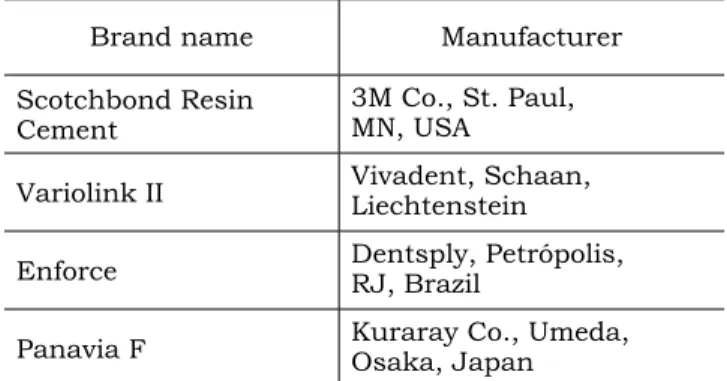
Four commercial dual-curing resin cements were tested (Table 1).
Equal weights (0.10 g) of base and catalyst pastes of each material were obtained using an analytical balance (Sartorius, Göttingen, Germany) and were spatulated according to manufacturers’ directions.
After spatulation, cements were inserted into acrylic resin moulds with circular cavities of 4 mm in diameter and 2 mm in height. Moulds were filled
with a slight excess of material. A mylar strip (Probem, Catanduva, Brazil), a microscope slide, a metallic support with an opening to allow pho-toactivation and a 1 kg weight were positioned on top of the resin cements to permit the overflow of material in excess. All these procedures, with the exception of weighing, were performed inside an X-ray film development box (Odontologic Indústria e Comércio Ltda., São Paulo, Brazil) shielding the materials from exposure to ambient light.
Subsequently, the cements were submitted to one of the following activation modes: 1) cements of the self-cured groups (chemical activation alone) remained in these conditions (described above) for 60 seconds; and 2) the upper surfaces of the cements of the dual-cured groups (dual-curing) were photoactivated for 60 seconds, using a halo-gen light source (Curing Light 2500 photo-polym-erization unit, 3M Co., St. Paul, MN, USA) with 510 mW/cm2 intensity, and were used as control
groups.
Afterwards, the specimens were stored dry, in lightproof containers at 37°C, until testing. The Vickers hardness numbers (VHN) were measured at 1 hour, 24 hours and 7 days after the start time of cements’ spatulation, using a M-Testor microhardness tester (Otto Wolpert-Werke, Lud-wigshafen, Germany), a Vickers diamond (Buehler, Lake Bluff, USA) and a force of 0.3 N, applied for 30 seconds.
Twenty-four experimental conditions were tested: 4 cements, 3 times and 2 activation modes. For each condition, 5 specimens were tested. For each test specimen, 12 hardness measurements were performed, three for each quadrant of the specimen. A mean was calculated for each test specimen using these measurements and, after-wards, for each experimental condition.
TABLE 1 - Dual-curing resin cements studied.
Brand name Manufacturer
Scotchbond Resin
Cement 3M Co., St. Paul, MN, USA Variolink II Vivadent, Schaan, Liechtenstein
Enforce Dentsply, Petrópolis, RJ, Brazil
230 231
230 231
Statistical analysis was performed with the software GMC 8.1 statistical package (School of Dentistry of Ribeirão Preto, University of São Pau-lo, Brazil).
Three comparative analyses were performed: 1. between the activation modes for each cement
and time studied, using the Student’s t-test; 2. between the 1-hour and 7-days conditions for
each cement and activation mode, also using the Student’s t-test;
3. between the self-cured groups of all cements for each of the three times, using ANOVA and Tukey’s test. All statistical tests used a 95% confidence level.
RESULTS
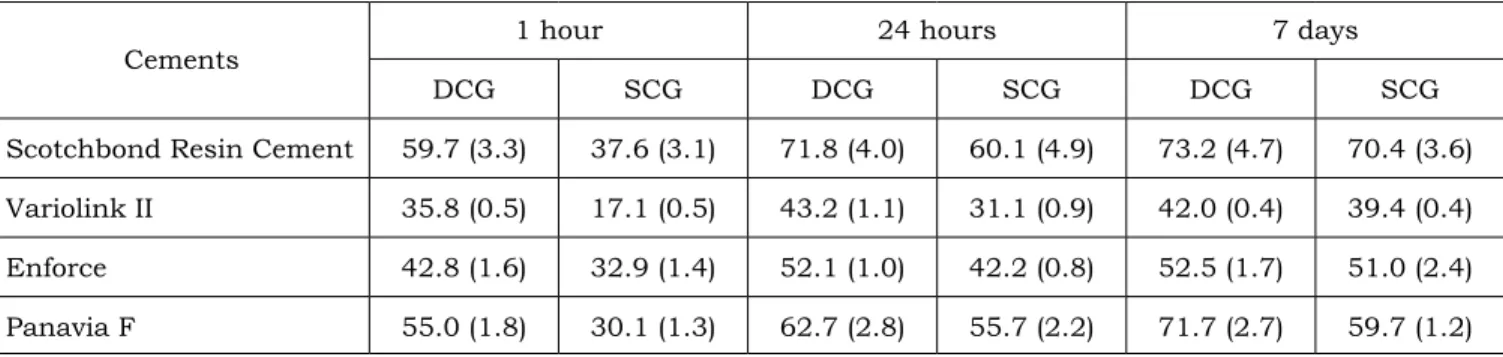
Means and standard deviations of the Vickers hardness numbers (VHN) obtained from self-cured and dual-cured groups of the examined cements at the three test intervals are presented in Table 2.
At 1 hour and 24 hours, for all cements, dual-curing activation produced higher Vickers hardness than chemical activation (p < 0.05). At 7 days, this still held true for the Variolink II and Panavia F cements (p < 0.05), whilst there was no difference between the two activation modes for the Scotchbond Resin Cement and Enforce cements (p > 0.05).
In terms of percentage, at 1 hour, the self-cured groups of Scotchbond Resin Cement, Vari-olink II, Enforce and Panavia F cements demon-strated 63%, 48%, 77% and 55% of the hardness values of the respective dual-cured groups. By 7 days, these percentage values had increased to 96%, 94%, 97% and 83%, respectively.
All resin cements showed a significant in-crease in hardness values from 1 hour to 7 days for both activation modes (p < 0.05). This increase
was 2 to 4 times greater for the self-cured groups than for the dual-cured groups. Scotchbond Resin Cement, Variolink II, Enforce and Panavia F ce-ments presented percentage increases of 18%, 15%, 18% and 23% for the dual-cured groups and of 46%, 57%, 35% and 49% for the self-cured groups.
The comparison of the self-cured groups for all cements at each of the three times analyzed reveals that Scotchbond Resin Cement showed the highest hardness value achieved by the ce-ments at 1 hour (p < 0.05). Enforce and Panavia F had statistically similar hardness values, while Variolink II presented the lowest hardness value of all cements. At 24 hours (p < 0.05), Panavia F, together with Scotchbond Resin Cement showed the highest hardness values, followed by Enforce and Variolink II cements, which were statistically different. At 7 days (p < 0.05), there were statistical differences between all the cements, with Scotch-bond Resin Cement showing the best results, fol-lowed by Panavia F, Enforce and Variolink II.
DISCUSSION
Ideally, dual-curing resin cements, when ac-tivated by chemical means alone, should demon-strate hardness, which is an indicator of degree of conversion, very similar to that achieved when submitted to dual-curing activation even in the initial period after cementation.
The present study, however, demonstrated that until 24 hours, for all the cements evaluated, the hardness values for the self-cured groups were significantly lower than the respective values for the dual-cured groups. A similar trend has been observed among other commercial brands of dual-curing resin cements in previous publica-tions3,6-9.
TABLE 2 - Means and standard deviations of Vickers hardness number.
Cements 1 hour 24 hours 7 days
DCG SCG DCG SCG DCG SCG
230 231
230 231
In other studies that utilized infrared spec-trometry to evaluate the degree of conversion of the dual-curing resin cements as activation mode, sig-nificantly superior results were also observed when specimens were exposed to photoactivation4,13,15.
Variability between the cements regarding the degree of hardness achieved via chemical acti-vation alone was observed, however, in relation to the respective dual-cured groups. At 1 hour, the hardness value of the Variolink II self-cured group reached 48% of the hardness value obtained in the dual-cured group, whilst for the Enforce cement, the hardness value of the self-cured group reached 77% of the hardness value of the dual-cured group. The other cements fell in between these two ex-tremes. At 7 days, the average hardness value for the self-cured groups for Scotchbond Resin Ce-ment, Enforce and Variolink II cements were quite close to the values for the respective dual-cured groups. In contrast, for Panavia F, there were great differences between the results obtained through the self-cured and the dual-cured treatments, demonstrating that this cement depends more on photoactivation than the other cements.
The significant increase in hardness value re-lated to time, for both activation modes, as was ob-served in this study, has also been demonstrated in previous studies7,8.In a general manner, the
highest percentage increases observed in the self-cured groups could conceivably be related to the lower hardness values seen at 1 hour, compared to the values of the respective dual-cured groups. This finding may be explained by the difference in velocity between the two activation mechanisms. Photoactivation results in an initial, fast hardening of the resin cement, yielding a hardness value at 1 hour significantly higher than that of the self-cured groups. Chemical activation results in a slow, progressive hardening. Lee, Um10 (2001), using
thermal analysis, observed that the cure speed of dual-curing resin cements by light exposure was 5-20 times greater than by chemical cure.
The comparative study between the groups of self-cured resin cements at each of the three ana-lyzed times showed that, even when considering a single activation mode, the cements exhibited different degrees of hardness.
At all analyzed times, Scotchbond Resin Ce-ment and Variolink II showed, respectively, the highest and lowest hardness values, with the other cements being in an intermediate position. At 1 hour, the mean hardness value for Scotchbond Resin Cement was twice as great as the mean value
for Variolink II, whereas Enforce and Panavia F cements presented statistically similar hardness values. At 7 days, Scotchbond Resin Cement and Enforce cements, which show no statistical differ-ence between the two activation modes, had their hardness values stabilized at the level of 70 VHN and 50 VHN, respectively. Although Variolink II, even at 7 days, showed significant difference be-tween the two activation modes, the two mean hardness values were close to the level of 40 VHN. Finally, the Panavia F cement, even showing a considerable difference between the two activation modes, had a hardness value for the self-cured group that was significantly higher than that of the Enforce and Variolink II cements.
The reason for this behavior variation of the cements studied is more related to the way these cements are formulated. Cement behavior is the consequence of not only the efficacy and amount of chemical and photochemical activators used, but also the general composition of the cement; for example, types and proportions of monomers used in each of them13.
Additional studies that evaluate important properties such as flexural strength, fracture toughness and modulus of elasticity, amongst oth-ers, should be performed to obtain the most reli-able parameters for the use of these materials.
CONCLUSIONS
Within the limits of this in vitro study, the authors concluded:
• Up to the time of 24 h, chemical activation alone was unable to promote similar hardness to that obtained by dual-curing (chemical and light activation).
• As with dual-curing activation, chemical acti-vation alone also promoted progressive hard-ness from 1 hour to 7 days.
• Scotchbond Resin Cement and Variolink II showed, respectively, the highest and the lowest hardness values for the three times tested.
ACKNOWLEDGMENTS
232 PB
REFERENCES
1. Attar N, Tam LE, McComb D. Mechanical and physical properties of contemporary dental luting agents. J Prosthet Dent 2003;89(2):127-34.
2. Blackman R, Barghi N, Duke E. Influence of ceramic thick-ness on the polymerization of light-cured resin cement. J Prosthet Dent 1990;63(3):295-300.
3. Braga RR, Cesar PF, Gonzaga CC. Mechanical properties of resin cements with different activation modes. J Oral Rehabil 2002;29(3):257-62.
4. Caughman WF, Chan DCN, Rueggeberg FA. Curing po-tential of dual-polymerizable resin cements in simulated clinical situations. J Prosthet Dent 2001;85(5):479-84. 5. Darr AH, Jacobsen PH. Conversion of dual cure luting
ce-ments. J Oral Rehabil 1995;22(1):43-7.
6. El-Badrawy WA, El-Mowafy OM. Chemical versus dual cur-ing of resin inlay cements. J Prosthet Dent 1995;73(6):515-24.
7. El-Mowafy OM, Rubo MH, El-Badrawy WA. Hardening of new resin cements cured through a ceramic inlay. Oper Dent 1999;24(1):38-44.
8. Hasegawa EA, Boyer DB, Chan DCN. Hardening of dual-cured cements under composite resin inlays. J Prosthet Dent 1991;66(2):187-92.
9. Hofmann N, Papsthart G, Hugo B, Klaiber B. Comparison of photo-activation versus chemical or dual-curing of resin-based luting cements regarding flexural strength, modulus and surface hardness. J Oral Rehabil 2001;28(11):1022-8.
10. Lee IB, Um CM. Thermal analysis on the cure speed of dual cured resin cements under porcelain inlays. J Oral Rehabil 2001;28(2):186-97.
11. Linden JJ, Swift EJ Jr, Boyer DB, Davis BK. Photo-activation of resin cements through porcelain veneers. J Dent Res 1991;70(2):154-7.
12. McComb D. Adhesive luting cements – classes, criteria and usage. Compend Contin Educ Dent 1996;17(8):759-73.
13. Peutzfeldt A. Dual-cure resin cements: in vitro wear and effect of quantity of remaining double bonds, filler vol-ume, and light curing. Acta Odontol Scand 1995;53(1):29-34.
14. Rosenstiel SF, Land MF, Crispin BJ. Dental luting agents: a review of the current literature. J Prosthet Dent 1998;80(3):280-301.
15. Rueggeberg FA, Caughman WF. The influence of light exposure on polymerization of dual-cure resin cements. Oper Dent 1993;18(2):48-55.
16. Strang R, McCrosson J, Muirhead GM, Richardson SA. The setting of visible-light-cured resins beneath etched porcelain veneers. Br Dent J 1987;163(5):149-51. 17. Uctasli S, Hasanreisoglu U, Wilson HJ. The
attenua-tion of radiaattenua-tion by porcelain and its effect on polymeriza-tion of resin cements. J Oral Rehabil 1994;21(5):565-75.