ISSN 0104-6632 Printed in Brazil
Vol. 19, No. 04, pp. 391 - 395, October - December 2002
of Chemical
Engineering
EFFECTS OF POPPING AND EXTRUSION
PROCESSES ON SOME HYDRATION
PROPERTIES
OF
AMARANTH
R.J.González
1, R L.Torres
1, D.M.De Greef
1, E.Tosi
2, and E.Re
21
Instituto de Tecnología de Alimentos (Fac. de Ing. Qca-UNL). CC 266, (3000) Ciudad Universitaria, Santa Fe - Argentina.
E-mail: [email protected]
2
Centro de Investigaciones de Tecnología de Alimentos (UTN-Regional Rosario) E. Zeballos 1341 (2000), Rosario – Sta Fe – Argentina.
(Received: March 5, 2002 ; Accepted: June 17, 2002)
Abstract - The effects of popping and extrusion processes onsome of the hydration properties of Amarantus
cruentus, which had already been degermed and dehulled, are discussed. Response surface methodology was used to analyse the effect of process variables (temperature and moisture) on hydration properties, evaluated by water solubility (S) and by amylographic retrogradation (R) .
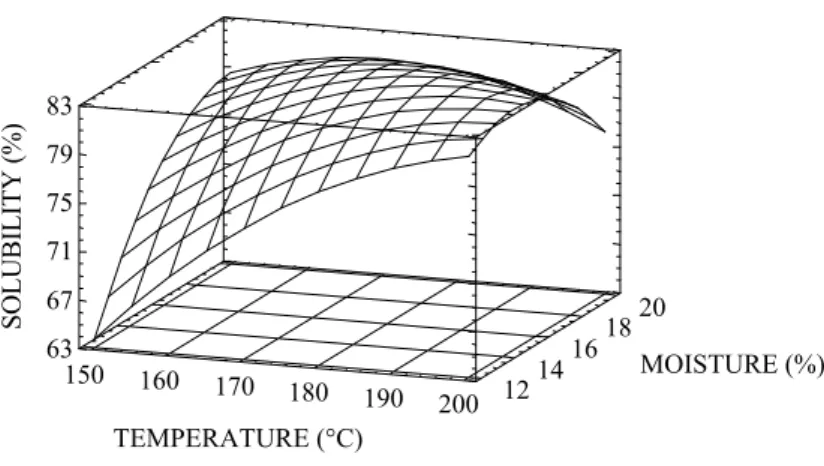
Results show that precooked flours obtained by popping have a very high suspension consistency with low or intermediate S, while those obtained by extrusion have very high S but a much lower suspension consistency. The high S values for extruded samples are even higher than those for extruded waxy types of cereals. The effects of the variables on each response depend on each case. S increases as temperature (T) and moisture (M) increase in both processes, although in extrusion, a maximum value was observed at 200 ºC and about 15% M. On the other hand, an inverse variable effect is observed for R; a minimum value is observed with extruded samples at about 14% M and for the whole T range, while a typical saddle-shaped surface is obtained for popped samples, with maximum values found at about 14 % and 18 % M for the two extreme T values, the highest and lowest, respectively. Another interesting effect is that the S-R pair values corresponding to popped samples do not fit the correlation between S and R, normally found with extruded samples. We can conclude that with the application of both processes it is possible to obtain precooked flours that have a wide range of hydration properties.
Keywords: extrusion, popping, amaranth.
INTRODUCTION
Amaranth has been produced in America and Africa for centuries (Bressani et al. 1987). The grains contain approximately 15% protein and 63% starch (on a dry basis). The starch has waxy characteristics and the protein is of a rather good quality with sulphur amino acid and lysine contents of about 4.4 and 5.0 (g per 100 g of protein), respectively (Teutónico and Knor, 1985; Lehman, 1996; Sanders and Becker, 1984; Becker et al. 1981; Betschart et
good raw material to produce a pregelatinized flour. Moreover dry-precooking processes, such as popping and extrusion, can modify the hydration properties of the raw material and consequently can be used for the production of pregelatinized flours (Koeppe et al. 1987; Mendoza and Bressani, 1987; Tosi et al. 1996).
The objective of the present work was to compare the effects of these two processes on the characteristics of the starch-rich fraction.
MATERIAL AND METHODS
Grains of Amarantus cruentus were degermed and dehulled in a disc-type mill to obtain the starchy fraction, as described previously (Tosi et al. 2000). The composition (on a dry basis) of this fraction, determined according to AACC methods (AACC, 1994) was 79.0% starch, 6.7% protein (N% x 6.25), 1.7% ash and 4.3% oil (soluble hexane fraction). This fraction was the raw material for the extrusion and popping processes. Extrusion was carried out in a 10 DN Brabender extruder with a 3:1 compression ratio screw at 173 rpm using a 3 mm diameter die. Popping was carried out using the fluidized bed equipment described previously ( Tosi et al. 1982 and 1996). Extruder barrel temperature and the fluidizing air temperature together with the raw material moisture were varied according to the experimental design. A two-factor experimental design 32 with a triplicate central point was used for each process to analyse its effects on some hydration properties, with temperature (T) and moisture content (M) as independent variables. The T and M ranges for popping were 190-210 ºC and 12-20%, respectively, and for extrusion, 150-200 ºC and 12-20%. Eleven experiments were conducted for each case. All samples were left in ambient air until equilibrium (final moisture was in the range of 10%). After that, samples were milled in a CICLOTEC mill and the hydration properties of the flour obtained were evaluated using the suspension consistency measured by amylographic retrogradation at 30ºC (R) and water solubility (S), which were taken as dependent variables or responses. S was determined using a modified Anderson method and R in a 8.6% solids suspension. A description of the methodology can be found elsewhere (Anderson et al. 1970; González et al. 1986 and 1987). S and R average values from duplicates were used to obtain the surface responses for each process, using the statgraphic program V3.0
RESULTS AND DISCUSSION
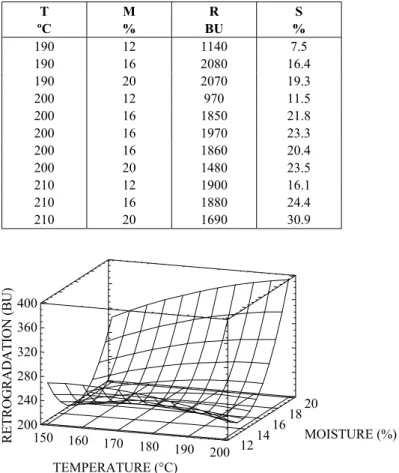
Tables 1 and 2 show the results of the eleven experiments corresponding to the extrusion and popping processes, respectively. It can be observed that precooked flours obtained by popping have a very high suspension consistency with low or intermediate S values, while those obtained by extrusion have very high S but a much lower suspension consistency. The high S values for the extruded samples are even higher than those for extruded waxy types of cereals (González et al. 2000), suggesting that the endosperm structure of Amaranth is much weaker than that of waxy cereals. This is also in agreement with the fact that hard grains like popcorn varieties need much higher temperatures for popping.
Results of the ANOVA indicate that the two variables significantly affect S and R in both processes, with p values lower than 0.02 for most of the regression coefficient model (surface response). In only four cases were the p values higher: a) the coefficient of T2 for R corresponding to extrusion with a p value of 0.0637, b) the coefficient of T for R corresponding to popping with a p value of 0.3848, c) the coefficients of T2 and TxM for S corresponding to popping with p values of 0.8625 and 0.4097, respectively . The lack of fit for the four models was not significant at a confidence level of 95%, except for S corresponding to extrusion. These results allows us to compare the effects produced by the two processes.
The response surfaces of R and S for both processes are shown in Figures 1, 2, 3 and 4.
moisture, but with much lower S values than for amaranth. In the case of popping, the complex type of response for R could be attributed to the different cooking mechanism for each process. The biggest changes (cooking) in extrusion occur inside the extruder, while in popping they occur during the explosion, in which T and M affect not only the development of pressure, but also the mechanical properties of the material. These different
mechanisms produce different product structures and consequently different shape and size distributions of the particles obtained after the sample milling (CICLOTEC) and could contribute to different responses in the suspension consistency. This explanation is supported by the fact that the S-R pair values corresponding to popped samples do not fit the correlation between S and R normally found with extruded samples (González, 1981).
Table 1: Results with extruded samples
T ºC
M %
R BU
S %
175 16 225 82.6 175 16 220 82.2 175 12 260 77.8 175 16 230 81.6 200 20 380 78.6 150 16 200 76 200 12 230 80.9 150 20 305 79.5 200 16 250 80.5 175 20 380 77.9 150 12 275 61.9
Table 2: Results with popped samples
T ºC
M %
R BU
S %
190 12 1140 7.5 190 16 2080 16.4 190 20 2070 19.3 200 12 970 11.5 200 16 1850 21.8 200 16 1970 23.3 200 16 1860 20.4 200 20 1480 23.5 210 12 1900 16.1 210 16 1880 24.4 210 20 1690 30.9
TEMPERATURE (°C)
MOISTURE (%)
RETROGRADATION (BU) 150 160 170 180
190 200 12 1416
1820 200
240 280 320 360 400
TEMPERATURE (°C)
MOISTURE (%)
SOLUBILITY (%)
150 160 170
180 190 200 1214 1618
20 63
67 71 75 79 83
Figure 2: Solubility response surface for extruded samples
Figure 3: Retrogadation response surface for popped samples
TEMPERATURE (°C)
MOISTURE (%)
SOLUBILITY (%)
190 194 198
202 206 210 1214 1618
20 0
5 10 15 20 25 30
CONCLUSION
We can conclude that with the application of both processes it is possible to obtain precooked flours that have a wide range of hydration properties. Precooked flours obtained by popping have very high suspension viscosities with low or intermediate S, while those from extrusion have very high S but a much lower suspension viscosity. The high S values for extruded samples are even higher than those for extruded waxy types of cereals. This suggests that the different cooking mechanisms involved in each process are the reason why the R responses are not similar.
ACKNOWLEDGMENT
We would like to thank Adriana Bonaldo for her cooperation in the laboratory work.
REFERENCES
American Association of Cereal Chemists. Approved Methods of the AACC, 1994. The Association: St. Paul, Minnesota.
Anderson, R.A. Conway, H.F. and Peplinski, A.J. 1970. Gelatinization of Corn Grits by Roll Cooking, Extrusion Cooking and Steaming. Die Starke, 22 (4), 130-135.
Becker, R. Wheeler, E.L. Lorenz, K. Stafford, A.E. Grosjean, O.K. Betschart, A.A. and Sanders, R.M. 1981. A Compositional Study of Amaranth Grain. Journal of Food Science, 46, 1175.
Betschart, A.A. Irving, D.W. Shepherd, A.D. and Sanders, R.M. 1981. Amaranthus cruentus: Milling Characteristics, Distribution of Nutrients within Seed Components and the Effects of Temperature on Nutritional Quality. Journal of Food Science, 46, 1181.
Bressani, R. Kalinowski, L.S. Ortiz, M.A. and Elias, L.G. 1987. Nutritional Evaluation of Roasted, Flaked and Popped A.candatus. Arch. Latinoam. Nutr. 37, 525.
González, R.J. 1981. Modificación de las Propiedades
de la Sémola de Maíz por el Proceso de Extrusión. Revista del ITA, 3, 55-73.
González, R.J. Torres, R.L. De Greef, D.M. and Gordo, N.A. 1986. Evaluación de Almidón de Maíz Precocido por Extrusión-cocción. Rev. Agroquim. Tecnol. Aliment., 26, (4), 552-564. González, R.J. De Greef, D.M. Torres, R.L and
Gordo, N.A. 1987. Efectos de algunas Variables de Extrusión sobre la Harina de Maíz. Archivos Latinoamericanos de Nutrición, 37/3, 578-592. González, R.J. Torres, R.L. and Añón, M.C. 2000.
Comparison of Rice and Corn Cooking Characteristics before and after Extrusion. Polish Journal of Food and Nutrition Sciences. 9/50 (1), 29-34.
Koeppe, S.J. Harris, P.L. Hanna, M.A. Rupnow, J.H. Walker, C.E. and Cuppett,S.L. 1987. Physical Properties and some Nutritional Characteristics an Extrusion Product with Defatted Amaranth Seeds and Defatted Maize Gluten Meal (80:20 ratio). Cereal Chem., 64, 332.
Lehman, J.W. 1996. Case History of Grains Amaranth as an Alternative Crop. Cereal Foods World, vol., 41, Nº5, 399-411.
Mendoza, C. and Bressani, R. 1987. Nutritional and Functional Characteristics of Extrusion. Cooked Amaranth Flour. Cereal Chem. 64, 218.
Sanders, R.M. and Becker, R. 1984. Amaranthus: A Potential Food and Feed Resource. Advances in Cereal Science and Technology. AACC, Vol. VI, 357-396.
Teutónico, R.A. and Knor, D. 1985. Amaranth: Composition, Properties, and Applications of Rediscovered Food Crop. Food Technology, Vol. 39, Nº 4, 49-60.
Tosi, E., Ré, E., Cazzoli, A. and Catalano, O. (1982). Essicamento del Grano sul Letto Fluidizzato. Técnica Molitoria 1, 3 - 16.
Tosi, E., Ré, E., Ciappini, M.C. and Masciarelli, R. 1996. Aplicación de la Técnica del Lecho Fluidizado a la Producción de Roseta de Amaranto. Alimentaria, 269, 45-47