NITROGEN RATES AND SOWING DATES INFLUENCE THE SEVERITY OF WHITE SPOT DISEASE AND GRAIN YIELD OF MAIZE
Abstract – The objective of this study was to analyze the effects of nitrogen rates and sowing dates on the severity of white spot disease (WSD) in first season maize hybrids, and their correlation with relative chlorophyll content, thousand grain weight and yield. The experiment was set in a randomized block design with treatments arranged in split-split plots. Two hybrids were tested in the main plots: AG9025 PRO3 (super early) and 30F53 VYH (early). Two sowing dates were evaluated in the split plots: preferential (9/20/2016) and late (12/05/2016). Four nitrogen rates were applied in the split-split plots. Nitrogen rates were top-dressed at the V4, V8 and V12 vegetative stages. The relative chlorophyll content reading was performed at VT stage. The quantification of WSD severity was made at R6, using diagrammatic scale. The AG9025 PRO3 hybrid showed higher average WSD severity (17.7%) than the 30F53 VYH (9.3%). The preferential sowing date showed lower severity (2.2%) compared to the late sowing date (31.4%). There was a significant positive correlation between the disease severity and the relative chlorophyll content, thousand grain weight and grain yield, except for the 30F53 VYH hybrid on the late sowing date. The hybrid AG9025 PRO3 showed increase in WSD severity when the highest nitrogen rates were applied, on both sowing dates. The effect of N rates on WSD was not significant for the 30F53 VYH hybrid. The late sowing time generates greater disease severity. The AG9025 PRO3 hybrid is more susceptible and the severity of its white spot is increased with the increment in N doses. There is a positive correlation between the relative chlorophyll content, disease severity, yield and thousand grain weight.
Keywords: Zea mays, foliar diseases, cultural control, Pantoea ananatis, Phaeosphaeria maydis.
DOSES DE NITROGÊNIO E ÉPOCAS DE SEMEADURA INFLUENCIAM NA SEVERIDADE DA MANCHA BRANCA E PRODUTIVIDADE DE GRÃOS DE MILHO
Resumo - O objetivo deste estudo foi avaliar o efeito da dose de nitrogênio e época de
semeadura sobre a severidade da mancha branca em híbridos de milho de primeira safra, e sua correlação com o teor relativo de clorofila, peso de mil grãos e produtividade. O experimento foi implantado no delineamento de blocos ao acaso, dispostos em parcelas sub-subdivididas. Dois híbridos foram avaliados na parcela principal: AG9025 PRO3 (super precoce) e 30F53 VYH (precoce). Duas épocas de semeadura foram avaliadas nas subparcelas: preferencial (20/09/2016) e tardia (05/12/2016). Quatro doses de nitrogênio foram testadas nas sub-subparcelas. As doses de nitrogênio foram aplicadas em cobertura nos estádios vegetativos V4, V8 e V12. A leitura do teor relativo de clorofila foi realizada no estádio VT. A quantificação da severidade da mancha branca foi feita no estádio R6 por meio de escala diagramática. O híbrido AG9025 PRO3 apresentou maior severidade média da doença (17,7%) do que o 30F53 VYH (9,3%). A época de semeadura preferencial apresentou menor severidade (2,2%) em relação à semeadura tardia (31,4%). Houve uma correlação positiva significativa entre a severidade da doença e o teor relativo de clorofila, peso de mil grãos e produtividade, exceto no híbrido 30F53 VYH, em época de semeadura tardia. O híbrido AG9025 PRO3 apresentou aumento na severidade de mancha branca quando as doses mais altas de nitrogênio foram aplicadas, nas duas épocas de semeadura. O efeito das doses de N sobre a mancha branca não foi significativo para o híbrido 30F53 VYH. A época de semeadura tardia gera maior severidade da doença. O híbrido AG9025 PRO3 é mais suscetível e tem a severidade de mancha branca aumentada em função do incremento de doses de N. Há correlação positiva entre o teor relativo de clorofila, severidade da doença, produtividade e peso de mil grãos.
Palavras-chave: Zea mays, doenças foliares, controle cultural, Pantoea ananatis,
Phaeosphaeria maydis.
ISSN 1980 - 6477
Journal homepage: www.abms.org.br/site/paginas
Juliano Berghetti(1)( ), Bruno Tabarelli Sheidt(1),
Ricardo Trezzi Casa(1), Antônio Eduardo Coelho(1),
Luis Sangoi(1), Mayra Juline Gonçalves(1) and
Lucielli Leolato(1)
(1)Universidade do Estado de Santa Catarina
E-mail: [email protected], [email protected], [email protected], [email protected], [email protected], [email protected], [email protected]. How to cite
BERGHETTI, J.; SHEIDT, B. T.; CASA, R. T.; COELHO. A. E.; SANGOI, L.; GONÇALVES, M. J.; LEOLATO, L.Nitrogen rates and sowing dates influence the severity of white spot disease and grain yield of maize. Revista Brasileira de Milho e Sorgo, v. 19, e1191, 2020.
Brazilian Journal of Maize and Sorghum
White spot disease (WSD) is one of the most important leaf diseases in maize crop. Its main damages include the reduction of the leaf area and plant photosynthetic capacity (Godoy et al., 2001). The fungi Phaeosphaeria maydis P. Henn was initially reported by Fantin (1994) as a precursor to the disease in Brazil, but the causal agent has been controversial (Amaral et al., 2004; Oliveira et al., 2004; Amaral et al., 2005; Bomfeti et al., 2008; Gonçalves et al., 2013). More recent works using analyses at the molecular level, and therefore accurate in the identification of organisms, show that the bacterium Pantoea
ananatis Serrano is responsible for causing the
disease (Figueiredo & Paccola-Meirelles, 2012; Lana et al., 2012; Lanza et al., 2013; Miller et al., 2016), and has important genetic diversity to be considered in programs aimed at improving plant resistance to the pathogen (Lana et al., 2012). Subsequently, its survival was observed as an epiphyte in healthy leaves, non-host plants and harvest remains, with possible multiplication (Sauer et al., 2015), as well as its occurrence in maize seeds (Mamede et al., 2018).
There are variations in susceptibility to the disease among maize genotypes (Brito et al., 2011), which makes the use of the resistant hybrids suggested the main control strategy for WSD. Nutritional factors can affect the intensity of the disease, especially the availability of nitrogen (N), which has an influence on the defense compounds of plant metabolism. At high doses of N, the content of low molecular weight organic N compounds, used as a substrate for
parasites, is increased, and some key phenolic metabolism enzymes have less activity, reduced phenolic content and lignin content that make part of the defense system of plants against infections (Dordas, 2008). The contribution of N in plant resistance to disease can vary depending on the pathogen, genotype, rate and source of the nutrient used and the interaction between nutrients (Pozza & Pozza, 2012).
The intensity of WSD also depends on the growing environment to which maize plants are exposed. The damages are more expressive during the crop reproductive stage from flowering to grain physiological maturity. Early sowing (August-September) and preferential sowing time (September-October) are usually less prone to the disease attack in the south of Brazil, as the plants are exposed to lower inoculum density and the crop reproductive stage does not coincide with favorable weather to the pathogen. Conversely, late sowings (November-December) are more susceptible to infections and may cause greater disease intensity (Pegoraro et al., 2001). Infection is favored by night temperatures between 14 and 20ºC, and relative humidity above 60% (Sabato et al., 2013). These conditions are frequently found in the crop reproductive period at late sowings due to the reduction of the photoperiod, the smaller availability of solar radiation and temperatures from February onwards.
This study aimed to identify the effect of nitrogen rates and sowing dates on the WSD severity of first season maize hybrids, and its correlation with the relative chlorophyll content,
thousand grain weight and yield. Material and Methods
The field experiment was conducted during the growing season of 2016/2017 in Atalanta, Santa Catarina, 27º 26´ 03´´ south latitude, 49º 42´ 06´´ west longitude, and 586 m altitude. The climate of the region is Cfa type, according to the Köppen classification, humid subtropical with hot summers. The soil of the experimental area is classified as a dystrophic Haplic Cambisol, presenting silty clay loam texture.
The experimental design was a randomized complete block with treatments arranged in split-split plots and four replications. Two hybrids were tested in the main plots: AG9025 PRO3 (single-cross, super early, with yellow dent kernels) and 30F53 VYH (single-cross, early, with semi-hard orange kernels). Two sowing dates (SD) were assessed in the split plots: preferential sowing date (PSD) on 09/20/2016 and late sowing date (LSD) on 12/05/2016. Four nitrogen top-dressing rates were evaluated in the split-split plots: 0; 150; 300 and 450 kg N ha-1, equivalent to 0; 0.5; 1.0
and 1.5 times the recommended rate for a grain yield expectation of 21,000 kg ha-1, respectively.
The base fertilization was performed in rows during sowing, being also calculated for yield expectation of 21,000 kg-1. It consisted of 30 kg
ha-1 of N, 300 kg ha-1 of P
2O5 and 200 kg ha-1
of K2O, following the recommendations from Comissão de Química e Fertilidade do Solo (Manual..., 2004) for maize in the south of Brazil.
Sowing was carried out manually in a no-tillage system. It followed a sequence of crops characterized by monoculture in the winter season (two years of black oat prior to maize) and crop rotation in summer (two years of soybean prior to black oat). Three to four seeds were dropped per hill during sowing. Seeds were evenly distributed and the space between rows was 0.7 m. Thinning of plants was carried out at V2 (two fully expanded leaves) of the scale of Ritchie et al. (1993), in order to adjust the population to 75,000 plants ha-1.
N rates were top-dressed using urea (45% N) as the nitrogen source (45% N). N rates were split in equal proportion at three growth stages: V4, V8 and V12 (4, 8 and 12 fully expanded leaves, respectively). Each experimental unit (split-split plot) had dimensions of 2.8m x 6m and was composed of four lines. The two central lines (64 plants) were considered as useful area and the two outer lines as borders.
The seeds were previously treated with carbendazim (0.45 g ai kg-1) + thiram (1 g ai kg-1)
and metalaxyl-M (0.015 g ai kg-1) + fludioxonil
(0.038 g ai kg-1). Weeds were controlled with
two herbicide applications: the first was carried out shortly after sowing [atrazine (1.5 kg ai ha -1) + metolachlor (1.7 g ai ha-1)], and the second
was performed at V3 [tembotrione (100 g ai ha -1)]. The control of leafworm was preventively
carried out to keep leaf area intact with the use of insecticide [lambda-cyhalothrin (6 g ai ha-1) + chlorantraniliprole (12 g ai ha-1)] and PRO
PRO3 and 30F53 VYH hybrids, respectively. No fungicide was applied to control foliar diseases.
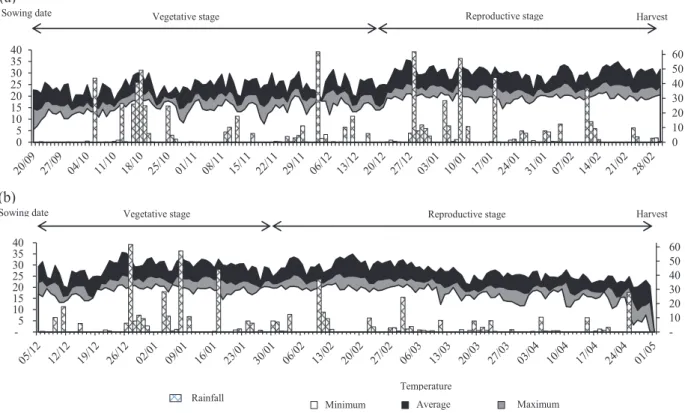
Climatic data from the automatic weather station of the Brazilian National Institute of Meteorology (INMET), located approximately 10 km from the experiment, in the municipality of Ituporanga-SC, were used to monitor temperature and precipitation variations during the crop cycle in both SD (Figure 1a and 1b).
At the VT stage, relative chlorophyll content (RCC) readings were taken using Clorofilog model CFL1030 Falker® based on absorbance and reflectance correlations. Six plants from each experimental unit were used. The leaf opposite to
the ear was evaluated at its base, middle and tip. Average values from these measurements were generated for each experimental unit.
The WSD severity was evaluated in six plants at the kernel physiological maturity stage R6 (presence of black colored layer in the insertion between the grain and the cob). Three leaves were evaluated in each plant: the leaf opposite to the main ear, one above and one below. Foliar severity was quantified using the diagrammatic scale proposed by Capucho et al. (2010), which evaluates the disease in nine classes (0.1, 1, 2, 4, 8, 16, 24, 32 and 64) expressed as percentage of leaf area affected.
Figure 1. Daily meteorological data of temperature in ºC (rows) in the lower session, and precipitation in mm (bars) in the upper session, during the maize cultivation cycles in preferential (a) and late (b) sowing season. Black arrows indicate the hybrid AG9025 PRO3 and grays the 30F53 VYH.
0 10 20 30 40 50 60 0 5 10 15 20 25 30 35 40 10 20 30 40 50 60 - 5 10 15 20 25 30 35 40 Sowing date Sowing date g Harvest Harvest Vegetative stage
Vegetative stage Reproductive stage
Reproductive stage
Rainfall Minimum TemperatureAverage Maximum
(a)
Maize ears were manually harvested and then threshed with a plot harvester. On both SD, the operation was performed 15 days after kernel physiological maturity, with grain moisture ranging between 18% and 22%. Grain yield and thousand grain weight (TGW) were calculated and expressed at the standard moisture of 13%.
RCC, WSD severity and grain yield were submitted to an analysis of variance using the F test. Transformation of WSD severity data into “arc sine [√ (x / 100)]” was used for data normality. When F values were significant (p<0.05), means were compared by the Tukey test, as well as regression analysis. Both comparisons were performed at the significance level of 5%. Correlation coefficients between RCC, WSD severity, TGW and grain yield were determined by Pearson correlation. Statistical analyses were performed using the statistical programs SISVAR 5.6 (Ferreira, 2011) and SAS 9.1 (SAS Institute, 2004).
Results and Discussion
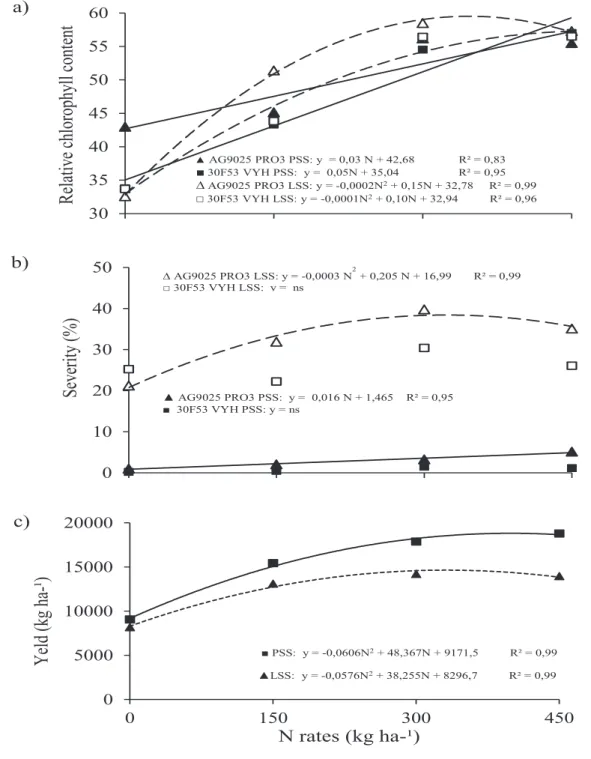
There was a triple interaction, significant at p≤0.05, between N rates, hybrids and SD for RCC, with an increase in the variable due to the greater availability of top-dressed N. The RCC values showed a linear behavior on PSD and a quadratic behavior on LSD (Figure 2a). This result and the existence of a correlation between the RCC and the leaf N content (Vargas et al., 2012) show that hybrids increase their leaf N content due to the higher N supply.
There was a significant difference at p≤0.05 in WSD severity for hybrids and SD. However, the highest degree of significance was observed in the interaction between N rates, SD and hybrids. Therefore, the triple interaction was submitted to regression analysis (Figure 2b).
The PSD had lower severity of WSD (2.2%) than the LSD (31.4%), on the average of N rates and hybrids. Figure 2b presents this information according to the significant interactions among hybrids, SS and N rates. On PSD, the reproductive stage of maize coincided with a period of higher radiation availability and greater temperatures in December and January (Figure 1a). Maize response to thermal sum accelerated its cycle under these conditions. On LSD, the reproductive stage coincided with the reduction of photoperiod, lower radiation availability and temperature decrease in March and April (Figure 1b). These meteorological conditions lengthened the crop cycle. With the cycle extension, plants remain predisposed to the WSD infection for a longer period. In addition to that, there was greater availability of inoculum from maize crops on PSD. Rainy periods and mild temperatures contribute to the increased incidence of the disease (Wordell Filho et al., 2016). In the south of Brazil, March and April are months when the photoperiod is reduced, generating mild temperatures and favoring the disease.
The triple interaction presented by the regression (Figure 2b) shows a significant linear behavior for the hybrid AG9025 PRO3 on PSD,
30 35 40 45 50 55 60 0 150 300 450 Rel ati ve chl orophy ll cont ent ▲AG9025 PRO3 PSS: y = 0,03 N + 42,68 R² = 0,83 ■30F53 VYH PSS: y = 0,05N + 35,04 R² = 0,95 ∆AG9025 PRO3 LSS: y = -0,0002N2+ 0,15N + 32,78 R² = 0,99 □30F53 VYH LSS: y = -0,0001N2+ 0,10N + 32,94 R² = 0,96 ■ PSS: y = -0,0606N2+ 48,367N + 9171,5 R² = 0,99 ▲LSS: y = -0,0576N2+ 38,255N + 8296,7 R² = 0,99 0 5000 10000 15000 20000 0 150 300 450 Ye ld ( kg ha -¹) N rates (kg ha-¹) a) b) c) 0 10 20 30 40 50 0 150 300 450 Se ve rit y ( %) ∆ AG9025 PRO3 LSS: y = -0,0003 N2 + 0,205 N + 16,99 R² = 0,99 □ 30F53 VYH LSS: y = ns ▲ AG9025 PRO3 PSS: y = 0,016 N + 1,465 R² = 0,95 ■ 30F53 VYH PSS: y = ns
Figure 2. Triple interaction regression for the relative chlorophyll content (a) and white spot severity (b) for the hybrid variables and sowing seasons as a function of N rates, and double interaction regression for yield (c) between sowing time and N rates in coverage.
demonstrating an increase of WSD severity due to the increase of N top-dressing rates. This hybrid, sown on LSD, maintained its behavior as a function of the increasing N doses, but with quadratic significance and a higher disease severity. On the average of N rates, AG9025 PRO3 showed more severity on LSD (37.1%) when compared to PSD (4.6%). There was no significance for the 30F53 VYH hybrid, and there was no relationship between WSD severity and N rates for this genotype, regardless of SD. It is noteworthy that, on average N rates, there was increase in severity for the 30F53 VYH hybrid on LSD (25.9%) compared to PSD (0.7%). The average N rates and SD of the AG9025 PRO3 hybrid presented an average severity of 17.7%, compared to 9.3% of the 30F53 VYH hybrid. Therefore, the AG9025 PRO3 was generally more susceptible to WSD than the P30F53 VYH.
The excessive N supply causes morphological and biochemical changes in plants. The Krebs cycle pathway increases the carbon demand of photosynthesis. This compromises the
synthesis of secondary metabolites responsible for the defense of plants by the shikimic acid pathway (Tsuioshi, 2004). Some key phenolic metabolism enzymes have lower activity, thus decreasing phenol content and affecting lignin content, important against infections (Dordas, 2008). Harvest maturation is delayed, barriers such as the wax layer and cell wall thickness are reduced due to its rapid growth, forming thinner, tender and more accumulated tissues and low molecular weight organic N compounds (carbohydrates), which are used as substrates for pathogens, making plants more vulnerable to infections (Dordas, 2008; Pozza & Pozza, 2012; Taiz & Zieger, 2013).
Grain yield was affected by the interaction between hybrids and SS. AG9025 PRO3 presented higher yield than P30F53 VYH on the PSD whereas the two hybrids had similar yields on the LSD (Table 1). Both hybrids reduced their yields by 25.8% (AG9025) and 11.9% (P30F53) when the SD was delayed from September to December. On PSD, the reproductive phase Table 1 - Yield (kg ha-1), as a function of hybrids and sowing date, on the average of the
four N side-dressing rates. Atalanta, SC, 2016/17.
Hybrids Sowing season
Preferential Late
AG9025 PRO3 16,304 a A* 12,106 a B
30F53 VYH 14,253 b A 12,624 a B
*The means followed by different letters, uppercase on the line and lowercase on the column differ statistically by the Tukey test (p <0.05).
coincides with the maximum availability of solar radiation, optimizing the photosynthetic process and the conversion of light energy into chemical energy, which is accumulated as starch in the grains. The smallest yield reduction of 30F53 VYH on the LSD can be attributed to its longer cycle. Because it is an early-cycle hybrid, the reduction of the emergence-flowering subperiod on LSD has less limitation compared to shorter-cycle hybrids, such as AG9025 PRO3, where the reduction of the subperiod is more pronounced. On LSD, it is recommended to use cultivars of longer cycle, with greater defensiveness, associated with improved tolerance to biotic and abiotic stresses (Sangoi et al., 2010).
On PSD, the duration of the vegetative subperiod was 90 and 93 days, and the reproductive period of 73 to 75 days, for the hybrids AG9025 PRO3 and 30F53 VYH, respectively. On LSD, the duration of the vegetative subperiod was 58 and 60 days, and the reproductive period of 86 to 90 days for the hybrids AG9025 PRO3 and 30F53 VYH, respectively. In addition to the inversion in the subperiod duration due to the SD, there was a reduction in the total cycle of 19 days for the AG9025 PRO3 hybrid and 18 days for the 30F53 VYH hybrid with the delay in sowing time.
The yield reduction that occurred when the sowing was postponed from September 20 to December 5 can be partially explained by the increase in WSD severity, with average values increased from 2.2% on PSD to 31.4% on LSD. However, structural and biochemical changes also occur in plants due to the detriment of
environmental conditions with the sowing time delay. On the PSD, there are few climatic restrictions to plant development. On the LSD, the low temperatures and small availability of solar radiation hamper ear and kernel formation (Sangoi et al., 2010).
The interaction between N rates and SD also influenced grain yield. A quadratic increment in yield, significant at p≤0.05, was observed with the increase of N side-dressing rate, regardless of SD (Figure 2c). This emphasizes the nutrient participation in the yield performance of the crop, with a tendency towards stability between 300 and 450 kg ha-1 of N. Chlorophyll content
is associated with the plant photosynthetic activity and the carbohydrate assimilation by grains. Maize shows a positive correlation between leaf N content and relative chlorophyll content (Vargas et al., 2012). Nitrogen acts as a chlorophyll constituent and, therefore, it is essential in the photosynthetic activity of the chlorophyll molecule. It is noteworthy that, at “high” doses of N, the chlorophyll content tends to stabilize, not responding with increment to the “luxury consumption” of the nutrient (Rambo et al., 2004).
Regarding RCC, there was a significant correlation of 75% and 76% for TGW and yield, respectively, as well as for WSD severity (28%) (Table 2). Therefore, the increase in RCC, related to the use of high N top-dressing rates (Figure 2a), contributed to the increase in TGW, yield and WSD severity.
Table 3. Correlation coefficient between the variables white spot disease, relative chlorophyll content, thousand grain weight and yield for AG9025 PRO3 hybrid, preferential (a) and late (b) sowing time, and for 30F53 VYH hybrid, preferential (c) and late (d) sowing time.
(a) (b) Variables WSD1 RCC2 TGW3 Variables WSD RCC TGW RCC 0.77 ** RCC 0.80 ** TGW 0.75 ** 0.84 ** TGW 0.69 ** 0.94 ** Yield 0.70 ** 0.83 ** 0.94 ** Yield 0.74 ** 0.93 ** 1.95 * (c) (d) Variables WSD RCC TGW Variables WSD RCC TGW RCC 0.78 ** RCC 0.19 ns TGW 0.81 ** 0.95 ** TGW 0.13 ns 0.89 ** Yield 0.70 ** 0.94 ** 0.94 ** Yield 0.04 ns 0.85 ** 0.89 **
1White spot disease; 2Relative chlorophyll content; 3Thousand grain weight; * and **, significance values at p<0.05 and p<0.01, respectively; ns: not significant.
LSD (Table 3c), there was a significant positive correlation between WSD severity and RCC, TGW and yield variables, with values above 69%. The lack of significant correlation between WSD severity and the other variables for the 30F53 VYH LSD hybrid (Table 3d) can be between WSD severity and TGW and yield
variables when data were independently assessed, considering the collective effect of all studied factors (Table 2). However, by evaluating hybrids and SS separately, it can be noted that, with the exception of the hybrid 30F53 VYH on
Table 2. Correlation coefficient between white spot disease, relative chlorophyll content, thousand grain weight and yield variables.
Variables WSD1 RCC2 TGW3
RCC 0.28 *
TGW 0.22 ns 0.75**
Yield -0.19 ns 0.76** 0.74**
1White spot disease; 2Relative chlorophyll content; 3Thousand grain weight; * and **, significance values at p <0.05 and p<0.01, respectively; ns: not significant.
attributed to the severity data that did not show significance to the N rate regression, maintaining the severity unchanged while the N levels, represented by RCC, were increasing, implying a yield increment with a correlation of 85%.
The greater availability of N, derived from high N top-dressing rates, increased grain yield and, in most of the evaluated situations, it also enhanced the severity of WSD. Thus, high N doses conceal the possible negative interference of the disease on grain yield. The same trend was observed by Dornelas et al. (2015) in relation to WSD, where the addition of increasing N top-dressing rates increased the yield and severity of the disease.
Conclusions
Late sowing of maize increases the severity of white spot disease. The AG9025 PRO3 hybrid is more susceptible to white spot disease than the 30F53 VYH hybrid. The increase of N top-dressing rate enhances the severity of white spot disease in the most susceptible hybrid. The increase in the relative chlorophyll content has a positive correlation with the thousand grain weight, the yield and the severity of white spot disease.
References
AMARAL, A. L.; CARLI, M. L.; BARBOSA NETO, J. F.; SOGLIO, F. K. D. Phoma sorghina, a new pathogen associated with phaeosphaeria leaf spot on maize in Brazil. Plant Pathology, v.
53, n. 2, p. 259-259, 2004. DOI:
10.1111/j.0032-0862.2004.00988.x.
AMARAL, A. L.; DAL SOGLIO, F. K.; DE CARLI, M. L.; BARBOSA NETO, J. F. Patho-genic fungi causing symptoms similar to
phaeos-phaeria leaf spot of maize in Brazil. Plant
Dis-ease, v. 89, n. 1, p. 44-49, 2005. DOI: 10.1094/ PD-89-0044.
BOMFETI, C. A.; SOUZA-PACCOLA, E. A.; MASSOLA JÚNIOR, N. S.; MARRIEL, I. E.; MEIRELLES, W. F.; CASELA, C. R.; PACCO-LA-MEIRELLES, L. D. Localization of Pantoea
ananatis inside lesions of maize white spot
dis-ease using transmission electron microscopy and molecular techniques. Tropical Plant Patology,
v. 33, n. 1, p. 63-66, 2008. DOI:
10.1590/S1982-56762008000100010.
BRITO, A. H.; VON PINHO, R. G.; SANTOS, A. O.; SANTOS, S. Reação de híbridos de mil-ho e comparação de métodos para avaliação da Cercosporiose e Mancha Branca. Tropical Plant Pathology, v. 36, n. 1, p. 35-41, 2011. DOI: 10.1590/S1982-56762011000100005.
CAPUCHO, A. S.; ZAMBOLIM, L.; DUARTE, H. S. S.; PARREIRA, D. F.; FERREIRA, P. A.; LANZA, F. E.; COSTA, R. V.; CASELA, C. R.; COTA, L. V.; SILVA, D. D. Desenvolvimento de metodologia para avaliação da mancha branca do milho. Sete Lagoas: Embrapa Milho e Sorgo, 2010. 28 p. (Embrapa Milho e Sorgo. Boletim de Pesquisa e Desenvolvimento, 26).
DORDAS, C. Role of nutrients in controlling plant diseases in sustainable agriculture: a review. Agronomy for Sustainable Development, v. 28, p. 33-46, 2008. DOI: 10.1051/agro:2007051.
DORNELAS, G. A.; POZZA, E. A.; SOUZA, P. E.; COSTA, R. V.; POZZA, A. A. A.; SANTOS, L. A. Nitrogen and potassium fertilization on the yield and intensity of the maize white spot. Re-vista Ceres, v. 62, n. 4, p. 351-359, 2015. DOI: 10.1590/0034-737X201562040004.
FANTIN, G. M. Mancha de Phaeosphaeria, doen-ça do milho que vem aumentando sua importância. Biológico, v. 56, p. 39-39, 1994.
FERREIRA, D. F. Sisvar: a computer statistical analysis system. Ciência e Agrotecnologia, v. 35,
n. 6, p. 1039-1042, 2011. DOI:
10.1590/S1413-70542011000600001.
FIGUEIREDO, J. E. F.; PACCOLA-MEIRE-LLES, L. D. Simple, rapid and accurate PCR-based detection of Pantoea ananatis in maize, sor-ghum and Digitaria sp. Journal of Plant Pathol-ogy, v. 94, n. 3, p. 663-667, 2012. DOI: 10.4454/ JPP.FA.2012.049.
GODOY, C. V.; AMORIM, L.; BERGAMIN FIL-HO, A. Alterações na fotossíntese e na transpi-ração de folhas de milho infetadas por
Phaeos-phaeria maydis. Fitopatologia Brasileira, v. 26,
n. 2, p. 209-215, 2001. DOI:
10.1590/S0100-41582001000200017.
GONÇALVES, R. M.; FIGUEIREDO, J. E. F.; PEDRO, E. S.; MEIRELLES, W. F.; LEITE JÚNIOR, R. P.; SAUER, A. V.; PACCOLA-MEIRELLES, L. D. Etiology of phaeosphaeria leaf spot disease of maize. Journal of Plant Pathology, v. 95, n. 3, p. 559-569, 2013. DOI: 10.4454/JPP.V95I3.037.
LANA, U. G. de P.; GOMES, E. A.; SIL-VA, D. D. da; COSTA, R. V. da; COTA, L. V.; PARREIRA, D. F.; SOUZA, I. R. P.; GUI-MARÃES, C. T. Detection and molecular di-versity of Pantoea ananatis associated with white spot disease in maize, sorghum and
crab-grass in Brazil. Journal of Phytopathology,
v. 160, n. 9, p. 441-448, 2012. DOI: 10.1111/j.
1439-0434.2012.01924.x.
LANZA, F. E.; ZAMBOLIM, L.; CASELA, C. R.; COSTA, R. V.; COTA, L. V.; SILVA, D. D.; FIGUEIREDO, J. E. F. Etiology and epidemio-logical variables associated with maize
resis-tance to white spot disease. Journal of Plant
Pathology, v. 95, n. 2, p. 349-359, 2013. DOI:
10.4454/JPP.V95I2.012.
MAMEDE, M. C.; TEBALDI, N. D.; MOTA, L. C. B. M.; MARTINS, O. M.; COELHO, L. Detection of Pantoea ananatis in corn seeds on semi-selective medium. Tropical Plant Pa-thology, v. 43, p. 254-256, 2018. DOI: 10.1007/ s40858-017-0203-z.
MANUAL de adubação e calagem para os Esta-dos do Rio Grande do Sul e de Santa Catarina. Porto Alegre: Sociedade Brasileira de Ciência
do Solo: Comissão de Química e Fertilidade do
Solo, 2004. 400 p.
MILLER, A. M.; FIGUEIREDO, J. E. F.; LINDE, G. A.; COLAUTO, N. B.; PACOLA-MEIRELLES, L. D. Characterization of the inaA gene and expression of ice nucleation phenotype in Pantoea ananatis isolates from Maize White
Spot disease. Genetics and Molecular
Re-search, v. 15, n. 1, p.1-8, 2016. DOI: 10.4238/ gmr.15017863.
OLIVEIRA, E.; FERNANDES, F. T.; CARV-ALHO, E. M.; MACHADO, J. C. The phaeos-phaeria leaf spot of maize in Brazil: evidences of a new ethiological agent. Revista Brasileira de Milho e Sorgo, v. 3, n. 3, p. 343-356, 2004. DOI: 10.18512/1980-6477/rbms.v3n3p343-356.
PEGORARO, D. G.; VACARO, E.; NUSS, C. N.; DAL SOGLIO, F. K.; SERENO, M. J. C. M.; NETO, J. F. B. Efeito de época de semeadura e adubação na mancha-foliar de Phaeosphaeria em milho. Pesquisa Agropecuária Brasileira, v. 36, n. 8, p. 1037-1042, 2001. DOI: 10.1590/ S0100-204X2001000800005.
POZZA, E. A.; POZZA, A. A. A. A nutrição mineral no manejo de doenças de plantas. In: NUTRIÇÃO no manejo de doenças de plantas. Viçosa, MG: Grupo de Estudos Avançados em
Fitopatologia, 2012. p. 177-212.
RAMBO, L.; SILVA, P. R. F.; ARGENTA, G.; SANGOI, L. Parâmetros de plantas para apri-morar o manejo da adubação nitrogenada em cobertura de milho. Ciência Rural, v. 34, n. 5, p. 1637-1645, 2004. DOI: 10.1590/S0103-84782004000500052.
RITCHIE, S. W.; HANWAY, J. J.; BENSON, G. O. How a corn plant develops? Ames: Iowa State University of Science and Technology, 1993. 21 p.
SABATO, E. O.; PINTO, N. F. J. A.; FER-NANDES, F. T. Identificação e controle de doenças na cultura do milho. Brasília, DF: Em-brapa, 2013. 198 p.
SANGOI, L.; SILVA, P. R. F.; ARGENTA, G.; RAMBO, L. Ecofisiologia da cultura do milho para altos rendimentos. Lages: Graphel, 2010. 84p.
SAS INSTITUTE. SAS: version 9.1. Cary, 2004. SAUER, A. V.; ROCHA, K. R.; GONÇALVES, R. M.; MEIRELLES, W. F.; FIGUEIREDO, J. E. F.; MARRIEL, I. E.; PACCOLA-MEIRELLES, L. D. Survival of Pantoea ananatis, causal agent of maize white spot disease in crop de-bris. Agronomy Science and Biotechnology, v. 1, n. 1, p. 21-24, 2015.
Porto Alegre: Artmed, 2013. 954 p.
TSUIOSHI, Y. Resistência de plantas a pragas e doenças: pode ser afetada pelo manejo da cul-tura? Informações Agronômicas, n. 108, p. 1-7, 2004.
VARGAS, V. P.; SANGOI, L.; ERNANI, P. R.; SIEGA, E.; CARNIEL, G.; FERREIRA, M. A. Os atributos nas folhas são mais eficientes que o N mineral no solo para avaliar a disponibili-dade desse nutriente para o milho. Bragantia, v. 71, n. 2, p. 245-255, 2012. DOI: 10.1590/S0006-87052012000200014.
WORDELL FILHO, J. A.; CASA, R. T.; NESI, C. N. Manejo de doenças na cultura do milho. In: WORDELL FILHO, J. A.; CHIARADIA, L. A. (Org.). A cultura do milho em Santa Catarina. 3. ed. Florianópolis: Epagri, 2016. 400p.