SAPANA
Creating a marketing tool for
social enterprises
Jéssica Gomes
Dissertation written under the supervision of Pietro Versari
Dissertation submitted in partial fulfilment of requirements for the MSc in
International Management, at the Universidade Católica Portuguesa, 2018.
i
ABSTRACT
Title: SAPANA – Creating a marketing tool for social enterprises Author: Jéssica Gomes
This thesis presents the issue of self-sustainability of social enterprises through the example of Sapana. This organization aims at developing a marketing tool for other social enterprises use, so they can simultaneously work effectively and reach their social mission.
Starting by questioning ―How can social enterprises develop marketing tools to help social and economic value co-creation?‖ my research intends to identify the company‘s critical practices and methodology that were adopted, enabling the creation of both social and economic value by constantly involving critical stakeholders.
With my analysis I propose essential components that should be present in the marketing tool. Social enterprises can adapt them to their business strategy, in order to effectively engage in the value co-creation process. This study can function as a guideline to social enterprises by offering them simple rules to succeed with their projects. They can find advice to shape their primary features in order to reach self-sustainability in the long-term.
Keywords: Social Entrepreneurship, Social Value, Service-dominant Logic
Esta tese apresenta a questão da auto-sustentabilidade das empresas sociais através do exemplo de Sapana. Esta organização procura desenvolver uma ferramenta de marketing a ser utilizada por outras empresas sociais, de forma que estas possam trabalhar efectivamente e alcançar a sua missão social ao mesmo tempo.
Começando por questionar "Como as empresas sociais podem desenvolver ferramentas de marketing para ajudar na co-criação de valor social e económico?" a minha pesquisa visa identificar as práticas cruciais e a metodologia da Sapana que foram adoptadas, permitindo a criação de valor económico e social, envolvendo sempre stakeholders fundamentais.
Com a minha análise proponho os componentes essenciais que devem estar presentes na ferramenta de marketing. As empresas sociais podem adaptá-los à sua estratégia de negócio de forma a comprometerem-se efectivamente com o processo de co-criação de valor. Este estudo pode funcionar como guia para outras empresas sociais oferecendo-lhes regras simples para ter sucesso com os seus projectos. Desta forma, podem encontrar conselhos para moldar os elementos essenciais a fim de alcançar a auto-sustentabilidade no longo-prazo.
Palavras-chave: Empreendorismo Social, Valor Social, Lógica Dominante do Serviço
ii
ACKNOWLEDGEMENTS
First, I would like to start by thanking my master thesis advisor Pietro Versari, for giving me the opportunity to carry out the present dissertation under his guidance. All the advice he gave, and sharing his knowledge with me was essential for the proper completion of this work. Undoubtedly, his guidance was determinant to write this master thesis with a clear structure.
Second, I would like to thank Sapana, namely Carolina Almeida Cruz, for sharing such an inspirational life story. Fighting against all odds, she gave up of her stable life (job, love, and home) to end up sleeping in the car. At that time, only she believed in herself. She truly believed that helping other people was her mission. Thus, I recognize that part of the motivation to do this research derived from the way she had always talked about her company.
Third, but of no less importance, and with all my heart, I would like to thank my father Carlos, my mother Olinda, my brother Filipe, and my boyfriend Cristiano for all the strength and support given. Without their unconditional support I would not be able to overcome the more complicated moments that have arisen during the course of this dissertation, nor could I have successfully completed this stage of my life.
Lastly, I would also like to thank all my close friends, and other people who, directly or indirectly, contributed to this dissertation. Thank you very much.
iii
CONTENTS
1 INTRODUCTION ... 1
2 CASE STUDY ... 3
2.1 Birth of Sapana ... 3
2.2 Awakening & Empowerment ... 4
2.3 Sapana‘s Awakening & Empowerment projects ... 5
2.3.1 TLT – Talentos em Livre-trânsito project (Portugal) ... 6
2.3.2 Breaking Bars – Shakespeare project (Portugal) ... 8
2.3.3 Power2U project (Portugal) ... 9
2.3.4 Echo Hamlet project (India) ... 9
2.4 Working to be a ―mission company‖ ... 10
2.5 iPath methodology ... 12
2.5.1 iPath ladders ... 12
2.6 Portugal‘s reality ... 14
2.7 India‘s reality ... 15
2.7.1 India‘s caste system ... 16
2.8 The future ... 17
3 LITERATURE REVIEW ... 19
3.1 Introduction ... 19
3.2 Evolvement of marketing perspective: from Goods-dominant logic to Service-dominant logic ... 20
3.3 Competing through service ... 21
3.4 Key drivers of S-D logic ... 21
3.5 Value co-creation ... 22
3.6 Foundational premises of S-D logic ... 22
3.6.1 Service exchange ... 22
3.6.1.1 FP1 (Axiom1): Service is the fundamental basis of exchange ... 22
3.6.1.2 FP2: Indirect exchange masks the fundamental basis of exchange ... 23
3.6.1.3 FP3: Goods are distribution mechanisms for service provision ... 23
iv
3.6.1.5 FP5: All economies are service economies ... 24
3.6.2 Actors‘ role ... 24
3.6.2.1 FP6 (Axiom2): Value is co-created by multiple actors, always including the beneficiary ... 24
3.6.2.2 FP7: Actors cannot deliver value but can participate in the creation and offering of value propositions ... 25
3.6.2.3 FP8: A service-centered view is inherently beneficiary oriented and relational ... 25
3.6.2.4 FP10: Value is always uniquely and phenomenologically determined by the beneficiary ... 26
3.6.3 Resource integration ... 26
3.6.3.1 FP9 (Axiom 3): All social and economic actors are resource integrators .... 26
3.6.4 Service ecosystems ... 27
3.6.4.1 FP11 (Axiom 5): Value co-creation is coordinated through actor-generated institutions and institutional arrangements ... 27
3.7 The narrative and process of S-D logic ... 28
4 TEACHING NOTE ... 30 4.1 Introduction ... 30 4.2 Learning objectives... 30 4.3 Assignment questions ... 30 4.4 Class discussion ... 31 4.4.1 Introduction ... 31
4.4.2 How should Sapana compete in order to enhance its competitive advantage in creating both economic and social value? ... 31
4.4.3 What are the key drivers for Sapana to successfully compete through service? What does support the activities and interactions through which the service occurs? ... 33
4.4.4 How does Sapana coordinate resource integration and service exchange within the process of collaboration? ... 34
4.4.5 Teaching note‘s conclusions & suggestions ... 36
5 CONCLUSION ... 41
REFERENCES ... 43
5.1 Articles & Books ... 43
v APPENDICES ... 47 5.3 Appendix 1 ... 47 5.4 Appendix 2 ... 48 5.5 Appendix 3 ... 48
vi
LIST OF FIGURES
Figure 1 – Carolina with Nepalese children 3
Figure 2 – Carolina in the left in TLT project 6
Figure 3 – Gradient Business Model‘s workflow powered by Sapana 8
Figure 4 – Sapana Global Approach 11
Figure 5 – Unemployment rate in Portugal 14
Figure 6 – India city scale map 15
Figure 7 – Main categories of India‘s caste system 16
Figure 8 – Service-dominant marketing 22
Figure 9 – The narrative and process of S-D logic 29
LIST OF TABLES
Table 1 – Primary and secondary data collected 1 Table 2 – ―Talentos em Livre Trânsito‖ project‘s steps 7
Table 3 – 5 Emotional intelligent skills at work 13
Table 4 – Key factor related projects‘ characteristics 32 Table 5 – Foundational premises relevant for the marketing tool 33 Table 6 – Levels of aggregation present in service ecosystem and in Sapana 35 Table 7 – Overview of operational Sapana‘s value co-creation 36
1
1 INTRODUCTION
“How can people adapt rapidly, on an ongoing basis, to an ever-changing array of unforeseeable and increasingly critical problems? Because of the size of the global population, the pace of change, the spread of technology, the urgency of financial, health, and environmental crisis, and the interdependence that has collapsed boundaries, our response time must be quicken: we must anticipate problems and attack them at their sources before they grow and multiply. And we must continually invent new solutions as conditions change. The emergence of the citizen sector and social enterprises are an adaptation to the changing demands of the global environment.‖ - Bornstein (2010, pp. 18-19).
In his book ―Social Entrepreneurship: What everyone needs to know‖, Mr. David Bornstein presents social enterprises as means to fight for the increasing social, economic, economic and environmental needs of the global environment.
In this line of though, this thesis presents the case of Sapana, a social enterprise founded by Carolina Almeida Cruz, which aims to fight social problems. Sapana has as mission the empowerment of each individual, communities, and/or organizations throughout training processes and social innovation projects. Sapana‘s action develops along two axes: for-profit (consulting services and business model) and non-profit (social responsibility).
I directly interviewed the Founder and CEO of Sapana, Carolina Almeida Cruz, who gave me detailed information that I could use to develop the case study. I also used internal data given by Carolina and her team regarding methodology and projects. Besides, I looked on public data to find everything possible about the company, such as websites, videos, comments, articles. Table 1 presents more in details the collected data.
Interview of 40 min with CEO 1
E-mails 3
Sapana‘s reports analysed 2
Sapana‘s methodology business model analyzed 1
Sapana‘s business and sustainability CORE model analyzed 1
2 To write the Literature Review chapter, I started looking at the origin and definition of social enterprise. Then, I found related studies that develop the issues that these organizations may face while being both self-sustainable and socially mission oriented. To conclude, I found studies related with how these issues can be overcome by defining a priori an appropriate marketing strategy.
My research was focused on the exploration of a marketing tool that social enterprises can apply in order to become self-sustainable while creating superior value propositions, and consequently, remain competitive. The aforesaid marketing tool is underpinned by the literature of Service-dominant logic of marketing. In this context, this dissertation intends to give a contribution to this literature, studying in particular a marketing tool that social enterprises can use in order to help them become more competitive and sustainable.
In order to draw my proposal to Sapana, I set myself one main research question: How can
social enterprises develop marketing tools to help social and economic value co-creation?
In the Teaching Note chapter, I suggest a class discussion where students are invited to analyze the research question and develop the elements of the marketing tool to reach a conclusion where the best tool is identified.
In the Conclusion chapter, I recap the answers from the assignment questions to formulate an answer for the research question. It is intended to be formulated in a way that other social enterprises could look at Sapana as a role model. To conclude, I approach what would be ―the‖ best future for Sapana.
Paper published on Universidade Católica Portuguesa and Universidade Nova de Lisboa 1
Videos 7
3
Figure 1 – Carolina with Nepalese children
http://sapana.org/como-tudo-comecou/
´
http://sapana.org/como-tudo-comecou/
2 CASE STUDY
In the year of 2009, Carolina was working for an agency in the United Nations active against human traffic. At that time, this was her dream job. However, in 2010, she left to travel for one year to India, Nepal and Tibet carrying only her backpack. After this trip her dream job had changed, becoming true in 2012 in the form of Sapana, a social enterprise that uses the two sides of the coin: for-profit - consulting services and business model for social enterprises - and non-profit - social responsibility on communities. The for-profit side enables Sapana to be self-sustainable. But this was not enough for Carolina. In fact, she was very satisfied with Sapana‘s general performance, because it was sustainable and it was doing well on the social side. Yet, she believed that the impact of one organization was not enough. She wanted all organizations to be able to work effectively and to reach their social mission. Therefore, she thought she had to find a way of helping them. Hence, the idea of elaborating a marketing tool arose, one that could help social enterprises determine the strategy to be used in their business development. Furthermore, by helping them, Sapana would also create social value.
2.1 Birth of Sapana
Sapana means ―dream‖ in Nepalese, and it was the name given by the orphans of a very poor zone in Nepal where Carolina had been, because she showed them a globe. They did not know that Catmandu, capital of Nepal, existed, even more that existed a world at all. Even the sea was new for them. Carolina was then their ―dream‖. And it was there that Carolina started realizing the existence of several gaps in local
nongovernmental organizations (NGOs), such as speaking English, working with computers, making budgets. Therewith, in her mind appeared the idea of providing communal consultancy to NGOs, that is, enabling organizations that are already doing an extraordinary work in the local community to provide fully sustainable communities. By being confronted with what one thinks is totally basic (e.g. not having electricity, not having potable water, being 47 degrees Celsius and having no fan) made her understand the importance of organizational consulting to NGOs. However, if basic needs are not fulfilled, it is impossible to do it. This is supported by Maslow‘s Hierarchy of Needs, which follows a hierarchical
4 structure, meaning that the needs of lower levels must be satisfied before the higher-level needs. Besides helping local organizations becoming better at their functions, helping communities build the core pillars of their human existence was also very important.
Back to Portugal, Carolina met Miguel Jerónimo and other people that would become her co-founders and with whom she would formalize an agreement. It was at January 2012, with the purpose of promoting human dignity, that these four people raised Sapana with a specific mission: empowerment from people to people; having as vision: making the organization disappear, because it will be the result of ―mission accomplished‖, that is, Sapana‘s resources would no longer be needed. Through two axes of action – for-profit (consulting services and business model) and non-profit (social responsibility) – Sapana intends to enable both individuals and social organizations to be the best version of themselves. In this way, Sapana improves individual lives and, consequently, their lives in community.
Carolina and her team decided to launch the project first both in India and in Portugal in a primordial stage. On one hand, India is not only one of the poorest countries in the world, with significant need for improvement of human lives‘ conditions, but also Carolina already had a good contact with the specific needs of the country. The harsh reality present in India‘s rural areas led to the concept design of Back to Basics as value proposition of Sapana‘s business model. Back to Basics is then intended to tackle the most basic needs from the ―root‖ until the ―surface‖, applied to society, groups and equally to individuals.
On the other hand, Portugal will be the head office of Sapana, because Carolina is Portuguese and she loves her home country, besides thinking that much remains to be done when it comes to bothlabor and social integration in the Portuguese market.
2.2 Awakening & Empowerment
What has most scared Carolina until now is the human waste, a person not knowing what he/she is good in and what value can he/she had. Carolina believes that no human can be capitalized, if the same party doesn‘t know him/herself intrinsically in a profound way. In other words, if an enterprise‘s employee or a nongovernmental organization does not know oneself, did not do his work of self-discovery defining his competencies and weaknesses, hence will certainly be a person less conscious of what he likes to do, what is his true vocation and the most essential for employers, what is his capital/real value. Only by capitalizing on humans we can contribute to the making of a better world.
5 In line with both India‘s and Portugal‘s realities, Sapana‘s could perfectly match its projects with two distinct focus areas, Awakening - raising awareness to current realities that require daily and consistent intervention - and Empowerment - capacity building projects for individuals/communities. Following the Awakening actions, it is fundamental to provide the individual/community with tools to act on behalf of his future, which complements one another. In a nutshell, Sapana seeks to awaken ―dormant consciences‖ to socially neglected themes with the purpose to incite to action.
2.3 Sapana’s Awakening & Empowerment projects
That being said, all projects are based on the development and sustainability of the Human Being, working in order to provide tools of management, finances, innovation and sustainability with influence at an interpersonal and social level.
The Awakening movements are instances when every human being faces realities that challenge us emotionally and leave us out of our comfort zone. Through socio-cultural activities, the Awakening movement has the capacity to sow and/or encourage positive change towards a better world. For Sapana, this change implies awareness.
Consequently, Sapana also started developing projects designed at the social and economic empowerment of individuals, communities and social exclusion groups. The projects are intended to develop people, communities and organizations having in mind their sustainability, dignity and resilience. Thus, Sapana intends to work especially on three pillars, aimed at awareness and at both social and economic empowerment of the individual: the unemployment (through the Talentos em Livre Trânsito project), ethnic minorities (with the Power2U project and Back to Basics concept), and the reclusion (in the Breaking Bars project).
Sapana‘s mission in Portugal is mainly focused on individuals (micro perspective). But considering the micro-meso intervention (person-community), Sapana strives to work with the individual, enabling him in terms of personal and social development, which, as a consequence, will maximize the impact on the community around. By empowering each individual, one ends strengthening the empowerment of a group. And throughout the training processes of various groups, one is able to take action in the community, implementing social innovation projects.
6
2.3.1 TLT – Talentos em Livre Trânsito project (Portugal)
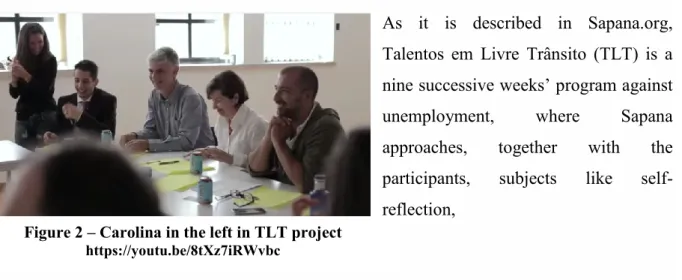
As it is described in Sapana.org, Talentos em Livre Trânsito (TLT) is a nine successive weeks‘ program against unemployment, where Sapana approaches, together with the participants, subjects like self-reflection,
self-motivation, increased self-esteem and empowerment to the definition of personal and professional goals for the search and/or job creation. Thus, TLT program for unemployed consist in an innovative methodology based on qualification and personal development tools, supported by processes of mentoring and coaching. Each individual‘s particular mental skills that are stimulated and empowered in this project through qualification and personal development tools are the operant resources engaged in the service exchange. Each individual‘s particular mental skills (i.e. know-how) will be his own component of differentiation that can be further exchanged with other person and/or organization. Since the purpose of exchange is co-creation of value it implies that the value creation is interactional: during the program Carolina and/or other mentors interact with the participant and this same participant also interacts with the other participants during the process, although the process always starts with the individual who is the primary beneficiary of the program. Because of this program‘s interactional and reciprocal nature, more information can be shared and generated.
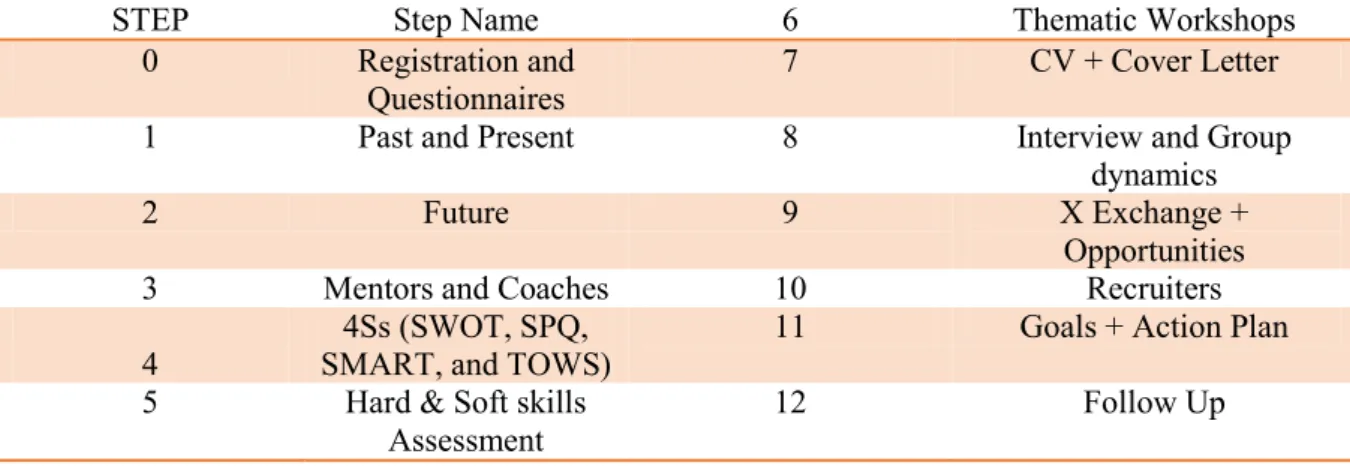
TLT project is segmented into 12 steps, which are unfolded into 18 sessions, and compounded by 3 follow-up stages. The project sessions take place two times a week, after working hours, with challenges raised between sessions. The follow-up actions happen on the 1st, 6th and 12th months after the end of process throughout in-house sessions, by applying suitable Key Performance Indicators (KPI‘s). Using an integrative methodology based on training and personal development tools, together with processes of mentoring, coaching and neuro-linguistic programming has been leading to the strengthening of human resources and capabilities to social innovation implementation and change. The ongoing interplay of
Figure 2 – Carolina in the left in TLT project
7 resource creation (―reinforcement of human resources and capabilities‖) and application (―social innovation implementation and change‖) are afforded through service reciprocal exchange between beneficiary and mentors.
The program's methodology is grounded on 12 different steps of self-knowledge, trainings, workshops and action and empowering for an effective job search. The major steps are the following:
Table 2 – “Talentos em Livre Trânsito” project’s steps
Source: Paper in Universidade Católica Portuguesa and Universidade Nova de Lisboa (In order to combat social inequality is not enough just to educate Social entrepreneurship as an opportunity system)
STEP Step Name 6 Thematic Workshops
0 Registration and
Questionnaires
7 CV + Cover Letter
1 Past and Present 8 Interview and Group
dynamics
2 Future 9 X Exchange +
Opportunities
3 Mentors and Coaches 10 Recruiters
4
4Ss (SWOT, SPQ, SMART, and TOWS)
11 Goals + Action Plan
5 Hard & Soft skills Assessment
12 Follow Up
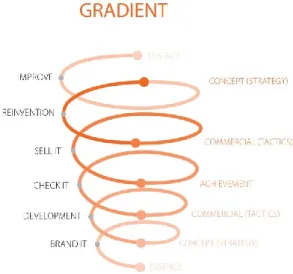
As it is described in the paper ―In order to combat social inequality is not enough just to educate Social entrepreneurship as an opportunity system‖, Sapana‘s modus operandi works as an upward spiral (see Figure 3), and enables social innovation projects‘ resource integration, because each phase needs to be combined or bundled with the next one. Initially, the need is analyzed and evaluated, i.e., the project‘s essence (Essence), and one has to recognize what are the purposes and potential methodologies. Then, one has to design the concept and the brand (Concept Strategy). In this particular case was named as TLT, given its purpose, methodologies applied and key stakeholders. The next step is to experiment the concept, through the pilot edition (Check It). It relies on the fact that there are enough and representative number of candidate registrations to conceive a group, and the analysis of various groups of KPI‘s that had been outlined for TLT. Thereafter, the social innovation personal development model can be then improved and its value proposition sold (Sell it) to social investors (in this particular case the Barclays Bank). This process workflow is called ―Gradient‖, which is authored by Sapana and has been the business model workflow used by
8 the organization for the implementation of all its social innovation projects. Aristotle once said that "Knowing yourself is the beginning of all wisdom" and Sapana agrees totally with it.
Figure 3 - Gradient Business Model’s workflow powered by Sapana
Source: Paper in Universidade Católica Portuguesa and Universidade Nova de Lisboa (In order to combat social inequality is not enough just to educate Social entrepreneurship as an opportunity system)
2.3.2 Breaking Bars – Shakespeare project (Portugal)
The Breaking Bars project was conceived as part of inspiration from the ―Shakespeare Behind Bars‖ project in United States. Sapana developed a replica, although distinct, where Sapana train men and women who are expected to leave the prison in less than one year, contributing to their social and labor integration.
The project started to be developed in Linhó prison, in Lisbon. Through a training program, it bridges the gap between the empowerment for employability, still in seclusion, and the monitoring at the release from prison. There is an individualized supervision at the level of employability as employees or at their own job creation, contributing to reduce recidivism, and thus improving their social inclusion.
Some of the activities included in this project are the promotion of the development of individual motivation, self-esteem and communication; sharing of tools and strategies for the creation of their own job; providing mentoring and monitoring during and after the seclusion time; development of a database of organizations willing to employ inmates and ex-inmates and monitor the process of entrance of the new employee. In all these activities, once again all starts with the beneficiary (inmates), but then they are stimulated by other actors (mentors) to
9 use their skills (operant resources) for their own good, and as a consequence, for future gain for society (in case of non-recidivism).
2.3.3 Power2U project (Portugal)
Power2U operates in disadvantaged neighborhoods, usually with a high rate of ethnic multiplicity, and aims to foster personal development in young people, foster the balance of family management, encourage employability and participation in civic life. This project is based on an integrated and cooperative intervention with various partners, with three areas of action: employability; rehabilitation of urban spaces; and active participation in civic life, fostering a sense of shared community. Due to the ―integrated and cooperative intervention with various partners‖, in this project all actors are resource integrators in a network of other actors, and thus all actors are co-creators of social value. Again it all starts with the empowerment of individual (beneficiary) to then involve other individuals in collective matters (e.g. balance of family management; participation in civic life). The project may involve the personal development of young people or encourage employability, and thus using their skills (operant resources) to their own advantage and further advantage for society, participating with an active role.
2.3.4 Echo Hamlet project (India)
This project consists on the implementation of sustainable tourism at social and environmental levels, which aim to have a positive impact on travelers and neighboring tribal communities through voluntary work, organic farming and cultural workshops. There is the example of the Katkari tribe, marginalized and considered a criminal community and impure by other social castes. The quality of life is reduced, without basic sanitation, access to own water for consumption or electricity. Thus, Sapana helps on the creation of new livelihoods as a means of empowering the community and developing the local economy of tribal villages. In other words, Sapana helps to build eco-center and hostel facilities by using materials and natural resources from contiguous regions (e.g., fishing villages, local people), as well as provides workmanship and develop learning and experience curves. Thus, in this project it is clear the integration of operand resources (e.g., fishing villages, local people) and operant
resources (e.g. workmanship) to support the activities and interactions through which the
10 workmanship, etc) are resource integrators and exchange operant resources (skills and knowledge about specific tasks and/or the place), for the benefit of the community.
2.4 Working to be a “mission company”
Sapana aspires to position itself as a mission company. This means that there is a mission, and the mission is to transform the world, but this world shall be transformed in a sustainable way. How will it be sustainable? Answering that, by the year of 2016, Sapana had created a third axis: Consulting services and business model. Basically, this third axis activates two for-profit action lines (CORE and Super Solutions) in addition to its non-profit Social Responsibility, and thus aligning its vision of social enterprise. Nonetheless, the concept of social enterprise is not clearly defined in the Portuguese context because no legal status of this new hybrid dimension was approved by the State. Carolina‘s vision is to create this new social economic paradigm in Portugal.
Core Solutions aims at empowering the Human Capital of companies, through transformational experiences. It creates sustainability departments developing strategies and methods based on the best practices of Economics of Cooperation/Economics with Impact. On the other hand, Super Solutions is dedicated to the incubation and launching of social businesses sustained on the training of people and based on Muhammad Yunus seven principles of Social Business1.
The courses Carolina took in Harvard were a key factor while defining this third component. It showed her that it was possible to have the social enterprise concept applied to her organization. With this third axis, Sapana wants to be an example in Portugal, working with organizations of excellence, whether they are from the social sector, public or private. This new axis of action earmarked the switch to a self-sustainable company.
However, the majority of third sector organizations are unable to become self-sustainable even when they want to. Therefore, there is a significant social business opportunity that can be taken by this way, which Sapana calls the MOOVER way. Given this, it becomes obvious the need for all organizations, in particular organizations of the third sector, to design new
1According to the Yunus Centre (http://www.muhammadyunus.org/index.php/social-business/seven-principles), the 7 principles of Social
Business are the following: - Business objective will be to overcome poverty, or one or more problems (such as education, health, technology access, and environment) which threaten people and society; not profit maximization; - Financial and economic sustainability; - Investors get back their investment amount only. No dividend is given beyond investment money; - When investment amount is paid back, company profit stays with the company for expansion and improvement; - Gender sensitive and environmentally conscious; - Workforce gets market wage with better working conditions; - ...do it with joy.
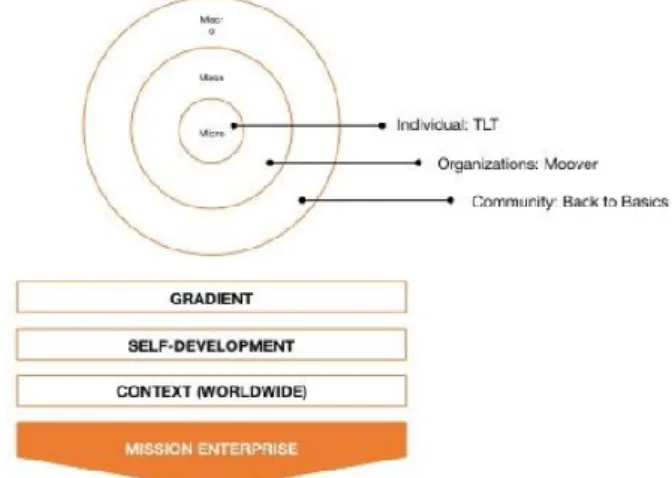
11 organizational social business formats and push a social culture of intervention tools usage, of administration and modern management to adjust to the society instability and changes. In this context, the MOOVER training program strives to address the gap in the formation of leaders, managers and technicians of social organizations in the areas of management, sustainability, coaching and leadership. The training owns as mission to foster more effective and efficient management within organizations. Hence, this training is intended to empower the trainees to take actions in order to react to the increasing challenges of these organizations, especially their financial sustainability, given the scarcity of resources. The MOOVER training program is conducted during 3 months, in 7 modules, 14 sessions in a total of 56 hours theoretical-practical steps. In MOOVER, the concepts of ―Gradient‖, ―TLT‖ and ―Back to Basics‖, are highlighted as a support of the whole theory of the empowerment program (Figure 4).
Figure 4 – Sapana Global Approach
Source: Paper in Universidade Católica Portuguesa and Universidade Nova de Lisboa (In order to combat social inequality is not enough just to educate Social entrepreneurship as an opportunity system)
As one can observe in the previous figure, Sapana‘s global approach has three levels of aggregation: micro, meso and macro. At the micro level is placed the TLT program, starting with activities destined to the empowerment of the individual; at the meso level is the MOOVER program, which is applied to the training of leaders, managers and technicians of social organizations; at the macro level one must see the broad picture of society. Thus, it is highlighted the concept of Back to Basics, which is directly designed to the improvement of the community.
12
2.5 iPath methodology
iPath is the basis of all of Sapana's philosophy of life - “It is a methodology consisting of
modules and I really like to think that somehow we are creating a ladder where the individual in order to reach the last step will have to be and start for himself.”. The methodology is
inspired by the twelve steps of the detoxification process of Alcoholics Anonymous groups. The methodology that SAPANA uses fits perfectly the three levels of aggregation of Service ecosystem: micro, meso and macro.
As it is outlined in ―iPath…to your best version‖ document, the methodology has then three dimensions: Micro - Each person has to be worked on himself, for himself and with himself;
Meso - Work with the person in a particular cycle of influences; the person with the others; Macro - The group where this person is inserted, with the society itself.
The modules/steps are divided mainly in two moments: A - UNO PER UNO - The first part of the methodology focuses fundamentally on the reconstruction of the individual and his/her discovery as an individual being. Our success as a person (happiness/fulfilled challenges and realized dreams) always starts in us; B - UNO PER ALTRE - The second part of the methodology already addresses the interaction of the being as singular with others, in order to abandon the idea that we are alone, we are constantly in mutation, as result of interactions and external variables; personal development takes place through the mirror of others, and the way we coexist with these same mutations and their assimilation. The human being is a binary being and the dichotomy of the one versus the community is fundamental to be accepted.
2.5.1. iPath ladders
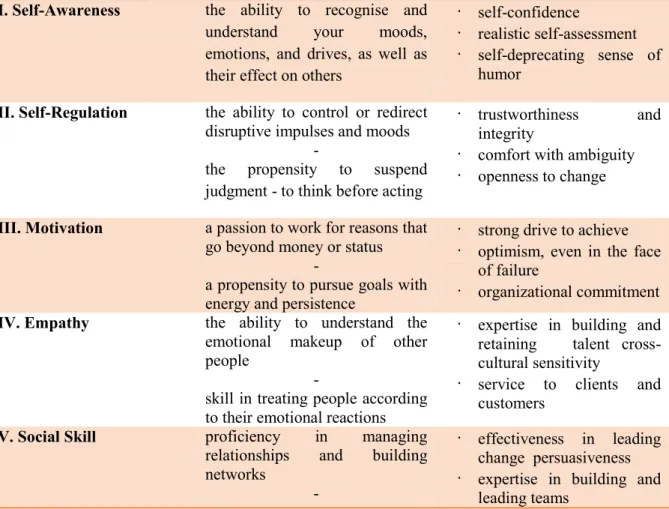
There are five ladders (Table 3), which have many sub steps "by the walk". It is not enough to empower the human being for emergency or sustainability work, it is becoming increasingly essential to emerge the "inside out" training. Then, very shortly, the steps are as it follows:
I. ladder: MICRO > SELF-AWARENESS (A - UNO PER UNO)
It is the first element of emotional intelligence - which makes sense when one considers that, for thousands of years, the Delphi Oracle advised "know yourself."
II. ladder: MICRO-MESO > SELF-REGULATION (A - UNO PER UNO)
13
III. ladder: MESO > MOTIVATION (B - UNO PER ALTRE)
From the moment we can understand who we are and expose our self-concept publicly, there is an enormous willingness and instinct to ―want to be‖ and ―do something‖ that is consistent with our ―new self‖.
IV. ladder: MESO-MACRO > TO CREATE EMPATHY (B - NO PER ALTRE)
Of all the dimensions of emotional intelligence, empathy is the most easily recognized. Empathy has as epistemological origin to put ourselves in the place of the other.
V. ladder: MACRO > SOCIAL SKILLS (B - UNO PER ALTRE)
The first three components of emotional intelligence are self-management skills. The latter two, empathy and social skills, involve the person's ability to manage relationships with others.
Table 3 – 5 Emotional intelligent skills at work
Source: ©2003 Harvard Business School Publishing Corporation. All rights reserved, iniPath…to your best version (2015)
Definition Hallmarks
I. Self-Awareness the ability to recognise and
understand your moods, emotions, and drives, as well as their effect on others
∙ self-confidence
∙ realistic self-assessment ∙ self-deprecating sense of
humor
II. Self-Regulation the ability to control or redirect disruptive impulses and moods
-
the propensity to suspend judgment - to think before acting
∙ trustworthiness and integrity
∙ comfort with ambiguity ∙ openness to change
III. Motivation a passion to work for reasons that
go beyond money or status -
a propensity to pursue goals with energy and persistence
∙ strong drive to achieve ∙ optimism, even in the face
of failure
∙ organizational commitment
IV. Empathy the ability to understand the
emotional makeup of other people
-
skill in treating people according to their emotional reactions
∙ expertise in building and retaining talent cross-cultural sensitivity
∙ service to clients and customers
V. Social Skill proficiency in managing
relationships and building networks
-
∙ effectiveness in leading change persuasiveness ∙ expertise in building and
14 an ability to find common ground
and build rapport
2.6 Portugal’s reality
By the time Sapana was founded, the "achilles heel" of Portugal was the unemployment rate. In 2012, unemployment rate reached a record of 17.5%, according to Eurostat. Nonetheless, Portuguese unemployment rate fell to 8.90 % in the third quarter of 2017, from 10.9% in the same quarter of 2016. It was the lowest jobless rate since the first quarter of 2009.
Figure 5 - Unemployment rate in Portugal Source: Eurostat
Notwithstanding, unemployment issue will be an ever-standing concern, not only for the every year‘s long number of new graduates but also to long-term unemployed and recent prisoners who usually face several constraints as regards both society and labor market integration.
According to a report released on October 2017 by the Portuguese Ministry of Justice, about the prison system, it has received close to 14.000 prisoners (140 inmates per 100.000 inhabitants), a rate of imprisonment higher than the European average of 116 inmates per 100.000 inhabitants. And, in 2016 the average number of inmates released was 5.754, according to a statistics from Pordata. These almost 6 thousand are people that need to be integrated in order be prevented from recidivism after they have been released.
15
2.7 India’s reality
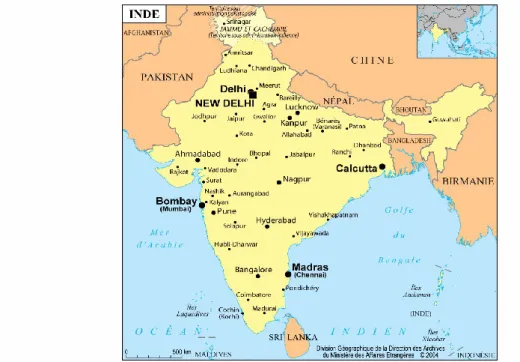
The Republic of India is an Asian country, located in the center-south of it. The current population of India is 1.344.164.148 as of Wednesday, November 1, 2017, based on the latest United Nations estimates. India population is equivalent to 17.74% of the total world population. These estimates guarantee to India the second place in population in the world, surpassed only by China.
Figure 6 – India city scale map
http://www.maps-of-india.com/india-cities-map/india-city-scale-map/
According to an article of BBC, its population is expected to reach 1.5 billion and become the world's largest nation by 2026, but its economy is not growing fast enough to create the 20 million new jobs per year they will need to prevent poverty increasing even further. The scale of continuing extreme poverty in India is huge, despite its economy growth rate of nine per cent in recent years.
In fact, one in three of the world's poorest people are living in India, according to a study by the World Bank on 2013. India has now a greater share of the world's poorest people than it did thirty years ago. In the past it was the home to one fifth of the world's poorest people, but today it accounts for one-third, about 400 million.
16
2.7.1 India's caste system
The principal religion of India, Hinduism, directly interferes in social structuring, since Hinduism divides society into castes. This system divides Hindus into rigid hierarchical groups based on their karma (work) and dharma (the Hindi word for religion), and is generally accepted to be more than 3.000 years old.
Manusmriti, widely recognized to be the most important and authoritative book on Hindu law dates back to at least 1.000 years before Christ was born, and "acknowledges and justifies the caste system as the basis of order and regularity of society".
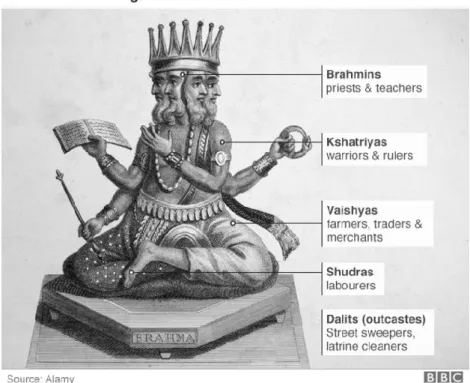
The caste system divides Hindus into four main categories - Brahmins, Kshatriyas, Vaishyas and the Shudras. Many believe that the groups were originated by Brahma, the Hindu God of creation.
Figure 7 – Main categories of India’s caste system
http://www.bbc.com/news/world-asia-india-35650616
At the top of the hierarchy were the Brahmins who were mostly teachers and intellectuals and are believed to have come from Brahma's head. Then came the Kshatriyas, known as the warriors and rulers, apparently from his arms. The third slot belongs to the Vaishyas, or the traders, who were created from his thighs. At the bottom of the hierarchy were the Shudras, who are believed to have come from Brahma's feet and did all the menial jobs.
17 The main castes were further split into about 3.000 castes and 25.000 sub-castes, each based on their particular occupation. Outside of this Hindu caste system were the achhoots - the Dalits or the untouchables.
For centuries, caste dictated almost all aspects of Hindu religious and social life. Rural communities were organized on the basis of castes - the upper and lower castes almost always lived in segregated colonies. For example, the water wells could not be shared, Brahmins could not accept food or drink from the Shudras, and one could marry only within one's caste. Traditionally, this system provided many privileges on the upper castes while sanctioning repression of the lower castes by privileged groups.
This caste system was often criticized for being brutally regressive and unjust, although it remained virtually unchanged for centuries, trapping people into fixed social orders from which it was not possible to escape.
In fact, in 1950, Independent India's constitution banned discrimination on the basis of caste. And in an attempt to remediate historical injustices, the authorities announced quotas in government jobs and educational institutions for the lowest castes and tribes in the caste hierarchy.
In the year of 1989, quotas were broadened to be able to include a grouping named the OBCs (Other Backward Classes) that fall between the traditional upper castes and the lowest.
In recent decades, as a result of the spread of increasing education and growing urbanization, the influence of caste has started to decline, especially in cities where different castes live side-by-side. Here, inter-caste marriages are becoming more common.
Despite the attempts to change the system, caste identities remain solid, and last names are almost always indications of what caste a person belongs to.
2.8 The future
There are particular challenges that Carolina had to face along her journey. The first challenge Carolina overcome was the fact that her work and the work of her team had to be compensated and recognized. In a prior stage, Sapana had to demonstrate success rates on its projects to its investors. It had to show that its work was worth millions. However, this message could be hampered sometimes because they had to be able to communicate that their
18 work would not deliver results in 6 months rather in the long-run it would save millions. For example, Sapana has a very practical example in its day-to-day work: a prisoner costs, on average, 47,50€ per day, therefore Portugal spend half a million per day on prisoners. Prison establishments are public, and if the work of Sapana is going to employ them, they will stop being a financial loss to become being a saving. They will start paying taxes as all of the rest taxpayers, representing money to our state and to all of us.
At the present, her biggest challenge is “How can we justify sustainability, if the majority of
third sector organizations are unable to focus and build in an effective and efficient mode their own social business models and management skills, even when it comes to basic concepts in these days, as for the internet or English? There must be an internal social responsibility for its human capital. Sapana works human capital, but at the same time has to work the society where it is integrated.” Thus, Carolina‘s mission now is to develop a tool
that social enterprises can use in order to help them become self-sustainable. The managerial problem they are facing now is the challenge of helping other social enterprises to become self-sustainable so Carolina can contribute to the creation of social enterprise paradigm in Portugal.
In order to overcome this challenge it is essential to start with the individual, the Human Capital. The central point of this issue is to find a marketing tool consistent with creation of value while empowering critical stakeholders to become part of the solution (co-creation of value). Since Service-dominant logic of marketing is focused on intangible resources, co-creation of value and relationships, this marketing framework is consistent with the aforementioned issue.
The team is aware that dialogue is a key factor in connecting and empowering people to make the difference. Only in this way, they can ―learn by doing‖ and become self-sustainable while contributing to a better world. And only then we can sow in Portugal the paradigm of social enterprise and being recognized and supported as one.
19
3 LITERATURE REVIEW
3.1 Introduction
Social entrepreneurship has become an important economic phenomenon at a global scale, with the additional possibility that it may become almost as important a phenomenon as commercial entrepreneurship (Santos 2012; Harding 2006).
Thus, what is this new ―important economic phenomenon‖ and what does it cover?
First, we view social entrepreneurship as a process of creating value by combining resources in new ways. Second, these combinations are intended primarily to explore and exploit opportunities to create social value by stimulating social change or meeting social needs. And third, when viewed as a process, social entrepreneurship involves the offering of services and products but can also refer to the creation of new organizations. (Mair & Martí 2006)
From this initial delineation many facets can be further analyzed, one of these is the ―creation of new organizations‖ that some scholars may call Social Enterprises (SEs). Over the last 30 years, the unprecedented increase in the number of organizations that operate at the intersection of both social and commercial sectors is notable. SEs primarily pursue a social mission while also engaging in commercial activities in order to be self-sustainable, such as the sale of products and/or services (Battilana et al. 2014). Some authors even see these groundbreaking organizations as ―hybrid‖, combining the organizational forms of both business and charity at their cores (Battilana & Lee 2014).
In fact, given the ―unprecedented increase in the number of organizations‖, not only in number but also in dimension, competition among entrepreneurs forces corporations to either adapt their business processes to remain competitive or they will be left behind (Santos 2012). This competition is enhanced by the fact that social enterprises already ―face increasing pressures to demonstrate the results of their work both from donors and from [the] public‖ (Holma & Kontinen 2011; Kroeger & Weber 2014).
Hereupon, it emerges the need to call for marketing in order to delineate an effective marketing strategy, one that could look into ―opportunities to create social value by stimulating social change or meeting social needs‖. Kotler and Levy (1969) already defined marketing as ―sensitively serving and satisfying human needs‖. In fact, ―it is marketing processes which promote an effective and efficient resolution of society's needs‖ (Murray &
20 Montanari 1986; Bartels 1968). These ―marketing processes‖ may involve a ―process of creating value by combining resources in new ways‖.
Social entrepreneurs are focused on value creation (contrarily to commercial entrepreneurs, who are focused on value capture instead), whereby their fundamental concern is about the effectiveness of the overall value system of activities and partners.
In order to achieve their desired outcomes, social entrepreneurs use a logic of empowerment of beneficiaries and potential stakeholders to become an integral part of the solution (Santos 2012). According to the World Bank (2009), empowerment is the ‗‗process of increasing the assets and capabilities of individuals or groups to make purposive choices and to transform those choices into desired actions and outcomes.‖.
Santos‘s (2012) logic of empowerment is in alignment with the Service-dominant logic (S-D logic) marketing perspective, which is nothing less than a process of co-creation of value, where all actors fundamentally do the same things: integrate resources and engage in service exchange, all in the process of co-creating value (Vargo & Lusch 2004, 2007 & 2015). The value co-creation process involves the creation of superior value propositions (Payne et al. 2007) that may help SEs to remain competitive.
In this section I will introduce to Service-dominant logic of marketing and then cover the related foundational premises (FPs) and characteristics of this framework. Social enterprises may want to integrate some of these FPs in their business strategies in order to be able to delineate a strategy aligned with S-D logic perspective.
The final purpose is to find the essential foundations of a marketing tool aimed at the maximization of social and economic value co-creation.
3.2 Evolvement of marketing perspective: from Goods-dominant logic to
Service-dominant logic
One key concept introduced by (and introducing) the previous definition of social entrepreneurship is resources, which can lead us to a model of exchange that marketing inherited from economics - Goods-dominant logic (G-D logic). This model is based on the exchange of ―goods‖, which are usually manufactured output (Vargo & Lusch 2004). Nevertheless, along with the passing of years grew the need for an alternative paradigm of marketing, one that could account for the continuous nature of relationships among marketing actors (Vargo & Lusch 2004). Accordingly, and in line with the work of Vargo & Lusch
21 (2004), ―over the past 50 years, resources have come to be viewed not only as stuff but also as intangible and dynamic functions of human ingenuity and appraisal, and thus they are not static or fixed.‖
This change in perspective on resources helped providing a framework for the new dominant logic of marketing: Service-dominant logic (S-D logic), a logic focused on intangible resources, co-creation of value, and relationships, instead of tangible resources, embedded value, and transactions (Vargo & Lusch 2004).
3.3 Competing through service
Social entrepreneurs should invite competition instead of resisting it, since replication of the innovative solutions will increase the value created to society (Santos 2012). Furthermore, according to Karmarkar (2004), competitive advantage can be enhanced through service (Lusch et al. 2007).
Service in S-D logic means applying specialized competences (knowledge and skills) through deeds, processes, and performances for the benefit of another actor or the actor itself (Vargo and Lusch 2004). This mind-set is applicable to business organizations, government organizations, nonprofit organizations, households, and individuals (Lusch & Nambisan 2015).
Effective competing through service involves the entire organization viewing and approaching both itself and the market with S-D logic (Vargo and Lusch 2004). It is about understanding, internalizing, and acting on this logic better rather than competition (Lusch et al. 2007).
3.4
Key drivers of S-D logic
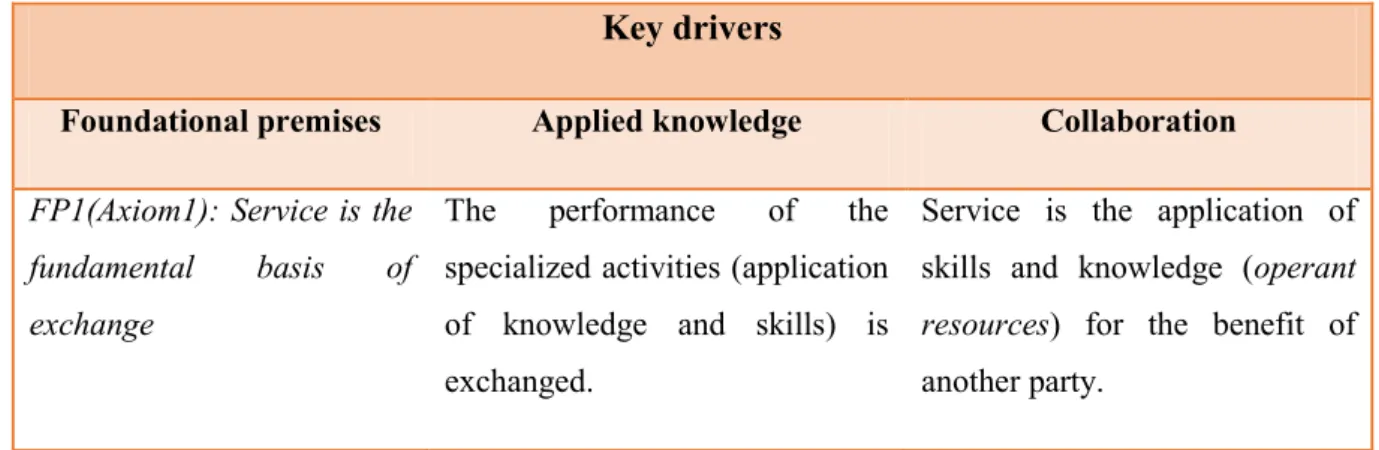
Overall, applied knowledge and collaboration are the key drivers for firms to more successfully compete through service. According to Lusch et al. (2007), to accomplish this, the firm must view external environments, costumers, and partners as operant resources (i.e. resources that can act on other resources to create a benefit).
For instance, S-D logic views the external environments as resources the firm draws upon for support by overcoming resistances and proactively co-creating these environments. Thus, the
22 environment should be viewed as potential sources of opportunities for collaboration (Lusch et al. 2007).
3.5 Value co-creation
Value co-creation gained the attention of academics and practitioners as an overarching concept that describes collaboration between multiple stakeholders (Prahalad & Ramaswamy 2000), and it was fuelled by the influential study by Vargo and Lusch (2004) on a co-creative service-dominant logic of marketing. Figure 8 represents the elements of this strategic vision.
3.6 Foundational premises of S-D logic
S-D logic described by Vargo & Lusch (2004, 2007 & 2015) is captured in eleven foundational premises (FPs), which were designed to settle a framework for the service-centered mindset. Since the first introduction of FPs, Vargo & Lusch have realized that some of the original FPs could be derived from others, thus identifying five FPs as particularly foundational. These particular five earned the status of axioms.
3.6.1 Service exchange
3.6.1.1 FP1(Axiom1): Service is the fundamental basis of exchange
Figure 8 - Service-dominant marketing
23 Physical and mental skills are resources that people have. Both types of skills are distributed unequally in a population. Each person‘s skills are not necessarily optimal for his or her survival and well-being, therefore, specialization becomes efficient for individual members of society and for society overall (Vargo & Lusch 2004). Because people largely specialize in particular skills, they achieve scale effects. This specialization requires exchange (Macneil 1980; Smith 1904). Under the service-centered view, is the performance of the specialized activities that is being exchanged (Lusch & Nambisan 2015).
If we look at these ―specialized activities‖ as the application of knowledge and skills, we are especially unveiling the primary role of operant resources. These resources can act on other resources to create a benefit, instead of being static or fixed as operand resources (e.g. natural resources).
According to Vargo & Lusch (2004), at the heart of S-D logic is the identification of service, and since ―service‖ is the ―application of skills and knowledge‖ (operant resources) for the benefit of another party, we can clearly see now the central role of service in exchange: Service is exchanged for service.
3.6.1.2 FP2: Indirect exchange masks the fundamental basis of exchange
The Industrial Revolution had a tremendous impact on organization‘s efficiency, but this came with the price of masking the true nature of exchange. Workers‘ specialization increasingly became micro specialization (i.e., the performance of increasingly narrow-skilled proficiencies); however, the micro specialists seldom completed a product or interacted with a customer. For instance, one worker would perform a micro specialized task and then pass the work product on to another worker, who would perform another task, and this process would continue throughout a service chain. Because the workers along the chain did not reciprocally exchange with one another and did not typically deal directly with external customers, they could ignore quality and both internal and external customers. Due to these forces, the skills-for-skills (services-for-services) nature of exchange became masked (Vargo & Lusch 2004). 3.6.1.3 FP3: Goods are distribution mechanisms for service provision
According to Vargo & Lusch (2004), in marketing, goods (manufactured output) are not the common denominator of exchange. The common denominator is instead the application of specialized knowledge, mental skills and physical labor (physical skills). Knowledge and skills can be transferred directly through education or training, or indirectly by embedding
24 them in objects. This way, tangible products can be viewed as embodied knowledge or activities (Normann & Ramirez 1993). For instance, wheels, pulleys, internal combustion engines, and integrated chips are all examples of encapsulated knowledge, which informs matter and in turn becomes the distribution channel for skill application (i.e., services) (Vargo & Lusch 2004).
3.6.1.4 FP4: Operant resources are the fundamental source of strategic benefit
Operant resources, especially ―know-how‖, are the essential component of differentiation (Lusch et al. 2007). Moreover, ―strategic benefit‖ highlights an important implication of the service-for-service conceptualization of S-D logic, namely, that the service provider also has the role of service ―beneficiary‖ given reciprocal service exchange (Vargo & Lusch 2015). 3.6.1.5 FP5: All economies are service economies
Vargo and Lusch (2014) also argue that virtually, all the activities performed today have always been performed in some manner. Nonetheless, they have become increasingly divided into specialties and further exchanged in the market. This does not mean that services just recently became important, but just recently have become more apparent in the economy as specialization increased and as less of what is exchanged fit the dominant manufactured output classification system of economic activity. In fact, services and the operant resources they represent have always characterized the essence of economic activity.
3.6.2 Actors’ role
3.6.2.1 FP6 (Axiom2): Value is co-created by multiple actors, always including the beneficiary
Co-creation of value is the purpose of exchange and, thus, foundational to markets and marketing. In specialized and interdependent human systems value is created through the integration of resources provided by many sources, including a range of market-facing, private and public actors. Therefore, value is not completely created unilaterally, neither dydically (Vargo & Lusch 2015). In fact, there is a collaborative nature of value creation implied on ―Value is co-created by multiple actors‖. It implies that value creation is interactional (Vargo & Lusch 2007, 2015). It is through interaction - ―mutual or reciprocal action or influence‖ (Merriam Webster 2015; Vargo & Lusch 2015) - that information is shared and knowledge is generated (Berthon & John 2006).
25 In this sense, in S-D logic all actors are resource integrators in a network of other actors, and thus all actors are co-creators of value. Therefore, S-D logic has a network-centric perspective (Lusch & Nambisan 2015), where value creation takes place through the activities among a whole host of actors (Vargo & Lusch 2015).
Moreover, FP6 recognizes that the beneficiary is always a party to its own value creation. Value co-creation is a multi-actor phenomenon, although with the referent beneficiary at the center, who plays a key role in all instances (Vargo & Lusch 2015).
3.6.2.2 FP7: Actors cannot deliver value but can participate in the creation and offering of value propositions
There is no value until an offering is used, because experience and perception are essential to value determination (Lusch et al. 2007). Value occurs when the offering is useful to the customer or beneficiary (value-in-use), and this is always in a particular context. The notion of context is, thus, important when discussing value-in-use. All actors are connected with other actors and other resources, and these connections provide the context for the actors to experience value (Chandler & Vargo 2011; Vargo et al. 2008; Lusch & Nambisan 2015). Fundamentally, actors are constantly dropping and forming new connections, contexts are always in flux and value experiencing is dynamic. Therefore, organizations can collaboratively (interactively) create value followed by the acceptance of value propositions, but cannot create and/or deliver value independently (Vargo & Lusch 2007).
Furthermore, we emphasize that the purpose of this FP is to establish the non-deliverable nature of value, i.e., it does not imply that, once value propositions have been embraced by potentially beneficial actors, nothing else can be done by the service-providing actor to contribute to value creation. On the contrary, the acceptance of value propositions implies a continuing role by the associated actors (Vargo & Lusch 2015).
3.6.2.3 FP8: A service-centered view is inherently beneficiary oriented and relational Over the last 50 years, marketing has been transitioning from a product and production focus to a consumer focus and, more recently, from a transaction focus to a relationship focus. In convergence with this, Glynn and Lehtinen (1995) notice that services scholars‘ recognition of characteristics of intangibility, inseparability, and heterogeneity has forced a focus on interaction and relationships (Vargo & Lusch 2004).
26 S-D logic assumes value co-creation, being inherently relational for this reason alone. Service provision and the co-creation of value imply that exchange is relational (Vargo & Lusch 2004).
Furthermore, there is an implicit multidimensional conceptualization of relationship in S-D logic. In particular, value co-creation is represented by the reciprocity of exchange, as previously mentioned, as well as by the existence of the shared institutions that facilitate this exchange (Lusch & Vargo 2014, Vargo & Lusch 2015), which will be further discussed. 3.6.2.4 FP10: Value is always uniquely and phenomenologically determined by the beneficiary
Besides value being created for multiple actors, the value is different for each referent and must be assessed separately (Vargo & Lusch 2015). Consequently, value is obtained in conjunction with market exchanges, involving a unique combination of resources. Thus, value is regarded to be idiosyncratic, experiential, contextual and meaning-laden (Vargo & Lusch 2007, 2017).
The referent beneficiary always plays a key, integrative and evaluative role in all instances of value co-creation. When the beneficiary experiences a useful offer of value (value-in-use), it becomes context particular. As also previously mentioned in FP7, the connections between actors and resources provide the context for the actors (beneficiary) to experience value (Chandler & Vargo 2011; Vargo et al. 2008; Lusch & Nambisan 2015).
3.6.3 Resource integration
3.6.3.1 FP9 (Axiom 3): All social and economic actors are resource integrators
In focusing on the integration of operand and operant resources to support the activities and interactions through which a service occurs, S-D logic views all social and economic actors (e.g. individuals, businesses, households, etc.) as resource integrators. Any resource an actor obtains can never be used in isolation but needs to be combined or bundled with other resources for usefulness or value (Lusch & Nambisan 2015).
Therefore, this FP/axiom reveals a ―network structure‖, one that has dynamic and recursive properties. The key to value co-creation is the ongoing interplay of resource creation and application afforded through reciprocal exchange and differential access and integration
27 (Vargo & Lusch 2017). It is the unique application of uniquely integrated resources that motivates and constitutes exchange, both economic and otherwise (Vargo & Lusch 2007).
3.6.4 Service ecosystems
3.6.4.1 FP11 (Axiom 5): Value co-creation is coordinated through actor-generated institutions and institutional arrangements
S-D logic framework establishes three key characteristics to the conceptualization of networks. First, the networks‘ inherent connections represent service-for-service exchange, rather than just connections of resources, people or product flows. Thus, in S-D logic, network actors are linked by common and dynamic processes (service provision). Second, actors are defined not only in terms of this service provision (resources applied for benefit) but also in terms of the resource-integration activities that the service exchange provides. Finally, the network has a purpose in the sense of individual survival/well-being, as a partial function of collective wellbeing (Vargo & Lusch 2017).
Hereupon, the coordination for value co-creation implies mechanisms for the facilitation of these resource integration and service-for-service exchange activities. The actor-to-actor (A2A) network orientation implied in S-D logic, where all actors are enterprises engaged in service-for-service exchange, suggests that the mechanisms to facilitate value co-creation in markets and elsewhere are the institutions and institutional arrangements (Vargo & Lusch 2017).
In S-D logic, these institutions—humanly devised rules, norms, and beliefs that enable and constrain action and make social life predictable and meaningful (Scott 2001) —and higher-order, institutional arrangements— interdependent assemblages of institutions—are essential to understand human systems and social activity, such as value co-creation (Vargo & Lusch 2015).
Furthermore, it is important to refer that, in S-D logic context, the term ―institutions‖ does not mean organizations, as it is sometimes intended in everyday discourse (Vargo & Lusch 2015). North (1990, pp. 4–5) distinguishes between the two as institutions being the ―rules of the game‖, and organizations being the players (the teams).
Institutions may come in several forms. They can be a norm, meaning, symbol, law, practice, or any other rubric that provides a shortcut to cognition, communication, and judgment. In