U
NIVERSIDADE DE
L
ISBOA
Faculdade de Ciˆencias
Departamento de Inform´atica
A TOOL FOR ONTOLOGY INSTANCE MATCHING
Andr´e Filipe Agostinho Lopes
DISSERTAC
¸ ˜
AO
MESTRADO EM INFORM ´
ATICA
U
NIVERSIDADE DE
L
ISBOA
Faculdade de Ciˆencias
Departamento de Inform´atica
A TOOL FOR ONTOLOGY INSTANCE MATCHING
Andr´e Filipe Agostinho Lopes
DISSERTAC
¸ ˜
AO
MESTRADO EM INFORM ´
ATICA
Dissertac¸˜ao orientada pelo Prof. Doutor Francisco Jos´e Moreira Couto e co-orientado pelo Prof. Doutor M´ario Jorge Costa Gaspar da Silva
Acknowledgments
I would like to thank my advisors, Dr. Francisco Couto and Dr. M´ario Silva, for their guidance. I also thank the REACTION group, where it is included Dr. M´ario Silva, because through their criticisms, in our periodic meetings, helped me to improve my work, and within the group, to S´ılvio Moreira for his technical guidance that was crucial in the beginning of my dissertation.
Finally, I am very grateful to LaSIGE for providing me a good place to work, and also to the Portuguese Fundac¸˜ao para a Ciˆencia e a Tecnologia through the financial support of the SOMER project (PTDC/EIA-EIA/119119/2010) that gave me a scholarship for conducting my studies. At last, to my parents and grandmother, that gave me emotional support.
Resumo
A Web Semˆantica pretende fornecer formatos comuns para caracterizar semantica-mente os dados publicados na Web, melhorando a interoperabilidade e integrac¸˜ao de da-dos. A iniciativa Linked Data visa ligar dados relacionados que n˜ao foram previamente ligados. As ontologias tˆem um papel fundamental nisso, pois, fornecem vocabul´arios controlados, para caracterizar semanticamente os dados de uma forma inequ´ıvoca.
Conforme definido por Gruber, uma ontologia ´e uma especificac¸˜ao de uma conceitua-c¸˜ao, que se destina a modelar um dom´ınio em particular. A especificac¸˜ao de uma ontolo-gia ´e composto por dois tipos de declarac¸˜oes: TBox (classes) e ABox (exemplares). TBox s˜ao classes que s˜ao interpretadas como um conjunto de indiv´ıduos no dom´ınio; ABox s˜ao exemplares que s˜ao interpretados como indiv´ıduos particulares de um dom´ınio. Al´em disso, uma ontologia tamb´em ´e composta por: Relacionamentos ou relac¸˜oes entre clas-ses e/ou exemplares; Tipos de dados s˜ao partes particulares do dom´ınio que especificam valores; Valores de dados s˜ao valores simples.
Apesar de uma ontologia se destinar a modelar um dom´ınio em particular, existem muitas ontologias de diferentes fontes a modelar o mesmo dom´ınio, isto ´e, existe um pro-blema de sobreposic¸˜ao. O propro-blema de sobreposic¸˜ao consiste em ontologias distintas que representam as mesmas entidades de uma forma diferente. ´E, portanto, necess´ario criar processos capazes de encontrar as sobreposic¸˜oes e fundi-las.
Emparelhamento de ontologias ´e geralmente aplicado para alinhar duas TBox de duas ontologias diferentes, ou seja, para encontrar relac¸˜oes ou correspondˆencias entre as clas-ses ontol´ogicas.
H´a um caso particular de emparelhamento de ontologias, o Emparelhamento de Exem-plares. O objetivo do emparelhamento de exemplares ´e alinhar dois ABox de duas onto-logias diferentes, ou seja, encontrar as correspondˆencias entre exemplares de diferentes ontologias. O Emparelhamento de Exemplares adota o princ´ıpio de que, quanto maior for a semelhanc¸a entre duas descric¸˜oes de exemplares de duas ontologias distintas, maior ´e a probabilidade de estes exemplares representarem a mesma entidade de um determinado dom´ınio. Por exemplo, no dom´ınio pol´ıtico, vamos considerar o actual Presidente da Co-miss˜ao Europeia, Dur˜ao Barroso e assumir que na Ontologia 1 tem um exemplar com o descritor: “Jos´e Manuel Dur˜ao Barroso”, e Ontologia 2 tem um exemplar com o descritor: “Jos´e Dur˜ao Barroso”. Portanto, ´e necess´ario implementar t´ecnicas de emparelhamento
de exemplares, para descobrir se estes dois exemplares destas duas ontologias diferentes correspondem `a mesma pessoa/entidade, isto ´e, se eles emparelham.
Os objectivos desta dissertac¸˜ao eram:
Desenvolvimento de algoritmos de emparelhamento de exemplares Que visou o de-senvolvimento de algoritmos para o emparelhamento de ontologias ao n´ıvel dos seus exemplares, de forma a resolver problemas de emparelhamento de exempla-res. O desenvolvimento de algoritmos foi baseado em t´ecnicas de emparelhamento de exemplares j´a propostas por outros;
Alinhamento de exemplares do mundo real Que visou a aplicac¸˜ao dos algoritmos de-senvolvidos, para gerar emparelhamentos de alta qualidade em exemplares do mundo real, e avaliar a sua qualidade em termos de Precis˜ao, Sensibilidade, Medida-F, Exa-tid˜ao e ExaExa-tid˜ao Unilateral;
Desenvolvimento de um emparelhador de exemplares Web Que visou o desenvolvi-mento de uma ferramenta capaz de realizar emparelhadesenvolvi-mento de exemplares atrav´es da Web, incorporando os algoritmos desenvolvidos por mim.
Os resultados alcanc¸ados por esta dissertac¸˜ao foram a produc¸˜ao de alinhamentos de exemplares, entre as ontologias DBpediaPT, Verbetes e POWER-POWER. Estas trˆes ontologias contˆem exemplares que representam entidades pol´ıticas. E tamb´em entre as ontologias provenientes do OAEI 2012. O OAEI (Ontology Alignment Evaluation Initiative), ´e um concurso international, realizado todos os anos, que entre v´arios tipos de competic¸˜oes, tem uma dedicada `a avaliac¸˜ao de ferramentas e de t´ecnicas de emparelhamento de exemplares. Para avaliar a qualidade dos alinhamentos produ-zidos foram implementadas as seguintes m´etricas: Precis˜ao; Sensibilidade; Medida-F; Exatid˜ao; e Exatid˜ao Unilateral. Esta dissertac¸˜ao tamb´em produziu um emparelhador de exemplares dispon´ıvel atrav´es da Web, que implementa as m´etricas mencionadas para avaliar os alinhamentos produzidos por ele.
POWER (Politics Ontology for Web Entity Retrieval) ´e uma ontologia que modela o dom´ınio da pol´ıtica Portuguesa, que foi desenvolvida e fornecida pela grupo REAC-TION. Os seus exemplares foram alinhados com os das ontologias DBpediaPT e Verbe-tes. A DBpediaPT ´e uma ontologia que cont´em exemplares que representam entidades da DBpedia vers˜ao 3.8. Cada entidade ´e referida na vers˜ao Portuguesa da Wikipedia. Esta ontologia foi constru´ıda a partir de uma lista, fornecida pelo grupo REACTION. Verbetes ´e uma ontologia, cujos os exemplares representam entidades que tˆem pelo menos cinco ocorrˆencias nas not´ıcias agregadas pelo servic¸o SAPO Verbetes.
Para avaliar o alinhamento POWER-DBpediaPT foi usada a m´etrica Exatid˜ao Unila-teral. Usando o algoritmo de emparelhamento FirstLastNamePlusJaccard, alcanc¸ou-se 97.29% de Exatid˜ao Unilateral para o POWER, e 87.25% de Exatid˜ao Unilateral para o
DBpediaPT. Usando o algoritmo de emparelhamento Stratified 10-fold Cross-Validation, alcanc¸ou-se 99.11% de Exatid˜ao Unilateral para o POWER, e 95.97% de Exatid˜ao Uni-lateral para o DBpediaPT. Estes foram os melhores resultados consigos para este ali-nhamento. No caso do alinhamento POWER-Verbetes n˜ao foram calculadas m´etricas mas, fez-se uma avaliac¸˜ao manual pela minha parte e pela parte do grupo REACTION, e foi positiva. Al´em disso, porque o POWER cont´em exemplares duplicados, ou seja, dois ou mais exemplares a representarem a mesma entidade, foi efectuado o alinhamento POWER-POWER de forma a encontrar os exemplares duplicados. No caso do POWER, estas situac¸˜oes n˜ao podiam acontecer. O alinhamento foi entregue ao grupo REACTION, para eles poderem melhorar a sua ontologia. Estes dois alinhamentos, POWER-Verbetes e POWER-POWER, foram realizados pelo algoritmo de emparelhamento MachineLear-ning.
Foram tamb´em realizados alinhamentos de exemplares entre as ontologias fornecidas pelo OAEI 2012. Estas ontologias encontram-se divididas em dois grupos: o Sandbox que cont´em onze ontologias; e o IIMB que cont´em oitenta ontologias. Os alinhamentos produzidos foram realizados dentro de cada grupo. Neste caso, os algoritmos de em-parelhamento utilizados foram FirstLastNamePlusJaccard e o Stratified 10-fold Cross-Validation. Na maioria dos alinhamentos produzidos a Medida-F foi maior no segundo algoritmo do que no primeiro.
Todas as ontologias cujos os exemplares foram alinhados, e os seus respectivos ali-nhamentos e m´etricas, est˜ao dispon´ıveis atrav´es da ligac¸˜ao:http://lasige.di.fc.ul. pt/webtools/instancematcher/dissertation_work.zip.
O emparelhador de exemplares Web, foi outra realizac¸˜ao desta dissertac¸˜ao, e est´a dis-pon´ıvel atrav´es da ligac¸˜ao:http://lasige.di.fc.ul.pt/webtools/instancematcher/.
Este disponibiliza aos utilizadores dois algoritmos de emparelhamento: o FirstLastNa-mePlusJaccard; e o MachineLearning. Al´em disso, tamb´em permite que o utilizador escolha que tipo de alinhamentos quer. Um-para-um (em Inglˆes: one-to-one) ou muitos-para-muitos (em Inglˆes: many-to-many). No primeiro caso, cada exemplar s´o pode estar presente uma vez no alinhamento, isto ´e, n˜ao pode haver mais do que um emparelha-mento por exemplar; no segundo caso, cada exemplar pode estar presente v´arias vezes no alinhamento, ou seja, pode haver mais do que um emparelhamento por exemplar. Os alinhamentos POWER-DBpediaPT e POWER-Verbetes foram um-para-um. E os alinha-mentos OAEI 2012 e POWER-POWER foram muitos-para-muitos. H´a ainda a opc¸˜ao Limiar (em Inglˆes: Threshold) que permite ao utilizador indicar qual ´e o valor m´ınimo dos alinhamentos devolvidos pelo emparelhador de exemplares Web. Em cada alinha-mento de exemplares ´e atribu´ıdo um valor [0,1] pelos algoritmos de emparelhaalinha-mento, que determina o grau de confiabilidade/certeza do alinhamento estabelecido. No alinhamento tamb´em se podem encontrar exemplares que emparelham para nada, ou seja, para NULL. Estes, s˜ao os exemplares para os quais o algoritmo de emparelhamento escolhido, n˜ao
encontrou nenhum exemplar correspondente. Para que o emparelhador de exemplares Web devolva m´etricas que atestem a qualidade do alinhamento produzido, o utilizador tem que introduzir o alinhamento de referˆencia (em Inglˆes: Reference Alignment). Este ´e um documento, que se assume, que contenha todos os emparelhamentos correctos entre os exemplares de duas ontologias. As m´etricas s˜ao calculadas aquando da comparac¸˜ao do alinhamento produzido com o alinhamento de referˆencia. Existem ainda as opc¸˜oes POWER 2010 e OAEI 2012, que permitem indicar ao emparelhador de exemplares Web, que os exemplares a emparelhar s˜ao do POWER e do OAEI 2012. ´E tamb´em necess´ario que o utilizador insira os identificadores dos descritores dos exemplares, para que o em-parelhador obtenha a informac¸˜ao necess´aria para poder efectuar os alinhamentos. Cada identificador tem que comec¸ar pelo prefixo http.
Palavras-chave: Web Semˆantica, Ontologias, Emparelhamento de Ontologias, Emparelhamento de Exemplares, Emparelhamento de cadeia de caracteres, Aprendizagem Autom´atica
Abstract
An ontology is an object-based conceptualization of some particular domain. An on-tology provides a shared controlled vocabulary to semantically characterize the data of the modelled domain. But it often happens that independently created ontologies model the same domain in different ways. This constitutes a problem because there may be entities being represented differently, therefore creating ambiguity and interoperability problems when linking related data characterized by two ontologies. So it is necessary to develop processes capable of matching the data.
The matching can be made at the class level or at the instance level. The goal of the instance matching is to find the correspondences between instances from different ontolo-gies, called instance alignments.
The objective of this dissertation was the development of instance matching algo-rithms for generating instance alignments of real world instances. And the creation of an instance matcher Web tool, where the algorithms developed by me were incorporated.
The outcome of this dissertation was the generation of instance alignments between POWER-DBpediaPT, POWER-Verbetes and POWER-POWER. All these three ontolo-gies have instances representing political entities. Furthermore, it was generated in-stance alignments between ontologies from the OAEI 2012. OAEI (Ontology Alignment Evaluation Initiative), is an international contest, that has a track focus on evaluation of instance matching tools and techniques. To assess the quality of the instance alignments produced, it was implemented the metrics of Precision, Recall, F-measure, Accuracy and Unilateral Accuracy.
Another outcome of this dissertation is the instance matcher tool, available through the Web. The tool implements two instance matchers. The FirstLastNamePlusJaccard which is based on element-level matching techniques, that uses the descriptors of the in-stances to correspond them. And the MachineLearning matcher that uses machine learn-ing approaches to find those correspondences. This Web tool also assesses the instance alignments that it produces, because it implements the already mentioned metrics.
Keywords: Semantic Web, Ontologies, Ontology Matching, Instance Matching, String matching, Machine Learning
Contents
List of Figures xx
List of Tables xxiii
1 Introduction 1 1.1 Motivation . . . 1 1.2 Goals . . . 2 1.3 Contributions . . . 2 1.4 Planning . . . 3 1.5 Document Structure . . . 3 2 Related Work 5 2.1 Ontologies . . . 5 2.1.1 OAEI 2012 . . . 5 2.1.2 POWER . . . 8 2.1.3 DBpediaPT . . . 9 2.1.4 Verbetes . . . 10
2.2 Element-level matching techniques . . . 10
2.3 Machine Learning techniques . . . 11
2.3.1 Set of Attributes . . . 13 2.3.2 Cross-Validation technique . . . 17 2.3.3 Classifiers . . . 17 2.4 Performance Evaluator . . . 18 2.5 PHP built-in Functions . . . 20 3 Implementation 21 3.1 System Architecture . . . 21 3.2 Pre-Processing . . . 22 3.2.1 Pre-Processing Sub-Modules . . . 23 3.3 Matching . . . 24 3.3.1 Element-level matcher . . . 24
3.3.2 Machine Learning matcher . . . 24
3.3.3 Instances matching to NULL . . . 25
3.4 Filtering . . . 26
3.4.1 Instances matching to NULL . . . 27
3.5 Performance Evaluator . . . 28
3.5.1 OAEI 2012 instance matching . . . 29
3.5.2 POWER-DBpediaPT instance matching . . . 30
3.6 Instance Matcher Web Tool . . . 32
3.6.1 Web Tool Input . . . 33
3.6.2 Usage . . . 34
3.6.3 Output . . . 34
3.6.4 Security . . . 35
3.6.5 Limitations . . . 35
3.6.6 Web Tool Screenshots . . . 36
4 Results 41 4.1 OAEI 2012 . . . 41 4.1.1 Attributes selection . . . 43 4.1.2 Uniform Distribution . . . 51 4.2 POWER-DBpediaPT Alignment . . . 54 4.3 POWER-Verbetes Alignment . . . 55 4.4 POWER-POWER Alignment . . . 56 5 Conclusion 57 5.1 Future Work . . . 59 Bibliography 64 xvi
List of Figures
2.1 Sample instance from the Sandbox and IIMB reference ontology . . . 6
2.2 Sample instance from the Sandbox 001 ontology . . . 6
2.3 Sample instance from the IIMB 018 ontology . . . 7
2.4 Predefined reference alignment sample . . . 7
2.5 Sample instance from POWER . . . 8
2.6 Sample labels from POWER . . . 9
2.7 Sample instances from DBpediaPT . . . 9
2.8 Sample instance from the Supporting ontology . . . 10
2.9 Sample instances from Verbetes . . . 10
2.10 Jaccard formula . . . 11
2.11 Training set .ARFF example . . . 12
2.12 Test set .ARFF example . . . 12
2.13 Predictions example . . . 12
2.14 The evidence content formula for a word . . . 14
2.15 The evidence content formula for a name . . . 14
2.16 The inverse document frequency formula . . . 16
2.17 Classification table . . . 18
2.18 Precision formula . . . 19
2.19 Recall formula . . . 19
2.20 F-measure formula . . . 19
2.21 Accuracy formula . . . 20
3.1 Overview of the System . . . 21
3.2 NULL’s confidence score setting . . . 25
3.3 NULL’s confidence score setting in the one-to-one matcher - scenario 1 . 27 3.4 NULL’s confidence score setting in the one-to-one matcher - scenario 2 . 28 3.5 POWER-DBpediaPT reference alignment sample . . . 31
3.6 Sample instances from DBpediaPT before the filter process . . . 32
3.7 Supporting instance . . . 32
3.8 Sample instances from DBpediaPT after the filter process . . . 32
3.9 Web tool header screenshot . . . 36
3.10 Web tool input screenshot . . . 36
3.11 Web tool output screenshot - part 1 . . . 37 3.12 Web tool output screenshot - part 2 . . . 37 3.13 Web tool output screenshot - alternative . . . 37 3.14 Missing compulsory input . . . 38 3.15 Input length violation . . . 39 3.16 Instance matching execution error . . . 39 3.17 Alignment assessment error . . . 39 3.18 Instance sets too big error . . . 40
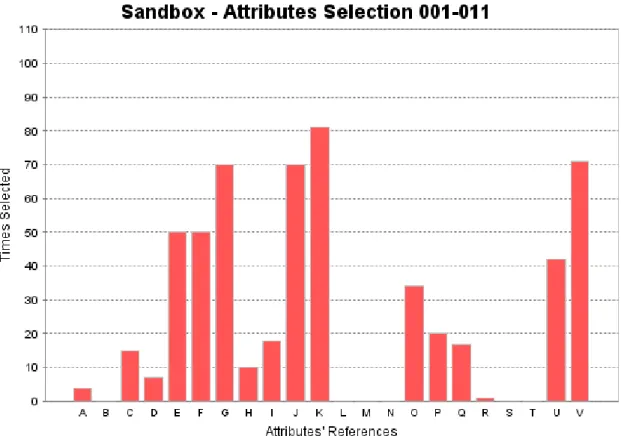
4.1 Precision/recall results of the Sandbox task . . . 42 4.2 Precision/recall results of the IIMB task . . . 43 4.3 Precision/recall results of the Sandbox task - Attributes selection . . . 44 4.4 Times Selected/Attributes’ References of the Sandbox task - Attributes
selection . . . 45 4.5 Precision/recall results of the IIMB task - Attributes selection . . . 46 4.6 Times Selected/Attributes’ References of the IIMB 001-020 - Attributes
selection . . . 47 4.7 Times Selected/Attributes’ References of the IIMB 021-040 - Attributes
selection . . . 48 4.8 Times Selected/Attributes’ References of the IIMB 041-060 - Attributes
selection . . . 49 4.9 Times Selected/Attributes’ References of the IIMB 061-080 - Attributes
selection . . . 50 4.10 Precision/recall results of the Sandbox task - Resample Uniform
Distri-bution . . . 52 4.11 Precision/recall results of the Sandbox task - SpreadSubsample Uniform
Distribution . . . 53 4.12 POWER-Verbetes Alignment sample . . . 55 4.13 POWER-POWER Alignment sample . . . 56
List of Tables
1.1 The milestones set in the Preliminary report . . . 3
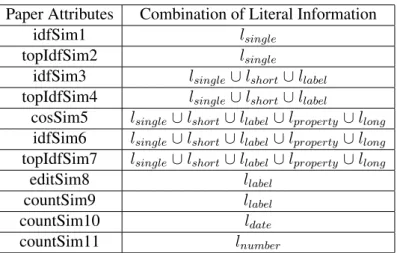
3.1 Paper Attributes overview . . . 29
4.1 Results of the Sandbox task . . . 42 4.2 Results of the IIMB task . . . 43 4.3 Results of the Sandbox task - Attributes selection . . . 44 4.4 Table showing the times each attribute was selected, and their respective
references. Sandbox task - Attributes selection . . . 45 4.5 Results of the IIMB task - Attributes selection . . . 46 4.6 Table showing the times each attribute was selected, and their respective
references. IIMB 001-020 - Attributes selection . . . 47 4.7 Table showing the times each attribute was selected, and their respective
references. IIMB 021-040 - Attributes selection . . . 48 4.8 Table showing the times each attribute was selected, and their respective
references. IIMB 041-060 - Attributes selection . . . 49 4.9 Table showing the times each attribute was selected, and their respective
references. IIMB 061-080 - Attributes selection . . . 50 4.10 Results of the Sandbox task - Resample Uniform Distribution . . . 52 4.11 Results of the Sandbox task - SpreadSubsample Uniform Distribution . . 53 4.12 POWER-DBpediaPT Alignment Results . . . 54
Chapter 1
Introduction
1.1
Motivation
The Semantic Web intends to provide common formats for semantically characterizing data published on the web, improving interoperability and integration of data (Berners-Lee et al., 2001). The Linked Data initiative aims at connecting related data that wasn’t previously linked (Bizer et al., 2009). Ontologies have a crucial role on this, since they provide shared controlled vocabularies to semantically characterize the data in an unam-biguous way.
As defined by Gruber, an ontology is a specification of a conceptualization (Gruber, 2008), that is meant to model some particular domain. The specification of an ontology is composed by two types of statements: TBox (classes) and ABox (instances). TBox are classes which are interpreted as a set of individuals in the domain; ABox are instances which are interpreted as particular individuals of a domain. Moreover, an ontology is also composed by: Relationships or relations between classes and/or instances; Data types are particular parts of the domain which specify values; Data values are simple values (Euzenat and Shvaiko, 2007).
Although an ontology is meant to model some particular domain, there are many on-tologies from different sources modelling the same domain, i.e., there is an overlapping problem. The overlapping problem consists on distinct ontologies representing the same entities in a different manner. It is thus necessary to create processes capable of finding those overlaps and merge them.
Ontology matching is usually applied to align two TBox from two different ontolo-gies, i.e., to find relationships or correspondences between ontological classes. These correspondences are the relation holding, or supposed to hold according to a particular matching algorithm, between classes of different ontologies (Euzenat and Shvaiko, 2007). There is a particular case of ontology matching, the Instance Matching. The goal of instance matching is to align the two ABox from two different ontologies, i.e., to find the correspondences between instances of different ontologies. An instance matching will
Chapter 1. Introduction 2
adopt the principle that the higher is the similarity between two instance descriptions of two distinct ontologies, the higher is the probability of these instances represent the same entity in a given domain. For example, in the political domain, let us consider the current President of the European Commission, Dur˜ao Barroso and assume that Ontology 1 has an instance with the label: “Jos´e Manuel Dur˜ao Barroso”; and Ontology 2 an instance with a label: “Jos´e Dur˜ao Barroso”. Therefore, it is necessary to implement instance matching techniques to find if these two instances of these two different ontologies correspond to the same entity, i.e., if they match. Another example, is the POWER, DBpediaPT and Verbetes ontologies that have instances representing political entities.
1.2
Goals
The objectives of this work were:
Development of instance matching algorithms That aimed at developing algorithms for ontology matching at the instance level, in order to solve instance matching prob-lems. The development of algorithms was based on current instance matching tech-niques already proposed by others;
Real world instance alignments That aimed at applying the algorithms developed to generate high quality matches for real world instances and assess their quality in terms of Precision, Recall, F-measure, Accuracy and Unilateral Accuracy;
Instance matcher Web tool development That aimed at developing a tool capable of performing instance matching through the Web, incorporating the algorithms de-veloped by me.
1.3
Contributions
The contributions of this work are the following:
• Development of instance matching algorithms;
• Real world instance alignments, namely: POWER-DBpediaPT and POWER-Verbetes; • POWER-POWER alignment to help the POWER developers to improve it;
Chapter 1. Introduction 3
1.4
Planning
Date Milestones
1st of October 2012 Familiarization with the work nature
5th of November 2012 First set of instance matching algorithms,Reference alignment and Preliminary report
1st of December 2012 First Tool Prototype, and Reference alignment update 1st of January 2013 Real world instance alignments
1st of February 2013 Second set of instance matching algorithms
1st of March 2013 Second Tool Prototype, and Reference Alignment update 1st of April 2013 Real world instance alignments
1st of May 2013 Master thesis and OAEI 2013 participation
1st of June 2013 Article about the obtained results
Table 1.1: The milestones set in the Preliminary report
The Table 1.1 presents the milestones of the original planning, set for this dissertation in the preliminary report. There was some deviations from the original milestones. The original planning supposed an iteration workflow that did not occur, because during the term of this work, in practice, it did not justify. The OAEI 2013 participation did not happen and an article about the obtained results was not made, due to the additional work caused by the POWER-DBpediaPT alignment. This also contributed to the delay in the delivery of the dissertation report. This milestone suffered a delay of almost 5 months.
Although the OAEI 2013 participation did not occur, it was performed instance align-ments between the ontologies provided by the OAEI 2012, for preparation. OAEI (Ontology Alignment Evaluation Initiative) (Ehrig and Sure, 2005) is an international contest, held every year, that has a track focus on evaluation of instance matching tools and techniques.
1.5
Document Structure
This document is structured as follows:
Chapter 2 – Presents some concepts and subjects necessary to understand this work;
Chapter 3 – Describes the architecture of the system developed and its modules;
Chapter 4 – Presents the results obtained by the system;
Chapter 5 – Shows conclusions and future work.
This work was done in the scope of the Master in Informatics provided by the De-partment of Informaticsof the Faculty of Sciences of University of Lisbon. This work also occurred within the SOMER project (PTDC/EIA-EIA/119119/2010), that is financially supported by the Portuguese Fundac¸˜ao para a Ciˆencia e a Tecnologia.
Chapter 2
Related Work
This chapter presents some concepts and subjects necessary to understand this work and, it also introduces available instance matching resources and techniques that were used in this dissertation.
2.1
Ontologies
In the following sections it is presented the ontologies from where it was performed the instance alignments. It is also presented the sources from where the ontologies are from.
2.1.1
OAEI 2012
The Ontology Alignment Evaluation Initiative (Ehrig and Sure, 2005), held every year, it is an international contest, that among different kinds of competitions, has a track fo-cus on evaluation of instance matching tools and techniques. That evaluation relates to the outcome of these tools and techniques, i.e., the alignments produced by them. The quality of these alignments are evaluated by comparing them with predefined reference alignments, provided by the contest, which are used to produce Precision, Recall and F-measure metrics.
The dissertation focuses on two tasks of the OAEI 20121 instance matching track:
the Sandbox task which is composed by eleven ontologies, and contains light matching problems such as, labels containing light textual changes; and the IIMB task which is composed by eighty ontologies, and contains hard matching problems such as, strong textual changes, and stronger structural and logical transformations. This track has a set of rules to follow: the alignments produced must be between two ontologies, and one of them must be the reference ontology. For example, the Sandbox or IIMB reference ontologies must be matched against each of the ontologies that respectively compose the Sandbox and IIMB tasks. The alignments produced are many-to-many, i.e., one instance
1http://oaei.ontologymatching.org/2012/
Chapter 2. Related Work 6
from one ontology can be matched to multiple instances of the other ontology. Finally, the alignments must respect the .RDF OAEI 2012 format.
Figure 2.1: Sample instance from the Sandbox and IIMB reference ontology
Chapter 2. Related Work 7
Figure 2.3: Sample instance from the IIMB 018 ontology
Figure 2.4: Predefined reference alignment sample
The Figure 2.1 shows that the reference ontologies of both Sandbox and IIMB are duplicates, i.e., have the same type of instances. The difference relies on the ontologies that compose the Sandbox and IIMB tasks. As shown in the Figure 2.3, the properties name, date of birth and gender have suffered more changes in their content than in the instance shown in the Figure 2.2. These three figures represent three different ways of describing the same entity. The entity is this case, is an actor called Andrew Secombe
Chapter 2. Related Work 8
born in 26th of April 1953, belonging to the male gender, and with the profession of actor. More details about the entity is then given by the article property.
The Figure 2.4 shows a sample of a predefined reference alignment, provided by the contest, between the IIMB reference ontology and the IIMB 018 ontology. Each map tag contains within: the pair of instances that are possible to be match, represented by their unique identifiers; the relation between them; and the confidence score of the match, represented by the measure tag. The first map tag of the example, shows that the instance present in the Figure 2.1 and the instance present in the Figure 2.3 are to be matched, because they are referring to the same entity. The alignments produced must be in the format shown in the Figure 2.4.
The OAEI 2012 instance matching track is no longer available, because it has been replaced by the OAEI 2013 instance matching track version. The Sandbox and IIMB group of ontologies of the OAEI 2012 can be accessed through this link:http://lasige. di.fc.ul.pt/webtools/instancematcher/dissertation_work.zip
2.1.2
POWER
POWER - Politics Ontology for Web Entity Retrieval - is an ontology that models the Por-tuguese political domain, that was built and provided by the REACTION group2. More precisely, POWER is an ontology of political processes and entities. It is designed for tracking politicians, political organizations and elections, both in mainstream and social media (Moreira et al., 2012). POWER is an ontology which needs yet to be improved, because it has duplicate instances. This situation in POWER, is considered not to be cor-rect. It is available in the following site:http://dmir.inesc-id.pt/project/ POWER-PT_01_in_English.
Figure 2.5: Sample instance from POWER. In bold, the labels’ references. The labels were the only data from POWER that were used on this dissertation.
Chapter 2. Related Work 9
Figure 2.6: Sample labels from POWER. In bold, the labels’ content from the instance of the Figure 2.5.
2.1.3
DBpediaPT
DBpediaPT is an ontology that contains instances that represent people from the DBpedia version 3.8. Each person is referred in the Portuguese version of Wikipedia. This ontology was built from the Person list3, provided by the REACTION group. I took the list and
converted it into an ontological format (.NT).
Figure 2.7: Sample instances from DBpediaPT
Supporting ontology
The supporting ontology is of the same version of the DBpedia (3.8), and it is available in the following site:http://downloads.dbpedia.org/3.8/pt/. This ontology contains abstract texts for each person of the Portuguese version of Wikipedia, giving several types of information such as the complete name of the person, its nationality, and profession.
Chapter 2. Related Work 10
Figure 2.8: Sample instance from the Supporting ontology. In bold, the complete name, the nationality and the profession, of the person represented in the instance.
2.1.4
Verbetes
Verbetes is an ontology, which instances represent people that have at least five occur-rences in the news aggregated by the SAPO Verbetes service4. I took the list of people
returned by the service and converted it into an ontological format (.NT).
Figure 2.9: Sample instances from Verbetes
2.2
Element-level matching techniques
Terminological approaches (Couto and Pinto, 2013) focus on the descriptors of the classes or of the instances, as opposed to structural approaches that explore the structure of the classes or of the instances, i.e., their relations to other classes or to other instances. The element-level matching techniques encompass several techniques, although only string-based techniques, were used in this dissertation.
String-based techniques (Euzenat and Shvaiko, 2007) are often used in order to match names of ontology entities. They are typically based on the following intuition: the more similar the names/strings, the more likely they denote the same entities. This disserta-tion used the Jaccard Similarity Coefficient (Jaccard, 1912) string-based technique, which given two strings (for example, instance labels) produces a (confidence) score [0,1] that represents the degree of similarity between them. Higher is the score, higher is the proba-bility of these instances correspond to the same entity. This technique measures similarity
Chapter 2. Related Work 11
between strings through the size of the intersection divided by the size of the union of the words composing the strings:
Figure 2.10: Jaccard formula
Source: http://en.wikipedia.org/wiki/Jaccard_index
For example, A = “Jos´e Dur˜ao Barroso”; B = “Dur˜ao Barroso” = |“Dur˜ao”∩“Barroso”|/ |“Jos´e”∪ “Dur˜ao”∪“Barroso”|= 2/3 = 0.66.
2.3
Machine Learning techniques
Machine learning techniques can be used in Instance Matching to determine if two in-stances of two different ontologies correspond or not to the same entity, i.e., if they match. In order to do that, the machine learning system learns, through a set of examples called training set, how to distinguish between matching or non-matching instances. The train-ing set works as empirical data that teaches the system how to predict the matches on input data, i.e., the test set.
The training set is a set of examples which contains many correct matches (positive examples) and incorrect matches (negative examples), that is used to train a classifier, re-sulting in the creation of a model. The model classifies/predicts each example of the test set as belonging to the categories of yes or no match. Furthermore, the model assigns to both of its predictions a probability distribution, that works as a confidence score for its decisions. In the yes category, higher is the probability distribution stronger is the predic-tion; in the no category, lower is the probability distribution stronger is the prediction.
The examples of either training and test sets are organized as a set of features/attributes that are used by the machine learning system as a criteria where it can learn (in the train-ing set) and predict (in the test set). The set of attributes, defined by the developer, can be composed of: the instances’ labels and their length; the Jaccard Similarity Coefficient between the labels; a Boolean value representing if both first and last names of two in-stances’ labels are equal; etc.
In order to implement the machine learning matcher, the Weka software (Hall et al., 2009) provides the necessary packages to do it. Here, the training and test sets are repre-sented in ARFF (attribute-relation format file) format.
Chapter 2. Related Work 12
Figure 2.11: Training set .ARFF example
Figure 2.12: Test set .ARFF example
Chapter 2. Related Work 13
The Figures 2.11 and 2.12 represent examples of training and test sets in the .ARFF format. The .ARFF files have two distinct sections: the Header section, which is com-posed of the name of the relation, a set of attributes and their types (STRING, NU-MERIC, nominal-specification . . . ); the Data section, where each line corresponds to a data to predict and each column, separated by comma, corresponds to the respective attribute.
In these Figures the set of attributes has the following elements: the pair of instances (instanceA and instanceB); the instances’ labels (instanceALabel and instanceBLabel); their length (instanceALabelLen and instanceBLabelLen); a Boolean value representing if both first and last names of two instances’ labels are equal (firstLastSame); the Jaccard Similarity Coefficient between the labels (JCValue). There is also the match? attribute where it is indicated if the pair of instances match (yes) or not (no). In the training set, the attribute is already assigned (yes - positive examples or no - negative examples) in the Data section, in order to teach the system how to distinguish between matching or non-matching instances. And in the test set, the same attribute as a question mark in the Data section, where the system places its prediction (yes or no). Note: in both sets, the STRING type attributes are merely for human information purposes. They are not con-sidered in the processes of training and prediction.
The Figure 2.13 represents the system’s prediction, and the question marks originally from the test set (Figure 2.12), were replaced by yes or no. According to the system’s pre-diction, the pair of instances (“http://instanceA/paulo portas”,“http://instanceB/paulo portas”) and
(“http://instanceA/paulo portas”,“http://instanceB/paulo sacadura cabral portas”)match, i.e., they cor-respond to the same entity. The last value of each line represents the probability distribu-tion of each predicdistribu-tion.
2.3.1
Set of Attributes
As said before, both training and test sets have a set of attributes, defined by the developer, that gives to the machine learning system a set of criteria where it can learn (in the training set) and predict (in the test set). This dissertation used attributes for its instance matching work, that were already proposed in other works. The attributes based on the paper (Rong et al., 2012): double idfSim1; double topIdfSim2; double idfSim3; double topIdfSim4; double cosSim5; double idfSim6; double topIdfSim7; double editSim8; double countSim9; double countSim10; double countSim11; and the attributes proposed by the REACTION group: int name1Len; int name2Len; boolean firstSame; double firstSameEC; boolean lastSame; double lastSameEC; boolean twoLastSame; double twoLastSameEC; boolean firstLastSame; double firstLastSameEC; double jcValue.
There are some considerations to be made about the attributes proposed by the RE-ACTION group. In this dissertation, they were only used for instance’s labels.
Chapter 2. Related Work 14
Figure 2.14: The evidence content formula for a word
Source: (Couto et al., 2005)
The evidence content formula works as follows: the less frequent is a word within a domain, higher is its evidence content. The idea is: if the instance A1from the Ontology
1 and the instance B1 from the Ontology 2 have in their labels the same uncommon word
(low frequency), they are more likely to represent the same entity, i.e., to match.
In this work, the domain corresponds to all instances belonging to the ontologies under process, where the frequency of a word (F req(w)) is just counted once per instance. The M axF req corresponds to the maximum frequency found. A word that is just found once has high evidence content, and a word that corresponds to the maximum frequency has no evidence content.
Figure 2.15: The evidence content formula for a name. The evidence content of a name is the sum of the evidence content of its words.
Source: (Couto et al., 2005)
Considering that a name is composed of a set of words (W ords(n)), its evidence content (N ameEC(n)) is calculated through the sum of the evidence content of them (P W ordEC(w)).
int nameXLen The length of the label of an instance. For example, instance A1with the
label: “blue”; nameXLen = 4. The name1Len and name2Len attributes represent respectively the length of the labels of the pair of instances under process;
boolean firstSame Whether or not two instances have in their labels equal first names. For example, the instance A1 from the Ontology 1 with the label: “jose manuel
durao barroso”; and the instance B1from the Ontology 2 with the label: “jose durao
barroso”. firstSame = true. Moreover, for cases where the labels have just one name, the attribute works as well. For example, the instance A2 from the Ontology
1 with the label: “barroso”; and the instance B2from the Ontology 2 with the label:
“barroso”. firstSame = true;
double firstSameEC It returns the evidence content of the word (Figure 2.14) that rep-resents the equal first name between two instances’ labels. If the first name is not the same, i.e., boolean firstSame = false, it returns 0.0;
Chapter 2. Related Work 15
boolean lastSame Whether or not two instances have in their labels equal last names. For example, the instance A1 from the Ontology 1 with the label: “jose manuel durao
barroso”; and the instance B1 from the Ontology 2 with the label: “jose durao
barroso”. lastSame = true. Moreover, for cases where the labels have just one name, the attribute works as well. For example, the instance A2 from the Ontology
1 with the label: “barroso”; and the instance B2from the Ontology 2 with the label:
“barroso”. lastSame = true;
double lastSameEC It returns the evidence content of the word (Figure 2.14) that repre-sents the equal last name between two instances’ labels. If the last name is not the same, i.e., boolean lastSame = false, it returns 0.0;
boolean twoLastSame Whether or not two instances have in their labels equal two last names. For example, the instance A1 from the Ontology 1 with the label: “jose
manuel durao barroso”; and the instance B1 from the Ontology 2 with the label:
“jose durao barroso”. twoLastSame = true. But, for cases where the labels have just one name, the attribute does not work (it returns false). For example, the instance A2 from the Ontology 1 with the label: “barroso”; and the instance B2
from the Ontology 2 with the label: “barroso”. twoLastSame = false;
double twoLastSameEC It returns the evidence content of the name (Figure 2.15) that represents the equal two last names between two instances’ labels. If the two last names are not the same, i.e., boolean twoLastSame = false, it returns 0.0;
boolean firstLastSame Whether or not two instances have in their labels equal first and last names. For example, the instance A1 from the Ontology 1 with the label: “jose
manuel durao barroso”; and the instance B1 from the Ontology 2 with the label:
“jose durao barroso”. firstLastSame = true. Moreover, for cases where the labels have just one name, the attribute works as well. For example, the instance A2from
the Ontology 1 with the label: “barroso”; and the instance B2from the Ontology 2
with the label: “barroso”. firstLastSame = true;
double firstLastSameEC It returns the evidence content of the name (Figure 2.15) that represents the equal first and last names between two instances’ labels. If the first and last names are not the same, i.e., boolean firstLastSame = false, it returns 0.0;
double jcValue This attributes is related with the Jaccard Similarity Coefficient, already presented in the section: Element-level matching Techniques.
Chapter 2. Related Work 16
There are also some considerations to be made about the attributes based on the paper (Rong et al., 2012).
Figure 2.16: The inverse document frequency formula
Source: http://en.wikipedia.org/wiki/Tf-idf
The inverse document frequency is a measure of whether the term is common or rare across all documents. In this work, the total number of documents (|D|) corresponds to the: Instances(ontology 1) + Instances(ontology 2); each document d correspond to each instance, and each term/word is just counted once per instance. Lower is the number of instances where the word appears, higher is the IDF for that word. The idea is: if the instance A1 from the Ontology 1 and the instance B1 from the Ontology 2 have in their
textual information the same uncommon word (low frequency), they are more likely to represent the same entity, i.e, to match.
double topIdfSim The topIdfSim2, topIdfSim4 and topIdfSim7 attributes are calculated based on the same formula. Given two sets of words T1 and T2, it is extracted
respectively from them, the words with the highest IDF values (topIdf): W1 and
W2. Then, the IDF values of the words from W1 that intersect the words from the
T2, and the IDF values of the words from W2 that intersect the words from the T1,
are all summed. This sum is then divided by the value that results from the sum of the W1 and W2 IDF values;
double idfSim The idfSim1, idfSim3 and idfSim6 attributes are calculated based on the same formula. This formula is the same of the double topIdfSim, but with the difference that the words with the highest IDF values (topIdf) are not extracted. Thus, the W1 and W2represent all the words that make part of the sets of words T1
and T2 respectively, and not just the ones with the highest IDF values;
double cosSim The double cosSim5 attribute is calculated as follows: given two sets of words T1and T2 is computed their cosine similarity5;
double editSim The double editSim8 attribute is calculated through a formula that uses the edit distance principle. Given two sets of words T1 and T2, it is measured the
minimum number of single-character edits necessary to make the T1 and T2 the
same. These edits can be the insertion of a character, the deletion of a character, or the substitution of a character in either T1 or T2. The edit distance algorithm used
was the Levenshtein distance (Levenshtein, 1966);
Chapter 2. Related Work 17
double countSim The countSim9, countSim10 and countSim11 attributes are calculated through a formula that counts the number of common words between two sets of words T1and T2.
2.3.2
Cross-Validation technique
Cross-Validation is a technique for estimating the performance of a predictive model. Here, the training and test sets are from the same dataset. In machine learning approaches is common to use the 10-fold cross-validation, where the dataset is divided into 10 equally (or nearly equally) sized parts/folds. Then, 10 iterations are performed such that within each iteration a different fold is used to validate the model (the fold is used as test set), be-ing the other 9 folds (the trainbe-ing set), along with a classifier, used to generate the model. Furthermore, in the stratified 10-fold cross-validation, the dataset is stratified to make sure that each of the 10 folds contains roughly the same proportions of the two categories (in the context of this work: yes - correct matches and no - incorrect matches). Note: when a fold is used as test set, the already known categories are not considered. Once again, the Weka software provides the necessary packages to implement this technique.
2.3.3
Classifiers
The Weka software already provides several classifiers. The classifiers used in this work are presented in the list below. The criteria to choose them was to encompass a variety of groups of classifiers. The groups are: Trees; Meta; Bayes; Functions; and Neural Networks.
Trees
J48 (Quinlan, 1993) is an open source Java implementation of the C4.5 algorithm in the Weka data mining tool;
Random forests are an ensemble learning method for classification (and regres-sion) that operate by constructing a multitude of decision trees at training time and outputting the class that is the mode of the classes output by individual trees6. The algorithm was developed by Leo Breiman (Breiman, 2001) and Adele Cutler; Random Tree constructs a tree that considers K randomly chosen attributes at each node7.
Meta
Rotation forest (Rodriguez et al., 2006) every decision tree is trained by first apply-ing principal component analysis (PCA) on a random subset of the input features.
6http://en.wikipedia.org/wiki/Random forest
Chapter 2. Related Work 18
Bayes
NaiveBayes classifier (John and Langley, 1995) is a simple probabilistic classifier based on applying Bayes’ theorem with strong (naive) independence assumptions8.
Functions
SMO (Platt, 1998) implements John Platt’s sequential minimal optimization algo-rithm for training a support vector classifier9.
Neural Networks
Multilayer Perceptron (Rosenblatt, 1961) utilizes a supervised learning technique called back propagation for training the network.
2.4
Performance Evaluator
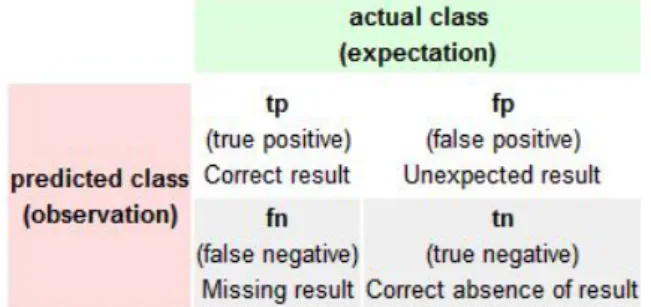
The Precision, Recall and Accuracy metrics are used to assess the quality of the align-ments produced by the instance matching techniques, and they are calculated when the comparison between the alignment and the reference alignment is made. The alignment can be one-to-one or many-to-many. In the first case, each instance is only present once in the alignment, i.e., there are no more than one match per instance; in the second case, each instance can be present several times in the alignment, i.e., it can be more than one match per instance. Furthermore, there is also the F-measure metric that is the harmonic mean of Precision and Recall.
In order to calculate these metrics it is necessary to make the further calculation:
Figure 2.17: Classification table
Source:http://en.wikipedia.org/wiki/Precision_and_recall
Actual class (expectation) = Reference alignment Predicted class (observation) = Alignment
Instances (ontology a) = {a1,...,an}
Instances (ontology b) = {b1,...,bm}
8http://en.wikipedia.org/wiki/Naive Bayes classifier
Chapter 2. Related Work 19
Reference alignment = {(ai,bj),...} 1<= i <=n and 1<= j <=m
Alignment = {(ak,bl),...} 1<= k <=n and 1 <= l <=m
Total domain (one-to-one) = ref erence alignment + Instances(ontology a) − ref erence alignment + Instances(ontology b) − ref erence alignment
Total domain (many-to-many) = Instances(ontology a) ∗ Instances(ontology b)
TP ={(ax, by) : (ax, by) in alignment and (ax, by) in ref erence alignment}
= {alignment ∩ ref erence alignment}
FP = {(ax, by) : (ax, by) in alignment and (ax, by) not in ref erence alignment}
= {alignment − T P }
FN = {(ax, by) : (ax, by) not in alignment and (ax, by) in ref erence alignment}
= {ref erence alignment − T P }
TN = {(ax, by) : (ax, by) not in alignment and (ax, by) not in ref erence alignment}
= {total domain − {alignment + {ref erence alignment − T P }}}
Precision: is the fraction of correct matches in the alignment. The correct matches are the matches present in the reference alignment.
Figure 2.18: Precision formula
Source:http://en.wikipedia.org/wiki/Precision_and_recall
Recall: is the fraction of matches of the reference alignment that are present in the align-ment.
Figure 2.19: Recall formula
Source:http://en.wikipedia.org/wiki/Precision_and_recall
F-measure: is the average of Precision and Recall rates.
Figure 2.20: F-measure formula
Chapter 2. Related Work 20
Accuracy: is the fraction of true results over all the matching possibilities (total domain) between the ontologies aligned.
Figure 2.21: Accuracy formula
Source:http://en.wikipedia.org/wiki/Precision_and_recall
2.5
PHP built-in Functions
PHP10 is a server-side scripting language designed mainly for web development, which provides several built-in functions.
1. trim function — Strip white space (or other characters) from the beginning and end of a string.
2. strip tags function — Strip HTML and PHP tags from a string.
3. htmlentities function — Convert all applicable characters to HTML entities; flags: ENT QUOTES Will convert both double and single quotes; encoding: UTF8 -ASCII compatible multi-byte 8-bit Unicode.
4. urlencode function — URL-encodes string. This function is convenient when en-coding a string to be used in a query part of a URL, as a convenient way to pass variables to the next page.
Chapter 3
Implementation
This chapter describes the architecture of the system developed and its modules. The system’s main goal was solving OAEI 2012 and POWER instance matching problems, as any other instance sets following the same formats.
3.1
System Architecture
This section presents the input and output of the system, its modules, their relations, and the data that flows between them.
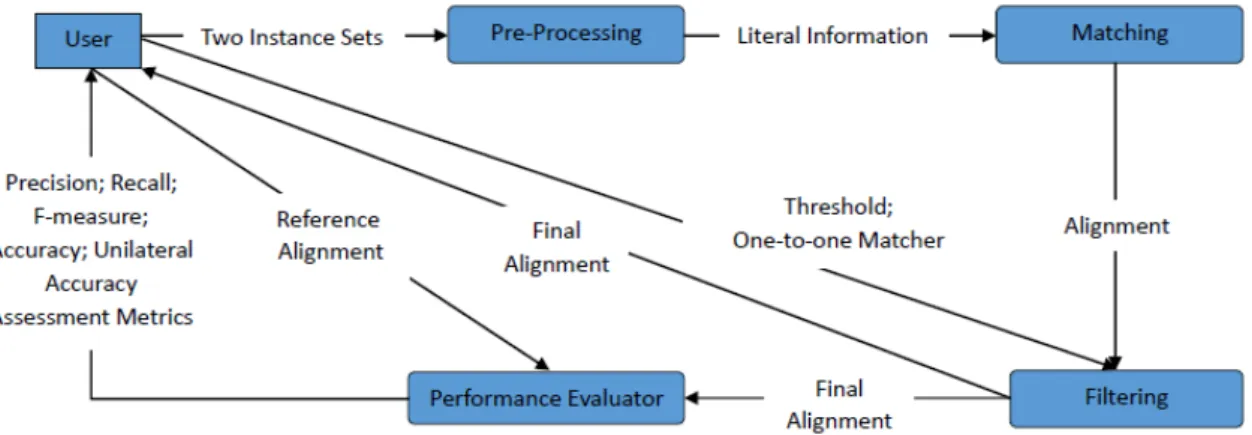
Figure 3.1: Overview of the System. This Figure shows the modules that are part of the system, the data flow between them, the user input and what it receives as output.
Based on: (Larman, 2004)
The system receives as input two instance sets introduced by the user of the system, and produces to the output the final alignment. The final alignment is composed of: in-stances for which was identified a match, i.e., the pairs of inin-stances matched; the inin-stances to which no match was identified, i.e., the instances matching to NULL; and their con-fidence score. The concon-fidence score [0,1] represents the probability of each match to be true. Optionally, the user can also input a reference alignment. This allows the system to output metrics that attest the quality of the final alignment, by comparing it with the
Chapter 3. Implementation 22
reference alignment. It is assumed that the reference alignment contains all the correct matches between the two instance sets.
In order to do that, the system on receiving as input the two instances sets, performs a pre-processing operation, in order to extract the data of each instance, i.e., the literal information. This is fundamental to perform the instance matching process because, it provides to the matcher the necessary information to determine if two instances corre-spond to the same entity or not, i.e., if they match. The outcome of it is the alignment. Furthermore, before becoming the final alignment, is applied to it a filtering process. This process receives two parameters given by the user on input. The first parameter is the Threshold and allows the user to select the minimum confidence score (0.0 by de-fault) of the matches to be included in the final alignment; and the second parameter is the one-to-one matcher, which is optional, and guarantees that in the final alignment, each instance is only present once in the final alignment, i.e., there are no more than one match per instance. If a reference alignment is given as well, the final alignment is assessed in its performance, through the metrics of Precision, Recall, F-measure, Accuracy and Unilateral Accuracy.
3.2
Pre-Processing
This module receives as input two instance sets, introduced by the user of the system, and through the Apache Jena1, extracts the literal information belonging to each instance.
The literal information of an instance is the textual content of its properties, and can be composed of: labels, dates, articles, codes, etc. For example, the following instance representation:
<instance:Instance rdf:about="http://tool.for.ontology.instance.matching/jose_manuel_durao_barroso"> <instance:name>Jos´e Manuel Dur˜ao Barroso</instance:name>
<instance:date_of_birth>23/03/1956</instance:date_of_birth>
<instance:article>Jos´e Manuel Dur˜ao Barroso ´e um pol´ıtico e professor portuguˆes, actual presidente da Comiss˜ao Europeia, cargo que ocupa desde Novembro de 2004. Em Portugal, foi sub-secret´ario do minist´erio dos assuntos internos, em 1985, e ministro dos Neg´ocios Estrangeiros em 1992.
Entre 2002 e 2004, ocupou o cargo de primeiro-ministro da Rep´ublica Portuguesa. </instance:article>
</instance:Instance>
Above, is shown an instance, represented in .RDF, corresponding to the Portuguese politi-cian Dur˜ao Barroso. The first line, is the URI of the instance. The following lines corre-spond to the properties of the instance: name (label), date of birth, and article. The content of the properties is the literal information: Jos´e Manuel Dur˜ao Barroso, 23/03/1956, Jos´e Manuel Dur˜ao Barroso ´e um pol´ıtico e professor portuguˆes...
This pre-processing operation returns two objects, corresponding to each instance set introduced, that maps each instance to the correspondent literal information. Because, this system only deals with the labels of the instances, in order to be able to perform instance matching between all kinds of instance sets, only the literal information corresponding to
Chapter 3. Implementation 23
the labels is extracted. This pre-processing operation was applied in the POWER, DBpe-diaPT and Verbetes instance sets.
However, for the OAEI 2012 matching problem the pre-processing operation had to be different. The literal information extracted corresponded to the properties such as: name and amount (both considered as labels); article; date of birth; form of government; capital; etc. Furthermore, it was also necessary to recur to the SPARQL provided by the Apache Jena to identify the instances, because this international contest introduced transformations at logical level that made harder to identify them.
3.2.1
Pre-Processing Sub-Modules
In the sub-sections below are described the pre-processing sub-modules, that are respon-sible for cleaning the literal information of the instances. This is done, with the purpose of putting all of them in the same textual conditions, in order to enhance the matchers performance.
Diacritical Eliminator
This sub-module is responsible for eliminating the diacritics that might exist in the literal information of an instance. For example, an instance with the label: “Jos´e Manuel Dur˜ao Barroso” is transformed to “Jose Manuel Durao Barroso”, by removing the accents. It was applied in POWER, DBpediaPT and Verbetes, because their labels were in Portuguese.
Literal Information Normalizer
This sub-module is responsible for performing a deeper cleaning operation on the literal information of the instances. Because, this system only deals with the labels of the in-stances, the cleaning process consists of: putting the labels to lower case; remove all contents placed within parentheses; remove all non-word characters; replace all under-score characters for a single white space; replace all multiple white spaces for a single one; remove the characters that are duplicate in row in each word; and finally, an op-eration of trim is executed. This process was applied in the POWER, DBpediaPT and Verbetes instance sets.
However, for the OAEI 2012 matching problem had to be created a different literal information normalizer. Because, it was introduced strong textual changes in the literal information of the properties. These changes were generally random text and words mod-ifications. To face and overcome it, the cleaning process consisted of: putting the literal information to lower case; remove all contents placed within parentheses; remove all non-word characters; replace all underscore characters for a single white space; replace all multiple white spaces for a single one; separate numbers from characters in a word; remove the characters that are duplicate in row in each word; remove single characters; remove the words that do not have vowels nor numbers; and finally, an operation of trim is executed. This process of normalization was not perfect and could sometimes produce errors by eliminating some important information. But, the harmful text that it cleaned paid off.
Chapter 3. Implementation 24
3.3
Matching
This module is responsible for performing instance matching between the instance sets introduced (already pre-processed), and to return the alignment. Basically, the instance matching mechanism tries to match each instance of one instance set with each instance of the other instance set.
3.3.1
Element-level matcher
This sub-module implements the FirstLastNamePlusJaccard matcher. This matcher, is an algorithm that considers a match the instances that have in their labels equal first and last names. The confidence score of each match is set by the Jaccard Similarity Coefficient (Jaccard, 1912) between the two labels. If the instances have multiple labels, each pair of labels are evaluated in their first and last names. In case of draw, i.e., in cases that there are more than one pair of labels that matches, the pair of labels that wins, is the one that has the highest confidence score set by the Jaccard Similarity Coefficient.
For example, assume that Instance set 1 has an instance with the labels: “jose manuel durao baroso” and “durao baroso”; and Instance set 2 has an instance with the labels: “jose durao baroso” and “durao baroso”. The matcher will match these two instances, be-cause the pairs of labels (“jose manuel durao baroso”,“jose durao baroso”) and (“durao baroso”,“durao baroso”), have the same first and last names. The confidence score of the match is set by the pair (“durao baroso”,“durao baroso”,1.0), because it is higher than the other pair (“jose manuel durao baroso”, “jose durao baroso”,0.75). Moreover, for cases where the labels have just one name the matcher works as well. Assume that Instance set 1 has an instance with the label: “durao”; and Instance set 2 has an instance with the label: “durao”; the matcher will consider that these two instances have the same first and last names. This matcher was used as baseline in the results presented in the Results Chapter 4.
3.3.2
Machine Learning matcher
This sub-module implements the machine learning matcher, through the Weka software (Hall et al., 2009). To decide which pairs of instances are to be matched or not, this matcher uses a model, whose training set was created from the POWER instance set against the DBpediaPT instance set, and classified by the Rotation Forest. This classi-fier was chosen because it proved to be one of the top classiclassi-fiers during the OAEI 2012 tests, as explained in the Results Chapter 4. This matcher only deals with the labels of the instances, in order to be able to perform instance matching between all kinds of in-stance sets. For that reason, the machine learning attributes that it uses, are based on the labels of the instances. These attributes are: boolean firstSame; double firstSameEC; boolean lastSame; double lastSameEC; boolean twoLastSame; double twoLastSameEC; boolean firstLastSame; double firstLastSameEC; double jcValue; double editSim; double countSim. The last two attributes are based on the paper (Rong et al., 2012). Note: the int name1Len and the int name2Len attributes, are not present in the set, because they were never selected during the attribute selection exercise, that is presented in the Results Chapter 4. Because the instance sets can have several labels for each instance, it is
pos-Chapter 3. Implementation 25
sible to use them as synonyms to improve the matching possibilities. The pair of labels that produces the highest non-boolean attributes sum, chooses the related attribute values (including the boolean attributes) that will represent the pair of instances in the matching process.
This matcher was used in the POWER-Verbetes and in the POWER-POWER align-ment, that are mentioned in the Results Chapter 4.
3.3.3
Instances matching to NULL
In both matchers, they assign a confidence score to the instances matching to NULL. An instance that matches to NULL, is an instance that was not matched to any other instance of the other instance set. However, the matchers assign a score for each match, even if it is a no match. The confidence score of an instance matching to NULL is set by the formula: 1 − (M axScore). Where the second term of the formula, is the maximum score, among the no matches, assigned by the matcher for that instance. Then, it is subtracted by one, because the higher a confidence score is, the lowest is the probability of not having a matching instance in the other set.
Figure 3.2: NULL’s confidence score setting by the instance matching process.
The Figure 3.2 shows how the confidence score of an instance matching to NULL is set by the instance matching process. The instance A1 of the Instance set 1, matches to
NULL because, the matcher did not match it to no-one (match:no to all instances of the Instance set 2). But, it assigned a score to each instance matching assessment (score: X). The maximum score is chosen (green box - score: 0,8), and the other ones are rejected (red boxes). At the end, the instance A1 is matched to NULL, and the confidence score is
Chapter 3. Implementation 26
3.4
Filtering
This module implements a set of filters on the alignment returned by the matching pro-cess. The set of filters is composed by two parameters given by the user. This module is also responsible for outputting the final alignment.
Threshold is the first parameter, and allows the user to select the minimum confidence score [0,1] of the matches to be included in the final alignment. Only the pairs of instances matched and the instances matching to NULL, that have their confidence score within the threshold are going to be present in the final alignment. All the results presented in the Results Chapter 4, were produced within a threshold of 0.0.
The second parameter is the one-to-one matcher, which is optional, and guarantees that each instance is only present once in the final alignment, i.e., there are no more than one match per instance. This can be done by using the bipartite graph matching approaches. This approach divides the pair of instances matched, into two disjoint sets, being each set composed by the instances of the same instance set. In this case, it matches one instance of one disjoint set to only one instance of the other disjoint set, guaranteeing that the confidence score of the match is the highest possible for the instances composing the pair. This is not valid for the (A) labels-sum+alphabetic-order one-to-one matcher, whose algorithm is explained below. Note: the instances matching to NULL are not con-sidered in this process, because they do not pair to any instance of the other disjoint set. This module incorporates three one-to-one matchers, each one having their own criteria to choose the instances that should pair. The matchers are: (A) labels-sum+alphabetic-order; (B) confidence-score+attribute-sum; Hungarian Algorithm (Kuhn, 1955), that is an algorithm for constructing a maximum weight perfect matching in a bipartite graph.
The (A) one-to-one matcher is based on two criteria. For example, given the instances A1 with the label “a1”, A2 with the label “a2”, and A3 with the label “a3”, from the
In-stance set 1, that are matched with the inIn-stance B1with the label “b1”, from the Instance
set 2. The first criteria, chooses the pair whose the sum of their labels length is the high-est; if there is a draw (in the example there is, because “a1b1”, “a2b1”, “a3b1” length is four), the second criteria chooses the pair, within the tied pairs, that is in the first place of the alphabetic order. To assess that, the labels of the pair of instances are concatenated. If there is still a draw, the pair chosen is randomly selected among the pairs that are placed in first. Following the example, the pair (A1,B1) is chosen, this means that the instances
A2 and A3 are excluded. In this scenario, they are matched to NULL because they do
not match to any other instance. It is also assigned a new confidence score for these two instances. Once again, they are going to be present in the final alignment, only if their (new) confidence scores are within the threshold.
As the previous matcher, (B) one-to-one matcher is based on two criteria as well. The first criteria is the highest confidence score, and the second criteria is the highest attribute sum. The attribute sum for each pair is set by the matchers. In the machine learning matcher, it corresponds to the sum of the non-boolean attributes. In the FirstLastName-PlusJaccard matcher, it corresponds to the double editSim and double countSim sum.
If the one-to-one matcher parameter is not chosen, matches of one instance from one disjoint set to multiple instances of the other disjoint set (many-to-many matches), may appear in the final alignment. In practice, the alignment will just be transformed into the final alignment (after the Threshold selection).
Chapter 3. Implementation 27
3.4.1
Instances matching to NULL
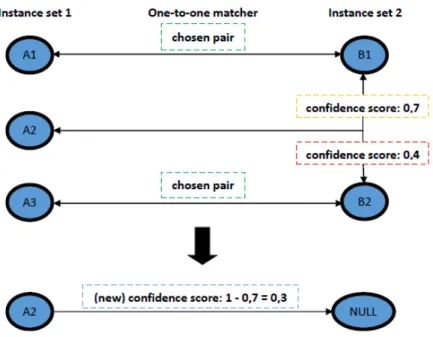
As said before, in the one-to-one matcher there can be instances when are excluded match to NULL, because they do not match to any other instance. In this case, a new confidence score is assigned to these instances. The formula is 1 − (M axScore), which was already introduced in a previous section. Following the example above, the second term of the formula is the confidence score of the match of the instance excluded.
Figure 3.3: NULL’s confidence score setting in the one-to-one matcher - scenario 1
The Figure 3.3 shows how the new confidence scores of the instances of the example are set. The instances A2 and A3 of the Instance set 1 were excluded of the match with
the instance B1 of the Instance set 2. These instances are then matched to NULL, being
their respective confidence scores (red boxes - confidence score: X) subtracted by one, assigning to these instances new confidence scores (blue boxes - (new) confidence score: 1 - X = Y).
Furthermore, there can be situations where an instance is excluded from several matches. In this case, the second term of the formula is the maximum confidence score among the matches of the instance excluded.
Chapter 3. Implementation 28
Figure 3.4: NULL’s confidence score setting in the one-to-one matcher - scenario 2
The Figure 3.4 shows how the confidence score of an instance that was excluded by the one-to-one matcher is set. The instance A2 of the Instance set 1 matches to NULL
because, the one-to-one matcher decided to match the instances B1 and B2 from the
In-stance set 2, to other inIn-stances from the InIn-stance set 1 (green boxes - chosen pair). The maximum confidence score among the matches of the instance A2is chosen (yellow box
-confidence score: 0,7), and the instance is matched to NULL with a new -confidence score assigned (blue box - (new) confidence score: 1 - 0,7 = 0,3).
3.5
Performance Evaluator
This module is responsible for assessing the quality of the final alignment returned by the filtering module. In case the user gives as input a reference alignment, which contains all the correct matches between the instance sets, it is calculated and produced to the output the following performance metrics: Precision; Recall; F-measure; and Accuracy.
Furthermore, this module also calculates the Unilateral Accuracy metric for each in-stance set. This metric shows the number of inin-stances of each inin-stance set, that are correctly matched over the total of instances composing the respective instance set. In this context, correctly means the instances that are matched in the final alignment that are present in the reference alignment; and the instances matching to NULL in the final alignment that are not present in the reference alignment.
In the sections below, it is presented the part of this work where it was implemented the cross-validation technique. This part was used to evaluate the cross-validation matcher performance and therefore to produce metrics.