Universidade Nova de Lisboa
Faculdade de Ciências e Tecnologia
Department of Computer Science
Extensible Metadata Repository for
Information Systems
by Pedro Honrado Rio Pereira
Thesis submitted to Faculdade de Ciências e Tecnologia of the Universidade Nova de Lisboa, in partial fulfillment of the requirements for the degree of Master in Computer Science
Supervisor: PhD João Moura Pires
Resumo
Sistemas de informação são, muitas vezes, sistemas com uma componente de integração de informação muito forte. Alguns desses sistemas recorrem a soluções de integração fazendo uso de metainformação (informação que descreve informação). É necessário lidar com essa metainformação e geri-la do mesmo modo que se faz com informação “normal”, para tal a existência de um repositório de metadados que garanta o armazenamento, integridade, validade e facilite os mecanismo de integração do sistema de informação é uma escolha lógica.
Existem vários repositórios disponíveis no mercado, mas nenhum virado para as exigências dos sistemas de informação, genérico o suficiente e com as características de integração necessárias. No projecto SESS, da agência espacial europeia (ESA), foi desenvolvido um repositório de metadados genérico, baseado em tecnologias XML. Esse repositório proporcionava mecanismos de integridade, validade, armazenamento, partilha, publicação, importação, integração de sistemas e de dados, mas obrigava à utilização de regras sintácticas fixas, colocadas dentro dos documentos XML, o que dificultava a integração de documentos de fontes externas.
Nesta tese desenvolveu-se um repositório de metadados, com base em tecnologias XML, que proporciona os mesmos mecanismos de armazenamento, integridade, validade, etc, mas que tem em atenção a capacidade de integrar, de forma fácil, metainformação estrangeira de qualquer tipo (em formato XML) e que é capaz de proporcionar um ambiente onde o reaproveitamento dos tipos de metadados para a construção de novos tipos de metadados é uma constante, sem ter necessidade de modificar os documentos que armazena.
O repositório armazena documentos XML, denominados de Instâncias, que são instâncias de um Conceito, esse Conceito define uma estrutura XML Schema que valida as Instâncias. Para lidar com o reaproveitamento, foram criadas unidades chamadas Fragmentos, que permitem definir uma estrutura XML Schema (que pode ser criada à custa da composição de outros Fragmentos) que pode ser reutilizada por Conceitos para definir a sua própria estrutura. Os elementos do repositório (Instâncias, Conceitos e Fragmentos) têm um identificador próprio baseado em (e compatível com) URIs, denominado MRI (Metadata Repository Identifier). Esses identificadores assim como informações de relacionamento e de gestão são geridas pelo repositório evitando assim a utilização de regras sintácticas fixas, facilitando a integração.
Abstract
Information Systems are, usually, systems that have a strong integration component and some of those systems rely on integration solutions that are based on metadata (data that describes data). In that situation, there’s a need to deal with metadata as if it were “normal” information. For that matter, the existence of a metadata repository that deals with the integrity, storage, validity and eases the processes of information integration in the information system is a wise choice.
There are several metadata repositories available in the market, but none of them is prepared to deal with the needs of information systems or is generic enough to deal with the multitude of situations/domains of information and with the necessary integration features. In the SESS project (an European Space Agency project), a generic metadata repository was developed, based on XML technologies. This repository provided the tools for information integration, validity, storage, share, import, as well as system and data integration, but it required the use of fix syntactic rules that were stored in the content of the XML files. This situation causes severe problems when trying to import documents from external data sources (sources unaware of these syntactic rules).
In this thesis a metadata repository that provided the same mechanisms of storage, integrity, validity, etc, but is specially focused on easy integration of metadata from any type of external source (in XML format) and provides an environment that simplifies the reuse of already existing types of metadata to build new types of metadata, all this without having to modify the documents it stores was developed. The repository stores XML documents (known as Instances), which are instances of a Concept, that Concept defines a XML structure that validates its Instances. To deal with reuse, a special unit named Fragment, which allows defining a XML structure (which can be created by composing other Fragments) that can be reused by Concepts when defining their own structure. Elements of the repository (Instances, Concepts and Fragment) have an identifier based on (and compatible with) URIs, named Metadata Repository Identifier (MRI). Those identifiers, as well as management information (including relations) are managed by the repository, without the need to use fix syntactic rules, easing integration.
Agradecimentos
Quero agradecer a toda a minha família, em especial ao meu pai José, à minha mãe Isabel e ao meu irmão Tiago, pelo amor e respeito dado e ensinado ao longo da minha vida. Obrigado por sempre me terem apoiado e por me terem dado tudo para eu conseguir chegar onde cheguei hoje. Votos de saúde e felicidade para todos.
Obrigado ao orientador, supervisor e colega Professor João Moura Pires. A sua participação neste projecto foi vital, em primeiro lugar por me ter proposto o desafio e em segundo por ter trabalhado nele comigo. Aprendi imenso consigo e espero voltar a ter a oportunidade de trabalhar novamente consigo.
Obrigado a todos os colegas que partilharam o gabinete 244 durante o tempo que estive lá enquanto fazia o mestrado, a vossa contagiante boa disposição foi uma grande ajuda.
Obrigado a todos os colegas de faculdade que de um modo ou de outro me ajudaram a chegar onde cheguei, particularmente os auto-denominados “Culelos” e em particular o colega que me acompanhou durante todo o curso e parte do mestrado, o Pedro Andrez.
Index
Chapter 1 Introduction ... 1
1.1. Motivation ... 3
1.2. Context ... 4
1.3. Objective ... 7
1.4. Thesis Structure ... 7
Chapter 2 State of the Art ... 9
2.1. Metadata in Organizations ... 10
2.1.1. The Use and Management of Metadata ... 11
2.2. XML Technologies ... 12
2.2.1. Definition of XML Vocabularies and Validation ... 12
2.2.2. XML Processing ... 13
2.2.3. Querying and Updating XML ... 14
2.3. Semantic Web ... 15
2.3.1. RDF ... 18
2.3.2. OWL... 20
2.3.3. Simple Knowledge Organization System ... 21
2.3.4. State of the Semantic Web and its applicability to organizations ... 21
2.4. Metadata Repositories and Tools ... 24
2.4.1. Repository In a Box ... 24
2.4.2. DSpace ... 25
2.4.3. Protégé ... 26
2.4.4. Fedora ... 29
2.4.5. Extensible Metadata Repository for Information Systems ... 31
2.5. Metadata Management Technologies and Repositories Appreciation ... 36
Chapter 3 Architecture Design ... 39
3.1. Requirements ... 41
3.2. Architecture ... 42
3.3. Information Model ... 43
3.4. M0 Layer (External Entities) ... 43
3.5. M1 Layer (Instances) ... 44
3.5.1. Instance Versions ... 45
3.5.2. Instance Relations ... 46
3.6. M2 Layer (Concepts)... 49
3.6.1. Fragments ... 49
3.6.2. Concepts ... 50
3.7. M3 Layer – Meta-meta-model ... 54
3.7.1. Evaluation ... 54
4.1. Metadata Repository Identifiers (MRI) ... 56
4.1.1. Instance Identification ... 57
4.2. Concept & Fragment Definition ... 57
4.2.1. Fragment Definition Language ... 58
4.2.2. Concept Definition Language ... 65
4.3. Metadata Validation and Integrity ... 76
4.3.1. Fragment Validation & Integrity ... 76
4.3.2. Concept Validation & Integrity ... 77
4.3.3. Instance Validation & Integrity... 78
4.3.4. Instance Relations, Creation & Validation... 78
4.4. System Concepts and Instances ... 80
4.5. Metadata Querying and Transforming ... 80
4.5.1. XQuery ... 81
4.5.2. Transforms ... 82
4.5.3. Generic Transforms ... 83
Chapter 5 Implementation ... 87
5.1. Technologies ... 88
5.2. Architecture Design Implementation ... 88
5.2.1. High Level Architecture ... 89
5.2.2. Low Level Architecture ... 89
5.3. Choice for the Underlying Database of the Storage Model ... 90
5.3.1. eXist XML Database ... 91
5.3.2. Sedna XML Database ... 91
5.3.3. Berkeley DB XML ... 92
5.3.4. Query Benchmarking ... 94
5.3.5. Storage Benchmarking ... 98
5.3.6. Final Evaluation ... 100
5.4. Storage Model ... 101
5.4.1. Concept Storage ... 101
5.4.2. Fragment Storage Model ... 102
5.4.3. Instance Storage Model ... 103
5.4.4. Additional System Management Information ... 104
5.4.5. Complete Storage Model ... 106
5.4.6. Access Permissions ... 106
5.5. Information Model ... 107
5.5.1. M2 Layer – Meta-model ... 107
5.5.2. M1 Layer - Model ... 109
5.6. Querying and Transforming ... 111
5.6.1. Repository Built-in XQuery Functions ... 115
5.7. Implementation Status ... 115
Chapter 6 Validation ... 119
6.1.2. Reusability Test ... 125
6.2. ITDS - Xeo ... 129
6.2.1. Evaluation ... 131
Chapter 7 Conclusions and Future Work ... 133
7.1. Conclusions ... 134
7.2. Future Work ... 136
Figure Index
Figure 1.1 SESS project architecture, taken from [1] ... 5
Figure 1.2 MOF model, taken from [1] ... 6
Figure 2.1 Semantic Web Layer Stack ... 16
Figure 2.2 RDF Example ... 19
Figure 2.3 RDF with multiple examples ... 19
Figure 2.4 RDF Graph ... 20
Figure 2.5 Semantic Web Layer Stack with Datalog Rules ... 23
Figure 2.6 Protégé-Frames editor ... 27
Figure 2.7 Protégé-Frames Query Interface ... 28
Figure 2.8 Protégé-OWL - Ontolgy Visualization Plugin ... 29
Figure 2.9 Fedora's online catalog ... 30
Figure 2.10 Fedora's Object Model... 30
Figure 2.11 MOF model in the context of the MDR, taken from [1] ... 31
Figure 2.12 Instance processing and transforming capabilities, taken from [1]... 33
Figure 2.13 Relationship syntax in a SESS Instance ... 34
Figure 2.15 Instance with outlined rules required by the MDR ... 35
Figure 2.14 Concept with outlined rules required by the MDR ... 35
Figure 3.1 Architecture of the Metadata Repository... 42
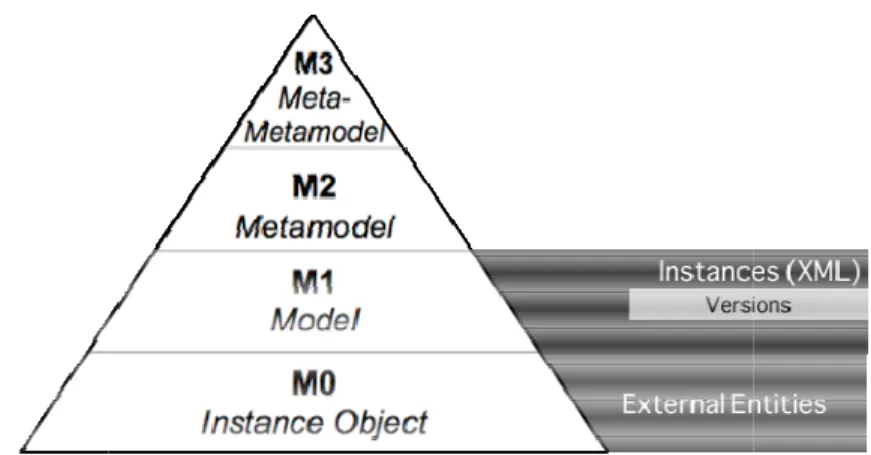
Figure 3.2 MOF layered architecture ... 43
Figure 3.3 M0 Layer - External Entities ... 44
Figure 3.4 M1 Layer: Instances ... 44
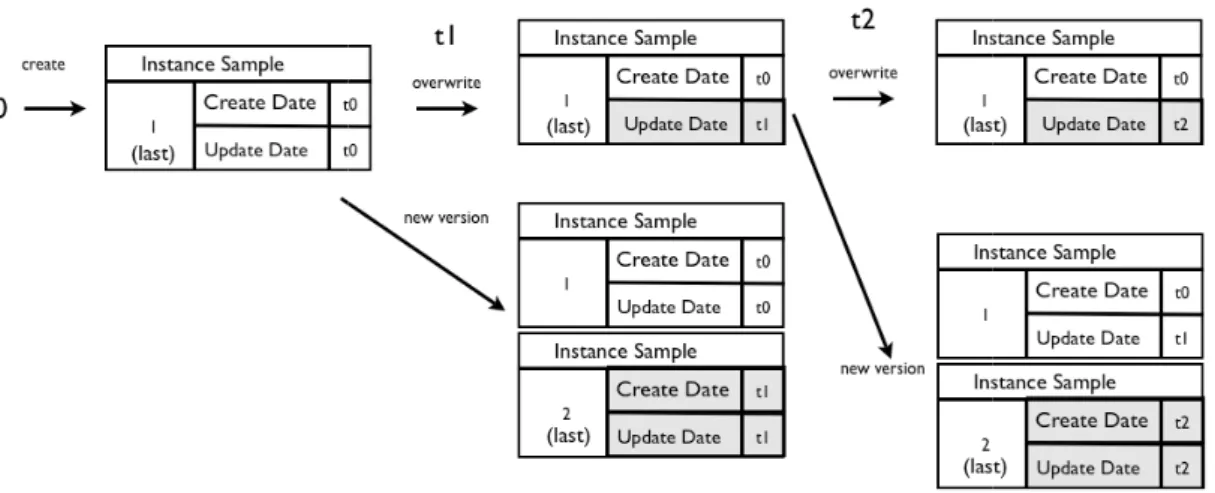
Figure 3.5 Temporal evolution of Instance versions ... 45
Figure 3.6 Instance Version Control Fields and Modification Notation ... 45
Figure 3.7 Information Model with Instance Versions ... 46
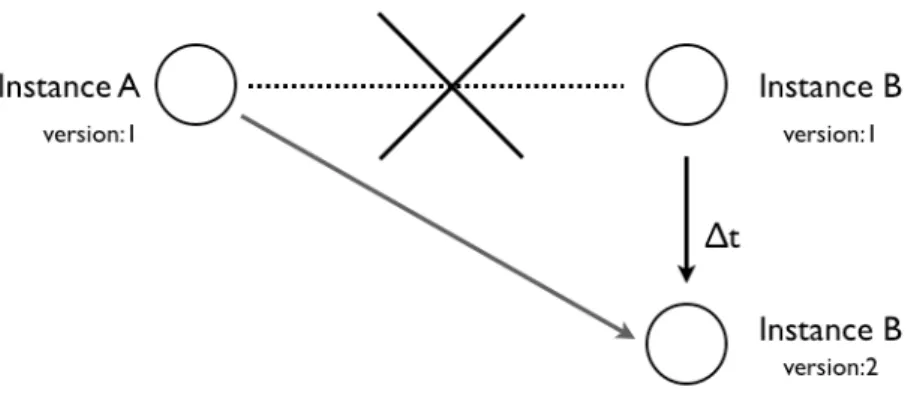
Figure 3.8 Relation between two Instances ... 47
Figure 3.9 Instance Relation with a Locking Version ... 47
Figure 3.10 Instance Relation with "Last Version" ... 48
Figure 3.11 M1 Layer, Instances with Relations and Versions... 49
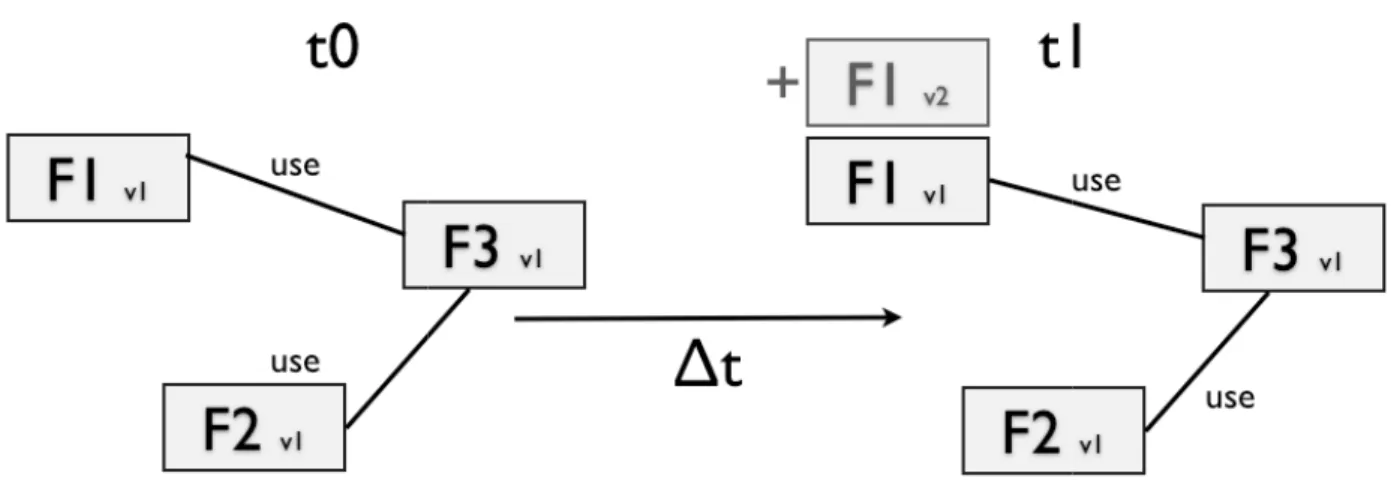
Figure 3.12 Fragment versions ... 50
Figure 3.13 Automatic Relation based on identifiers ... 52
Figure 3.14 Content Relations ... 52
Figure 3.15 M2 Layer, with Concept and Fragment Versions ... 53
Figure 3.16 Full Information Model, with M3 Layer ... 54
Figure 4.1 Fragment main structure ... 58
Figure 4.2 Fragment definition ... 59
Figure 4.3 Embedded XML Schema in a Fragment definition ... 59
Figure 4.4 GlobalComposition element converted to XML Schema ... 60
Figure 4.5 Global Composition with Attributes ... 60
Figure 4.6 Structure of a Sequence element ... 61
Figure 4.7 Structure of the Schema element ... 62
Figure 4.8 Correspondence of a Fragment definition and XML Schema ... 63
Figure 4.9 Use of local embedded XML schema in a Fragment definition ... 63
Figure 4.10 Use of Constant Annotation in Fragment definition ... 64
Figure 4.11 Structure of a XSL element ... 64
Figure 4.12 XSL code used in element XSL ... 65
Figure 4.13 Generic Structure of a Concept ... 66
Figure 4.16 Concept structure definition referencing a Fragment ... 67
Figure 4.17 Schematron list syntax ... 68
Figure 4.18 Structure of the Schematron element ... 68
Figure 4.19 Schematron element with embedded Schematron code ... 69
Figure 4.20 Schematron element with reference ... 69
Figure 4.21 XSLList element syntax and usage ... 70
Figure 4.22 Syntax of the Relations element ... 70
Figure 4.23 List of valid target Concepts for a relation ... 71
Figure 4.24 Syntax of the Cardinality element... 71
Figure 4.25 Automatic Relation based on content syntax ... 72
Figure 4.26 Definition of targets for the automatic relation based on content ... 72
Figure 4.27 Usage of the LocalInstanceXPath element ... 73
Figure 4.28 RemoteInstanceXPath element syntax ... 73
Figure 4.29 Syntax of the behavior of a relation ... 73
Figure 4.30 Syntax for the behavior (update) of a relation ... 74
Figure 4.31 Syntax for the creation of automatic annotations of relations... 74
Figure 4.32 Structure of the AutoRelMRI element ... 75
Figure 4.33 Structure of the AutoRelContent element ... 75
Figure 4.34 Syntax for constant annotations to the Concept ... 76
Figure 4.35 Behaviors of a relation in case of an update/removal of a target Instance ... 79
Figure 4.36 Metadata querying output capabilities ... 80
Figure 4.37 Metadata repository transforming and output capabilities ... 81
Figure 4.38 XQuery functions to access relations in instances ... 81
Figure 4.39 Example XSLT association to a Fragment ... 82
Figure 4.40 XSLT with reuse of Fragment templates ... 83
Figure 4.41 Regular transforming process in the repository ... 84
Figure 4.42 Generic Transform processing in the repository (example for a HTML Generic Transform) ... 84
Figure 5.1 Metadata Repository's High-level architecture ... 88
Figure 5.2 Metadata Repository's low-level architecture ... 89
Figure 5.3 XMark XML structure [2] ... 93
Figure 5.4 Results for Query 2 of the XMark Benchmark ... 96
Figure 5.5 Results of Query 8 of the XMark Benchmark ... 97
Figure 5.6 Concept's Storage Model ... 101
Figure 5.7 Fragments Storage Model ... 102
Figure 5.8 Instances Storage Model ... 103
Figure 5.9 Additional System Management Information ... 104
Figure 5.10 Internal Structure of the IdentifierList.xml ... 105
Figure 5.11 FragmentList.xml structure ... 105
Figure 5.12 ConceptList.xml structure ... 106
Figure 5.13 Metadata Repository Complete Storage Model ... 106
Figure 5.14 Storage Model's access permissions ... 107
Figure 5.15 Sample Concept Management File ... 109
Figure 5.16 Sample Instance Management File ... 111
Figure 5.17 Club Concept XML Schema structure ... 111
Figure 5.18 Instance Manchester United of Concept Club ... 112
Figure 5.19 Instance Arsenal of Concept Club... 112
Figure 5.20 XQuery example ... 113
Figure 5.21 Instance of the Query System Concept ... 113
Figure 5.22 Result of XQuery execution ... 114
Figure 5.23 XSLT applied to the result of a query ... 114
Figure 6.1 SESS domain concepts relationships, taken from [1] ... 122
Figure 6.2 SESS Concepts used as an example in import ... 122
Figure 6.4 Graph of captured relations from Instances of SESS ... 125
Figure 6.5 Relations between Concepts and included Schemas ... 126
Figure 6.6 Fragment definition of the DIM Fragment ... 127
Figure 6.7 Groundstation Concept Definition... 128
Figure 6.8 Result of converting a Concept definition in XML Schema ... 129
Figure 6.9 xeoModel Concept definition ... 130
Table Index
Table 5.1 Table of document size and number to benchmark ... 99
Table 5.2 Sedna XML database storage results ... 99
Table 5.3 Berkeley DBXML database storage results ... 99
Table 5.4 eXist XML Database storage results ... 100
Table 5.5 Properties of a relation in an Instance management file ... 110
Table 5.6 List of XQuery functions provided by the repository ... 115
Table 5.7 Implementation status of the features of the Repository ... 116
1.1 Motivation……….………….………….………….………….………….………….………….………….……….. 3 1.2 Context………….………….………….………….………….………….………….………….………….………….………….…… 4 1.3 Objective………….………….………….………….………….………….………….………….………….………….………. 7 1.4 Thesis Structure………….………….………….………….………….………….………….………….………….………….…. 7
This chapter presents the motivations for the elaboration of this thesis, the main one being the use of metadata repositories to support the life cycle of Information Systems (IS). The chapter also presents the goal of this thesis and the context in which it was created.
Metadata, usually defined as “data about data” or “information about information”, can be described, in the context of IS, as “all physical data and knowledge-containing information about the business and technical processes, and data, used by a corporation” [1]. Metadata, as in any other kind of information, can be grouped in categories. The main categories found in common literature, are “technical metadata” and “domain metadata” [1] [3] [4].
Domain metadata is specified by domain experts and software analysts, while technical metadata is specified by technicians and developers. Both kinds of metadata can further be categorized as “documentation metadata” and “operational metadata”. The purpose of “documentation metadata” is, as the name implies, to document functionality (ex. data dictionaries, system diagrams or corporate policies). “Operational metadata” models the behavior of the system itself (or part of it), this means that the behavior of the system is directly tied to the content of the metadata.
The tool that eases management, provides the means to validate, maintains integrity, stores and visualizes metadata within an organization, is designated as Metadata Repository (MDR).
In the context of Information Systems, metadata can be seen as any information required to develop and maintain a system [5]. In this perspective, metadata is the fundamental component of an Information System, as it allows the supervision of all development phases, since initial requirement analysis, through the implementation and maintenance phases.
specification is stored as metadata and can be done using several standard Web Service (WS) composition formats, such as BPEL4WS [7], BPML [8], among others (BPSS, DAML-S, WSCI).
The explicit use of metadata in Information Systems has several advantages, as pointed earlier, but its adoption has been slow and limited to some specific areas. There are specialized solutions of information management (which possess internal metadata repositories), although they are part of systems with a considerable dimension, which may have a very high cost for a small or medium enterprise (SME) and, even still, they don’t allow for another application to take advantage of that metadata (because it’s in an internal repository). The ideal solution would be a Metadata Repository that is capable of validating, storing, transforming, visualizing, importing and exporting metadata, as well as, above all, be extensible and versatile enough to centralize all metadata of a given system or systems [1].
As such, to summarize, the motivation for this thesis was the opportunity to work in an essential field (metadata repository) of information systems that base their integration strategy on a metadata solution.
The Space Environment Support System (SESS) [9] was a project developed for the European Space Agency (ESA) with the objective of providing the tools and means to analyze and monitor Space Weather (S/W) occurrences. S/W is the combination of conditions in solar wind, magnetosphere, ionosphere and thermosphere that can influence the performance, integrity and reliability of space-borne and ground-based technological systems [1]. Degradation of sensors, or unpredicted changes in the on-board memories are some of the consequences of S/W phenomenon.
The scientific domain of the problem is complex and, to be able to monitor it properly, it was necessary to integrate data from several heterogeneous sources for analysis. The data consists of S/W parameters, Spacecraft (S/C) parameters, S/W events, S/C events, etc. These are domain data, not including all the technical data required for their monitoring. Thus, a considerable amount of metadata existed that needed to be stored, managed, validated, visualized and created.
For the SESS project, an evolution of the SEIS project [10], a metadata repository was designed that attended the previously referred requirements, as well as other requirements necessary to metadata management [3, 11]. The repository was able to deal with such different kinds of information as the ones described in the previous paragraph.
source community and the comm XML reflects that acceptance.
The architecture of the SESS p (DPM), which is responsible for d Providers (through HTTP/FTP) an Integration Module (DIM). The DI feed the Client Tools Module (C necessary parameters, configure a
All the tools read and store m content of metadata stored in th connects all parts of the system.
In this project, the metadata between technical metadata and metadata it stores. Metadata tran information from the repository.
The repository is built on top of
information model,
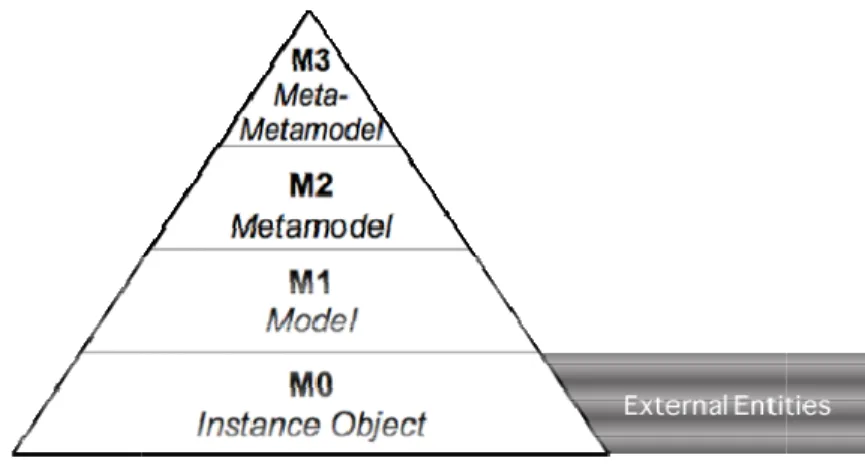
Figure 1.2, is a layer-based mode base of the hierarchy, is the M0 la layer (Model) describes the objec of the M1 layer, which means it’s M3 layer (Meta-meta-model) desc
Figu
mmercial industry. The vast number of tools an
SS project is depicted in Figure 1.1. There’s a D for downloading the necessary information ava and, after the download, process the data e DIM stores, in a series of databases, values o e (CTM), which is a set of graphical tools for
re alarms for special situations, etc.
e metadata in the repository and their behavio in the repository. This situation makes the rep
ata repository also stores the documentation, and domain metadata, guarantees their inte transforming and querying is also used by the ry.
p of XML technologies (with a Java [13] engine)
an OMG [15]
odel where each layer describes the layer imm 0 layer that represents “real” objects of a given jects in the M0 layer. The M2 layer (Meta-mode it’s the definition of a language, notation or pro describes Meta-models, i.e., a set of rules and co
Figure 1.1 SESS project architecture, taken from [1]
ls and libraries that process
a Data Processing Module available in external Data ata passing it to the Data es of S/W and S/C that will for users to monitor the
avior is dependent on the repository the “glue” that
on, maintains the relations integrity and validates the the components to extract
ine) and using the MOF [14]
standard. MOF,
meta-models. In the context of t “Instances” layer (represents met vocabulary and represent the M2
An Instance is a XML file tha vocabulary is specified using XML restrictions imposed by a set of r (to ensure some restrictions not p that a certain level of “order” is p that all Concepts must include a must identify their root element the relations between Instances a
Although successful and well adoption as a solution for externa
The use of fixed syntactic rules restrictions to the structure of ea only known after insertion of an I inside the content of Instances, a identifiers, implies that every ex repository. On another hand, the reutilization (of code that proces mean new XML Schemas, the reu new Meta-models (new XML Sche
In a system that stores a cons machines or databases), if the co non-trivial and non-automatic con using such a repository (due to thi
of the SESS metadata repository, the M1 laye metadata), which is described by “Concepts” (t M2 layer) that, in turn, are subject to “Rules” (th
that is compliant with the vocabulary define ML Schema and, optionally, Schematron [16]. C rules. The rules are composed of XML Schem ot possible with the two previous technologies) is present, both in Instances and Concepts. Rule e a “base” XML Schema (supplied by the repos
nt with a specific attribute. Java rules guarantee es and assure Concept and Instance uniqueness
ell accepted, the MDR has some issues that c rnal data integration in other environments.
es, such as the inclusion of a base XML Schem f each Concept, the use of internally generate an Instance and management information abou , as well as those same relations being depe y external XML document must be modified , the original motivation for the use of syntact
ocesses Instances). However, and because new reutilization rate proved to be very low, beca chemas) rarely checked on the already existing o
considerable amount of metadata (possibly sca e cost of importing that metadata to a reposito conversions, it's very likely an organization will o this startup cost).
Figure 1.2 MOF model, taken from [1]
layer is designated as the s” (that define a controlled ” (the M3 layer).
efined by a Concept. That . Concepts are subject to ema, Schematron and Java ies) and they exist to assure Rules include, for example, pository) or that Concepts ntee referential integrity in ess.
at create difficulties in its
hema, that imposes certain rated identifiers which are bout relations being stored ependant on the previous ied to be accepted in the tactic rules was to enable new Concepts in practice because people developing
ing ones.
Non-promotion of Concept reuse is a problem that affects an organization after the adoption of the metadata repository. When new definitions need to be created, if there's no mechanism to reuse already existing definitions it will require the creation of the new ones from scratch and code to process those definitions will also have to be created from scratch, making the use of a metadata repository less attractive.
These two aspects: difficult external metadata integration and the non-promotion of Concept reuse (or parts of them), are serious obstacles in the adoption of the MDR as a solution of integration for the design and development of Information Systems.
To address these issues a profound and nontrivial revision of the philosophy of the repository is required. The work on this thesis pretends to present a concrete solution to solve these problems.
The objective of this thesis is to propose and implement a Metadata Repository that is able to easily integrate metadata from heterogeneous sources, without having to modify the documents in order to integrate them, and supply a set of features that promote the reuse of previously created metadata fragments.
The content of this thesis is structured in seven chapters and one annex. Follows the listing and description of each chapter:
2.1 Metadata in Organizations……….. 10 2.2 XML Technologies……….. 12 2.3 Semantic Web……….. 15 2.4 Metadata Repositories……… 24 2.5 Metadata Management Technologies and Repositories Appreciation……… 36 This chapter presents the state of the art in metadata
In this chapter the state of metadata management in organizations is presented, featuring technologies and tools to deal with it. Among those technologies are the XML technologies and the Semantic Web, which will be presented and evaluated. Some metadata repositories and tools will also be presented and evaluated. In this chapter and this thesis, the focus is on metadata related to Information Systems and organizations and not on metadata in general.
!
For several years, information technologies have been focused on processes and data with the aim of building systems and manage their operation [17]. Information and its processing is a vital part of these systems, which, in turn, are the core of modern organizations. The amount of information produced by organizations is increasing and this information is increasingly important (this includes digital and non-digital information). The information produced includes, for example, documents with operative rules of the company, specifications of products, security policies, sales reports, etc. [18]
Some organizations and enterprises have a Knowledge Management (KM) department. KM focuses on the acquisition, maintenance and access to information within an organization. It is a core activity within them, because organizations themselves see their internal information as a resource that can be used to improve productivity, create added value and enhance their competitiveness. It is, therefore, vital to know the answer to five questions within an organization [4].
• What information do we have?
• What is the significance of that information? • Where is it?
• How did it get there? • How can I access it?
The second question is particularly important, because information without its associated context is worth little. To this “context” one could call “meta-information” (or metadata) and, therefore, it can be concluded that without metadata, data has no value [17]. A good example is in [17]: If someone in a crowd shouts "42", most people will simply stare. However, people who are fans of writer Douglas Adams and know his work in "The Hitch Hiker's Guide to the Galaxy" certainly know that "42" is the answer for the "meaning of life, the universe and everything else". This example shows that the context of any type of data is extremely important for any system and to any attempt of analysis of their content, although every one of the other four questions is equally important in knowledge management.
Metadata eases the search for information, promotes the reuse of already existing knowledge, facilitates access to correct data [17], aids in the integration of systems, increases the confidence of users in the information they are using and is a great tool when there’s staff replacement in the organization, which requires to make them aware of how the organization’s internal procedures and processes work [11]. Several standards of metadata can be used to enhance interoperability between internal systems, or with external systems [19].
There are several different types of metadata in Information Systems, but they can be grouped in two categories. Business Metadata and Technical Metadata [17]. Technical Metadata helps development teams, programmers and technical users in the tasks of maintaining and developing new features. Business metadata helps nontechnical users (administrators, consultants, etc.) to make better decisions for the organization based on available information or to find the information they need for their tasks.
A classic example of technical metadata is a data dictionary that helps development teams to know, in detail, the structure of a database. In the case of business metadata, one can think of the example of a library catalog in which summaries and descriptions of books are stored, for users to consult in order to find a book that covers a topic in which they may be interested.
" #
The use of metadata in an organization brings added value, but assumes that it’s available in an easy, safe and valid way. The problem is that, generally, there’s no centralized and controlled source of metadata in organizations [18] and the sources of metadata are spread over various parts of the organization, leading to the repetition of definitions and mismatched versions. Another issue is that, frequently, there is nobody responsible for the production of metadata [18] and much of the metadata remains in the minds its potential producers [17]. The problematic of capturing metadata in an automatic way is also a barrier to its adoption[18].
The solutions in current literature [1, 3, 10, 16, 18], propose the creation of a centralized repository of metadata (that can also be in a distributed environment) that allows the storage of different types of metadata, is designed to ensure the integrity and validity of metadata, enables metadata relationships, eases the search, import and export of metadata.
$ % &
XML (eXtensible Markup Language) is a meta-markup language that defines a syntax with which other markup languages can be created [20].
XML derives from SGML [21] and was defined by the World Wide Web Consortium (W3C) [22], an international consortium that sets standards for the Internet. XML enables the creation of languages in which the vocabulary (the set of tags) is defined by the designer and not fixed like, for example, in the HTML markup language [23]. XML format is easily readable by people, although restrictive rules regarding the opening and closing of tags and the definition of attributes exist. These features make XML an appropriate technology for the representation of all kinds of information, as along with being a simple textual format, they allow the representation of domain specific languages, make data self-descriptive and allow easy sharing of information between software from different manufacturers or technologies [20].
XML allows the coexistence of vocabularies with tags that have the same name, but are defined by different organizations, using namespaces [24]. Namespaces allow the use of a prefix in elements of a vocabulary, which maps to a URI [25]. This technique allows solving any ambiguities in the resolution and validation of vocabularies.
The easy creation of a vocabulary in a format readable by people and the ability to model any existing domain, made XML a rather well adopted technology for the representation of metadata, as the number of different domain specific (or generic) metadata standards that are XML-based is a proof. Examples of these standards are the Dublin Core Metadata Initiative (DCMI or DC) [26] for any kind of metadata or METS [27] for metadata about objects in a digital library.
In the following sections, some of the XML technologies and how those technologies are suited for representing, processing, validating and querying metadata, will be discussed.
' $ % ( & ( &
spread in the market, as there are multiple tools that can process it, both commercial [30] [31] and open source. There are also libraries such as libxml [32] (C) or Xerces [33](Java) and there is a quite extensive list of tools with support for XML Schema[34].
Relax NG [35] is another technology for the definition of XML vocabularies; it was defined by the Organization for the Advancement of Structured Information Standards (OASIS) and has several similarities with XML Schema, however, it has two ways of expressing the vocabulary. One is through a XML syntax and the other through a simple syntax that is convertible to XML, this possibility is similar to what was possible with DTD [36], one of the first technologies to define vocabularies. Relax NG also has extensive support in tools and libraries [37].
Schematron is a XML-based language to make assertions over the presence or absence of patterns in XML documents [16]. In Schematron, instead of defining the structure of a document, the name of the elements, their attributes or data-type (like in XML Schema), one can define properties that elements should have (or not have) as well as values they must match. Schematron is able to verify several conditions that are not possible with XML Schema, such as, for example, check if any given element has a certain attribute with a certain value. Schematron’s nature makes it better suited for validation than for documentation (it would be rather hard to infer the structure of a document from a set of Schematron rules), so the most frequent use is as a companion to other validation technology such as XML Schema or Relax NG. The set of tools that natively supports Schematron is small, but there’s a XSLT implementation of Schematron [38] that enables any recent XML processing library to use it.
XML Schema is the ideal choice for Concept definition and Instance validation due to the fact that it’s a W3C standard that can be used to create controlled vocabularies, document (implicitly or explicitly) those vocabularies and is very well supported in both commercial and open source tools (also the XML community is of a considerable dimension). Schematron’s ability to verify conditions that are not possible with XML Schema and by being usable through the XSLT implementation, make it the best choice for extra-validations on Instances.
$ % )
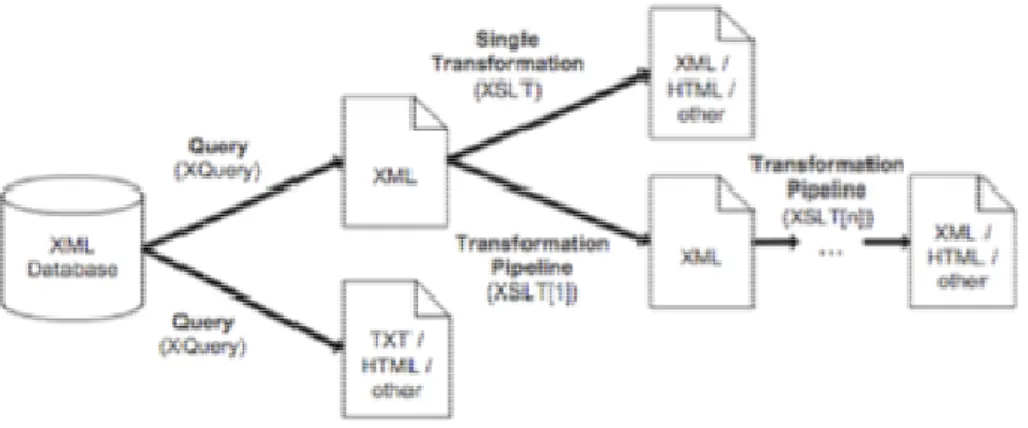
eXtensible Style-sheet Language Transformation (XSLT) [41], is a declarative XML-based language, for transforming XML documents into other XML documents [42]. It’s a language based on patterns (or rules) that identify a part of a document (using XPath) and apply a transformation to that part, using a set of predefined functions to produce the desired result. XSLT can be used to transform XML in XML, but also to produce documents such as HTML, Rich Text Format (RTF), plain text, Javascript, SQL and XSL-Formating Object (XSL-FO) [42].
In the context of metadata, XSLT supplies the necessary mechanism to visualize metadata under various forms (HTML, RTF or other) as well as convert the metadata into different formats. The ability to transform metadata to other formats means that it’s possible to convert metadata from one standard to another standard or to be compatible with a given application/repository. Transformations with the purpose of visualizing, enable the explicit creation of documentation, which makes the life of any one trying to understand that information, a lot easier.
* + " $ %
XQuery [43] is a query language designed by the W3C to deal with the issue of selecting from a XML document, or a collection of XML documents stored in a file system or database (relational, or native XML), elements of interest, reorganize them, eventually transform them and return the results in a structure of the interest of the user issuing the query [44].
XQuery is a typed, functional and declarative language that shares the same data model and type system with XML Schema, as do other technologies of the XML family, such as XPath 2.0 and XSLT 2.0. It was designed to work with non-typed XML documents (without an associated schema), typed with a XML Schema or a combination of both [45]. XQuery is a modular language that supports functions and libraries. There are two kinds of functions, the built-in functions and the user defined functions; built-in functions and operators supply the means to deal with the several data types available. Presently XQuery does not provide support for data types found in other schema languages such as DTD, Relax NG or Schematron [44]. The XQuery language is well spread, being implemented in several native XML databases, as well as relational databases [44].
XUpdate [46] is an update language for XML files, developed by the XML:DB Group [47] to update instances (or collections) of XML document stored in native XML databases. It’s a declarative language that enables to creation, change or removal of XML fragments from a document, using XPath and specific constructions. Although initial adoption, the definition never really matured and the last known draft is from the year 2000.
is, as of August 2008, a W3C candidate recommendation and provides the following set of operations over a XML instance:
• Insertion of a node. • Deletion of a node.
• Modification of a node by changing some of its properties while preserving its node identity. • Creation of a modified copy of a node with a new node identity.
XQUF was created to address the problem of updating the content of XML documents in a simple way. Despite being a candidate recommendation, there are already some implementations that support it, such as XQilla [49] , a XQuery processor included in the Oracle Berkley DBXML native XML database, and the MonetDB [50] database system.
In the context of Metadata, XQuery provides the means to query and transform XML documents, given its powerful mechanisms and the fact it’s widely supported in all major databases that store XML. On the other hand, XQuery Update Facility provides the mechanisms to update the content of documents.
# ,
The Semantic Web [51] is a vision of Tim Berners-Lee, regarding the current World Wide Web, that can be defined as “a network of intelligent data that is machine processable”. Intelligent data can be described as data that is independent of an application, can be composed, is classified and is part of a bigger information ecosystem (an ontology) [52]. The concept of Semantic Web requires that the web is filled with metadata that catalogs, relates and identifies the documents present in it and, also, the existence of applications that can understand that information and process it. The W3C established an activity (composed by several groups) dedicated to the implementation of the vision of the Semantic Web.
Another way of defining the Semantic Web is “a framework to create, maintain, publish and search
semantically rich metadata about web resources; annotating web resources with precise information
and meaning about conceptual aspects of its content that provides the bases to resolve the existing
limitations with current search engines” [53].
The structure of the Semantic Web is defined as a “Layered Cake”. The decision is based on the fact that it’s simpler to reach consensus through small steps than trying to achieve all at once. The process of building one layer of the Semantic Web on top of another, should follow two basic principles [54]:
• “Downward compatibility. Agents fully aware of a layer should also be able to interpret and
use information written at lower levels. For example, agents aware of the semantics of OWL
• “Upward partial understan at least partial advantage
the RDF and RDF Schem
disregarding those elemen
In figure 2.1 the layer stack of the
At the bottom of the “cake” is X vocabulary and is particularly suita
The second layer is the Resource write statements about web objec XML, but has a XML serialization, b
The third layer, RDF Schema (RD objects in hierarchies, with the m property”, domain restrictions an ontologies.
An ontology is “the set of terms u to express more complex relation as such, on top of RDFS there are l
In the “Logic” layer, lies the ab declarative knowledge can be dec
The “Proof” layer is where the de knowledge provided by lower laye
standing. On the other hand, agents fully aware
age of information at higher levels. For example,
ema semantics can interpret knowledge writ
ents that go beyond RDF and RDF Schema”.
the Semantic Web is depicted; bellow a descript
is XML that lets one write structured docume suitable to send documents through the web.
urce Description Framework (RDF), which is th bjects (resources) that are identified by a URI. R on, being that the reason it’s placed on top of th
(RDFS), which is based on RDF, supplies the e major ones being relations of “class”, “prop s and range of values. RDFS can be seen as a si
s used to describe an area of knowledge” [55] tions between resources, a more expressive lan are languages to write complex ontologies.
ability to extend an ontology and, also, wh declared.
deductive process occurs, as well as proof vali layers.
Figure 2.1 Semantic Web Layer Stack
ware of a layer should take
ple, an agent aware only of
written in OWL partly, by
cription according to [54].
uments using a controlled
is the basic data model to RI. RDF does not depend on
f the XML layer.
the primitives to organize roperty”, “subclass”, a simple language to write
[55]. Since there’s the need e language is required and,
where application-specific
Finally, the “Trust” layer is used to evaluate if the knowledge deducted in the “Proof” layer can be trusted or not. Applications can have a “Trust” certification and use those certificates to prove to other applications that they’re a reliable source of information.
The Semantic Web vision of transforming the current global web in a web full of machine-processable information, has several applications, such as, intelligent agents that execute actions on behalf of users (for example search for a doctor’s appointment near home for the best price), Business-2-Consumer & Business-2-Business Electronic Commerce, or, in the area of Knowledge Management (KM) [54].
KM will be improved by the Semantic Web in the following fields [54]:
• Knowledge will be organized by areas, according to its meaning.
• Automatic tools would deal with information maintenance, checking for inconsistencies and extracting
new knowledge.
• Query based searches will replace the current keyword based ones.
• Support for query answering over several documents.
• Ability to define who may see certain parts of information (event parts of a document) will be possible.
To make the Semantic Web possible, a set of technologies and practices are required. First, information must be annotated with metadata that enables it to be processed. On top of metadata, ontologies that define a vocabulary and its semantic (relations between words and their meaning). The logic layer enables that, starting from ontologies and metadata, new knowledge can be extracted and that that knowledge is valid. Above all these, there are still agents that can receive a set of requests (and knowledge) and will try to satisfy those requests with the knowledge they possess and the one they find throughout their execution [54].
Consider the contribution that the Semantic Web can bring by the value of the following query: “I want all articles about Intel’s competitors” and, given ontologies that define the notion of “competitor” and give semantic aid (that guarantees, for example, that “Palm” and “Palm, Inc.” are considered the same company) and the existence of metadata that relates articles with the companies they refer. The results would be very meaningful and, thus, there’s great added value in this kind of searches [56].
-'.
The Resource Description Framework [57] (RDF) is a W3C standard to describe resources through statements. In RDF, a statement (or triple) is composed of three parts: A resource, a property and a property value. In the case where the statement is referred to as a triple, the component names are, respectively, subject, predicate and object.
A resource identifies an object through a URI (any object is identified with a URI).
A property describes an attribute of a resource identified by a URI.
A property value, is the value a given property has. This value can be another resource, if a URI is used.
As an example, to describe the title of the movie based on the book by Dan Brown, “The Da Vinci Code”, identifying the movie with the URI http://www.sonypictures.com/…/index.html and the title property by the URI of the Dublin Core element title, http://purl.org/dc/elements/1.1/title, the following statement can be defined.
Resource (Subject): http://www.sonypictures.com/homevideo/thedavincicode/index.html
Property (Predicate): http://purl.org/dc/elements/1.1/title
Property Value (Object): The Da Vinci Code
A RDF document contains a set of RDF statements. To define RDF documents, several syntaxes are available [58], one of them being the RDF/XML syntax [59]. This syntax defines the structure of a RDF document as the following:
A root element “rdf” that must include the namespace declaration with the “rdf” prefix, mapped to the address “http://w3.org/TR/1999/PR-rdf-syntax-19990105#”. Children of this node can only be elements of type “Description”.
In RDF, each predicate must be as between predicates with the sam search for the meaning of any give
The next example (Figure 2.3) with the predicate “DC Creator defining them as references to o document.
e associated to a namespace [60], to be possible same name, but defined by different entities given predicate.
), adds more information to the movie, includ tor” and a film contributor with the predicate
to other elements (using the attribute rdf:reso
Figure 2.2 RDF Example
Figure 2.3 RDF with multiple examples
sible to resolve ambiguities ties and to know where to
From the previous example, th visualize each predicate, as can be
RDF is a technology that enabl and is the base for the Semantic that will be briefly presented in th
RDF Schema [62] is a W3C re Essentially, it allows the definitio similar way to most Object Orient creation of hierarchies of classes f
SPARQL [63] is a RDF documen W3C Recommendation. SPARQL information is natively in RDF or is graph or a set of statements.
,%
The Web Ontology Language create ontologies. It was designe information, instead of just prese content, between machines, than supplying an extended vocabula ontologies.
OWL is composed by three su OWL Full [1, 55].
1− OWL Lite supports clas
cardinality restrictions (0 o
, the W3C RDF validation service [61] can be us n be seen in Figure 2.4.
ables the annotation of existing content with a ntic Web. In the RDF family there are still som n the following paragraphs.
C recommendation for the construction of RD ition of classes, subclasses and properties of t iented (OO) programming languages, such as Jav
es for the description of “objects”.
ent query language designed by the W3C, that QL allows querying multiple sources of info or is supplied by some middleware. The results
ge (OWL) [64] is a family of knowledge-repre igned for usage by applications that need to resenting it to people. OWL promotes a better than what is supported by formats such as XML bulary as well as a formal semantic, allowi
sub-languages, progressively more expressive:
class hierarchies and simple restrictions. It 0 or 1), equality restrictions between classe
Figure 2.4 RDF Graph
e used to create a graph to
ith a well defined semantic, ome relevant technologies
f RDF based vocabularies. of those classes, in a very s Java. As such, it allows the
that since January 2008 is a information, whether that ults of a query can be a RDF
presentation languages to to process the content of tter interoperability of web XML, RDF and RDF Schema, lowing to develop formal
sive: OWL Lite, OW DL and
properties (transitivity, symmetry), restrictions to the property values (for example values from a list of values, or a subset of values from a list), class intersection, versions and annotations.
2− OWL DL includes support for all functionalities, allowing full expressiveness, having some
restrictions at the computability and decidability level (i.e. all conclusions are computable and are guaranteed to finish).
3− OWL Full allows for full expressiveness and syntactic freedom of RDF, but gives no
guarantees about the end of the computation.
# & / 0& ! + #
The Simple Knowledge Organization System (SKOS) is a RDFS designed to represent and share controlled vocabularies, such as taxonomies, glossaries or thesauri in a simple way within the structure of the semantic web [65]. An ontology language such as OWL, adds a layer of greater expressiveness to RDF, which is used to create statements about resources. However, to develop a complete ontology, a precise modeling effort (a time consuming process) is required and that process demands qualified people. In several cases there’s no need of such a formal effort, thus, there was the need to develop a language to write vocabularies to use with semantically rich metadata, powerful enough to support semantic querying, but simple enough so that is doesn’t require a vast amount of resources in its production [53].
The core vocabulary of SKOS allows the definition of several types of controlled vocabularies normally used in IS, such as, for example a glossary, taxonomy, a thesaurus of a classification schema. SKOS can be combined with other vocabularies and the semantic of its relating properties, extended [53].
Currently, SKOS is a W3C working draft and a great amount of work still needs to be done, as such, it cannot be used as a standard, but the basis is solid enough to consider that in the future, with the availability of tools (that are being created) for the production, maintenance, management and sharing of these vocabularies, this system can be a viable choice for integrating metadata in information systems.
# , & & + !
Knowledge Management within organizations. In spite of this situation there are several factors that don’t favor the Semantic Web (RDF/OWL) at its current development stage.
RDF and OWL are standard technologies, although they are not so widely available and implemented as, for example, XML technologies. XML is found in nearly everywhere, and most people know XML (or, at least, have heard of it). Literature and support at the open source (and commercial) level is very high and web services (currently very popular) use XML for transmitting information. Also, XML is widely used since controlled vocabularies can be created with it and there are several standard XML vocabularies that model numerous domains of knowledge [66] and technologies to validate, transform and store XML are also very wide-spread [27, 34, 38, 39, 41, 44, 60].
For some time now, most open source and commercial databases include support for XML in several ways while support for RDF was introduced as an add-on only to the latest version of Oracle 11G Enterprise Edition [67]of the popular Oracle Relational database, but it’s not found in other popular databases such as MySQL, PostgreSQL or MS SQLServer, however, all of them include support for XML [68-70]. Also, several native XML databases exist, but the choice for RDF native storage is much smaller and less mature.
As an example, a simple search for “XML” in one of the major online book store, returns more than 18.000 results. A search for “RDF” returns about 6.000 results and a “Semantic Web” search, about 4.000 results. It strengthens the idea that XML knowledge is more widespread and known; on the other hand Semantic Web technologies (and there several of them) would force technicians, users and development teams to a long learning curve, given the quantity of new content to master and its complexity (particularly at the inference level).
The nature of the Semantic Web is such that users and organizations must build applications and add content to make use of the content. The problem is that users cannot wait for the vision of the Semantic Web to fully materialize, because that can take over ten years (taking into account the current vision) [54]. In that scenario, the adoption of XML for the representation of metadata and its management in an organization, presents a far lower cost.
The Semantic Web does not have issues only with maturity, technological support and documentation support for its adoption at a large scale. It has its own problems to solve, even inside its community, namely the Open Word Assumption (OWA) versus the Closed World Assumption (CWA) issue and the problematic of ontology integration.
OWA models well several norm need full knowledge about the “w schedule; if on the schedule there that particular train does not exist is, there are real-world problems There’s some research regarding non-monotonic constructors, alth recurring only to first order logi resolves the issue. OWL is also cr rich in dealing with properties. composed property and another example is the relation between t [74].
Another issue with the Semant the Semantic Web the layer stac stabilization of the lower layers, s exclusive OWA usage versus the u to some alternative propositions depicts the proposed model.
This structure has the obvious which the author of [75] consider and proposes another alternative
A real Semantic Web would al at any given time to integrate a long as it’s related somehow. In
Figure
ormal inference situations, but can be inadeq e “world” (the context of the problem). Conside here is no information about the train at 12.47, xist. In OWA, that cannot be concluded, only in ms that require CWA, or at least CWA applied ing this topic [72, 73], that propose the exten although there are some who defend that the logic, a statement that the authors of [72] ar
criticized for having a rich set of constructors ies. In particular, it’s not possible to capture
ther property (regardless of it being compose en the composition of “father” and “brother” an
antic Web is that its structure is not fully stable stack proposed by Tim Berners-Lee was accep rs, some work has been done in the logic layer he usage of local CWA on some situations, has ns of the well-known layer stack model, for exa
ious disadvantage of taking the Semantic Web iders harmful (because it promoted the division tive in [75].
d allow for applications that process informatio a new ontology about the same subject, or jus . In an ideal situation, a program would be cap
re 2.5 Semantic Web Layer Stack with Datalog Rules
dequate for problems that sider the problem of a train .47, one would assume that y in CWA [72]. The problem lied to part of the problem. tension of OWL to include the problem can be solved argue that only partially tors for classes, but not as ture a relation between a posed or not). The classic r” and the property “uncle”
able. Since the beginning of cepted. Recently, with the yer and the problem of the has risen. This situation led example in [75]. Figure 2.5
eb in two separate ways, sion of the Semantic Web),
ontology, process the data taking into account the new knowledge it possesses and extract new knowledge. Reality, however, shows that ontology integration is a difficult process. There are several challenges in ontology integration and a large number of investigators assume this is one of the biggest challenges of the Semantic Web [76]. The existing challenges for ontology integration according to [77] are the following:
• Discovery of similarities and differences between ontologies in an automatic or
semiautomatic way;
• Definition of mappings between ontologies;
• Development of an architecture for the integration of ontologies; • Composition of mappings between different ontologies;
• Representation of uncertainties and inaccuracies in mappings.
The requirements derive from problems found, at various levels, when ontologies need to be combined. A list of these problems can be found in [78] and can be divided in problems related to the used language (in the cases where the language used to define the ontology was different), such as syntax problems, logical representation problems and semantic disparities with the operators of the language. The other class of problems is related with ontologies themselves. For ontologies that model overlapped domains (partially overlapped or fully overlapped) there are, potentially, scope problems when two classes that represent the same concept have different scope in each ontology or when ontologies model the domain with different levels of granularity or do not cover the same extension of the domain. Essentially the problem is: different people use different terms for the same things and, as such, there’s the need for mappings and translations between different ontologies [79]. Another fact is that ontology integration is a subject of great interest in the academic world, but not as much in the commercial one (with no tool support for this).
- &
This section presents a set of tools and repositories that provide the means to manage metadata for end users and systems. There are two kinds of metadata management tools, the specific tools (that only allow a certain type of metadata) and the generic tools that allow any kind of metadata. There are several software programs that are based on metadata; the most well known examples are Data Warehousing and ETL (Extraction, Transformation and Loading) tools. No commercial tool will be presented in this section, only open source tools that make use of the previously mentioned technologies.
- + 1
objects (resources) and can share the information with other repositories that support the same model (RIB repositories, or not). The Basic Interoperability Data Model (BIDM) is a standard to define the minimal set of information for assets (generic items of interest) in reusable libraries. BIDM results of a collaboration between the Reuse Library Interoperability Group (RIG) and the Software Engineering Standards Committee (SESC) of the IEEE Computer Society and was developed in 1995. It’s composed of five classes, each of them having a fix set of attributes and relations [81]. It’s possible to alter the BIDM model used by the repository, although it’s not advisable because it can limit its interoperability features with other BIDM repositories, despite that, a data model editor is supplied so that the model can be altered.
RIB can create an online HTML, customizable, catalog from its stored metadata and it’s possible to make simple searches in the catalog. Data input is done in a web-based interface (with web forms) so that users can add, update and maintain metadata about objects. The repository offers a web-based administration interface for each of the three kinds of existing users. The “general” user, which can add and edit metadata as well as browser the catalog. The “repository administrator”, which can alter the data model used by the repository and the “RIB administrators” that can create or delete repositories. At the security level, a password for browsing a given repository/catalog can be set.
RIB is built entirely with Java technology, with data persistency being assured by the open source relational database MySQL. Server side components are Java Servlets, while on the client side Java Applets are used. It’s possible to communicate with the repository thorough the RIBAPI, an API supplied by the authors, so that other applications can use RIB and access its data. The API usually returns the result as a XML document, with a well-defined structure (described in the manual of the API).
Although it supports a standard for metadata, makes some use of XML technologies and has an interface for other applications to communicate with it, RIB is very specific and not adequate for a generic information system; also the last update to RIB was in October 2006.
'
DSpace is an open source digital repository that “captures, stores, indexes, preserves and shares
digital research material” [82]. It was developed by the Massachusetts Institute of Technology (MIT)
these documents in collections. DSpace is implemented in Java, runs in a web server such as Apache Tomcat and uses a relational database to store the data. The database that can be open source (such as PostgreSQL) or commercial (such as Oracle) or a database that is not part of a DBMS, such as McKoi [83]. DSpace specifically runs in UNIX systems, but it can run on Windows also [84] and has an API that allows for external applications to use the repository and have access to its content.
DSpace has a fixed data model [85] that allows the definition of a hierarchy of “Communities” each them being a set of “Collections” that contain “Items” composed by “Resources” (Files) and “Metadata” (compatible with Dublin Core). DSpace is considerably versatile and there are several Institutions/Organizations and Universities that use it [86] and it’s considered a good solution for sharing digital assets, but the fact that it only supports the Dublin Core format, makes it an inadequate solution for a generic information system that does not require (or need) support for the format.
) 2 2
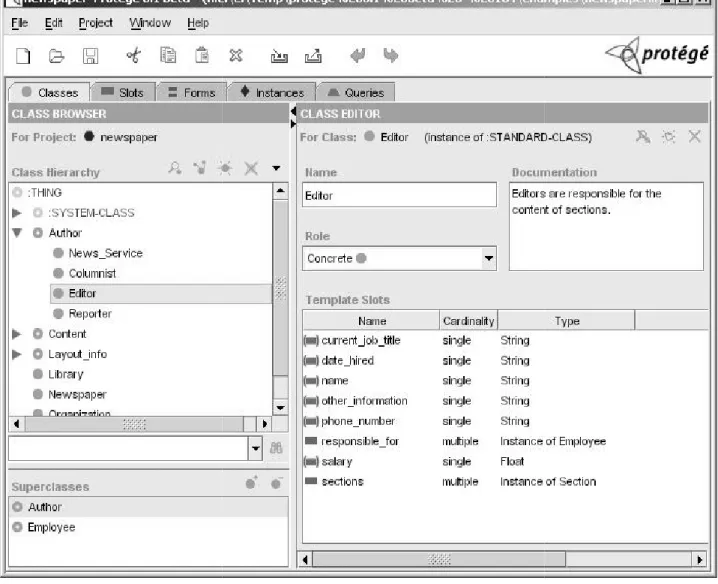
Protégé [87] is an open source tool for creating domain models and knowledge-oriented applications through ontologies, developed by the Stanford Center for Biomedical Informatics Research of the Stanford University School of Medicine. The core of Protégé, implements a rich set of knowledge representation structures and actions that allow creating, managing and visualizing ontologies in several formats. Although not a metadata repository, protégé was chosen as a representative tool of the Semantic Web world for illustration purposes and to illustrate some possibilities of the semantic web techonologies.
It has a customizable interface, so that a simple graphic application can be produced for the creation of ontologies (and populating them with information). Protégé can be extended with plugins and a Java API exists so that applications on top of (or connected to) protégé can be built [88].
The protégé platform is available as two products. Protégé-Frames and Protégé-OWL, explained in the following sections.
Protégé-Frames
instances of the ontology that a property values.
The ontology creation process After creating non-abstract classes action Protégé eases by generatin
customized to make it even easi ontologies (or of class instances) a restrictions to values of propertie account [90].
at are individual examples of classes that have
cess is eased by a simple graphic interface, as sses in an ontology, it’s possible to create instan ating specific forms to create those instances (
easier for users to interact with them). During es) all rules are verified, including cardinality rul rties and the generated interfaces already have
Figure 2.6 Protégé-Frames editor
have specific (and distinct)
, as depicted in Figure 2.6. stances of those classes, an s (the forms can be further
Protégé-Frames supplies a gra making selections based on criteri interface for querying, using “sala
Protégé-OWL
Protégé-OWL is an extension o Ontology Language [91]. Beyond offered by Protégé-Frames, Prot RDF/OWL format, allows defining engines to extract new knowledg rules of the ontology. It also supp eases the graphical inspection of 2.8.
Protégé-OWL is closely tied to supplies a standard environment RDFS, OWL and SPARQL, featuring ontologies. There’s a Java API to available in Protégé-OWL. Protégé Web and, thus, are not of interes generic tools to deal with metadat
graphical interface to query instances of the iteria over the values of the slots of a class. In fi salary” as a criteria for the search.
n of Protégé that enables the creation of ontolo nd the possibility of creating classes (and restr rotégé-OWL allows users to create, or load, ing the properties of classes (specific of OWL) a ledge not explicitly in instances, but achievable upplies an equally simple interface (supported
of an ontology (among many other actions) th
d to the Jena framework [92]. Jena is a Java ent for the creation of Semantic Web applicati ring an inference engine that can extract new k I to which applications can connect to take adv
tégé-Frames and Protégé-OWL are tools in the d erest to this thesis, which will be using XML tec
adata in an Information System.
Figure 2.7 Protégé-Frames Query Interface
the ontology, and allows In figure 2.7 is depicted the
tologies based on the Web restrictions, instances, etc.) ad, their ontologies in the L) as well as use inference able through the semantic ted by several plugins) that ) that is depicted in Figure
![Figure 1.1 SESS project architecture, taken from [1]](https://thumb-eu.123doks.com/thumbv2/123dok_br/16516027.735225/21.892.220.716.596.892/figure-sess-project-architecture-taken.webp)