UNIVERSIDADE DOS AÇORES
Departamento de Ciências Agrárias
S
TUDIES ON EQUINE SPERM CRYOPRESERVATIONF
UNDAMENTAL AND APPLIED ASPECTSJoanna Sousa de Vasconcelos Franco
TESE DE DOUTORAMENTO EM CIÊNCIAS AGRÁRIAS ESPECIALIDADE REPRODUÇÃO ANIMAL
Orientador: Professor Doutor Joaquim Fernando Moreira da Silva
2014
STUDIES ON EQUINE SPERM CRYOPRESERVATION
FUNDAMENTAL AND APPLIED ASPECTS
By
Joanna Sousa de Vasconcelos Franco M.Sc. in Veterinary Medicine
Thesis
Submitted to fulfillment of the Requirements of the Degree of
Doctor of Philosophy In
Agricultural Science (Animal Reproduction)
Promotor
Professor Doutor Joaquim Fernando Moreira da Silva
2014
II
The work described in this thesis was financially supported as a PhD grant (BD M3.1.2./F/002/2010) by:
The studies described in this thesis were performed at the Animal Reproduction Group, Department of Agrarian Sciences, CITA–A, University of the Azores, Angra do Heroísmo, Portugal.
III
To my family
V
GENERAL ABSTRACT
Studies on equine sperm cryopreservation – Fundamental and applied aspects
The use of frozen stallion spermatozoa for artificial insemination is increasing in the equine industry. Unfortunately, the fertilizing capacity of cryopreserved stallion semen is generally considered to be lower than that of some other domestic species, especially that of dairy cattle. Several different freezing regimes with new protocols and extenders have been designed and published to improve the quality of post-thaw equine semen; however, no ideal protocol for all cases exists. Therefore, the aim of the research presented in this thesis was to improve stallion cryopreservation. It has been hypothesized that the addition of antioxidants (α-tocopherol and ascorbic acid) in the freezing extender and the use of different freezing rates (FRs) might yield increased cryosurvival of spermatozoa. Sperm's physiological and metabolic studies were also evaluated, in order to understand the mechanisms by which cryopreservation can alter sperm function, and to improve the quality of post-thaw equine semen. Moreover, the study also aimed to prove that the heterologous in vitro fertilization (IVF) can predict male fertility, validating a new approach for a heterologous IVF assay using bovine oocytes with zona pellucida (ZP) intact and equine sperm. In Chapter II, the impact of different concentrations of antioxidants (α-tocopherol and ascorbic acid) supplementation on the freezing extender of post-thaw equine semen was investigated. Based on the results, it was concluded that α-tocopherol is an efficient antioxidant reducing the oxidative stress provoked by cryopreservation, decreasing lipid membrane peroxidation (LPO) on equine spermatozoa. On the other hand, the extenders supplemented with ascorbic acid did not improve the LPO on equine semen frozen-thawed. In Chapter III, a study was conducted to determine the impact of antioxidant (α-tocopherol) supplementation in the freezing extender and three
VI
different FRs on the quality of post-thaw semen, in order to elaborate a new protocol for stallion semen cryopreservation. Semen was exposed to three different FRs between 5 ºC and -15 ºC: slow (5 ºC/min), moderate (10 ºC/min), and fast (20 ºC/min). The addition of α-tocopherol in the freezing extender was used as a way to strengthen the impact of this antioxidant on the results of quality of frozen-thawed stallion semen achieved in chapter II. In this chapter (III), we concluded that the FR of 5 ºC/min between 5ºC to -15ºC tended to give better results on quality of post-thaw stallion semen. In Chapter IV, a study was conducted to investigate the effects of supplementation of α-tocopherol and two different FRs (between 5ºC to -15ºC) on the ability of stallion sperm to heterologous IVF of bovine oocytes with ZP-intact, in an attempt to develop a model for assessing cryopreserved sperm function. The results clearly demonstrated that post-thaw stallion spermatozoa are able to fuse with in vitro mature bovine ZP intact oocytes, to decondense and form male pronuclei. Heterologous IVF proved to be a good assay to evaluate the quality of frozen-thawed stallion semen, which can also be used to verify the storage quality of banked sperm samples. The α-tocopherol supplementation on the stallion freezing extender might exert a protective effect against oxidative damage during in vitro fertilization, improving the results. However, the addition of this antioxidant to the freezing extender did not improve the viability of stallion spermatozoa after thawing, which suggests that the role of oxidative stress in cryopreservation-induced damage of equine spermatozoa requires further investigation.
Keywords: Semen; Stallion; Cryopreservation; Antioxidants; Freezing Rates; Heterologous
VII
RESUMO GERAL
Estudos sobre criopreservação de sémen de equinos - Aspectos fundamentais e aplicados
Nos últimos anos, verifica-se um aumento na utilização de sémen criopreservado na inseminação artificial na indústria equina. Contudo, o potencial de fertilização do sémen criopreservado nos equinos é menor do que o de outras espécies domésticas, especialmente nos bovinos. Vários estudos têm sido realizados com a utilização de diferentes curvas e meios de congelação, com o objectivo de melhorar a qualidade do sémen equino após a criopreservação; contudo, ainda não existe um protocolo ideal para todos os casos. Assim sendo, o objectivo desta tese de doutoramento foi melhorar a criopreservação de sémen equino. A nossa hipótese foi a de que a adição de antioxidantes (α-tocoferol e ácido ascórbico) no meio de congelação e o uso de diferentes curvas de congelação (CCs) poderão aumentar as taxas de sobrevivência do sémen equino. Foram realizados estudos fisiológicos e metabólicos do sémen, a fim de compreender os mecanismos pelos quais a criopreservação pode alterar a função espermática, e melhorar a qualidade esta metodologia. Como também, pretendeu-se provar que a fertilização in vitro (FIV) heteróloga pode predizer o potencial fertilizante do sémen, validando um novo protocolo de FIV heteróloga utilizando oócitos bovinos com zona pelúcida (ZP) intacta e sémen equino. No capítulo II, o impacto da suplementação de diferentes concentrações de antioxidantes (α-tocoferol e ácido ascórbico) no meio de congelação de sémen de equino foi investigado. Com base nos resultados obtidos neste capítulo, concluiu-se que o α-tocoferol é um eficiente antioxidante, tendo a capacidade de reduzir o stresse oxidativo provocado pela criopreservação, através da diminuição da peroxidação lipídica das membranas (PLM) dos espermatozóides. Por outro lado, a adição de ácido ascórbico não melhorou a PLM. No Capítulo III, foi realizado um estudo para
VIII
determinar o impacto da suplementação de α- tocoferol no meio de congelação e de três diferentes CCs sobre a qualidade do sémen após criopreservação, com o objectivo de elaborar um novo protocolo para o congelamento de sémen de garanhões. O sémen foi exposto a três diferentes TCs entre 5 ºC e -15 ºC: lenta (5 °C / min), moderada (10 °C/min), e rápida (20 °C / min). Neste capítulo, concluímos que a CC de 5 °C/min entre 5 °C a -15 °C tende a melhorar os parâmetros de qualidade seminal dos garanhões após a descongelação. No capítulo IV, foi realizado um estudo para analisar os efeitos da suplementação de α -tocoferol e duas diferentes CCs (entre 5ºC a -15ºC) sobre a capacidade espermática de garanhões para a FIV heteróloga de oócitos bovinos com ZP- intacta, de forma a desenvolver uma metodologia para avaliação da função espermática. Os resultados demonstraram que o sémen equino após descongelação é capaz de fundir-se com os oócitos maduros com ZP intacta de bovinos, e formar o pronúcleo masculino. A FIV heteróloga provou ser um bom ensaio para avaliar a qualidade do sémen de garanhão após criopreservação, bem com pode ser utilizada para verificação da qualidade de bancos de sémen. A suplementação de α-tocoferol no meio de congelação de sémen de garanhão parece ter um efeito protector contra os danos oxidativos durante a FIV, melhorando os resultados. Contudo, a adição de α-tocoferol no meio de congelação não melhorou a viabilidade espermática, o que sugere que esta temática necessita de uma maior investigação no futuro.
Palavras-Chave: Equino; Sémen; Criopreservação; Antioxidantes; Curvas de congelação;
IX
Table of Contents
Page
GENERAL ABSTRACT………...………...……… V
RESUMO GERAL……… VII
List of Figures………... XII
List of Tables………...….. XIII
List of Abbreviations……… XV
Chapter 1: General introduction………... 1
1. Introduction and aims……….. 2
1.1.Literature survey……….…...……...….. 5
1.1.1. History and present of equine sperm cryopreservation…………... 5
1.1.2. Current freezing protocols for stallion semen………...…… 6
1.1.3. Cryobiological determinants of equine sperm function………...….… 10
1.1.4. Particularities of the lipid composition of the equine sperm plasma membrane……….. 14
1.1.5. Oxidative stress….………....…… 16
1.1.6. ROS scavengers in equine semen………...…..….… 17
1.1.7. ROS Generation by Spermatozoa………..……...… 18
1.1.8. Vulnerability of Spermatozoa to Oxidative Stress.…………...……… 19
1.1.9. Prevention and management of oxidative stress: effects of antioxidants on equine semen cryopreservation..……...……...……… 21
1.2. References………...…… 23
X
after cryopreservation………... 35
2.1. Abstract………...…………...… 36
2.2. Introduction………...…………...….. 37
2.3. Materials and methods………...…...……. 39
2.4. Results………...………...….. 43
2.5. Discussion………..……...……. 49
2.6. Conclusion………...……...…… 53
2.7. Acknowledgments………...………… 53
2.8. References………...…...……… 54
Chapter 3: Effect of Freezing Rates and Supplementation of α-Tocopherol in the Freezing Extender in Equine Sperm Cryosurvival………..…... 61
3.1. Abstract………...…………...……… 62
3.2. Introduction………...………...….. 63
3.3. Materials and methods………...…...…. 64
3.4. Results………...…………...……….. 68
3.5. Discussion……….……. 71
3.6. Conclusion………...……...… 74
3.7. Acknowledgments………...…...…… 75
3.8. References………...……..…. 75
Chapter 4: Sperm parameters and heterologous in vitro fertilization capacity of stallion sperm, frozen in the presence of α-tocopherol in different freezing rates………...………...…… 81
4.1. Abstract………...…...… 82
4.2. Introduction……….……...… 83
XI 4.4. Results………...………...…….. 91 4.5. Discussion………..………...………. 92 4.6. Conclusion……….…………. 96 .4.7. Acknowledgments………...…..… 96 4.8. References……….……. 96
Chapter 5: General discussion, conclusions and perspectives…………...…. 103
5.1. General discussions……….………...……… 104
5.2. Conclusions and perspectives……….……… 110
5.3. References………...………...…… 112
Acknowledgements………... 115
XII
List of Figure
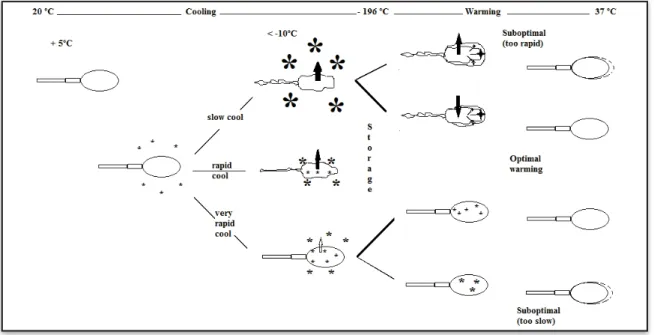
Page Figure 1.1.: Putative changes in sperm and extender during freezing and thawing.
The effects of various cooling rates on formation of ice crystals and microcrystals and the movement of solvents and penetrating solutes (heavy or light arrows) and shown. After an initial cooling formation of extracellular microcrystals at about -5 ºC, cooling at variable rate affects both the rate of water movement out of the cell and the extent of intracellular ice formation. Thus, when the sperm arrives at – 196ºC, the intracellular and extracellular environments differ according to freezing rate. Damage can result if the chosen thawing rate is inappropriate. Extremes values are illustrated: top right, where too thawing results in unbalanced rates of efflux of cryoprotectant and influx of water, and bottom right, where a slow thawing results in recrystallization of microcrystals of intracellular water and resultant damage to cellular organelles (adapted from
XIII
List of Tables
Page Table 2.1: Evaluation by flow cytometry of viability and acrosome status (Mean ±
SE); acrosome intact and live cells (AIL), acrosome intact and dead cells (AID), acrosome reacted and live cells (ARL) and acrosome degenerate and dead cells (ARD), after freeze-thawing semen in the different concentrations of α-tocopherol (mM) and ascorbic acid (g/L) in freezing medium, for the three incubation
times……….…... 44
Table 2.2.: Evaluation by flow cytometry of mitochondrial membrane potential
(MMP) (Mean ± SE); after freeze-thawing semen in the different concentrations of α-tocopherol (mM) and ascorbic acid (g/L) in freezing medium, for the three
incubation times………...…... 45
Table 2.3.: Evaluation by flow cytometry of lipid membrane peroxidation (Mean
± SE) after freeze-thawing semen in the different concentrations of α-tocopherol (mM) and ascorbic acid (g/L) in freezing medium, for the three incubation
times……….……... 46
Table 2.4.: Evaluation by flow cytometry of the stability of the membrane (Mean
± SE); viable cells with plasma membrane`s stability (SMYo-PRO-1 (-)), viable cell with no plasma membrane`s stability (NSMYo-PRO-1 (-)) and dead cells (Yo-Pro-1 (+)), after freeze-thawing semen in the different concentrations of α-tocopherol (mM) and ascorbic acid (g/L) in freezing medium, for the three
XIV
Table 3.1.: Thawed stallion sperm viability, frozen in the present or not of
α-tocopherol (2 mM) in the extender at different freezing rates. Each value
represents the mean ± SE of 4 stallions, (6 ejaculates per stallion)………...…. 69
Table 3.2.: Mean (± SE) values of MMP, (n=4 stallions, 6 ejaculates per stallion);
after freeze-thawing semen in a commercial extender supplemented or not with α-tocopherol (2 mM) and three different freezing rates from 5ºC to -15ºC
(FR)………..………... 69
Table 3.3.: Evaluation by flow cytometry of lipid membrane peroxidation (LPO;
Mean ± SE, n=4 stallions, 6 ejaculates per stallion); after freeze-thawing semen in a commercial extender supplemented or not with α-tocopherol (2 mM) and three
different freezing rates from 5ºC to -15ºC………..… 70
Table 3.4: Evaluation by flow cytometry of apoptosis status (Mean ± SE, n=4
stallions, 6 ejaculates per stallion); after freeze-thawing semen in a commercial extender supplemented or not with α-tocopherol (2 mM) and three different
freezing rates from 5ºC to -15ºC……….……… 71
Table 4.1.: Evaluation by flow cytometry of viability, mitochondrial membrane
potential (MMP) and lipid membrane peroxidation (LPO) (Mean ± SE, n=4 stallions, 4 ejaculates per stallion); after freeze-thawing semen in a commercial extender supplemented or not with α-tocopherol (2 mM) and two different
freezing rates from 5ºC to -15ºC... 91
Table 4.2.: Results of in vitro heterologous fertilization (IVF) rate involving
frozen-thawed stallion sperm in a commercial extender supplemented or not with
XV
List of Abbreviations
AID– Acrosome intact dead AIL – Acrosome intact live ARD – Acrosome damaged dead ARL– Acrosome reacted live
Annexin-V-FITC –Fluorescein isothiocyanate-conjugated annexin V ATP – Adenosine tri-phosphate
COCs – Cumulus oocytes complexes
DPBS – Dulbecco‘s phosphate buffered saline DMSO – Dimethyl sulfoxide
FBS – Fetal Bovine Serum FR – Freezing rate
FITC-PSA – Pisum sativum agglutinin conjugated to fluorescein isothiocyanate IVF – In vitro fertilization
JC-1 – 5,5`,6,6`-tetrachloro-1,1`,3,3`tetraethylbenzymidazolyl carbocianyne iodine LSD – Fisher`s least significant difference
LPO – Lipid membrane peroxidation MW – Modified Whitten`s
MMP – Mitochondrial membrane potential
NADPH oxidase – Nicotinamide adenine dinucleotide phosphate-oxidase NSMYo-PRO-1 negative – Cells with no plasma membrane stability PBS – Phosphate buffered saline
PI – Propidium iodide PLA2 – Phospholipase A2
XVI
PUFAs – Polyunsaturated fatty acids SEM – Standard error of the mean
SMYo-PRO-1 negative –Cells with plasma membrane`s stability TALP – Tyrode‘s albumin lactate pyruvate
Yo-PRO-1-positive – Nonviable sperm cells ZP – Zona pellucida
CHAPTER
1
Chapter 1
2
1. Introduction and aims
The use of frozen stallion spermatozoa for artificial insemination is increasing in the equine industry. This technology is of great importance for equine breeding, since it allows the long-term storage and transportation of semen (irrespective the location and availability of a stallion), allows to preserve semen from genetically superior animals and enable the development of a successful breeding program, as well as allows to control or eradicate venereal and others infectious diseases. Perhaps one of the major advantages with the availability of frozen semen is that breeders can more easily inseminate a mare at the optimal breeding time instead of having to rely on the availability of stallion semen. Moreover, cryopreservation is a safe approach to banking gametes, supporting the conservation of biodiversity and protection of endangered species.
Unfortunately, the fertilizing capacity of cryopreserved stallion spermatozoa is generally considered lower than that of some other domestic species, especially that of dairy cattle, as well as there is inter-individual variability in the cryosurvival of their semen. The reason for this reduction in fertility is likely due to the fact that stallions are selected for their performance record, pedigree, and conformation characteristics, instead for their fertility accomplishment [1]. It is generally assumed that 40–50% of the spermatozoa do not survive the freezing and thawing process [2]. Also, although the success of cryopreservation in stallions is lower than other farm animals, there are poor correlations between semen motility and fertility (35-40%), like also observed in other domestic species [3].
The cryopreservation technology is still in a suboptimal level of development, and cause extensive chemical and physical cryo-damages (lethal or sub-lethal) to the structural integrity, biochemistry, and biophysics of the spermatozoa. A number of factors related to cryo-injury have been characterized: phase transitions in the plasmalemma, oxidative stress,
Chapter 1
3 apoptotic-like changes, capacitation-like changes, and mechanical stress on cell membranes due to osmotic stress and temperature changes during the process of freezing and thawing, contributing to sperm death or, if surviving, to their reduced fertilizing capacity [4; 5; 6].
Success in cryopreserving stallion semen has been very variable. Several different freezing regimes with new protocols and extenders have been designed and published to improve the quality of post-thaw equine semen; however, no ideal protocol for all cases exists. The complexity of sperm cell biology is believed to be an important factor when developing improvements in stallion semen cryopreservation. It may be assumed that impairment of cell function resulting from cold shock, osmotic shock, and oxidative stress, is a main source of stallion sperm sensitivity to conventional freezing procedures. Thus, in order to achieve increased survival rates after cryopreservation, cryopreservation methods need to be improved.
Scope of this thesis
The aim of the research presented in this thesis was to improve stallion cryopreservation. It has been hypothesized that the addition of antioxidants (α-tocopherol and ascorbic acid) in the freezing extender and the use of different freezing rates might yield increased cryosurvival of equine semen. Physiological and metabolic study of stallion sperm was also studied, in order to help to understand the mechanisms by which cryopreservation can alter sperm function, and to improve the quality of post-thaw equine semen.
Therefore the main objectives of this study were:
Chapter 1:
Chapter 1
4
Chapter 2:
b) To assess the impact of the addition of α-tocopherol and ascorbic acid supplementation in the freezing extender, on the equine sperm’s acrosomal integrity, mitochondrial membrane potential, stability of the plasmatic membrane and lipid membrane peroxidation, after post-thaw.
Chapter 3:
c) To elaborate a new protocol for stallion semen cryopreservation.
d) To evaluate if the addition of α-tocopherol in the freezing extender could improve the quality of post-thaw semen.
e) To identify if different freezing rates could produce best post-thaw equine semen quality parameters.
Chapter 4:
f) To study the impact of antioxidant (α-tocopherol) supplementation in the cryopreservation extender and two different freezing rates (between 5ºC to -15ºC) on quality of post-thaw stallion semen.
g) To prove that the heterologous in vitro fertilization can be used as a good test to predict the semen fertility, comparing with the functional semen tests.
h) To elaborate a new protocol of heterologous in vitro fertilization of equine semen.
Chapter 5:
i) An overview and discussion of the results of these studies and their possible implications for the practice and for future research are given.
Chapter 1
5
1.1. Literature survey
1.1.1. History and present of equine sperm cryopreservation
The first mammalian cells to be successfully cryopreserved were the spermatozoa at -79 °C [7], demonstrating the cryoprotective properties of glycerol. And, the first birth of a foal from a mare that was inseminated with cryopreserved semen occurred in 1957 [8]. Since then, spermatozoa cryopreservation and its use for artificial insemination became of great importance for the equine breeding industry; however, it is not yet an established technology. One of the challenges for those attempting to cryopreserve stallion spermatozoa is dealing with the stallion inter-individual variability in the cryosurvival of their semen. Such variability is most often ascribed to the fact that most stallions have been selected by performance and phenotype, and not for sperm quality.
Stallions have shown a particularly high degree of individual variation with respect to the cryosurvival of their sperm. It has been estimated that 20% of stallions produce semen that freeze well, 60% freeze acceptably and 20% freeze poorly. Stallions that are satisfactorily fertile under normal field conditions can produce semen that after freezing and thawing produces very low pregnancy rates [4]. Only 30–40% of stallions produce semen that is constantly suitable for cryopreservation with acceptable pregnancy results after AI, and a consistent variation on sperm freezability has been also observed among breeds [9; 10; 11]. Consequently, post-thaw semen motility and pregnancy rates can vary greatly between stallions. The mechanisms underlying the differences in cryosensitivity between different individuals have yet to be elucidated. Such differences could be genetic in origin, and the genetic selection of stallions for successful freezing could be a possibility. On the other hand, the difference might be non-genetic and in this regard it would be particularly desirable to be
Chapter 1
6
able to apply assays of sperm function before and after freezing which correlate well with either semen freezability or stallion fertility [12; 13].
The process of cryopreservation of spermatozoa causes non-lethal damage and alters the sperm plasma membrane in a way that at some points resemble the changes during sperm capacitation [24], due the detrimental effects of osmotic and oxidative stress and temperature changes that sperm are exposed to during this process [15]. As a consequence, fertility following artificial insemination with frozen semen is poorer than with fresh semen is most species, which can be only partially compensated by inseminating greater numbers of live spermatozoa [14].
1.1.2. Current freezing protocols for stallion semen
Current freezing protocols for stallion semen and instructions for insemination of mares with frozen–thawed semen are far from standardized comparing protocols from different countries (for review [16]). Methods for freezing stallion semen involve a two-step dilution procedure in which semen is first diluted with a primary extender, centrifuged and then diluted a second time prior to freezing in an extender containing a cryoprotectant.
In order to obtain a better stallion sperm post-thaw quality, the cryopreservation should be done during the non-breeding season [17]. Stud farms should take into consideration many practical matters (e.g. sexual rest, individual characteristics of stallions, and hygienic conditions) that precede the freezing campaign. After long sexual rest, extragonadal sperm reserves should be depleted by repeated collections until good sperm quality is established. For preparing frozen semen, it would be preferable to make the semen collection interval at least 48 h, though this should be adapted to the individual stallion [18]. Semen collection should be carried out using a suitable technique (type of artificial vagina,
Chapter 1
7 lubricant, collector) and a fixed time interval between collections to minimize intra-individual differences between ejaculates.
After semen collection, the gelatinous portion is removed by filtration, and then the semen is diluted and centrifuged to remove the seminal plasma. The first dilution employs either saline/sugar or skim milk extenders used to dilute fresh semen in a rate 1:1 or the semen is diluted to a concentration of 50 million spermatozoa per ml [4]. The success of centrifugation depends on duration (10–15 minutes) and force (350–700 × g) [19]. To increase sperm recovery, the use of high-speed/time centrifugation (20 minutes, 1000 × g) through a liquid cushion has been introduced into laboratory practice [20], with no detrimental effect on fertility [21]. Regarding seminal plasma, Moore et al [22] demonstrated their deleterious effect on stallion spermatozoa during cryopreservation; however, retention of 5–20% of seminal plasma in the suspension after centrifugation has been considered to be essential for cryosurvival [23].
Most cells are lethally damaged during the freezing and warming processes of cryopreservation in the absence of protective agents. Therefore, in order to minimize damage due to freezing and thawing, cryoprotective agents are added to the extender in which sperm are cryopreserved. Freezing extenders used for cryopreservation of stallion sperm typically include skim milk, egg yolk and glycerol as cryoprotective agents. Cryoprotectants play a role in affecting ice formation, minimizing exposure to osmotic stress, preserving biomolecular and cellular structures, and limiting the damaging reactions of reactive oxygen species [15; 24; 25]. The effectiveness of a given cryoprotective agent for a given cell type usually depends on the permeability of the cell membrane for the solute and the toxicity of the solute [14].
Glycerol has been the major penetrating cryoprotectant routinely used to freeze stallion semen at a concentration of 2.5-5% [26]. In the presence of this cryoprotectant, the
Chapter 1
8
point where the total solute concentration (glycerol and others solutes) become high enough to stop further ice formation, is reached at a lower salt concentration than in the absence of cryoprotectant. Consequently, the size of unfrozen fraction will be larger, and the degree of shrinkage of cells will be limited [27]. Glycerol is a cryoprotective agent that can move across cellular membranes. Glycerol and water can interact with each other via hydrogen bonding interactions [28], which results in lowering the temperature at which ice formation occurs. This facilitates a longer time for the cell to respond osmotically. In addition, glycerol is described to form hydrogen bonds with the membrane phospholipid head-groups upon removal of water, which is supposed to stabilize membranes [29]. The tightly packed gel phase that is formed upon extracellular ice formation, however, indicates that cryoprotectants do not replace water molecules interacting with phospholipid head groups nor facilitate entrapment of water around the phospholipid head groups in the frozen state [30; 31]. It has been reported that other cryoprotectants such as dimethyl sulfoxide, ethylene glycol, methyl formamide or dimethyl formamide, may yield similar or even superior results [9; 26]. The yolk of fresh chicken or duck eggs at a concentration of 10–20% v: v has remained the preferred source of protein in the freezing mixture. Sugars (usually combination of fructose and glucose, alternatively raffinose or trehalose) are often added to media which act as non-penetrating cryoprotectants [26].
Freezing extenders for semen have a number of functions. They should protect the sperm from any damage that could decrease the fertilizing capacity of sperm. They may need to provide energy for the cells metabolism. Lastly, it increases the total volume of a sperm dose to a usable and practical level [14]. Also, the composition of the freezing extender may influence the length of the cooling phase required before freezing. Comparisons among stallion freezing extenders are documented poorly [32]. It has also been reported that the most effective semen extender for one stallion is not necessarily the most effective for another [16].
Chapter 1
9 A large variety of extenders combining various components (sugars, electrolytes, buffers, egg yolk, milk and milk products), have been proposed and used for extending sperm [32; 34–37]. Casein micelles and lactose have been described as protective components in milk, acting similarly as lipid-binding proteins [38]. Milk and milk-based extenders are known to be practical and efficient in protecting spermatozoa. Egg yolk contains low-density lipoproteins which are described to be responsible for the cryoprotective action of egg yolk. These proteins can sequester lipid-binding proteins present in the seminal plasma to prevent cholesterol and phospholipid-efflux and consequent destabilization of the sperm membrane [38]. In addition, egg yolk is described to have free radical scavenging properties [39].
Afterwards, the centrifuged and extended semen is commonly packed for freezing in 0.5 mL French straws, cooled to 4°C before freezing in liquid nitrogen vapour by suspending the rack of pre-filled straws a few centimeters above the liquid nitrogen in a specially adapted freezing bath, or in a computer controlled automated freezing machine [37]. Depending on the method of processing and storage, several authors [40–42] reported that the optimal freezing rate for stallion semen might range between 20ºC and 100 ºC/min.
Some alternative methods such as unique freezing technique (UFT) [43; 44], ultra-low temperature freezers [45], 'Multi- Thermal-Gradient' (MTG) technology [46; 47] have also been utilized and showed comparable results than conventional liquid nitrogen methodology. In directional freezing, after an initial seeding stage, the semen sample is advanced at a constant velocity through a linear temperature gradient. In this way, the ice crystal propagation can be controlled so as to optimize crystal morphology, achieve continual seeding and a homogenous cooling rate throughout the entire freezing process [46; 47]. These techniques may be suitable to replace the traditional method.
Subsequently, the straws are stored in liquid nitrogen (- 196ºC) to be thawed when it is time to inseminate the mare. Frozen-thawed sperm must survive the rigors of the
freeze-Chapter 1
10
thawed process and meet the requirements for fertilization. In practice, the equine industry uses 2 main thaw rates. The most popular thaw rate, 37ºC for 30 seconds, originates from early bovine studies and is used by horse breeders and researchers alike. The thaw rate of 75ºC for 7 seconds followed by short-term immersion in a 37ºC water bath has gained interest and has been noted to improve sperm motility, viability and reduced premature capacitation yet is still not often practiced [48].
1.1.3. Cryobiological determinants of equine sperm function
For a successful freezing/thawing protocol, cryopreservation of equine spermatozoa must be carried out within certain physical and biological conditions, as: (1) sperm cells must be frozen in such a way that little or none of their water freezes intracellularly and they must be warmed in such a way that any unfrozen intracellular water remains unfrozen during warming; (2) most sperm cells will not survive unless substantial concentrations of cryoprotectants agents are present and the solute permeates. These cryoprotectants agents must be introduced before freezing and removed after thawing in ways that do not exceed osmotically tolerable limits. Their concentrations should not be toxic [14; 49].
Although these general limits are necessary, they may not be sufficient for one or more possible reasons. One is that cells may be injured by factors such as cold shock that have nothing to do with ice formation or cryoprotectants agents damage. Another reason is that cell viability limits are defined primarily in terms of an intact plasma membrane that retains normal, semipermeable properties. It is possible that conditions that allow the plasma membrane to “survive” may not allow the “survival” of critical organelles such as the acrosome or the mitochondrial-axonemal system responsible for motility [50].
Chapter 1
11 Cryopreservation requires exposure of spermatozoa to extreme variations in temperature and osmolality. Post-thaw survival of cryopreserved spermatozoa exhibits a maximum at a presumptive optimum cooling rate, and the optimum cooling rate is also dependent on the warming rate, the optimum rates presumably being due to sperm permeability properties. The optimum cooling and warming rates may also be significantly dependent on the specific cryoprotectant additive and buffer solution in which the spermatozoa are cryopreserved [51].
The major challenge that sperm cells have to undergo is the lethality of an intermediate zone of temperature (between the freezing point and to - 60ºC) that the cells must traverser twice: once during cooling and once during warming, rather than their ability to tolerate storage at low temperature [52]. The principal physical events occurring in equine sperm during freezing are depicted schematically presented in Figure 1.
As the semen is cooled below freezing point of the extender, it remains free of ice to temperatures substantially lower than the freezing point. This is referred to as “supercooling”. Depending on the way of packaging the semen, spontaneous ice nucleation will in most instances occur between -5 and ~ -15ºC. To prevent extensive supercooling, ice nucleation can be induced (e.g. by touching the package of semen with a very cold metal rod). Ice will then form in the external extender but the contents of the cells remain unfrozen and supercooled, probably because the plasma membrane blocks the growths of ice crystals into the cytoplasm [53]. The extracellular growth of ice results in rapid increase of the extracellular solute concentration and corresponding decrease of the water “concentration”. As a consequence, water flows out the cells osmotically and freezes externally.
Chapter 1
12
Figure 1.1: Putative changes in sperm and extender during freezing and thawing. The effects of various cooling
rates on formation of ice crystals and microcrystals and the movement of solvents and penetrating solutes (heavy or light arrows) and shown. After an initial cooling formation of extracellular microcrystals at about -5 ºC, cooling at variable rate affects both the rate of water movement out of the cell and the extent of intracellular ice formation. Thus, when the sperm arrives at – 196ºC, the intracellular and extracellular environments differ according to freezing rate. Damage can result if the chosen thawing rate is inappropriate. Extremes values are illustrated: top right, where too thawing results in unbalanced rates of efflux of cryoprotectant and influx of water, and bottom right, where a slow thawing results in recrystallization of microcrystals of intracellular water and resultant damage to cellular organelles (adapted from [14]).
The subsequent physical events in the cells depend on the cooling rate. If freezing progresses at very slow rates, the dehydration will take place over a longer time period resulting in high degree of shrinking, extreme dehydration of the cytoplasm associated with fatal cellular disruption [54]. Moreover, at low cooling rates the cells may be damaged by long exposure to the high solute concentration of the extracellular solution before reaching temperatures at which cells finally become stabilized in the glassy state. Nevertheless, the cooling rate must be slow enough to allow water to leave the cells by osmosis in sufficient quantity. If cooling is sufficiently slow the sperm cells will lose water rapid enough to
Chapter 1
13 concentrate the intracellular solution sufficiently to eliminate supercooling. As a result the cells do not freeze intracellular.
If the freezing progresses at rapid rates of cooling, water is not lost fast enough to maintain equilibrium; the cells become increasingly supercooled, which increases the probability of formation of intracellular ice nucleation. However, no direct evidence of intracellular ice has been observed in stallion`s semen cryopreservation process. In the study developed by Morris et al [55], it has been concluded that cell damage to equine spermatozoa, at cooling rates of up to 3000 °C/min, is not caused by intracellular ice formation rather the cells are subjected to an osmotic shock when they are thawed. The observed differences in the viability and motility measurements suggest that different mechanisms of cellular injury may be occurring at ‘‘slow’’ and ‘‘rapid’’ rates of cooling. Thawing of semen generally should be done at very rapid rates to decrease the possibility of damage from extracellular ice crystal growth [56].
Therefore, too high or too low cooling rates can kill cells, although the mechanisms underlying cell damage are different. Based upon this, an optimal cooling rate for cell cryosurvival should exist between the “high” and “low” rates. Whether a known cooling rate is too “high” or “low” for a given cell type depends on the capability of water to flow across the cell membrane [14]. During freezing and ice crystal formation, sperm are exposed to mechanical stresses as well as osmotic challenges [15; 24; 56]. With slow cooling rates, extracellular ice is formed resulting in an increase of the solute concentration in the unfrozen water fraction, which exposes sperm to hypertonic conditions. In order to retain equilibrium between the intra- and extracellular solute concentrations, sperm respond by movement of water out of the cell. During thawing and insertion in the female reproductive tract, the reverse process takes place and sperm are exposed to hypotonic conditions. When the cooling rate is too fast, there is not enough time for water to leave the cell and intracellular ice is
Chapter 1
14
formed, which is detrimental to cells. Thus, sperm cryosurvival depends on the cooling rate used: at high cooling rates cell survival losses are associated with intracellular ice formation, whereas at slow cooling rates cellular dehydration prevails and damage is attributed to ‘solution effects injury’. At the optimal cooling rate, damage due to intracellular ice formation and cellular dehydration is minimal and cell survival after thawing is maximal [56]. However, Morris et al [57] did not observe evidence for intracellular ice formation in sperm at fast cooling rates. They concluded that upon rapid cooling a glassy matrix forms in which sperm as well as ice crystals are embedded.
1.1.4. Particularities of the lipid composition of the equine sperm plasma membrane
Many aspects of stallion´s semen cryopreservation have still remained empirical and relatively little information is available on the basic cryobiologic and biophysical stresses imposed during freezing and thawing processes.
Firstly, the sperm cell plasma membrane is not a simple semi-permeable barrier. It is a complex dynamic structure composed of lipids and phospholipids distributed as a bilayer by metabolic activity. Within the membrane are embedded proteins and glycoproteins with access to the external environment, as well as to the interior. One class of such proteins, aquaporins, is involved in water transport. Other functions as ion channels with specificity to particular ion species; some of the channels are energy-requiring pumps which transport the ions against concentration gradients. The physical and chemical structure of the plasma membrane and its associated metabolic activity is complex and affected by temperature: changes in molecular structure at deeper temperatures will alter solute and water transport
Chapter 1
15 through pores and channels. Changes in mobility and distribution of lipids will affect diffusion through the lipid bilayer [58].
Secondly, the sperm plasma membrane plays a very active role in sperm fertilization and in sperm-oocyte cross talk. Sperm membrane fluidity is a pre-requisite for normal cell functions, and fluidity and flexibility of sperm membranes are mainly dependent on their lipid composition [59]. There is considerable variation in the lipid composition of the sperm plasma membrane in different mammalian species. In stallion´s sperm there is a relatively high cholesterol content (37% of total lipids), comparing with boars sperm membrane (24%) [60; 61]. Semen lipids play a major role in motion characteristics, sensitivity to cold shock and fertilizing capacity of sperm. It is important to note that the distribution of long chain polyunsaturated fatty acids (PUFAs) in stallion sperm is more similar to boars than that of the bulls. Bulls produce sperm that are more resistant to cold shock and freeze well, whereas sperm from boars and stallions have very low tolerance to cold shock and in general, freeze poorly. Sperm of bulls have higher levels of docosahexanoic (22:6) fatty acids, whereas sperm from stallions and boars have much higher levels of docosapentanoic (22:5) fatty acids [61; 62]. The variation on membrane fluidity could be an explanation for the variability on sperm freezability observed between individual stallions. The major variable is the amount of cholesterol in the sperm plasma membrane between different males and even between different ejaculates from a single male.
Furthermore, the cholesterol content seems to be related to the rate of capacitation possibly because cholesterol must be depleted from the plasma membrane during this process [60]. The sperm plasma membrane serves as the main physical barrier to the outside environment and is a primary site of post-thaw damage. Such damage includes membrane destabilization due to lateral lipid rearrangement, loss of lipids from the membrane, and
Chapter 1
16
peroxidation of membrane lipids (LPO), as a result of formation of reactive oxygen species (ROS) [63].
1.1.5. Oxidative stress
Oxidative stress is defined as the imbalance between the systemic manifestation of ROS and a biological system`s ability to readily detoxify the reactive intermediates or to repair the resulting damage. In a healthy body, pro-oxidants and antioxidants remain in balance. Spermatozoa are equipped with antioxidant defense mechanisms and are likely to quench ROS, thereby protecting gonadal cells and mature spermatozoa from oxidative damage. However, under pathological conditions, the uncontrolled production of ROS exceeds the antioxidant capacity of the seminal plasma resulting in oxidative stress [64]. The generation of ROS may occur as a normal consequence of oxidative metabolism or may results from specific mechanisms within particular cell types, such as the oxidative burst of leukocytes. This imbalance can lead to damage to the structure of cells and macromolecules such as plasma membrane components, proteins, and DNA [65].
Spermatozoa were the first cell type reported to show potential susceptibility to oxidative stress. In some situations, the damage caused by oxidants may be repaired. Unfortunately, spermatozoa are unable to restore the damage induced by oxidative stress because they lack the necessary cytoplasmic-enzyme repair systems. This is one of the features that make spermatozoa unique in their susceptibility to oxidative insult [66]. This is predominantly due to the fact that their cell membranes are rich in PUFAs, rendering them highly susceptible to oxygen-induced damage and hence, LPO. Subsequently, a rapid loss of intracellular adenosine tri-phosphate (ATP) from LPO causes axonemal damage, decreased
Chapter 1
17 sperm viability, and increased mid-piece sperm morphological defects, all of which contribute to decreased sperm motility [64; 66].
The susceptibility of equine spermatozoa to oxidative damage is attributed to the individual differences in fatty acids composition of the sperm membrane of stallion spermatozoa (depends on the proportion of saturated (e.g. C16:0 palmitic, C18:0 stearic and C20:0 arachidic) and PUFAs in phospholipids of the sperm membrane), that are susceptible to LPO and, further, to the innate deficiency of spermatozoa regarding the availability of cytoplasmic protective enzymes [61]. The effects of oxidative stress are particularly important during sperm cryopreservation, since much of the antioxidant capacity in semen resides with seminal plasma, and this is removed during the freezing process [65].
1.1.6. ROS scavengers in equine semen
The primary ROS scavengers described in semen are catalase, superoxide dismutase and glutathione-peroxidase-reductase system [67]. According to Ball [65], sperm cells appear to have very limited amounts of ROS scavengers, while seminal plasma is a potent source of ROS scavengers which functions are to protect ejaculated equine semen from the adverse effects of ROS. In addition to the enzyme scavengers, a number of other components of seminal plasma likely to counteract oxidative stress and may act as antioxidants. These antioxidants with low molecular weight are albumin, urate, taurine, hypotaurine, pyruvate, lactate, ascorbic acid, tocopherol and ergothioniene. However, the elimination of seminal plasma during the stallion semen cryopreservation process may raise the sensitivity of sperm to oxidative stress, because much of the antioxidant capacity (enzyme scavengers and antioxidants) in semen resides with plasma seminal.
Chapter 1
18
1.1.7. Generation of ROS by spermatozoa
ROS, also known as free radicals, have at least one unpaired electron. They are oxidizing agents generated as byproducts from the metabolism of oxygen and due to the unpaired electron in the outer shell, they form highly reactive molecules. ROS represent a collection of a broad range of radicals (e.g., hydroxyl ion [OH-], superoxide ion [O2-], nitric
oxide [NO], peroxyl [RO2], lipid peroxyl [LOO], and Thiyl [RS-]) and non-radical molecules
(singlet oxygen [-1O2], hydrogen peroxide [H2O2], hypochloric acid [HOCL], lipid peroxide
[LOOH], and ozone [O3]) [66].
Research has shown that ROS causes electron leakage from actively respiring spermatozoa, mediated by intracellular redox activities. The mechanism of ROS production by sperm is still unclear. It seems to be derived from either a sperm-specific nicotinamide adenine dinucleotide phosphate-oxidase (NADPH oxidase) (NOX5) present in the plasma
membrane of the sperm head or from sperm mitochondria [68; 69]. The generation of ROS in spermatozoa may occur via two methods: (1) the NADPH oxidase system at the level of the sperm plasma membrane and/or (2) the nicotinamide adenine dinucleotide-dependent oxido-reductase reaction at the mitochondrial level. The latter mechanism appears to be the main source of ROS. Spermatozoa are rich in mitochondria because a constant supply of energy is required for their motility [66]. Therefore, the presence of dysfunctional spermatozoa in the semen significantly elevates the production of ROS, which in turn affects its mitochondrial function and subsequently, sperm function such as motility.
Generation of ROS is significantly increased in the presence of cryodamage, non-viable or morphologically abnormal sperm, particularly sperm characterized by the presence of proximal cytoplasmic droplets or abnormalities of the midpiece [70]. Under these conditions, generation of greater amounts of ROS is principally driven by electron leakage
Chapter 1
19 from the mitochondrial electron transport chain with subsequent reduction of molecular oxygen to form the superoxide anion [68]. Although the superoxide anion (O2-) appears to be
the primary ROS generated by equine sperm, this short-live specie rapidly dismutates to form hydrogen peroxide (H2O2) [70; 71], and it is likely H2O2 that accounts for the major cytotoxic
effect in sperm [72]. The suggestion that H2O2 is particularly pernicious, as far as
spermatozoa are concerned, was confirmed by Aitken et al [73] in an experiment involving exposure of human spermatozoa to a mixture of ROS generated by xanthine oxidase in vitro. In that experiment, addition of superoxide dismutase, or scavengers of hypochlorous and hydroxyl radicals, had no impact on motility loss. However, the cytotoxic effects of ROS could be completely eliminated by the presence of catalase, again confirming the vulnerability of mammalian spermatozoa to H2O2 attack. Moreover, this study also demonstrated that other
aspects of sperm function, such as sperm–oocyte fusion, were even more susceptible to peroxide attack than motility. The same experimental paradigm was subsequently replicated using equine spermatozoa, with exactly the same outcome. Thus, exposure of equine spermatozoa to the mixture of ROS generated by xanthine oxidase in vitro was found to significantly suppress equine sperm motility via mechanisms that could be completely reversed by catalase but not by superoxide dismutase [72]. These studies demonstrated that (i) mammalian spermatozoa are susceptible to oxidative stress and that (ii) one of the most powerful initiators of that stress is H2O2.
1.1.8. Vulnerability of Spermatozoa to Oxidative Stress
Spermatozoa are vulnerable to oxidative stress because they contain an abundance of PUFA´s, such as arachidonic and docosahexaenoic acids, in their plasma membrane that are susceptible to LPO [61]. In normal situations, the presence of these fatty acids seems to give
Chapter 1
20
fluidity to the sperm membrane, promoting the activity of key enzymes, such as the plasma membrane ATPases, and to facilitate the membrane fusion events during fertilization. However, these PUFA´s are vulnerable to oxidative attack, because the carbon hydrogen dissociation energies are lowest at the bis-allylic methylene position. As a result, the hydrogen abstraction event that initiates LPO is promoted, triggering a LPO cascade that leads to the generation of small molecular mass, electrophilic aldehydes such as acrolein,
4HNE, and malondialdehyde. These compounds are very toxic to the spermatozoa and
ultimately overwhelm the limited defensive capabilities of these cells, triggering a lipoperoxidative death [74].
It has been known that spermatozoa are very vulnerable to LPO and that this process can be promoted by the concomitant presence of transition metals such as iron and copper. Just a small amount of Fe (II) in the culture medium can trigger a LPO cascade that will lead to a loss of sperm motility and other membrane-dependent functions such as sperm–oocyte fusion [75; 76].
The precise manner in which LPO leads to a loss of functional competence is still not clear. In general, this process involves the activation of phospholipase A2 (PLA2), in order to
effect removal of the oxidized fatty acid from the parent phospholipid for further processing by the glutathione peroxidase system and conversion of the toxic lipid peroxide to a harmless alcohol. The result of PLA2 action is to create a lysophospholipid, which destabilizes the
plasma membrane and facilitates a loss of membrane integrity. Once the peroxidized fatty acid has been cleaved out of the membrane by PLA2, it can also be effectively sequestered by
albumin. The latter is highly effective at protecting spermatozoa from oxidative stress by virtue of its ability to bind and neutralize cytotoxic lipid hydroperoxides [77; 78]. Removal of such lipid peroxides from the plasma membrane is essential because otherwise they will serve
Chapter 1
21 to propagate the LPO chain reaction throughout the plasma membrane, particularly if catalytic amounts of Fe (II) are available [79].
Another consequence of LPO is the stimulation of additional ROS generation by the sperm mitochondria [80; 81]. As indicated above, lipid aldehydes such as 4HNE are able to
form adducts with multiple proteins, including key constituents of the mitochondrial electron transport chain. One of the consequences of this adducting activity is a significant stimulation of mitochondrial ROS generation as a result of the direct targeting of succinic acid dehydrogenase [82; 83]. Consequently, any factors stimulating ROS generation and LPO will trigger yet more free radical generation from the mitochondria and amplify the levels of LPO. This lipoperoxidative cascade underpins the process of sperm senescence and is one of the major factors triggering spermatozoa to default to the intrinsic pathway of apoptosis [84].
1.1.9. Prevention and management of oxidative stress: effects of some antioxidants on equine semen cryopreservation
The apparent susceptibility of equine spermatozoa to oxidative stress has stimulated interest in the use of antioxidants to counteract this process, as an aid to fertility in vivo and in
vitro. Also, it is important to restore optimal levels of antioxidants in semen by adding them
into the extender. A variety of antioxidants have been used to prolong the lifespan of stallion spermatozoa in a variety of different circumstances. Several trials were performed in various mammals on the effect of addition of vitamin E (α-tocopherol) [85 – 89] and vitamin C (ascorbic acid) [70; 90 – 95] in freezing extenders with the aim to improve semen quality, but inconsistent results were observed to date regarding stallion spermatozoa cryopreservation. A positive effect of the addition of ascorbic acid on preservation of membrane integrity of cooled equine sperm has been observed [90]. According to Agüero et al [96], the addition of
Chapter 1
22
vitamin E prior to cooled semen storage (5ºC) exerted a protective effect on the plasma membrane and maintained progressive motility, regardless of the presence or absence of seminal plasma. Nevertheless, Baumber et al [97] observed that the addition of α-tocopherol and ascorbic acid to the cryopreservation extender did not improve the quality of equine spermatozoa after thawing; failing to demonstrate a clear, positive effect on the maintenance of sperm motility or fertility during liquid storage. Nevertheless, assessment of the total antioxidant capacity of seminal plasma suggests that ascorbic acid and a-tocopherol may constitute most of the antioxidant capacity of semen [98].
Vitamin E or α-tocopherol is believed to be the primary component of the antioxidant system of spermatozoa, and it is considered the major membrane protectant against ROS and membrane LPO [89; 99]. This low molecular weight antioxidant can inhibit LPO reaction in the membrane by eliminating peroxyl (ROO), alkoxyl (RO), and other lipid-derived radicals [100]. Furthermore, vitamin E can be recycled to function again, even when its concentration is low [99]. This small-molecule antioxidant is a chain breaking antioxidant and not a scavenging antioxidant found in the sperm’s cell membrane [101], and acts by neutralizing H2O2 and quenching free radicals, hence halting chain reactions that produce lipid peroxides
and protecting the membrane from the damage induced by ROS [64]. The ability of α-tocopherol to maintain a steady state rate of peroxyl radical reduction in the plasma membrane depends on the recycling of α-tocopherol by external reducing agents such ascorbate or thiols [67]. Furthermore, it improves the activity of other scavenging oxidants [102], helping to preserve both sperm motility and morphology [103].
Ascorbic acid (vitamin C) is a chain-breaking antioxidant that plays a significant role (up to 65%) in combatting oxidative stress in the seminal plasma. It is a naturally occurring free scavenger, and as such, its presence assists various other mechanisms in decreasing numerous disruptive free radical processes, including LPO [91; 104]. It reacts with OH-, O2-,
Chapter 1
23 and H2O2 in the extracellular fluid, thus protecting sperm viability and motility [105].
However, vitamin C is only a weak ROS scavenger in the cell membrane and, hence, has almost no effect within the cell [64].
1.2. References
[1] Hussain J, Salam A, Gohar A. A Study on the Cryopreservation of Stallion Semen with Alpha Lipoic Acid. Intl R J of Pharmaceuticals 2011;1:21–6.
[2] Watson PF. The causes of reduced fertility with cryopreserved semen. Anim Reprod Sci 2000; 60-61:481–592.
[3] Blottner S, Warnke C, Tuchscherer A, Heinen V, Torner H. Morphological and functional changes of stallion spermatozoa after cryopreservation during breeding and non breeding season. Anim Reprod Sci 2001;65:75–88.
[4] Sieme H, Harrison RAP, Petrunkina AM. Cryobiological determinants of frozen semen quality, with special reference to stallion. Anim Reprod Sci 2008;107:276–92.
[5] Ortega Ferrusola C, González Fernández L, Morrell JM, Salazar Sandoval C, Macías García B, Rodríguez-Martinez H, Tapia JA, Peña FJ. Lipid peroxidation, assessed with BODIPY-C11, increases after cryopreservation of stallion spermatozoa, is stalliondependent and is related to apoptotic-like changes. Reproduction 2009;138:55– 63.
[6] Mara L, Casu S, Carta A, Dattena M. Cryobanking of farm animal gametes and embryos as a means of conserving livestock genetics. Anim Reprod Sci 2013;138:2–38.
[7] Smith AU, Polge C. Survival of spermatozoa at low temperatures. Nature 1960;166:668– 9.
Chapter 1
24
[8] Barker CA, Gandier JC. Pregnancy in a mare resulting from frozen epididymal spermatozoa. Can J Comp Med Vet Sci 1957;21:4–51.
[9] Alvarenga MA, Papa FO, Landim-Alvarenga FC, Medeiros AS. Amides as cryoprotectants for freezing stallion semen: A review. Anim Reprod Sci 2005;89:105– 13.
[10] Loomis PR, Graham JK. Commercial semen freezing: Individual male variation in cryosurvival and the response of stallion sperm to customized freezing protocols. Anim Reprod Sci 2008;105:119–28.
[11] Morrel JM. Stallion sperm selection: past, present, and future trends. J Equine Vet Sci 2012;32:436–40.
[12] Katila T. In vitro evaluation of frozen–thawed stallion semen: a review. Acta Vet Scand 2001;42:199–217.
[13] Kuisma P, Andersson M, Koskinen E, Katila T. Fertility of frozen–thawed stallion semen cannot be predicted by the currently used laboratory methods. Acta Vet Scand 2006;48:14.
[14] Chaveiro A. Bull sperm cryopreservation: fundamental and applied aspects. PhD thesis. Utrecht University, 2005.
[15] Amann RP, Pickett BW. Principles of cryopreservation and a review of cryopreservation of stallion spermatozoa. J Equine Vet Sci 1987;7:145–73.
[16] Samper JC, Morris CA. Current methods for stallion semen cryopreservation: a survey. Theriogenology 1998;49:895–903.
[17] Janett F, Thun R, Niederer K, Burger D, Hässig M. Seasonal changes of semen quality and freezability in the warm blood stallion. Theriogenology 2003;60:453–61.
Chapter 1
25 [18] Sieme H, Katila T, Klug E. Effect of semen collection practices on sperm characteristics before and after storage and on fertility of stallions. Theriogenology 2004;61:769–84.
[19] Hoogewijs M, Rijsselaere T, De Vliegher S, Vanhaesebrouck E, De Schauwer C, Govaere J, Thys M, Hoflack G, Van Soom A, de Kruif A. Influence of different centrifugation protocols on equine semen preservation. Theriogenology 2010;74:118– 26.
[20] Knop K, Hoffmann N, Rath D, Sieme H. Effects of cushioned centrifugation technique on sperm recovery and sperm quality in stallions with good and poor semen freezability. Anim Reprod Sci 2005;89:294–7.
[21] Ecot P, Decuadro-Hansen G, Delhomme G, Vidament M. Evaluation of cushioned centrifugation technique for processing equine semen for freezing. Anim Reprod Sci 2005;89:245–8.
[22] Moore AI, Squires EL, Graham JK. Effect of seminal plasma on the cryopreservation of equine spermatozoa. Theriogenology 2005;63:2372–81.
[23] de Andrade AF1, Zaffalon FG, Celeghini EC, Nascimento J, Tarragó OF, Martins SM, Alonso MA, Arruda RP. Addition of seminal plasma to post-thawing equine semen: what is the effect on sperm cell viability? Reprod Domest Anim 2011;46:682–6.
[24] Hammerstedt RH, Graham JK, Nolan JP. Cryopreservation of mammalian sperm: what we ask them to survive. J Andrology 1990;11:73–88.
[25] Watson PF. Recent developments and concepts in the cryopreservation of spermatozoa and assessment of their post-thawing function. Reprod Fertil Dev 1995;7:871–91.
[26] Squires EL, Keith SL, Graham JK. Evaluation of alternative cryoprotectants for preserving stallion spermatozoa. Theriogenology 2004;62:1056–65.
Chapter 1
26
[27] Mazur P, Rigopoulos N. Contributions of unfrozen fraction and of salt concentration to the survival of slowly frozen human erythrocytes: influence of warming rate. Cryobiology 1983;20:274–89.
[28] Dashnau J L, Nucci NV, Sharp KA, Vanderkooi JM. Hydrogen Bonding and the Cryoprotective Properties of Glycerol/Water Mixtures. J Phys Chem B 2006;110:13670–7.
[29] Aanchordoguy TJ, Rudolph AS, Carpenter JF, Crowe JH. Modes of interaction of cryoprotectants with membrane phospholipids during freezing. Cryobiology 1987;24:324–31.
[30] Oldenhof H, Friedel K, Sieme H, Glasmacher B, Wolkers WF. Membrane permeability parameters for freezing of stallion sperm as determined by Fourier transform infrared spectroscopy. Cryobiology 2010;61:115–22.
[31] Akhoondi M, Oldenhof H, Sieme H, Wolkers WF. Freezing-induced cellular and membrane dehydration in the presence of cryoprotective agents. Mol Membr Biol 2012;29:197–206.
[32] Heitland AV, Jasko DJ, Squires EL, Graham JK, Pickett BW, Hamilton C. Factors affecting motion characteristics of frozen-thawed stallion spermatozoa. Equine Vet J 1996;28:47–53.
[34] Martin JC, Klug E, Gunzel AR. Centrifugation of stallion semen and its storage in large volume straws. J Reprod Fertil 1979;27(Suppl):47–51.
[35] Loomis PR, Amann RP, Squires EL, Pickett BW. Fertility of unfrozen and frozen stallion spermatozoa extended in EDTA-lactose-egg yolk and packaged in straws. J Anim Sci 1984;56:687–93.
[36] Ecot P, Vidament M, de Mornac A, Perigault K, Clément F, Palmer E. Freezing of stallion semen: interactions among cooling treatments, semen extenders and stallions. J Reprod Fertil Suppl 2000;56:141–50.
Chapter 1
27 [37] Allen WR. The development and application of the modern reproductive technologies to
horse breeding. Reprod Dom Anim 2005;40:310–29.
[38] Bergeron A, Manjunath P. New insights towards understanding the mechanisms of sperm protection by egg yolk and milk. Mol Reprod Dev 2006;73:1338–44.
[39] Chatterjee S, Gagnon C. Production of reactive oxygen species by spermatozoa undergoing cooling, freezing, and thawing. Mol Reprod Dev 2001;59:451–8.
[40] Cristanelli MJ, Amann RP, Squires EL, Pickett BW. Effects of egg yolk and glycerol level in lactose–EDTA–egg yolk extender and of freezing rate on the motility of frozen–thawed stallion spermatozoa. Theriogenology 1985;23:25–38.
[41] Devireddy RV, Swandlund DJ, Olin T, Vincente W, Troedsson MHT, Bischof JC, Roberts KP. Cryopreservation of equine sperm: optimal cooling rates in the presence and absence of cryoprotective agents determined using differential scanning calorimetry. Biol Reprod 2002a;66:222–31.
[42] Devireddy RV, Swanlund DJ, Alghamdi AS, Duoos LA, Troedsson MHT, Bischof JC, Roberts KP. Measured effect of collection and cooling conditions on the motility and the water transport parameters at subzero temperatures of equine spermatozoa. Reproduction 2002b;124:643–8.
[43] Vartorella HA. Cryopreservation of equine and porcine spermatozoa with a unique freezing technology (UFT). PhD thesis. Texas Tech University, 2003.
[44] Goolsby HA, Elanton JR, Prien SD. Preliminary comparisons of a unique freezing technology to traditional cryopreservation methodology of equine spermatozoa. J Equine Vet Sci 2004;24:314–8.
[45] Álamo D, Batista, M, Gonzalez F, Rodrıguez N, Cruz G, Cabrera F, Gracia A. Cryopreservation of semen in the dog: use of ultra-freezers of −152 °C as a viable alternative to liquid nitrogen. Theriogenology 2005;63:72–82.
Chapter 1
28
[46] Zirkler H, Gerbes K, Klug E, Sieme H. Cryopreservation of stallion semen collected from good and poor freezers using a directional freezing device (Harmony CryoCare – Multi thermal Gradient 516). Anim Reprod Sci 2005;89:291–4.
[47] Saragusty J, Gacitua H, Pettit MT, Arav A. Directional freezing of equine in larges volumes. Reprod Domest Anim 2007;42:610–5.
[48] Bradford LL, Buhr MM. Function of cryopreserved horse semen is improved by optimized thawing rates. J Equine Vet Sci 2002;22:546–50.
[50] Karow AM, Critser JK. Reproductive Tissue Banking: Scientific Principles. Academic Press. USA, 1997.
[51] Leibo SP. Cryobiology of spermatozoa: principles, species differences and individual variations. 10th International Symposium on Spermatology, Madrid, 2006;17-22:48.
[52] Mazur P. Kinetics of water loss from cells at subzero temperatures and the likelihood of intracellular freezing. J Gen Physiol 1963;47:347–69.
[53] Mazur P. Physical and chemical basis of injury in single-celled microorganisms subjected to freezing and thawing. In Cryobiology, Academic Press, London, 1966;213-315.
[54] Mazur P, Leibo SP, Chu EH. A two-factor hypothesis of freezing injury. Evidence from Chinese hamster tissue-culture cells. Exp Cell Res 1972;71:345–55.
[55] Morris GJ, Faszer K, Green JE, Draper D, Grout BW, Fonseca F. Rapidly cooled horse spermatozoa: loss of viability is due to osmotic imbalance during thawing, not intracellular ice formation. Theriogenology 2007;68:804–12.
[56] Mazur P. Freezing of living cells: mechanisms and implications. Am J Physiol 1984;247:124–42.
Chapter 1
29 [57] Morris GJ, Acton E, Murray BJ, Fonesca F. Freezing injury: the special case of the
sperm cell. Cryobiology 2012;64:71–80.
[58] James PS, Wolfe CA, Mackie A, Ladha S, Prentice A, Jones R. Lipid dynamics in the plasma membrane of fresh and cryopreserved human spermatozoa. Hum Reprod 1999;14:1827–32.
[59] Ladha S. Lipid heterogeneity and membrane fluidity in a highly polarized cell: the mammalian spermatozoon. J Membr Biol 1998;165:1–10.
[60] Gadella BM, Rathi R, Brouwers JFHM, Stout TAE, Colenbrander B. Capacitation and the acrosome reaction in equine sperm. Anim Reprod Sci 2001;68:249–65.
[61] Macias García BM, Fernández LG, Ferrusola CO, Salazar-Sandoval C, Rodríguez AM, Martinez HR, Tapia JA, Morcuende D, Peña FJ. Membrane lipids of the stallion spermatozoon in relation to sperm quality and susceptibility to lipid peroxidation. Reprod Domest Anim 2011;46:141–8.
[62] Parks, JE, Lynch DV. Lipid composition and thermotropic phase behavior of boar, bull, stallion and rooster sperm membranes. Cryobiology 1992;29:255–66.
[63] De Leeuw FE, Chen HC, Colenbrander B, Verkleij AJ. Cold-induced ultrastructural changes in bull and boar sperm plasma membranes. Cryobiology 1990;27:171–83.
[64] Agarwall A, Virk G, Ong C, du Plessis SS. Effect of oxidative stress on male reproduction. World J Mens Health 2014;32:1–17.
[65] Ball BA. Oxidative stress, osmotic stress and apoptosis: Impacts on sperm function and preservation in the horse. Anim Reprod Sci 2008;107:257–67.
[66] Bansal AK, Bilaspuri GS. Impacts of oxidative stress and antioxidants on semen functions. Vet Med Int 2011;2011:686137.