CRISTINA MADORRAN [email protected]
Professor at Universidad Pública de Navarra, Facultad de Ciencias Económicas y Empresariales – Navarra, Spain
TERESA GARCIA [email protected]
Professor at Universidad Pública de Navarra, Facultad de Ciencias Económicas y Empresariales – Navarra, Spain
ARTICLES
Submitted 05.27.2014. Approved 10.30.2014
Evaluated by double blind review process. Scientiic Editor: Teresia Diana Lewe van Aduard de Macedo Soares
CORPORATE SOCIAL RESPONSIBILITY
AND FINANCIAL PERFORMANCE: THE
SPANISH CASE
Responsabilidade social corporativa e desempenho inanceiro: O caso espanhol
Responsabilidad social corporativa y desempeño inanceiro: El caso español
ABSTRACT
The enormous interest aroused by corporate social responsibility both in the academic and the busi-ness worlds forms the background for this study. Its objective is to analyze the relationship between corporate social responsibility and inancial performance in view of the debate in the literature on the subject. The study focuses on a sample of Spanish companies taken from the IBEX 35 stock market index, using panel data methodology, which ofers advantages in comparison to methodologies used in other studies. We analyzed the period from 2003 to 2010. Our indings suggest that there is no obvious relationship between corporate social responsibility and inancial results, at least in the case of Spain.
KEYWORDS | Corporate social responsibility, panel data, performance, Spanish irms, IBEX 35.
RESUMO
O enorme interesse gerado pela responsabilidade social corporativa tanto no mundo acadêmico quanto no empresarial forma o pano de fundo para este estudo. Seu objetivo é analisar a relação entre a responsabilidade social corporativa e o desempenho financeiro em vista do debate existente na literatura sobre o tema. O estudo concentra-se em uma amostra de empresas espanholas tomadas do índice IBEX 35, da bolsa de valores de Madri, utilizando a metodologia de dados em painel, que oferece vantagens em comparação com metodologias utilizadas em outros estudos. Analisamos o período que abrange os anos de 2003 a 2010. Nossas conclusões sugerem que não há relação óbvia entre a responsabilidade social corporativa e os resultados financeiros, ao menos no caso da Espanha.
PALAVRAS-CHAVE | Responsabilidade social corporativa, dados em painel, desempenho, empresas espanholas, IBEX 35.
RESUMEN
El enorme interés que despierta la responsabilidad social corporativa tanto en el ámbito empresa-rial como académico da sentido a este trabajo. El objetivo del trabajo es analizar la relación entre la responsabilidad social corporativa y sus resultados financieros, ya que existe debate en la literatura académica sobre esta cuestión. La cuestión de análisis se aplica a una muestra de empresas españo-las que cotizan en el IBEX 35, utilizando una metodología de datos de panel que aporta novedades a otros análisis realizados. El período de análisis abarca desde 2003-2010. Los resultados sugieren que la relación entre responsabilidad social y resultados no es tan obvia, al menos para el caso español.
PALABRAS CLAVE | Responsabilidad social corporativa, datos de panel, resultados, empresas españo-las, IBEX 35.
INTRODUCTION
It is a well-known fact that businesses are currently incorporating corporate social responsibility (henceforth, CSR) criteria into their activities. The demands of a changing environment have led irms to pay ever greater attention to their inluence over it, both in economic and social terms and those of the environment.
In this context, irms have also been seeking competitive advantages sustainable on a long-term basis in a turbulent, uncertain environment by incorporating CSR policies into their activities, while doing so as a key to value creation.
Furthermore, in the international context, policies and measures have been introduced that are aimed at encouraging the growth of CSR. At the same time, changes have occurred in society’s values which have included a growing interest in environmental and social consequences of business activities, as well as in the ethics and transparency of business activities, the latter as a consequence of the most recent global economic crisis with its inancial scandals and revelations of abusive practices by some irms.
The academic literature has taken account of this phenomenon and, starting from the 1970s until today, numerous studies have sought arguments in favor of CSR. An aspect of the literature worthy of particular note is the controversy regarding whether the integration of CSR into a irm’s activities can improve its performance. The conclusions reached in this regard have been various. Some have found that CSR has a positive efect on proitability while others have found a negative relationship, and still others found no relationship (Margolis & Walsh, 2003;Orlitzky, Schmidt, & Rynes, 2003; Peloza, 2009; Waddock & Graves, 1997; Wu, 2006, among others). The diferences found arise from diferent ways of measuring variables, errors in the models used and the study design, and a failure to deal with the problem of endogeneity. This present study seeks to contribute to this debate by examining the abovementioned relationship in the case of a sample of Spanish irms quoted in the IBEX 35 Stock Exchange Index on a longitudinal basis between 2003 and 2010. The length of the period studied relects the fact that the impact of CSR might take time to manifest itself.
The present study contributes to the literature on CSR in various ways. It does so in the irst place by deepening our knowledge of how CSR practices may impact on irm inancial performance. This is an issue that has received attention since as early as the 1970s (Bragdon & Marlin, 1972;Moskowitz, 1972), continuing until today. Attention has also been paid to it in Spain, with the works of Reverte (2009, 2011), Prado, Gallego, García, and Rodríguez (2009), García-Castro, Ariño, and Canela, (2010), and Martínez-Campillo, Cabeza-García, and Marbella-Sánchez (2012) being particularly noteworthy.
The second aspect of the contribution made by this paper lies in the methodology it employs. The methodology in question is panel data, which includes temporal heterogeneity, thus allowing macro-economic efects to be controlled for, as well as individual heterogeneity, which allows the individual characteristics of irms to be controlled for. This methodology also includes the dynamic performance of irms. In the reviewed literature of the efects of CSR on irm performance, cross-section data has mainly been used. The use of panel data methodology allows more consistent and robust results to be obtained as well as to correct for the problems of endogeneity inherent to the relationship between CSR and irm performance, a problem that has received much attention in the literature (García-Castro et al., 2010; Gómez-García, 2008).
The third contribution made by this study has to do with the fact that it focuses on a sample of Spanish irms while the majority of existing studies look into British and American ones. The problems and particularities of the two groups are quite diferent.
The following section presents the theoretical basis for the study and the hypotheses to be tested, the third describes the database, the fourth discusses the methodology and results, and the ifth summarizes the main conclusions.
THEORICAL FRAMEWORK
Carroll and Shabana (2010) explain how CSR activities can have a positive inluence on proits based on arguments put forward by Kurucz, Colbert, and Wheeler (2008). These arguments relate speciically to the reduction of costs and risks that comes with the adoption of CSR activities, as they reduce the threat of environmental regulation, avoid negative reactions from society, and bring about tax advantages.
Other arguments refer to competitive advantages through diferentiation, the development of the irm’s reputation and legitimacy in the eyes of shareholders, and, inally, the adoption of a win-win perspective in the sense that adopting CSR practices satisies the demands of stakeholders while at the same time allowing the irm to develop its activities and achieve its objectives. In the context of this hypothesis, CSR can be treated as an independent variable that explains the irm’s results, the sign of this relationship being positive. A signiicant number of studies support the existence of such a relationship, in chronological order:
Moskowitz (1972, 1975), Bragdon and Marlin (1972), Cochram and Wood (1984), McGuire, Sundgren, and Schneeweis. (1988),
McGuire, Schneeweis, and Branch (1990),Waddock and Graves (1997), Simpson and Kohers (2002). In the case of Spain, Fernández-Rodríguez, Gómez-Ansón, and Cuervo-García (2004), Fernández and Luna (2007), Prado et al. (2008), and Charlo and Moya (2010)
also point in this direction. These results are also supported by recent meta-analyses which support the idea that adopting CSR practices and responding to shareholders expectations can produce a completive advantage and an improvement in the irm’s results
(Allouche & Laroche, 2005; Margolis et al., 2003; Margolis, Elfenbein, & Walsh, 2007; Orlitzky et al., 2003; Peloza, 2009; Wu, 2006).
The second of Preston and O’Bannon’s (1997) hypotheses which we make use of in this study is positive synergy. This hypothesis suggests that a virtuous circle exists relating the variables involved: more CSR leads to better results, which in turn lead to better management and communication of CSR. The meta-analyses cited in the previous paragraph support this hypothesis. In light of the foregoing, the following hypothesis is proposed:
H1: There is a positive relationship between the practice of
CSR and irm performance.
Thirdly, the negative synergyhypothesis holds that there is a negative, interactive relationship between CSR and irm performance. More CSR leads to worse irm performance, which may in turn lead to managers feeling encouraged to put more eforts into CSR. Investment in CSR produces costs that are a source of competitive disadvantage to the irm in comparison with other irms that do not have to spend in the same way (Waddock & Graves, 1997). Another determining factor here is the opportunity costs arising from missing opportunities to spend the same money on more proitable activities.
There are fewer studies supporting this hypothesis; among the most noteworthy are the studies of Vance (1975), Aupperle, Carroll, and Hatield (1985), and Patten (2002). In the case of
Spain, López, García, and Rodríguez (2007) found a negative but not signiicant relationship between the two variables. In light of the foregoing, the second hypothesis is proposed:
H₂: There is a negative relationship between the practice of CSR and irm performance.
We inally add the hypothesis of moderating variables proposed by Gómez-García (2008). It holds that there is no clear and signiicant relationship between CSR and irm performance, and maintains that other variables such as R&D, irm size, and industry sector might moderate this link and account for the fact that some studies have found no conclusive relationships between them. On this basis and that of results obtained previously (Angla-Jiménez & Setó-Pamiés, 2009; Aupperle et al., 1985; Bajo & Durán, 2009; Callado & Utrero, 2008; Charlo & Moya, 2010; Fernández et al., 2009; García-Caåstro et al., 2010; Gil, Giner, & Gríful, 2009; McWilliams & Siegel 1997, 2000, 2001;Waddock & Graves, 1997), the following, inal, hypothesis is proposed.
H₃: The practice of CSR has no inluence on irm results.
Materials
Sample
The sample comprises irms in the IBEX 35 stock market index in 2010, excluding inancial sector irms, due to their accounting and inancial peculiarities. All the irms included were large and relevant in their sectors and so have enough resources and motivation to engage in CSR practices.
For these irms, panel data covering the years 2003-2010 were produced. The necessary economic and inancial data were taken from the SABI database (Sistema de Análisis
de Balances Ibéricos, Bureau Van Djk, Electronic Publishing)
and the information referring to CSR from the Observatorio de
Responsabilidad Corporativa. With the inancial sector irms
excluded, the sample consisted of 208 observations.
Variables
Firm performance
as measures used to determine it, and among those of particular note are the studies of Margolis and Walsh (2003), Orlitzky et al. (2003), Wu (2006), and inally – and most recently – that of Peloza (2009). These studies make it clear that, sometimes, the main measures of results used are based on accounting and inancial data and, sometimes, on other market measures. Furthermore, they show that the measures used referred to both long and short term efects.
Some studies have used partial financial performance measures such as an increase in sales and productivity (Prado et al., 2008) and profits before and after tax (López et al., 2007; McWilliams & Siegel, 2000). More use has been made of indicators of financial or economic profitability (Angla-Jiménez & Setó-Pamiés, 2009;Bajo & Durán, 2009; Berman, Wicks, Kotha, & Jones, 1999; Charlo & Moya, 2010; Gil et al., 2009; Godos-Díaz, Fernández-Gago, & Cabeza-García, 2012; Griffin & Mahon, 1997; López et al., 2007; Martínez-Campillo et al., 2012; Reverte, 2009, 2011;Waddock & Graves, 1997) and the market value of shares (Black, Carnes, & Richardson, 2000; Callado & Utrero, 2008; Fernández et al., 2009; McGuire et al., 1988;Nieto, Fernández, & Cabeza, 2012; Prado et al., 2008;
Roberts & Dowling, 2002).
In this study, we have chosen the inancial option and used ROA (return on assets) and ROE (return on equity), given its possible inluence on the future development of CSR activities, according to information provided by the database used. We have also chosen these measures of performance in inancial terms so as to conirm our results with those obtained in previous indings.
Corporate social responsibility
The CSR indicators used come from the Observatorio de
Responsabilidad Corporativa and have been previously used in
studies of Spanish irms (Nieto et al., 2012; Reverte, 2009, 2011). This body was created in 2003 by various organizations that had previously worked separately on the study and encouragement of CSR. They include nonproits, trade unions, charities, and consumer organizations. Since 2003, the observatory has published an annual report titled La responsabilidad social corporativa en las memorias anuales de las empresas del IBEX 35 [CSR in the Annual Reports of IBEX 35 Firms] with the purpose of evaluating the quality of the information related to CSR provided in the general documentation and annual reports of IBEX 35 irms. With this aim in mind, the report measures both the level of technical quality and coherence as well as the contents and management systems described. It also seeks to measure the degree to which annual reports of CSR are in fact useful tools that provide information for the internal control and management of
the irms themselves. Eforts are also made to determine what actual use the irms make of their CSR reports, whether they are purely informative in nature or a fundamental accountability and management tool.
The tools used in the report, which are used for calculating the CSR indicators, are from the Global Reporting Initiative (GRI) and include the GRI Profile and Index, GRI Indicators, and GRI Principles. The second tool is corporate governance, using the Código Aldama’s good governance requisites, additional recommendations from the Comisión Nacional del Mercado de Valores (CNMV) [Stock Market Regulatory Body], Sarbanes-Oxley Act requirements for U.S.-listed companies, and the Código Unificado de Buen Gobierno de la CNMV (Código Conthe). A third tool is the NNUU norms on human rights for transnational companies. Finally, the report also uses AA1000 (Accountability), including AA1000 Requirements, AA1000 Principles, and the model of the New Economics Foundation (NEF).
With these four instruments, an index was constructed with a range from 0 to 4 for the degree of compliance with the abovementioned recommendations.
Size
This variable was used as a control variable in the model employed. Various measures have been used for this variable in the literature, such as asset value, sales, number of employees, etc. In this study, we have used asset value measured in millions of euros (Godos-Díaz et al., 2012; López et al., 2007; McWilliams & Siegel, 1997, 2000; Nieto et al., 2012; Reverte, 2009; Waddock & Graves, 1997). Size has usually been positively associated with CSR practices due to the greater exposure of large irms to the public opinion, the socio-economic impact on the environment in which they carry out their activities, and the fact that large irms can pay greater attention to the interests of stakeholders and respond to their demands.
Business sector
This factor has been used because the diferences arising from the characteristics of diferent sectors have to be controlled for (Godos-Díaz et al., 2012; López et al., 2007; McWilliams & Siegel, 1997, 2000;Nieto et al., 2012; Reverte, 2009; Waddock & Graves, 1997). The sectors concerned were grouped into ive blocks according to the classiication under which they are listed on the Spanish stock exchange. The blocks were: energy, transport, industry, construction, and, inally, services.
METHOD AND RESULTS
Panel data was used to test the hypotheses. This methodology allows dynamic aspects of the performance variable to be taken into account, i.e., both temporal heterogeneity, which allows macroeconomic efects to be controlled for, and unobservable individual heterogeneity, which allows hard-to-measure irm-level features that can impact irm value to be controlled for. This technique provides more complete information about the hypothesis to be tested as it allows the mentioned aspects to be taken into account. The results so obtained are thus more robust than those obtained in the literature so far, in which mainly cross-section data have been used.
The model proposed to test the hypotheses is the following:
Performanceit = β1Performanceit-1 + β2 CSRit-1+ β3 SZit+ β4
Sectorit +β5YR + ηi + νit
Performanceit captures the performance measures
considered in the study of irm i in year t (ROE and ROA are used alternately). In order to include dynamic performance indicators, the model introduces one-period lagged performance, where parameter β1 measures the level of performance persistence.
CSRit-1 is theCSR indicator of the irm i in year t-1. A lag has been introduced into this variable because the view was taken that the CSR eforts made by irms would not have an immediate efect and that the efects will be felt later.
The value of assets (log) is the proxy for irm size (SZ). Finally, Sector is the variable that indicates the activity sector of the irm. Both are control variables.
The choice of appropriate methodology to achieve the objectives is vital to the robustness of the results. This study employs panel data methodology for a number of diferent reasons. Firstly, the method incorporates the dynamic features
of the variable under analysis. In addition, the model controls the time efect through the Year variable, the individual heterogeneity by introducing the unobserved individual efect, ηi, and, inally, the random disturbance, vit.
The estimation of the dynamic model uses a two-step generalized method of moments (GMM, Hansen, 1982) that provides a consistent and eicient estimator (Arellano & Bond, 1991) to address potential endogeneity in the model. The instruments are the lags of the dependent variable from t-2 and the lags of the independent variables from t-1.
Hansen’s statistic tests instrument validity. Hansen’s over-identiication test follows a chi-square distribution with degrees of freedom equal to the number of over-identifying restrictions. In order to eliminate individual efects, and given that ηi may be correlated with the remaining variables, the analysis applies the irst diferences of the variables. The model estimation uses the error correction procedure proposed by Windmejer (2005) for small samples. The tests m1 andm2 – serial correlation tests for order 1 and 2, respectively – have been calculated using residuals in the irst diferences. The tests are asymptotically distributed as N (0, 1) under the null hypothesis of no serial correlation, and the
m2 statistic is calculated following Arellano and Bond (1991). In addition, the estimation ofers two Wald’s statistics: z1, for the joint signiicance of the model coeicients; and z2, for joint signiicance
of the time dummies. Both statistics are asymptotically distributed as a chi square under the null hypothesis of no joint signiicance. All estimations were performed using STATA/SE 10.
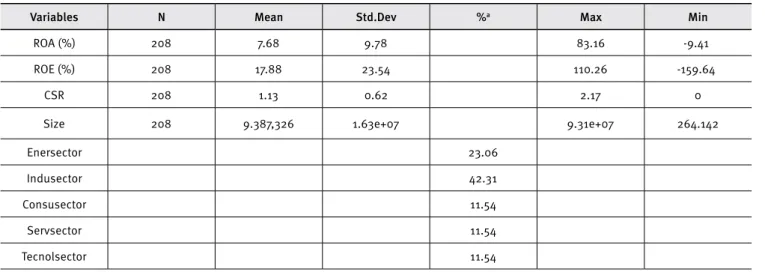
Firstly and prior to presenting the results of the analysis carried out, Table 1 presents the main descriptive statistics (mean, standard deviation, maximum and minimum value) of the variables used in the study, while Table 2 shows the bivariate correlations between them.
Table 1.
Descriptive statistics
Variables N Mean Std.Dev %a Max Min
ROA (%) 208 7.68 9.78 83.16 -9.41
ROE (%) 208 17.88 23.54 110.26 -159.64
CSR 208 1.13 0.62 2.17 0
Size 208 9.387,326 1.63e+07 9.31e+07 264.142
Enersector 23.06
Indusector 42.31
Consusector 11.54
Servsector 11.54
Tecnolsector 11.54
As Table 1 shows, there is a high level of heterogeneity among the irms in the sample, as the ranges of proitability and size indicate. Basic Materials sector stands out as the top sector followed by Industry and Construction. There is also a high level of variability in the CSR indicator used to measure the objective of this study in the companies that make up the sample, so this value remained low over the analyzed period.
Table 2 shows the correlations between the explanatory variables. Although some of them show a signiicant correlation, factor analysis of variance inlation (VIF) indicated no evidence of collinearity since in any case the VIF values were over 10.
Table 2.
Matrix of correlations
Variables 1 2 3 4 5 6 7
1 CSR 1.00
2 Size 0.45** 1.00
3 Enersec 0.42* 0.27* 1.00 4 Indusec -0.46* -0.30* -0.47* 1.00 5 Consusec -0.12 -0.12* -0.2* -0.31* 1.00 6 Servsec 0.10 -0.10 -0.2* -0.31* -0.13 1.00 7 Tecnsec 0.17* 0.4* -0.2* -0.31* -0.13 -0.13 1.00 Note. **p < 0,01;*p 0,05.
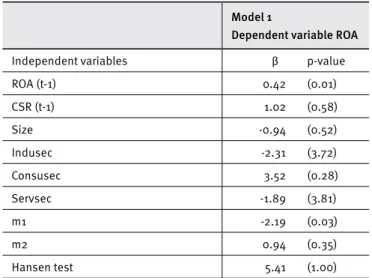
Tables 3 and 4 show the result of the GMM estimation used to test the hypotheses, with the size of the irms and their sectors controlled for. Performance is the dependent variable, and the explanatory variables are CSR lagged by period, irm size, and the activity sector to which it belongs. A lag was also included in the dependent variable.
Model 1 shows irm performance measured with ROA and Model 2 measured with ROE.
Table 3.
GMM results
Model 1
Dependent variable ROA
Independent variables β p-value
ROA (t-1) 0.42 (0.01)
CSR (t-1) 1.02 (0.58)
Size -0.94 (0.52)
Indusec -2.31 (3.72)
Consusec 3.52 (0.28)
Servsec -1.89 (3.81)
m1 -2.19 (0.03)
m2 0.94 (0.35)
Hansen test 5.41 (1.00)
The results of Model 1 in Table 3 show a positive but not signiicant relationship between ROA and the carrying out of CSR activities. These results are in line with those produced by
McWilliams and Siegel (1997, 2000, 2001) and those by Gil et al. (2009), Bajo and Durán (2009), and García-Castro et al. (2010)
in the case of Spain.
Table 4.
GMM results
Model 2
Dependent variable ROE
Independent variables β p-value
ROE (t-1) 0.54 (0.004)
CSR (t-1) -10.18 (0.4)
Size 0.13 (0.96)
Indusec -7.12 (0.56)
Consusec 7.42 (0.58)
Servsec -8.23 (0.69)
Tecnsec 13.87 (0.86)
m1 -2.30 (0.02)
m2 1.05 (0.29)
Hansen test 6.43 (1.00)
Model 2 shows a negative but not signiicant relationship between inancial ROE and the CSR indicator, and this result coincides with those of Aupperle et al. (1985), McWilliams and Siegel, (1997, 2000, 2001), Angla-Jiménez and Setó-Pamiés (2009, 2011), Gil et al. (2009), Bajo and Durán (2009), and García-Castro et al. (2010) in the case of Spain.
Both models show the signiicance of the lag for the dependent variable, which shows the persistence of performance over time. The Size variable did not prove signiicant, but keeps its place as it has been broadly used in the literature as a control variable. The variables representing activity sectors are not signiicant in any model.
These results conirm the existence of a neutral relationship between the measures of irm performance and the CSR indicator used in this study. Thus Hypotheses 1 and 2 are rejected while Hypothesis 3 is accepted.
CONCLUSIONS
To this end, panel data was used from a sample of IBEX 35 irms over the period from 2003 to 2010.
This paper, therefore, contributes to the current debate on this relationship. Previous studies in this area have relied on cross-section methodology, and the use of panel data deals with a number of its deiciencies, the existence of which can be seen in the literature. The results obtained show the existence of a neutral relationship between CSR and inancial performance, since in the models used the relationship between the two of them did not prove to be signiicant.
A comparison between the results found here and those produced by older studies gives rise to some relections. Firstly, if irm performance is measured by ROA, then the results coincide with those of McWilliams and Siegel (1997, 2000, 2001), as well as those of Bajo and Durán (2009), Gil et al. (2009), and García-Castro et al. (2010). It has been shown that including variables that cover R&D and advertising intensity (McWilliams & Siegel, 2000) has an efect on irm results and would therefore afect the results of the model. García-Castro et al. (2010) maintain the importance of including in this type of model some measure of management quality, as this is a factor that is probably related to the carrying out of CSR practices and, thus, with the values these indicators might reach. When using ROE as a measure of performance, we can add the studies of Aupperle et al. (1985), Bajo and Durán (2009), Gil et al. (2009), and Angla-Jiménez and Setó-Pamiés (2009) in the case of Spain, to corroborate the results found here.
These results show in all cases a neutral relationship between CSR and inancial performance, so they are in line with the international results discussed in the previous section. CSR does not mean worse economic outcomes for Spanish companies
We can add reports on the state of CSR in Spain that reveal that Spanish companies recognize the value generated by CSR. According to the latest study by Forética (2011), we can say that most Spanish companies (94% of large companies and 80% of small and medium) believe that an active CSR policy provides competitive advantages, particularly related to improvements in management (climate, competitiveness, productivity), brand, and visibility (reputation, loyalty).
Occupational hazard prevention, environmental management plans, conciliation, and gender equality are Spain’ most integrated management areas.
Seventy eight percent of Spanish irms consider that CSR contributes to reduce costs (human factor productivity, higher levels of motivation and satisfaction, eicient use of resources, and supply chain optimization) and 76% consider that it can improve income (margin increase, image enhancement, increased turnover due to customer loyalty and new markets).
Finally, with regard to the formalization of CSR policies, 5% of Spanish companies have a formal CSR policy in writing, and 11% are in the process of formalizing their policies.
Other possible causes of the neutral relationship between inancial performance and CSR are measurement problems, which are particularly signiicant for the CSR variable and could hide the real relationship between it and any other variable. As indicated by Griin and Mahon (1997), there is still no ideal empirical measurement for the CSR construct, something which may signiicantly afect the results found here. Furthermore, besides the variables indicated previously, there are many others involved in the relationship, so there is no necessary reason for such a relationship to exist, except perhaps occasionally (Ullman, 1985). None of this means that irms should not make eforts to develop CSR practices, since doing so will have an efect on the creation of value. CSR is seen as a way of promoting changes in consumer preferences, introducing new diferentiation variables and, inally, improving the irm’s working climate, trust, legitimacy, and support. Good CSR management ofers an opportunity to contribute greater value to the irm as it is a suitable instrument for creating and accumulating intangible assets such as reputation, brand, and human capital, which are things the market is beginning to value.
This is a pioneering study in that it uses panel data methodology and controls for both individual and temporal homogeneity. However, it sufers from a number of limitations which should be addressed in future research. Other CSR indicators could be used, such as the MERCO. It would be impossible to use KLD – a very widely used indicator in studies of British, American, and European companies – as few irms in the sample are included in it. Secondly, other variables could be used in the study that would take account of R&D, given its possible inluence on results.
Finally, there is the question of the size of the sample, as it is formed from IBEX 35 companies only and excludes irms from the inancial sector because of the possible distortions they might cause. An attempt was made to minimize the impact of this factor by using Windmejer’s (2005) correction for small samples. Nevertheless, the sample’s size continues to represent a limitation to this study.
REFERENCES
Allouche, J., & Laroche, P. (2005). A meta-analytical investigation of the relationship between corporate social and financial performance. Revue de Gestion des Ressources Humaines, 57, 18–41.
Angla-Jiménez, J., & Setó-Pamiés, D. (2011). La naturaleza de la relación entre la responsabilidad social de la empresa (RSE) y el resultado inanciero. Revista Europea de Dirección y Economía de la Empresa, 20(4), 161–176.
Arellano, M., & Bond, S. (1991). Some tests of speciication for panel data: Monte Carlo evidence and an application to employment equations. Review of Economics Studies, 58(2), 277–297. doi:10.2307/2297968 Aupperle, K. E., Carroll, A. B., & Hatield, J. D. (1985). An empirical
examination of the relationship between corporate social responsibility and proitability. Academy of Management Journal, 28(2), 446–463.
Bajo, N., & Durán, J. J. (2009). Responsabilidad social y variables estratégicas en las grandes empresas españolas. Revista de Responsabilidad Social de la Empresa, (2), 51–76.
Baron, D. (2008). Managerial contracting and corporate social
responsibility. Journal of Public Economics, 92(1-2), 268–288.
doi:10.1016/j.jpubeco.2007.05.008
Berman, S. L., Wicks, A. C., Kotha, S., & Jones, T. M. (1999). Does stakeholder orientation matter? The relationship between stakeholder management models and irm inancial performance. Academy of Management Journal, 42(5), 488–506. doi:10.2307/256972
Black, E. L., Carnes, T. A., & Richardson, V. J. (2000). The market valuation of corporate reputation. Corporate Reputation Review, 3(1), 31–42. doi:10.1057/palgrave.crr.1540097
Bragdon, J. H., & Marlin, J. A. T. (1972). Is pollution proitable? Risk Management, 19, 9–18.
Callado, F. J., & Utrero, N. (2008). Do investors react to environmental friendly news? An analysis for Spanish capital market. Corporate Ownership & Control, 5(2), 315–323.
Carroll, A. B., & Shabana, K. M. (2010). The business case for corporate social responsibility: A review of concepts, research and practice. International Journal of Management Review, 12(1),85–105. doi:10.1111/j.1468-2370.2009.00275.x
Charlo, M. J., & Moya, I. (2010). El comportamiento inanciero de las empresas socialmente responsables. Investigaciones Europeas de Dirección y Economía de la Empresa, 16(2), 15–25. doi:10.1016/ S1135-2523(12)60109-9
Cochran, P. L., & Wood, R. A. (1984). Corporate social responsibility and inancial performance. Academy of Management Journal, 27(1), 42– 56. doi:10.2307/255956
Fernández, J. L., & Luna, L. (2007). The creation of value through corporate reputation. Journal of Business Ethics, 76(3), 335–346. doi:10.1007/s10551-006-9285-0
Fernández, M., Aragó, V., Matallín, J. C., & Nieto, M. L. (2009). Do investors in Spain react to news on sustainability and corporate social responsibility (CSR)? International Journal of Sustainable Economy, 1(3), 227–244. doi:10.1504/jse.2009.024313
Fernández-Rodríguez, E., Gómez-Ansón, S., & Cuervo-García, Á. (2004). The stock market reaction to the introduction of best practices codes by Spanish irms. Corporate Governance: An International Review, 12(1), 29–46. doi:10.1111/j.1467-8683.2004.00341.x
Forética (2011). Informe Forética. Evolución de la responsabilidad social de las empresas en España. Forética. Madrid.
Freeman, R. E. (1984). Strategic management:A stakeholder approach. Marshield, MA: Pitman Publishing Inc.
García-Castro, R., Ariño, M. A., & Canela, M. A. (2010). Does social performance really lead to inancial performance? Accounting for endogeneity. Journal of Business Ethics, 92(1), 107–126. doi:10.1007/ s10551-009-0143-8
Gil, M. A., Giner, F., & Gríful, C. (2009). Benchmarking corporate social responsibility within Spanish companies. International Advances in Economic Research, 15(2), 207–225. doi:10.1007/s11294-008-9190-7 Godos-Díaz, J. L., Fernández-Gago, R., & Cabeza-García, L. (2012).
Propiedad y control en la puesta en práctica de la RSC. Cuadernos de Economía y Dirección de Empresas. 15(2012), 1–11. doi:10.1016/j. cede.2011.06.2002
Gómez-García, F. (2008). Responsabilidad social corporativa y performance inanciero: Treinta y cinco años de investigación empírica en busca de un consenso. Principios: Estudios de Economía Política, (11), 5–24.
Griin, J. J., & Mahon, J. F. (1997). The corporate social performance and corporate inancial performance debate: Twenty-ive years of incomparable research. Business and Society, 36(1), 5–31. doi:10.1177/000765039703600102
Hansen, L. P. (1982). Large sample properties of generalized method of moments estimators. Econometrica, 50(4), 1029–1054. doi:10.2307/1912775
Kurucz, E., Colbert, B., & Wheeler, D. (2008). The business case for corporate social responsibility. In A. Crane, A. McWilliams, D. Matten, J. Moon, & D. Siegel (Eds.). The Oxford handbook of corporate social responsibility (pp. 83–112). Oxford: Oxford University Press.
López, M. V., García, A., & Rodríguez, L. (2007). Sustainable development and corporate performance: A study based on the Dow Jones sustainability index. Journal of Business Ethics, 75(3), 285– 300. doi:10.1007/s10551-006-9253-8
Maignan, I., & Ralston, D. A. (2002). Corporate social responsibility in Europe and the U.S.: Insights from businesses’ self-presentations. Journal of International Business Studies, 33(3), 497–514.
McGuire, J. B., Schneeweis, T., & Branch, B. (1990). Perceptions of irm quality: A cause or result of irm performance. Journal of Management, 16(1), 167–180. doi:10.1177/014920639001600112
McGuire, J. B., Sundgren, A., & Schneeweis, T. (1988). Corporate social responsibility and irm inancial performance. Academy Management Journal, 31(4), 854–872.
Margolis, J. D., & Walsh, J. P. (2003). Misery loves companies: Rethinking social initiatives by business. Administrative Science Quarterly, 48(2), 268–305. doi:10.2307/3556659
Margolis, J. D., Elfenbein, H. A., & Walsh, J. P. (2007). Does it pay to be good? A meta-analysis and redirection of research on the relationship between corporate social and financial performance. Working paper, Harvard Business School, Cambridge MA..
Martínez-Campillo, A., Cabeza-García, L., & Marbella-Sánchez, F. (2012). Responsabilidad social corporativa y resultado inanciero: Evidencia sobre la doble dirección de la causalidad en el sector de las Cajas de Ahorros. Cuadernos de Economía y Dirección de la Empresa, 16(1), 54-68. doi:10.1016/j.cede.2012.04.005
McWilliams, A., & Siegel, D. (1997). The role of money managers in assessing corporate social responsibility research. Journal of Investing, 6(4), 98–107. doi:10.3905/joi.1997.408440
McWilliams, A., & Siegel, D. (2000). Corporate social responsibility and inancial performance: Correlation or misspeciication? Strategic Management Journal, 21(5), 603–609. doi:10.1002/(sici)1097-0266(200005)21:5<603::aid-smj101>3.0.co;2-3
Moskowitz, M. (1972). Choosing socially responsible stocks. Business and Society Review, 1, 72–75.
Moskowitz, M. (1975). Proiles in corporate responsibility: The ten worst and the ten best. Business and Society Review, 13, 28–42.
Nieto, M., Fernández, R., & Cabeza, L. (2012). La RSC en la relación entre composición del consejo y valor de mercado de la empresa. Papeles de Economía Española, (132), 315–328.
Orlitzky, M., Schmidt, F. L., & Rynes, S. L. (2003). Corporate social and inancial performance: A meta-analysis. Organization Studies, 24(3), 403–441. doi:10.1177/0170840603024003910
Patten, D. M. (2002). The relation between environmental performance and environmental disclosure: A research note. Accounting, Organizations and Society, 27(8), 763–773. doi:10.1016/S0361-3682(02)00028-4
Peloza, J. (2009). The challenge of measuring inancial impacts from investments in corporate social performance. Journal of Management, 35(6), 1518–1541. doi:10.1177/0149206309335188
Prado, J. M., Gallego, I., García, I. M., & Rodríguez, L. (2008). Social responsibility in Spain, practices and motivations in irms. Management Decision, 46(8), 1247–1271. doi:10.1108/00251740810901417 Preston, L. E., & O’Bannon, D. (1997). The corporate social-inancial
performance relationship: A typology and analysis. Business and Society, 36(4), 419-429. doi:10.1177/000765039703600406
Reverte, C. (2009). Determinants of corporate social responsibility disclosure ratings by Spanish listed irms. Journal of Business Ethics, 88(2), 351–366. doi:10.1007/s10551-008-9968-9
Reverte, C. (2011). The impact of better corporate social responsibility disclosure on the cost of equity capital. Corporate Social Responsibility and Environmental Management, 19(5), 253–272. doi:10.1002/csr.273
Roberts, P. W., & Dowling, G. R. (2002). Corporate reputation and sustained superior inancial performance. Strategic Management Journal, 23(12), 1077–1093. doi:10.1002/smj.274
Simpson, W. G., & Kohers, T. (2002). The link between corporate social and inancial performance: Evidence from the banking industry. Journal of Business Ethics, 35(2), 97–109. doi:10.1023/a:1013082525900
Ullman, A. (1985). Data in research of a theory: A critical examination of the relationship among social performance, social disclosure and economic performance of US irms. Academy of Management Review, 10(3), 540–557. doi:10.5465/amr.1985.4278989
Vance, S. C. (1975). Are socially responsible corporations good investment risks? Management Review, 64(8), 19–24.
Waddock, S. A., & Graves, S. B. (1997). Quality of management and quality of stakeholder relations: Are they synonymous? Business and Society, 36(3), 250–279. doi:10.1177/000765039703600303
Windmejer, F. (2005). A inite sample correction for the variance of linear eicient two-step GMM estimators. Journal of Econometrics, 126(1), 25–51. doi:10.1016/j.jeconom.2004.02.005