OF THE EXECUTIVE COMMITTEE
32nd Session, 25-26 March 1999
Provisional Agenda Item 4 SPP32/4 (Eng.)
28 January 1999
ORIGINAL: ENGLISH
EXPANDED TEXTBOOK AND INSTRUCTIONAL MATERIALS PROGRAM
Since 1968, the Expanded Textbook and Instructional Materials Program (PALTEX) has provided nearly 4 million books and instruments to students and health workers at over 600 institutions in 20 Latin American and Caribbean countries. In summary, it involves bulk purchase of materials to obtain high discounts; use of PAHO's Headquarters' and country offices' infrastructure for logistics and financial management; and volunteer administration of sales by participating universities and health service institutions. PALTEX has evolved to serve the needs of a wide range of professional health disciplines: dentistry, environmental health, health administration, medicine, nursing, nutrition, public health, and veterinary medicine.
Far more than a book sales program, PALTEX is an integral part of PAHO’s program of technical cooperation. It is an example of a creative mechanism of collaboration in the management and transmission of knowledge in health, involving international organizations, national and local governments, and the private sector. Through involvement of national and local institutions in the materials selection and development process, PALTEX is now supporting the training, use, distribution, and management of health personnel in the reorganization of the national health systems, especially the development of training activities linked with practice.
CONTENTS
Page
1. Background... 3
2. PALTEX and PAHO's Technical Cooperation Activities ... 4
3. How the Program Works... 4
3.1 Program Operations ... 4
3.2 Program Financing... 5
3.3 Selection of Materials ... 6
3.4 Benefits Offered by PALTEX ... 7
3.5 Materials Currently Available ... 7
4. Program Accomplishments ...8
4.1 Distribution Network in the Countries ...8
4.2 Financial Viability ...9
4.3 Sales of Materials by Subject Area and Country... 10
5. Present Challenge: PALTEX and Continuing Education ... 12
6. PALTEX Development Plan for 1999-2000... 14
1. Background
The education and training of health workers has always had a high priority for the Organization. In addition to a concern with training programs and educational methodology, PAHO has also had a long-term interest in the preparation and provision of instructional materials needed by health personnel as part of their learning process. PAHO efforts in this area date from the 1960s, when a lack of access to high-quality textbooks for undergraduate Latin American medical students was identified as a serious impediment to the training of physicians.
A study carried out in 1965 under PAHO auspices determined that relatively few high-quality medical textbooks were available in Spanish, and those that were had prices beyond the reach of many potential users. The answer to the problem developed by PAHO in consultation with its Member States and the universities of the Region was to create the Medical Textbook Program, a mechanism to provide high-quality instructional materials at prices which would represent a real incentive for students to use them. First implemented in 1968, the basic scheme involves centralized book purchase in bulk quantities by the Pan American Health and Education Foundation (PAHEF), thus obtaining significant discounts from publishers; use of PAHO's Headquarters' and country offices' infrastructure for assistance in shipping logistics and financial management; and administration of sales by the universities without charge to the Program.
Over the Program's more than 30 years of operation, the health manpower training needs of Latin American countries have continued to evolve, but the basic Program mechanism has continued to provide a flexible tool for delivering the different kinds of materials required. Today's Program (now known as the Expanded Textbook and Instructional Materials Program, or "PALTEX") serves the needs not only of medical students, but also of a wide range of professional health disciplines, including dentistry, environmental health, nursing, nutrition, and veterinary medicine. It provides not only print materials, but also basic diagnostic instruments required for hands-on student practice.
In addition to textbooks for professionals, PALTEX also publishes and distributes manuals and other materials focused on the needs of health services personnel at all levels of the health system. PALTEX is now meeting the urgent need for constant updating and improvement of health workers' skills by providing materials especially designed for programs of continuing education.
2. PALTEX and PAHO's Technical Cooperation Activities
From the time of its creation in the late 1960s, the Program has always been considered an integral part of PAHO's technical cooperation in human resources development. While PALTEX produces and distributes many publications, this is not the fundamental reason for its existence within the PAHO framework. From the outset, the distribution of textbooks at low cost was conceived as only a part of a larger effort to improve the training of health professionals, involving frequent meetings of committees, not only for selection of books, but also for wide-ranging discussion of curricula and teaching methodology.
In terms of PAHO’s current priorities, PALTEX has been adapted to serve as a support mechanism for the technical cooperation activities of the Division of Health Systems and Services Development (HSP), the Human Resources Development Program (HSR), PAHO’s other divisions and special programs, and the PAHO/WHO (PWR) country offices. Accordingly, the current focus is on supporting the training, use, distribution, and management of health personnel in the reorganization of the national health systems, especially the development of training activities linked with practice.
Technical coordination of PALTEX at the regional level is a programmatic responsibility of HSP/HSR. It encompasses coordination of the selection process, including screening of books recommended for inclusion in PALTEX, proposals for the development of new materials, identifying reviewers inside and outside of PAHO, and designing activities to make PALTEX more responsive to the needs of teaching and service institutions. It should be stressed that the HSR role here is one of coordination, and that HSR draws on the recommendations and expertise of all PAHO technical units at Headquarters and the field in reviewing materials and participating in the decision as to which items will be included.
3. How the Program Works
3.1 Program Operations
PALTEX is a collaborative effort of several counterpart agencies: PAHO, PAHEF, Member States, publishing houses, and the universities and other institutions that train or employ health workers.
In order to comply with the requirements of the Inter-American Development Bank (IDB), Program financing is conducted through a US nonprofit organization, the Pan American Health and Education Foundation (PAHEF). While from the point of view of users in the Region PALTEX is seen primarily as a PAHO program, legally it is considered a PAHEF enterprise qualifying for nonprofit status under the pertinent US regulations.
recovery, coordinates the activities of the PWR offices in the administration of PALTEX in the countries, and maintains the PALTEX books of account. Once manufactured, the materials are shipped in bulk to the PWR offices in each country on a periodic schedule, with a view to economizing on shipping costs and having stock available in-country on a timely basis for redistribution in accordance with the needs of the participating institutions.
PALTEX relies on the established PAHO administrative framework for clearing international shipments of materials and for accounting and crediting sales proceeds to PAHEF. PAHO accepts payment in the local currency of each country, and credits to PAHEF an equivalent amount in US dollars at prevailing rates of exchange, using the local currency to meet normal country office operating expenses. The Member States cooperate by signing basic agreements with PAHO permitting PALTEX operation in each country.
PALTEX textbook purchase contracts with commercial publishers stipulate that the books may not be resold through commercial channels. When an existing title is incorporated in PALTEX, commercial bookstore sales are essentially unaffected, so that the additional bulk sales to PALTEX represent income that would not otherwise be available.
Two mechanisms of participation are available to interested institutions: direct purchase, or sales on consignment. In the first, the institution simply pays for the materials upon receipt; special quantity discounts are sometimes available. The second requires the signing of a Memorandum of Understanding with PAHO, in which the institution agrees to receive and sell stocks of materials on consignment, assuming the cost and responsibility of the local sales operation.
3.2 Program Financing
PAHO, PAHEF and the participating institutions have each played an important role in support of PALTEX. Program operations are financed by two revolving funds created by PAHEF with loans from the IDB. The first loan of $2 million was made in 1971 for the purchase of textbooks for medical students. PAHO itself undertook the responsibility to repay the loan principal over the 20-year period from 1976 to 1996. The final loan payment was made in February 1996, and no further payments from PAHO are required for this purpose.
Capital Fund at least equal to the outstanding loan balance (about $3.2 million as of December 1998).
With the termination of the Medical Program subsidy, the direct PAHO financial contribution to PALTEX essentially ceased. Almost all personnel and other direct operating costs are now being met from PALTEX revenues. However, PAHO continues to make a major contribution through the services of its technical and administrative staff at Headquarters and in the countries. PAHO provides the diplomatic franchise for clearing customs shipments, credits the local currency sales proceeds to PAHEF through its accounting system, and provides office space and facilities for the personnel responsible for day-to-day program administration. PAHO's technical staff serves as the Program's editorial board and agent of promotion.
PALTEX could not function without the voluntary administration of the sales operation by the participating institutions, which bear a major share of the cost in the form of the services of part-time staff who actually sell the materials to the final purchaser. The schools agree to supply a part-time clerk, physical facilities, and faculty coordination at no cost to the Program. PALTEX pays a nominal amount of 2.5% of gross sales to each school in recognition of this voluntary effort.
3.3 Selection of Materials
Among the criteria for selecting materials for distribution through PALTEX are high technical and instructional quality, consonance with PAHO program priorities, and a user demand sufficient to justify production of economic quantities. The PALTEX book list is kept up to date and new materials are introduced on a continuing basis through a process of consultation coordinated by HSR. Manuscripts or published materials submitted by authors, publishers, and government agencies or other institutions are reviewed initially by HSR staff and, if necessary, sent for a second opinion to PAHO specialized staff at Headquarters or in the field, or to selected experts in Latin American universities or health services.
Depending on program needs, PAHO technical units frequently initiate the preparation of materials in coordination with HSR. In such cases, the actual writing is done by PAHO staff or other experts chosen for their knowledge of the manpower training needs of the Region. Most of PAHO's technical programs have taken advantage of PALTEX to produce and distribute materials of importance to their current priorities.
how to improve the Program and to supply feedback regarding the materials provided. This also gives teachers an opportunity to compare notes on the utilization of materials in the curriculum.
3.4 Benefits Offered by PALTEX
PALTEX serves its participating institutions by providing an opportunity for their students, faculty and other health workers in training or in service to purchase textbooks and other instructional materials at prices about 60%-70% of the normal commercial price. Furthermore, it publishes materials at low cost in some aspects of primary health care and continuing education which commercial publishers in Latin America have not yet begun to cover adequately. Students and health workers gain access to books by Latin American authors of Region-wide interest and usefulness, which they might not otherwise have been able to obtain in their own countries.
Participation in PALTEX also permits the institution to take part in the continuing analysis and refinement of curricula and teaching methodology that the selection process involves. It gives school and other health services personnel an opportunity to exchange ideas with their counterparts and to help create the kinds of educational materials they feel would be most suitable for local conditions.
3.5 Materials Currently Available
A broad range of instructional materials is currently available through PALTEX. Health science textbooks for undergraduates continue to be provided. While translations of classic works make up a substantial proportion of the sales, PALTEX has also given special priority to distributing works by Latin American authors, in the interest of promoting appropriate technology and fostering national intellectual and scientific development.
health research methodology, and special aspects of epidemiology in PHC. The program also publishes the Serie PALTEX Salud y sociedad 2000, covering the relationship between social realities and the health status of the population.
In addition to these three series, PALTEX seeks out and distributes materials of public health interest written and/or published by other sources, including commercial and university publishers, specialized institutes, and nongovernmental organizations. Selected PAHO publications are also distributed to students and health workers through the PALTEX system, including materials produced by the PAHO Publications and Editorial Services and the individual technical programs.
PALTEX also includes non-print materials. Basic diagnostic and dental instruments are available, such as stethoscopes, sphygmomanometers, oto-ophthalmoscopes, basic surgery kits, and dental handpieces and other hand instruments. The Spanish version of the EPI-INFO computer software can now be purchased through PALTEX, and other software is being reviewed for possible inclusion.
4. Program Accomplishments
4.1 Distribution Network in the Countries
Over the years, the number of participating institutions has grown steadily, and now stands at over 600, significantly enhancing PAHO’s presence at the local level Region-wide. In some countries, the PALTEX offices in participating institutions represent the major opportunity for the public to learn of PAHO’s existence. This sales network was created with the distribution of undergraduate textbooks in mind, and works well for this purpose. However, it is less well adapted to the distribution of books in public health and social medicine or primary health care manuals directed at in-service personnel rather than university students. Accordingly, special efforts have been made to promote PALTEX more intensively with health services institutions which train or employ health workers.
One approach has been to interest national and local health services in setting up sales posts similar to those at the universities. Another way has been to publicize PALTEX extensively within public and private sector institutions, encouraging persons to buy books and other materials through the existing sales posts at the universities or in the PAHO country offices.
opportunities for sales include special training courses financed by the IDB or the World Bank in connection with development loans. Available information indicates that the Program is achieving considerable success in distributing public health and primary health care materials in addition to undergraduate textbooks.
4.2 Financial Viability
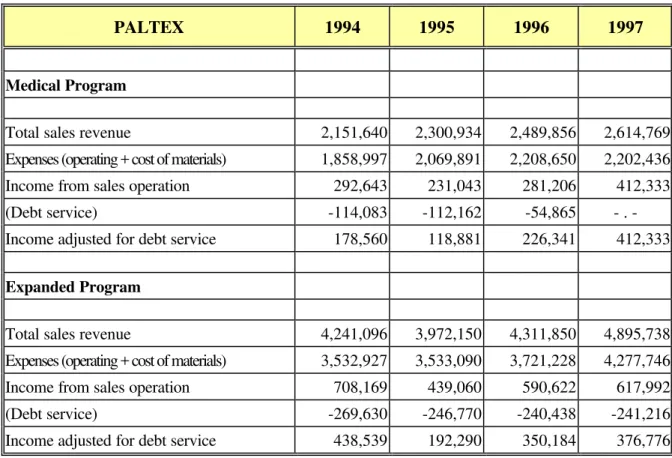
Both the Medical and the Expanded Program have turned in an excellent financial performance in recent years as indicated in Table 1. Sales revenue has been more than sufficient not only to meet all the costs of purchasing inventory and carrying out the sales operation throughout the Region, but also to meet the cost of debt service. Over and above income from sales operations, both Programs have also earned substantial interest on invested cash.
Table 1: Revenue and Expense (in US dollars)
PALTEX 1994 1995 1996 1997
Medical Program
Total sales revenue 2,151,640 2,300,934 2,489,856 2,614,769
Expenses (operating + cost of materials) 1,858,997 2,069,891 2,208,650 2,202,436
Income from sales operation 292,643 231,043 281,206 412,333
(Debt service) -114,083 -112,162 -54,865 .
-Income adjusted for debt service 178,560 118,881 226,341 412,333
Expanded Program
Total sales revenue 4,241,096 3,972,150 4,311,850 4,895,738
Expenses (operating + cost of materials) 3,532,927 3,533,090 3,721,228 4,277,746 Income from sales operation 708,169 439,060 590,622 617,992
(Debt service) -269,630 -246,770 -240,438 -241,216
4.3 Sales of Materials by Subject Area and Country
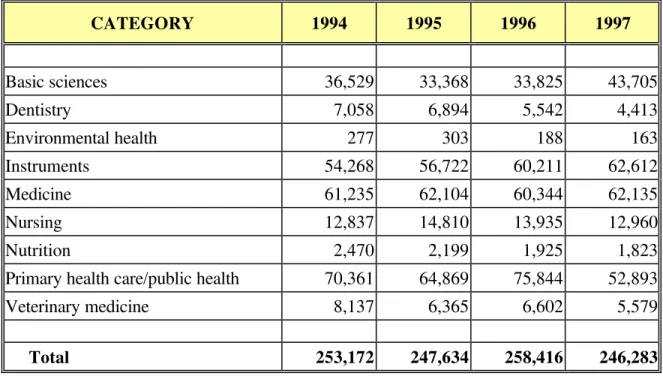
Overall unit sales, as seen in Table 2, have grown from a level of about 200,000 per year in the early 1990s to a relatively stable current level of about 250,000. This reflects the fact that most PALTEX sales continue to be made in the medical schools, where enrollment has also stabilized. Future PALTEX market growth will have to come through opening new sales channels for the in-service personnel employed in national and local health systems.
Primary health care and public health materials published by PALTEX, PAHO, and other sources, medical textbooks, and basic diagnostic instruments are the categories with the highest unit sales. Textbooks in the basic sciences occupy an intermediate position in overall sales, followed at a distance by materials in other professional areas. It should of course be noted that there are far fewer students in such areas as dentistry or nursing than in medicine. The higher selling prices of textbooks and instruments provide an indirect subsidy, permitting lower prices for materials of more programmatic interest to PAHO.
Table 2: Unit Sales by Category
CATEGORY 1994 1995 1996 1997
Basic sciences 36,529 33,368 33,825 43,705
Dentistry 7,058 6,894 5,542 4,413
Environmental health 277 303 188 163
Instruments 54,268 56,722 60,211 62,612
Medicine 61,235 62,104 60,344 62,135
Nursing 12,837 14,810 13,935 12,960
Nutrition 2,470 2,199 1,925 1,823
Primary health care/public health 70,361 64,869 75,844 52,893
Veterinary medicine 8,137 6,365 6,602 5,579
The number of book titles included in the program has grown rapidly over the past decade, mostly explained by the expansion of the primary health care/public health category (Table 3). These materials cover areas of special interest to PAHO in terms of its mission and strategic priorities. The major categories are:
Ÿ the "PALTEX Series" published directly by the Program, including manuals for technicians and auxiliaries, as well as for health program managers;
Ÿ other PAHO publications, including items published by the technical divisions and items from the PAHO Scientific Publications series;
Ÿ manuals similar to the PALTEX Series issued by other publishers in aspects of primary health care and frontline clinical management;
Ÿ works on important aspects of public health, social medicine, and health administration.
Table 3. Number of Book Titles Available
SUBJECTS 1994 1995 1996 1997
Environmental health 4 4 4 4
Nutrition 5 5 5 5
Veterinary medicine 19 9 17 18
Dentistry 21 20 21 20
Basic sciences 24 26 35 38
Nursing 25 28 28 28
Medicine 78 83 90 92
Primary health care/public health 118 140 154 160
Table 4 summarizes unit sales by country from 1994 through 1997. Logically, the distribution of sales by country tends to follow relative size. Countries with especially good performance in proportion to size include Bolivia, Paraguay, Peru, and most of Central America.
Table 4. Unit Sales by Country
COUNTRY 1994 1995 1996 1997
Argentina 62,221 54,161 51,074 52,692
Bolivia 7,453 5,845 6,231 7,526
Brazil 19,121 17,905 22,218 26,307
Chile 4,841 4,649 5,658 7,308
Colombia 34,726 29,824 34,063 26,316
Costa Rica 7,063 7,594 4,942 5,523
Dominican Republic 6,037 6,340 6,128 7,156
Ecuador 6,495 6,480 7,617 8,362
El Salvador 7,463 7,777 9,644 8,938
Guatemala 4,687 4,908 4,948 5,312
Honduras 2,652 2,450 2,504 3,168
Mexico 35,404 29,074 27,918 30,349
Nicaragua 7,128 7,816 6,398 6,243
Panama 2,216 2,666 1,903 1,904
Paraguay 3,330 3,450 4,631 4,627
Peru 21,856 26,706 26,033 24,386
Uruguay 4,676 3,875 4,021 5,351
Venezuela 10,443 10,338 6,892 9,740
5. Present Challenge: PALTEX and Continuing Education
which satisfy the continuing education needs of in-service personnel in light of changing practice profiles and the need to improve performance. PAHO is cooperating with the countries in the training component of several investment projects in support of sectoral reform whose educational needs are of two kinds:
Ÿ Needs of managerial staff derived from changes in the direction, organization and management of systems;
Ÿ Needs relating to the improvement of the quality, effectiveness and productivity of health care.
PALTEX needs to adjust its strategy to better respond to these needs and to find new ways of relating to service institutions, including greater flexibility in the development and provision of materials, technical support for innovative development projects, and cooperation in strengthening national continuing education capabilities.
In the selection or development of materials oriented toward these needs, PALTEX has begun to test several approaches:
Ÿ Work groups composed of both academic and in-service personnel to analyze changes in the health services and work-related practices and the corresponding training needs;
Ÿ Participation in several technical cooperation projects in the countries aimed at improving overall management of continuing education;
Ÿ Special joint action with PAHO Representatives in 12 countries to identify training materials needs and promote the Program in the health services.
The challenges which the Program continues to face in supporting the development of suitable materials in close collaboration with the users include:
Ÿ The low priority now given to continuing education, where sporadic efforts tend to reproduce centralized norms rather than reflect the specific needs of local institutions;
Ÿ Technical and managerial weakness of in-service training units;
Ÿ Lack of individual purchasing power on the part of health service personnel, depending on their institutions to provide the necessary training materials;
Ÿ Multiplicity of health sector actors, whose diversity reflects that of the institutional health sector among the countries of the Region.
6. PALTEX Development Plan for 1999-2000
The PALTEX development plan will address the issues covered in Section 5 within the framework of PASB’s strategic and programmatic orientations and its technical cooperation priorities for health manpower and educational development. Given the importance of continuing education in the political and institutional context of sectoral reform, HSP and HSR have promoted a process of PAHO interdivisional cooperation in defining PALTEX strategy that will result in a formal PALTEX development plan by the end of the first semester of 1999.
During the second half on 1998, HSP/HSR organized meetings with all PAHO technical divisions and special programs to review their joint experience with PALTEX, the possibilities of PALTEX supporting their technical cooperation activities, the educational development needs identified by the divisions in accordance with their strategies, and the potential for financial support for materials development.
7. PALTEX Perspectives for the Next Quadrennium
There are specific mandates about disseminating scientific and technical knowledge and information in the new strategic and programmatic orientations approved for the period 1999-2002.1 PAHO has committed to promote a reorientation of education for health professionals and continuing education for workers in the sector, while strengthening institutions and supporting integrated processes in public health education. PALTEX will play a key role in it.
PALTEX is not facing financial viability difficulties at present and they are not foreseen in the immediate future. The presence of the Program in the educational institutions of the health sector is solid. In this context, it is worthwhile to emphasize the function that PALTEX fulfills in the dissemination of knowledge about the activities of PAHO in general. PALTEX facilitates the extension of PAHO’s programs to the health services by improving the relevance of instructional materials to the needs of service personnel, as well as contributing to managerial development in each country and at the central level. In this perspective, interdivisional and interprogrammatic participation—by means of a development plan—and the support of the PWR offices (always a pillar of the development of PALTEX in each country) will be of capital importance.
There arises the question of the future of printed material (books) in a future society transformed by the progress of information science and computerized networks
1
(network society). One point of agreement is that the effect of the book is still far from over, as can be inferred from the current dynamism of the publishing industry in the developed countries and especially of the distribution industry. On the other hand, the penetration of telecommunications and information science in the health services in the Region is still limited. It is to be expected that, given the conditions and economic and social trends of the Region, the effect of the printed materials still has a time horizon measurable in decades.
However there exist other challenges, derived from the development of knowledge and technology and of the organizational transformations that characterize contemporary society.
One of the most important is PALTEX adaptation and leadership in transforming the potential of distance learning in light of the ever-increasing use of computer networks at the local and national levels, as well as the Internet. Distance learning based on the use of traditional mail had a relatively poor acceptance and development in the Region, especially in Latin America and the Caribbean. Communication difficulties worked against reduction of the gap between educators and students and the development of meaningful learning.
Such difficulties have disappeared with the advent of modern interactive technologies of communication and expansion of the Internet in the countries to include World Wide Web access. The virtual space configured by information networks permits real-time student-educator interaction. The use of hypertext has made it possible to expand the margins of cognitive flexibility and to strengthen intelligence dissemination. The quality, effectiveness, and accessibility of distance learning have grown notably and should be subject to study as a PAHO technical cooperation strategy. What role can PALTEX will play in this new development?
This notable process of change in distance learning has permitted the exponential expansion of educational opportunities in the developed countries. It has resulted in the appearance of a very dynamic and competitive education industry, already being expanded to Latin America and the Caribbean, which has brought with it problems of relevance, quality, and importance of the educational materials in the market. It should be possible to capitalize on the experience of PALTEX with printed materials in order to attack those problems.