Copper, zinc, mercury and arsenic content in
Micropogonias furnieri
and
Mugil platanus
of the Montevideo coastal zone, Río de la Plata
Metals (Cu, Zn, Hg) and metalloid (As)
concentrations were measured in
Micropogonias
furnieri
and
Mugil platanus
caught in three
areas along the Montevideo coastal zone during
winter 2010, spring 2010 and 2011. Compared
to previous studies conducted in the zone, both
species showed higher (for Cu), similar (for Zn)
or lower (for Hg) concentrations. The highest
Hg values were found in the
M. furnieri
of
Montevideo bay. There was no spatial variation
in Cu, Zn, and As concentrations in muscle,
likely due to the high mobility of both species.
However, the Cu content in the liver of M.
furnieri was higher in fish from the West zone.
Cu, Zn and As found in the liver of
M. platanus
were much higher than in that of
M. furnieri
. A
functional relationship between muscle levels
of Zn and Hg and fish length of
M. furnieri
indicates bioaccumulation of these metals.
According to the results,
M. furnieri
may be used
as a temporal bioindicator for Hg, but not as a
spatial bioindicator. Mercury levels were below
the maximum safety level based on international
standard values for human consumption.
A
bstrAct
Diego Corrales
1, Alicia Acuña
1, María Salhi
2,3, Gustavo Saona
4, Ernesto Brugnoli
1,*
1 Oceanografía y Ecología Marina, Instituto de Ecología y Ciencias Ambientales, Facultad de Ciencias, Universidad de la República. 2 Laboratorio de Análisis de Productos Pesqueros, Dpto. de Industria Pesquera, Dirección Nacional de Recursos Acuáticos, Ministerio de Ganadería Agricultura y Pesca (MGAP), Uruguay.
3 Laboratorio de Recursos Naturales, Instituto de Ecología y Ciencias Ambientales, Facultad de Ciencias , Universidad de la República, Uruguay.
4 Servicio de Evaluación de la Calidad y Control Ambiental, Intendencia de Montevideo, Uruguay
*Corresponding author: [email protected]
Descriptors:
Metals, Fish, Bioaccumulation, Estuary,
Human consumption, Río de la Plata.
Foram estudadas as concentrações de metais (Cu, Zn,
Hg) e metaloides (As) em exemplares de
Micropogonias
furnieri
e
Mugil platanus
coletados em três locais ao
lon-go da costa de Montevidéu (Uruguai) durante o inverno
de 2010 e as primaveras de 2010 e 2011. Comparados
com estudos prévios realizados nessas áreas, ambas as
espécies apresentaram concentrações maiores (para Cu),
similares (para Zn) ou menores (para Hg). Os valores
mais elevados de Hg foram encontrados em
M. furnieri
da baía de Montevidéu. Não houve variação espacial na
concentração dos elementos Cu, Zn, and As,
provavel-mente devido à alta mobilidade de ambas as espécies.
No entanto, a concentração de Cu no fígado de
M.
fur-nieri
foi maior nos peixes da área Oeste. Cu, Zn e As
fo-ram encontrados em
M. platanus
em valores mais
eleva-dos do que no fígado de
M. furnieri
. A relação funcional
entre os níveis de Zn e Hg no músculo e o comprimento
dos peixes em
M. furnieri
indica bioacumulação para
estes metais. De acordo com os resultados,
M. furnieri
pode ser utilizado como bioindicador temporal para Hg,
mas não como bioindicador espacial. Os níveis de Hg
registrados estiveram abaixo do nível máximo de
segu-rança com base nos valores do padrão internacional para
o consumo humano.
r
esumo
Descritores:
Metais, Peixes, Bioacumulação, Estuário,
Consumo humano, Río de la Plata.
INTRODUCTION
Metals and metalloids are present in aquatic environments and originate from both natural and anthropogenic sources. Low concentrations of essential elements such as zinc (Zn) and copper (Cu) play an important metabolic role in aquatic organisms, while the non-essential mercury (Hg) and arsenic (As) can be toxic at low concentration (LUOMA; RAINBOW, 2011; WANG et al., 2010).
Metals and metalloids may bioaccumulate and biomagnify in aquatic organisms (TAGLIAMONTE et al., 2008; REJOMON et al., 2010). In ish, these elements tend to accumulate in muscle, liver and gills; thus these tissues are the most commonly used to measure contaminant levels (REJOMON et al., 2010). However, bioaccumulation varies with environmental parameters and is also species dependent, (e.g. life history, age, length and sex) (LOMBARDI et al., 2010; REJOMON et al., 2010; WANG et al., 2010; QADIR; MALIK, 2011; ABDOLAHPUR et al., 2013).
Bioaccumulation and biomagniication are a major con -cern in commercially exploited ish species (BURGER; GOCHFELD, 2005). Micropogonias furnieri (whitemouth croaker) and Mugil platanus (mullet) are among the most abun-dant ish species in the coastal zone of Montevideo, bordering the Río de la Plata (NIÓN, 1997). The whitemouth croaker is of high economic value since it is the principal resource of coastal isheries in Uruguay and Argentina, where in the Montevideo coastal zone an important artisanal ishery is un -dertaken (DEFEO et al., 2009). In this coastal area, the highest pollution load is in Montevideo Bay, notably in the inner bay, due to urban and industrial discharges, industrial activities, and maritime trafic associated with the harbor. However, the west and east of this area are only moderately polluted (MUNIZ et al., 2004; 2011; BRUGNOLI et al., 2007).
Studies of metal contamination in ish from the Montevideo coast are scarce. VIANA et al. (2005) have found evidence of bioaccumulation of Hg and Zn in the whitemouth croaker. Both M. furnieri and species of the genus Mugil are considered potential bioindicator species for metal contamination (VIANA et al., 2005; MARCOVECCHIO, 2004; FRANCO; LEÓN, 2012).
The present study was conducted to update and extend the observational records of Cu, Zn, Hg, and As in muscle and liver of M. furnieri and M. platanus along the Montevideo coastal zone. It also assesses their quality for human consumption. The potential use of these ish species as bioindicators of metal contamination in the area is also considered.
MATERIAL AND METHODS
S
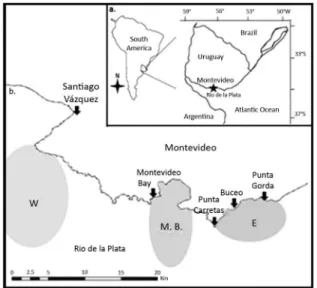
tudyareaandSamplingprocedureThe Montevideo coastal zone has an extension of approximately 50 km. Its major feature is the Montevideo bay, where the principal Uruguayan harbor is located. A total of 75 specimens of Micropogonias furnieri (61) and Mugil platanus (14) were obtained in winter 2010, spring 2010 and spring 2011 from the artisanal ishery at the landing sites of Santiago Vázquez town (West zone), Montevideo Bay (MB) and Punta Carretas, Buceo and Punta Gorda (East zone) (Figure 1).
The specimens were kept refrigerated at 4°C in a cooler and transported to the laboratory for dissection and analysis. Total length (cm) and weight (kg) of each individual were recorded. Based on the protocol of SERICANO and BESADA (2009), two samples from axial muscle and the liver of each specimen were extracted and frozen for further analysis.
analytical techniqueS
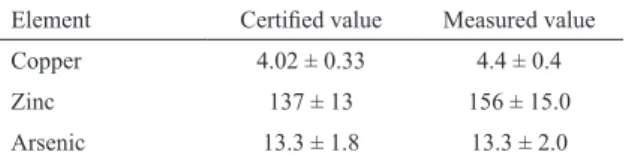
Cu, Zn and As were quantiied in muscle and liver using Energy Dispersive X-Ray Fluorescence (EDXRF) in the Tecnogestión laboratory (MIEM). The quality assurance system (ISO/IEC 17025) was used throughout the process. The analytical procedure was checked using standard reference materials (Table 1; IAEA-392; IAEA - 336 and NIST 2976). Muscle samples were analyzed individually but pools of 4-5 livers (3-4g) were prepared to meet analytical requirements.
Figure 1. a) Geographical location of Uruguay and Montevideo city
Table 1. Comparison between experimental results and certiied values (mg Kg-1 dry weight) of mussel tissue NIST 2976
Element Certiied value Measured value
Copper 4.02 ± 0.33 4.4 ± 0.4
Zinc 137 ± 13 156 ± 15.0
Arsenic 13.3 ± 1.8 13.3 ± 2.0
Total Hg was quantiied only in the muscle tissue by Cold Vapor Atomic Absorption Spectroscopy (CVAAS) in the Laboratory of Analysis of Fishery Products (DINARA, MGAP). Each CVAAS sample of muscle tissue was frozen and grounded until a homogeneous product was obtained and analyzed for Hg content following HATCH; OTT (1968; modiied according to MENDEZ et al., 2001), after validation and accreditation ISO/IEC 17025.
data analySiS
Prior to performing the statistical analyses, values of element concentrations lower than the limit of detection (LOD µg g-1 wet weight (W.W.): Cu: 0.40; Zn: 0.40; As: 0.80; Hg: 0.04) were replaced by half this value (LOD/2). The element concentrations were expressed as mg g-1 W.W.
The average, standard deviation and range of concentrations of elements and ish length of M. furnieri and M. platanus were calculated for each zone (West zone, MB, and East zone) and seasons (winter 2010, spring 2010, and spring 2011). A functional relationship between the concentration of each metal and M. furnieri length was calculated by itting linear and exponential regressions. The best regression model was selected by choosing the highest coeficient of determination (r2). The Analysis of Covariance (ANCOVA) was used to compare the metal concentrations in M. furnieri muscle between sampling zone and periods, adjusting for the effect of ish size. The assumptions of normality and homoscedasticity were tested using the Shapiro-Wilk and Levene tests, respectively. The metal concentrations were transformed using the natural logarithm (Ln) to reduce the heteroscedasticity effect in statistical analyses. P-values lower than or equal to 0.05 were considered signiicant (ZAR, 1996).
RESULTS
Detectable levels of Cu, Zn and As were found in muscle and liver tissues of both species. Values of these elements were always much higher in liver than in muscle,
sometimes by up to one order of magnitude. Mercury was detected only in M. furnieri muscle. However, Hg was not detectable in a high number of samples (n = 21), resulting in high standard deviation of average results (Table 2 and 3).
Average Cu, Zn and As concentrations in muscle of M. furnieri and M. platanus were similar along the coast and during all seasons (Tables 2 and 3). On the other hand, values of Hg found in muscle of M. furnieri showed the highest values in Montevideo Bay (0.14 ± 0.13 mg g-1 W.W.) (Table 2) and were lower in spring 2010 than in winter 2010 and spring 2011 (Table 3).
With regard to the metal content in liver of M. furnieri, the average concentrations of Cu and As were similar across seasons, but Zn contents incresed from the lowest value in spring 2010 (33.75 ± 4.54 mg g-1 W.W.) to the highest value in spring 2011 (44.48 ± 7.93 mg g-1 W.W.). Average Cu content in liver of M. furnieri from the West zone was higher than in the other zones (Table 2). For M. platanus, levels of Cu, Zn and As found in the East zone were much higher than those in liver of M. furnieri from the same zone (Table 2); levels of As and Zn in liver of M. platanus were higher in winter 2010 (14.81 ± 4.58 mg g-1 W.W. and 103.25 ± 18.44 mg g-1 W.W. respectively) than in spring 2011 (Table 3).
The regression analysis showed that for M. furnieri, Zn and Hg contents in muscle were signiicantly associated with total ish length (p < 0.05; Figure 2 a, b). The functional relationships were itted with linear (for Zn) and exponential (for Hg) regressions (Figure 2 a, b). The ANCOVA showed that Cu content in muscle of M. furnieri was correlated with the season (p = 0.015) with signiicant differences between spring 2010 and spring 2011. Zinc concentrations also varied by season (p = 0.035) and ish length (p = 0.0001), although signiicant differences were observed only between winter 2010 and spring 2011. Arsenic contents showed no signiicant differences. Mercury content was signiicantly correlated with season and ish length (p = 0.0006), as well as with capture site (p = 0.0004) (Table 2 and 3).
In all samples, average muscle concentrations of Hg (M. furnieri) were below the maximum permitted levels for human consumption (0.5 mg kg-1 W.W.; CODEX-STAN 193-1995, 2010; MERCOSUR, 2011).
DISCUSSION
Table 2. Cu, Zn and As concentrations in muscle and liver, Hg concentrations in muscle of Micropogonias furnieri and Mugil platanus samples from West and East zone and Montevideo Bay.
Cu Zn As Hg
Muscle Liver Muscle Liver Muscle Liver Muscle
West Zone
Micropogonias furnieri
Length (47.5 ± 4.3) (47.5 ± 4.3)
N 12 (67%) 4 (100%) 12 (100%) 4 (100%) 12 (92%) 4 (100%) 12 (25%)
Concentration
(Mean ± SD) 0.40 ± 0.17 26.50 ± 7.54 3.56 ± 0.84 40.79 ± 6.01 1.82 ± 1.16 2.55 ± 0.22 0.05 ± 0.04 Range < 0.40-0.65 21.00-37.62 2.58-5.27 36.96-49.65 < 0.80-4.09 2.24-2.76 < 0.04-0.14 Montevideo Bay
Micropogonias furnieri
Length
(46.6 ± 10.8) (47.2 ± 11.2)
N 22 (64%) 6 (100%) 22 (100%) 6 (100%) 22 (68%) 6 (100%) 19 (53%)
Concentration
(Mean ± SD) 0.36 ± 0.15 16.30 ± 6.09 3.62 ± 0.72 43.17 ± 9.26 1.26 ± 0.81 1.88 ± 0.50 0.14 ± 0.13 Range < 0.40-0.62 10.44-27.59 1.93-4.94 28.76-53.79 < 0.80-3.08 0.95-2.32 < 0.04-0.48
Mugil platanus
Length (44.0)
N 1 (100) 1 (100) 1 (100) 1 (100) 1 (100) 1 (100) 1 (0)
Mean value 0.6 487.6 3.2 96.2 1.26 19.77 < 0.02
Range - - -
-East Zone
Micropogonias furnieri
Length (47.2 ± 8.9) (46.8 ± 9.1)
N 27 (63%) 12 (100%) 27 (100%) 12 (100%) 27 (67%) 12 (100%) 25 (32%)
Concentration
(Mean ± SD) 0.40 ± 0.18 19.17 ± 9.03 3.67 ± 0.35 42.61 ± 8.86 1.45 ± 1.24 2.71 ± 0.79 0.06 ± 0.05
Range < 0.40-0.80 6.30-43.21 2.90-4.26 30.51-53.97 < 0.80-5.43 1.61-4.05 < 0.04-0.19
Mugil platanus
Length (45.6 ± 10.2)
N 13 (77%) 6 (100%) 13 (100%) 6 (100%) 13 (69%) 6 (100%) 13 (0%)
Concentration
(Mean ± SD) 0.63 ± 0.33
486.72 ±
272.69 4.81 ± 0.63 93.96 ± 35.59 1.13 ± 0.56 8.01 ± 4.46 < 0.04 Range < 0.40-1.90 20.36-773.75 4.05-5.76 60.96-142.89 < 0.80-1.94 3.76-13.93 -Notes: Mean concentrations in g g-1 W.W.; mean value of total length in cm. N: total number of individuals analyzed; the percentages (%) of specimens with concentrations greater than the limit of detection (LOD) are presented in brackets. LOD: Cu: 0.40; Zn: 0.40; As: 0.80; Hg: 0.04.
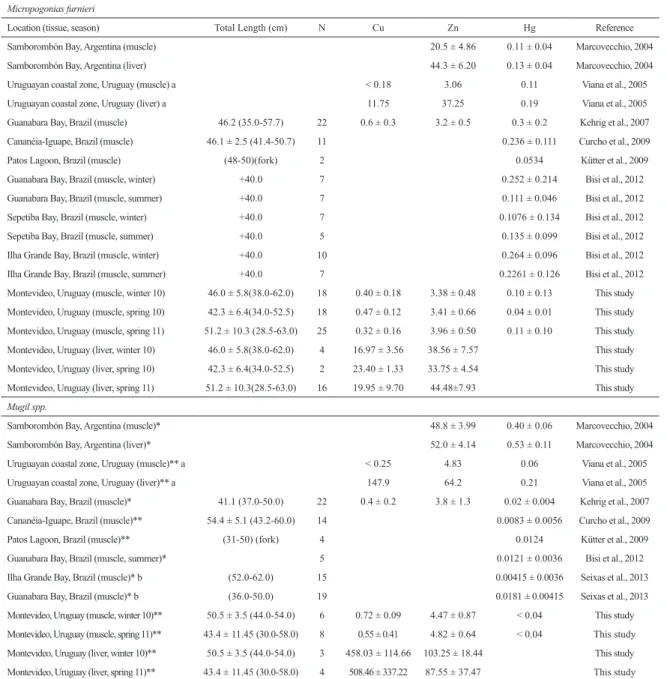
and liver from both species), similar (Zn in muscle from both species) or lower (Hg in muscle from both species) than those reported by VIANA et al. (2005) (Table 4). This study is the irst record of As content in muscle tissues of these species for the area and also represents a temporal update in the data for the Montevideo coastal zone. The results obtained in this study showed similar concentrations to those given by the other studies from the
Table 3. Cu, Zn and As concentrations in muscle and liver, and Hg concentrations in muscle of Micropogonias furnieri and Mugil platanus samples in winter, spring 2010 and spring 2011.
Cu Zn As Hg
Muscle Liver Muscle Liver Muscle Liver Muscle
Winter 2010
Micropogonias furnieri
Length (46.0 ± 5.8) (46.3 ± 5.5)
N 18 (72%) 4 (100%) 18 (100%) 4 (100%) 18 (61%) 4 (100%) 14 (36%)
Concentration
(Mean ± SD) 0.40 ± 0.18 16.97 ± 3.56 3.38 ± 0.48 38.56 ± 7.57 1.34 ± 1.25 2.32 ± 1.32 0.10 ± 0.13 Range < 0.40-0.83 13.57-21.00 1.93-3.86 28.80-47.20 < 0.80-4.09 0.95-4.05 < 0.04-0.39
Mugil platanus
Length (50.5 ± 3.5)
N 6 (100%) 3 (100%) 6 (100%) 3 (100%) 6 (100%) 3 (100%) 6 (0%)
Concentration
(Mean ± SD) 0.72 ± 0.09 458.03 ± 114.66 4.47 ± 0.87 103.25 ± 18.44 1.45 ± 0.24
14.81 ±
4.58 < 0.04
Range 0.60-0.86 331.47-555.00 3.20-5.76 89.36-124.17 1.18-1.80 10.74-19.77 -Spring 2010
Micropogonias furnieri
Length (42.3 ± 6.4) (41.7 ± 6.2)
N 18 (89%) 2 (100%) 18 (100%) 2 (100%) 18 (94%) 2 (100%) 17 (7%)
Concentration
(Mean ± SD) 0.47 ± 0.12 23.40 ± 1.33 3.41 ± 0.66 33.75 ± 4.54 1.92 ± 1.17 2.52 ± 0.34 0.04 ± 0.01
Range < 0.40-0.58 22.46-24.34 2.58-5.27 30.54-36.96 < 0.80-5.43 2.28-2.76 < 0.04-0.08 Spring 2011
Micropogonias furnieri
Length (51.2 ± 10.3)
N 25 (40%) 16 (100%) 25 (100%) 16 (100%) 25 (72%) 16 (100%) 25 (60%)
Concentration
(Mean ± SD) 0.32 ± 0.16 19.95 ± 9.70 3.96 ± 0.50 44.48 ± 7.93 1.20 ± 0.80 2.48 ± 0.61 0.11 ± 0.10
Range < 0.40-0.65 6.30-43.21 2.90-4.94 30.51-53.97 < 0.80-3.82 1.61-4.00 < 0.04-0.48
Mugil platanus
Length (41.7 ± 11.5)
N 8 (63%) 4 (100%) 8 (100%) 4 (100%) 8 (50%) 4 (100%) 8 (0%)
Concentration
(Mean ± SD) 0.55 ± 0.41 508.46 ± 337.22 4.82 ± 0.64 87.55 ± 37.47 0.99 ± 0.60 5.84 ± 3.58 < 0.04 Range < 0.40-1.29 20.36-773.75 4.05-5.61 60.96-142.88 < 0.80-1.94 3.76-11.19
-As expected, all elements showed higher concentra-tions in liver tissues than in muscle, due to the metabolic role of the liver as a major storage site, as well as in regu -lating and detoxifying (MACEDA-VEIGA et al., 2012; ABDOLAHPUR et al., 2013).
The absence of spatial variability of Cu, Zn and As, notably in muscle tissues, may be attributed to the mobility of both species (JAUREGUIZAR et al., 2008). The highest levels of As in liver of M. platanus and Hg in muscle of M. furnieri, however, were measured in specimens from
Montevideo Bay, which is the most contaminated site in the study zone (DANULAT et al., 2002; MUNIZ et al., 2011). Despite these indings, caution must still be exercised, given that the As in liver of M. platanus was only found in one specimen. More studies on environmental pollution and bioavailability of contaminants must be carried out before causal relationships can be determined.
Figure 2. Functional relationship between zinc (a) and mercury (b) concentrations (µg g-1 W.W.) in muscle and total length (cm) of Micropogonias
furnieri.
and exposure time (QADIR; MALIK, 2011; MACEDA-VEIGA et al., 2012). M. furnieri is a demersal ish, a generalist-opportunist carnivore that reproduces and grows in the estuary (MENDOZA-CARRANZA; VIERA, 2008). M. platanus is a bentho-pelagic species; an iliophagus that spends part of its life in estuarine environments and then migrates to the ocean during the spawning season (FISCHER et al., 2011). Because Cu, Zn, As and Hg tend to accumulate in sediments (CHENG et al., 2013) both M. furnieri and M. platanus will be exposed by virtue of their benthic habitat and feeding habits, and may be prone to biomagniication and bioaccumulation processes.
In this study, M. furnieri showed the highest levels of Hg and As in muscle tissue, and a signiicant functional relationship between Zn and Hg concentrations and total length were found. Because of the feeding behavior of whitemouth croaker, these results suggest some degree of biomagniication for these elements, a phenomenon already observed with Hg in a previous study in the area (VIANA et al., 2005) and in other aquatic ecosystems (KEHRIG et al., 2007). Mercury biomagniication and bioaccumulation in ish depend mostly on the ish’s position in the food web and its feeding habits (DSIKOWITZKY et al., 2013). However, As showed contradictory results in the literature in terms of the biomagniication process (DSIKOWITZKY et al., 2013). Finally, the functional relationship found with Zn and Hg indicates bioaccumulation in M. furnieri for these elements. This relationship, however, was not observed with Cu. The highest levels of Cu were
found in spring 2010 when the ish were the smallest in size. This bioaccumulation behaviour could be due to different reproductive status, since M. furnieri breeds in spring (JAUREGUIZAR et al., 2008) and the specimens studied were of mixed immature and mature stages. The reproductive status can affect the concentration of metals in the liver (MONSEFRAD et al., 2012). Although VIANA et al. (2005) found similar relationships for M. furnieri in this region, it has not been possible to determine the reason for these results (MONSEFRAD et al., 2012; DSIKOWITZKY et al., 2013). More studies of the biomagniication and bioaccumulation processes of metals and metalloids are necessary, considering the importance of both species for the ecosystem and the isheries.
Table 4. Total length and mean values (± SD) of metals (Cu, Zn, Hg) reported in regionals studies.
Micropogonias furnieri
Location (tissue, season) Total Length (cm) N Cu Zn Hg Reference Samborombón Bay, Argentina (muscle) 20.5 ± 4.86 0.11 ± 0.04 Marcovecchio, 2004 Samborombón Bay, Argentina (liver) 44.3 ± 6.20 0.13 ± 0.04 Marcovecchio, 2004 Uruguayan coastal zone, Uruguay (muscle) a < 0.18 3.06 0.11 Viana et al., 2005 Uruguayan coastal zone, Uruguay (liver) a 11.75 37.25 0.19 Viana et al., 2005 Guanabara Bay, Brazil (muscle) 46.2 (35.0-57.7) 22 0.6 ± 0.3 3.2 ± 0.5 0.3 ± 0.2 Kehrig et al., 2007 Cananéia-Iguape, Brazil (muscle) 46.1 ± 2.5 (41.4-50.7) 11 0.236 ± 0.111 Curcho et al., 2009 Patos Lagoon, Brazil (muscle) (48-50)(fork) 2 0.0534 Kütter et al., 2009 Guanabara Bay, Brazil (muscle, winter) +40.0 7 0.252 ± 0.214 Bisi et al., 2012 Guanabara Bay, Brazil (muscle, summer) +40.0 7 0.111 ± 0.046 Bisi et al., 2012 Sepetiba Bay, Brazil (muscle, winter) +40.0 7 0.1076 ± 0.134 Bisi et al., 2012 Sepetiba Bay, Brazil (muscle, summer) +40.0 5 0.135 ± 0.099 Bisi et al., 2012 Ilha Grande Bay, Brazil (muscle, winter) +40.0 10 0.264 ± 0.096 Bisi et al., 2012 Ilha Grande Bay, Brazil (muscle, summer) +40.0 7 0.2261 ± 0.126 Bisi et al., 2012 Montevideo, Uruguay (muscle, winter 10) 46.0 ± 5.8(38.0-62.0) 18 0.40 ± 0.18 3.38 ± 0.48 0.10 ± 0.13 This study Montevideo, Uruguay (muscle, spring 10) 42.3 ± 6.4(34.0-52.5) 18 0.47 ± 0.12 3.41 ± 0.66 0.04 ± 0.01 This study Montevideo, Uruguay (muscle, spring 11) 51.2 ± 10.3 (28.5-63.0) 25 0.32 ± 0.16 3.96 ± 0.50 0.11 ± 0.10 This study Montevideo, Uruguay (liver, winter 10) 46.0 ± 5.8(38.0-62.0) 4 16.97 ± 3.56 38.56 ± 7.57 This study Montevideo, Uruguay (liver, spring 10) 42.3 ± 6.4(34.0-52.5) 2 23.40 ± 1.33 33.75 ± 4.54 This study Montevideo, Uruguay (liver, spring 11) 51.2 ± 10.3(28.5-63.0) 16 19.95 ± 9.70 44.48±7.93 This study
Mugil spp.
Samborombón Bay, Argentina (muscle)* 48.8 ± 3.99 0.40 ± 0.06 Marcovecchio, 2004 Samborombón Bay, Argentina (liver)* 52.0 ± 4.14 0.53 ± 0.11 Marcovecchio, 2004 Uruguayan coastal zone, Uruguay (muscle)** a < 0.25 4.83 0.06 Viana et al., 2005 Uruguayan coastal zone, Uruguay (liver)** a 147.9 64.2 0.21 Viana et al., 2005 Guanabara Bay, Brazil (muscle)* 41.1 (37.0-50.0) 22 0.4 ± 0.2 3.8 ± 1.3 0.02 ± 0.004 Kehrig et al., 2007 Cananéia-Iguape, Brazil (muscle)** 54.4 ± 5.1 (43.2-60.0) 14 0.0083 ± 0.0056 Curcho et al., 2009 Patos Lagoon, Brazil (muscle)** (31-50) (fork) 4 0.0124 Kütter et al., 2009 Guanabara Bay, Brazil (muscle, summer)* 5 0.0121 ± 0.0036 Bisi et al., 2012 Ilha Grande Bay, Brazil (muscle)* b (52.0-62.0) 15 0.00415 ± 0.0036 Seixas et al., 2013 Guanabara Bay, Brazil (muscle)* b (36.0-50.0) 19 0.0181 ± 0.00415 Seixas et al., 2013 Montevideo, Uruguay (muscle, winter 10)** 50.5 ± 3.5 (44.0-54.0) 6 0.72 ± 0.09 4.47 ± 0.87 < 0.04 This study Montevideo, Uruguay (muscle, spring 11)** 43.4 ± 11.45 (30.0-58.0) 8 0.55 ± 0.41 4.82 ± 0.64 < 0.04 This study Montevideo, Uruguay (liver, winter 10)** 50.5 ± 3.5 (44.0-54.0) 3 458.03 ± 114.66 103.25 ± 18.44 This study Montevideo, Uruguay (liver, spring 11)** 43.4 ± 11.45 (30.0-58.0) 4 508.46 ± 337.22 87.55 ± 37.47 This study
Notes: Mean concentrations in µg g-1 W.W. N: total number of individuals analyzed. For As no data found in the above references except in the present study. * Mugil liza, ** Mugil platanus. a Concentrations expressed in dry weight were converted to W.W. using the factors estimated in this study (wet wt./dry wt.) of 0.18 and 0.25 for muscle and liver of M. furnieri, and of 0.23 and 0.30 for muscle and liver of M. platanus; b Concentrations expressed in dry weight were converted to W.W. using the factor of 0.25 used by SEIXAS et al., 2013.
a spatial bioindicator remains an open question. Future assessments of environmental quality for this region should consider ish species with territorial behavior. Despite these indings, the importance of M. furnieri as a temporal bioindicator should still be considered. The Hg concentrations in this present study showed a reduction compared to those found by VIANA et al. (2005). These results do, however, support M. furnieri as a bioindicator
for temporal variation of Hg along the Montevideo coastal zone.
ACKNOWLEDGEMENTS
The authors would like to thank SNI-ANII, CSIC-VUSP (UdelaR), Administración Nacional de Puertos (ANP) (Uruguay) and Project RLA 5/054-001 (ARCAL-OIEA), for the partial funding provided for the development of this study. They also wish to express their thanks to: Rosario Odino, Adriana Gabrielli, Lourdes Piuma and Ethel Reina for the analysis of Cu, Zn metals and As metalloid (Laboratorios de Tecnogestión, Ministerio de Industria, Energía y Minería, Uruguay); PhD Beatriz Baliño, University of Bergen, for technical recomendations and proofreading. To the colleagues of the Department of Oceanography and Marine Ecology (Facultad de Ciencias) for their assistance in this project. We are also grateful for the suggestions of the reviewer which permitted us to improve this document.
REFERENCES
ABDOLAHPUR, M. F.; SAFAHIEH, A.; SAVARI, A.; DORAGHI, A. Heavy metal concentration in sediment, benthic, benthopelagic, and pelagic fish species from Musa Estuary (Persian Gulf). Environ. Monit. Assess.,v. 185, n. 1, p. 215-222, 2013.
BISI, T. L.; LEPOINT, G.; AZEVEDO, A. F.; DORNELES, P. R.; FLACH, L.; DAS, K.; MALM, O.; LAILSON-BRITO, J. Trophic relationships and mercury biomagnification in Brazilian tropical coastal food webs. Ecol. Indic., v. 18, p. 291-302, 2012.
BRUGNOLI, E.; MUNIZ, P.; VENTURINI, N.; BURONE, L. Environmental perturbation and coastal benthic biodiversity in Uruguay. In: WILLIS, I. C. (Ed.). Progress in Environmental Research. New York: Nova Publishers, 2007. p. 75-126.
BURGER, J.; GOCHFELD, M. Heavy metals in commercial fish in New Jersey. Environ. Res., v. 99, n. 3, p. 403-412, 2005.
CHENG, Z.; CHEN, K. C.; LI, K. B.; NIE, X. P.; WU, S. C.; WONG, C. K.; WONG, M. H. Arsenic contamination in the freshwater fish ponds of Pearl River Delta: bioaccumulation and health risk assessment. Environ. Sci. Pollut. Res., v. 20, n. 7, p. 4484-4495, 2013.
CODEX STAN 193-1995. Codex General Standard for Contaminants and toxins in food and feed. 2010. 39 p. Available from: <http://www.codexalimentarius.net/download/ standards/17/CXS_193e.pdf>. Accessed 5 Jul 2014.
CURCHO, M. R. S. M.; FARIAS, L. A.; BAGGIO, S. R.; FONSECA, B. C.; NASCIMENTO, S. M.; BORTOLI, M. C.; BRAGA, E. S.; FÁVARO, D. I. T. Mercury and methylmercury
content, fatty acids proile, and proximate composition of consumed ish in Cananéia, São Paulo, Brazil. Rev. Inst.
Adolfo Lutz, v. 68, n. 3, p. 442-450, 2009.
DANULAT, E.; MUNIZ, P.; GARCÍA-ALONSO, J.; YANNICELLI, B. First assessment of the highly contaminated harbour of Montevideo, Uruguay. Mar. Pollut. Bull.,v. 44, n. 6, p. 551-576, 2002.
DEFEO, O.; HORTA, S.; CARRANZA, A.; LERCARI, D.; DE ALAVA, A.; GOMEZ, J.; MARTINEZ, G.; LOZOYA,
J. P.; CELENTANO, E. Hacia un manejo ecosistémico
de las pesquerías. Áreas Marinas Protegidas en Uruguay. Montevideo: Facultad de Ciencias-DINARA, 2009, 122 p. DSIKOWITZKY, L.; MENGESHA, M.; DADEBO, E.;
CARVALHO, C. E. V.; SINDERN, S. Assessment of heavy
metals in water samples and tissues of edible ish species from
Awassa and Koka Rift Valley Lakes, Ethiopia. Environ. Monit. Assess., v. 185, n. 4, p. 3117-3131, 2013.
FISCHER, L. G.; PEREIRA, L. E. D.; VIEIRA, J. P. Peixes estuarinos e costeiros. 2a. ed. Rio Grande, 2011. 131 p. FRANCO, A. J.; LEÓN, I. M. Bioacumulación de metales traza
en Mugil incilis (Hancock, 1830); una herramienta útil para el biomonitoreo de la contaminación metálica en el litoral costero del departamento del Atlántico-Colombia. In: UNESCO Ofice Montevideo and Regional Bureau for Science in Latin America and the Caribbean. (Ed.). Costas: Revista Iberoamericana de
Manejo Costero Integrado. Montevideo: UNESCO Ofice
Montevideo, 2012. p. 98-106.
HATCH, W. R.; OTT, W. L. Determination of submicrogram quantities of mercury by atomic absorption spectrophotometry. Anal. Chem., v. 40, n. 14, p. 2085-2087, 1968.
JAUREGUIZAR, A. J.; MILITELLI, M. I.; GUERRERO, R. Distribution of Micropogonias furnieri at different maturity stages along an estuarine gradient and in relation to environmental factors. J. Mar. Biol. Assoc. UK, v. 88, n. 1, p. 175-181, 2008.
KEHRIG, H. A; COSTA, M.; MALM, O. Estudo da contaminação por metais pesados em peixes e mexilhão da Baia de Guanabara – Rio de Janeiro. Trop. Oceanogr. Onl., v. 35, n. 1, p. 32-50, 2007.
KÜTTER, V. T.; MIRLEAN, N.; BAISCH, P. R. M.; KÜTTER, M. T.; SILVA-FILHO, E. V. Mercury in freshwater,
estuarine, and marine ishes from Southern Brazil and its
ecological implication. Environ. Monit. Assess., v. 159, p. 35-42, 2009.
LOMBARDI, P. E.; PERI, S. I.; VERRENGIA GUERRERO, N. R. Trace metal levels in Prochilodus lineatus collected from the La Plata River, Argentina. Environ. Monit. Assess., v. 160, p. 47-59, 2010.
LUOMA, S. N.; RAINBOW, P. S. Metal Contamination in Aquatic Environments: science and lateral management. Cambridge: Cambridge University Press, 2011. p. 588.
MACEDA-VEIGA, A.; MONROY, M.; DE SOSTOA, A. Metal bioaccumulation in the Mediterranean barbel (Barbus meridionalis) in a mediterranean river receiving efluents from
urban and industrial wastewater treatment plants. Ecotoxicol. Environ. Saf., v. 76, p. 93-101, 2012.
MARCOVECCHIO, J. E. The use of Micropogonias furnieri and
Mugil liza as bioindicators of heavy metals pollution in La Plata river estuary, Argentina. Sci. Total. Environ.,v. 323, p. 219- 226, 2004.
MENDEZ, E.; GIUDICE, H.; PEREIRA, A.; INOCENTE, G.;
MEDINA, D. Total mercury content-ish weight relationship in swordish (Xiphias gladius) caught in the South Atlantic Ocean. J. Food. Compost. Anal., v. 14, p. 453-460, 2001. MENDOZA-CARRANZA, M.; VIEIRA, J. Whitemouth croaker
MERCOSUR/GMC/RES. Nº 12/11. Reglamento técnico MERCOSUR sobre límites máximos de contaminantes inorgánicos en alimentos. (Derogación de las RES.GMC Nº 102/94 y Nº 35/96). Asunción, 2011. 18 p.
MONSEFRAD, F.; IMANPOUR NAMIN, J.; HEIDARY, S. Concentration of heavy and toxic metals Cu, Zn, Cd, Pb and Hg in liver and muscles of Rutilus frisii kutum during spawning season with respect to growth parameters. Iran. J. Fish. Sci., v. 11, n. 4, p. 825-839, 2012.
MUNIZ, P.; DANULAT, E.; YANNICELLI, B.; GARCÍA-ALONSO, J.; MEDINA, G.; BÍCEGO, M. C. Assessment of contamination by heavy metals and petroleum hydrocarbons in sediments of Montevideo Harbour (Uruguay). Environ. Int., v. 29, n. 8, p. 1019-1028, 2004.
MUNIZ, P.; VENTURINI, N.; HUTTON, M.; KANDRATAVICIUS, N.; PITA, A.; BRUGNOLI, E.; BURONE, L.; GARCÍA-RODRÍGUEZ, F. Ecosystem health of Montevideo coastal zone: A multi approach using some different benthic indicators to improve a ten-year-ago assessment. J. Sea Res., v. 65, n. 1, p. 38-50, 2011.
NIÓN, H. Fishes of the Río de La Plata and some aspects of their ecology. In: WELLS, P. G.; DABORN, G. R. (Eds). The Río de La Plata - An environamental overview. An Ecoplata
Project Background Report. Halifax: Dalhousie University,
1997. p. 163-185.
QADIR, A.; MALIK, R. N. Heavy metals in eight edible ish
species from two polluted tributaries (Aik and Palkhu) of the River Chenab, Pakistan. Biol. Trace. Elem. Res., v. 143, n. 3, p. 1524-1540, 2011.
REJOMON, G.; NAIR, M.; JOSEPH, T. Trace metal dynamics
in ishes from the southwest coast of India. Environ. Monit.
Assess., v. 167, p. 243-255, 2010.
RODRÍGUEZ FORERO, A.; GONZÁLEZ MANTILLA, J. F.; SUÁREZ MARTÍNEZ, R. Accumulation of lead, chromium, and cadmium in muscle of capitán (Eremophilus mutisii), a catfish from the Bogota River basin. Arch. Environ. Contam. Toxicol., v. 57, n. 2, p. 359-365, 2009.
SEIXAS, T. G.; MOREIRA, I.; MALM, O.; KEHRIG, H. A. Ecological and biological determinants of methylmercury
accumulation in tropical coastal ish. Environ. Sci. Pollut. Res. Int., v. 20, n. 2, p. 1142-1150, 2013.
SERICANO, J.; BESADA, V. Recomendaciones para la toma y preparación de muestras de bivalvos y peces. Manual preparado para el “Programa Regional para el Biomonitoreo de Contaminantes en Moluscos y peces” RLA/5/054 (ARCAL), 2009.
TAGLIAMONTE, F.; BESSONART, M.; FOGLIA, M.; SALHI, M. Determinación de mercurio y cadmio enOtaria lavescens (Shaw, 1800) y Arctocephalus australis (Zimmermann,
1783) en Uruguay. XIII Reunión de Trabajo de Especialistas
en Mamíferos Acuáticos de América del Sur y 7° Congreso SOLAMAC, Montevideo, 2008. p. 93.
VIANA, F.; HUERTAS, R.; DANULAT, E. Heavy metal levels in
ish from coastal waters of Uruguay. Arch. Environ. Contam.
Toxicol., v. 48, p. 530-537, 2005.
WANG, Y.; CHEN, P.; CUI, R.; SI, W.; ZHANG, Y.; JI, W. Heavy metal concentration in water, sediment, and tissues of two species (Triplohysa pappenheimi, Gobioh wanghensis) from the Lanzhou section of the Yellow River, China. Environ. Monit. Assess., v. 165, p. 97-102, 2010.