Nematodes as indicators of shrimp farm impact on an amazonian estuary
(Curuçá, Pará, Brazil)
Shrimp farming reduces demand on wild ishery
stocks and avoids environmental damage resulting
from ishing practices, however, it has the potential
to affect the water quality if not properly managed.
In this study the impacts of a shrimp farm in an
Amazonian estuary were evaluated, focusing
on changes in nematodes regarding taxonomic
composition, richness, density and diversity.
Sampling was conducted in August 2004 (dry
season) and January 2005 (rainy season) in the
river at stations situated upstream and downstream
at different distances from the main source of farm
efluent discharge. Thirty-eight genera were recorded
with
Terschellingia
dominating in the dry season
and
Terschellingia
,
Daptonema
,
Ptycholaimellus
and
Gomphionema
in the rainy season. Abundances
were within the range recorded in other estuaries and
together with genera richness and diversity showed
a strong temporal pattern with signiicantly higher
values in the rainy season. No clear patterns of
changes were observed at the stations. Some signs of
organic enrichment were detected but they were not
yet intense, probably a consequence of the strong
local hydrodynamics and the age of the shrimp
farm, which was just starting its operation. We
recommend that in future studies on farming impacts
a combination of factors, beyond the physical and
chemical parameters of the water and sediments or
taxonomic reinement, should be taken into account -
such as the duration of the operation of the farm, the
area occupied by ponds and the farm's production.
Furthermore, we also believe that nematodes are a
useful tool for evaluating aquaculture impacts due to
the ease of sampling and because they are organisms
at the base of marine food chain.
A
bstrAct
Virag Venekey
1*, Tatianne Pereira Gomes de Melo
11 Universidade Federal do Pará
(Av. Augusto Corrêa, 01. Guamá - Belém - PA, Brazil. CEP: 66075-110)
*Corresponding author: [email protected]
Descriptors:
Meiobenthos, Impact, Aquaculture,
Amazon Region.
A carcinocultura reduz a demanda de estoques pes
-queiros naturais e evita o dano ambiental resultante da
pesca. Entretanto, tem o potencial de afetar a
quali-dade da água quando não manejada apropriadamente.
Nesse trabalho, os impactos de uma fazenda de
car-cinocultura foram avaliados em um estuário amazô
-nico focando nas mudanças de composição taxonô
-mica, riqueza, densidade e diversidade de Nematoda.
A amostragem ocorreu em agosto de 2004 (período
seco) e janeiro de 2005 (período chuvoso) a
montan-te e jusanmontan-te em locais situados a diferenmontan-tes distâncias
do principal local de descarga de eluentes da fazenda.
Trinta e oito gêneros foram encontrados, com
domi-nância de
Terschellingia na estação seca e
Terschellin-gia
,
Daptonema
,
Ptycholaimellus e Gomphionema na
estação chuvosa. As abundâncias foram similares às
encontradas em outros estuários e, juntamente com a
riqueza e diversidade, apresentaram um forte padrão
sazonal com valores signiicativamente maiores na
estação chuvosa. Nas estações de coleta não foram
encontrados padrões claros de mudanças. O estuário
de Curuçá mostrou alguns sinais de enriquecimento
orgânico ainda não intensos, provavelmente devido à
forte hidrodinâmica local e à idade da fazenda, que
re-centemente começou suas atividades. Recomenda-se
que no futuro os trabalhos sobre impactos de cultivo,
além dos parâmetros físico-químicos da água e
sedi-mento ou reinasedi-mento taxonômico dos organismos
es-tudados, considerem também outros fatores, tais como
tempo de estabelecimento do cultivo, área ocupada
pelos tanques e sua taxa de produção. Além disso, os
dados apontam que a nematofauna pode ser uma fer
-ramenta útil na avaliação de impactos da aquicultura
devido sua fácil
coleta e por serem organismos na base
da cadeia alimentar marinha.
r
esumo
Descritores:
Meiobentos, Impacto, Aquacultura,
Região Amazônica.
http://dx.doi.org/10.1590/S1679-87592016108206401
BJOCE
INTRODUCTION
Shrimp farming reduces demand on wild ishery stocks and avoids the environmental damage resulting from ishing practices. However, shrimp farming has the potential to adversely affect receiving water quality if not properly managed (NAYLOR et al., 2000). In the last years, shrimp farming has been increasing in tropical regions, especially in South Asia and Latin America (PAQUOTTE et al., 1998). The expansion of these activities in tropical and subtropical zones is due to the climate which is favorable to the farming of aquatic species and the availability of space for the construction of ponds (PÁEZ-OSUNA, 2001).
As a general rule, marine shrimp farms have been developed in mangrove areas. Most farms use a semi-intensive system, bringing post-larval formsto maturity in earth ponds. The stocking densities range from 10 to 30 animals.m-2 (100,000 – 300,000 animals.ha-1), artiicial
protein-rich food is provided, ponds are fertilized to stimulate productivity and water is discharged from these shrimp ponds into the coastal ecosystem as part of the water exchange which occurs when ponds are drained (BOYD, 2000; BARRAZA-GUARDADO et al., 2013).The expansion of shrimp farming in estuaries has resulted in environmental and social-economic impacts like mangrove deforestation, water contamination by the farm efluent discharges, salinization of aquifers, the escape of exotic animals and the extinction of many local species (PRIMAVERA, 1997; BERLANGA-ROBLES et al., 2011). Organic (animal parts) and inorganic residues (fertilizers) are discharged directly in the efluents resulting in nutrient and organic matter enrichment which modify the localwater’s and sediment’s physical-chemical characteristics and consequently result in the modiication of benthic community structures (FOLKE; KAUTSKY, 1992; WOLANSKI et al., 2000).
In Brazil, shrimp farming began in the 1980s and after a period of technological validations and enhancements the country rose to the position of world leader in produc-tivity in 2003 (ROCHA, 2010). The shrimp farming agri-business has assumed increasing social importance, espe-cially in the northeastern region, which accounts for 95% of national production (ROCHA, 2010). In North Brazil, including the Amazonian region, shrimp farms are not well developed and they are mostly characterized by small and medium sized farms which produce for local consumption (MARTINELLI; FREITAS-JÚNIOR, 2007). The main
species farmed are the freshwater species Macrobrachium
rosembergii and Macrobrachium amazonicum and the
marine species Litopenaeus vannamei (ABCC, 2013). In
Pará State only ive medium-sized marine shrimp farms were functioning at the time of this study (MARTINELLI; FREITAS-JÚNIOR, 2007).
In mangrove areasmeiofauna are excellent organisms for studying pollution as these animals facilitate the biomineralization of organic matter, serve as food for higher trophic levels and show high sensitivity to anthropogenic inputs (COULL; CHANDLER, 1992). Furthermore, their intimate association with and dependence on sedimentary environments, high abundance and holobenthic life-cycle make them a good tool to assess the effects of contaminants (COULL; CHANDLER, 1992). Among meiobenthic organisms nematodes are usually dominant in mangrove areas (GIERE, 2009) and they have been largely used as indicators of organic disturbance because of their high densities and high taxonomic diversity (BONGERS; FERRIS, 1999). They can show sensitivity to oil spills (DANOVARO et al., 1995), drilling activities (GEE et al., 1992; NETTO et al., 2009), inorganic fertilizer (SANTOS et al., 1999; FERREIRA et al., 2015) and even non-organic disturbances such as tourist trampling (SARMENTO et al., 2013).
Meiofauna has also been used in studies of environmental impact caused by worldwide farming, such as that of mussel farms (MIRTO et al., 2000; DANOVARO et al., 2004; PINTO et al., 2007; MAHMOUDI et al., 2008; NETTO; VALGAS, 2010), ish farms (MAZZOLA et al., 1999; LA ROSA et al., 2001; MIRTO et al., 2002; SUTHERLAND et al., 2007; GREGO et al., 2009; RIERA et al., 2011; MIRTO et al., 2012; RIERA et al., 2012) and that of seaweed (ÓLAFSSON et al., 1995). These studies have used the whole meiofauna community, or isolated groups as Nematoda and Copepoda, and as a general rule the faunal responses are rather uniform with an initial enrichment in meiofaunal numbers and a decrease in diversity with an increase in the dominance of a few species (GIERE, 2009).
al., 2006; DEBENAY et al., 2009; PATRONA et al., 2012) and as far as we know those of NETTO and MEURER (2007) and SANTOS et al. (2007) are the only ones using nematodes at low taxonomic levels (genera/species) but even so they do not present complete information about nematode assemblages. The present study used nematodes as biological indicators of the impacts of a shrimp farm in an Amazonian estuary (Curuçá, Pará, Brazil) with the main objective of verifying how the farm’s impacts and the changes produced in the assemblages’ structure affected taxonomic composition (at genus level), richness, density and diversity.
MATERIAL AND METHODS
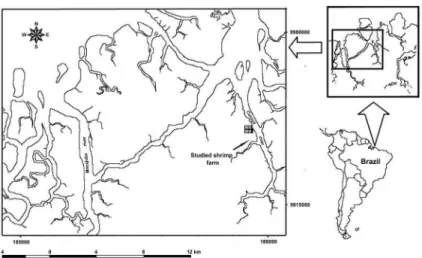
The study area is located in the Curuçá estuary (Northern Brazil), 150 km from Belém, being limited to the North by the Atlantic Ocean and forming part of the second largest continuous mangrove unit of the world (KJERFVE; LACERDA, 1993) (Figure 1). The Curuçá estuary is formed by the conluence of the Curuçá and Muriá rivers. The climate is Amazon equatorial according to the Köppen system, and is characterized by high temperatures (average value of 27 °C), small temperature amplitude and an abundant rainfall regimen thatexceeds2500 mm.year-1. The months from December to June are rainy (the rainy season) with rainfall rates above 300 mm.month-1 and from July to
November (the dry season) the rainfall decreases to 60mm.month-1 (MORAES et al., 2005). Salinity ranges
from 7 (rainy period) to 22 (dry period) (FLAMBOT, 1988). Bottom sediments are very ine with less than 10% of sand (PAULA et al., 2006).
The shrimp farm producing Litopenaeus vannamei,
where the samplings were carried out, used a semi-intensive system and had been established ive years before the time of sampling. The farm is located at the side of the Curuçá river’s main channel and covers an area of approximately 55ha (12ha of ponds). Three production cycles of 90 days are undertaken annuallyand the average production isof 20 to 60 tons per cycle (MARTINELLI; FREITAS-JÚNIOR, 2007). A study carried out by PEREIRA et al. (2007) showed that the waters around the efluent discharge outlet presented small variations between seasons, and had characteristics of typical estuarine non-polluted waters as regards pH (7.2-8), salinity (around 27), turbidity (6.7-9.4 NTU), particulate suspended matter (around 52 mg.L-1),
dissolved oxygen (above 7.5 mg.L-1), total nitrogen (1-2.2
µM) and total phosphorus (0.3-0.8 µM).
Samples were collected in August 2004 (dry season) and January 2005 (rainy season) in the river, both upstream (A) and downstream (B) from the farm at localities situated at 0m (Station 1), 30m (Station 2) and 200 m (Station 3) from the main outlet of farm efluent discharge. At each sampling site four meiofauna replicates were collected using a corer (2 cm inner diameter and 5 cm deep) and ixed in 4% formaldehyde solution. Samples for organic matter, nitrogen and phosphorous analysis were collected to a depth of 10 cm (5 cm inner diameter) and kept on ice in the dark at low temperatures in thelaboratory(-18°C).
The samples were treated using the routine methods for meiofauna (manual centrifugation and humid sieving using 0.5 and 0.063mm sieves) suggested by ELMGREN (1973). The nematodes were sorted using Dollfus plates and
a stereoscopic microscope. Permanent slides were made following DE GRISSE (1969) and the nematodes were identiied to genus level with the use of the pictorial keys of WARWICK et al. (1998). Genera were assigned to feeding types according to the classiication of WIESER (1953) based on the structure of buccal cavity: 1A – selective deposit feeders without buccal cavity, 1B – non-selective deposit feeders with an unarmed buccal cavity, 2A – epigrowth feeders with a buccal cavity armed with small teeth and 2B – predators or omnivorous with a large strongly armed buccal cavity. Organic matter content was estimated by burning sediments at 450°C for 24h (WALKLEY; BLACK, 1934). Total nitrogen and total phosphorus were measured by MURPHY and RILEY’s (1958) method.
Nematode richness (S – total number of genera), density (N – number of individuals per 10 cm2) and diversity (H´ –
Shannon-Wiener) were calculated for each sample. Two-way ANOVA and two-way PERMANOVA were employed to compare nematode assemblages as a whole and individual assemblage descriptors as between seasons and sampling stations. Abundance data per sample were log (x+1) transformed and the resemblance matrix was calculated using Bray Curtis similarity. In those cases in which the ANOVA and
PERMANOVA results were signiicant(p < 0.05), pairwise a
posteriori comparisons were performed using Tukey’s test and permutations, respectively. Multidimensional scaling analysis (MDS) was used to organize samples according to their sampling occasion and site. Statistical analyses were applied using STATISTICA 8, PRIMER 6 and PERMANOVA+ for PRIMER programs.
RESULTS
The characteristics of the sediment at the different stations are presented in Table 1. In a general view downstream stations (B) had higher values of organic matter, nitrogen and phosphorus than upstream stations (A). Organic matter varied from 0.16 to 0.48% in August with higher values at stations 2B and 3B. During January organic matter attained higher values, varying from 0.26
to 0.53%, with the highest value occurring at the central station (1). Nitrogen presented the same variation of values between stations in both seasons (from 0.14 to 0.19%) but in August the highest value was measured at central station 1 and in January at the downstream stations 2B and 3B. Phosphorus varied from 30.0 to 39.0 mg/dm3
in August (the highest value being recordedat station 2A) and from 21.0 to 35.0 mg/dm3 in January (the highest value
being found at station 3B). Although some variation was observed, no clear differences were observed for sediment characteristics between theseasons.
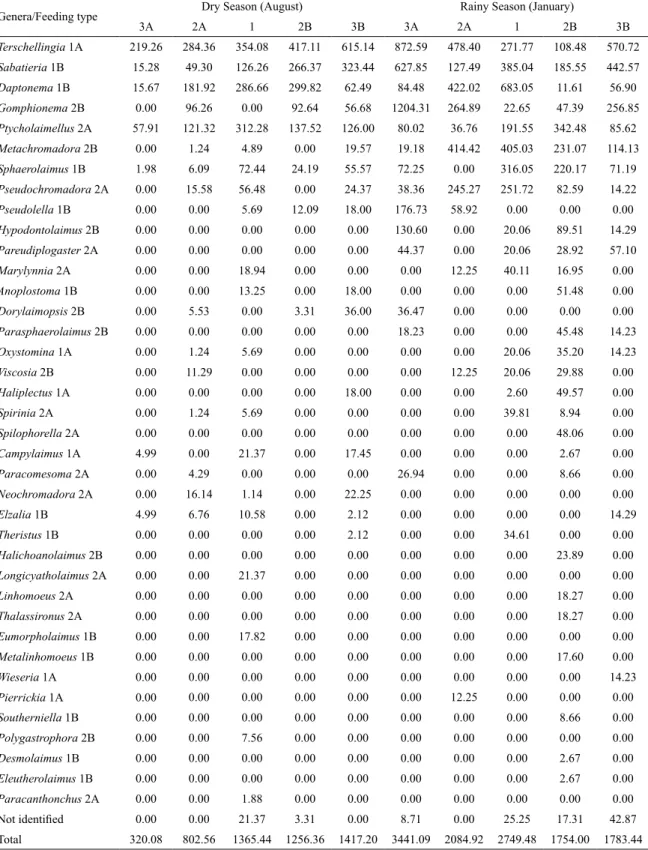
The nematode assemblage of the Curuçá consisted of 38 genera (Table 2). Although we did not identify them to species level, we observed that both the upstream and downstream stations presented the same group of species. Six genera accounted for 80% of all the nematodes identiied: Terschellingia, Sabatieria, Daptonema,
Gomphionema, Ptycholaimellus and Metachromadora.
During the dry season (August), 25 genera were found with a dominance of Terschellingia, a selective deposit feeder, at all the stations, whereas in the rainy season (January) 33 genera (20 in common with August) were found, with a dominance of Terschellingia only at stations
2A and 3B. Further stations were each, during the rainy season, dominated by different genera: Daptonema,
a non-selective deposit feeder, at 1; Ptycholaimellus,
an epigrowth feeder, at 2B and Gomphionema, an
omnivorous, at 3A. The genus Sabatieria, a non-selective
deposit feeder, was the most consistent taxon throughout the study, iguring always among the most abundant genera at all the stations and on all the sampling occasions.
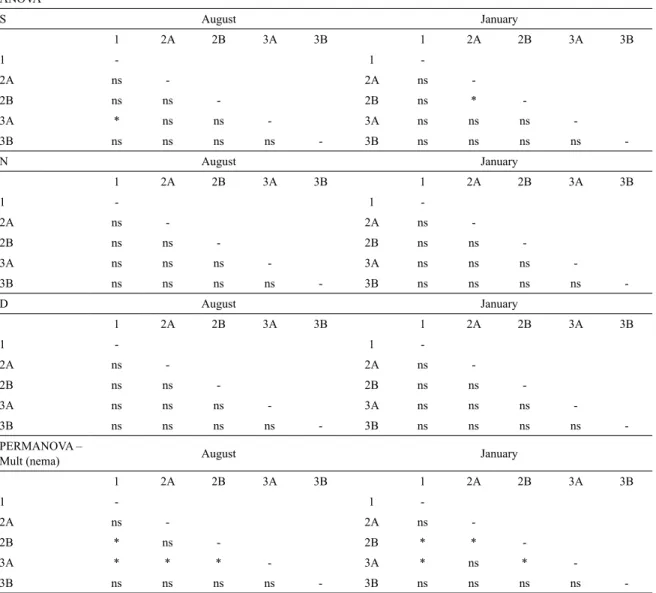
Richness varied signiicantly between seasons, stations and the interactions between seasons and stations (Table 3). Richness was higher during the rainy season than the dry season, the exception being station 2A (Figure 2). Post-hoc comparisons showed signiicant differences between stations 1 and 3A during the dry season and 2A and 2B during the rainy season (Table 4). Abundances were much lower in August than in January, with values ranging from 320.06 to 1410.15 ind/10cm2 and from 1753.97 to 3441.07
Table 1. Sediment characteristics in the proximity of a shrimp farm in Curuçá estuary. D1 = 0m; D2 = 30m; D3 = 200m. %OM = percentage of organic matter; Ntotal(%) = percentage of total Nitrogen; Ptotal (mg/dm
3) = total phosphorus
Dry Season (August) Rainy Season (January)
3A 2A 1 2B 3B 3A 2A 1 2B 3B
OM(%) 0.31 0.16 0.40 0.48 0.48 0.26 0.34 0.53 0.32 0.43
Ntotal (%) 0.14 0.16 0.19 0.17 0.16 0.14 0.15 0.14 0.19 0.19
Table 2. Mean density (Ind/10 cm2) and feeding types (Wieser, 1953) of nematode genera in the proximity of a shrimp farm
in Curuçá estuary.
Genera/Feeding type Dry Season (August) Rainy Season (January)
3A 2A 1 2B 3B 3A 2A 1 2B 3B
Terschellingia 1A 219.26 284.36 354.08 417.11 615.14 872.59 478.40 271.77 108.48 570.72
Sabatieria 1B 15.28 49.30 126.26 266.37 323.44 627.85 127.49 385.04 185.55 442.57 Daptonema 1B 15.67 181.92 286.66 299.82 62.49 84.48 422.02 683.05 11.61 56.90 Gomphionema 2B 0.00 96.26 0.00 92.64 56.68 1204.31 264.89 22.65 47.39 256.85 Ptycholaimellus 2A 57.91 121.32 312.28 137.52 126.00 80.02 36.76 191.55 342.48 85.62
Metachromadora 2B 0.00 1.24 4.89 0.00 19.57 19.18 414.42 405.03 231.07 114.13 Sphaerolaimus 1B 1.98 6.09 72.44 24.19 55.57 72.25 0.00 316.05 220.17 71.19 Pseudochromadora 2A 0.00 15.58 56.48 0.00 24.37 38.36 245.27 251.72 82.59 14.22
Pseudolella 1B 0.00 0.00 5.69 12.09 18.00 176.73 58.92 0.00 0.00 0.00 Hypodontolaimus 2B 0.00 0.00 0.00 0.00 0.00 130.60 0.00 20.06 89.51 14.29 Pareudiplogaster 2A 0.00 0.00 0.00 0.00 0.00 44.37 0.00 20.06 28.92 57.10
Marylynnia 2A 0.00 0.00 18.94 0.00 0.00 0.00 12.25 40.11 16.95 0.00
Anoplostoma 1B 0.00 0.00 13.25 0.00 18.00 0.00 0.00 0.00 51.48 0.00 Dorylaimopsis 2B 0.00 5.53 0.00 3.31 36.00 36.47 0.00 0.00 0.00 0.00 Parasphaerolaimus 2B 0.00 0.00 0.00 0.00 0.00 18.23 0.00 0.00 45.48 14.23 Oxystomina 1A 0.00 1.24 5.69 0.00 0.00 0.00 0.00 20.06 35.20 14.23
Viscosia 2B 0.00 11.29 0.00 0.00 0.00 0.00 12.25 20.06 29.88 0.00 Haliplectus 1A 0.00 0.00 0.00 0.00 18.00 0.00 0.00 2.60 49.57 0.00
Spirinia 2A 0.00 1.24 5.69 0.00 0.00 0.00 0.00 39.81 8.94 0.00
Spilophorella 2A 0.00 0.00 0.00 0.00 0.00 0.00 0.00 0.00 48.06 0.00
Campylaimus 1A 4.99 0.00 21.37 0.00 17.45 0.00 0.00 0.00 2.67 0.00
Paracomesoma 2A 0.00 4.29 0.00 0.00 0.00 26.94 0.00 0.00 8.66 0.00
Neochromadora 2A 0.00 16.14 1.14 0.00 22.25 0.00 0.00 0.00 0.00 0.00
Elzalia 1B 4.99 6.76 10.58 0.00 2.12 0.00 0.00 0.00 0.00 14.29 Theristus 1B 0.00 0.00 0.00 0.00 2.12 0.00 0.00 34.61 0.00 0.00 Halichoanolaimus 2B 0.00 0.00 0.00 0.00 0.00 0.00 0.00 0.00 23.89 0.00 Longicyatholaimus 2A 0.00 0.00 21.37 0.00 0.00 0.00 0.00 0.00 0.00 0.00
Linhomoeus 2A 0.00 0.00 0.00 0.00 0.00 0.00 0.00 0.00 18.27 0.00
Thalassironus 2A 0.00 0.00 0.00 0.00 0.00 0.00 0.00 0.00 18.27 0.00
Eumorpholaimus 1B 0.00 0.00 17.82 0.00 0.00 0.00 0.00 0.00 0.00 0.00 Metalinhomoeus 1B 0.00 0.00 0.00 0.00 0.00 0.00 0.00 0.00 17.60 0.00 Wieseria 1A 0.00 0.00 0.00 0.00 0.00 0.00 0.00 0.00 0.00 14.23
Pierrickia 1A 0.00 0.00 0.00 0.00 0.00 0.00 12.25 0.00 0.00 0.00
Southerniella 1B 0.00 0.00 0.00 0.00 0.00 0.00 0.00 0.00 8.66 0.00 Polygastrophora 2B 0.00 0.00 7.56 0.00 0.00 0.00 0.00 0.00 0.00 0.00 Desmolaimus 1B 0.00 0.00 0.00 0.00 0.00 0.00 0.00 0.00 2.67 0.00 Eleutherolaimus 1B 0.00 0.00 0.00 0.00 0.00 0.00 0.00 0.00 2.67 0.00 Paracanthonchus 2A 0.00 0.00 1.88 0.00 0.00 0.00 0.00 0.00 0.00 0.00
Table 3. Results of two-way ANOVA and two-way PERMANOVA for descriptors of nematode assemblages using seasons and stations as factors in the proximity of a shrimp farm in the Curuçá estuary. S = genera richness, N = density, D = diver-sity, Mult(nema) = multivariate structure of nematode assemblage. Asterisks represent signiicant differences (p < 0.05).
ANOVA Source DF MS F P
S
Seasons 1 0.58 6.39 0.024*
Stations 4 0.41 4.50 0.007*
Seasons x Stations 4 0.45 4.97 0.004*
Error 25 0.09
N
Seasons 1 10.16 13.67 0.001*
Stations 4 0.48 0.65 0.631
Seasons x Stations 4 2.20 2.96 0.040*
Error 25 0.74
D
Seasons 1 0.10 9.69 0.005*
Stations 4 0.03 2.56 0.063
Seasons x Stations 4 0.02 1.87 0.147
Error 25 0.01
PERMANOVA
Mult (nema)
Source DF MS Pseudo-F P(perm)
Seasons 1 8315.10 8.57 0.001*
Stations 4 2951 3.04 0.001*
Seasons x Stations 4 3134.50 3.23 0.001*
Error 25 969.91
Figure 2. Mean (± SD) values of density (ind./10 cm2), genera richness and diversity (H’) of Nematoda in the proximity of a shrimp farm in the
Table 4. Results of the paired tests for descriptors of nematode assemblages using seasons and stations as factors in the proximity of a shrimp farm in the Curuçá estuary. S: genera richness, N = density, D = diversity, Mult(nema) = multivariate structure of nematode assemblage. ns = not signiicant; * signiicant differences (p < 0.05)
ANOVA
S August January
1 2A 2B 3A 3B 1 2A 2B 3A 3B
1 - 1
-2A ns - 2A ns
-2B ns ns - 2B ns *
-3A * ns ns - 3A ns ns ns
-3B ns ns ns ns - 3B ns ns ns ns
-N August January
1 2A 2B 3A 3B 1 2A 2B 3A 3B
1 - 1
-2A ns - 2A ns
-2B ns ns - 2B ns ns
-3A ns ns ns - 3A ns ns ns
-3B ns ns ns ns - 3B ns ns ns ns
-D August January
1 2A 2B 3A 3B 1 2A 2B 3A 3B
1 - 1
-2A ns - 2A ns
-2B ns ns - 2B ns ns
-3A ns ns ns - 3A ns ns ns
-3B ns ns ns ns - 3B ns ns ns ns
-PERMANOVA –
Mult (nema) August January
1 2A 2B 3A 3B 1 2A 2B 3A 3B
1 - 1
-2A ns - 2A ns
-2B * ns - 2B * *
-3A * * * - 3A * ns *
-3B ns ns ns ns - 3B ns ns ns ns
-ind/10cm2, respectively (Figure 2). In August the highest
densities were recorded at the central station (1) and the stations located downstream (B). In January the highest densities were recorded at the central station and those located upstream (A). Signiicant differences were found for abundances when comparing seasons and interactions between seasons and stations (Table 3). The differences found for abundances are due to the much higher densities in January, with values never less than those found in August. Diversity varied signiicantly only between seasons with values higher during the rainy season than during the dry season, the exception being station 2A (Table 3, Figure
2). In a general overview of the stations, those with highest genera richness were also the stations with highest diversity, but no other clear patterns were observed.
estuarine areas (1 - 98 mg/dm3 in MUROLO et al., 2006
in the Siri estuary, Northeast Brazil) but much lower than those of some other estuarine localities (220 - 540 mg/dm3
in BOTO and WELLINGTON, 1984 in Australia). These comparisons led us to conclude that although Curuçá estuary shows some signs of eutrophication, it is not yet intense. The vigorous local hydrodynamics, consequence of strong currents and macrotidal regime, may be responsible for the suspension of organic matter and nutrients and consequent reduction of their concentrations in the sediment. Probably, the higher values of all the environmental parameters at the downstream stations as compared to the upstream ones are also a direct consequence of the local hydrodynamics.
The nematode abundances found in the Curuçá estuary (320.08 – 3441.09 ind/10cm2) are within the
range registered in other Brazilian estuaries: 598 – 2844.4 ind/10cm2 in Santa Cruz Channel, Northeast Brazil
(ALMEIDA; FONSECA-GENEVOIS, 1999); 36 – 3339 ind/10cm2 in Pina Basin, Northeast Brazil (SOMERFIELD
et al., 2003); 972.4 – 6007.1 ind/10cm2 in Rio Formoso,
Northeast Brazil (VASCONCELOS et al., 2004) and 133.1 – 719.2 ind/10cm2 in Tramandaí-Armazém, South Brazil
(KAPUSTA et al., 2005). The abundances showed a strong temporal pattern with signiicantly higher values in the rainy season (January). This result is different from those given by other studies conducted in tropical estuaries that found higher densities during the dry season (ALMEIDA; FONSECA-GENEVOIS, 1999) or did not ind any clear pattern (GOMES et al., 2002; SANTOS et al., 2007). ISAAC and BARTHEM (1995) state that rain is the main factor responsible for biological changes in the Amazonian region. During periods of high precipitation abrupt changes can occur in salinity values measured in estuaries. It seems that the nematodes in Curuçá were favored by the lower salinities during the rainy season, presenting not only higher abundances but also signiicantly richer and morediverse assemblages. Higher abundances and richness during the rainy season had already been observed by PAULA et al. (2006) when studying the meiobenthos community in the same samples. The authors saw that nematodes were the dominant meiobenthic taxon and in our study we conirmed that the nematode assemblage considered at low taxonomic level maintained the same pattern as the meiobenthos community.
As compared to investigations into metallic or other pollution sources, studies of the impact of farming on meiobenthos are still rare and the majority of them report experiments or sampling strategies developed over a short
Figure 3. Non-metric Multidimensional Scaling plot of samples in the
proximity of a shrimp farm in the Curuçá estuary.
DISCUSSION
In the present study the main differences for nematodes were found between seasons, when higher abundances, richness and diversity were found for the rainy month (January). Although differences were found for nematodes, the sediment parameters investigated (organic matter, nitrogen and phosphorus) did not present a signiicant variation between seasons. Concerning stations, no clear differences were observed either for nematodes or sediment characteristics. These results give us an indication as to the situation of the Curuçá estuary in terms of nutrient enrichment and its possible effects on nematodes.
One of the indicators of environmental modiication is eutrophication, which can be deined as water nutrient enrichment, especially by nitrogen and/or phosphorus and organic matter. This nutrient enrichment can cause disturbance to the structure, function and stability of organisms present in the water and the quality of the water itself (ANDERSEN et al., 2006). In Curuçá estuary the concentrations of organic matter (always less than 0.48%) were low as compared to those of other localities, either impacted (e.g. more than 1.6% in MAHMOUDI et al. 2008 and around 3% in NETTO and VALGAS, 2010, both close to mussel farms) or non-impacted (e.g. more than 3% in NETTO and GALLUCCI, 2003 in Ratones river estuary, South Brazil and from 0.51 to 14.24% in VASCONCELOS et al., 2004 in Rio Formoso estuary, Northeast Brazil). Values of nitrogen (from 0.14 to 0.19%) were within the range registered for other estuarine areas (e.g. 0.02 - 0.16% in JAPTAP, 1987 in Goa, India and 0.05-0.8% in MUROLO et al., 2006 in the Siri estuary, Northeast Brazil). As for the values of phosphorus (less than 39 mg/dm3), they
period (generally not more than some weeks). Few studies consider longer periods (such as months), therefore the possible seasonal variations or long-term effects of farming are not usually investigated. In areas suchas the Amazonian region seasonal variations arespecially important because of the strong variation in hydrodynamics, which could be responsible for the re-distribution of farming discharges. MIRTO et al. (2002) and MIRTO et al. (2012) are among the few studies that have investigated the effects of a Mediterranean ish farm on nematodes for longer periods, i.e., 7 and 10 months, respectively. These authors found strong differences between controls and impacted sites, but not between months. In Curuçá the pattern of nematode variation was clearly seasonal and did not vary between locations. This result suggests that in areas with vigorous hydrodynamics, studies of the effect of any impact should be interpreted with caution.
The genera Terschellingia and Sabatieria presented,
respectively,the highest and most consistent abundances in Curuçá estuary. Both genera are frequently cited as among themost abundant nematodes in Brazilian estuaries (e.g. FONSECA; NETTO, 2006; KAPUSTA et al., 2006) and alsoin studies involving farming effects. NETTO and VALGAS (2010) investigating the responses of nematode assemblages to the effects of intensive mussel farming in a South Brazilian shallow embayment (Bay of Santa Catarina Island) declared Terschellingia to be the most
abundant genus at mussel farm sites and found Sabatieria
to be among the most abundant genera at both mussel farm and control sites. NETTO and MEURER (2007) studying the shrimp farm impact in benthic communities at another South Brazilian site (Laguna Estuarine System) also reported Terschellingia and Sabatieria as among the most abundant nematode genera. Considering the whole nematode assemblage of Curuçá, predator/omnivorous genera (type 2B) such as Gomphionema, Metachromadora
and Hypodontolaimus seemed to be favored by the rainy
season, with increases in their densities. Probably the higher abundances and richness of meiobenthic groups and nematodes, which can be feeding resources for genera of type 2B, contributed to this result. Considering nematode assemblages, clear differences were again detected as between seasons,though not between stations. The most abundant genera Terschellingia, Sabatieria, Daptonema,
Gomphionema, Ptycholaimellus and Metachromadora
were almost constantly present at all stations. Their main variation related to their abundances between seasons. This result indicates that the shrimp farm investigated in Curuçá
also had no effect on the main nematode genera, as has alreadybeen reported for total nematode abundance.
Studies that have used nematode abundance as one of the indicators of farming impacts on meiobenthos have detected different responses. Studying the effect of mussel culture on nematodes, CASTEL et al. (1989), GUELORGET et al. (1994) and MAHMOUDI et al. (2008) found an increase in densities; MIRTO et al. (2000) and NETTO and VALGAS (2007) reported a decrease in abundances and DANOVARO et al. (2004) and PINTO et al. (2007) found no signiicant changes. Concerning the effect of shrimp farm impacts, PATRONA et al. (2012) found a decrease in meiobenthos abundance and NETTO and MEURER (2007) registered a decrease in nematode abundance but only after the post-cultivation period. In Curuçá the response of nematodes to shrimp farm discharge was not clear. No decreasing pattern was observed in abundance, genera richness or diversity from the more distant to the central station (station 1). On the contrary, the central station presented the second highest abundances in both seasons andas regardsgenera richness and diversity the central station presented the highest values during the dry season and the second highest values during the rainy season. MAHMOUDI et al. (2008) and NETTO and VALGAS (2010) suggest that low hydrodynamics and/ or microtidal regime would, respectively,limit the dispersal ofbiodeposits of mussel farms in a Mediterranean lagoon or a South Brazilian shallow embayment. On the basis of this idea we suppose that thevigorous local hydrodynamics in Curuçá might be responsible for the rapid dispersal of the local shrimp farm residues as a result of which there is no clear change in nematode assemblages at the sampling sites close to the shrimp farm.
authors recommended that studies should be undertaken with reined taxonomy in order to obtain a more precise response. OLAFSSON et al. (1995) studying the effect of seaweed farming on meiobenthos in a tropical lagoon of Zanzibar could compare the response of nematodes at major taxon (pylum) and minor (genera/species) levels and were able to ind signiicant alterations in nematode assemblages only when using a reined taxonomy. In our study we would also have been able to verify whether with a reined taxonomy a different response could have been obtained. PAULA et al. (2006) in a previousstudy analyzing the meiobenthos community in the same samples as we used in our study were also unable to detect signiicant differences. The use of a reined taxonomy is not, therefore, the only question deserving of consideration in future studies.
Global demand for seafood continues to rise despite most wild animal resources being at their maximum level of sustainable exploitation (DE SILVA, 2012). At the beginning of this century the prediction was that by 2030 more than 50% of isheries production would need to come from aquaculture in view ofhuman population growth, the continuing demand for seafood, and static or
declining ish harvests (FAO, 2000). This percentage was, however, attained earlier than had been expected and in 2011 aquaculture already accounted for nearly 50% of global ish consumption, and the activity was reputed to be the fastest growing primary production sector, averaging an annual growth rate of nearly 7% (FAO, 2011). Meeting the food demand for a growing population is a major issue confronting us globally, with continuing population and consumption growth expected to increase for at least the next 40 years (GODFRAY et al., 2010). Assuring food security or responding to the challenge of feeding 9 billion people by 2050 has to be achieved in a climate of increasing competition for land, water and energy and, as is also important, with a reduced impact of the food system on the environment (GODFRAY et al., 2010). Aquaculture is in a phase of adjustment, attempting to embrace practices that are conceivably more environmentally friendly and sustainable (DE SILVA, 2012), we are, therefore,in time to unite this line of thinking with continuous and more eficient environmental monitoring. In environments such as Amazonian mangrove swamps where shrimp farming is still at an early stage it is especially important to study aquaculture impacts because the farms can then adapt their practices from the beginning and consequently reduce local degradation. We recommend that in future studies
of farming impact should cover a combination of factors beyond the physical/chemical parameters or taxonomical reinement which should also be taken into account, among them being: the time of establishment of the farm, the area occupied by it and its production. Furthermore, we believe that nematodes are a useful tool in evaluating aquaculture impacts due to the relatively easy sampling involved and because they are organisms at the base of marine food chains.
ACKNOWLEDGEMENTS
The sampling was conducted within the project “Use and appropriation of coastal zone resources - Millenium Institute” and was funded by CNPq (Brazilian Research Council). The authors wish to express their gratitude to Petrobras (Brazilian Petroleum Company) for research fellowships and Dr. José Souto Rosa-Filho for the opportunity to work with these samples and for his suggestions regarding a previous version of the manuscript. We are also grateful to two anonymous referees and the editor for improving the previous version of this manuscript.
REFERENCES
ABCC – Associação Brasileira dos Criadores de Camarões. 2013. Available at: < http://www.abccam.com.br>. Accessed 19 July 2013.
ALMEIDA, Z. S.; FONSECA-GENEVOIS, V. Análise quali--quantitativa da meiofauna na região de Itapissuma - PE. Pesq. Foco, v. 7, n. 9, p. 115-137, 1999.
ANDERSEN, J. H.; SCHLÜTER, L.; AERTEBJERG, G. Coastal eutrophication: recent developments in deinitions and impli-cations for monitoring strategies. J. Plankt. Res., v. 28, n. 7, p. 117-143, 2006.
BARRAZA-GUARDADO, R. H.; ARREOLA-LIZÁRRAGA, J. A.; LÓPEZ-TORRES, M. A.; CASILLAS-HERNÁNDEZ, R.; MIRANDA-BAEZA, A.; MAGALLÓN-BARRAJAS, F.; IBARRA-GÁMEZ, C. Efluents of shrimp farms and its in-luence on the coastal ecosystems of Bahía de Kino, Mexico. Sci. World J., v. 2013, 8 p., 2013.
BERLANGA-ROBLES, C. A.; RUIZ-LUNA, A.; HERNÁN-DEZ-GUZMÁN, R. Impact of Shrimp Farming on Mangrove Forest and Other Coastal Wetlands: the case of Mexico. In: SLADONJA, B. (Ed.). Aquaculture and the Environment - A Shared Destiny. Rijeka: Intech, 2011. p. 1-15.
BONGERS, T.; FERRIS, H. Nematode community structure as a bioindicator in environmental monitoring. Trends Ecol. Evol., v. 16, n. 6, p. 224-228, 1999.
BOTO, K. G.; WELLINGTON, J. T. Soil characteristics and nu-trient status in northern Australian mangrove forests. Estua-ries, v. 7, p. 61-69, 1984.
CASTEL, J.; LABOURG, P. J.; ESCARAVAGE, V.; AUBY, I.; GARCIA, M. E. Inluence of seagrass beds and oyster parks on the abundance and biomass patterns of meio- and macro-benthos in tidal lats. Estuar. Coast. Shelf Sci., v. 28, n. 1, p. 71-85, 1989.
CONSTANZO, S. D.; O’DONOHUE, M. J.; DENNISON, W. C. Assessing the inluence and distribution of shrimp pond efluent in a tidal mangrove creek in north-east Australia. Mar. Pollut. Bull., v. 48, n. 5/6, p. 514-525, 2004.
COULL, B. C.; CHANDLER, G. T. Pollution and meiofauna: ield, laboratory and mesocosm studies. Oceanogr. Mar. Biol. Ann. Rev., v. 30, p. 191-271, 1992.
DANOVARO, R.; FABIANO, M.; VINCX, M. Meiofauna res-ponse to the Agip Abruzzo oil spill in subtidal sediments of the Ligurian Sea. Mar. Pollut. Bull., v. 30, p. 133-145, 1995. DANOVARO, R.; GAMBI, C.; LUNA, G. M.; MIRTO, S.
Sus-tainable impact of mussel farming in the Adriatic Sea (Me-diterranean Sea): Evidence from biochemical, microbial and meiofaunal indicators. Mar. Pollut. Bull., v. 49, n. 4, p. 325-333, 2004.
DE GRISSE, A. T. Redescription ou modiication de quelques techniques utilisés dans l’ étude des nématodes phytoparasi-taires. Mededel. Rijks. Landbouw. Gent., v. 34, p. 351-369, 1969.
DE SILVA, S. S. Aquaculture: a newly emergent food production sector – and perspectives of its impacts on biodiversity and conservation. Biodivers. Conserv., v. 21, n. 12, p. 3187-3220, 2012.
DEBENAY, J. P.; DELLA PATRONA, L.; HERBLAND, A.; GOGUENHEIM, H. The impact of easily oxidized material (EOM) on the meiobenthos: Foraminifera abnormalities in shrimp ponds of New Caledonia; implications for environ-ment and paleoenvironenviron-ment survey. Mar. Pollut. Bull., v. 59, p. 323-335, 2009.
ELMGREN, R. Methods of sampling sublittoral soft bottom meiofauna. Oikos, v. 15, p. 112-120, 1973.
FAO. The state of world isheries and aquaculture. Food and Agri-culture Organization. Rome, 2000.
FAO. World aquaculture 2010. FAO Fisheries and Aquaculture Technical Paper. 500/1. Rome, 2011.
FERREIRA, R. C.; NASCIMENTO-JUNIOR, A. B.; SANTOS, P. J. P.; BOTTER-CARVALHO, M. L.; PINTO, T. K.
Res-ponses of estuarine nematodes to an increase in nutrient su
-pply: an in situ continuous addition experiment. Mar. Pollut. Bull., v. 90, n. 1/2, p. 115-120, 2015.
FLAMBOT, F. C. Aqüicultura: indicadores de salinidade da água na microrregião do Salgado. Belém: Banco da Amazônia, 1988. 43 p.
FOLKE, C.; KAUTSKY, N. Aquaculture with its environment - prospects for sustainability. Ocean. Coast. Manag., v. 17, p. 5-24, 1992.
FONSECA, G.; NETTO, S. A. Shallow sublittoral benthic com-munities of the Laguna Estuarine System, South Brazil. Braz. J. Oceanog., v. 54, n. 1, p. 41-54, 2006.
GEE, J. M.; AUSTEN, M.; DE SMET, G.; FERRARO, T.; MCA-VOY, A.; MOORE, S.; VAN GAUSBEKI, D.; VINCX, M.; WARWICK, R. M. Soft sediment meiofauna community res-ponses to environmental pollution gradients in the German bight and at a drilling site off the Dutch coast. Mar. Ecol. Prog., v. 91, p. 289-302, 1992.
GIERE, O. Meiobenthology: the microscopic motile fauna in aqua-tic sediments. 2nd. ed. Berlin: Springer-Verlag, 2009. 527 p. GODFRAY, H. C. J.; BEDDINGTON, J. R.; CRUETE, I. R.;
HADDAD, L.; LAWRENEC, D.; MUIR, J. F.; PRETTI, J.; ROBINSON, M. S.; THOMAS, S. M.; TOULMIN, C. Food security: the challenge of feeding 9 billion people. Science, v. 327, p. 812-817, 2010.
GOMES, C. A. A.; SANTOS, P. J. P.; ALVES, T. N. C.; ROSA--FILHO, J. S.; SOUZA-SANTOS, L. P. Variação temporal da meiofauna em área de manguezal em Itamaracá-Pernambuco. Atlantica, v. 24, n. 2, p. 35-42, 2002.
GREGO, M.; DE TROCH, M.; FORTE, J.; MALEJ, A. Main
meiofauna taxa as an indicator for assesssing the spatial and
seasonal impact of ish farming. Mar. Poll. Bull., v. 58, n. 8, p. 1178-1186, 2009.
GUELORGET, O.; PERTHUISOT, J. P.; LAMY, N.; LEFEBRE, A. Structure et organization de l’etang de Thau d’ aprés la fauna benthique (macrofaune, meiofaune). Relations avec le coninement. Ocean. Acta, v. 17, n. 1, p. 105-114, 1994. ISAAC, V. J.; BARTHEM, R. B. Os recursos pesqueiros da
Ama-zônia brasileira. Bol. Mus. Para. Emílio Goeldi, Série antro-pologia, v. 11, n. 2, p. 295-339, 1995.
JAPTAP, T. G. Seasonal distribution of organic matter in mangro-ve environment of Goa. Ind. J. Mar. Sci., v. 16, p. 103-106, 1987.
KAPUSTA, S. C.; WÜRDING, N. L.; BEMBENUTI, C. E.; OZORIO, C. P. Meiofauna structure in Tramandaí-Armazém estuary (South of Brazil). Acta Limnol. Bras., v. 17, n. 4, p. 349-359, 2005.
KAPUSTA, S. C.; WURDIG, N. L.; BEMVENUTI, C. E.; PIN-TO, T. K. Spatial and temporal distribution of Nematoda in a subtropical estuary. Acta Limnol. Bras., v. 18, n. 2, p. 133-144, 2006.
KJERFVE, B.; LACERDA, L. D. Mangroves of Brazil. In: LA-CERDA, L. D. (Eds.). Conservation and sustainable utilization of mangrove forest in Latin America and Africa regions. Part I - Latin America. Mangrove Ecosystem Technical Report No.2. Okinawa: International Tropical Timber Organization/Interna-tional Society for Mangrove Ecosystems, 1993. p. 245-272. LA ROSA, T.; MIRTO, S.; MAZZOLA, A.; DANOVARO, R.
Differential responses of benthic microbes and meiofauna to ish-farm disturbance in coastal sediments. Environ. Poll., v. 112, n. 3, p. 427-434, 2001.
MAHMOUDI, E.; ESSID, N.; BEYREM, H.; HEDFI, A.; BOU-FAHJA, F.; AÏSSA, P.; VITIELLO, P. Mussel-farming effects on Mediterranean benthic nematode communities. Nematolo-gy, v. 10, n. 3, p. 323-333, 2008.
MARTINELLI, J. M.; FREITAS-JÚNIOR, J. R. C. Diagnóstico da carcinicultura marinha no estado do Pará. In: BARROSO, G. F.; POERSCH, L. H. S.; CAVALLI, R. O. (Eds.). Sistemas de cultivos aquicolas na zona costeira do Brasil: recursos, tecnologias, aspectos ambientais e sócio-economicos. Rio de Janeiro: Museu Nacional, 2007. p. 291-302.
MAZZOLA, A.; MIRTO, S.; DANOVARO, R. Initial ish-farm impact on meiofaunal assemblages in coastal sediments of the Western Mediterranean. Mar. Poll. Bull., v. 38, n. 12, p. 1126-1133, 1999.
MIRTO, S.; LA ROSA, T.; DANOVARO, R.; MAZZOLA, A. Microbial and meiofaunal response to intensive mussel-farm biodeposition in coastal sediments of the western Mediterra-nean. Mar. Pollut. Bull., v. 40, n. 3, p. 244-252, 2000. MIRTO, S.; LA ROSA, T.; GAMBI, C.; DANOVARO, R.;
MA-ZZOLA, A. Nematode community response to ish-farm im-pact in the western Mediterranean. Environ. Pollut., v. 116, n. 2, p. 203-214, 2002.
MIRTO, S.; GRISTINA, M.; SINOPOLI, M.; MARICCHIOLO, G.; GENOVESE, L.; VIZZINI, S.; MAZZOLA, A. Meiofau-na as an indicator for assessing the impact of ish farming at an exposed marine site. Ecol. Indic., v. 18, p. 468-476, 2012. MOLNAR, N.; WELSH, D. T.; MARCHAND, C.; DEBORDE,
J.; MEZIANE, T. Impacts of shrimp farm efluent on water quality, benthic metabolism and N-dynamics in a mangrove forest (New Caledonia). Estuar. Coast. Shelf Sci., v. 117, p. 12-21, 2013.
MORAES, B. C.; COSTA, J. M. N.; COSTA, A. C. L.; COSTA, M. H. Variação espacial e temporal da precipitação no estado do Pará. Acta Amaz., v. 35, n. 2, p. 207-214, 2005.
MUROLO, P. P. A.; CARVALHO, P. V. V. C.; CARVALHO, M. L. B.; SOUZA-SANTOS, L. P.; SANTOS, P. J. P. Spatio--temporal variations of microphytobenthos in the Botafogo and Siri estuaries (Northeast – Brazil). Braz. J. Oceanog., v. 54, n. 1, p. 19-30, 2006.
MURPHY, J.; RILEY, J. P. A single-solution method for the de-termination of phosphate in seawaters. J. Mar. Biol. Assoc. U. K., v. 37, n. 1, p. 9-14, 1958.
NAYLOR, R. L.; GOLDBURG, R. J.; PRIMAVERA, J. H.; KAUTSKY, N.; BEVERIDGE, M. C. M.; CLAY, J.; FOLKE, C.; LUBCHENCO, J.; MOONEY, H.; TROELL, M. Effect of aquaculture on world ish supplies. Nature, v. 405, p. 1017-1024, 2000.
NETTO, S. A.; GALLUCCI, F. Meiofauna and macrofauna com-munities in a mangrove from the Island of Santa Catarina, South Brazil. Hydrobiologia, v. 505, n. 1, p. 159-170, 2003. NETTO, S. A.; MEURER, A. Z. Inluência de eluentes de cultivo
de camarão na estrutura das comunidades bênticas do siste-ma estuarino de Laguna (SC, Brasil). In: BARROSO, G. F.; POERSCH, L. H. S.; CAVALLI, R. O. (Eds.). Sistemas de cultivos aquicolas na zona costeira do Brasil: recursos, tec-nologias, aspectos ambientais e sócio-econômicos. Rio de Janeiro: Museu Nacional, 2007a. p. 129-138.
NETTO, S. A.; VALGAS, I. Efeitos do cultivo de mexilhões so-bre a estrutura da meiofauna In: BARROSO, G. F.; POERS-CH, L. H. S.; CAVALLI, R. O. (Eds.). Sistemas de cultivos aquicolas na zona costeira do Brasil: recursos, tecnologias, aspectos ambientais e sócio-economicos. Rio de Janeiro: Mu-seu Nacional, 2007b. p. 119-128.
NETTO, S. A.; VALGAS, I. The response of nematode
assembla-ges to intensive mussel farming in coastal sediments (Sou
-thern Brazil). Environ. Assess. Manag., v. 162, n. 1, p. 81-93, 2010.
NETTO, S. A., GALLUCCI, F.; FONSECA, G. Deep-sea meio-fauna response to synthetic-based drilling mud discharge off SE Brazil. Deep Sea Res. Part II Top. Stud. Oceanogr., v. 56, n. 1, p. 41-49, 2009.
ÓLAFSSON, E.; JOHNSTONE, R. W.; NDARO, S. G. M. Effects of intensive seaweed farming on the meiobenthos in a tropical lagoon. J. Exp. Mar. Biol. Ecol., v. 191, n. 1, p. 101-117, 1995.
PÁEZ-OSUNA, F. The environmental impact of shrimp aquacul-ture: a global perspective. Environ. Pollut., v. 112, n. 2, p. 229-231, 2001.
PAQUOTTE, P.; CHIM, L.; MARTIN, J. L. M.; LEMOS, E.; STERN, M.; TOSTA, G. Intensive culture of shrimp Penaeus vannamei in loating cages: zootechnical, economic and en-vironmental aspects. Aquaculture, v. 164, p. 151-166, 1998. PATRONA, L. D.; BIANCHELLI, S.; BELIAEFF, B.;
POSCE-DDU, A. Meiobenthos in earthen ponds used for semi-inten-sive shrimp farming (New Caledonia, South Paciic). Chem. Ecol., v. 28, n. 6, p. 506-523, 2012.
PAULA, J. H. C.; ROSA-FILHO, J. S.; SOUZA, A. L. B.; AVIZ, D. A meiofauna como indicadora de impactos na carcinocul-tura no estuário de Curuçá (PA). Bol. Lab. Hidrobiol., v. 19, p. 61-72, 2006.
PEREIRA, C. T. C.; GIARRIZZO, T.; JESUS, A. J. S.; MAR-TINELLI, J. M. Caracterização do eluente de cultivo de Litopenaeus vannamei no estuário de Curuçá (PA). In: BAR-ROSO, G. F.; POERSCH, L. H. S.; CAVALLI, R. O. (Eds.). Sistemas de cultivos aquícolas na zona costeira do Brasil: re-cursos, tecnologia, aspectos ambientais e sócio-econômicos. Rio de Janeiro: Museu Nacional, 2007. p. 291-302.
PINTO, T. K.; BOINA, C. D.; VIEIRA, S. D. M. A. Inluência do cultivo de moluscos na comunidade bentônica: meiobenthos. In: BARROSO, G. F.; POERSCH, L. H. S.; CAVALLI, R. O. (Eds.). Sistemas de cultivos aquicolas na zona costeira do Brasil: recursos, tecnologias, aspectos ambientais e sócio-eco-nomicos. Rio de Janeiro: Museu Nacional, 2007. p. 235-241. PRIMAVERA, J. H. Socio-economic impacts of shrimp culture.
Aquac. Res., v. 28, n. 10, p. 815-827, 1997.
RIERA, R.; MONTERROSO, O.; RODRIGUEZ, M.; RAMOS, E.; SACRAMENTO, A. Six-year study of meiofauna dyna-mics in ish farms in Tenerife (Canary Islands, NE Atlantic Ocean). Aquat. Ecol., v. 45, n. 2, p. 221-229, 2011.
RIERA, R.; SANCHES-JEREZ, P.; RODRÍGUEZ, M.; MON-TERROSO, O.; RAMOS, E. Long-term monitoring of ish farms: application of Nematode/Copepod index to oligotrophic conditions. Mar. Pollut. Bull. v. 64, n. 4, p. 844-850, 2012. ROCHA, I. P. Shrimp farming in Brazil: burgeoning industry
re-covering, future holds potential. Global Aquac. Advoc., v. 13, n. 5, p. 43-45, 2010.
RODRIGUEZ-GALLEGO, L.; MEERHOFF, E.; POERSCH, L.; AUBRIOT, L.; FAGETTI, C.; VITANCURT, J.; CONDE, D. Establishing limits to aquaculture in a protected coastal lagoon: Impact of Farfantepenaeus paulensis pens on water quality, sedi-ment and benthic biota. Aquaculture, v. 277, n. 1/2, p. 30-38, 2008. SANTOS, P. J. P. 1999. O meiobentos da Costa Brasileira: pa-drões de diversidade, de densidade e de dominância. Sim-pósio sobre Bentos Costeiros. XII Encontro de Zoologia do Nordeste: 91-100.
SANTOS, P. J. P.; BOTTER-CARVALHO, M. L.; NASCI-MENTO-JÚNIOR, A. B.; MARINHO, R. G. C.; CARVA-LHO, P. V. V. C.; VALENÇA, A. P. M. C. Response of estuarine meiofauna assemblage to effects of fertilizer en-richment used in the sugar cane monoculture, Pernambuco, Brazil. Braz. J. Oceanog., v. 57, n. 1, p. 43-55, 2009. SARMENTO, V. C.; BARRETO, A. F. S.; SANTOS, P. J. P.
Recovery of meiofauna following a short-term disturbance on coral reefs. Biodivers. Conserv., v. 22, n. 11, p. 2645-2663, 2013.
SOARES, R.; PEIXOTO, S.; BEMVENUTI, C.; WASIE-LESKY, W.; D’INCAO, F.; MURCIA, N.; SUITA, S. Composition and abundance of invertebrate benthic fauna in Farfantepenaeus paulensis culture pens (Patos Lagoon estuary, Southern Brazil). Aquaculture, v. 239, p. 199-215, 2004.
SOMERFIELD, P. J.; FONSÊCA-GENEVOIS, V.; RODRI-GUES, A. C. L.; CASTRO, F. J. V.; SANTOS, G. A. P. Factors affecting meiofauna community structure in the Pina Basin, an urbanized embayment on the coast of Per-nambuco, Brazil. J. Mar. Biol. Ass. U. K., v. 83, p. 1209-1213, 2003.
SUTHERLAND, T. F.; LEVINGS, C. D.; PETERSEN, S. A.; POON, P.; PIERCEY, B. The use of meiofauna as an indi-cator of benthic organic enrichment associated with salmo-nid aquaculture. Mar. Poll. Bull., v. 54, n. 8, p. 1249-1261, 2007.
THOMAS, Y.; COURTIES, C.; EL HELWE, Y.; HERBLAND, A.; LEMONNIER, H. Spatial and temporal extension of
eutrophication associated with shrimp farm wastewater
discharges in the New Caledonia lagoon. Mar. Pollut. Bull., v. 61, p. 387-398, 2010.
TROTT, L. A.; ALONGI, D. M. The impact of shrimp pond efluent on water quality and phytoplankton biomass in a tropical man-grove estuary. Mar. Pollut. Bull., v. 40, 11, p. 947-951, 2000. VASCONCELOS, D. M.; SANTOS, P. J. P.; LOPES, R.
Distri-buição espacial da meiofauna no estuário do Rio Formoso, Pernambuco, Brasil. Atlântica, v. 26, n. 1, p. 45-54, 2004. WALKLEY, A.; BLACK, I. A. An examination of the
Degtja-reff method for determining soil organic matter and propo
-sed modiication of the cromic and titration method. Soil Sci., v. 37, n. 1, p. 29-38, 1934.
WARWICK, R. M.; PLATT, H. M.; SOMERFIELD, P. J. Free--living Marine Nematodes. Part III. British Monhysterids. Synopses of the British Fauna, n. 53 (New Series). Shrews-bury: Field Studies Council, 1998.
WIESER, W. Die Beziehung zwischen Mundhoehlengstalt, Er-naehrungsweise und Vorkommen bei frelebenden marinen Nematoden. Eine oekologisch – morphologische studie. Ark. Zool., v. 2, n. 4, p. 439-484, 1953.