Modeling the dispersion of endocrine disruptors in the Santos Estuarine
System (Sao Paulo State, Brazil)
Estrogens are hormones responsible for growth
and reproduction. They are naturally synthesized
by animals and humans alike. Xenoestrogens are
identical to natural hormones, but they are
man-made and used as oral contraceptives. Xenoestrogens
are a speciic group of drugs found in domestic
wastewater and some environmental matrices.
These compounds remain after conventional
sewage treatment and, consequently, affect both
the environment and non-target aquatic organisms.
In this study, we used the Delft3D hydrodynamic
model to estimate the amount of both natural and
synthetic estrogens that have been released in the
Estuarine System of Santos and São Vicente and
the Santos Bay. The data on low from the sewage
treatment plants and on average concentrations of
natural and synthetic estrogens released in aquatic
environments were obtained from the literature. The
results of the modeling showed higher concentrations
of estrogens in the estuarine waters of the Largo
Pompeba region, the São Vicente Canal, and the
Santos Bay, which are regions that receive greater
inlows of domestic sewage. The results also suggest
that higher concentrations of estrogenic compounds
are expected to be found in areas with higher levels
of salinity.
AbstrAct
Giovana Teixeira Gimiliani
1*, Roberto Fioravanti Carelli Fontes
1, Denis Moledo de Souza Abessa
11 Universidade Estadual Paulista "Júlio de Mesquita Filho" - Campus do Litoral Paulista. (Praça Infante Dom Henrique, s/n, 1330-900, São Vicente, SP, Brasil)
*Corresponding author: [email protected]
Descriptors:
Estrogens, Dispersion, Delft 3, Santos
Estuarine System, Santos Bay.
Estrogênios são hormônios responsáveis pelo
cresci-mento e reprodução, sendo naturalmente sintetizados
por animais e seres humanos. Os xenoestrogênios são
hormônios idênticos aos naturais, porém fabricados
pelo homem e utilizados como contraceptivos orais.
Xenoestrogênios formam um grupo especíico de
fármacos encontrados em eluentes domésticos e em
algumas matrizes ambientais. Estes compostos
per-sistem nos tratamentos convencionais de esgotos e,
consequentemente, atingem os ambientes e os
orga-nismos aquáticos não alvos. Neste trabalho, foi
esti-mada a dispersão de estrogênios naturais e sintéticos
quando estes são possivelmente lançados no Sistema
Estuarino de Santos e São Vicente e Baía de Santos,
utilizando o modelo hidrodinâmico Delft3D. Os dados
das vazões de estações de tratamento de esgotos e de
concentrações médias de estrogênios naturais e
sinté-ticos lançadas nos ambientes aquásinté-ticos foram obtidos
da literatura. Os resultados mostraram concentrações
mais elevadas de estrogênios nas águas estuarinas da
região do Largo da Pompeba, Canal de São Vicente, e
na Baía de Santos, sendo estas as regiões que recebem
maior aporte de esgotos domésticos. Os resultados da
modelagem sugerem ainda que maiores concentrações
dos compostos estrogênicos são esperadas nos locais
com níveis mais elevados de salinidade.
resumo
Descritores:
Estrogênios, Dispersão, Delft 3D,
Siste-ma Estuarino de Santos, Baía de Santos.
http://dx.doi.org/10.1590/S1679-87592016072806401
BJOCE
INTRODUCTION
Estrogenic hormones are primarily responsible for the growth and maintenance of a healthy reproductive system of both humans and animals. Estrogens in the form of estradiol and estrone are naturally secreted by women in amounts of approximately 2-12 mg and 3-20 mg per individual per day, respectively (YING et al., 2002; JOBLING et al., 1998).
Ethinylestradiol (EE2), or xenoestrogen, is a synthetic estrogen used as an oral contraceptive and an additive in animal feed (GHISELLI; JARDIM, 2007).
Natural and synthetic estrogens are a group of the most potent class of drugs found worldwide in different environmental matrices. Estrogens and their metabolites have been identiied in domestic sewage in nature, in efluents from wastewater treatment plants (WWTPs), and in surface and drinking waters (BILA; DEZOTTI, 2007; MULROY, 2001; TERNES, 2001; BELFROID et al., 1999; STUMPF et al., 1999; TERNES et al., 1999).
Efluents from both WWTPs and preconditioning stations combined with ocean disposal systems (outfalls) represent the main sources of estrogenic compounds in the aquatic environment, since such processes do not allow for the complete removal of these compounds (TERNES et al., 1999).
The amounts of estrogen identiied in efluents are enough to induce vitellogenin synthesis (VTG), changes in gonads, impaired reproduction, and increased offspring mortality in aquatic organisms (PAWLOWSKI et al., 2004; FOLMAR et al., 2000; RODGRES-GRAY et al., 2000; ROUTLEDGEet al., 1998).
Few studies have documented the presence of estrogens in marine and estuarine environments (ROBINSON et al., 2009; ISOBE et al., 2006), and data on the persistence of these compounds in environmental compartments is scarce.
For a better understanding of the dispersion and transport of estrogenic compounds throughout coastal regions, the use of hydrodynamic models is a useful option for making environmental predictions in environmental monitoring studies. The current study estimated the dispersion of natural and synthetic estrogens in the Santos Estuarine System using the Delft-3D hydrodynamic model combined with a water quality module.
MATERIAL AND METHODS
S
tudyareaThe Santos Estuarine System (SES) is located on the central coast of the state of São Paulo, Brazil
(23°30’5”S - 24°S; 46°05’W – 46°30’W). It is within the Santos Metropolitan Region, which is the third largest metropolitan region in São Paulo State, with an area of 2.373 km² and 1.7 million inhabitants. The SES is part of the Santos Metropolitan Region and covers approximately 300 km². It is home to almost 1 million residents. Figure 1 shows the domain studied, as well as its bathymetry and point-sources of sewage discharge.
Only part of the local population lives in areas with sewage collection and have their efluents treated before disposal into the estuary. The discharge of treated and untreated sewage into the water bodies of the region has caused the contamination of the waters, sediments, and biota. Thus, sewage is considered one of the major problems of the SES.
The SES is a complex of continental water pathways connected to the Santos Bay, mostly through the Santos Canal (port access) and the São Vicente Channel, a longer and shallower connection. Other channels, rivers, creeks, and urban drainage canals help to form the estuarine complex. The SES includes a set of important ecosystems which, due to their fragility and lack of resilience, have their lora and fauna threatened by human activity.
The largest Brazilian industrial complex is located in this densely urbanized region and consists of major petrochemical, steel, and fertilizer factories. The largest port complex in Latin America (the Port of Santos) is located within the SES.
Apart from its noteworthy economic importance to the country, the region is also of considerable environmental relevance, since the SES is surrounded by mangrove swamps. These swamps account for 43% of the total mangrove area of the state of São Paulo (LAMPARELLI et al., 2001). Tourism, ishery and recreational activities are also popular in the region. In addition to the natural variation in the water intakes that low into the estuary, there is a well-established urban drainage system (local and remote) that lows to the coast, as well as a hydro-power plant which is connected to a national electricity system network.
These interferences signiicantly increase the fresh water low into the estuary. Their impacts are not yet completely known nor measurable.
19 to 24°C, depending on the season. Salinity, which is also inluenced by the season, varied from 15 to 35. Tides act as stirring mechanisms, and the result is an estuary that is partially mixed in its middle portion most of the time, and slightly mixed at its heads. The tidal regime is semidiurnal, with some degree of diurnal inequality (F = 0.30) and an amplitude ranging from 0.14 to 0.60 m, accordingly to the neap and spring periods.
HARARI et al. (2008) found that neap tidal currents in the major channel oscillate between -0.22 and 0.26 ms-1 at 5 m depth and between -0.15 and 0.25 ms-1 at 10 m depth (+ mean outlow, down the estuary). Currents are more energetic during the spring tidal cycles, varying from -0.35 to 0.30 at 5 m depth and from -0.26 to 0.25 at 10 m depth.
River inlow contributions do not have any major inluence on the estuarine dynamics: the highest low perceived during summer is approximately 60 m3s-1, which is distributed throughout the whole system (FRF, 2008).
MIRANDA et al. (2012) measured the thermohaline properties and currents in the northernmost portion of the SES during the winter and found velocities varying from -0.20 to 0.30 ms-1 (v > 0 corresponding to the ebb low) during neap tidal cycles. Salinity stratiication was relatively weak, with small variations from the surface to the bottom (S = 26.4 to S = 30.7, respectively). During the spring tides, currents increased to –a range of 0.40 to 0.45 ms-11, while salinity stratiication remained the same. The authors concluded that the driving mechanism in the estuarine circulation and mixing was the imbalance between fresh water discharge and the baroclinic component of the pressure gradient. They also concluded that fortnightly tidal modulation does not lead to any signiicant changes in circulation or salinity stratiication.
t
hed
elft3d M
OdelS
uiteThe kernel module of the Delft3D Suite of models is the Delft3D-FLOW, which solves the three-dimensional Navier-Stokes equations for an incompressible luid, under the non-hydrostatic and Boussinesq approximations for a non-inertial system of reference. A detailed formulation and discretization of momentum equations can be found in Deltares (2013). The Delft3D-FLOW module employs a horizontal, curvilinear and orthogonal mesh of inite differences, capable of best itting the computational domain to
the geographical coastline. Vertical discretization uses sigma coordinate transformation, which ensures that depth variations maintain proper resolution into both the supericial and bottom boundary layers. It is, in fact, a four-dimensional model, because it allows for the simulation to run in the time domain, which helps to best evaluate estuary dynamics in terms of tides, river intakes, mixing processes, and effects of buoyancy. The system of equations is completed from the diffusion of heat and salt, turbulence, continuity, and a state equation for density.
The Delft3D-WAQ is a three-dimensional module that deines water quality, which solves advection-diffusion-reaction equations in a computational mesh. This model makes use of hydrodynamic conditions (salinity, density, water elevation, and velocity), which are calculated using the Delft3D-FLOW model.
d
ataSetF
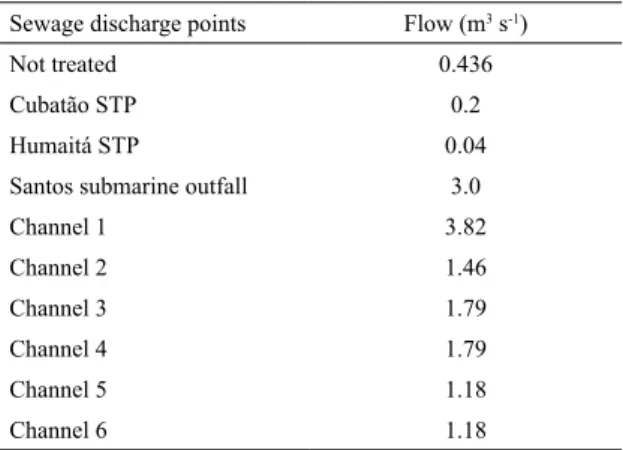
lowdataThe low data from the Santos drainage channels, sewage point, and diffuse sources used in this study were derived from the model that was implemented in the Laboratory of Estuarine Dynamics and Coastal Seas (LADIN / EMC) at São Paulo State University in São Vicente (UNESP). The low of sewage efluents from both unregulated sources and WWTPs was obtained by SAMPAIO et al. (2008). The current low of the outfall from Santos was obtained by LAMPARELLI and ORTIZ (2006). The river sources and natural inputs used herein were taken from a diagram compiled by SAMPAIO et al. (2008) (Table 1).
Sewage discharge points Flow (m3 s-1)
Not treated 0.436
Cubatão STP 0.2
Humaitá STP 0.04
Santos submarine outfall 3.0
Channel 1 3.82
Channel 2 1.46
Channel 3 1.79
Channel 4 1.79
Channel 5 1.18
Channel 6 1.18
P
hySicOcheMicalPrOPertieSOfeStrOgenSThe dispersal, transport, and biological effects of estrogen in surface waters all depend on a number of physical processes (dilution, advection and dispersion), chemical processes (sorption, volatilization, and photolysis), and biological processes (biodegradation, bio-activation) (WRITER et al., 2012).
For the sorption process, both estrogen distribution and estrogen partitioning in the environment are determined by physicochemical properties and site-speciic environmental conditions (YING et al., 2002). (Table 2).
low for the river inlow and climatological values for salinity and temperature, since these values represented the most typical environmental scenario.
RESULTS AND DISCUSSION
When it comes to the long-term low regime in the SES, the numerical results found for the circulation agreed with typical estuarine circulation. During neap tides, low in the main channel oscillated between -0.20 and +0.25 ms-1 (+ seaward).
The bathymetry of the SES (Figure 1) deines the Santos Canal as the most important feature in the estuarine dynamic because it includes the largest amount of the estuarine system in terms of volume. In this canal, most of the estuarine out-lows and vertical salinity stratiication are more noticeable. The horizontal distribution of salinity, which is integrated throughout a tidal cycle, determines the positioning of the es-tuarine front. Indeed, the front in this system is located where the salinity gradient is highest. This information is helpful for deining the estuarine mixing zone and its boundaries when the river and coastal domains are concerned.
Table 2. Physicochemical properties of estrogens (LAI et al., 2000).
Estrogen
Molecular weight (g mol-1)
Water solubility (mg L-1 at
20°C)
Vapor pressure
(mm Hg)
log Kow
log Koc
Estrone 270.4 13 2.3 x
10-10 3.43 4.882
Estradiol 272.4 13 2.3 x
10-10 3.94 3.300
EE2 296.4 4.8 4.5 x
10-11 4.15 4.770
Estrogens are hydrophobic organic compounds of low volatility and are moderately adsorbed by sediment. The sorption of estrogens in soil or sediment may be an important factor in reducing aqueous phase concentrations. It may also be correlated with the presence of organic carbon content, and it may increase as salinity levels in the water increase (YING et al., 2002; LAI et al., 2000).
Information on the average concentrations of synthetic and natural estrogens was obtained from the paper by TERNES et al. (1999) on the domestic sewage from the STP in Rio de Janeiro, Brazil. These average concentrations, which were detected within Brazil and which resulted from Brazilian environmental and temperature conditions, were chosen because variations in estrogen concentrations are inluenced by environmental, physical, chemical, and biological factors. However, the three estrogens that were most commonly found in the environmental samples were estradiol and estrone (natural estrogens), and synthetic EE2, which is used in oral contraceptives.
The numerical experiments were run for 15 days in order to account for the effect of spring-neap tidal variation on hydrodynamics and on dispersion of substances throughout the estuary. We chose the long-term average
The salinity front positioning is shown in Figure 2 and reaches as far as 10 km from the main entrance. Another estuarine front is at the mouth of the secondary and shallower channel (the São Vicente Channel), a factor which is critical for deining water quality conditions.
results of the residual low estimate are in Figure 3. For the sake of comparison, L was the same as in the western estuarine channel and the bay. Although stratiication is important (particuarly in the main channel), residual lows were modeled based on the depth-integrated velocities.
Figure 2. Horizontal distribution of salinity in the surface of the Santos Estuarine System and its bay.
r
eSidencet
iMeThe results of the tidal circulation and freshwater discharge dynamics models allowed for the estimation of the residence time, which may indicate the dispersion of substances and pollutants in the SES. The results of this estimation revealed unique patterns in particular regions of the estuary, in both horizontal ields and vertical structures.
The residual low estimate emerged after integrating tidal circulation for 355 h, the nearest integer to the fortnightly tidal cycle. It was downstream in the western channel, where shallowness and narrowness disrupt most of the stratiication. The residual low was also downstream at the surface in the principal estuarine channel while it was upstream when depth-integrated velocities were considered.
The estimation of the residence time is: (1)
e
StrOgend
iSPerSiOnThe estrogen formulation follows a mass balance approach for the advection-diffusion formulation:
(2)
where: S and f are advection-diffusion-reaction functions, S is source inlows that were absent in the hydrodynamic model and which represent the concentration of the modeled substance present in discharges, small rivers, sewage and waste load outfalls, represents the reaction term of the estrogens and considers evaporation and dilution processes, volatilization of the substance itself, and chemical reactions. This term has been omitted, since it represents a reinement of results at a smaller order of magnitude. The other terms in Equation (2) are concentration of the substance (C), the diffusion coeficient (D) and low velocity (v). All variables were measured in terms of the three spatial dimensions (x, y, and z) and time (t).
Figure 3. Estimation of residence time in the SES. Sectors A, B, and C correspond to the upper, mid- and lower estuary, where mean values were 8.0, 7.4, and 4.8 days, respectively. The mean values for the Pompeba Channel and the São Vicente Channel were 1.0 day.
of estrogens are found. Consequently, sediments in the region may adsorb estrogens more eficiently, though this process has not been modeled.
The relatively higher concentration of hormones in Pompeba Channel can be explained by the illegal discharge of sewage from both shantytowns and residential areas, as well as by the dispersion conditions imposed by the hydrodynamic regime and channel morphology. The small channels drain wastewater from the surrounding neighborhoods and release it into the estuary. The amount of fecal coliforms found in samples collected in this region of the estuary exceeds the legally permitted standards, a inding which shows that this region is strongly inluenced by sewage discharges. The values have progressively increased in recent years, and domestic sewage remains a primary pollutant in this region (SAMPAIO et al., 2008).
The residence time ranges from 1 to 8 days and does not pose any signiicant inluence on estrogen concentrations in different locations of the SES. The hydrodynamic regime and the differences in the volume of the sectors are indeed the most important aspects to consider when determining which regions have the highest concentrations of estrogens (nearby outlow source locations, for example).
Contraceptives and hormonal treatment pharmaceuticals are linked to socioeconomic issues, since they are widely consumed by the local population. The synthetic estrogen EE2 passes through the sewage disposal system and is dispersed throughout the environment.
In addition to its signiicant economic importance, Santos is the largest city in the region in terms of Results for the dispersion modeling analyses
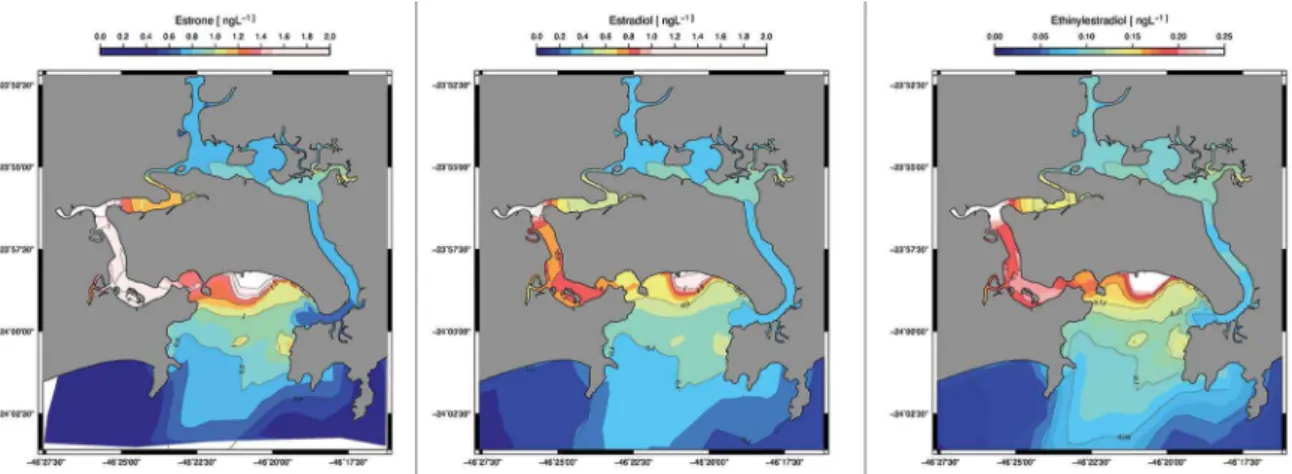
can be found in Figure 4. The dispersion rates of the three estrogens within the study area reveal higher concentrations in the Pompeba Channel, the São Vicente Channel, and the Santos Bay. The concentration values were determined to be 0 - 0.5 ng L-1 in the case of estradiol and 0.06 - 0.25 ng L-1 in the case of EE2. Estrone showed the highest concentration value at 0.6 - 1.2 ng L-1.
The modeled concentration results were below the limit values for toxicity in aquatic organisms, except in the case of EE2. The estimated EE2 concentrations were between 0.06 and 0.25 ng L-1, which is within the toxic range of 0.1 - 100 ng L-1, levels which are harmful to some species of aquatic organisms (PAWLOWSKIet al., 2004; FOLMAR et al., 2000; RODGRES-GRAY et al., 2000; ROUTLEDGE et al., 1998).
These results suggest that estrogens are unlikely to cause adverse effects on the biota in the SES environment, since the concentrations of estrogens in surface waters were generally found to be below toxic thresholds. However, one cannot give any assurance that the nearby discharge sources are free of acute or chronic toxicity: concentrations were above 0.1 ng L-1 in some portions of the SES, such as the São Vicente Channel. The sediment-water partition coeficient (log Koc) for estrogens increases as salinity increases (LAI et al., 2000). Salinity may be a factor in the sorption of these compounds by sediments and organic matter. These factors may change estrogen dispersal levels in aquatic environments. Salinity is higher in the Santos Channel because the channel is the deeper domain, so it is there the lowest concentrations
Figure 4. A: Horizontal distribution of natural and synthetic estrogens in the surface waters of the Santos Estuarine System and its bay. Results
after 15 days of simulation with the average long-term low rate. a) Estradiol; b) Estrone; c) EE2. B: Horizontal distribution of natural and synthetic estrogens in the surface waters of the Santos Estuarine System and its bay. Results after 15 days of simulation with the average long-term low rate.
a) Estradiol; b) Estrone; c) EE2. C: Horizontal distribution of natural and synthetic estrogens in the surface waters of the Santos Estuarine System
urbanized land area, and it has the highest population density per square kilometer with a total of more than 400,000 inhabitants. The city currently has more women than men; the current ratio being approximately 80 males to 100 females (SEADE, 2012; IBGE, 2010). Areas with potential sources of estrogens may be contributing to health risks for the population that uses the waters of the estuary for leisure and recreation. These activities allow for contact with and ingestion of contaminated compounds. Estrogens may also contribute to toxicity levels in aquatic biota through their synergism with other chemicals present in domestic efluents.
Further investigations in this area will ideally consider sampling and monitoring in the regions studied in this paper.
r
ecOMMendatiOnSfOrfuturereSearchThe routes of exposure to estrogens and the presence of these hormones in the region surrounding the Santos Estuary System should consider the inluence of pH, temperature, and thermodynamic parameters on the dispersion and sorption kinetics of estrogens. Other studies could quantify environmental compartments in the region or perform ecological risk assessments using ecotoxicological information and other lines of evidence. Still others can include research results on the consumption of birth control pills by the local female population. For the sake of the greater reinement of results, the chemical reactions of estrogens might consider the effect of salinity and sediment sorption at different concentrations in subdomains of the SES. Salinity distribution in sediments is a key issue within the comprehensive analysis of the kinematics of endocrine disruptors in highly impacted subtropical estuaries.
REFERENCES
BELFROID, A. C.; VAN DER HIORST, A.; VETHAAK, A. D.; SCHÄFER, A. J.; RIJIS, G. B. J.; WEGENER, J. CONFINO, W. P. Analysis and occurrence of estrogenic hormones and their glucuronides in surface water and waste water in The Nether-lands. Sci. Total. Environ., v. 225, n. 1/2, p. 101-108, 1999. BILA, D. M.; DEZOTTI, M. Desreguladores endócrinos no meio
ambiente: efeitos e conseqüências. Quím. Nova, v. 30, n. 3, p. 651-666, 2007.
FOLMAR, L. C.; HEMMER, M.; HEMMER, R.; BOWMAN, C.; KROLL, K.; DENSLOW, N. D. Comparative estrogenicity of estradiol, ethynyl estradiol and diethylstilbestrol in an in vivo, male sheepshead minnow (Cyprinodon variegatus), vitello-genin bioassay. Aquat. Toxicol., v. 49, n. 1/2, 77-88, 2000.
FRF. Fundação Ricardo Franco. Estudo de Impacto Ambiental (EIA) e Relatório de Impacto Ambiental (RIMA): Projeto de Aprofundamento do Canal de Navegação do Porto de Santos. Santos, 2008.
GHISELLI, G.; JARDIM, W. F. Interferentes endócrinos no ambiente. Quím. Nova, v. 30, n. 3, p. 695-706, 2007. HARARI, J.; FRANÇA, C. A. S.; CAMARGO, R. Climatology
and Hydrography of Santos Estuary. In: NEVES, R.; BAR-ETTA, J.; MATEUS, M. (Eds.). Perspectives on integrated coastal zone management in South America. Lisboa: IST Press, 2008. p.147-160.
BRASIL. IBGE. Instituto Brasileiro de Geograia e Estatística 2012. Censo demográico, 2010. Available at: < http://www. ibge.gov.br/home/estatistica/populacao/censo2010/>. Ac-cessed on 20 Dec. 2015.
ISOBE, T.; SERIZAWA, S.; HORIGUCHI, T.; SHIBATA, Y.; MANAGAKI, S.; TAKADA, H.; MORITA, M.; SHIRASHI, H. Horizontal distribuition of steroid estrogens in surface sediments in Tokio Bay. Environ. Pollut., v. 144, n. 2, p. 632-638, 2006.
JOBLING, S.; NOLAN, M.; TYLER, C. R.; BRIGHTY, G.; SUMPTER, J. P. Widespread sexual disruption in wild ish. Environ. Sci. Technol., v. 32, p. 2498-2506, 1998.
LAI, K. M.; JOHNSON, K. L.; SCRIMSHAW, M. D.; LESTER, J. N. Binding of waterborne Steroid estrogens to solid phases in river and estuarine Systems. Environ. Sci. Technol., v. 34, p. 3890-3894, 2000.
LAMPARELLI, C. C. Desafios para o licenciamento e moni-toramento ambiental de emissários: A experiência de São Paulo. In: LAMPARELLI, C. C.; ORTIZ, J. P. Emissários submarinos: Projeto, avaliação de impacto ambiental e monitoramento. Relatório Técnico CETESB. Secretaria do Meio Ambiente do Estado de São Paulo. Escola Po-litécnica da Universidade de São Paulo: EPUSP, 2006. 240 p.
LAMPARELLI, M. L.; COSTA, M. P.; PRÓSPERI, V. A.; BE-VILÁCQUA, J. E.; ARAÚJO, R. P. A.; EYSINK, G. G. L.; POMPÉIA, S. Sistema Estuarino de Santos e São Vicente. Relatório Técnico CETESB: São Paulo, 2001. 178 p. MIRANDA, L. B.; OLLE, E. D.; BÉRGAMO, A. L.; SILVA, L.
S.; ANDUTTA, F. P. Circulation and salt intrusion in the Pia-çaguera Channel, Santos (SP). Braz. J. Oceanogr., 60, n. 1, p. 11-23, 2012.
MULROY, A. When the cure is the problem. Water Environ. Technol., v. 13, n. 2, p. 32-36, 2001.
PAWLOWSKI, S.; VAN AERLE, R.; TYLER, C. R.; BRAUN
-DECK, T. Effects of 17alpha-ethinylestradiol in a fathead minnow (Pimephales promelas) gonadal recrudescence assay. Ecotoxicol. Environ. Saf., v. 57, n. 3, p. 330-345, 2004.
ROBINSON, B.; HUI, J. P.; SOO, E.; HELLOU, J. Estrogenic compounds in seawater and sediment from Halifax Harbor, Nova Scotia, Canada. Environ. Toxicol. Chem., v. 28, n.1, p. 18-25, 2009.
ROUTLEDGE, E. J.; SHEAHAN, D.; DESBROW, C.; BRIGHTY, G. C; WALDOCK, M.; SUMPTER, J. P. Identiication of estro -genic chemicals in STW efluent. 2. In vivo responses in trout and roach. Environ. Sci. Technol., v. 32, p. 1559-1565, 1998. SAMPAIO, A. F. P.; MATEUS, M.; RIBEIRO, R. B. Assessing the
impact of several development scenarios on the water quality in Santos Estuary. In: NEVES, R; BARETTA, J. W.; MATE -US, M. Perspectives on integrated coastal zone management in South America. Lisboa: IST Press, 2008. p. 435-444. SEADE. Fundação Sistema Estadual de Análise de Dados, 2012.
Avail-able at: <http://www.seade.gov.br/>. Accessed on: 17 Nov 2015. STUMPF, M.; TERNES, T. A.; WILKEN, R. D.; RODRIGUES, S.
V.; BAUMANN, W. Polar drug residues in sewage and natural waters in the state of Rio de Janeiro, Brazil. Sci. Total Environ., v. 225, n. 1/2, p. 135-141, 1999.
TERNES, T. A.; STUMPF, M.; MUELLER, J.; HABERER, K.; WILKEN, R. D.; SERVOS, M. Behavior and occurrence of estrogens in municipal sewage treatment plants--I. Investiga-tions in Germany, Canada and Brazil. Sci. Total. Environ., v. 225, n. 1/2, p. 81-90, 1999.
TERNES, T. A. Analytical methods for the determination of phar-maceuticals in aqueous environmental samples. Trends Analyt. Chem., v. 20, n. 8, p. 419-434, 2001.
WRITER, J. H.; RYAN, J. N.; KEEFE, S. H.; BARBER, L. B. Fate of 4-nonylphenol and 17ß-estradiol in the Redwood Ri-ver of Minnesota. Environ. Sci. Technol.; v. 46, n. 2, p. 860-868, 2012