1 Physical Therapy Department, Universidade Federal do Rio Grande do Norte (UFRN), Natal, RN, Brazil 2 Physical Therapy Department, Universidade Federal de Pernambuco (UFPE), Recife, PE, Brazil 3 Physical Therapy Department, Universidade Federal de São Carlos (UFSCar), São Carlos, SP, Brazil
4 Physical Therapy Department, College of Applied Health Sciences, University of Illinois Chicago, Chicago, IL, USA
Received: 05/09/2013 Revised: 08/20/2013 Accepted: 10/02/2013 a r t i c l e
Costs and benefits of Pulmonary Rehabilitation in
Chronic Obstructive Pulmonary Disease:
a randomized controlled trial
Catharinne C. Farias1, Vanessa Resqueti2, Fernando A. L. Dias1,
Audrey Borghi-Silva3, Ross Arena4, Guilherme A. F. Fregonezi1
ABSTRACT | Objective: The current study evaluated the costs and beneits of a simple aerobic walking program for patients with chronic obstructive pulmonary disease (COPD). Method: This was a blinded randomized controlled clinical trial that recruited 72 patients diagnosed with COPD, 40 of whom were included in the study and divided into two groups [control group (CG) and pulmonary rehabilitation group (GPR)]. We assessed pulmonary function, distance covered during the 6-minute walk test (6MWT), respiratory and peripheral muscle strength, health-related quality of life (HRQOL), body composition, and level of activities of daily living (ADLs) before and after an 8-week walking program. The inancial costs were calculated according to the pricing table of the Brazilian Uniied Health System (SUS). Results: Only 34 of the 40 patients remained in the inal sample; 16 in the CG and 18 in the GPR (FEV1: 50.9±14% predicted and FEV1:
56±0.5% predicted, respectively). The intervention group exhibited improvements in the 6MWT, sensation of dyspnea and fatigue, work performed, BODE index (p<0.01), HRQOL, ADL level (p<0.001), and lower limb strength (p<0.05). The inal mean cost per patient for the GPR was R$ 148.75 (~US$ 75.00) and no patient signiicantly exceeded this value. However, 2 patients in the CG did exceed this value, incurring a cost of R$ 689.15 (~US$ 345.00). Conclusion: Aerobic walking demonstrated signiicant clinical beneits in a cost-eficient manner in patients with COPD.
Keywords: rehabilitation; chronic obstructive pulmonary disease; exercise; health care costs. The study was registered in the Brazilian Clinical Trials Registry (RBR-7bqxm2).
HOW TO CITE THIS ARTICLE
Farias CC, Resqueti V, Dias FAL, Borghi-Silva A, Arena R, Fregonezi GAF. Costs and beneits of Pulmonary Rehabilitation in Chronic Obstructive Pulmonary Disease: a randomized controlled trial. Braz J Phys Ther. 2014 Mar-Apr; 18(2):165-173. http:// dx.doi.org/10.1590/S1413-35552012005000151
Introduction
Chronic Obstructive Pulmonary Disease (COPD) is a worldwide public health problem characterized by chronic and progressively limited airlow that is not completely reversible, leading to high morbidity and mortality. Dyspnea, fatigue, and chronic cough are the most common symptoms in COPD1. In
addition to these conventional symptoms, clinical worsening or exacerbations related to increased mortality, diminished health-related quality of life, and a substantial rise in sanitary and social expenses occur during the natural history of the disease. Non-participation in pulmonary rehabilitation programs was considered the most common risk factor in patients hospitalized for exacerbation2.
In spite of the good results3, multidisciplinary
pulmonary rehabilitation programs are not always accessible, incur an additional cost that may not be feasible for all patients, and exhibit low patient
adherence, resulting in beneits disappearing between 6 months and one year after program completion4.
On the other hand, engaging in regular independent aerobic exercise for more than 4 hours/week lowers the risk of hospitalization and mortality. This effective activity is more likely to be adhered to, is less expensive, and can be easily applied in environments near the patients’ home5,6.
Method
This is a blind randomized controlled clinical trial, conducted according to Consolidated Standards of Reporting Trials (CONSORT) guidelines7. Patients
with COPD, aged 40 to 85 years and enrolled at the high-cost drug distribution center of the municipality were recruited. The individuals were in medical follow-up, not undergoing home oxygen therapy, free of COPD exacerbations for at least three months prior to enrollment and had not participated in any physical activity program in the last six months. Exclusion criteria were comorbidities that potentially interfered with gait, a decline in peripheral oxygen saturation (SpO2) to <90% during the six-minute walk test (6MWT), withdrawal from the exercise program, absence from activity sessions more than once a week or absence from reassessment. The study was approved by the Research Ethics Committee of Universidade Federal do Rio Grande do Norte (UFRN), Natal, RN, Brazil, under protocol 449/2010, according to the Declaration of Helsinki of 1975, and registered with the Brazilian Clinical Trials Registry (RBR-7bqxm2). All of the subjects were informed of the procedures and gave their informed written consent.
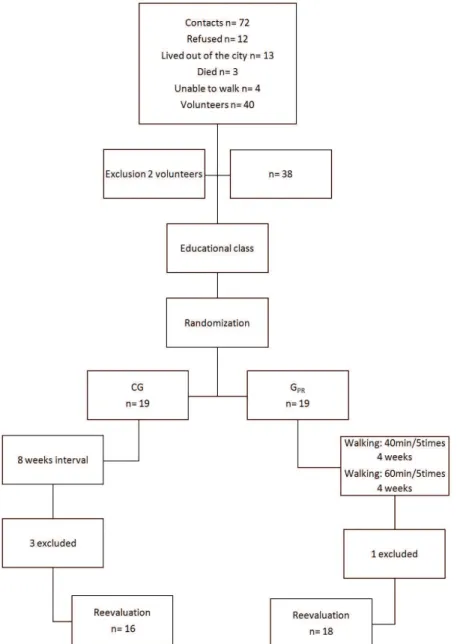
Initial evaluation was carried out by a physical therapist blinded to group assignment. All subjects attended two educational classes on COPD and the role of aerobic exercises in improving symptoms and activities of daily living. Next, subjects were randomly allocated to a control group (CG) or an intervention group (GPR) bsealed envelopes. In addition to the two educational classes, the GPR engaged in aerobic walking for eight weeks. Both groups were reassessed at the end of the eight weeks, as shown in the low diagram in Figure 1.
Assessment instruments and procedures
Aerobic walking program
The GPR underwent an eight-week aerobic walking program with ive weekly sessions, two of which were supervised by a physical therapist. In the initial weeks, the goal was to walk for 40 minutes and, after the fourth week, walking time was progressively increased to 60 minutes. Supervised activities were performed in small groups (maximum of three patients), always interrupted whenever the sensation of dyspnea reached a score of ive (intense). Each patient received a chart to record the progress of walking time, sensation of dyspnea, and fatigue for non-supervised activities, and were instructed to
use the modiied Borg scale (0 to 10), attributing a maximum score of 5 for interruption. The CG was not submitted to an exercise program, but was offered the same program as the GPR after the conclusion of the study.
Body composition and anthropometric assessment
Body composition was obtained by bioimpedance (Inbody R20, Biospace Co. Ltd., Seoul, South Korea) before and after the program, which determined fat free mass (FFM) and skeletal muscle mass (SMM) of the limbs. For measurement, the individual should be standing after 5 minutes of rest with an emptied bladder and no metal objects on the body. Height was measured with a stadiometer coupled to a Filizola PL200 anthropometric scale (Filizola®, São Paulo,
Brazil).
Spirometry and respiratory muscle strength
Spirometry was performed with the DATOSPIR-120 spirometer (SibelMed®, Barcelona, Spain) following
Brazilian Pneumology Society guidelines8 and
considering the predictive reference values proposed by Pereira et al.9. Maximum inspiratory and expiratory
pressures (MIP and MEP) and sniff nasal inspiratory pressure (SNIP) were assessed using a MicroRPM electronic pressure transducer (Micromedical®,
Kent, UK). Technical criteria followed American Thoracic Society/European Respiratory Society recommendations10. MIP and MEP were obtained
considering the maximum value reached in at most ive tests with a 1-minute rest period between tests. Values obtained for MIP and MEP were compared with reference values for the Brazilian population11.
SNIP was deined as the highest of 10 measurements, with a 30-second rest period between them, according to previously described reference values12.
Six-minute walk test
The six-minute walk test was used to analyze exercise tolerance, in accordance with American Thoracic Society recommendations13. The test was
conducted in a 30-meter lat corridor. Respiratory rate, heart rate, and SpO2 were assessed before and immediately after the test, the latter two with the a pulse oximeter, model 2500A (Nonin Medical Inc., Plymouth, MN, USA) and blood pressure using the ML035 aneroid sphygmomanometer (Solidor®,
Figure 1. Flow diagram.
with a 30-minute rest period between them, and the longest distance covered was recorded. The predicted distance was calculated using equations proposed by Iwama et al.14. Maximum work (W
max) performed was
calculated with the equations proposed by Hill et al.15
and Cavalheri et al.16 using body weight and fat free
mass, respectively.
Peripheral muscle strength
Hand-grip strength was obtained with a hand-held dynamometer on the dominant side (Jamar®,
Sammons Preston Inc., Bolingbrook, IL, USA). Three reproducible tests (≤5%) were carried out, and the highest value recorded. Lower limb strength was
evaluated by a one repetition maximum test (1RM) of the dominant side, on a leg curl machine (Studio Residencial Modelo 405, Embreex Ind. e Com. Ltda., Brusque, SC, Brazil).
BODE index and health-related quality of life
The mortality index was calculated based on the Body-mass index, airlow Obstruction, Dyspnea, and Exercise capacity (BODE) index17. Health-related
quality of life (HRQOL) was assessed using the Saint George’s Respiratory Questionnaire (SGRQ), with aspects related to three domains: symptoms, activity, and impacts18. Perceived dyspnea was evaluated by
London Chest Activity of Daily Living (LCADL)20
scale was used to determine the intensity of perceived dyspnea in daily activities.
Cost calculation
Direct costs, which include those of the aerobic exercise program, were calculated based on the value of physical therapy treatment of patients with respiratory disease and systemic complications. The cost of each assessment procedure was also considered. This procedure consisted of assessing body and anthropometric composition, pulmonary function, respiratory muscle strength, 6MWT, peripheral muscle strength, mortality index, and HRQOL. The cost of exacerbations, hospitalizations, and increased use of medication were calculated using the Pricing Table for Procedures, Medication, Orthoses, Prostheses, and Special Materials (OPM, National Health System/SUS)21. The values of
generic drugs were obtained in Brazilian currency (Reais), according to the Ministry of Health price
structure22.
Sample calculation and statistical analysis
The standard deviation of the 133-meter walk test from a previously published study17 was used to
obtain the total sample number. Student’s t-test, an alpha error of 0.05 with bilateral distribution, and a test power of 80% were applied. The test considered an intergroup difference of 84.48 meters, indicating a sample size of 20 patients for treatment. The Shapiro-Wilk test was used to analyze sample distribution, an unpaired t-test was used for intergroup comparisons before the intervention, and two-way ANOVA (time vs.intervention) with Bonferroni’s post-hoc test was used to analyze intragroup and intergroup differences. The GraphPad Prism 4 software (GraphPad Software Inc., San Diego, CA, USA) was used at a signiicance level of 95% (p<0.05).
Results
Forty of the 72 patients contacted agreed to take part in the study, all of whom underwent the irst assessment and attended educational classes. Two individuals with SpO2<90% were excluded during the 6MWT. The sample was randomized and patients were allocated to the CG or GPR (19 subjects in each group). The intervention program, consisting of walks in public squares and parks in the city, exhibited a certain limitation owing to climatic variations. However, these variations were very small during
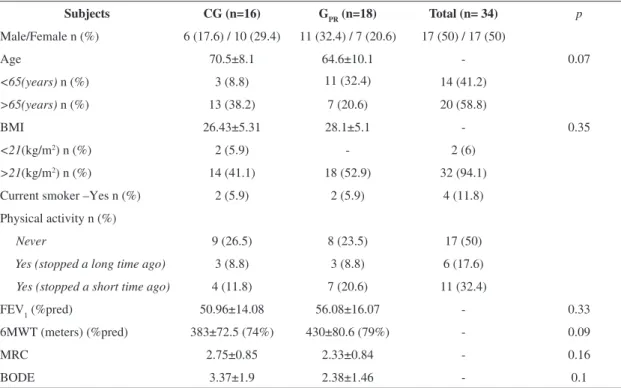
the study period, since our city often suffers from long periods of drought, which favored the proposed program. During the intervention period 4 patients were excluded, 1 from the GPR who required surgery, and 3 from the CG, 2 of whom exacerbated during the 8-week study and 1 who did not appear for clinical reassessment. The inal sample was composed of 34 patients of the total sample, 16 in the CG and 18 in the GPR, with 61.8% having above-ideal BMI values (62.5% of the CG and 61.1% of the GPR; Table 1).
Spirometry showed a chronic obstructive pattern with no post-bronchodilator reversibility, and subjects were classified according to GOLD recommendations1. The CG exhibited an FEV
1/FVC
of 0.60±0.09 and FEV1 of 50.9±14% predicted, and the GPR exhibited an FEV1/FVC of 0.62±0.08 and FEV1 of 56±0.5% predicted. With respect to respiratory muscle strength, subjects in the CG demonstrated MIP, MEP, and SNIP values of 75.2±22.8 cmH2O (88%pred), 81±19.1 cmH2O (102%pred), 88±24.8 cmH2O (81%pred), respectively, while values in the GPR were 92.2±24.2 cmH2O (86%pred), 70.3±14.7 cmH2O (93%pred), and 75.6±16.7 cmH2O (82%pred), respectively. Initially, there were no statistically signiicant intergroup differences between anthropometric and pulmonary function values (Table 1).
Effects of the aerobic exercise program
After the eight-week intervention, there was improvement in the 6MWT distance in the GPR (∆=42.8 meters, p<0.01) and a signiicant decrease (p<0.01) in the sensation of dyspnea and fatigue. The CG showed a reduction in meters walked (∆=-51.5 meters) at follow-up. After the intervention, the GPR achieved better BODE index scores and, although the intervention was not aimed at improving respiratory muscle strength, there were signiicant improvements in MEP and SNIP (p=0.03 and p=0.02), respectively (Table 2).
HRQOL exhibited significantly different intergroup scores after the intervention period in the domains symptoms, activity, and impacts. Hand-grip strength did not change after the intervention (CG: 23±8.6 vs. 23.1±8 and GPR 30.7±8.2 vs. 30.6±6.8). Muscle strength in the lower limbs improved signiicantly (p<0.05), as did muscle mass (Table 2).
Costs of the aerobic exercise program
the Uniied Health System (SUS) price structure does not include this examination. The costs incurred for spirometry, 6MWT, assessment of respiratory mechanics (spirometry and maximum respiratory pressures), and peripheral muscle function were R$6.36, R$2.78, R$10.00, and R$1.26, with a total individual assessment cost of R$20.40.
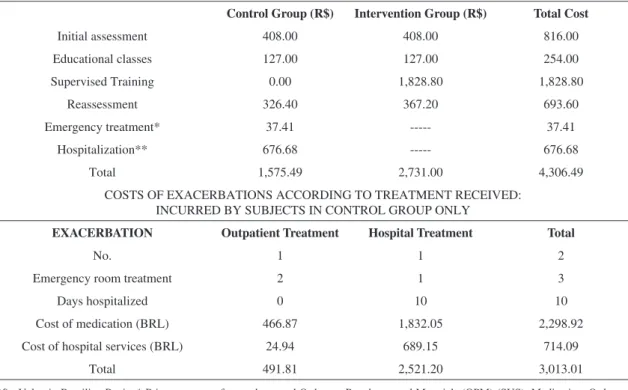
In cost analysis for each group, costs related to educational classes and physical therapy supervision during walking activities were added, both with individual values of R$6.35. Walks were performed with professional supervision twice a week, for 8 weeks (18 sessions), for a total of R$101.60/ person. The GPR underwent 288 exercise sessions, with a total cost for the CG and GPR of R$1,575.49 and R$2,731.00, respectively. Individual costs of patients with COPD in the public health system, with and without walking intervention, demonstrate that subjects who did not participate in the intervention and consequently exacerbated, could incur a higher individual cost for the public health system, estimated to be 46.33% higher (Table 3). Costs related to the type of care received, number of days hospitalized, costs of procedures, and medication due to exacerbation were calculated according to generic drug prices, considering the type of treatment received and number of days hospitalized in patients
who exacerbated (Table 4). Two subjects in the CG experienced exacerbations, leading to a total cost of care being substantially higher compared to the GPR.
Discussion
The aim of the present study was to determine the costs and beneits of an aerobic exercise walking program, conducted at primary care centers for patients with COPD. After the program, subjects exhibited greater tolerance to exercise, reduced symptoms, increased muscle strength and lower limb skeletal muscle mass, enhanced HRQOL, and a higher level of daily aerobic exercise. Moreover, there was a reduction in sanitary costs for the GPR compared to the CG.
Among the lifestyle interventions proposed for patients with COPD, there is convincing evidence that aerobic-based physical exercises provide important clinical beneits. The updated COPD clinical practice guidelines of the National Institute for Health and Clinical Excellence (NICE) emphasize the beneits of exercise and recommend it to all patients with this diagnosis23. The guide strongly suggests the practice
of daily aerobic exercises in order to minimize the number of exacerbations and hospitalizations23. In
the present study, the aerobic exercise program, composed simply of two initial educational classes
Table 1. Anthropometric distribution, life habits and disease classiication.
Subjects CG (n=16) GPR (n=18) Total (n= 34) p
Male/Female n (%) 6 (17.6) / 10 (29.4) 11 (32.4) / 7 (20.6) 17 (50) / 17 (50)
Age 70.5±8.1 64.6±10.1 - 0.07
<65(years) n (%) 3 (8.8) 11 (32.4) 14 (41.2)
>65(years) n (%) 13 (38.2) 7 (20.6) 20 (58.8)
BMI 26.43±5.31 28.1±5.1 - 0.35
<21(kg/m2) n (%) 2 (5.9) - 2 (6)
>21(kg/m2) n (%) 14 (41.1) 18 (52.9) 32 (94.1)
Current smoker –Yes n (%) 2 (5.9) 2 (5.9) 4 (11.8)
Physical activity n (%)
Never 9 (26.5) 8 (23.5) 17 (50)
Yes (stopped a long time ago) 3 (8.8) 3 (8.8) 6 (17.6)
Yes (stopped a short time ago) 4 (11.8) 7 (20.6) 11 (32.4)
FEV1 (%pred) 50.96±14.08 56.08±16.07 - 0.33
6MWT (meters) (%pred) 383±72.5 (74%) 430±80.6 (79%) - 0.09
MRC 2.75±0.85 2.33±0.84 - 0.16
BODE 3.37±1.9 2.38±1.46 - 0.1
and walking in public areas 5 times a week (2 of which were supervised by physical therapists) for 8 weeks, resulted in signiicant clinical beneits. The program demonstrated that, due to good adherence, the program contributed to the results obtained in this study, given its easy accessibility and low cost. Costs may be further reduced if, after a few weeks, supervised sessions are reduced to once a week.
Clinically, aerobic exercise caused greater tolerance to exercise, as evidenced by the 6MWT. The improvement occurred due to a combination of increased strength and peripheral muscle endurance, which could be explained by enhanced muscle oxidative capacity or positive adaptations in the ventilatory pattern during exercise24. The present
study showed a mean increase of 42 meters in the 6MWT (∆=10%) in the GPR possibly due to the walking intervention, while CG patients exhibited a reduction of 52.8 meters (∆=13%), since 2 subjects
Table 2. Clinical effects of the Pulmonary Rehabilitation Program.
CG GPR
Initial Final %change Initial Final %change
Distance (6MWT) 383±72.5 331.8±86.7 –13.6 430±80.6 472±72.7* 9.8
Borg’s dyspnea 2.8±1.5 4.1±1.5 46.4 2.3±1.4 1.8±1.2* –21.7
Borg’s fatigue 2.6±2 3.7±1.7 42.4 1.8±1.6 1.7±1.3* –5.5
Wmax (Kg x m) 24.8±8.2 21.3±8 –13.9 31±10.7 34.2±10* 10.3
Wmax (FFM x m) 14.8±5.2 12.4±4.6 –16.2 18.4±5.2 21.3±5.2* 15.8
MRC 2.8±0.9 3.3±0.8 17.9 2.3±0.8 2±0.6* –13.0
BODE 3.4±2 4.8 ±1.7 41.4 2.4±1.4 1.9±1.3* –20.5
MEP (cmH2O) 88±25 82±24.2 –6.8 92.1±23.5 103±24.1* 11.9
SNIP (cmH2O) 70.3±14.7 63.3±12.4 –9.9 75.6±16.3 77±18.8* 1.9
SGRQ (total) 55±17 64.3±12 16.9 42.8±14.7 26.4±7.3*† –38.5
SGRQ (symptoms) 58.3±15.5 61±14.1 4.5 41.6±19.3 25±12.5*† –40.0
SGRQ (activity) 64.8±16.5 76.5±11.7 18.1 56±16.8 36.5±9*† –34.8
SGRQ (impacts) 47.3±20.5 58.2±17.3 23.0 35.7±16.3 21.1±7.8*† –40.9
LCADL (total) 29.8±7.7 36.2±8.5 21.5 30.5±7.4 24.1±5.1* –21.1
LCADL (personal care) 23.8±6.5 29.1±5.2 22.3 27.2±5.3 21.4±2.5 –21.3
LCADL (domestic activity) 22.1±19.4 28.2±22.9 27.5 19.3±17.2 13±11.5*† –40.5
LCADL (physical activity) 37.5±11.8 50.6±11.2 35 37.2±11 27.2±8*† –26.9
LCADL (leisure) 25±6.7 26.3±7.1 5.2 25.9±7 20.4±1.5 –21.3
1 RM 9.9±5 9.3±6 6.1 8.8±3.3 13.2±4.4* 50.0
SMM (LRL) 5.3±1.5 5.1±1.5 –3.7 6±1.3 6.5±1.5* 8.5
SMM (LLL) 5.3 ±1.4 5.1±1.4 –3.7 6±1.34 6.5 ±1.5* 8.5
*p<0.05; † - ANOVA with Bonferroni’s post-test; 6MWT: 6-minute walk test (meters); Wmax: maximum work; FFM: fat free mass; MEP: maximum expiratory pressure; SNIP: sniff nasal inspiratory pressure; MRC: Medical Research Council; BODE: Body mass index, airlow Obstruction, Dyspnea, and Exercise capacity; SGRQ: Saint George’s Respiratory Questionnaire; LCADL: London Chest Activity of Daily Living; 1RM: 1 repetition maximum; SMM: skeletal muscle mass; LRL: lower right limb; LLL: Lower left limb.
Table 3. Individual cost of a patient with COPD: without Pulmonary Rehabilitation and with Pulmonary Rehabilitation.
COPD without PR (R$)***
COPD with PR (R$)
Initial assessment 0.00 20.40
Educational class 0.00 6.35
Supervised training 0.00 101.60
Reassessment 0.00 20.40
Emergency treatment* 12.47 0.0
Hospitalization** 676.68 0.0
Total 689.15 148.75
in that group exacerbated. Furthermore, we observed a signiicant decline in the sensation of dyspnea and fatigue reported at the end of the program only in the GPR. These indings are consistent with previous studies employing more conventional pulmonary rehabilitation programs3.
Despite using a simple aerobic exercise program, the present study found similar responses to those reported by other authors who assessed more structured programs25. It is important to underscore
that structured, traditional pulmonary rehabilitation programs are more costly, since they involve a large number of professionals, are conducted over a longer period of time, and mostly in secondary or tertiary hospitals far from patients’ homes26. The
therapeutic modality used in the present investigation promoted an increase in lower limb peripheral muscle strength, combined with gains in skeletal muscle mass (SMM) in both limbs. Another important aspect of the program was its capacity to potentially lower the mortality risk (BODE) through consecutive improvements in exercise capacity and dyspnea. Therefore walking, the primary therapeutic modality in the program, is a safe, comfortable, and low-cost method that provides important clinical beneits. Given the quality of the therapeutic modality applied, we observed that the program used in the present study could be easily reproduced by the Public
Health System in primary care centers, representing an important and effective low-cost strategy.
In relation to complications, 2 CG patients deteriorated during the study period. Exacerbations have a negative impact on the respiratory system, which can inluence the trajectory of the disease. These clinical declines are related to increased mortality and reduced HRQOL2. Estimated costs
of treating exacerbations, including emergency care and hospitalizations, were added to CG costs. Thus, while the GPR incurred a higher initial cost, avoidance of exacerbations resulted in a substantially lower ultimate cost of care compared to the CG. Exacerbations and hospitalizations are the major determinants of sanitary costs in COPD27. Data from
the USA estimated that COPD mean annual costs per patient were US$1,522.00, 17.3% of which was spent on medical consultations and emergency treatment28.
Another study carried out in Canada29 found fewer
hospitalizations and emergency room visits, due to the practice of domiciliary non-supervised aerobic exercises on a bicycle ergometer, coupled with a disease management education program. This study estimated a mean annual saving of US$ 2,300.00 per patient.
To the best of our knowledge, no other studies have been published regarding the costs of any type of rehabilitation program for the COPD population in Brazil. The results presented here demonstrate
Table 4. Total costs for the control and intervention group calculated according to the Uniied Health System (SUS) Price structure21.
Control Group (R$) Intervention Group (R$) Total Cost
Initial assessment 408.00 408.00 816.00
Educational classes 127.00 127.00 254.00
Supervised Training 0.00 1,828.80 1,828.80
Reassessment 326.40 367.20 693.60
Emergency treatment* 37.41 --- 37.41
Hospitalization** 676.68 --- 676.68
Total 1,575.49 2,731.00 4,306.49
COSTS OF EXACERBATIONS ACCORDING TO TREATMENT RECEIVED: INCURRED BY SUBJECTS IN CONTROL GROUP ONLY
EXACERBATION Outpatient Treatment Hospital Treatment Total
No. 1 1 2
Emergency room treatment 2 1 3
Days hospitalized 0 10 10
Cost of medication (BRL) 466.87 1,832.05 2,298.92
Cost of hospital services (BRL) 24.94 689.15 714.09
Total 491.81 2,521.20 3,013.01
an increase in medication costs caused by the high cost of exacerbation in the CG. Despite the short follow-up period regarding the results obtained for exacerbation costs, we can hypothesize that it would be economically feasible and beneicial to implement simple, cost-eficient aerobic exercise walking programs for patients with COPD. Studies have demonstrated that the costs of exacerbation account for 40-79% of total direct costs in individuals with COPD30. As such, implementing proven
interventions directed toward reducing such costs is highly advantageous.
The present study exhibits a potential limitation, despite its functional relevance with respect to HRQOL and possible financial ramifications of the interventions applied. Speciically, conducting training activities with walking in public areas was considered the main limitation, in light of possible climatic alterations that may occur and restricted times to conduct the activities. However, this limitation is related to the methodological design of the research, aimed at providing patients with an accessible intervention. Rectifying this limitation using other, more environmentally predictable, exercise environments, would rectify this issue and likely produce similar beneits. Furthermore, another limitation was the sample loss by exacerbations, surgery, desaturation, and withdrawal from the program, which turned out to be a selection bias.
A simple rehabilitation program, consisting of two educational sessions and an eight-week aerobic walking program applied at primary care centers for COPD, demonstrated signiicant clinical beneits and economic feasibility for possible large-scale implementation. It is therefore considered important to promote public policies to implement low-complexity programs for these patients, especially in the family health programs of our country.
References
1. Rodriguez-Roisin R, Anzueto A, Bourbeau J, De Guia TS, Hui DSC, Jenkins C, et al. GOLD - Global strategy for the diagnosis, management and prevention of chronic obstructive pulmonary disease. 2011. Available from: http://www.goldcopd.org/uploads/users/files/ GOLDReport_April12011.pdf.
2. Garcia-Aymerich J, Lange P, Benet M, Schnohr P, Antó J M. Regular physical activity reduces hospital admission and mortality in chronic obstructive pulmonary disease: a population based cohort study. Thorax. 2006;61:772-8. PMid:16738033 PMCid:PMC2117100. http://dx.doi. org/10.1136/thx.2006.060145
3. Wehrmeister FC, Knorst M, Jardim JR, Macedo EC, Noal RB, Martínez-Mesa J, et al. Pulmonary rehabilitation programs for patients with COPD. J Bras Pneumol.
2011;37(4):544-55. Pmid:21881745. http://dx.doi. org/10.1590/S1806-37132011000400017
4. Egan C, Deering BM, Blake C, Fullen BM, McCormack NM, Spruit MA, et al. Short term and long term effects of pulmonary rehabilitation on physical activity in COPD. Respir Med. 2012;106(12):1671-9. PMid:23063203. http://dx.doi.org/10.1016/j.rmed.2012.08.016
5. Sindhwani G, Verma A, Biswas D, Srivastava M, Rawat J. A pilot study on domiciliary pulmonary rehabilitation programme in the management of severe chronic obstructive pulmonary disease. Singapore Med J. 2011;52(9):689-93. PMid:21947149.
6. Puhan MA, Scharplatz M, Troosters T, Steurer J. Respiratory rehabilitation after acute exacerbation of COPD may reduce risk for readmission and mortality-a systematic review. Respir Res. 2005;8(6):54. PMid:15943867 PMCid:PMC1164434. http://dx.doi. org/10.1186/1465-9921-6-54
7. Schulz KF, Altman DG, Moher D, for the CONSORT Group (2010). CONSORT 2010 Statement: updated guidelines for reporting parallel group randomized trials. Open Med. 2010;4(1):60.
8. Sociedade Brasileira de Pneumologia e Tisiologia. Diretrizes para Testes de Função Pulmonar. J Bras Pneumol. 2002;28:1-221.
9. Pereira CAC, Sato T, Rodrigues SC. Novos valores de referência pra espirometria forçada em brasileiros adultos de raça branca. J Bras Pneumol. 2007;33(4):397-406. PMid:17982531. http://dx.doi.org/10.1590/ S1806-37132007000400008
10. American Thoracic Society, European Respiraory Society. ATS/ERS. Statement on respiratory muscle testing. Am J Respir Crit Care Med. 2002;166:518-624. PMid:12186831. http://dx.doi.org/10.1164/rccm.166.4.518
11. Neder JA, Andreoni S, Lerario MC, Nery LE. References values for lung fucntion tests. Maximal respiratory pressures and voluntary ventilation. Braz J Med Biol Res. 1999;32:719-27. PMid:10412550. http://dx.doi. org/10.1590/S0100-879X1999000600007
12. Araújo PRS, Resqueti VR, Nascimento J Jr, Carvalho LA, Cavalcanti AGL, Silva VC, et al. Valores de referência da pressão inspiratória nasal em indivíduos saudáveis no Brasil: estudo multicêntrico. J Bras Pneumol. 2012;38(6):700-7. PMid:23288114. http://dx.doi. org/10.1590/S1806-37132012000600004
13. American Thoracic Society. ATS statement: guidelines for six minute walk test. Am J Respir Crit Care Med. 2002;166:111-17. PMid:12091180. http://dx.doi. org/10.1164/ajrccm.166.1.at1102
14. Iwama AM, Andrade GN, Shima P, Tanni SE, Godoy I, Dourado VZ. The six-minute walk test and body weight-walk distance product in healthy Brazilian subjects. Braz J Med Biol Res. 2009;42:1080-5. PMid:19802464. http:// dx.doi.org/10.1590/S0100-879X2009005000032 15. Hill K, Jenkins SC, Cecins N, Philippe DL, Hillman DR,
16. Cavalheri V, Hernandes NA, Camillo CA, Probst VS, Ramos D, Pitta F. Estimation of Maximal Work Rate Based on the 6-Minute Walk Test and Fat-Free Mass in Chronic Obstructive Pulmonary Disease. Arch Phys Med Rehabil. 2010;91(10):1626-8. PMid:20875524. http:// dx.doi.org/10.1016/j.apmr.2010.07.002
17. Celli BR, Cote CG, Marin JM, Casanova C, Montes de Oca M, Mendez RA, et al. The body-mass index, airlow obstruction, dyspnea, and exercise capacity index in chronic obstructive pulmonary disease. N Engl J Med. 2004;350(10):1005-12. PMid:14999112. http://dx.doi. org/10.1056/NEJMoa021322
18. Sousa TC, Jardim JR, Jones P. Validação do Questionário do Hospital Saint George na doença respiratória (SGRQ) em pacientes portadores de doença pulmonar obstrutiva crônica no Brasil. J Bras Pneumol. 2000;26(3):119-28. http://dx.doi.org/10.1590/S0102-35862000000300004 19. Kovelis D, Segretti NO, Probst VS, Laureau SC, Brunetto
AF, Pitta F. Validação do Modiied Pulmonary Functional Status and Dyspnea Questionnaire e da escala do Medical Research Council para o uso em pacientes com doença pulmonar obstrutiva crônica no Brasil. J Bras Pneumol. 2008;34(12):1008-18. PMid:19180335. http://dx.doi. org/10.1590/S1806-37132008001200005
20. Carpes MF, Mayer AF, Simon KM, Jardim JR, Garrod R. The Brazilian Portuguese version of the London Chest Activity of Daily Living scale for use in patients with chronic obstructive pulmonary disease. J Bras Pneumol. 2008;34(3):143-51. PMid:18392462. http://dx.doi. org/10.1590/S1806-37132008000300004
21. Brasil. Ministério da Saúde. Tabela de Procedimentos, Medicamentos, Órteses, Próteses e Materiais Especiais (OPM) do Sistema Único de Saúde - SIGTAP. Portaria nº 2.848. Brasília: Ministério da Saúde; 2007.
22. Brasil. Ministério da Saúde. Lei nº 9.787, de 10 de fevereiro de 1999. Dispõe sobre a vigilância sanitária, estabelece o medicamento genérico, dispõe sobre a utilização de nomes genéricos em produtos farmacêuticos e dá outras providências. Diário Oicial da República Federativa do Brasil; 1999 fev. 12.
23. National Institute for Health and Care Excellence - NICE. Chronic obstructive pulmonary disease -COPD guidelines. Management of chronic obstructive pulmonary disease in adults in primary and secondary care (partial update). 2010
[cited 2012 May]. Available from: http://publications.nice. org.uk/chronic-obstructive-pulmonary-disease.
24. Troosters T, Casaburi R, Gosselink R, Decramer M. Pulmonary Rehabilitation in Chronic Obstructive Pulmonary Disease. Am J Respir Crit Care Med. 2005;172:19-38. PMid:15778487. http://dx.doi. org/10.1164/rccm.200408-1109SO
25. Bourbeau J. Making pulmonary rehabilitation a success in COPD. Swiss Med Wkly. 2010;140:w13067. PMid:20809435.
26. Lacasse Y, Goldstein R, Lasserson TJ, Martin S. Pulmonary rehabilitation for chronic obstructive pulmonary disease. Cochrane Database Syst Rev. 2006,4:CD003793. Pmid:17054186. http://dx.doi.org/10.1002/14651858. CD003793.pub2
27. Miravitles M. Avaliação económica da doença pulmonar obstrutiva crônica e de suas agudizações. Aplicação na América Latina. J Bras Pneumol. 2004;30(3):274-85. http://dx.doi.org/10.1590/S1806-37132004000300015 28. Rochester CL. Exercise training in chronic obstructive
pulmonary disease. J Rehabil Res Dev. 2003;40(5):59-80. PMid:15074454. http://dx.doi.org/10.1682/ JRRD.2003.10.0059
29. Bourbeau J, Collet JP, Schwartzman K, Ducruet T, Nault D, Bradley C. Economic benefits of self-management education in COPD. Chest. 2006;130;1704-11. PMid:17166985. http://dx.doi.org/10.1378/ chest.130.6.1704
30. Halpern MT, Stanford RH, Borker R. The burden of COPD in the U.S.A: results from the Confronting COPD survey. Respir Med. 2003;97:S81-9. PMid:12647946. http:// dx.doi.org/10.1016/S0954-6111(03)80028-8
Correspondence
Guilherme Augusto de Freitas Fregonezi Universidade Federal do Rio Grande do Norte Departamento de Fisioterapia
Pneumocardiovascular Performance & Respiratory Muscle Laboratory
Caixa Postal 1524, Campus Universitário Lagoa Nova CEP 59072-970, Natal, RN, Brazil