1Universidade Federal do Rio Grande do Sul (UFRGS), Instituto de Psicologia, Programa de Pós-Graduação em Psicologia –Psychology MD (UFRGS). 2Division of Cognitive Neuroscience, Department of Neurology, University of Iowa Carver College of Medicine, #2007 RCP, 200 Hawkins Drive, Iowa
City, Iowa52242-1053 USA.3Universidade Federal do Rio Grande do Sul (UFRGS), Instituto de Psicologia, Programa de Pós-Graduação em Psicologia
– Psychology PhD (USP).
Dra. Maria Alice de Mattos Pimenta Parente – Universidade Federal do Rio Grande do Sul / Instituto de Psicologia Rua Ramiro Barcelos, 2600 -90035-003 Porto Alegre RS - Brazil. E-mail: [email protected]
Iowa gambling task
Administration effects in older adults
Daniela Di Giorgio Schneider
1, Gabriela Peretti Wagner
1,
Natalie Denburg
2, Maria Alice de Mattos Pimenta Parente
3Abstract – The Iowa Gambling Task (IGT) assesses decision-making.Objective: The objective of the present study was to investigate whether specific changes in administering the IGT can affect performance of older adults completing the task.Method: Three versions of the IGT were compared regarding the feedback on the amount of money won or lost over the course of the test. The first version (I) consisted of a replication of the original version (Bechara et al., 1994), which utilizes a computerized visual aid (green bar) that increases or decreases according to the gains or the losses. The second version (II), however, involved a non-computerized visual aid (cards) and, in the third version (III) the task did not include any visual aid at all. Ninety-seven older adults, divided into three groups, participated in this study. Group I received computerized cues (n=40), group II, non-computerized cues (n=17) and III was submitted to a version without any cues (n=40).Results: The participants without any cues achieved only a borderline performance, whereas for those with non-computer-ized cues, twice the number of participants showed attraction to risk in relation to those with aversion. The participants of the computerized version were homogeneously spread across the three performance levels (impaired, borderline and unimpaired).Conclusions: Aspects of the complexity of the decision process as well as of the task used are proposed as possible theoretical explanations for the performance variation exhibited. KEY WORDS: decision-making, Iowa gambling task, ageing.
“Iowa gambling task”: efeitos das formas de administração no desempenho de idosos
Resumo – A Iowa Gambling Task (IGT) consiste em um instrumento que avalia tomada de decisão.Objetivo: O objetivo do presente estudo foi investigar se alterações específicas na administração da IGT podem afetar o desempenho de idosos na execução da tarefa.Método: Três versões da IGT foram comparadas, de acordo com o resultado obtido em termos do número de cartas selecionadas de cada um dos baralhos. A primeira versão (I) consistiu em uma replicação da versão original (Bechara et al., 1994), a qual apresenta uma pista visual (barra verde) que aumenta ou diminui de acordo com ganhos e perdas monetários. A segunda versão (II) envolveu uma pista visual não computadorizada (cartões) e, na terceira versão (III), não houve nenhuma espé-cie de pista. Noventa e sete idosos, divididos entre os três grupos, participaram do estudo. O grupo I (pista computadorizada) foi composto por 40 idosos, enquanto os grupo II (pista não computadorizada) contou com 17 e, por fim, o grupo III (sem pista), foi formado por 40 idosos.Resultados: Os participantes submetidos à versão sem pista apresentaram um desempenho limítrofe. Em relação aos idosos submetidos à variação com pista não computadorizada, os participantes apresentaram duas vezes mais atração ao risco, quando compara-dos àqueles com aversão. Os participantes que realizaram a tarefa com pista computadorizada apresentaram desempenho homogêneo entre os três subgrupos de desempenho quanto à busca ou aversão pelo risco. Conclusões: Possíveis explicações teóricas das diferenças de desempenho decorrem principalmente de di-ferentes aspectos da complexidade do processo de decisão e da tarefa.
Over the last decade, the Iowa Gambling Task (IGT)1
has been widely used among researchers as a neuropsy-chological measure that assesses decision-making (DM) under ambiguity. This task intends to simulate a real-life decision-making situation, in which the participants have to choose cards in order to win or lose money. The task enables classification of a subject’s decision-making be-havior in terms of risk aversion versus risk taking.
The IGT was first developed to investigate the real-world deficits exhibited by patients with lesions in the ventromedial prefrontal cortex (VMPC)1-4. Prior to the
development of the IGT, conventional “lab” tasks were not able to index the types of defective decisions such patients took in their everyday-life. Briefly, patients with lesions to the VMPC displayed myopia for the future, preferring short-term reinforcement over long-term repercussions. Despite strong evidence for the IGT’s sen-sitivity to VMPC functioning, some studies have indicat-ed that the IGT may present some limitations as regards its lack of specificity. In other words, studies carried out on patients that have damage in non-VMPC brain areas have also showed impairment in their ability to decide5.
One of the hypothetical explanations places emphasis on the IGT’s complexity, an aspect that requires the involvement of other cognitive components besides deci-sion-making. A first process that seems to be of special relevance concerns behavioral inhibition, crucial for a decision process to take place6. In other words, in order to
allow a balance between different options of choice, it is necessary to control impulsive behavior enabling appro-priate use of the cognitive process for the information handled. Thus, attention processes seem to be equally important, enabling relevant aspects of the information on the options to be highlighted7. Similarly, the
informa-tion regarding these opinforma-tions must be held in the con-scious process for some time using the working memory, allowing the use of reasoning processes and judgment concerning the advantages and disadvantages of each option of choice.
Therefore, it is plausible to assume that particular administration differences amongst the different IGT ver-sions used, such as the kind of financial feedback provid-ed or reinforcement usprovid-ed (real or fake money), among others, may be an important factor to consider. The un-derlying reason behind this is that these differences may provide additional important hints that can maximize the participation of some cognitive components much more than others, or vice versa. For instance, visual feed-back can be memorized differently to verbal feedfeed-back, interfering in the memorization process necessary for appropriate performance of the task.
Some studies have focused on aspects of administer-ing the task, which vary accordadminister-ing to researcher, aimadminister-ing to verify whether they can differentially affect the per-formance of the participants on the IGT. No difference has been observed regarding the kind of reinforcement used (real or facsimile money)8-9. Similarly, no difference
in performance has been found stemming from the kind of version used (computerized or manual)10. When
focus-ing these discussions on the elderly population11-15, the
hypothesis over the possible effects of administration dif-ferences takes into consideration specific aspects of the ageing process. Regarding the cognitive changes found in this elderly population, we have considered segmented studies on memory loss, mainly those showing significant working memory damage and impaired ability to re-member11. Thus, it is plausible to suggest that usage
changes that facilitate the mnemonic process can assist older individuals in their decision-making process throughout the IGT.
Denburg, Tranel & Bechara15carried out a study in
which they observed that a sub group of older adults showed DM impairment compared to younger individu-als. Moreover, when repeating the performance analysis of the elderly, the study by McPherson, Phillips & Della Sala12, Denburg et al.15suggest that the same subgroup
composition could be found if the authors had conduct-ed a group subdivision. On the other hand, the study car-ried out by Schneider16reveals that neither young nor old
people showed evidence of borderline performance when submitted to a different version of the IGT. Basically, this version shares the same characteristics found in the origi-nal1, except for a lack of visual cues concerning the
amount of gain and loss throughout the games (green bar, which increases and decreases). Wagner17showed
that the aid of a manual visual cue, which interfered in the decision processes of the older adults, improved the performance in terms of aversion to risk.
Considering the arguments presented so far, we note the importance of carrying out studies with different ver-sions of the IGT to verify in what way the specific changes in task administration may affect individuals’ perform-ance. Also, studies of this nature enable a better under-standing about the different components involved in the task, allowing greater control of its complexity and a consequent increase in its specification. In this sense, the present study will compare three versions of the IGT regarding the feedback provided by the test in relation to the amount of money lost or won during the game. The first version (I) consists of a replication of the original version1. It has a computerized visual aid which is
de-creases according to the gains or losses. The second ver-sion (II) however, will involve a non-computerized visual aid (cards), which will enable the participants to have some idea of the amount gained (or lost) at any given time. In the third version (III), the task will not present any visual aid, thus not offering any idea of the amount won or lost at any given time.
Methods
Design and participants
Older adults were recruited from the community, and randomly assigned to one of the three aforementioned groups. Social-demographic data of the participants are provided in Table 1.Three groups of participants were evaluated. Group I had 40 participants (22 male), while there were 17 participants in Group II (all female) and 40 in Group III (13 male). The first group comprised Amer-icans while the other two groups were Brazilians. Ac-cording to the Kruskal-Wallis Test, there were no signifi-cant differences (p value greater than 0.05) among the groups concerning age [χ2(0.610)=2; p=0.737] or
educa-tion [χ2(5.030)=2; p=0.081].
Exclusion criteria involved non-corrected visual and/ or hearing impairment, presence of psychiatric disorders (that required treatment or affect daily life), and/or neu-rological disease (vascular-brain disease, epilepsy, among others, including disorders that can generate changes in cognitive functions). Regarding the inclusion criteria, the minimum age was 56 years old, and participants must have received at least 4 years of formal education.
Measures and procedures
The older adults were invited to participate in the study as volunteers. All the participants lived in the com-munity, and had never been institutionalized. After being informed about the objectives of the study and having signed the Consent Agreement, the participants were submitted to evaluation.
Self-report questionnaire of social-demographic and cultural data
Firstly, the Brazilian older adults completed a social-demographic and cultural data self-report questionnaire, in
order to obtain data to characterize the sample studied. Through this form it was possible to glean information such as age, education, social-economic level, reading and writing habits, among others. The data on demographic variables were obtained through objective questions. Re-garding the North American sample, the participants were submitted to a semi-structured interview15, which had
sim-ilar objectives to those in the Brazilian sample form.
Iowa gambling test (IGT)
The IGT is a neuropsychological measure that assesses decision-making ability (1). The computerized version was used in all three studies, with some variations, as out-lined below. All of the statistical data were analyzed with SPSS, version 12.
Original version (with computerized visual reinforcement)1
Using monetary choices, the task allows classification of the participant’s performance in terms of aversion or risk taking. The task consists of four decks of cards of similar appearance (labeled A, B, C and D). The partici-pant is told, during the initial verbal instructions, to select one card at a time from any of the fours decks. They are told that each time they choose a card they will win some money and that occasionally they will also lose some money. They are also told that the goal of the IGT is to win money, or maximize profit.
For instance, when the participant chooses a card from Decks A and B, they win R$ 100,00, whereas when they choose from Decks C and D, they might win R$ 50,00. Decks A and C have frequent but low penalties whereas Decks B and D have occasional penalties but of high values. Despite the large amount of money one can win, Decks A and B are considered disadvantageous because the losses outweigh the gains, yielding an overall net loss. However, Decks C and D are considered advan-tageous, because the gains outweigh the losses, yielding an overall net gain. The task continues until all 100 cards are selected. During the task, the individual can obtain an estimate of the value won so far, but cannot know the amount exactly. This is possible because the computer offers a cue informing the participant about the losses
Table 1.Mean and standard deviation of age and education of the sample studied.
Group I (computerized cue) n=40
Group II (non-computerized cue) n=17
Group III (without cue) n=40
Age 69.68 (8.27) 70.59 (8.16) 68.60 (5.02)
and gains. Specifically, there are two bars are displayed on the computer screen, one that does not change represent-ing the initial situation (the loan the participant receives), and another indicating the gains and losses, that increases or decreases in size as the wins and losses are accumulat-ed. As the participant performs the task, this bar provides information (not exact numbers) of the remaining mon-etary balance.
Version with non-computerized visual reinforcement17
This task is the same as the original version1, with one
variation. At every selection, besides the message of receiving or losing money on the computer screen, the participant gains or loses the equivalent in colorful tokens presented by the examiner. The tokens used are of three colors: yellow (worth R$ 25,00), blue (worth R$ 50,00), and pink (R$ 100,00 each).
The older adults were not informed about how much each token was worth, only that they represent money won by them during the test. As money is lost or won, tokens of the corresponding values are placed into or withdrawn from sight of the participant. The participants were not told to make precise calculations of losses or gains. The objective was that only an estimate of the bal-ance was available, from the accumulation or loss of col-orful tokens. The indexes used for the calculations were the same as in the original version.
Version without visual reinforcement16-18
This version without visual reinforcement was adapt-ed by Schneider16, and is administrated according to
stan-dard protocol10, except for one aspect. In this version, the
participants had no computerized bars with the direction of the gains and the losses, where this aid is believed to facilitate the development of an approximation of the value obtained throughout the experiment. The partici-pants received computerized feedback related to the amount lost or gained, without, however, receiving the mnemonics given by the green bar, which increased or decreased according to the losses and gains. Thus, partici-pants were informed of the wins and potential losses for each card choice, but were not provided a directional visual depiction of cumulative gains and losses.
Calculation of the aversion to risk and classification of the participants
The same calculation of the aversion to risk was used in the three versions studied, and this served as the main dependent variable. From the result of choices from the four decks we were able to establish an index through the following operation [(C+D)-(A+B)]. The performance of
each participant was classified after the calculation according to the criteria of Denburg et al.15, under of the
three following categories: (1) Participant unimpaired
(aversion to risk); (2) participant borderline; and (3) par-ticipant impaired (risk attraction).Scores below zero indi-cate loss of money and risk attraction, whereas scores greater than zero indicate gain of money and an aversion to risk. The Chi-square test (χ2) was used to calculate data
related to the Iowa Gambling Test (aversion to risk).
Ethical aspects
Participants in each of the three groups completed an evaluation according to the bioethical norms governing research on humans. For Brazilian participants, these rights were assured according to norms19-20. The research
project related to group II went before the Research Ethics Committee of the Universidade Federal do Rio Grande do Sul (CEP/UFRGS) and was registered under number 2005463. This was approved at meeting number 43, of 24/11/2005, minute nº 64, and deemed ethically, and methodologically adequate20.
Regarding the North American participants, they were invited to participate in the research, and given the choice whether they would like to take part in the study or not. If they agreed, they would receive the Informed Consent Document, which included the purpose of the study in detail. Additionally, the participants were paid for taking part in this research study ($12.50 per hour). All the research assistants completed the online course “Human Participant Protections Education for Research Teams”, sponsored by the National Institute of Health (NIH).
Results
The data related to the Iowa Gambling Test (calcula-tions of aversion to the risky decks) were analyzed using the Chi-square (χ2) test. As can be seen from the data
provided in Table 2, the participants without any cues had only borderline performance, whereas out of those with non-computerized cues, twice the number of partic-ipants showed attraction to risk than those with aversion. The participants of the computerized cue version were homogeneously spread across the three groups (Im-paired, borderline and unimpaired performance). The analysis was firstly performed using the test of Chi-square. The distribution of the three groups was signifi-cantly different (χ2=40, 99 df=4, p value less than 0.001).
The expected value corresponds to 10, which enables comparison through the Chi-square, in spite of the two occurrences lower than 521. Since this position does not
grouped the borderline patients with the patients with attraction to risk. The Fisher’s exact test showed a signifi-cant difference between the cueless version compared to both the computerized cue version (p<0.001) and the non-computerized cue version (p<0.001). Thus, even with a smaller group receiving no computerized cues, sig-nificant differences were obtained. However, the comput-erized cue version did not differ significantly from the non-computerized one (p=0.61).
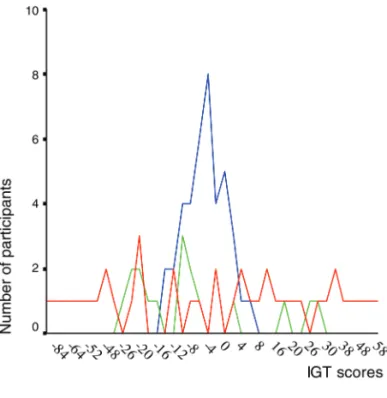
Figure 1 shows the individual scores of each partici-pant submitted to one of the three versions of the experi-ment. We can observe that the computer version stimu-lated a wider range of scores from –84 to + 64, whereas the manual cue showed a more restricted range, with a slightly greater number of participants having negative scores. The group without cues, on the other hand, result-ed in little variation in the scores of participants, showing a curve in a central position near zero. In other words, the computerized cue version lead to the choice of one of the tendencies, while the version without cues with the result around zero indicates that the participants made similar choices for advantageous decks as well as disadvanta-geous.
Discussion
In the present study, the participants in the computer-ized cue version,version I, were spread more homoge-nously across the three subgroups of performance classi-fication, that is, one third showed impaired performance. For group II,non-computerized visual reinforcement,in spite of the fact that the majority had their performance classified as borderline, twice as many participants showed impaired performance in relation to those with aversion to risk. The older adults belonging to group III,
without cue version,showed borderline performance in relation to aversion to risk, as their behavior did not sig-nificantly differentiate from the value “0.”
The first explanation for the difference in perform-ance among the groups is related to the complexity of the process in the decision-making and consequently of the IGT itself, that could have stemmed from administration
differences. decision-making is a complex cognitive proc-ess, which involves other cognitive components through-out. Given the IGT involves these components to measure the decision process, any alteration in instructions might decrease the role of some specific and hierarchal subordi-nated cognitive processes, such as working memory, explicit learning23and attention, minimizing the
influ-ence of these in the process of making choices during the task. Although not addressed in the present study, moti-vation might also play an important role in the perform-ance on the IGT24.
Empirical evidence corroborates the notion of the involvement of other cognitive components in DM. Be-sides the emotional factors clearly presented in the somatic marker hypothesis7, DM involves the learning
processes (through association between specific cate-gories of stimuli and specific catecate-gories of somatic states), attention processes and working memory compo-nents, making this outcome feasible6,7,25,26.
Table 2.Number of participants with or without aversion to risk in the three groups.
No cue Non-computerized cue Computerized cue Total
Impaired 0 6 14 20
Borderline 40 8 13 61
Unimpaired 0 3 13 16
Total 40 17 40 97
The working memory acts by aiding the temporary holding of information concerning different options of choice in conscious processing, allowing processes of log-ical thinking and reasoning about advantages and disad-vantages of each option to be employed. The working memory is also responsible for the challenging task of considering past events and projecting them to a scenario in the future, based on the present situation6.
On submission to the IGT, the cognitive and emo-tional information that has already passed is reactivated when the individual considers the characteristics involved in each deck, contributing to the analysis of the actual chances. Attention processes seem to be also required, enabling those relevant aspects of the information of choices to be highlighted7.
In this sense, it is plausible to consider that the intro-duction of a reinforcement cue albeit visual or computer based, authorizes the allocation of more cognitive resources for the decision. Thus, the use of a cue would facilitate the task, especially amongst the aged, by allow-ing lesser interference of the cognitive, attention, and mnemonic processes in the decisional process.
Although some studies investigating the role of the working memory in the performance of individuals on the IGT have presented contradictory results27-30, an
alter-native explanation is proposed. This proposes that the working memory and decision-making are asymmetri-cally dependent, evidencing a simple dissociation3,25,31,32.
This implies the working memory is not dependent on impairment in decision-making, in other words, partici-pants can present a working memory in the presence or absence of a deficit in decision-making. However, integri-ty of decision-making seems to depend on a working memory without impairment.
Revisiting the model of the somatic markers, it is valid to consider that beyond the attention and mnemon-ic processes involved in the judgment and analysis of the choice options, as well as in decision-making, the emo-tional learning that the individual develops during the course of the task makes it equally important. Thus, besides involving cognitive processes usually accessed by conventional tests that measure executive powers, the IGT calls on participants’ feelings regarding the options, which can be characterized as an emotional anticipation of the consequences33. Kahneman34follows a similar line,
when defending two cognitive function approaches: an intuitive way involving fast and automatic decision-mak-ing, implicitly, and a controlled side, which involves a slower and pondered process.
Regarding the performance of the individuals on the IGT, when the necessity of resources of working memory
is minimized, the role that this would assume long ago, mainly in the aged population, seems to be reduced. In other words, if when offering a visual cue of the value gained (or lost) at the time one gives the elderly more information regarding the task, the work of the calcula-tion during the course of the process is facilitated. Hence, it can be inferred that a more controlled learning is facili-tated, since these cognitive processes are less vulnerable to error, increasing the role of the most implicit processes when choosing the decks.
This hypothesis requires further studies verifying its assertions empirically. Firstly, because even though the alterations in the instruction of the task may have re-duced the role of some resources of memory and atten-tion, much of these are still necessary for a satisfactory result. Furthermore, the notion that a greater role of the implicit components would have led the aged to demon-strate a higher attraction to risk contradicts the ideas of some empirical evidences demonstrating a preserved emotional process of positive and negative valences in this population, compared with the young13,35.
Amongst other possible variables involved in the choice of the process, it is reasonable to believe that char-acteristics of personality exert a certain tendency in pref-erences. Besides the related cognitive and emotional processes, some studies have shown that characteristics of personality can have some effect on the choices made, if added to the influences of the somatic marker and the executive processes36-38.
In addition to the complexity of the process of DM, a second, nevertheless no less important explanation for the results involves the possible influence of cultural as-pects on the performance of the individuals in the differ-ent versions. Some authors have shown the influence of factors such as education and partner-cultural level in different neuropsychological tests, as well as those that evaluate executive powers39, attention40, perception41,
memory42, language43and constructive praxis44. However,
in the case of the IGT, the importance of gambling habits and values of a particular culture may influence the greater or lesser tendency for risk. Therefore, the continu-ity of relevant studies comparing the same version of the task in different cultures is important.
as a neuropsychological measure of DM. Moreover, fur-ther studies must be conducted, focusing on the valida-tion process of the different versions, especially the ver-sion with non-computerized reinforcement. Given the demographic differences observed in the Brazilian popu-lation, the investigation of such effects on individuals’ performance on the IGT may be an important direction for the continuity of this research.
References
1. Bechara A, Damasio AR, Damasio H, Anderson S. In-sensitivity to future consequences following damage to human prefrontal cortex. Cognition 1994;50:7-15.
2. Bechara A, Damasio H. Decision-making and addiction (part I): impaired activation of somatic states in substance dependent individuals when pondering decisions with neg-ative future consequences. Neuropsychologia 2002;40: 1675-1689.
3. Bechara A, Damasio H, Damasio AR. Emotion, decision-making, and the orbitofrontal cortex. Cereb Cortex 2000; 10:295-307.
4. Tranel D, Bechara A, Denburg N. Asymmetric functional roles of right and left ventromedial prefrontal cortices in social conduct, decision-making and emotional processing. Cortex 2002;38:589-612.
5. Fellows LK, Farah M. Different underlying impairments in decision-making following ventromedial and dorsolateral frontal lobe damage in humans. Cereb Cortex 2003;15:58-63. 6. Palmini A. O cérebro e a tomada de decisões. In: Knapp, P.
Terapia cognitivo-comportamental na prática psiquiátrica. Porto Alegre: Artmed; 2005:1-520.
7. Damasio A. O Erro de Descartes. São Paulo: Companhia das Letras; 1996.
8. Bowman CH, Turnbull OH. Real versus facsimile reinforces on the Iowa Gambling Task. Brain Cogn 2003;53:207-210. 9. Mazas CA, Finn PR, Steinmetz JE. Decision-making biases,
antisocial personality, and early-onset alcoholism. Alcohol Clin Exp Res 2000;24:1036-1040.
10. Bechara A, Tranel D, Damasio H. Characterization of the decision-making deficit of patients with ventromedial pre-frontal cortex lesions. Brain 2000;123:2189-2202.
11. Parkin AJ, Getting old. Parkin A.J, editor. Memory phenome-na, experiment and theory. Cambriged, USA: Blackwell; 1993. 12. MacPherson SE, Phillips LH, Della Sala S. Age, executive function, and social decision-making: a dorsolateral pre-frontal theory of cognitive aging. Psychol Aging 2002; 17:598-609.
13. Wood S, Busemeyer J, Koling A, Cox C, Davis H. Older adults as adaptive decision-makers: evidence from the Iowa Gambling Task. Psychol Aging 2005;20:220-225.
14. Kovalchik S, Camerer C, Grether D, Plott C, Allman JM.
Aging and decision-making: a comparison between neuro-logically healthy elderly and young individuals. J Econ Behav Org 2005;58:79-94.
15. Denburg N, Tranel D, Bechara A. The ability to decide advantageously declines prematurely in some normal older persons. Neuropsychologia 2005;43:1099-1106.
16. Schneider DDG. O desempenho de adultos jovens e idosos na tarefa do jogo: um estudo sobre tomada de decisão. Dis-sertação, Programa de Pós-Graduação em Psicologia do Desenvolvimento, Universidade Federal do Rio Grande do Sul, Porto Alegre, Rio Grande do Sul, 2004.
17. Wagner GP. Disfunções executivas no envelhecimento cog-nitivo: investigações com os instrumentos tarefa do jogo e teste Wisconsin de classificação de cartas. Dissertação, Curso de Pós-Graduação em Psicologia do Desenvolvi-mento, Universidade Federal do Rio Grande do Sul. Porto Alegre, Rio Grande do Sul , 2006.
18. Schneider DDG, Parente MAMP. O desempenho de adultos jovens e idosos no Iowa Gambling Task: um estudo sobre a tomada de decisão. Psicologia: Reflexão e Crítica (in press). 19. CFP Conselho Federal de Psicologia. Resolução 016/2000.
Re-solução para pesquisa com seres humanos. Brasília: CFP; 2000. 20. Conselho Nacional de Saúde. Resolução 196/1996.
Dire-trizes e normas regulamentadoras de pesquisas envolvendo seres humanos, Brasília: CNS;1996.
21. Callegari-Jacques SM. Bioestatística. Princípios e aplicações. Porto Alegre: Artmed; 2004.
22. Dancey CP, Reidy J. Estatística sem matemática para psi-cologia. Porto Alegre: Artmed; 2006.
23. Gutbrod K, Krouzel C, Hofer H, Muri R, Perrig W, Ptag R. Decision-making in amnesia: Do advantageous decisions require conscious knowledge of previous behavioural choic-es? Neuropsychologia 2006;44:1315-1324.
24. Czernecki V, Pillon B, Houeto JL, Pochon JB, Levy R, Dubois B. Motivation, reward, and Parkinson's disease: Influences of dopatherapy. Neuropsychologia 2002;40:2257-2267. 25. Bechara A, Damasio H, Tranel D, Anderson C. Dissociation
of working memory from decision-making within the hu-man prefrontal cortex. J Neurosci 1998;18:428-437. 26. Damasio A. Looking for Spinoza: joy, sorrow and the feeling
brain. London: William Heinemann; 2003.
27. Crone EA, van der Molen MW, Developmental changes in real life decision-making: performance on a gambling task previously shown to depend on the ventromedial prefrontal cortex. Dev Neuropsychol 2004;25:251-279.
28. Hinson JM, Jameson TL, Whitney P. Somatic markers, working memory, and decision-making. Cogn Affect Behav Neurosci 2002;2:341-353.
30. Hooper CJ, Luciana M, Conklin HM, Yarger RS. Ad-olescents' performance on the Iowa Gambling Task: impli-cations for the development of decision-making and ven-tromedial prefrontal cortex. Dev Psychol 2004;40:1148-1158.
31. Bechara A, Martin EM. Impaired decision-making related to working memory deficits in individuals with substance addictions. Neuropsychology 2004;18:152-162.
32. Martin EM, Pitrak DL, Weddington W, et al. Cognitive im-pulsivity and HIV serostatus in substance dependent males. J Int Neuropsychol Soc 2004;10:931-938.
33. Turnbull OH, Evans CEY, Bunce A, Carzolio B, O’Connor J. Emotion-based learning and central executive resources: an investigation of intuition and the Iowa Gambling Task. Brain Cogn 2005;57:244-247.
34. Kahneman D. A perspective on judgment and choice. Am Psychol 2003;58:697-720.
35. Denburg N, Buchanan T, Tramel D, Adolphs R. Evidence for preserved emotional memory in normal older persons. Emotion 2003;3:239-253.
36. Davis C, Patte K, Tweed S, Curtis C. Personality traits asso-ciated with decision-making deficits. Pers individ. differ 2007;42:279-290.
37. Franken IHA, Muris P. Individual differences in decision-making. Pers individ differ 2005;39:991-998.
38. Gonzalez R, Vassileva J, Bechara A, Grbesic S, Sworowski L,
Novak RM. The influence of executive functions, sensation seeking, and HIV serostatus on the risky sexual practices of substance dependent individuals. J Int Neuropsychol Soc 2005;11:121-131.
39. Plumet J, GIL R, Gaonac’h D. Neuropsychological assess-ment of executive functions in women: Effects of age and education. Neuropsychology 2005;19:566-577.
40. Rosselli M, Tappen R, Williams C, Salvatierra J. The relation of education and gender on the attention items of the Mini-Mental State Examination in Spanish speaking Hispanic elders. Arch Clin Neuropsychol 2006;21:677-686.
41. Herrera-Guzman I, Pena-Casanova J, Lara JP, Gudayol-Ferre E, Bohm P. Influence of age, sex, and education on the visual object and space perception Battery (VOSP) In a Healthy Normal Elderly Population. Clin Neuropsychol 2004;18:385-394.
42. Johnson DK, Storandt M, Balota DA. Discourse analysis of logical memory recall in normal aging and in dementia of the Alzheimer type. Neuropsychology 2003;17:82-92. 43. Lecours A, Mehler J, Parente MA, et al. Illiteracy and brain