MD, PhD, Medical Sciences Post-Graduation Course and Neurology Service, Hospital de Clinicas de Porto Alegre, Universidade Federal do Rio Grande do Sul, Porto Alegre, Brazil.
Dra. Marcia L.F. Chaves – Serviço de Neurologia / Hospital de Clinicas de Porto Alegre - Rua Ramiro Barcelos 2350 / sala 2040 - 90035-003 Porto Alegre RS - Brazil. E-mail: [email protected]
How many items from a
word list can Alzheimer’s disease
patients and normal controls recall?
Do they recall in a similar way?
Marcia Lorena Fagundes Chaves, Ana Luiza Camozzato
Abstract – The serial position effect occurs when individuals are asked to recall a list of information that exceeds normal attention span. Alzheimer’s disease (AD) patients show lower scores on word span recall tests when compared to healthy aging subjects, younger individuals or depressed patients.Objective: To evaluate the immediate free recall and the serial position effect of a 10-word list, emotionally neutral in tone, in Alzheimer’s disease (AD) patients and two age-groups of healthy controls.Methods: The free word recall test was applied in a sample of 44 mild AD outpatients and 168 >50 year and 173 ≤50 year-old healthy controls. The span of recalled words and order of recollection of each item was recorded. Scores for serial position effect were ana-lyzed. MMSE scores were recorded for all participants. Descriptive statistics and the ANOVA with Tukey test were performed.Results: The controls scored significantly better than AD patients on the MMSE and word span (p=0.0001). Older controls word span mean ±SD was 5.65±1.75, younger controls was 5.99±1.27, and AD patients was 2.86±1.42. The best recalled item in all groups was the first item of the list. Primacy was observed across the three groups, although AD patients presented lower scores. Recency was diminished among AD patients compared to control groups.Conclusions: Primacy effect was observed in AD patients as well as in both normal control groups. Recency effect was presented by the normal control groups but was extremely poor among AD patients. The first item was universally best retrieved.
Key words:immediate recall, neuropsychological tests, memory, Alzheimer’s disease, elderly, aging.
Quantos itens de uma lista de palavras podem lembrar pacientes com doença de Alzheimer e controles nor-mais? Eles lembram de forma similar?
Resumo – O efeito de posição de palavras numa lista (posição serial) ocorre quando o indivíduo é solicitado a recuperar informação que excede sua capacidade de atenção. Pacientes com doença de Alzheimer (DA) apre-sentam escores mais baixos nos testes de recuperação de palavras, quando comparados com idosos sadios ou pacientes com depressão.Objetivo: Avaliar a evocação imediata livre e o efeito da posição serial de uma lista de 10 palavras, de conteúdo emocional neutro, em pacientes com doença de Alzheimer (DA) e dois grupos etários de controles saudáveis.Métodos: O teste de evocação livre de palavras foi aplicado em uma amostra de 44 pacientes com DA leve ambulatoriais e 168 controles saudáveis com idade >50 anos e 173 com idade ≤50 anos. O escore da evocação de palavras e a ordem de evocacão de cada item foram registrados. Escores para o efeito da posição seriada foram analisados. O Mini Exame do Estado Mental foi também obtido de todos os partici-pantes. Análise descritiva e ANOVA de uma via com teste de Tukey post hoc foram realizados.Resultados: Os controles obtiveram escores significativamente mais altos do DA no MEEM e span de palavras (p=0.0001). A extensão de palavras dos controles mais velhos mostrou uma média±DP 5,65±1,75, controls mais jovens foi 5,99±1,27, e pacientes com DA foi 2,86±1,42. O item melhor lembrado em todos os grupos foi o primeiro da lista. O efeito de primazia foi observado nos três grupos, ainda que pacientes com DA tenham apresentado os escores mais baixos. Recência mostrou-se reduzida entre os pacientes em relação aos grupos controles.
The serial position effect occurs when individuals are asked to recall a list of information that exceeds normal attention span. Normal individuals recall items from a list better which are positioned at the beginning (primacy effect) and the end of a list (recency effect) than those items from the middle of the list. When recall is plotted as a function of serial position, the U-shaped learning curve
emerges1. Older and younger adults show similar
pro-files2-5 although overall recall in older adults may be
lower, with the whole pattern shifted downward. This phenomenon is thought to reflect the concurrent contri-butions of secondary and primary memory, respectively, to recall performance6.
The word span is a common neuropsychological task for the assessment of memory in many conditions such as
Alzheimer’s disease7. A list of ten unrelated words are
orally presented one by one, and subjects are instructed to recall as many items as possible immediately after their presentation (immediate free recall, the traditional span task) and after a predetermined time, in general 5 to 10 minutes (delayed free recall).
These tasks are used worldwide and have been vali-dated in a variety of languages and cultures including Brazilian7-10.
Alzheimer’s disease patients show lower scores on word span recall tests when compared to healthy aging
subjects, younger individuals or depressed patients9,11-12.
But do normal elderly individuals and AD patients recall in a similar way? It has previously been demonstrated that AD patients exhibit a significantly reduced primacy effect
with a normal recency effect6. But what is the clinical or
practical application (or meaning) of this information? With this purpose, the present study evaluated the performance and the serial position effect on the imme-diate recall of a word list (word span) in Alzheimer’s dis-ease patients and healthy normal controls.
Methods
For this study, we selected 44 patients with Alzhei-mer’s disease (AD) from the AlzheiAlzhei-mer’s Disease Center and Neurogeriatric Clinic of Hospital de Clinicas de
Porto Alegre. We applied the DSM-IV13criteria for
de-mentia and the NINCDS-ADRDA for probable AD14.
Se-verity of dementia was classified as mild according to the
CDR scale (CDR=1)15,16. The diagnosis of dementia was
based on clinical history of cognitive and functional im-pairments and neurological examination. Imim-pairments in cognitive function were documented using standardized psychometric tests. Lewy body dementia, frontotemporal and other rare causes of dementia were also excluded according to standardized criteria17,18.
Simultaneously, two normal control groups were se-lected in different sectors of the hospital (relatives, care-givers and visitors) totaling 341 participants. One hun-dred and sixty eight older healthy subjects (> 50 years) were included following application of the inclusion and exclusion criteria. Inclusion criteria were functionally independent, cognitively normal. Exclusion criteria were presence of any psychiatric or neurologic disease and use
of psychoactive drugs. Younger individuals (≤50 years)
totaled 173 being selected according to the same eligibili-ty criteria.
All participants were briefly tested for hearing19and
vision20with quick screenings (the whispered voice test
for screening and the self-reported measures for vision impairment, respectively).
Demographic data of the sample is presented in Table 1. The sample size was calculated based on the serial
position scores effect observed by Foldi et al. (2003)11,
OR=2.97; % of condition among exposed (AD)=56%; alpha error=5% and beta error=20%. The exposed: non-exposed ratio was 3:1, the number of non-non-exposed was 123, and the number of exposed was 41.
All participants were assessed by the Mini Mental
State Examination (MMSE)9,21. Educational attainment
was given in years.
The memory task was a 10-item list composed of fre-quent and concrete words from Brazilian Portuguese, without emotional tone (neutral words), in a simple
im-mediate recall paradigm8-9. The order of recollection of
each item was recorded. Scores for serial position effect
were11,22:
Standard score – Standard scores are based on the number of words recalled in a list region divided by the total number of words correctly recalled by the partici-pant.
Regional score – The regional scores were calculated as the number of items recalled divided by the number of items presented from each region of the list.
The regions of the 10-word list were defined as follows:
– First 3 items: primacy region. – Next 4 words: middle region. – Last 3 words: recency region.
The study was approved by the Ethics Committee for Medical Research at Hospital de Clinicas de Porto Alegre. Patients and/or their proxies signed an informed consent before being enrolled onto the study.
Statistical analysis
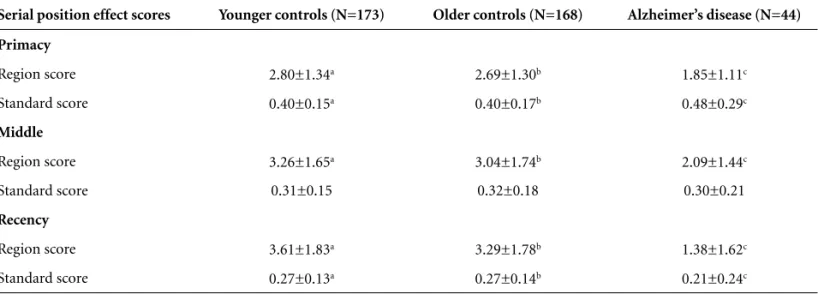
Table 3.Distribution of serial position effect among normal controls and Alzheimer’s disease patients.
Serial position effect scores Younger controls (N=173) Older controls (N=168) Alzheimer’s disease (N=44)
Primacy
Region score 2.80±1.34a 2.69±1.30b 1.85±1.11c
Standard score 0.40±0.15a 0.40±0.17b 0.48±0.29c
Middle
Region score 3.26±1.65a 3.04±1.74b 2.09±1.44c
Standard score 0.31±0.15 0.32±0.18 0.30±0.21
Recency
Region score 3.61±1.83a 3.29±1.78b 1.38±1.62c
Standard score 0.27±0.13a 0.27±0.14b 0.21±0.24c
Primacy – Region score: a,b>c (p=0.0001), Standard score: a,b>c (p=0.030); Middle – Region score: a,b>c (p=0.002); Recency – Region score: a,b>c (p=0.0001), Standard score: a>c (p=0.043).
Statistical Package for the Social Sciences (SPSS for MacOs 11.0) software. Descriptive statistics (mean, SD, and fre-quency) were calculated for demographic data, perform-ance on MMSE and word span. Parametric data were analyzed by one-way ANOVA multivariate procedures. The Chi-square test (with Yates correction or Fisher exact) was used for the association analysis.
Results
The older control group did not differ from the Al-zheimer’s disease patients for age and educational attain-ment, whereas the younger group showed lower mean age and higher education than both the older control and the dementia group (Table 1). Sex distribution was similar across the three groups.
Table 1.Demographic data of sample groups.
Younger controls (N=173)
Older controls (N=168)
Alzheimer’s disease (N=44)
p value*
Age (mean SD) 34.81±10.36a 65.51±7.57b 67.68±6.73c 0.001
Education (mean SD) 9.14±4.88a 6.22±5.014b 6.39±4.05c 0.001
Sex – male (N%) 58 (33.5%) 53 (31.5%) 20 (46%) 0.045
*one-way ANOVA; Age: a<b,c (p=0.0001) – post hoc Tukey test; Education: a>b (p=0.001) and a>c (p=0.007) – post hoc Tukey test; Sex: chi-square=3.039; p=0.219.
Table 2.Word span and Mini Mental State Examination (MMSE; mean±standard deviation): Alzheimer’s disease and normal controls.
Younger controls (N=173)
Normal controls (N=168)
Alzheimer’s disease (N=44)
p value
Word span 5.99±1.27a 5.65±1.75b 2.86±1.42c 0.0001
MMSE 26.59±3.83a 26.31±3.29b 18.85±5.56c 0.0001
Younger individuals scored significantly higher than older controls while both scored higher than Alzheimer’s disease patients on the MMSE and word span (Table 2). Young healthy subjects immediately recalled a mean of 6 words out of ten, old normal individuals retrieved around 5.5 words while AD patients recalled a mean of 3 words.
The most recalled item by all groups was the first word of the 10-item list (Figure 1). Among older normal controls, the first word was retrieved by 90% of partici-pants (N=151), and among younger controls by 96.5% (N=167). However, only 73% (N=32) of the Alzheimer’s disease patients recalled the first item of the list. The sec-ond word was recalled by 65% (N=109) of older and 69.4% (N=120) of younger controls. Only 45.5% (N=20) of the AD group remembered this item.
The scores of serial position effect were standard and region (Table 3). For primacy, younger and older subjects presented better performances – for region and standard scores – than Alzheimer’s disease patients (p = 0.0001 and p=0.030, respectively). For recency, younger and older subjects presented higher region scores than AD patients (p=0.0001), and younger subjects showed significantly better performance than AD patients on standard scores (p=0.043). For the middle region of the list, the region score presented significant differences among groups (younger and older showed higher scores).
The unadjusted mean (SD) correct words recalled for each region is presented in Table 4. For all regions, younger and older subjects retrieved more words than Alzheimer’s patients.
Alzheimer’s disease patients produced a significantly larger proportion of intrusion errors, (32%), followed by younger subjects (16%) (p=0.00001). The older subjects presented the lowest percentage of false recollection (2.4%) (Table 5).
Table 4.Mean±SD of the score for the items composing the regions of the list (primacy, middle and recency regions).
Region scores Younger controls (N=173) Older controls (N=168) Alzheimer’s disease (N=44)
Score for the first 3 items - Primacy region 2.34±0.79a 2.18±0.85b 1.48±0.90c
Score for the 4 middle items - Middle region 1.88±0.99a 1.77±0.97b 0.95±0.71c
Score for the last 3 items - Recency region 1.65±0.79a 1.55±0.85b 0.70±0.79c
First 3 items: a,b>c (p=0.0001); Middle 4 items: a,b>c (p=0.0001); Last 3 items: a,b>c (p=0.0001); Tukey test.
Table 5.Distribution of “intrusion” errors (false positive items recalled).
Items of the list Older controls Younger controls AD patients
“False positive” - N (%) 5 (2.4%) 34 (16.2%) 25 (31.8%)
Actual items - N (%) 164 (97.6%) 145 (83.8%) 30 (68.2%)
Total 169 179 55
Chi-square: 36.28; p=0.00001; OR (Mantel-Haenszel) for all strata: 4.89–95% CL 2.7–8.04.
Discussion
The performance on word span in this immediate free recall paradigm was significantly lower among AD pa-tients than normal controls. The most notable finding was that AD patients from this sample could effectively recall the first three items from the 10-word list, particu-larly the first word. On the other hand, these patients did not remember the final words of the list as well as ex-pected (recency effect) and as reported in many
stud-ies6,23-27.
Distinct serial position profiles have been identified in clinical populations. Many studies on Alzheimer’s pa-tients have showed that serial position recall was
charac-terized by a prominent recency effect6,23-27. The
promi-nent recency effect could be the result of a rapid decay of
information from short-term storage28, which in turn
prevents item rehearsal or transfer of items to long-term storage, according to a dual storage model29.
One study that evaluated patients with major depres-sion alone, major depresdepres-sion with reversible depresdepres-sion- depression-related cognitive dysfunction, and primary dementia and
major depression has suggested different results30.
Pa-tients with MD alone acquired significantly more infor-mation on the California Verbal Learning Test and show-ed a more pronouncshow-ed primacy effect. Item recall of the recency region was equal across the three groups, which was considered surprising by the authors, in that the demented patients did not show the characteristic recen-cy effect.
In the present sample, we observed the primacy effect across groups but not a pronounced recency effect in AD patients. From a practical point of view, if the first words were “kept in mind” the other information was lost. This finding should be taken into account when addressing dementia patients for everyday conversations and deliver-ing information. Usdeliver-ing fewer words (just 3 or 4) and stressing them should provide more effective communi-cation. In our culture wordiness is a very common char-acteristic of communication and it is very difficult for the family members and caregivers to pay attention to the way they communicate with AD patients. To be more effective, we should use fewer words. AD patients can be specifically vulnerable to information overload inherent to a supraspan task, which could be related to the theoret-ical framework of working memory and to the so-called phonological loop for the temporary storage of acoustic or verbal information as well as the so-called central executive responsible for attentional control31.
Alzheimer’s disease patients generated more errors of intrusion than older and younger normal controls, an
observation made by previous investigations30. We also
observed a significant percentage of intrusions among younger controls. Younger adults can show more
subjec-tive organization than older individuals32, which could
lead to occurrence of this proportion of memory errors. Primacy and recency effects are currently believed to reflect the temporal distinctiveness of individual items in
memory representations33-35. When the time interval
be-tween presentation of the list and memory testing is in-creased, the serial position curve changes from a predom-inantly recency to a predompredom-inantly primacy type
func-tion35-38, with cross over on different time scales for
pi-geons, monkeys and humans38. In a study with pigeons,
monkeys and humans, the task for all three species was a
serial-probe-recognition task38. The trials consisted of
pressing down a three-position T lever (monkeys and humans) or pecking on a 9 by 9.3 cm clear window (pi-geons). Lists of color slides were projected one at a time on the upper of two screens. A probe item was projected on the lower screen after a delay (retention interval) from the last list item. If the probe item was a repeat of one of the list items (“same” trial), a correct response by humans or monkeys was a lever movement to the right and by pigeons a peck to a right disk (lighted red). Otherwise (on “different” trials) a left lever movement or a left disk (lighted green) peck was correct. The authors suggested that qualitative similarity implies similar memory mech-anisms. This suggests that changes in serial position curves with retention interval may reflect the temporal organization of information processing in short-term memory. The need remains for more information about cultural differences in serial position effect, because this could be one explanation for the differential finding of pronounced primacy and poor recency effect in AD patients. Nevertheless, further examination of the serial position effect and its relationship to other aspects of cul-ture is clearly warranted.
References
1. Murdock Jr BB. Serial position effect of free recall. J Exp Psychol 1962;64:482-488.
2. Wright RE. Adult age similarities in free recall output order and strategies. J Gerontol 1982;37:76-79.
3. Mitrushina M, Satz P, Chervinsky A, et al. Performance of four age groups of normal elderly on the rey auditory-ver-bal learning test. J Clin Psychol 1991;47:351-357.
4. Petersen RC, Smith G, Kokmen E, et al. Memory function-ing in normal agfunction-ing. Neurology 1992;42:396-401.
com-ponents in word-list forgetting of pure amnesics, degenera-tive demented, and healthy subjects. Cortex 1995;31:735-745.
6. Bayley PJ, Salmon DP, Bondi MW, et al. Comparison of the serial position effect in very mild Alzheimer’s disease, mild Alzheimer’s disease and amnesia associated with electrocon-vulsive therapy. J Int Neuropsychol Soc 2000;6:290-298. 7. Lezak MD. Neuropsychological assessment. 3thed. New
York: Oxford University Press; 1995:366-368.
8. Ceitlin L, Santos B, Parisotto L, Zanatta M, Chaves ML. Elaboration of word lists in Portuguese with emotional con-tent and their influence on memory function in normal subjects. Int J Methods Psychiatr Res 1995;5:195-203. 9. Chaves ML, Izquierdo I. Differential diagnosis between
dementia and depression: a study of efficiency increment. Acta Neurol Scand 1992;85:378-382.
10. Bertolucci PHF, Okamoto.IH, Brucki SM, Siviero MO, Toniolo Neto J, Ramos LR. Applicability of the CERAD neu-ropsycological battery to brazilian elderly. Arq Neuro-psiquiatr 2001;59:532-536.
11. Foldi NS, Brickman AM, Schaefer LA, Knutelska ME. Distinct serial position profiles and neuropsychological measures differentiate late life depression from normal aging and Alzheimer's disease. Psychiatry Res 2003;120:71-84. 12. Buschke H, Sliwinski MJ, Kuslansky G, Katz M, Verghese J,
Lipton RB. Retention weighted recall improves discrimina-tion of Alzheimer's disease. J Int Neuropsychol Soc 2006; 12:436-440.
13. American Psychiatric Association. Diagnostic and Statistical Manual of Mental Disorders DSM-IV, 4th ed. Washington DC: American Psychiatric Association; 1994.
14. McKhann G, Drachman D, Folstein M, Katzman R, Price D, Stadlan EM. Clinical diagnosis of Alzheimer’s disease: report of the NINCDS-ADRDAWork Group under the auspices of the Department of Health and Human Services Task Force on Alzheimer’s disease. Neurology 1984;34:939-944. 15. Morris JC. The clinical dementia rating (CDR): current
ver-sion and scoring. Neurology 1993;43:2412-2414.
16. Maia AL, Godinho C, Ferreira ED, et al. Application of the Brazilian version of the CDR scale in samples of dementia patients. Arq Neuropsiquiatr 2006;64:485-489.
17. McKeith IG, Fairbairn AF, Bothwell RA, et al. An evaluation of the predictive validity and inter-rater reliability of clinical diagnostic criteria for senile dementia of Lewy body type. Neurology 1994;44:872-877.
18. Brun A, Englund B, Gustafson L, et al. Clinical and neu-ropathological criteria for frontotemporal dementia. The Lund and Manchester Groups. J Neurol Neurosurg Psy-chiatry 1994;57:416-418.
19. Pirozzo S, Pa pinczak T, Glasziou P. Whispered voice test for
screening for hearing impairment in adults and children: systematic review. BMJ 2003;327:967-971.
20. Smeeth L, Iliffe S. Community screening for visual impair-ment in older people. J Am Geriatric Soc 2001;49:673-675. 21. Folstein MF, Folstein SE, McHugh PR. Mini-Mental State: a
practical method for grading the cognitive state of patients for the clinician. J Psychiatr Res 1975;12:189-198.
22. Delis DC, Kaplan E, Kramer JH, et al. California Verbal Learning Test-II. 2nd ed. San Antonio, TX: The Psycho-logical Corporation; 2000.
23. Bigler ED, Rosa L, Schultz F, Hall S, Harris J. Rey-Auditory Verbal Learning and Rey-Osterrieth Complex Figure Design performance in Alzheimer’s disease and closed head injury. J Clin Psychol 1989;45:277-280.
24. Delis DC, Massman PJ, Butters N, Salmon DP, Demadura TL. Profiles of demented and amnesic patients on the California Verbal Learning Test: implications for the assessment of memory disorders. J Consult Clin Psychol 1991;3:19-26. 25. Gainotti G, Marra C. Some aspects of memory disorders
clearly distinguish dementia of the Alzheimer’s type from depressive pseudo-dementia. J Clin Exp Neuropsychol 1994; 16:65-78.
26. Gainotti G, Marra C, Villa G, Parlato V, Chiarotti F. Sen-sitivity and specificity of some neuropsychological markers of Alzheimer’s dementia. Alzheimer Dis Assoc Disord 1998;12:152-162.
27. Bäckman L, Small BJ. Influences of cognitive support on episodic remembering: tracing the process of loss from nor-mal aging to Alzheimer’s disease. Psychol Aging 1998;13: 267-276.
28. Kopelman MD. Rates of forgetting in Alzheimer-type dementia and Korsakoff ’s syndrome. Neuropsychologia 1985;23:623-638.
29. Atkinson RC, Shiffrin RM. Human memory: a proposed system and its control processes. In: Spence KW, Spence JI, editors. The psychology of learning and motivation: ad-vances in research and theories. New York: Academic Press; 1968:89-195.
30. Hill CD, Stoudemire A, Morris R, Martino-Saltzman D, Markwalter HR. Similarities and differences in memory in patients with primary dementia and depression-related cog-nitive dysfunction. J Neuropsychiatry Clin Neurosci 1993; 5:277-282.
31. Cherry BJ, J. Buckwalter JG, Henderson VW. Better preser-vation of memory span relative to supraspan immediate recall in Alzheimer’s disease. Neuropsychologia 2002;40: 846-852.
33. Baddeley AD, Hitch G. The recency effect: Implicit learning with explicit retrieval. Mem Cognit 1993;21:146-155. 34. Glenberg AM. Temporal context and recency. In: Gorfein
DS, Hoffman RR, editors, Memory and learning: The Ebbinghaus Centennial Conference. Hillsdale, NJ: Erlbaum; 1987:173-190.
35. Neath I. Distinctiveness and serial position effects in recog-nition. Mem Cognit 1993;21:689-698.
36. Korsnes MS, Magnussen S, Reinvang I. Serial position effects in visual short-term memory for words and abstract spatial designs. Scand J Psychol 1996;37:62-73.
37. Korsnes SM, Gilinsky AS. Aging and serial-list picture mem-ory. Percept Mot Skills 1993;76:1011-1014.