Cognitive rehabilitation of neuropsychological
deficits and mild cognitive impairment
A review of the literature
Eliane Correa Miotto
1,
Valéria Trunkl Serrao
2, Gláucia Benutte Guerra
3,
Mara Cristina Souza de Lúcia
4, Milberto Scaff
5Abstract – Neuropsychological rehabilitation is related to the treatment or optimization of disabilities, handi-caps and cognitive deficiencies including emotional, behavioral and personality alterations, aiming at the best cognitive, neurobiological and social re-adaptation. Objective: The main aim of this paper is to review scientific studies published over the last five years on cognitive training with rehabilitation, focusing on elderly subjects with cognitive complaints and patients diagnosed with MCI. Methods: Data were generated from Medline, PsychoInfo
and EMBASE including publications from 2002 to 2007 using the search terms “Mild Cognitive Impairment”, “Cognitive Complaints”, ”Rehabilitation” and “Intervention Studies”. Data collection criteria were restricted to the quality of evidence Class I. Results: Eight articles out of sixty eight previously selected were chosen because of their randomized studies, including techniques of cognitive rehabilitation in patients with cognitive complaints, MCI and neuropsychological training. Conclusions: The studies showing generalization of rehabilitation techniques to practical real life situations and use of an errorless learning approach were considered more effective in terms of maintaining treatment follow up, although further studies are recommended.
Key words: mild cognitive impairment, neuropsychological rehabilitation, cognitive training.
Reabilitação cognitiva de déficits neuropsicológicos e transtorno cognitivo leve: revisão da literatura Resumo – A reabilitação cognitiva se ocupa do tratamento e otimização das incapacidades, desvantagens e deficiências cognitivas, bem como de alterações emocionais, comportamentais e de personalidade. Visa a melhor readaptação neuropsicológica, neurobiológica e social. Objetivo: Realizar revisão literária sobre os estudos cientí-ficos publicados nos últimos cinco anos em reabilitação cognitiva, em sujeitos com queixas cognitivas e pacientes idosos diagnosticados com TCL. Métodos: As informações foram obtidas nas bases de dados Mediline, PsychoInfo e EMBASE com recomendações baseadas na qualidade de evidência Classe I. Resultados: Foram encontrados 68 artigos. Destes, selecionados oito, por caracterizarem estudos randomizados, incluir técnicas de reabilitação cognitiva em pacientes com queixas cognitivas e TCL e por documentarem avaliações neuropsicológicas. Con-clusões: As pesquisas que demonstraram técnicas de reabilitação com abordagens capazes de generalização para as atividades práticas da vida e uso da abordagem aprendizagem sem erro se mostraram mais efetivas quanto à manutenção no seguimento, contudo, são necessários estudos mais detalhados.
Palavras-chave: transtorno cognitivo leve, reabilitação neuropsicológica e treino cognitivo.
1Clinical Director of the Division of Psychology, Hospital das Clinicas, University of São Paulo, Brazil. 2Post-Graduate Student in Clinical
Neuropsychol-ogy, Hospital das Clinicas, University of São Paulo, Brazil. 3Research Director of the Division of Psychology, Hospital das Clinicas, University of São Paulo,
Brazil. 4Director of the Psychology Division, Hospital das Clínicas, University of São Paulo, Brazil; 5 Professor of the Neurology Department, Hospital das
Clínicas, University of São Paulo, Brazil.
Eliane Correa Miotto – Division of Psychology and Department of Neurology / Hospital das Clinicas / University of Sao Paulo - Av. Dr Enéas de Carvalho Aguiar, 155 - 05403-000 São Paulo SP - Brazil. E-mail: [email protected]
Received March 24, 2008. Accepted in final form May 20, 2008.
Due to the growth in the elderly population over recent decades, an increase in the number of degenerative diseases including dementia has been documented. Consequently, an increasing number of non-pharmacological treatments aimed at cognitive improvement have emerged,1 particularly
because these deficits are the first to appear, affecting mem-ory, behavior alterations and loss of functional activities.2
Mild Cognitive Impairment (MCI)3 has been widely
studied in the international literature4 as a response to the
in Mild Cognitive Impairment5 recommends the
assess-ment of complex instruassess-mental activities and a variety of cognitive functions including memory, attention, executive functions, praxis, language and visuo-perception abilities for differential diagnosis. In particular, an objective mem-ory impairment and/or other cognitive impairment must also be present to characterize MCI.6 This decline should
be confirmed by the person, family, and by neuropsycho-logical evaluation which enables cognitive alterations to be identified at a very early stage.
Several studies have reported that the earlier the identifi-cation of the MCI subtype and beginning of therapy, the bet-ter the results concerning the improvement in cognition.7,8
The clinical and pharmacological interests have grown be-cause of the high possibility of the development of demen-tia. In an attempt to better understand this process9 some
practical guidelines have been proposed by some studies.10
A Canadian study11 performed over a period of five
years, showed that the prevalence of MCI varied between 1.03 to 3.02%, with the criteria of loss of memory or im-paired daily activities not being used. There was an increase in the risk of death, institutionalization and development of dementia (mainly Alzheimer Disease – A.D.) at the end of follow up, demonstrating the importance of evaluating and monitoring patients with MCI.12 The annual conversion rate
to A.D. was approximately 10 to 15%, representing an in-creased subgroup to develop this dementia syndrome, par-ticularly those who presented MCI of multiple domains.13
Additional exams for diagnosis such as neuroimaging exams are not yet specific for A.D. and have not been vali-dated in MCI detection. Discussions on this issue remain pertinent since the concept of MCI has only recently been and neuropathological data are limited.14
Since there is no cure or reversal of neurological dete-rioration caused by dementia, the available pharmacologi-cal and non-pharmacologipharmacologi-cal treatments try to minimize the speed of progression of the symptoms, especially those related to memory difficulties. Among non-pharmacologi-cal treatments, the rehabilitation of cognitive deficits or neuropsychological rehabilitation are highlighted.9,14-18
Most neuropsychological interventions include the treatment or adjustment of emotional and behavioral alter-ations in addition to cognitive, neurobiological and social readaptation.19 In this context, a broad comprehension of
the concept and objectives of neuropsychological rehabili-tation should include the following aspects:20 (1)
rehabilita-tion conducted together with the patients with brain lesion, their family members and a multi-professional team; (2) before any rehabilitation program is started it is necessary to identify realistic goals of treatment; (3) the neuropsy-chological interventional programs should address the cog-nitive deficits, as well as the emotional and psychological
problems; (4) the compensation of difficulties have been widely benefited by technological advance; (5) the reha-bilitation treatment should go beyond the outpatient clinic or private consulting room and address real life difficul-ties in ‘real environments’; (6) like any other area of study, neuropsychological rehabilitation needs a theoretical base that includes models and methods from different areas. Over the past thirty years, the literature has described a number of memory rehabilitation techniques, including compensatory and restorative techniques. However, there are few neuropsychological techniques based on theoreti-cal models. One such model, Goal Management Training (GMT) developed by Robertson (1996)21 was derived from
theories of executive function particularly from Duncan’s (1995)22 theory of goal neglect. In this technique, patients
are trained to ‘stop and think’ about various problems and goals before and during the performance of a task. They are also trained to use a ‘mental blackboard’ or working memory to keep track of what they are doing and check if it matches their original goal.
Another technique, Errorless Learning (EL), prevents people from making mistakes when learning new informa-tion or a new skill. This procedure is based on the noinforma-tion that without proper declarative memory that enables one to remember and then correct errors or learning through trial and error, error prevention should be adopted (Bad-deley & Wilson, 1994).23 It has been suggested that
error-less learning works through implicit memory, normally preserved in severe memory disorders and in amnesics. In cases of partial preservation of episodic memory, it works by strengthening explicit memory.
Recently, a number of studies have included computer-ized cognitive training (CCT) in their neuropsychological re-habilitation program aimed at stimulating specific cognitive functions such as memory, attention, language or executive functions. These computer programs include Smartbrain (www.educamigos.com), the Training Neuropsicológico di Mario (TNP) software24,25 used to stimulate specific cognitive
functions26 and other programs still undergoing investigation.
Various studies using cognitive training focusing on mem-ory, attention, language or executive deficits27 have suggested
that it is possible to improve some of these cognitive deficits.28
However, only a few studies addressed the rehabilitation of these cognitive deficits in elderly patients with MCI and cognitive deficits. This article aimed to perform a literature review over the last five years on cognitive training in elderly patients with cognitive complaints or diagnosed with MCI.
Methods
Neuropsychological Rehabilitation, Cognitive Training and Cognitive Rehabilitation” were included as main descrip-tors, in Portuguese or English. The selected publications were restricted to the quality of evidence Class I – studies using randomized and controlled groups. Class II – non-randomized and non-controlled group studies and class III – case studies were not included.29 According to guidelines
from the American Academy of Neurology, “Class I studies have a lower risk of bias than class II or III studies”.29,30
Results
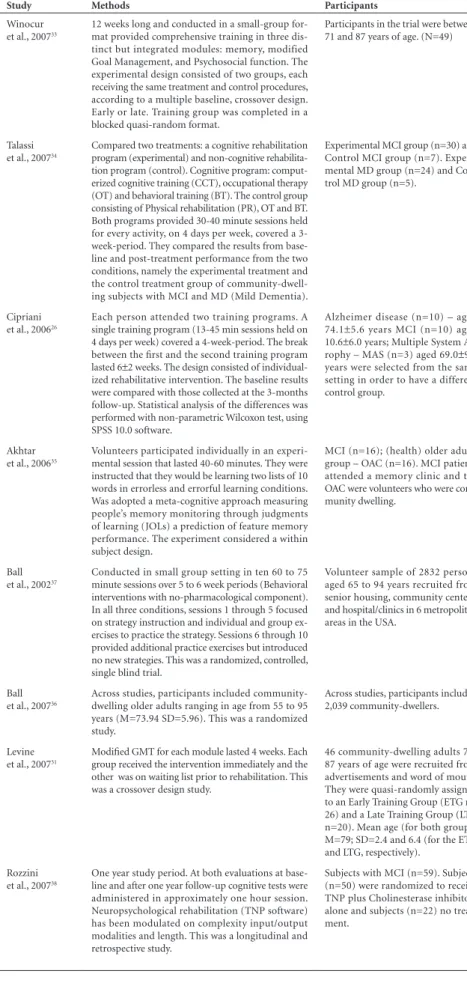
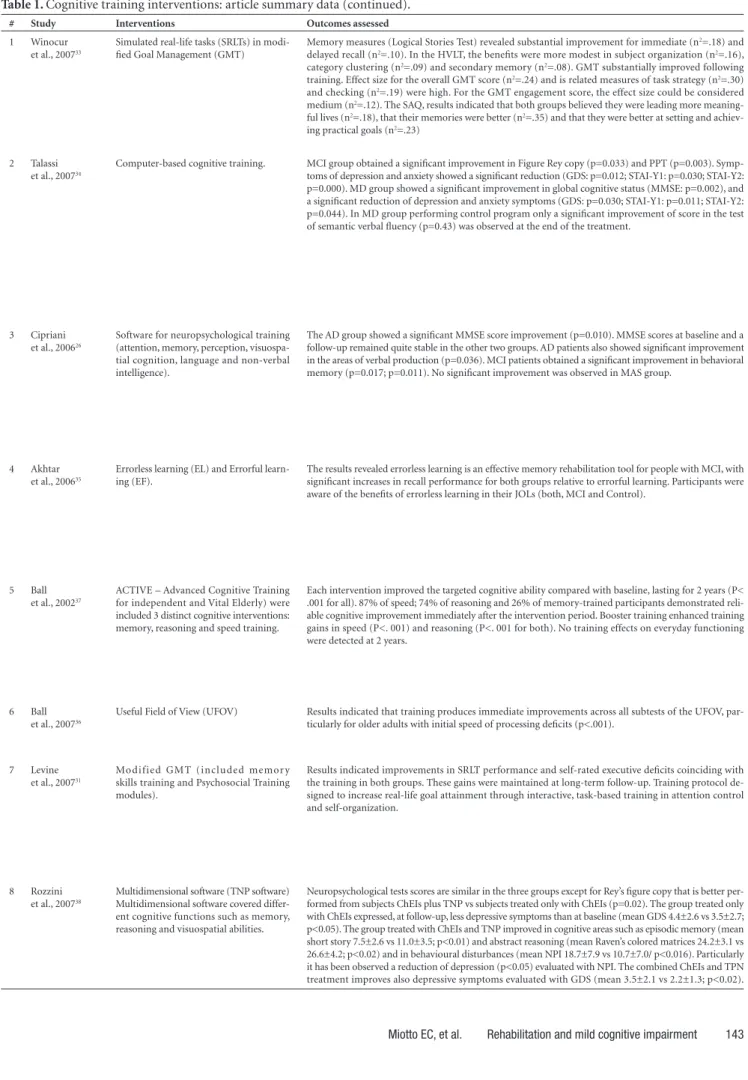
Amongst the 68 articles found, eight were selected and are characterized in Table 1. These are randomized con-trolled studies with techniques of cognitive rehabilitation in elderly subjects with memory complaints or MCI.
Levine et al.31 and Winocur et al.32 described the
cog-nitive rehabilitation of elderly subjects with memory complaints over a period of twelve weeks. Focusing on a modular training program, two groups of elderly subjects (Group 1 N=29 and Group 2 N=20, average age 79 years, SD=2.4 years) with memory complaints received a neuro-psychological rehabilitation program based on three mod-ules. Three subjects were excluded due to technical reasons. The first module, named Memory Skills Training focused on how to use the external and internal strategies to learn, retain and retrieve the information including diaries and notes. The second, the Modified Goal Management Train-ing – GMT33 trained subjects to plan and organize fictitious
and real life activities breaking down complex tasks into small and simple steps while monitoring the outcome. The third, Psychosocial Training aimed at psychosocial well-be-ing enhancwell-be-ing self-confidence and trust in their cognitive abilities. Each module lasted 4 weeks and the two groups of elderly subjects received the 3 modules in separate peri-ods. The results indicated an improvement in real-life tasks and on a self-reported questionnaire (DEX) after the three-module program in both groups. There was also evidence of some generalization to practical situations. The limita-tion of these studies included the reduced sample, the need to better refine the program of training and adaptation of the protocol to address other cognitive deficits.31,32
Talassi et al. (2007)34 assessed the effectiveness of a
structured cognitive rehabilitation program based on computer cognitive training of neuropsychological and behavioral difficulties and functional status in a group of elderly subjects with MCI (N=30) and mild dementia (MD, N=24). This program was compared to a control condi-tion where subjects received physical rehabilitacondi-tion, occu-pational therapy and behavioral training. The experimental cognitive rehabilitation program consisted of three activi-ties: computerized cognitive training (CCT), occupational therapy (OT) and behavioral training (BT). The CCT used
the TNP software24,25 to stimulate each cognitive function
addressing groups of exercises; the OT stimulated the pa-tients to reproduce or simulate basic activities of daily liv-ing and the BT treated mood disorders with behavioral therapy. The control group received either physical reha-bilitation (PR), OT or BT. Each group had a 30-40 minute session held for every activity, 4-days a week for a 3-week period. The results indicated that systematic rehabilitation with the computer training program showed an improve-ment in constructive apraxia, visuospatial recall, functional status and mood in the MCI group. The group with MD also showed an improvement on global cognitive func-tion assessed by the MMSE and mood. The control group showed no significant improvement.
Cipriani et al.26 investigated the outcome of a
com-puter-based cognitive training program in patients with MCI (N=10), Alzheimer’s disease (AD, N=10) and mul-tiple system atrophy (MSA, N=3). Each patient attended two training programs with an interval of 4-8 weeks. The sessions lasted for 13-45 minutes over 4 days per week dur-ing a 4-week-period. The computer program was the same as mentioned in the previous study by Talassi et al.34 They
used a modified version of the NPT software which aimed to stimulate attention, memory, perception, visuospatial abilities, language and non-verbal intelligence. Patients were assessed before and after 3 months at the end of the second training program. The MCI group improved on memory test score and the AD group improved on verbal fluency, ex-ecutive functions and on MMSE scores. The MSA group did not show any changes in scores before and after treatment. The data from this research suggest that TNP can be used in specific groups of patients with memory impairment al-though no generalization effects were described.
Akhtar et al.35 adopted the “Errorless learning”– EL
ap-proach, i.e. learning without making mistakes, in patients with MCI (N=16). The results indicated that this technique was an effective tool showing significant improvements in the recall of a list of words in comparison to Errorful learn-ing (EF). An important aspect considered in this study was the fact that in the group with memory impairment, the rehabilitation allowed for effective learning of new infor-mation by deploying this paradigm (EL).
Ball et al. (2007)36 combined data from six studies using
Table 1. Cognitive training interventions: article summary data.
# Study Methods Participants Assessment battery
1 Winocur
et al., 200733
12 weeks long and conducted in a small-group for-mat provided comprehensive training in three dis-tinct but integrated modules: memory, modified Goal Management, and Psychosocial function. The experimental design consisted of two groups, each receiving the same treatment and control procedures, according to a multiple baseline, crossover design. Early or late. Training group was completed in a blocked quasi-random format.
Participants in the trial were between 71 and 87 years of age. (N=49)
Logical Stories Test; Hopkins Verbal Learning Test; Self-assessment questionnaire – (SAQ).
2 Talassi
et al., 200734
Compared two treatments: a cognitive rehabilitation program (experimental) and non-cognitive rehabilita-tion program (control). Cognitive program: comput-erized cognitive training (CCT), occupational therapy (OT) and behavioral training (BT). The control group consisting of Physical rehabilitation (PR), OT and BT. Both programs provided 30-40 minute sessions held for every activity, on 4 days per week, covered a 3-week-period. They compared the results from base-line and post-treatment performance from the two conditions, namely the experimental treatment and the control treatment group of community-dwell-ing subjects with MCI and MD (Mild Dementia).
Experimental MCI group (n=30) and Control MCI group (n=7). Experi-mental MD group (n=24) and Con-trol MD group (n=5).
Mini Mental State Examination (30-item); Forward and backward digit span; Phonemic and semantic verbal fluency; Sub-test for episodic memory of Riv-ermead behavioral memory test; Visual Search; Digit Symbol test; Rey complex figure copy and recall, and Clock-drawing test. Geriatric Depression Scale (GDS-30); State-trait anxiety inventory (Stai-Y1 and Stai-Y2) and Neuropsychiatric inventory (NPI). Physical Perfor-mance test (PPT), Basic ADL (BADL) and Instrumental ADL (IADL). Caregiver burden inventory (CBI).
3 Cipriani
et al., 200626
Each person attended two training programs. A single training program (13-45 min sessions held on 4 days per week) covered a 4-week-period. The break between the first and the second training program
lasted 6±2 weeks. The design consisted of
individual-ized rehabilitative intervention. The baseline results were compared with those collected at the 3-months follow-up. Statistical analysis of the differences was performed with non-parametric Wilcoxon test, using SPSS 10.0 software.
Alzheimer disease (n=10) – aged
74.1±5.6 years MCI (n=10) aged
10.6±6.0 years; Multiple System
At-rophy – MAS (n=3) aged 69.0±9.5
years were selected from the same setting in order to have a different control group.
MMSE and the following tests: phonemic and seman-tic verbal fluency (cued verbal production); visual search (sustained attention), trail making test A/B (vi-sual search, attention and executive functions); digit symbol test (psychomotor learning), and Rivermead behavioral memory test (behavioral memory). GDS; Advanced activity of daily living (AADL); State anxiety (STAI-X1) and trait anxiety (STAI-X2) and short form health survey (SF-12)
4 Akhtar
et al., 200635
Volunteers participated individually in an experi-mental session that lasted 40-60 minutes. They were instructed that they would be learning two lists of 10 words in errorless and errorful learning conditions. Was adopted a meta-cognitive approach measuring people’s memory monitoring through judgments of learning (JOLs) a prediction of feature memory performance. The experiment considered a within subject design.
MCI (n=16); (health) older adults group – OAC (n=16). MCI patients attended a memory clinic and the OAC were volunteers who were com-munity dwelling.
CAMCOG, MMSE, NART, CERAD (word-learning list).
5 Ball
et al., 200237
Conducted in small group setting in ten 60 to 75 minute sessions over 5 to 6 week periods (Behavioral interventions with no-pharmacological component). In all three conditions, sessions 1 through 5 focused on strategy instruction and individual and group ex-ercises to practice the strategy. Sessions 6 through 10 provided additional practice exercises but introduced no new strategies. This was a randomized, controlled, single blind trial.
Volunteer sample of 2832 persons aged 65 to 94 years recruited from senior housing, community centers, and hospital/clinics in 6 metropolitan areas in the USA.
MMSE; SF-36 physical function.
6 Ball
et al., 200736
Across studies, participants included community-dwelling older adults ranging in age from 55 to 95 years (M=73.94 SD=5.96). This was a randomized study.
Across studies, participants included 2,039 community-dwellers.
Useful Field of View Test (UFOV); Digit Symbol copy; Letter comparison; Patter comparison; Stroop; Trails B; Road Sign test; Rey-O Immediate Memory; Benton Visual Retention and Pelli-Robson Contrast Sensitivity.
7 Levine
et al., 200731
Modified GMT for each module lasted 4 weeks. Each group received the intervention immediately and the other was on waiting list prior to rehabilitation. This was a crossover design study.
46 community-dwelling adults 71-87 years of age were recruited from advertisements and word of mouth. They were quasi-randomly assigned to an Early Training Group (ETG n= 26) and a Late Training Group (LTG n=20). Mean age (for both groups) M=79; SD=2.4 and 6.4 (for the ETG and LTG, respectively).
Simulated real life tasks (SRLTs) and Dysexecutive questionnaire (DEX).
8 Rozzini
et al., 200738
One year study period. At both evaluations at base-line and after one year follow-up cognitive tests were administered in approximately one hour session. Neuropsychological rehabilitation (TNP software) has been modulated on complexity input/output modalities and length. This was a longitudinal and retrospective study.
Subjects with MCI (n=59). Subjects (n=50) were randomized to receive TNP plus Cholinesterase inhibitors alone and subjects (n=22) no treat-ment.
Table 1. Cognitive training interventions: article summary data (continued).
# Study Interventions Outcomes assessed
1 Winocur
et al., 200733
Simulated real-life tasks (SRLTs) in modi-fied Goal Management (GMT)
Memory measures (Logical Stories Test) revealed substantial improvement for immediate (n2=.18) and
delayed recall (n2=.10). In the HVLT, the benefits were more modest in subject organization (n2=.16),
category clustering (n2=.09) and secondary memory (n2=.08). GMT substantially improved following
training. Effect size for the overall GMT score (n2=.24) and is related measures of task strategy (n2=.30)
and checking (n2=.19) were high. For the GMT engagement score, the effect size could be considered
medium (n2=.12). The SAQ, results indicated that both groups believed they were leading more
meaning-ful lives (n2=.18), that their memories were better (n2=.35) and that they were better at setting and
achiev-ing practical goals (n2=.23)
2 Talassi
et al., 200734
Computer-based cognitive training. MCI group obtained a significant improvement in Figure Rey copy (p=0.033) and PPT (p=0.003).
Symp-toms of depression and anxiety showed a significant reduction (GDS: p=0.012; STAI-Y1: p=0.030; STAI-Y2: p=0.000). MD group showed a significant improvement in global cognitive status (MMSE: p=0.002), and a significant reduction of depression and anxiety symptoms (GDS: p=0.030; STAI-Y1: p=0.011; STAI-Y2: p=0.044). In MD group performing control program only a significant improvement of score in the test of semantic verbal fluency (p=0.43) was observed at the end of the treatment.
3 Cipriani
et al., 200626
Software for neuropsychological training (attention, memory, perception, visuospa-tial cognition, language and non-verbal intelligence).
The AD group showed a significant MMSE score improvement (p=0.010). MMSE scores at baseline and a follow-up remained quite stable in the other two groups. AD patients also showed significant improvement in the areas of verbal production (p=0.036). MCI patients obtained a significant improvement in behavioral memory (p=0.017; p=0.011). No significant improvement was observed in MAS group.
4 Akhtar
et al., 200635
Errorless learning (EL) and Errorful learn-ing (EF).
The results revealed errorless learning is an effective memory rehabilitation tool for people with MCI, with significant increases in recall performance for both groups relative to errorful learning. Participants were aware of the benefits of errorless learning in their JOLs (both, MCI and Control).
5 Ball
et al., 200237
ACTIVE – Advanced Cognitive Training for independent and Vital Elderly) were included 3 distinct cognitive interventions: memory, reasoning and speed training.
Each intervention improved the targeted cognitive ability compared with baseline, lasting for 2 years (P< .001 for all). 87% of speed; 74% of reasoning and 26% of memory-trained participants demonstrated reli-able cognitive improvement immediately after the intervention period. Booster training enhanced training gains in speed (P<. 001) and reasoning (P<. 001 for both). No training effects on everyday functioning were detected at 2 years.
6 Ball
et al., 200736
Useful Field of View (UFOV) Results indicated that training produces immediate improvements across all subtests of the UFOV,
par-ticularly for older adults with initial speed of processing deficits (p<.001).
7 Levine
et al., 200731
Modified GMT (included memor y skills training and Psychosocial Training modules).
Results indicated improvements in SRLT performance and self-rated executive deficits coinciding with the training in both groups. These gains were maintained at long-term follow-up. Training protocol de-signed to increase real-life goal attainment through interactive, task-based training in attention control and self-organization.
8 Rozzini
et al., 200738
Multidimensional software (TNP software) Multidimensional software covered differ-ent cognitive functions such as memory, reasoning and visuospatial abilities.
those with speed of processing deficits. In addition, age and education had little to no impact on training gains and the participants maintained these gains for at least 2 years.
In another study, Ball et al. (2002)37 investigated
wheth-er cognitive training intwheth-erventions improved mental abili-ties and daily functioning in elderly, independent-living adults with memory complaints. The 2832 participants aged 65 to 94 years’ old and were recruited from six met-ropolitan areas in the United States. Each intervention improved the targeted cognitive ability compared with baseline over two years. Three distinct cognitive interven-tions were used: memory, reasoning and speed training. Participants received instructions regarding strategies or mnemonic rule, and individual exercises or group feedback about their performance. They were trained to organize word lists with images and mental associations in order to recall them. The exercises involved laboratory memory tasks (e.g. recalling a list of nouns) as well as memory tasks related to cognitive activities of everyday life (e.g. remem-bering a shopping list). Reasoning training focused on the ability to solve problems in a serial pattern. Speed-of-pro-cessing training focused on visual search skills and ability to identify and locate visual information quickly in a di-vided-attention format. The results suggested that the cog-nitive training interventions improved targeted cogcog-nitive abilities in an effective way. However, no training effects on everyday functioning were detected after two years.
Subjects diagnosed with MCI who were submitted to neuropsychological training associated to cholinesterase inhibitors (ChEIs),38 achieved in the long term, cognitive
improvement in memory, abstract reasoning and humor. It was evident that the combined treatment produced poten-cializing effects in the reduction of memory deterioration and in the delay of conversion from MCI to AD. Since there was no longer-term follow-up in this study, it was not pos-sible to observe the presence of deterioration or whether the effect of improvement was associated with the training or resulted from a possible synergy between the cholines-terase inhibitors and neuropsychological training.
Discussion
The aim of this study was to review the benefits of cog-nitive rehabilitation techniques in patients with cogcog-nitive complaints and MCI.
Cognitive training has been based on theories that sup-port the use of specific techniques in order to optimize cog-nitive functioning (e.g. mnemonic techniques) in individu-als with cognitive impairments and MCI, and to slow the rate of cognitive decline and handicap in daily life activities.
The main findings of the studies included in this review suggest that neuropsychological rehabilitation is recommend-ed for patients with cognitive complaints, MCI and pre-clin-ical dementia which employ the Errorless Learning strategy.
Clare et al.39,40 suggested that awareness by the
partici-pants in terms of their potential and limitations leads to significant benefits from the rehabilitation techniques.
Another issue raised by the studies is the fact that pro-grams of cognitive rehabilitation do not necessarily provide generalization from a controlled environment into every-day life situations. Even if there were transfer of the ben-eficial effects to daily activities, these would be restricted to a limited number of tasks. There are only few Class I studies in the literature on cognitive rehabilitation of these subjects and one of the reasons is the fact that there are few techniques including computerized training programs available, and also because this is a relatively new area in comparison to the rehabilitation of patients with AD.
Nevertheless, the implementation of rehabilitation pro-grams with this population should be based on knowledge of the disease process, identifying the preserved and im-paired abilities and handicaps. Knowledge of the most ap-propriate techniques to be applied for specific difficulties is also key, as is focusing on an errorless learning approach and always considering the carers as an integral part of the treatment receiving information and emotional support. It is also necessary to identify the consequences of cognitive impairment to daily life activities, since the goal of neuro-psychological rehabilitation is not an improvement in the performance of cognitive tests but rather an improvement in quality of life of the patients, family members and caregivers.
References
1. IBGE: Estimativas anuais e mensais da população do Brasil e das unidades da federação: 1980-2020. Metodologias Esti-mativas das populações municipais. Acessado em 28/11/2007. http://www.ibge.gov.br/brasil_em_sintese/default.htm. 2. Ávila R, Miotto E. Reabilitação Neuropsicológica de déficits
de memória em pacientes com demência de Alzheimer. Rev Psiq Clin 2002;29:190-196.
3. Petersen RC, Smith GE, Waring SC, et al. Mild cognitive im-pairment: Clinical characterization and outcome. Arch Neu-rol 1999;56:303-308.
4. Petersen RC, Doody R, Kurz A, et al. Current concepts in mild cognitive impairment. Arch Neurol 2001;58:1985-1992. 5. Petersen, RC. Mild cognitive impairment as a diagnostic
en-tity. J Intern Med 2004; 256:183-194.
6. American Psychiatric Association. Diagnostic and Statistical Manual of Mental Disorders. 4th Ed. Washington, DC: Ameri-can Psychiatric Association; 1994.
7. De Vreese LP, Neri M, Fioravanti M, BelL OI, Zanetti O. Mem-ory rehabilitation in Alzheimer’s: a Review of Progress. Int J Geriatr Psychiatry 2001;16:794-809.
8. Larrieu S, Letenneur L, Orgogozo JM, et al. Incidence and outcome of mild cognitive impairment in a population-based prospective cohort. Neurology 2002;59:1594-1599.
cogni-tive impairment - MCI Conference Paper. Int Psychogeriatr 2008;20:57-66.
10. Artero S, Ritchie K. The detection of Mild Cognitive Impairment in the general practice setting. Aging Ment Health, 2003;7:251-258. 11. Fisk JD, Merry HR, Rockwood K. Variations in case definition
affect prevalence but not outcomes of mild cognitive impair-ment. Neurology 2003;61:1179-1184.
12. Bottino CMC, Moreno MDPQ. Comprometimento cogni-tivo leve: Critérios diagnósticos e validade clínica. In: Bottino CMC, Laks J, Blay SL, editores. Demência e transtornos cog-nitivos em idosos. Rio de Janeiro: Guanabara Koogan; 2006. 13. Morris LC, Storandt M, Miller JP, et al. Mild cognitive impair-ment represents early-stage Alzheimer disease. Arch Neurol 2001;58:397-405.
14. Boyle PA, Wilson RS, Aggarwal NT, Tang Y, Bennett DA. Mild cognitive impairment: Risk of Alzheimer disease and rate of cognitive decline. Neurology 2006;67: 441-445.
15. Pérès K, Chrysostome V, Fabrigoule C, Orgogozo JM, Dar-tigues JF, Barberger-Gateau P. Restriction in complex activi-ties of daily living in MCI – Impact on outcome. Neurology 2006;67:461-466.
16. Belleville S, Gilbert B, Fontaine F, Gagnon L, Ménard É, Gauthier S. Improvement of episodic memory in persons with mild cognitive impairment and healthy adults: evidence from a cognitive intervention program. Dement Geriatr Cogn Disord 2006;22:486-499.
17. Perrotin A, Belleville S, Isingrini M. Metamemory monitoring in mild cognitive impairment: Evidence of a less accurate episod-ic feeling-of-knowing. Neuropsychologia 2007;45:2811-2826. 18. Portet F, Ousset PJ, Visser PJ, et al. Mild Cognitive Impairment (MCI) in medical practice: a critical review of the concept and new diagnostic procedure. Report of the MCI Working Group of the European Consortium on Alzheimer’s Disease. J Neurol Neurosurg Psychiatry 2006;77:714-718.
19. Wilson BA. Reabilitação das Deficiências Cognitivas, In: Ni-trini R, Caramelli P, Mansur LL, editores. Neuropsicologia das Bases Anatômicas à Reabilitação. São Paulo, Clínica Neu-rológica HC-FMUSP; 1996.
20. Wilson BA. Avanços recentes em reabilitação neuropsicológi-ca. In: Miotto EC, Lúcia MCS, Scaff M, editores. Neuropsico-logia e as Interfaces com as Neurociências – São Paulo: Casa do Psicólogo; 2007.
21. Robertson I.H. Goal Management training: A clinical manual. Cambridge, UK: PsyConsult; 1996.
22. Duncan J. Attention, Intelligence, and the frontal lobes, In: Gazzaniga MS, editor. The cognitive neurosciences. Cam-bridge, MA: MIT press; 1995.
23. Baddeley AD, Wilson BA. When implicit learning fails: amne-sia and the problem of error elimination. Neuropsychologia 1994;32: 53-68.
24. Tonetta M. II TNP, un software che opera in ambiente Win-dows. Atti del 4 Convegno Nazionale Informatica, Didattic e Disabilità. Napoli, (in Italian); 1995.
25. Tonetta M. Riabilitazione neuropsicológica e TNP (training neuropsicológico). Aspetti teorici e pragmatici. New Maga-zine Publisher, Trento (in Italian); 1998.
26. Cipriani G, Bianchetti A, Trabucchi M. Outcomes of a com-puter-based cognitive rehabilitation program on Alzheim-er’s disease patients compared with those on patients af-fected by mild cognitive impairment. Arch Gerontol Geriatr 2006;43:327-335.
27. Ala TA, Berck G, Popovich AM. Using the telephone to call for help and caregiver awareness in Alzheimer disease. Alzheimer Dis Assoc Disord 2005;19:79-84.
28. Salloway S, Correia S, Richardson S. Key lessons learned from short-term treatment trials of cholinesterase inhibitors for amnestic MCI. Int Psychogeriatr 2008;20:40-46.
29. American Academy of Neurology – Clinical Practice Guide-line Process Manual. Approved by the AAN Board of Direc-tors January, 2004.
30. Brainin A, Barnes M, Baron JC, et al. Guidance for the prepa-ration of neurological management guidelines by EFNS sci-entific task forces – revised recommendations 2004. Eur J Neurol 2004;11:577-581.
31. Levine B, Stuss DT, Winocur W, et al. Cognitive rehabilitation in the elderly: Effects on strategic behavior in relation to goal management. J Int Neuropsychol Society 2007;13:143-152. 32. Winocur G, Craik FIM, Levine B, et al. Cognitive
rehabili-tation in the elderly: Overview and future directions. J Int Neuropsychol Society 2007;13:166-171.
33. Levine B, Robertson IH, Clare L, et al. Rehabilitation of executive functioning: An experimental-clinical validation of Goal Man-agement Training. J Int Neuropsychol Society 2000;6:299-312. 34. Talassi E, Guerrecshi M, Feriani M, Fedi V, Bianchetti A, Trabuc-ci M. Effectiveness of a cognitive rehabilitation program in mild dementia (MD) and mild cognitive impairment (MCI): a case control study. Arch Gerontol Geriatr 2007;44(Suppl 1):391-399. 35. Akhtar S, Moulin CJA, Bowie PCW. Are people with mild cognitive impairment aware of the benefits of errorless learn-ing? Neuropsychol Rehabil 2006;16:329-346.
36. Ball K, Edwards JD, Ross LA. The impact of speed of process-ing trainprocess-ing on cognitive and everyday functions. J Gerontol B Psychol Sci Soc Sci 2007; 62B:19-31.
37. Ball K, Berch DB, Helmers KF, et al. Effects of cognitive train-ing interventions with older adults: A randomized controlled trial. J Am Med Assoc 2002;288:2271-2281.
38. Rozzini L, Costardi D, Chilovi VB, Franzoni S, Trabucchi M, Padovani A. Efficacy of cognitive rehabilitation in patients with mild cognitive impairment treated with cholinesterase inhibitors. Int J Geriatr Psychiatry 2007;22:356-360. 39. Clare L, Woods RT. Cognitive training and cognitive
reha-bilitation for people with early-stage Alzheimer’s disease: A review. Neuropsychol Rehabil 2004;14:385-401.