Textual reading comprehension and
naming in Alzheimer’s disease patients
Juciclara Rinaldi
1, Gabriela Sbardelloto
2,
Christian Haag Kristensen
3, Maria Alice de Mattos Pimenta Parente
4Abstract – Among linguistic-cognitive failures, the retelling of stories and lexical disorders occur from the onset of AD. Recent studies have discussed whether lexical failures in AD patients include naming actions. Objectives: The aims of this study were to verify naming and reformulation of action difficulties in AD patients and their relationship with the retelling of stories. Our main questions were: Are there two linguistic abilities impaired in the early stages of AD? Is there some correlation between the capacity of naming actions and the retelling of stories? Methods: We assessed 28 elderly participants: 17 with probable AD and 11 control subjects, with school-ing ≥4 years. The textual reading comprehension was measured using four stories with descriptive and narrative textual structure. The lexical production was verified by 17 actions on video, assessed by the participants’ first and second verbal emissions. Results: The results showed that the retelling of stories is a task that discriminates patients with AD from healthy individuals. The naming and reformulation of actions tasks did not show signifi-cant differences among the patients and their controls. A positive correlation was found between the difficulties in retelling stories and the reformulation of the naming of actions. Conclusions: These results confirm previous findings that show the preservation of naming actions in patients with AD, which involve familiar actions, and that the retelling of short stories is an instrument that discriminates patients with AD from healthy elders. Re-sults also suggest that the difficulties in retelling are related a breakdown in reformulating information, perhaps stemming from mechanisms of decreased memory work.
Key words: Alzheimer’s, textual comprehension, lexical production, memory, language.
Leitura e compreensão textual nomeando pacientes com doença de Alzheimer
Resumo – Entre as falhas lingüísticas, o reconto de histórias e os problemas lexicais ocorrem desde o início da DA. Estudos recentes têm discutido se as falhas lexicais nos pacientes com DA incluem a nomeação de ações. Objetivos: Os objetivos deste estudo foram verificar as dificuldades de nomeação e reformulação de ações em pa-cientes com DA e sua relação com o reconto de histórias. As principais questões que nortearam esse estudo foram: As duas habilidades lingüísticas estão prejudicadas no início da DA? Há alguma correlação entre a capacidade de nomeação de ações e de reconto de histórias? Métodos: Foram avaliados 28 idosos: 17 com DAs prováveis e 11 sem demência, com escolaridade ≥4 anos. A compreensão de leitura textual foi avaliada através de quatro histórias com estrutura textual descritiva e narrativa. A nomeação foi verificada por 17 ações em vídeo, tendo primeira e segunda emissão para cada participante. Resultados: Os resultados mostraram que o reconto de histórias é uma tarefa que discrimina pacientes com DA de idosos normais; já as tarefas de nomeação e de reformulação de ações não apresentaram diferenças significativas entre os pacientes e seus controles. Foi encontrada uma correlação positiva entre as dificuldades de reconto de histórias e a reformulação da nomeação de ações. Conclusões: Esses resultados confirmam achados anteriores que mostram a preservação da nomeação de ações em pacientes com DA, nas ações familiares e que o reconto de histórias curtas é um instrumento que discrimina pacientes com DA de idosos normais. Também sugerem que as dificuldades de reconto estão relacionadas a falhas de reformulação de informações, talvez oriundas de mecanismos de memória de trabalho diminuída.
Palavras-chave: Alzheimer, compreensão textual, produção lexical, memória, linguagem.
1MSc in Psychology, Universidade Federal do Rio Grande do Sul, Porto Alegre RS, Brasil. 2BSc in Psychology, Universidade Federal do Rio Grande do Sul,
Por-to Alegre RS, Brasil. 3PhD, Pontifícia Universidade Católica do Rio Grande do Sul. 4PhD, Universidade Federal do Rio Grande do Sul, Porto Alegre RS, Brasil.
Christian Haag Kristensen – Programa de Pós-Graduação em Psicologia / Pontifícia Universidade Católica do Rio Grande do Sul - Av. Ipiranga, 6681 / Prédio 11 / Sala 936 - 90619-900 Porto Alegre RS - Brasil. E-mail: [email protected].
The cognitive functions of language and memory are compromised in the initial stages of Alzheimer’s disease (AD). Among the language tasks that are impaired in the initial stages of AD are the understanding of textual read-ing and lexical production. The difficulties in understand-ing textual readunderstand-ing in these patients are known to be at-tributed to cognitive flaws, such as those involving episodic memory, short term memory (working memory) and at-tention, found early in the disease. Reports from1-4 outline
that the elderly without dementia remember more items of information than those with dementia. These studies show that the retelling of stories is an accurate procedure to discriminate the disease.5 On the other hand, lexical
dif-ficulties, verified through the naming of pictures, have been said to be due to flaws in the lexical access or to semantic memory flaws. As the studies about linguistics disturbances in patients with AD have focused on these two activities separately, little is known about how these lexical difficul-ties interfere in the retelling of stories.
The understanding of contextual reading demands a variety of abilities from the language beholder, such as codification of text information, ability to retain the ideas read, search of textual coherence and narrative reproduc-tion. Different models have been proposed in order to understand how people comprehend a text, taking into consideration the constructive process the reader performs during textual comprehension.6 Labov and Waletzky7
pres-ent a structural model for narratives. These are composed of five parts called macrocategories. The narrative starts with the orientation and situation macro category, inform-ing the reader where, when, who and the situation (what); moving on to complication, that presents a series of events. Subsequently, the complication macrocategory introduces an event (following an action) and a problem, which will be solved or ended by the resolution macrocategory. Between complication and resolution lies the evaluation macrocat-egory that compares narrative units within the same struc-ture. The resolution macrocategory ends the actions, while some narratives have one more macrocategory, the conclu-sion of the story offering a summary of what happened. No studies were found verifying whether one of these macrocategories hampers comprehension of stories for pa-tients with AD. Nevertheless, studies on papa-tients with AD have shown that the kind of textual structure may facilitate comprehension, as evidenced in the comparative study be-tween patients with AD and elderly patients without de-mentia, in which the participants have to retell 4 stories, 2 narrative and 2 descriptive.3 Within the perspective of the
model,7 the descriptions are texts with a predominance of
the first macrostructure, the situation/orientation compo-nent. In a study by Gély-Nargeot, Ska and Touchon,3 not
only the patients with AD but also those without dementia presented a better performance when the structure was of a narrative. These authors also verified that more detailed versions, that is, more redundant, improve the comprehen-sion of patients with AD. On the other hand, the results have shown that remembering, not only the main idea but also the details, decreases with the severity of the dementia, although in spite of this overall worsening, the main ideas are retained for longer than the details. The worsening of dementia, thus, besides impacting the story recall in pa-tients with dementia, led them to remembering the main idea of the text over and above the details.8-9
Two models have proposed that text comprehension is a complex activity, with the participation of cognitive func-tions. Kintsch and van Dijk10 focused on the participation
of short term memory (working memory) and long term memory (episodic memory) for textual comprehension. Due to the limited capacity of the short term memory, it is important to select the macrostructures of the text, that is, identify the main idea and discard the microstructures (de-tails).11-12 Comprehension is performed in cycles, sent to the
episodic memory, to build a base text. On the other hand,13
the relationship between cause and consequence of the events are emphasized in the text. According to this model, the comprehension of the narrative is stored in the long term memory (semantic memory) as a network, and the nodes of this net (sentences in the text) are interconnected by the causative relations.14 Under this model, the
possi-bility of creating inferences, based on the four criteria of casual relation is important. Furthermore, the same model assumes that comprehension is based on the possibility of solving problems, and is not concerned about memory.
Retelling a story is not reproducing it word by word. Memory mechanisms retain the plot or the script and a variety of significant units of the story. The latter are called propositions. Each proposition is formed by an argument and a predicate. The argument corresponds to an action (verb) and the predicate may be who performs the action, suffers its consequences, etc. The nucleus of the narrative information is, thus, based on the actions and it is possible that the retelling of stories is related to the patient’s capac-ity of naming these actions.
Studies on the lexical difficulties of patients with AD have shown dissociation in the flaws in naming actions and objects. From the neuroanatomic point of view, there is evidence that various areas are responsible for the process-ing of these two word classes. While common and proper nouns are processed by posterior and temporal regions, verbs are represented in frontal circuits.15-16 Some
dissociation.17 Tyler, Russell, Fadili Cappa18 also found an
extensive area of semantic processing that extends from the inferior frontal cortex up to the temporal lobe of the same side, with no grammatical class differentiation of words.
Comparing the task of naming of actions and objects performed by patients with AD versus patients with front temporal dementia (FTD),19 has shown that both groups
were worse in naming compared to their controls in both classes, while patients with FTD were significantly better at naming objects compared to patients with AD. Overall, maintaining the ability to name actions with difficulties in naming objects is explained by the anatomical organi-zation, since in the early stages of AD the posterior areas responsible for naming objects are more affected than the anterior ones, responsible for naming actions.
Another study group found the opposite pattern where verbs were more affected than nouns.20-23 This pattern is
explained through the semantic characteristics of the verbs. Verbs are more complex, less imaginable and more abstract. This work intends to fill a gap in the literature concern-ing the lconcern-inguistic difficulties of patients with AD, studyconcern-ing the same group of participants for the capacity of retell-ing a story, namretell-ing verbs and retellretell-ing with namretell-ing pro-duction (reformulation task). Based on previous studies, patients with AD are expected to perform worse on both tasks than their controls. Given the action is an extremely important feature to the information units of a narrative, one expects to find a correlation between the retelling tasks and naming of actions.
Methods
Twenty-eight aged native speakers of Brazilian-Portu-guese participated in this study (8 males and 20 females). Patients fulfilled the DSM-IV criteria for dementia24 and
the NINCDS-ADRDA for probable AD,25 as well as the
Clinical Dementia Rating scale – CDR.26 The Mini Mental
State Examination (MMSE) was also applied,27-28 and
pa-tients with scores between 24 and 27 were included in the group of mild AD, whereas patients with scores between 12 and 24 were included in the moderate group. Cognitively
normal individuals were selected from within the com-munity and only those with scores greater than 27 on the MMSE were selected. All subjects were submitted to the GDS-1529,30 scale, and those with scores lower than 10 were
included in this study. Other criteria for inclusion were: schooling greater than four years, lack of history of any psychiatric or neurological disease, and visual or hearing impairment without correction. Table 1 shows the demo-graphic characteristics of subjects in the three groups.
Materials and procedures
Two experimental tasks were selected for this study: a reading comprehension task and a verb naming task.
Reading comprehension task
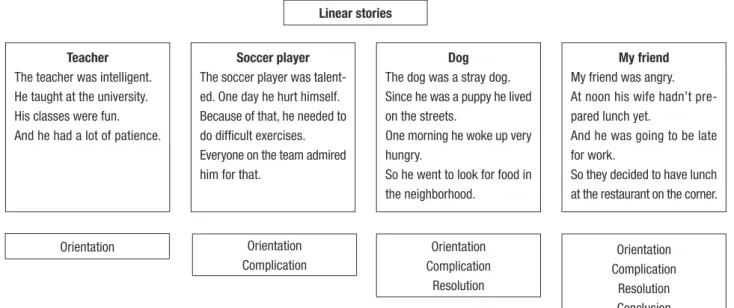
Four stories, each composed by four sentences were presented visually to the participants in a presentation on a computer. Four macro-categories were controlled in the construction of the stories. The first story had only the situation/orientation category, and thus was similar to a description. The second story had situation/orientation and complication; the third situation/orientation, compli-cation and resolution and the fourth, all four categories7
(Figure 1). The computer presentation was controlled by the E-Prime Program. A dark blue notebook screen (17”) showed the first sentence in the upper part in white let-ters. In the lower part, the following sentence was writ-ten in yellow. The participant was instructed to read the sentence and when finished to hit a key on the computer. The following sentence appeared in the upper screen. After reading the four sentences the participants were asked to retell the story. The patient’s recall was recorded and later transcribed. For each story, participants received a score of percentage of the number of propositions recalled that were similar to those presented in the original story.
Verb naming and reformulation tasks
A verb naming task was elicited by the presentation of 17 different short videos. In each film, the same sound indi-cated the beginning of the movie. A red curtain opened and
Table 1. Mean±SD demographic characteristics of Alzheimer’s disease patients and normal elderly subjects.
Variables
Normal elderly (n=11)
Mild Alzheimer’s patients
(n=8)
Moderate Alzheimer’s patients
(n=9)
All Alzheimer’s patients
(n=17)
Age (years) 78.27±6.51 76.75±6.76 80.13±4.49 78.44±5.80
Education (years) 8.00±3.64 7.88±3.64 7.00±1.85 7.44±2.83
MMSE (maximum=30) 27.55±1.44 21.63±1.19 15.67±1.32 18.47±3.30
Gender (male/female) 3/8 4/4 1/8 5/12
a masquerade woman walked towards a table where several objects were displayed. She selected a different object each time and performed an action of destruction or separation of the object. For example, a balloon was burst with her hand or a doll was undressed. Videos were presented indi-vidually in Windows Media Player format, and the length of each film varied from 42sec to 1min 13sec.31 Films
were shown to participants in a random order (Table 2). At the end of the action, the examiner asked participants “What has the woman done?”
The reformulation task followed the naming task. After naming, the examiner asked “Tell me what the woman has done using another word.” All answers were tape-recorded and subsequently written down. Each response was clas-sified according to: 1 - Conventional response: a response with a verb where the verb was considered, from a semantic and pragmatic point of view, to belong to the semantic domain of the action shown in the film. 2 - Non-conven-tional responses: were those verbs that showed a semantic relationship to the action in the film, but their use was not accepted as adequate for the linguistic community to denote the action depicted in the film. Three independent raters scored all verbs produced by the participants. The fi-nal score was obtained by intra-rater agreement. The study was approved by the Ethics Committee for Research. Par-ticipants or their guardians consented to participate before enrolling on the study.
Statistical analyses
Descriptive statistics (mean, SD, and relative frequency) were calculated for demographic data, MMSE, verb naming and data and text scores (score of each story, mean score of the four stories and the best remembered story).The Kruskall-Wallis test was used for comparison of the three groups. Spearman’s rho correlation coefficients were calcu-lated for correlations between MMSE, text scores and verb naming and reformulation data. The statistical analysis was carried out by the Statistical Package for the Social Sciences for Windows (SPSS 11).
Linear stories
Teacher The teacher was intelligent. He taught at the university. His classes were fun. And he had a lot of patience.
Soccer player The soccer player was talent-ed. One day he hurt himself. Because of that, he needed to do difficult exercises. Everyone on the team admired him for that.
Dog The dog was a stray dog. Since he was a puppy he lived on the streets.
One morning he woke up very hungry.
So he went to look for food in the neighborhood.
My friend My friend was angry. At noon his wife hadn’t pre-pared lunch yet.
And he was going to be late for work.
So they decided to have lunch at the restaurant on the corner.
Orientation Orientation
Complication
Orientation Complication
Resolution
Orientation Complication
Resolution Conclusion
Figure 1. Stories and macrocategories used in textual reading comprehension.
Table 2. Number of film, verbs, objects and actions of the naming and reformulation of actions tasks.
Action
To peel a slice of a tree trunk
To blow up a balloon
To peel a banana
To peel a carrot
To partially rip the sleeve of a shirt
To tear a newspaper in half
To break a glass with a hammer
To dismantle a small Lego castle
Partially peel an orange
To cut a loaf of bread in half with a bread knife
To screw up a sheet of paper
To saw a board in half
To undress a doll
To squash a tomato with a slap
To break a loaf of bread in half with the hands
To crumble a toasted loaf of bread
Results
Are there group differences in naming and reformulation tasks of actions?
Descriptive statistics of naming action and reformula-tion tasks of AD patients and their controls are shown in Table 3. On naming task and reformulation tasks, no sta-tistically significant effects were observed for comparisons between AD and their controls (naming: Kruskall-Wallis test, chi-square=0.974; p=0.324; reformulation: Kruskall-Wallis test, chi-square=0.688; p=0.407). Also, no significant differences were found between mild and moderate AD patients in both naming and reformulation tasks (naming: Kruskall-Wallis test, chi-square=.096; p=0.757; reformula-tion: Kruskall-Wallis test, chi-square=1.033; p=0.309)
Are there group differences in text recall?
To study text recall, we obtained six different scores: one score that corresponded to the mean recall of the four texts; one score of the story best recalled by each subject, and four individual scores that express the recall of each text. Table 4 shows their means and standard deviations. Performance on text recall differed significantly between AD patients and their controls in all six measures (mean recall score Kruskall-Wallis test, chi-square=16.942; p<.001; best recalled story Kruskall-Wallis test, chi-square=15.918; p<.001; descriptive story Kruskall-Wal-lis test, chi-square=12.590; p<.001; story ended in the complication Kruskall-Wallis test, chi-square=11.194; p=.001; the story ended in the resolution Kruskall-Wallis test, chi-square=12.012; p=.001; and story with all nar-rative elements Kruskall-Wallis test, chi-square=15.918; p<.001). Controls’ scores were significantly better than mild AD in all text measures (mean recall score Kruskall-Wallis test, chi-square=14.142; p<.001; best recalled story Kruskall-Wallis test, chi-square=14.392; p<.001; descrip-tive story Kruskall-Wallis test, chi-square=12.017; p<.001; story ended in the complication Kruskall-Wallis test, chi-square=11.829; p=.001; the story ended in the resolu-tion Kruskall-Wallis test, chi-square=12.674; p=.001; and
story with all narrative elements Kruskall-Wallis test, chi-square=13.743; p<.001). Comparison between Mild and Moderate AD patients showed significant differences in the mean recall score (Kruskall-Wallis test, chi-square=6.750; p=.009), in the best recalled story (Kruskall-Wallis test, chi-square=5.572; p=.18) in the descriptive story (Kruskall-Wallis test, chi-square=4.580; p=.32), in the story with all narrative elements (Kruskall-Wallis test, chi-square=4.793; p=.29), and in the story ended in the resolution (Kruskall-Wallis test, chi-square=4.464; p=.035). No differences were found in the recall of the story ended in the complication (Kruskall-Wallis test, chi-square=1.494; p=.222).
Does MMSE correlate with naming verbs and text recall measures?
Significant correlations were found between MMSE and all six text recall measures (MMSE and mean text recall score, Spearman rho=.822; MMSE and descriptive text re-call score, Spearman rho=0.759; p<0.001; p<0.001; MMSE and text recall score of the story ended in complication, Spearman rho=0.728; p <0.001; MMSE and text recall score of the story ended in resolution, Spearman rho=0.751; p<0.001; MMSE and text recall score of the story with all narrative macrostructures, Spearman rho=0.753; p< 0.001). No correlation was found between MMSE and nam-ing or reformulation tasks (namnam-ing, Spearman rho=214 p=0.274; reformulation, Spearman rho=0.363 p=0 .278). Table 3. Mean ±SD in naming actions and in reformulation task scores of Alzheimer’s disease (AD) patients and normal elderly subjects.
Naming actions
Reformulation tasks
Effect Mean±SE Mean±SE
Mild AD patients 15.50±0 .92 10.87±4.45 Moderate AD patients 15.22±1.09 8.11±5.44 All AD patients 15.35±1.00 9.41±5.05 Controls 15.64±1.20 11.36±2.54
Table 4. Mean±SD in all text recall scores of Alzheimer’s disease (AD) patients and normal elderly subjects.
Scores
Mild AD Mean±SE
Moderate AD Mean±SE
All AD Mean±SE
Do text measures correlate with naming action score measures?
As shown in Table 5, no correlations were found among naming action and all text recall scores, but significant correlation was found between reformulation of naming action and the best story recalled (Spearman rho=0.953; p<0.001), the descriptive story (Spearman rho=0.480; p=0.011) and the story ended in complication (Spear-man rho=0.620; p= 0.001). No correlation was found be-tween naming action and reformulation task (Spearman rho=0.620; p=0.001).
Discussion
Our results showed that the retelling of stories is a task that discriminates patients with AD from healthy elders. In all the measurements obtained, the AD patients remem-bered significantly fewer propositions than their controls. This difference was found even among patients with mild AD and healthy elders. Among the elders with moderate AD and those with mild AD, only one story did not yield a significant difference. The results also show that even in very short stories, cognitive impairment measured by MMSE, is associated with the difficulty of common
retell-ing in the elderly. Therefore, further studies involvretell-ing a greater population of patients with AD could describe dif-ferent levels of abilities according to mental decline, im-proving the communicative diagnosis of these patients.
As this text is a set of inter-related meanings, some results can evidence a degree of semantic influence. Our work did not evidence a major preservation of the nar-rative structure over the descriptive. Perhaps due to the control of the size of the sentences and the fact that the de-scriptive text was short and having the qualities of a teacher that could be summarized in one topic only, “the teacher was good”. The information became redundant, making memorization easy. On the other hand, factors related to the familiarity of the story could explain the good perfor-mance of the moderate AD patients compared to the mild AD, in the story that ended in complication. This story was about a domestic dog and its general meaning was frequently retold by the patients with moderate AD.
The naming of actions and their reformulation did not present any difficulties for our patients with AD. These two tasks did not inter relate with the scores on the MMSE. In relation to the correlation between the tasks of naming and textual retelling, only the reformulation task showed a Table 5. Spearman correlations between naming action, reformulation task and text retelling scores.
Naming Reformulation
Mean text retelling Descriptive story Story ended in complication Story ended in resolution Story with 4 macro categories
Reformulation rho p n
0.328 0.089 28
Mean text retell rho p n 0.127 0.519 28 0.053 28
Descriptive story rho p n 0.000 1.000 27 0.480(*) 0.011 27 0.918(**) 0.000 27
Story ended in complication rho p n 0.314 0.111 27 0.620(**) 0.001 27 0.897(**) 0.000 27 0.820(**) 0.000 27
Story ended in resolution rho p n 0.047 0.817 27 0.076 0.708 27 0.914(**) 0.000 27 0.738(**) 0.000 26 0.668(**) 0.000 26 Story with macroestructures rho p n 0.123 0.532 28 0.170 0.386 28 0.939(**) 0.000 28 0.783(**) 0.000 27 0.788(**) 0.000 27 0.853(**) 0.000 27
Story best retold rho p n 0.088 0.655 28 0.457(*) 0.015 28 0.953(**) 0.000 28 0.931(**) 0.000 27 0.908(**) 0.000 27 0.814(**) 0.000 27 0.843(**) 0.000 28
positive correlation with the best told story by the partici-pants. These results indicate the preservation of the naming of actions in patients with AD, at least for fairly familiar actions and when a wide aspect of conventional answers is considered (for example, for the action of sawing wood, besides the verb to saw, the verb to cut and to divide were also considered conventional). Is it possible that patients with AD use more generic verbs as a strategy to compen-sate for the semantic impairment?21
The correlation between the reformulation task and three scores of story retelling indicates that one of the pro-cesses involved in the difficulty in retelling for patients with AD is the process of reformulating textual information. Upon retelling, the individual looks for words associated to the meanings of the story and then reformulates it seeking to maintain the same meaning. This process likely involves mechanisms of working memory, which is very impaired in the early stages of AD.
This work has shown that the retelling of stories, even short ones, is compromised in patients with mild and mod-erate AD. The same does not hold however with tasks of naming and reformulation of actions. On the other hand, retelling of texts linked to the reformulation task, indicat-ing that among the difficulties these patients encounter in retelling texts, flaws occur in reformulating the information of a text which is heard or read.
From a clinical point of view, the retelling of short sto-ries seems to be an instrument able to discriminate pa-tients with AD from healthy elders. Future studies should establish performance levels according to the severity of the disease, enriching the diagnosis and body of knowledge on the communicative capacity of this patient group.
References
1. Braver TS, Satpute AB, Rush BK, Racine CA, Barch DM. Con-text processing and conCon-text maintenance in healthy aging and early stage dementia of the Alzheimer’s type. Psychol Aging 2005;20:33-46.
2. Chapman SB, Zientz J, Weiner M, Rosenberg R, Frawley W, Burns MH. Discourse changes in early Alzheimer disease, mild cognitive impairment, and normal aging. Alzheimer Dis Assoc Disord 2002;16:177-186.
3. Gély-Nargeot M, Ska B, Touchon J. Text structure and content modulate the recall of patients with dementia of the Alzheim-er’s type. Brain Cogn 2002;48:371-375.
4. Parente MAMP, Kieling CC, Rinaldi J, Holderbaum CS. The impact of the interactivity of the hypertext in the recall of aged and of Alzheimer’s patients. Revue Parole, Bruxelas 2004;29/30:189-216.
5. Orange JB, Kertesz A. Discourse analyses and dementia. Brain Lang 2000;71:172-174.
6. Bonini A. Reflexões em torno de um conceito psicolingüístico de tipo de texto. DELTA 1999;15:301-318.
7. Labov W, Waletzky J. Narrative analysis: Oral versions of person-al experience. In: J Helm, editor. Essays on the verbperson-al and visuperson-al arts. Seattle, USA: University of Washington Press; 1967:12-44. 8. Hudon C, Belleville S, Gély-Nargeot MC, Souchay C, Chert-kow H. Memory for gist and detail information in Alzheim-er’s disease and mild cognitive impairment. Neuropsychology 2006;20:566-577.
9. Johnson DK, Storandt M, Balota DA. Discourse analysis of logical memory recall in normal aging and in dementia of the Alzheimer type. Neuropsychology 2003; 17:82-92. 10. Kintsch W, van Dijk TA. Toward a model of text
comprehen-sion and production. Psychol Rev 1978;85:363-394. 11. De Salles J, Parente MAMP. Compreensão textual em alunos
de segunda e terceira séries: uma abordagem cognitiva. Estu-dos de Psicologia 2004;9:71-80.
12. Fávero L, Koch IV. Lingüística textual: Introdução. São Paulo, Brasil: Cortez Editora; 2005.
13. Trabasso T, van den Broek P. Causal thinking and the repre-sentation of narrative events. J Mem Lang 1985;4:612-630. 14. Trabasso T, van den Broek P, Suh S. Logical necessity and
transitivity of causal relations in stories. Discourse Processes 1989;32:1-25.
15. Miceli G, Silveri M, Villa G, Caramazza A. On the basis for the agrammatic’s difficulty in producing main verbs. Cortex 1984;20:207-220.
16. Damasio A, Tranel D. Nouns and verbs are retrieved with differently distributed neural systems. Neurobiology 1993;90: 4957-4960.
17. Perani D, Cappa S, Schnur T, et al. The neural correlates of verb and noun processing: a PET Study. Brain 1999;122:2337-2344. 18. Tyler L, Russell, R, Fadili J, Cappa H. The neural representation of nouns and verbs: PET Studies. Brain 2001;124:1619-1634. 19. Cappa SF, Binetti G, Pezzini A, Padovani A, Ruzzini L,
Tra-bucci M. Object and action naming in Alzheimer’s disease and frontotemporal dementia. Neurology 1998;50:351-355. 20. Bushell CM, Martin A. Automatic semantic priming of nouns
and verbs in patients with Alzheimer disease. Neuropsycho-logia 1997;35:1059-1067.
21. Kim M, Thompson CK. Verb deficits in Alzheimer’s disease and agrammatism: implications for lexical organization. Brain Lang2004;88:1-20.
22. Robinson K, Grossman M, White-Devine T, D’Esposito M. Category-specific difficulty naming with verbs in Alzheimer’s disease. Neurology 1996;47:178-182.
24. American Psychiatry Association. Diagnostic Criteria from DSM-IV. Washington, 1994.
25. McKhann G, Drachman D, Folstein M, Katzman R, Price D, Stadlan E M. Clinical diagnosis of Alzheimer’s disease: Report of the NINCDS-ADRDA Work Group under the Auspices of Departament of Health and Human Services Task Force on Alzheimer’s Disease. Neurology 1984;34:939-944.
26. Hughes CP, Berg L, Danziger WL, Coben LA, Martin RL. A new clinical scale for the staging of dementia. Br J Psychiatry 1982;140:566-572.
27. Folstein MF, Folstein SE, McHugh PR. Mini-Mental State: A practical method for grading the cognitive state of patients for the clinician. J Psychiatr Res 1975;12:189-198.
28. Chaves MLF, Izquierdo I. Differential diagnosis between de-mentia and depression: A study of efficiency increment. Acta Neurol Scand1992;85:378-382.
29. Yesavage JA, Brink TL, Rose TL, et al. Development and vali-dation of a geriatric depression screening scale: a preliminary report. J Psychiatr Res1983;17:37-49.
30. Almeida O, Almeida S. Reliability of the Brazilian version of the ++abbreviated form of Geriatric Depression Scale (GDS) short form. Arq Neuropsiquiatr 1999;57:421-426.