Abstract—ChemCad 6.5.6 simulation package has been used
to study the effect of light hydrocarbons (n-C5 to n-C10) on the
effective diffusivity of reactants in solid catalyst during the conversion of waste vegetable oils (WVO) into biodiesels in presence of methanol. The WVO was simulated as a mixture of triolein and oleic acid. The results suggest that light hydrocarbons significantly lower the reaction medium viscosity and consequently improve reactants diffusivity in the catalyst. Comparisons based on the same hydrocarbon-to-WVO ratio suggest that short-chain hydrocarbons are more effective in lowering the reaction medium viscosity than hydrocarbons with long carbon chain.
Index Terms— Biodiesel, Diffusivity, Light hydrocarbons,
Waste vegetable oil
I. INTRODUCTION
HE conversion of waste vegetable oils into biodiesel is an attractive process since it is based on cheap feedstock. However, this process is still confronted with a number of challenges that are still part of research topics in the scientific community. WVO usually possess high contents of free fatty acids which can undergo saponification in the presence of a homogeneous base catalyst [1] such as sodium hydroxide, potassium hydroxide, etc. This complicates downstream biodiesel purification processes. To avoid this side reaction, a number of options can be considered. For example homogeneous acid catalyzed reactions can be adopted but have low reactants conversion rates [2]. For industrial application, they will require bigger reactors, and consequently higher capital costs. A second option could be to use two-step processes where the free fatty acids contained in the WVO are first converted to biodiesel using an acid catalyst followed by transesterification using a homogeneous base catalyst [3]. With the addition of new processing steps, this option will results in an increase of both capital and operating cost. Studies on the use of solid catalysts have also been reported in literature [4-7]. They do not require additional reaction steps and make product purification simpler but still suffer
Manuscript received July 13, 2015; revised August 16, 2015. This work was supported in part by the National Research Foundation (NRF) and the Faculty of Engineering and the Built Environment at the University of Johannesburg.
K. Jalama is the Department of Chemical Engineering, University of
Johannesburg, South Africa (corresponding author, e-mail:
[email protected], phone: +27-11-559-6157).
from low conversion rates at low temperatures. The various approaches to improve the activity of solid catalyst at low to moderate temperatures include new catalyst formulation and strategies of reducing mass transfer resistance in the catalyst as the pores are filled with liquid during the reaction. One of the expressions for effective diffusivity, Deff, of solute molecules in pores filled with liquid was reported by Ternan [8].
P D Deff b
1
1 2
(1)
Where Db is the bulk diffusivity, λ the molecule to pore size ratio and P a fitting parameter that was calculated to be 16.26 for organic molecules in a silca-alumina catalyst. If the properties of liquids inside the pores and the catalyst are assumed unchanged, Deff is proportional to Db [9]. In the case of a transesterification reaction in a batch reactor, these assumptions can be justified at the start of the reaction where the pores are mainly filled with reactants and solvent (if added) before significant amounts of products are formed. Based on the above assumptions, equation 1 can be re-written as:
b eff mD
D 1 (2) Where m1 is the proportionality constant given by
P m
1
1 2
1 (3)
A number of correlations for diffusivities in liquid systems have been reported in literature [10-16].
At a given temperature, the bulk molecular diffusivity for a solute-solvent pair only depends on the viscosity of the medium as shown by the Stokes-Einstein equation below [9].
. Const T
D (4)
This equation suggests that the bulk diffusivity increases when the viscosity of the medium decreases. It is possible to improve the effective diffusivity in a solid catalyst by lowering the viscosity of the reaction medium by adding an appropriate solvent. Therefore, the aim of this study is to investigate the effect of light liquid hydrocarbons (C5 – C10)
Effective Diffusivity in Solid Catalysts for the
Conversion of Waste Vegetable Oils into
Biodiesel: Part 1-Effect of Light Hydrocarbons
as Co-solvent
Kalala JalamaT
Proceedings of the World Congress on Engineering and Computer Science 2015 Vol II WCECS 2015, October 21-23, 2015, San Francisco, USA
ISBN: 978-988-14047-2-5
ISSN: 2078-0958 (Print); ISSN: 2078-0966 (Online)
addition to WVO during conversion to biodiesel in presence of methanol on the effective diffusivity in a solid catalyst.
II.METHODOLOGY
This study has been performed using ChemCad 6.5.6 simulation package and Microsoft Excel. The WVO has been simulated by a mixture of triolein (95 wt.%) and oleic acid (5 wt.%). Methanol to WVO molar ratio of 6:1 was used and the light hydrocarbons (C5 to C10) amount added to the reacting system was varied as hydrocarbon-to-WVO molar ratios of 0.5, 2, 5, 10, 15, 20 and 25 respectively. All the components used in this study were available in the simulator database. Temperatures from 100 to 150oC were considered. In order to keep methanol and the added light hydrocarbons in liquid phase over the whole range of temperature selected, a system pressure of 45 bar was selected. NRTL was selected as property model for simulation. All binary interaction parameters (BIP) were imported from ChemCad simulation package.
III. RESULTS AND DISCUSSION
Fig. 1 shows individual viscosities for methanol and simulated WVO over a temperature range of 100 to 200oC. The data show that the viscosity of WVO is significantly higher compared to that of methanol. For example at 100oC, the estimated WVO viscosity was ca. 7.5 compared to 0.26
cP for methanol. This value significantly decreases as the temperature is increased and reaches ca. 2.7 cP at 200oC while the corresponding viscosity for methanol decreases to ca. 0.15 cP. A proper mixing of the two reactants must be pursued in order to reduce mass transfer limitations in the system.
0 1 2 3 4 5 6 7 8
90 110 130 150 170 190 210
Vis
cosit
y
[c
P]
Temp [oC]
Methanol WVO
Fig. 1 Simulated methanol and WVO viscosity as function of temperature
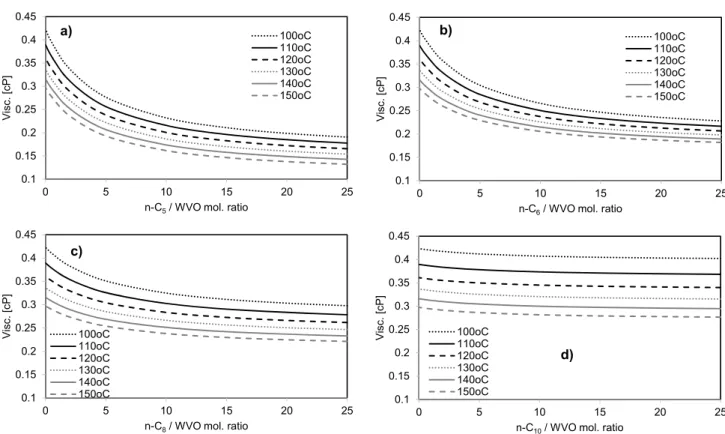
Fig. 2 summarizes the effect of light hydrocarbons on the reacting medium viscosity as function of temperature and hydrocarbon-to-WVO molar ratio.
0.1 0.15 0.2 0.25 0.3 0.35 0.4 0.45
0 5 10 15 20 25
Vi
sc.
[cP]
n-C5/ WVO mol. ratio
100oC 110oC 120oC 130oC 140oC 150oC
0.1 0.15 0.2 0.25 0.3 0.35 0.4 0.45
0 5 10 15 20 25
Vi
sc.
[cP]
n-C6/ WVO mol. ratio
100oC 110oC 120oC 130oC 140oC 150oC
0.1 0.15 0.2 0.25 0.3 0.35 0.4 0.45
0 5 10 15 20 25
Vi
sc
. [c
P]
n-C8/ WVO mol. ratio
100oC 110oC 120oC 130oC 140oC
150oC 0.1
0.15 0.2 0.25 0.3 0.35 0.4 0.45
0 5 10 15 20 25
Vi
sc
. [c
P]
n-C10/ WVO mol. ratio
100oC 110oC 120oC 130oC 140oC 150oC
a)
d) c)
b)
Fig. 2 Effect of light hydrocarbons (a: n-pentane, b: n-hexane, c: n-octoane, d: n-decane) addition on the reaction medium viscosity as function of temperature
Proceedings of the World Congress on Engineering and Computer Science 2015 Vol II WCECS 2015, October 21-23, 2015, San Francisco, USA
ISBN: 978-988-14047-2-5
ISSN: 2078-0958 (Print); ISSN: 2078-0966 (Online)
In the absence of light hydrocarbons, i.e. at the hydrocarbon-to-WVO ratio of zero, the viscosity of the reaction medium decreases with an increase in temperature. At 100oC, the viscosity of the reaction medium was estimated to be ca. 0.42 cP. As expected, this value is well between 0.26 and 7.5 cP, individual viscosities respectively for methanol and WVO at 100oC. At 150oC, the reaction medium viscosity decreases to ca. 0.3 cP. This decrease in medium viscosity with temperature can explain, at least in part, the high conversion usually measured for transesterification reactions at high temperatures over solid catalysts [6, 17].
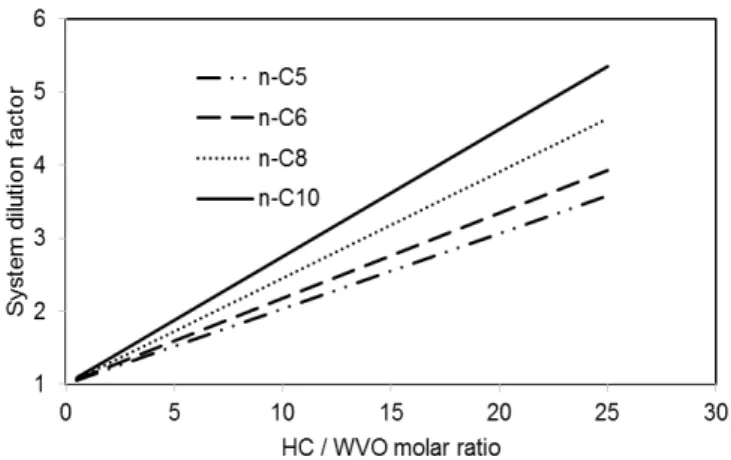
At a given temperature, the viscosity decreases with an increase in hydrocarbon-to-WVO molar ratio. In addition, the following can be observed: i) the magnitude of the decrease in medium viscosity with the hydrocarbon-to-WVO molar ratio at constant temperature is bigger when shorter hydrocarbons are used. For example the medium viscosity decreased from ca. 0.42 to 0.19 cP when n-C5 was added at a ratio of 25 at 100oC (fig. 2a) compared to a decrease to ca. 0.40 cP when n-C10 was added under equivalent conditions (fig. 2d) ; ii) The decrease in medium viscosity tends to flatten off as the hydrocarbon-to-WVO is increased above 10. The data suggest indeed that light hydrocarbons have a positive effect on the reaction medium viscosity and consequently on the reactants diffusivity in the solid catalyst. It must also be pointed out that as the diffusivity is improved in the catalyst by addition of light carbons, the system is also being diluted. A much diluted system may result in low reaction rates as the concentration of reactants is low. An optimum amount of light hydrocarbons must therefore be determined such that it is enough to improve reactants diffusivity but in limited amount to avoid significant system dilution. Fig. 3 shows the system dilution factor as function of hydrocarbon-to-WVO molar ratio. In addition to the higher ability that shorter hydrocarbons possess to improve the system diffusivity, they also lead to less system dilution than long-chain hydrocarbons. For example at a hydrocarbon-to-WVO molar ratio of 10, the system dilution factor increases as follows: 2 for n-C5 < 2.2 for n-C6 < 2.5 for n-C8 < 2.7 for n-C10. This study suggests that n-C5 or n-C6 should preferentially be considered as co-solvent for transesterification reaction instead of longer-chain hydrocarbons. In agreement with this study, a number of experimental studies [5, 18] have reported the positive effect of hexane as co-solvent for transesterification reaction.
Fig 3. Effect of light hydrocarbons addition on system dilution.
IV. CONCLUSION
This study has used correlations reported in literature to relate effective diffusivity in liquid-filled pore system to the bulk diffusivity of reactants and predicted the effect of light hydrocarbons as co-solvent in the conversion of WVO into biodiesel. The data suggest that short-chain liquid hydrocarbons are most effective in lowering the reaction medium viscosity (consequently the effective diffusivity in the catalyst) and lead to limited system dilution.
REFERENCES
[1] M.P. Dorado, E. Ballesteros, J.A. Almeida, C. Schellet, H.P. Lohrlein,
R. Krause, Trans ASAE 45 (2002) 525
[2] U. Schuchardt, R. Sercheli, R.M. Vargas, J Braz Chem Soc 9 (1998)
199
[3] L. Fjerbaek, K. V. Christensen, B. Norddahl, Biotechnol Bioeng 102
(2009) 1298
[4] G. Peterson, W. Scarrach, J Am Oil Chem Soc 61(1984) 1593
[5] H-J. Kim, B-S. Kang, M-J. Kim, Y. M. Park, D-K. Kim, J-S. Lee,
K-Y. Lee, Catal Today 93-95 (2004) 315
[6] C. Xu, D.I. Enache, R. Lloyd, D.W. Knight, J.K. Bartley, G.J.
Hutchings, Catal Lett 138 (2010) 1
[7] L.L. Mguni, M. Mukenga, K. Jalama, R. Meijboom, Catal Comm 34
(2013) 52
[8] M. Ternam, Can J Chem Eng 65(1987) 244
[9] M.A. Vannice, Kinetics of catalytic reactions, Springer Science &
Business Media, 2006, pp. 1-240
[10] W. Hayduk, H. Laudie, AIChE J 20 (1974) 611
[11] M.A. Siddiqi, K. Lucas, Can J Chem Eng 64 (1986) 839
[12] M.T. Tyn, W.F. Calus, J Chem Eng Data 20 (1975) 310
[13] N.O. Umesi, R.P. Danner, Ind Eng Chem Process Des Dev 20 (1981)
662
[14] C.R Wilke, P. Chang, AIChE J 1 (1955) 264
[15] C.J. King, L. Hsueh, K. Mao, J Chem Eng Data 10 (1965) 348
[16] C.S. Caldwell, A.L. Babb, J Phys Chem 60 (1956) 51
[17] T. Sithole, K. Jalama, R. Meijboom, Appl Mech Mat 492 (2014) 350
[18] N. Mahangani, E. Vunain, R. Meijboom, K. Jalama, Proceeding of the
Word Congress on Engineering (WCE), London, 1-3 July 2015, pp. 828 - 832
Proceedings of the World Congress on Engineering and Computer Science 2015 Vol II WCECS 2015, October 21-23, 2015, San Francisco, USA
ISBN: 978-988-14047-2-5
ISSN: 2078-0958 (Print); ISSN: 2078-0966 (Online)