www.atmos-chem-phys.net/15/10239/2015/ doi:10.5194/acp-15-10239-2015
© Author(s) 2015. CC Attribution 3.0 License.
Effect of tropical cyclones on the tropical tropopause parameters
observed using COSMIC GPS RO data
S. Ravindra Babu1, M. Venkat Ratnam2, G. Basha3, B. V. Krishnamurthy4, and B. Venkateswararao1 1Jawaharlal Nehru Technological University, Hyderabad, India
2National Atmospheric Research Laboratory (NARL), Gadanki, India
3Masdar Institute of Science and Technology, Abu Dhabi, United Arab Emirates 4CEBROSS, Chennai, India
Correspondence to:M. Venkat Ratnam ([email protected])
Received: 24 March 2015 – Published in Atmos. Chem. Phys. Discuss.: 5 May 2015 Revised: 8 July 2015 – Accepted: 27 August 2015 – Published: 16 September 2015
Abstract. Tropical cyclones (TCs) are deep convective synoptic-scale systems that play an important role in modify-ing the thermal structure, tropical tropopause parameters and hence also modify stratosphere–troposphere exchange (STE) processes. In the present study, high vertical resolution and high accuracy measurements from COSMIC Global Posi-tioning System (GPS) radio occultation (RO) measurements are used to investigate and quantify the effect of tropical cy-clones that occurred over Bay of Bengal and Arabian Sea in the last decade on the tropical tropopause parameters. The tropopause parameters include cold-point tropopause altitude (CPH) and temperature (CPT), lapse-rate tropopause altitude (LRH) and temperature (LRT) and the thickness of the trop-ical tropopause layer (TTL), that is defined as the layer be-tween convective outflow level (COH) and CPH, obtained from GPS RO data. From all the TC events, we generate the mean cyclone-centred composite structure for the tropopause parameters and removed it from the climatological mean ob-tained from averaging the GPS RO data from 2002 to 2013. Since the TCs include eye, eye walls and deep convective bands, we obtained the tropopause parameters based on ra-dial distance from the cyclone eye. In general, decrease in the CPH in the eye is noticed as expected. However, as the distance from the cyclone eye increases by 300, 400, and 500 km, an enhancement in CPH (CPT) and LRH (LRT) is observed. Lowering of CPH (0.6 km) and LRH (0.4 km) val-ues with coldest CPT and LRT (2–3 K) within a 500 km ra-dius of the TC centre is noticed. Higher (2 km) COH lead-ing to the lowerlead-ing of TTL thickness (2–3 km) is clearly ob-served. There are multiple tropopause structures in the
pro-files of temperature obtained within 100 km from the centre of the TC. These changes in the tropopause parameters are expected to influence the water vapour transport from the tro-posphere to the lower stratosphere, and ozone from the lower stratosphere to the upper troposphere, hence influencing STE processes.
1 Introduction
cold temperatures present at the tropopause (Fueglistaler et al., 2009). The lifetime and size of cyclones also might affect the tropopause parameters on the regional scale (Cairo et al., 2008). There could be a possibility that TCs lift and cool the tropopause more than other mesoscale systems (Romps and Kuang, 2009). It is well known that the intensity and fre-quency of TCs have increased in recent years (Emmanuel, 2005; Webster et al., 2005).
The tropopause, which is the boundary between the tro-posphere and the stratosphere, plays a crucial role in the ex-change of mass, water vapour, and other chemical species between the two atmospheric regions (Holton et al., 1995). Most of these exchanges (water vapour to the lower strato-sphere and ozone to the upper tropostrato-sphere) take place around the tropopause only and as such, it is very important to study and understand the physical processes occurring around the tropopause region. The tropopause itself varies temporally and as well as spatially. Generally, radiosonde data have been used to study the tropopause parameters and their character-istics (e.g. Randel et al., 2000; Seidel et al., 2001); however radiosonde data are not available over oceans, particularly during severe atmospheric conditions like TCs. Thus, ob-taining tropopause characteristics during TCs has remained a daunting task. However, the availability of Global Position-ing System (GPS) radio occultation (RO) measurements with high vertical resolution, high accuracy and all-weather capa-bility has made it possible to study the tropopause character-istics over the globe including over oceans. Several studies showed that the GPS RO measurements are well suited for studying severe storms (Pommereau and Held, 2007; Corti et al., 2008; Romps and Kuang, 2009; Biondi et al., 2013).
A few studies have been carried out relating TCs to the UTLS as well as tropopause parameters. Studies in-clude the thermal and dynamical structure of UTLS dur-ing TC (Koteswaram, 1967), horizontal and vertical struc-ture of temperastruc-ture in the cyclone (Waco, 1970), temper-ature and ozone variations in a hurricane (Penn, 1965), troposphere–stratosphere transport and dehydration in cy-clones (Danielsen, 1993), UTLS structure during TCs us-ing AIRS and MLS measurements (Ray and Rosenlof, 2007), RO bending angle anomalies during tropical cyclones (Biondi et al., 2011), thermal structure of intense convective clouds derived from GPS RO (Biondi et al., 2012), estimat-ing the TC cloud top height and vertical temperature struc-ture using GPS RO measurements (Biondi et al., 2013), and observations of temperature in the UTLS of tropical weather disturbances (Davis et al., 2014). Note that the above list is only indicative, not exhaustive. Recently Emmanuel (2013) showed that the modulations of cold-point temperatures in-fluence the maximum potential intensity of tropical cyclones and tropical cyclone activity; however, the effect of the deep convection associated with the TCs on the tropopause param-eters is not yet fully understood.
The main objective of the present study is to investigate the spatial variation of tropopause parameters such as
cold-point tropopause altitude (CPH)/temperature (CPT), lapse-rate tropopause altitude (LRH)/temperature (LRT), convec-tive outflow level altitude (COH) and tropical tropopause layer (TTL) thickness with respect to the TC centre during the entire TC period. Vertical structure of temperature and tropopause parameters within a 5◦radius of the cyclone cen-tre during the TC period is also presented. The water vapour variability in the vicinity of TC is also investigated. The de-tails of the data used for the present study are mentioned in Sect. 2. Methodology for obtaining tropopause parameters during the TC period is mentioned in Sect. 3. Results and discussion are presented in Sect. 4. Finally, summary and conclusions drawn from the present study are presented in Sect. 5.
2 Database
2.1 COSMIC GPS RO data
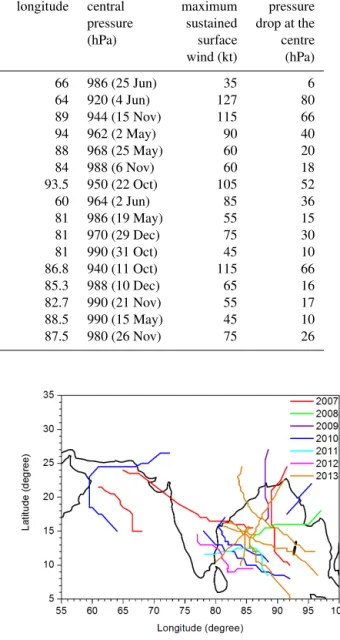
Table 1.Cyclone name, grade, cyclone intensity (CI) number, period, centre latitude, centre longitude, estimated central pressure, estimated maximum sustained surface wind, and estimated pressure drop at the centre of all the cyclones used in the present study provided by the IMD.
Cyclone Grade CI no. Period Centre Centre Estimated Estimated Estimated
name latitude longitude central maximum pressure
pressure sustained drop at the
(hPa) surface centre
wind (kt) (hPa)
03B CS 2.5 21–26 Jun 2007 23.5 66 986 (25 Jun) 35 6
Gonu SuCS 6.5 2–7 Jun 2007 20 64 920 (4 Jun) 127 80
SIDR VSCS 6 11–16 Nov 2007 19.5 89 944 (15 Nov) 115 66
Nargis VSCS 5 27 Apr–3 May 2008 16 94 962 (2 May) 90 40
Aila SCS – 23–26 May 2009 22 88 968 (25 May) 60 20
Jal SCS 3.5 4–7 Nov 2010 11 84 988 (6 Nov) 60 18
Giri VSCS 5.5 20–23 Oct 2010 19.8 93.5 950 (22 Oct) 105 52
PHET VSCS 4.5 31 May–6 Jun 2010 18.5 60 964 (2 Jun) 85 36
Laila SCS 3.5 17–21 May 2010 14.5 81 986 (19 May) 55 15
Thane VSCS 4.5 25–30 Dec 2011 12 81 970 (29 Dec) 75 30
Nilam CS 3 28 Oct–1 Nov 2012 11.5 81 990 (31 Oct) 45 10
Phailin VSCS 6 8–14 Oct 2013 17.1 86.8 940 (11 Oct) 115 66
Madi VSCS 4 6–12 Dec 2013 15.4 85.3 988 (10 Dec) 65 16
Helen SCS 3.5 19–22 Nov 2013 16.1 82.7 990 (21 Nov) 55 17
Mahasen CS 3 10–16 May 2013 18.5 88.5 990 (15 May) 45 10
Leher VSCS 4 23–28 Nov 2013 13.2 87.5 980 (26 Nov) 75 26
2.2 TC best tracks
We have taken the TC track information (TC best tracks) data from the India Meteorological Department (IMD) for the period 2007 to 2013. Though GPS RO data are available between 2002 and 2006 from CHAMP GPS RO, we have not utilized them for estimating the tropopause parameters during TC, as the number of occultations from this single satellite are too sparse (maximum 250–300 occultations over the entire globe). TC track information includes TC name, dates, centre latitude and longitude, cyclone intensity (CI), and minimum sea level (MSL) pressure of the TC at 3 h inter-vals during its formation. During this period (2007 to 2013), around 44 TCs formed over the north Indian Ocean. For the present study, we consider only the TCs whose lifetime is a minimum of 4 days or more. From these 44 TCs, we se-lected 16 TCs based on their lifetime to investigate the effect of TCs on the tropical tropopause parameters. The tracks of all the TCs used for the present study are shown in Fig. 1 and different colours indicate TCs which occurred in differ-ent years. Note that only two TCs formed over the AS and the rest all formed over the BoB. Only one TC that formed over BoB crossed the Indian land mass and became stronger again when it reached the AS. The details of TC are shown in Table 1, such as name, grade, CI (cyclone intensity) number, as designated by IMD, lifetime, and central latitude and lon-gitude (position) of the cyclone, where lowest pressure and highest wind speed are observed with an estimated pressure
Figure 1.TC tracks with a minimum TC lifetime of 4 days and above used for the present study during 2007–2013 over the north Indian Ocean. Different colours indicate TCs that occurred in dif-ferent years.
drop. Details of the acronyms used in this table are provided in Sect. 3.2.
3 Analyses procedure
trop-ics is the cold-point tropopause. The CPH is defined as the altitude of the temperature minimum that exists between the troposphere and stratosphere. Another one is LRH, defined by the World Meteorological Organization (WMO; 1957) as “the lowest level at which the lapse rate decreases to 2 K/km or less, provided that the average lapse rate between this level and all higher levels within 2 km does not exceed 2 K/km.”
In recent years, the study of the tropopause over the trop-ics has led to the concept of a tropical tropopause layer (TTL) (Highwood and Hoskins, 1998; Gettelman and Birner, 2007; Fueglistaler et al., 2009), which is the transition region between the convective–radiative equilibrium of the tropo-sphere and the stratotropo-sphere. In this transition region, both stratospheric and tropospheric processes interact. The top of the TTL is marked by the CPH and the base by the level of the top of all the major convective outflows, named as the convective tropopause altitude (COH), and the altitude difference between CPH and COH is the TTL thickness. A minimum in potential temperature gradients is identified as COH following Gettelman and Forster (2002). Note that it closely matches with the divergence profile obtained from mesosphere-stratosphere-troposphere (MST) radar observa-tions (Mehta et al., 2008). All these parameters (CPH, CPT, LRH, LRT, COH, and TTL thickness) are estimated for each profile of GPS RO during the entire TC lifetime. In order to estimate the effect of TCs on the tropopause parameters, the background of all the tropopause parameters is obtained by averaging the data from 2002 to 2013 (climatology) with ex-clusion of the days of the TCs. These climatological values are grouped into 2.5◦×2.5◦ grids. There could be day-to-day to interannual variability in the observed climatological tropopause parameters. Since large data (14 years) have gone through climatology, we assume that variability less than the solar cycle is nullified, if not removed completely.
3.2 Classification of the TCs
The effect of the TCs on the tropopause parameters mainly depends on the intensity of the cyclone. Tropical cyclone in-tensity is defined by the maximum mean wind speed over open flatland or water, sometimes referred to as the maxi-mum sustained wind that will be experienced around the eye wall of the cyclone. The low pressure system over the In-dian region is classified based on the maximum sustained wind speed associated with the system, and the pressure deficit/number of closed isobars associated with the sys-tem. The pressure criteria are used when the system is over land and wind criteria are used when the system is over the sea (IMD). Based on 10 min maximum sustained wind speed, IMD has defined various stages of the TC. It is named as low pressure when the maximum sustained wind speed at the sea surface is <17 knots/32 kmph, as
depres-sion (D) at 17–27 knots/32–50 kmph, deep depresdepres-sion (DD) at 28–33 knots/51–59 kmph, cyclonic storm (CS) at 34– 47 knots/60–90 kmph, severe cyclonic storm (SCS) at 48–
63 knots/90–110 kmph, very severe cyclonic storm (VSCS) at 64–119 knots/119–220 kmph, and super cyclonic storm (SuCS) at >119 knots/220 kmph. As an example, the TC Nargis is chosen to show the different stages of TC and also its pressure and wind speed. The TC Nargis originated as a depression formed over the south-east of the BoB at 03:00 UTC on 27 April 2008. From Table 1 it is clear that this cyclone comes under the category VSCS, which has a CI of 5. The observed IMD track of the VSCS Nargis is shown in Fig. 1 (green line). This system moved slightly north-eastwards and intensified into a cyclone at 00:00 UTC of 28 April. It remained stationary for some time and fur-ther intensified into an SCS at 09:00 UTC on 28 April and into a VSCS grade, as classified by the IMD, at 03:00 UTC on 29 April (Pattnaik and Rama Rao, 2008). It moved fur-ther eastward and crossed the coast of Myanmar on 2 May at 06:00 UTC.
The IMD-reported maximum wind speed and minimum SLP of the TC Nargis are shown in Fig. 2a. Note that high-est wind speed (∼90 knots) and lowest pressure (∼960 hPa)
are evident on 2 May. The interpolated outgoing long-wave radiation (OLR), which is considered a proxy for tropi-cal deep convection, obtained from the NOAA satellite on 28 April 2008, is shown in Fig. 2b along with the track of the cyclone provided by IMD. Black circles are drawn to show the 500, 1000, 1500, and 2000 km radius from the TC cen-tre. Note that this cyclone was stationary on 28 April and the minimum OLR (maximum convection) which was as low as 90 W m−2, lay over the region within 500 km and extended to south-east and west side of the cyclone track within 1000 km. The monthly mean CPH for the month of April is shown in Fig. 2c and a small black circle shows the TC Nargis cen-tre observed on 28 April 2008. An interesting feature to be noticed is the enhancement of CPH around 25◦N over the Indian region more than equatorial latitudes, which are well reported earlier (Venkat Ratnam et al., 2005). This feature is commonly observed over the Indian region. Note that lat-itudinal variation of 500 m can be observed if we consider 2000 km from the centre of the cyclone. In order to avoid this latitudinal variation, we hereafter restrict our discussion to within 1000 km from the cyclone centre.
Figure 2. (a)IMD-observed minimum sea level pressure (MSLP; red line) and maximum wind speed (black line) during TC
Nargis. (b) TC-centred composite of NOAA OLR observed on
28 April 2008 along with IMD-observed Nargis track (red line). White arrows show the wind vectors obtained from ERA-Interim on the same day. White circles show the COSMIC RO observed on the same day. Black circles are drawn to shown the 500, 1000,
1500, and 2000 km distance away from TC centres.(c)
Climatol-ogy of CPH for the month of April obtained while averaging from 2002 to 2013. The small black circle shows the Nargis TC centre observed on 28 April 2008.
4 Results and discussion
4.1 Tropopause parameters observed during VSCS Nargis
The locations of all the COSMIC GPS RO observations on 28 April 2008 are shown (white circles) in Fig. 2b. There were about 13 occultations that occurred within 1000 km from the centre of the cyclone. All the tropopause parame-ters mentioned in Sect. 3.1 are estimated for each of these profiles and climatological values were subtracted for esti-mating the effect of the TCs on the tropopause parameters. A typical example of cyclone-centred tropopause parame-ters obtained from the COSMIC GPS RO profiles during TC
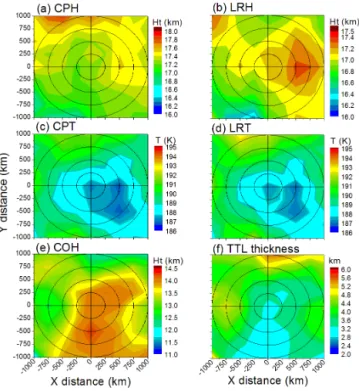
Figure 3.Spatial variation of(a)CPH,(b)LRH,(c)CPT,(d)LRT,
(e)COH, and(f)TTL thickness with respect to the centre of cyclone
Nargis observed on 28 April 2008 for the RO shown in(b). Black
circles are drawn to show the 250, 500, 750, and 1000 km distance away from TC centres.
Nargis on 28 April 2008 is shown in Fig. 3; panel (a) CPH, panel (b) LRH, panel (c) CPT, panel (d) LRT, panel (e) COH, and panel (f) TTL thickness. Black circles are drawn to show the 250, 500, 750, and 1000 km distance away from the TC centres. Though it is difficult to draw any conclusions from this figure as occultations are sparse, it is clear that CPH and LRH are slightly lower (∼17.25 km) within 500 km, and
higher (>17.5 km) further away from the centre when
com-pared to the CPH and LRH around 1000 km. There is no substantial difference in the CPT and LRT within 500 km of TC in this example. However, COH is a little higher (∼14 km) within 500 km and slightly lower away from the
centre, and TTL thickness is small (<4 km) within 500 km
from the centre of TC Nargis. This suggests that the TC af-fects the tropopause parameters. Note that the variations ob-served from further away than 500 km, mainly over land, can be partly attributed to the latitudinal change itself which will be discussed further in the next sections.
is not that sensitive when compared to the pressure and wa-ter vapour. Since the changes are found to be up to 4–5 K, we expect these are meaningful, even after considering expected larger bias during disturbed weather conditions. More details of COSMIC temperature during the cyclone period can be found in Biondi et al. (2011).
4.2 Spatial variations of tropopause parameters from the centre of the TC
In this subsection, the spatial variations of tropopause param-eters from the cyclone centre for different intensities of TC are presented. From the example of Nargis it is clear that we have a fewer number of occultations for a single TC day and hence it is difficult to describe the tropopause characteristics away from the TC centre. In order to obtain more data points for statistically significant results, we have separated COS-MIC RO data based on TC intensity from all 16 TCs. When we separated these based on TC intensity with respect to their distance from the TC centre, there are 381, 727, 1124, 481, and 865 occultations for D, DD, CS, SCS and VSCS, respec-tively. From these profiles, we made a 250 km×250 km grid
of tropopause parameters based on the TC centre for all TC intensities. After going through the detailed analysis, no sig-nificant difference in the tropopause parameters between D and DD or CS and SCS was noticed. So, we have combined the observations obtained during those periods. Since there is no significant difference in the tropopause parameters during D and DD we have not shown these here.
Figure 4 shows the cyclone-centred composite of panel (a) CPH, panel (b) LRH, panel (c) CPT, panel (d) LRT, panel (e) COH, and panel (f) TTL thickness for the cases of CS and SCS. From the figure it is clear that the south-west side of the area up to 1000 km radius from the TC centre the CPH (Fig. 4a) and LRH (Fig. 4b) is lower than the north side of the TC centre. However, colder tropopause tempera-tures are clearly observed within 1000 km in the case of CPT (Fig. 4c) and LRT (Fig. 4d). A 10 K difference in the CPT and LRT can be noticed from the TC centre to the north side. Very interestingly COH is much higher over 1000 km and also towards the south side of the TC centre, with a maxi-mum altitude of around 15 km (Fig. 4e) leading to a smaller TTL thickness (Fig. 4f). Note that TTL thickness is less than 3 km within 500 km from the centre of the TC and up to 1000 km on the southern side. These different variations in the tropopause parameters might be due to two reasons. One may be due to the distribution of convection during the de-veloping stages of TCs, such as depression and deep depres-sion on the south side of the TC centre which moved to the north-west side. Another reason, at least in part, can be at-tributed to the latitudinal variation; however, we found very low values of CPH within a 500 km radius of the TC cen-tre. Similar variations are observed when we separated the TC based on different intensities (figures not shown). Thus, in general, we observed a lowering of CPH and LRH values
Figure 4. Cyclone-centred composite of (a) CPH, (b) LRH,
(c)CPT,(d)LRT,(e)COH, and(f)TTL thickness observed
dur-ing the CS and SCS.
with coldest CPT and LRT within a 500 km radius of the TC centre. Higher COH leading to a lowering of TTL thickness is clearly observed. Higher COH within 500 km from the TC centre suggests that maximum convective outflow reached higher altitude. At the same time lowering the CPH, leading to the small TTL thickness within the TC centre is observed, probably due to the subsidence. In order to quantify the effect of TCs on the tropopause parameters more clearly we have obtained anomalies by subtracting the tropopause parame-ters observed during TC from the background climatological tropopause parameters.
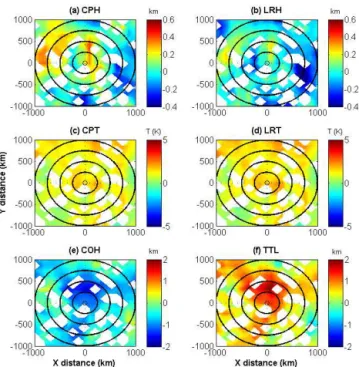
Figure 5. Same as Fig. 4, but for the mean difference in the tropopause parameters between climatological mean and individual tropopause parameters observed during TCs (irrespective of cyclone intensity).
the COH but also a decrease of CPH. It is worth quoting the recent findings of Biondi et al. (2015) where they reported a decrease in the temperatures of 3–4 K and a reduction in the TTL thickness to 2–3 km over the north Indian basin. Our findings match with their reports for the Indian region ex-actly.
4.3 Spatial variations of water vapour from the centre of the TC
Deep convection is expected to reach up to the tropopause altitude and sometimes above it during the TCs, leading to the penetration of water vapour to the lower stratosphere. At the same time, chances of pushing down the ozone from the lower stratosphere, leading to lower CPH (subsidence) is also expected, leading to STE processes. Though not completely relevant to the present study, it is worth recalling recent re-sults by Škerlak et al. (2014), where it was quantitatively shown that maxima of STE are located over the storm (cy-clone) track regions in the North Atlantic and North Pacific during all seasons (except summer), with an averaged mass flux of approximately 500 kg km−2s−1from the stratosphere to the troposphere and approximately 300 kg km−2s−1in the opposite direction. It will be interesting to investigate how these numbers compare for TC over the Indian region. Since GPS RO also provides information on water vapour (Kishore et al., 2011), we have further investigated the effect of TCs on the vertical distribution of water vapour. A cyclone-centred composite of averaged relative humidity (RH) observed
dur-ing all the TCs, irrespective of TC intensity, in the 0–5, 5–10, and 10–15 km layer using COSMIC GPS RO wet profiles is shown in Fig. 6a–c, respectively. Note that above these al-titudes, water vapour is not sensitive in the GPS RO mea-surements. In general, larger RH values are noticed in the south-eastern side of the TCs in the lower layer (0–5 km) and throughout the south side of the TC in the 5–10 km layer. Higher RH is noticed within 500 km from the TC centre. In-terestingly, high RH values of 70 % or more are noticed on the eastern side of the TC in the 10–15 km layer. Thus, it is clear that deep convection prevailing during the TC within 500 km from the centre of the TC can penetrate to the lower stratosphere through the tropopause. The higher RH values observed in the 10–15 km layer may be due to the upper level anti-cyclonic circulation over the cyclones. Ray and Rosenlof (2007) reported higher water vapour mixing ratios to the east of the cyclone centre for TCs over the Atlantic and Pacific oceans and found averaged water vapour is en-hanced by 30–50 ppmv or more within 500 km of the eye compared to the surrounding average water vapour mixing ratios. Our results match well with these. Note that Biondi et al. (2015) reported 30–50 % of the time overshooting of convection during TCs, strongly supporting our findings. At the same time, Midya et al. (2012) reported that over BoB and AS, the total column ozone (TOC) decreases steadily be-fore and during the formation of a TC, followed by a more or less increasing trend after dissipation of the cyclone. A very recent case study by Das et al. (2015) also confirms the intrusion of stratospheric air into the upper and middle tropo-sphere during the passage of tropical cyclone Nilam. It will be interesting to see the variability of ozone during the same time for all the cyclones presented here to investigate the STE processes away from the TC centre.
From the above, in general, it can be concluded that the tropical tropopause is significantly affected by TCs. The ef-fect is more pronounced within 500 km from the centre of the TC. Note that TCs have their eye, eye wall, rain bands, convective cloud tops, strong updrafts, and cirrus deck all oc-curring in the range of 500 to 1000 km from the TC centre. From the above results, we expect that a significant effect of the TCs on the tropopause parameters could be felt up to 500 km from the TC centre. We have further investigated the effect of TCs on the thermal structure of the UTLS region and the results are presented in the next section.
4.4 Vertical thermal structure of UTLS within 500 km from the TC centre
We considered the GPS RO with respect to the IMD best track data and took a±1 h time window of co-located RO
Figure 6.Cyclone-centred composite of averaged RH observed
dur-ing TCs (irrespective of TC intensity) in the (a)0–5 km, (b)5–
10 km, and(c)10–15 km layer using COSMIC GPS RO wet
pro-files.
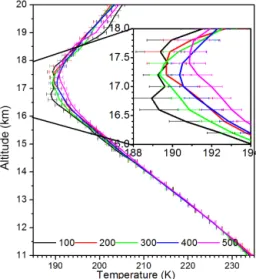
we separated them at 100 km steps, there were 7, 11, 20, 20, and 32 profiles, respectively. Figure 7 shows the mean ver-tical structure of temperature with respect to distance within 500 km at steps of 100 km from the TC centre along with the standard error. The enlarged portion in Fig. 7 shows the vertical structure of the temperature within the UTLS re-gion from 16 to 18 km. Here we considered a ±1 h time
window of co-located RO profiles with respect to IMD cy-clone best track data for obtaining the thermal structure over the TC period. Note that this is a better time window reso-lution than the earlier reported 3 h time window by Biondi et al. (2013) for describing the thermal structure during the cyclone period. In general, no significant difference is evi-dent in the temperature structure within 500 km from the TC centre below 14 km. This is mainly due to the synoptic na-ture of convection within a 500 km radius of the TC centre. Generally, in the troposphere below approximately 14 km, the radiative cooling balances the latent heat release by con-vection. However, large variation in the mean temperature structure can be noticed above 14 km. This is mainly due to balancing between the radiative heating and the stratosphere-driven upwelling above 16 km. Strong updrafts around the eye wall and down drafts, subsidence near the eye, and for-mation of the cirrus clouds might change the temperature structure in the UTLS region strongly. It is interesting to notice lowering of tropopause altitudes with colder
temper-Figure 7.Mean temperature structure observed using GPS RO pro-files that occurred within 100, 200, 300, 400, and 500 km from the TC centre. Horizontal bars show the standard error. For clarity, the temperature structure observed between 16 and 18 km is shown in the box.
atures in the profiles obtained within 100 km, followed at 300, 200, and 400 km. It indicates that rain bands are of the size of roughly 100 km. There is a temperature differ-ence of 5 K in the UTLS region in the profiles that occurred within 100 km from the profiles that occurred further away than 400 km. These are statistically significant differences as the error bars do not mix with each other for the profile that occurred within 100 km to the rest of the profiles. Warmer temperatures are also visible in the lower stratosphere in the profiles that are obtained within 100 km when compared to those that occurred further away. Multiple tropopause struc-tures are clearly visible in the profiles that occurred within 100 km from the TC, though the number of profiles avail-able is small. These multiple tropopauses are similar to dou-ble tropopauses observed by Corti et al. (2008), Biondi et al. (2011), and Davis et al. (2014). The cause for these mul-tiple tropopauses might be either due to clouds (Biondi et al., 2013), wave activity, cirrus deck or ozone (Mehta et al., 2011), which demands separate investigation.
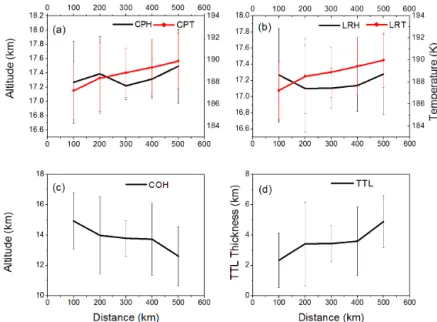
no-Figure 8.Variability in the tropopause parameters of(a)CPH and CPT,(b)LRH and LRT,(c)COH, and(d)TTL thickness observed within 500 km from the centre of the TC. Vertical bars show the standard error.
ticed (Fig. 8c) when we move away from the TC centre lead-ing to the increase in the TTL thickness of 3 km (Fig. 8d). Note that a lowering of CPH (may be due to the presence of subsidence and strong downdrafts) in the eye region and higher COH, leading to a lowering of TTL thickness within 100 km from the TC centre is again evident. Most of the over-shooting convection may occur within 200 km and the top of the convection may be lifting the tropopause higher. An ad-ditional 1 km lowering of the TTL thickness within 100 km when compared to 500 km away from the TC centre mainly comes from a lowering of CPH. Thus, a decrease in TTL thickness is the combination of the pushing up of COH and a lowering of CPH.
5 Summary and conclusions
In the present communication, we investigated and quanti-fied the effects of tropical cyclones that occurred between 2007 and 2013 on the tropical tropopause parameters ob-tained from simultaneous high vertical resolution and high accuracy COSMIC GPS RO measurements. TCs are catego-rized, based on the intensity of their effect on the thermal structure and thus tropopause parameters are different for dif-ferent intensities. Out of 44 cyclones that originated over the BoB and the AS, the investigation is carried out on 16 cy-clones which have lifetimes of 4 days or more. The TC centre is fixed, based on the best tracks data available from the IMD at 3 h intervals. GPS RO overpasses that occurred within a ra-dius of 1000 km of the centre of the TC are separated. Trop-ical tropopause parameters are estimated for each individual profile that occurred at various distances within 1000 km and are grouped for every 250 km radius from the centre of the
TC. They are further separated based on the intensity of the TC. In order to make quantitative estimates of the effect of TCs on the tropopause parameters, individual tropopause pa-rameters obtained during TC are removed from the clima-tological mean tropopause parameters that are obtained by averaging the GPS RO measurements available from 2002 to 2013 (CHAMP and COSMIC). The effect of TCs on the vertical distribution of water vapour obtained from COSMIC GPS RO is also investigated. Again GPS RO overpasses that occurred within a radius of 500 km of the TC centre within
±1 h for every 3 h are separated for every 100, 200, 300, 400,
and 500 km from the centre of the TC. Finally, detailed inves-tigations are made to see the effect of TCs on the tropopause parameters within 500 km from the centre of the TC. The main findings of the present study are summarized as fol-lows.
1. In general, the CPH (LRH) is lowered by 0.6 km (0.4 km) in most of the areas within a 1000 km radius of the TC centre and CPT (and LRT) is colder by 3– 4 K. COH is increased up to 2 km and TTL thickness is reduced by 2 km within 500 km from the TCs and in some areas, up to 1000 km.
3. The decrease in TTL thickness within 500 km from the TC centre is not only because of the pushing up of the COH but also because of the decrease of CPH.
4. Higher RH is evident within 500 km from the TC centre, reaching as high as 15 km. Thus, it is clear that deep convection prevailing within 500 km from the centre of the TC can penetrate to the lower stratosphere through the tropopause.
5. In general, no significant difference in the temperature structure within 500 km from the TC centre is noticed below 14 km; however, large variation in the mean tem-perature structure is noticed above 14 km. There is a temperature difference of 5 K in the UTLS region be-tween the profiles that occur within 100 km and the pro-files that occurred within 500 km.
6. Multiple tropopause structures are also visible in the profiles that occurred within 100 km from the TC. 7. The colder tropopause temperatures are clearly
ob-served within 1000 km in the case of CPT and through-out 1000 km on the eastern side in the case of LRT. In general, larger RH values are noticed on the south-eastern side of the TCs in the lower layer (0–5 km), but throughout the south side of the TC in the 5–10 km layer. Higher RH values of 70 % or more are noticed on the eastern side of the TC in the 10–15 km layer. In-terestingly COH is much higher over 1000 km and also towards the south side of the TC centre, with maximum altitude of around 15 km, leading to a lesser TTL thick-ness. TTL thickness is less than 3 km within 500 km from the centre of the TC and up to 1000 km on the southern side.
Thus, this study clearly demonstrated that the TCs can sig-nificantly affect the tropical tropopause, and the effects are more pronounced within 500 km from the centre of the TC. It will be interesting to see the ozone variability in the upper troposphere and water vapour in the lower stratosphere using satellite observations at the same time and hence STE pro-cesses during the TC will be investigated in our future work. Further, in the present study we are unable to make quantita-tive estimates of the tropopause parameters’ variability dur-ing different stages (time series) of the cyclone due to sparse data of existing GPS RO observations. Once data are avail-able from the other similar payload (the ROSA onboard the Megha-Tropiques) launched in 2011 in low inclination and from the forthcoming COSMIC-2, which will have six low earth orbit GPS receivers to be launched in low inclination in the first half of 2016, we will be able to quantity the effects more effectively.
Acknowledgements. We would like to thank COSMIC Data Analysis and Archive Centre (CDAAC) for providing GPS RO data used in the present study through their FTP site. The provision of tropical cyclone best track data used in the present study by IMD through their website is highly acknowledged. This work is done as a part of CAWSES India Phase-II Theme 3, fully supported by Indian Space research organization.
Edited by: P. Haynes
References
Anthes, R. A., Bernhardt, P. A., Chen, Y., Cucurull, L., Dymond, K. F., Ector, D., Healy, S. B., Ho, S.-H., Hunt, D. C., Kuo, Y.-H., Liu, H., Manning, K., McCormick, C., Meehan, T. K., Randel, W. J., Rocken, C., Schreiner, W. S., Sokolovskiy, S. V., Syndergaard, S., Thompson, D. C., Trenberth, K. E., Wee, T.-K., Yen, N. L., and Zeng, Z.: The COSMIC/Formosat/3 mission: Early results, B. Am. Meteorol. Soc., 89, 313–333, 2008.
Biondi, R., Neubert, T., Syndergaard, S., and Nielsen, J. K.: Radio occultation bending angle anomalies during tropical cyclones, Atmos. Meas. Tech., 4, 1053–1060, doi:10.5194/amt-4-1053-2011, 2011.
Biondi, R., Randel, W. J., Ho, S.-P., Neubert, T., and Syndergaard, S.: Thermal structure of intense convective clouds derived from GPS radio occultations, Atmos. Chem. Phys., 12, 5309–5318, doi:10.5194/acp-12-5309-2012, 2012.
Biondi, R., Ho, S. P., Randel, W., Syndergaard, S., and Neubert, T.: Tropical cyclone cloud-top height and verti-cal temperature structure detection using GPS radio occulta-tion measurements, J. Geophys. Res.-Atmos., 118, 5247–5259, doi:10.1002/jgrd.50448, 2013.
Biondi, R., Steiner, A. K., Kirchengast, G., and Rieckh, T.: Charac-terization of thermal structure and conditions for overshooting of tropical and extratropical cyclones with GPS radio occultation, Atmos. Chem. Phys., 15, 5181–5193, doi:10.5194/acp-15-5181-2015, 2015.
Cairo, F., Buontempo, C., MacKenzie, A. R., Schiller, C., Volk, C. M., Adriani, A., Mitev, V., Matthey, R., Di Donfrancesco, G., Oulanovsky, A., Ravegnani, F., Yushkov, V., Snels, M., Cagnazzo, C., and Stefanutti, L.: Morphology of the tropopause layer and lower stratosphere above a tropical cyclone: a case study on cyclone Davina (1999), Atmos. Chem. Phys., 8, 3411– 3426, doi:10.5194/acp-8-3411-2008, 2008.
Corti, T., Luo, B. P., deReus, M., Brunner, D., Cairo, F., Mahoney, M. J., Matucci, G., Matthey, R., Mitev, V., dos Santos, F. H., Schiller, C., Shur, G., Sitnikov, N. M., Spelten, N., Vossing, H. J., Borrmann, S., and Peter, T.: Unprecedented evidence for over-shooting convection hydrating the tropical stratosphere, Geo-phys. Res. Lett., 35, L10810, doi:10.1029/2008GL033641, 2008. Danielsen, E. F.: In situ evidence of rapid, vertical, irreversible transport of lower tropospheric air into the lower tropical strato-sphere by convective cloud turrets and by larger-scale up-welling in tropical cyclones, J. Geophys. Res., 98, 8665–8681, doi:10.1029/92JD02954,1993.
Stratosphere-troposphere exchange during the tropical cyclone Nilam, Atmos. Chem. Phys. Discuss., submitted, 2015.
Davis, C. A., Ahijevych, D. A., Haggerty, J. A., and Mahoney, M. J.: Observations of Temperature in the Upper Troposphere and Lower Stratosphere of Tropical Weather Disturbances, J. Atmos. Sci., 71, 1593–1608, doi:10.1175/JAS-D-13-0278.1, 2014. Emanuel, K. A.: Increasing destructiveness of tropical
cy-clones over the past 30 years, Nature, 436, 686–688, doi:10.1038/nature03906, 2005.
Emanuel, K. A.: Downscaling CMIP5 climate models shows in-creased tropical cyclone activity over 21st century, P. Natl. Acad. Sci. USA, 110, 12219–12224, 2013.
Fueglistaler, S., Dessler, A. E., Dunkerton, T. J., Fu, I., Folkins, Q., and Mote, P. W.: Tropical tropopause layer, Rev. Geophys., 47, RG1004, doi:10.1029/2008RG000267, 2009.
Gettelman, A. and Birner, T.: Insights into tropical tropopause layer processes using global models, J. Geophys. Res., 112, D23104, doi:10.1029/2007JD008945, 2007.
Gettelman, A. and Forster, P. M. F.: A climatology of the trop-ical tropopause layer, J. Meteorol. Soc. Jpn., 80, 911–924, doi:10.2151/jmsj.80.911, 2002.
Highwood, E. J. and Hoskins, B. J.: The tropical
tropopause, Q. J. Roy. Meteorol. Soc., 124, 1579–1604, doi:10.1002/qj.49712454911, 1998.
Holton, J. R., Haynes, P. H., McIntyre, M. E., Douglass, A. R., Rood, R. B., and Pfister, L.: Stratosphere Troposphere exchange, Rev. Geophys., 33, 403–439, doi:10.1029/95RG02097, 1995. Kishore, P., Venkat Ratnam, M., Namboothiri, S. P., Velicogna, I.,
Basha, G., Jiang, J. H., Igarashi, K., Rao, S. V. B., and
Sivaku-mar, V.: Global (50◦S–50◦N) distribution of water vapor
ob-served by COSMIC GPS RO: Comparison with GPS radiosonde, NCEP, ERA-Interim and JRA-25 reanalysis data sets, J. Atmos. Sol.-Terr. Phy., 73, 1849–1860, doi:10.1016/j.jastp.2011.04.017, 2011.
Koteswaram, P.: On the structure of hurricanes in the upper tropo-sphere and lower stratotropo-sphere, Mon. Weather Rev., 95, 541–564, 1967.
Kuo, Y.-H., Wee, T.-K., Sokolovskiy, S., Rocken, W., Schreiner, W., Hunt, H., and Anthes, R. A.: Inversion and Error Estimation of GPS Radio Occultation Data, J. Meteorol. Soc. Jpn., 82, 507– 531, 2004.
Kursinski, E. R., Hajj, G. A., Schofield, J. T., Linfield, R. P., and Hardy, K. R.: Observing Earth’s atmosphere with radio occulta-tion measurements using the Global Posiocculta-tioning System, J. Geo-phys. Res., 102, 23429–23465, 1997.
Mehta, S. K., Krishna Murthy, B. V., Rao, D. N., Ratnam, M. V., Parameswaran, K., Rajeev, K., Raju, C. S., and Rao, K. G.: Identification of tropical convective tropopause and its associa-tion with cold point tropopause, J. Geophys. Res., 113, D00B04, doi:10.1029/2007JD009625, 2008.
Mehta, S. K., Venkat Ratnam, M., and Krishna Murthy, B. V.: Mul-tiple tropopauses in the tropics: A cold point approach, J. Geo-phys. Res., 116, D20105, doi:10.1029/2011JD016637, 2011. Midya, S. K., Dey, S. S., and Chakraborty, B.: Variation of the total
ozone column during tropical cyclones over the Bay of Bengal and the Arabian Sea, Meteorol. Atmos. Phys., 117, 63–71, 2012. Pattnaik, D. R. and Rama Rao, Y. V.: Track Prediction of very sever cyclone “Nargis” using high resolution weather research fore-casting (WRF) model, J. Earth Syst. Sci., 118, 309–329, 2008. Penn, S.: Ozone and temperature structure in a Hurricane, J. Appl.
Meteorol., 4, 212–216, 1965.
Pommereau, J.-P. and Held, G.: Is there a stratospheric fountain?, Atmos. Chem. Phys. Discuss., 7, 8933–8950, doi:10.5194/acpd-7-8933-2007, 2007.
Randel, W. J., Wu, F., and Gaffen, D.: Interannual variability of the tropical tropopause derived from radiosonde data and NCEP re-analysis, J. Geophys. Res., 105, 15509–15524, 2000.
Rao, D. N., Ratnam, M. V., Mehta, S., Nath, D., Ghouse Basha, S., Jagannadha Rao, V. V. M., Krishna Murthy, B. V., Tsuda, T., and Nakamura, K.: Validation of the COSMIC radio occultation data over Gadanki (13.48 N, 79.2 E): A tropical region, Terr. Atmos. Ocean. Sci., 20, 59–70, doi:10.3319/TAO.2008.01.23.01(F3C), 2009.
Ray, E. A. and Rosenlof, K. H.: Hydration of the upper tropop-sphere by tropical cyclones, J. Geophys. Res., 112, D12311, doi:10.1029/2006JD008009, 2007.
Romps, D. M. and Kuang, Z. M.: Overshooting convec-tion in tropical cyclones, Geophys. Res. Lett., 36, L09804, doi:10.1029/2009GL037396, 2009.
Schreiner, W., Rocken, C., Sokolovskiy, S., Syndergaard, S., and Hunt, D.: Estimates of the precision of GPS radio occultations from the COSMIC/FORMOSAT-3 mission, Geophys. Res. Lett., 34, L04808, doi:10.1029/2006GL027557, 2007.
Seidel, D. J., Ross, R. J., Angell, J. K., and Reid, G. C.: Climato-logical characteristics of the tropical tropopause as revealed by radiosondes, J. Geophys. Res., 106, 7857–7878, 2001.
Škerlak, B., Sprenger, M., and Wernli, H.: A global climatology of stratosphere–troposphere exchange using the ERA-Interim data set from 1979 to 2011, Atmos. Chem. Phys., 14, 913–937, doi:10.5194/acp-14-913-2014, 2014.
Venkat Ratnam, M., Tsuda, T., Shiotoani, M., and Fujiwara, M.: New Characteristics of the Tropical Tropopause Revealed by CHAMP/GPS Measurements, Scientific Online Letters of Atmo-sphere, 1, 185–188, doi:10.2151/sola.2005-048, 2005.
Waco, D. E.: Temperatures and turbolence at tropopause levels over hurricane Beula, Mon. Weather Rev., 98, 749–755, 1970. Webster, P. J., Holland, G. J., Curry, J. A., and Chang, H.-R.:
Changes in Tropical Cyclone Number, Duration, and Intensity in a Warming Environment, Science, 309, 1844–1846, 2005. World Meteorological Organization (WMO): Meteorology-A three