In-hospital mortality risk factors in patients with ascites due
to cirrhosis
MIGUEL HERNAN VICCO1*, LUZ RODELES1, FRANCO FERINI1, ANA KARINA LONG1, HÉCTOR MARIO MUSACCHIO1
1*Internal Medicine Service, Hospital J. B. Iturraspe, Santa Fe, Argentina
S
UMMARYStudy conducted at the Internal Medicine Department, Hospital J. B. Iturraspe, Santa Fe, Argentina
Article received: 4/7/2014 Accepted for publication: 6/7/2014
*Correspondence: Address: Bv Pellegrini, 3551,
Postal Code: 3000 Santa Fe, Argentina [email protected]
http://dx.doi.org/10.1590/1806-9282.61.01.035
Conflict of interest: none
Introduction: ascites is one of the most common complications of cirrhosis
as-sociated with a high rate of mortality. Although several scores have been devel-oped in order to assess the prognosis of the disease, they were designed for pre-dicting liver transplantation requirements and mortality in the short term, but not while in hospital. The aim of this study was to weigh risk factors for in-hos-pital mortality in adult patients with ascites due to alcoholic cirrhosis.
Material and methods: we performed a cross-sectional study in 180 adult
pa-tients with diagnosis of cirrhosis with portal hypertension associated with high alcohol intake. The diagnosis of cirrhosis was made by liver echography and por-tal hypertension was deined by clinical features plus serum-ascites albumin gra-dient. Sampled individuals were subjected to complete clinical examination. Child Pugh and the MELD scores were applied in all the patients.
Results: nineteen patients died while in-hospital. Mortality was associated with increased levels of serum white blood cell, urea, creatinine, prolonged prothrom-bin time, aspartate aminotransferase and alanine aminotransferase. We conduct-ed a multiple binary logistic to prconduct-edict in-hospital mortality which yieldconduct-ed that
serum urea, creatinine and prothrombin time made a signiicant contribution to prediction with an OR 14 (95% CI 12.8 - 16.7 p = 0.03), 2 (95% CI 0.5 - 3.47, p = 0.04), and 2 (95% CI 1.03 - 2.31, p = 0.01) linearly-related.
Conclusions: our results suggest that acute renal failure and prolonged
pro-thrombin time are predictors of in-hospital mortality in patients with portal hy-pertension due to alcoholic cirrhosis.
Keywords: ascites, alcoholic, liver cirrhosis, hospital mortality.
I
NTRODUCTIONThe three most common complications of cirrhosis are as-cites, hepatic encephalopathy and variceal hemorrhage.1
Ascites usually develops within 10 years during the course of the disease in the 60% of the patients with compensa-ted cirrhosis,2 and it is associated with poor prognosis with
a rate of mortality of approximately 40% after 1 year.3-7 The
related factors for mortality prediction in patients with as-cites include hyponatremia, high serum creatinine and low arterial blood pressure.3-9 These patients also have high risk
for other complications such as spontaneous bacterial pe-ritonitis (SBP), hyponatremia and hepatorenal syndromes, which increase the risk of fatal outcome.1,3,7-16
Several scores have been developed in order to predict severity of the disease and prognosis in order to consider
liver transplantation as a potential treatment option.2
The-se scores are Child Turcotte Pugh and MELD; however, they were designed for predicting liver transplantation re-quirements and mortality in the short term, but not whi-le in hospital.3,14-21 The present study was carried out in
or-der to evaluate risk factors for in-hospital mortality in adult patients with ascites due to alcoholic cirrhosis.
M
ATERIALS AND METHODSStudy population and subject evaluation
December of 2010. The diagnosis of cirrhosis was made by liver echography and portal hypertension was deined according to clinical features plus serum-ascites albumin gradient. Sampled individuals were subjected to a com-plete clinical examination including chest X-ray, and bio-chemical tests. Exclusion criteria comprised: age <18 years, coronary artery disease or history of other cardiac disea-ses, chronic renal disturbances, immunosuppression or ongoing use of immunosuppressant agents, diabetes, po-sitive serology for viral hepatitis A, B and C, autoimmu-ne hepatitis, hepatorenal syndrome and other systemic complaints. The data recorded included clinical and de-mographic characteristics of each patient and the varia-bles needed to determine the Child Pugh categories and MELD scores.
The study was approved by the Ethics Review Board of National Coastal University. Informed consent was ob-tained from all participants. All patients were treated ac-cording to local practice and international established guidelines.
Statistical analysis
Data were analyzed by using MedCalc version 12.2.1. Nor-mal distributions of the continuous variables were tested by Kolmogorov-Smirnov method. The data are expressed as means ± SD or median and interquartile range. Chi--square test or Fisher’s exact were used for categorical va-riables, whereas the one-way Anova was used to compare means. A multiple binary logistic regression model was used to assess the impact of variables associated with in--hospital mortality. The Hosmer-Lemeshow test was
em-ployed for goodness of it of the logistic regression model. A p value <0.05 was considered signiicant.
R
ESULTSGeneral population
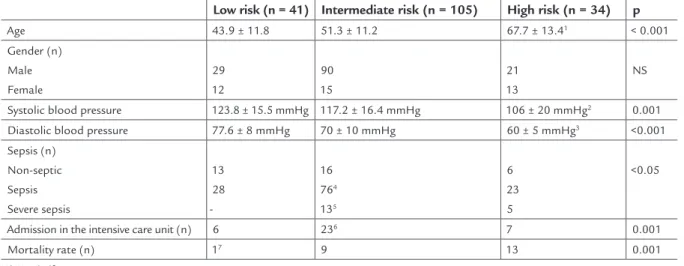
We included 180 patients aged 53.6±10.3 years (means ± SD), 140 males and 40 females, with ascites due to por-tal hypertension. There were no age differences between genders. Nineteen patients died while in hospital. The median time of the admission period of the whole sam-pled individuals was 41 days. The mean age of the pa-tients who died was 52.8 ± 11.1 years (range 43-71). The-re was no The-relation between the Child Pugh and MELD scores. In regard to the complications of portal hyperten-sion, 32 individuals presented spontaneous bacterial pe-ritonitis (SBP) and 18 esophageal variceal bleeding. Pro-longed prothrombin time was not related with variceal bleeding. The features of the patients stratiied by the Child Pugh score are summarized in Table 1.
As shown in Table 1, mortality was not related with age, sex or clinical complications such as SBP or esopha-geal variceal bleeding. Furthermore, this group presen-ted lower casuistic of spontaneous bacterial peritonitis (p <0.0001), esophageal variceal bleeding (0.05) and en-cephalitis (p <0.0001). From the whole sampled indivi-duals with SBP, only 17 presented positive ascites cultu-res to Escherichia coli (n = 10), Klebsiella pneumoniae (n = 4),
Streptococcus viridans (n = 2) and Enterococcus faecalis (n = 1). No particular microbe was related to fatal outcome. On the other hand, Child Pugh C group presented higher rate of mortality (p = 0.04).
TABLE 1 Characteristics of the patients. Quantitative variables are expressed as means ± SD
Low risk (n = 41) Intermediate risk (n = 105) High risk (n = 34) p
Age 43.9 ± 11.8 51.3 ± 11.2 67.7 ± 13.41 < 0.001
Gender(n) Male Female
29 12
90 15
21 13
NS
Systolic blood pressure 123.8 ± 15.5 mmHg 117.2 ± 16.4 mmHg 106 ± 20 mmHg2 0.001
Diastolic blood pressure 77.6 ± 8 mmHg 70 ± 10 mmHg 60 ± 5 mmHg3 <0.001
Sepsis (n) Non-septic Sepsis Severe sepsis
13 28
-16 764
135
6 23 5
<0.05
Admission in the intensive care unit (n) 6 236 7 0.001
Mortality rate (n) 17 9 13 0.001
NS: Not signiicant.
Patients with high risk according to the Child Pugh score were older1 and presented lower levels of systolic2 and diastolic blood3 pressure compared to the remaining groups. On the
other hand, those who were stratiied as intermediate risk, showed a higher rate of sepsis4 and severe sepsis5 with more frequent admission in the intensive care unit.6 However, there
Prediction of in-hospital mortality
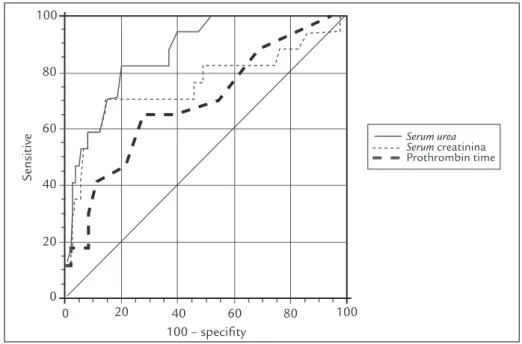
As mentioned above, SBP was not related to in-hospi-tal morin-hospi-tality. We evaluated if SBP caused by microbes isolated from culture was associated with fatal outco-mes, yielding negative results. In relation to biochemi-cal tests, patients who died presented increased levels of serum white blood cell, urea, creatinine, prothrombin time, aspartate aminotransferase and alanine amino-transferase. Also, they had lower ascites albumin con-centration and decreased serum-ascites albumin gra-dient. Then we analyzed the area under the curve (AUC) for each of them, leading to the conclusion that only
serum urea, creatinine and prothrombin time had sta-tistically significant AUC of 87% (95% CI 81.6 to 91.7, p <0.0001), 75% (95% CI 68.9 to 81.7, p = 0.0014) and 69% (95% CI 62.2 to 75.9, p = 0.007), respectively (Fi-gure 1).
Multiple binary logistic regression was conducted to predict in-hospital mortality using the categorical varia-ble Child Pugh, and the continuous variavaria-bles MELD sco-re, level of serum urea, serum creatinine and prothrombin time. The Wald criterion demonstrated that serum urea, se-rum creatinine and prothrombin time made a signiicant contribution to prediction with OR: 14 (95% CI 12.8 - 16.7 p = 0.03), 2 (95% CI 0.5 - 3.47, p = 0.04), and 2 (95% CI 1.03 - 2.31, p = 0.01) linearly-related. The overall model it Chi-squared was 46.3 (p<0.0001) with a
Hosmer-Leme-show test of 4.54 p = 0.8, indicating a good logistic regres-sion model it. The area under the receiver operating cha-racteristic (ROC) curve of the model was 92% (95% CI 87.6 - 95.8).
D
ISCUSSIONAscites develops in approximately 60% of the patients with cirrhosis within 10 years during the course of the di-sease. Its very presence is an indicator of poor prognosis with a mortality approximately of 40% after 1 year, and it is suggested that if ascites is diagnosed, liver transplan-tations should be considered as a treatment option.1,5
Furthermore, scores were developed in order to forecast the requirement of liver transplantation or the mortality risk; however, they were designed for short term predic-tions and not for in-hospital death outcome.2,18-21 In our
work, we analyzed these variables related to the adverse outcome on admission.
None of the scores were useful to predict in-hospital mortality. Also, despite hyponatremia is described as one of the mortality risk factors,5,15,21 it was not related to this
outcome in our casuistic. On the other hand, as it was observed previously,5,21-24 high serum creatinine presented
a signiicant contribution to prediction. We did not in-cluded patients with diagnosis of hepatorenal syndrome, which presents a high mortality rate by itself; however, despite these exclusions, serum creatinine persisted as an
Sensitive
100
80
60
40
20
0
0 20 40 60 80 100
100 – speciity
Serum urea Serum creatinina Prothrombin time
FIGURE 1 Area under the ROC curve for mortality by serum urea, creatinine and prothrombin time.
The associated criterion for serum urea was 0.42 g/L, with sensitivity of 82.4% (95% CI 56.6 to 96.2), speciicity of 79.9% (95% CI 73 to 85.6) and positive likelihood ratio of 4. In the case of serum
indicator of adverse outcome. This variable is used to cal-culate the MELD score; nevertheless, it has limitations as an estimate of glomerular iltration rate in cirrhosis, so the score possible underestimates the mortality risk in patients with ascites.
Although, similarly to other authors, we observed that
serum creatinine is related to mortality, we found two other variables related to the adverse outcome. Prolonged pro-thrombin time presented a low AUC of 69% with an odds ratio of 2. This risk factor was not related to esophageal variceal bleeding but it is associated with liver dysfunction, which increases the probability of death in the short term. Last, the other risk factor with a great AUC of 87% and an odds ratio of 14, was higher level of serum urea. This varia-ble was not described previously as a predictor of morta-lity in patients with ascites caused by cirrhosis and it is not included in the scores. Despite serum urea level might in-crease due to hemorrhage, in our casuistry only 18 indivi-duals presented digestive bleeding (esophageal variceal bleeding), most of them in the surviving patient group.
Considering our results, in-hospital mortality was re-lated to acute renal failure with increased levels of serum urea and creatinine and prolonged prothrombin time.
C
ONCLUSIONOur results suggest that acute renal failure and prolonged prothrombin time are predictors of in-hospital mortality in patients with portal hypertension due to alcoholic cir-rhosis, despite Child Pugh category or clinical presentation.
L
IMITATION OF THE STUDYOur study was performed in a single center with a relati-vely reduced sample size. Also, because it is a cross-sectio-nal study, it is dificult to establish the role of the determi-ned variables as risk factors for in-hospital mortality.
A
CKNOWLEDGMENTSThis work was sponsored by National Coastal University, Argentina. Miguel H. Vicco and Luz Rodeles are resear-cher fellows of the National Scientiic and Technical Re-search Council.
R
ESUMOFatores de risco de mortalidade intra-hospitalar em pa-cientes com ascite por cirrose hepática.
Introdução: ascite é uma das complicações mais comuns
de cirrose associadas a uma elevada taxa de mortalidade. Embora vários escores tenham sido desenvolvidos a im
de avaliar o prognóstico da doença, eles foram concebi-dos para prever requisitos de transplante de fígado e mor-talidade a curto prazo, mas não durante a internação. O objetivo deste estudo foi o de pesar fatores de risco para a mortalidade intra-hospitalar em pacientes adultos com ascite decorrente de cirrose alcoólica.
Material e métodos: foi realizado um estudo
transver-sal em 180 pacientes adultos com diagnóstico de cirrose com hipertensão portal, associada à alta ingestão de ál-cool. O diagnóstico de cirrose foi feita por ecograia he-pática e a hipertensão portal foi determinada por caracte-rísticas clínicas e pelo gradiente de albumina soro-ascite. Indivíduos avaliados foram submetidos a exame clínico completo. A classiicação de Child-Pugh e a escala MELD foram aplicadas em todos os pacientes.
Resultados: dezenove pacientes morreram durante a
in-ternação. A mortalidade foi associada ao aumento dos níveis de glóbulos brancos, ureia, creatinina, aspartato aminotransferase, alanina aminotransferase e tempo de protrombina prolongado. Realizamos uma logística bi-nária múltipla para prever a mortalidade intra-hospita-lar, que conirmou que ureia, creatinina e tempo de pro-trombina contribuíram signiicativamente para a previsão, com uma OR = 14 (IC 95% 12,8-16,7 p = 0,03), 2 (IC 95% 0,5-3,47, p = 0,04), e 2 (IC 95% 1,03-2,31, p = 0,01), rela-cionada linearmente.
Conclusões: nossos resultados sugerem que a
insuiciên-cia renal aguda e de tempo de protrombina prolongado são preditores de mortalidade intra-hospitalar em pacien-tes com hipertensão portal decorrente de cirrose alcoólica.
Palavras-chave: ascite, alcoólico, cirrose hepática, mor-talidade hospitalar.
R
EFERENCES1. Ginés P, Quintero E, Arroyo V, Terés J, Bruguera M, Rimola A, et al. Compensated cirrhosis: natural history and prognostic factors. Hepatology 1987;7:122-28.
2. Runyon BA. Management of adult patients with ascites due to cirrhosis: update 2012. Hepatology. 2009; 49(6):2087-107.
3. Planas R, Montoliu S, Balleste B, Rivera M, Miguel M, Masnou H, et al. Natural history of patients hospitalized for management of cirrhotic ascites. Clin Gastroenterol Hepatol 2006;4:1385-394.
4. Lucena MI, Andrade RJ, Tognoni G, Hidalgo R, de la Cuesta FS, Fraile JM, et al. Multicenter hospital study on prescribing patterns for prophylaxis and treatment of complications of cirrhosis. Eur J Clin Pharmacol 2002;58:435-40.
5. Marchesini G, Bianchi G, Amodio P, Salerno F, Merli M, Panella C, et al. Factors associated with poor health-related quality of life of patients with cirrhosis. Gastroenterology 2001;120:170-178.
6. Moller S, Henriksen JH. The systemic circulation in cirrhosis. In: Ginès P, Arroyo V, Rodés J, Schrier RW, editors. Ascites and renal dysfunction in liver disease. Malden: Blackwell; 2005. p. 139-55.
renal dysfunction in liver disease: pathogenesis, diagnosis and treatment. Malden: Blackwell; 2005. p. 260-70.
8. Ginès P, Schrier RW. Renal failure in cirrhosis. N Engl J Med 2009;361:1279-90. 9. Llach J, Ginès P, Arroyo V, Rimola A, Titó L, Badalamenti S, et al. Prognostic
value of arterial pressure, endogenous vasoactive systems and renal function in cirrhotic patients admitted to the hospital for the treatment of ascites. Gastroenterology 1988;94:482-87.
10. Moore KP, Wong F, Gines P, Bernardi M, Ochs A, Salerno F, et al. The management of ascites in cirrhosis: report on the consensus conference of the International Ascites Club. Hepatology 2003; 38(1):258-66.
11. Arroyo V, Ginès P, Gerbes AL, Dudley FJ, Gentilini P, Lafi G, et al. Deinition and diagnostic criteria of refractory ascites and hepatorenal syndrome in cirrhosis. Hepatology 1996; 23:164-76.
12. Salerno F, Gerbes A, Ginès P, Wong F, Arroyo V. Diagnosis, prevention and treatment of hepatorenal syndrome in cirrhosis. Postgrad Med J. 2008; 84(998):662-70.
13. Myers RP, Quan H, Hubbard JN, Shaheen AA, Kaplan GG. Predicting in-hospital mortality in patients with cirrhosis: results differ across risk adjustment methods. Hepatology 2009; 49(2):568-77.
14. Lippi G, Danese E, Cervellin G, Montagnana M. Laboratory diagnostics of spontaneous bacterial peritonitis. Clin Chim Acta 2014; 430C:164-70. 15. Kim WR, Biggins SW, Kremers WK, Wiesner RH, Kamath PS, Benson JT, et
al. Hyponatremia and mortality among patients on the liver transplant waiting list. N Engl J Med 2008; 359:1018-26.
16. Chaulk J, Carbonneau M, Qamar H, Keough A, Chang HJ, Ma M, et al. Third-generation cephalosporin-resistant spontaneous bacterial peritonitis: A single-centre experience and summary of existing studies. Can J Gastroenterol Hepatol 2014; 28(2):83-8.
17. European Association for the Study of the Liver. EASL clinical practice guidelines on the management of ascites, spontaneous bacterial peritonitis, and hepatorenal syndrome in cirrhosis. J Hepatol 2010; 53(3):397-417. 18. Rahimi-Dehkordi N, Nourijelyani K, Nasiri-Tousi M, Ghodssi-Ghassemabadi
R, Azmoudeh-Ardalan F, Nedjat S. Model for End stage Liver Disease (MELD) and Child-Turcotte-Pugh (CTP) scores: Ability to predict mortality and removal from liver transplantation waiting list due to poor medical conditions. Arch Iran Med. 2014; 17(2):118-21.
19. Guardiola J, Baliellas C, Xiol X, Fernandez EG, Ginès P, Ventura P, et al. External validation of a prognostic model for predicting survival of cirrhotic patients with refractory ascites. Am J Gastroenterol 2002; 97:2374-2378.
20. Kamath PS, Wiesner RH, Malinchoc M, Kremers W, Therneau TM, Kosberg CL, et al. A model to predict survival in patients with end-stage liver disease. Hepatology 2001; 33:464-70.
21. Durand F, Valla D. Assessment of prognosis in cirrhosis. Semin Liver Dis 2008; 28:110-22.
22. Rimola A, Gracia-Tsao G, Navasa M, et al. Diagnosis, treatment and prophylaxis of spontaneous bacterial peritonitis: a consensus document. International Ascites Club. J Hepatol 2000; 32:142-53.
23. Caregaro L, Menon F, Angeli P, et al. Limitations of serum creatinine level and creatinine clearance as iltration markers in cirrhosis. Arch Intern Med 1994; 154:201-5.
24. Terg R, Gadano A, Cartier M, Casciato P, Lucero R, Muñoz A, et al. Serum