Generic versus branded enoxaparin in prophylaxis and treatment
of vein thrombosis
IVAN BENADUCE CASELLA1*, PEDRO PUECH-LEÃO2
1Physician and Collaborating Professor, Faculty of Medicine, University of São Paulo (FMUSP), São Paulo, SP, Brazil 2Full Professor, Vascular Surgery, FMUSP, São Paulo, SP, Brazil
S
UMMARYStudy conducted by the Department of Vascular and Endovascular Surgery – FMUSP (São Paulo)
Article received: 5/7/2014 Accepted for publication: 6/3/2014
*Correspondence: Address: Rua Dr. Ovídio Pires de Campos,
225 – PAMB 6th loor, Block 5
Cerqueira César Postal code: 05403-010 São Paulo – SP – Brazil [email protected]
http://dx.doi.org/10.1590/1806-9282.61.01.044
Financial support: The research was funded by Aspen Labs. The authors did not receive inancial support for the authorship or publication of this article.
Conflict of interest: none
Objectives: to compare the biological efficacy of generic enoxaparin (Heptron™) versus branded Sanofi-Aventis enoxaparin for prophylaxis and treatment of
low-er-extremity deep venous thrombosis (DVT) in a prospective, randomized, open-label study.
Methods: patients with diagnosed lower-extremity DVT (therapeutic branch, n=57) and patients requiring venous thromboembolism (VTE) prophylaxis af-ter araf-terial vascular surgery or major lower-extremity amputations (prophylac-tic branch, n=57) were randomized to receive generic or branded enoxaparin for up to seven days. Enoxaparin activity was measured by estimating blood anti-fac-tor Xa levels at the peak plasma concentration. As secondary outcomes, develop-ment or progression of VTE events, major adverse events and major bleeding events were considered for efficacy and safety comparisons.
Results: DVT therapy: twenty-five patients received generic enoxaparin while 32 received branded enoxaparin (subcutaneous, 1 mg/kg BID). Mean percentages of anti-factor Xa levels within the target ranges were 62 ± 35.4% and 67.5 ± 24.7%, respectively (p= .035 for non-inferiority). No patient presented DVT progression, clinically detectable pulmonary embolism, or major bleeding events in any sub-group. DVT prophylaxis: Thirty patients received generic enoxaparin and 27 re-ceived branded enoxaparin (subcutaneous, 40 mg/day). Mean percentages of an-ti-factor Xa levels within the target ranges were 77.9 ± 30.9% and 77.8 ± 32.9%, respectively (p = .009 for non-inferiority). There were no cases of VTE or major bleeding events in any subgroup.
Conclusion: generic and branded enoxaparins exhibited similar in vivo respons-es as measured by the anti-factor Xa activity, as well as similar clinical efficacy and safety outcomes.
Keywords: enoxaparin, controlled clinical trial, biosimilar pharmaceuticals.
INTRODUCTION
Low-molecular-weight heparins (LMWH) are a class of antithrombotic drugs that are widely used for the pro-phylaxis and treatment of deep venous thrombosis (DVT). Meta-analyses have confirmed that LMWH shows supe-rior efficacy to unfractionated heparin for the prevention and treatment of DVT.1,2 The pharmacologic properties
of LMWH enable longer intervals between doses and pro-vide more predictable plasma concentrations, dimini-shing the need for laboratory monitoring.
In recent years, bioequivalent (also described as ‘gene-ric’) preparations of LMWH have been introduced to the
market, leading to cost reductions and increased access to this class of drugs.3 However, unlike purely chemical
gene-ric drugs, LMWHs comprise a variable pool of similar mo-lecules from biological origin within an expected range of molecular weights that may differ between manufacturers or even among batches from a single manufacturer.
OBJECTIVES
The primary objective of this study was to compare the in vivo biological efficacy of generic enoxaparin
(Hep-tron™, Aspen Pharma; hereafter generic enoxaparin) with that of a branded preparation of enoxaparin (ClexaneTM
or LovenoxTM; Sanofi-Aventis; hereinafter, branded
eno-xaparin) for prophylaxis and treatment of lower-limb DVT by estimating blood anti-factor Xa levels measured at peak plasma enoxaparin concentration. Secondary out-comes included the clinical efficacy and safety of each preparation used for prophylaxis and treatment of DVT.
METHODS
Study design and patients
The study was designed as a single-center, prospective, ran-domized open-label study of patients who received enoxa-parin for prophylaxis or treatment of lower-limb DVT. The study was approved by the local ethics committee and all patients included signed informed consent forms.
Patients who received enoxaparin for treatment of DVT had ultrasound-confirmed diagnosis of lower-limb DVT, and had no contraindications to full anticoagula-tion or heparin. Patients with both proximal (87.7%) and distal DVT were included. Patients given enoxaparin for prophylaxis had vascular diseases and were at high risk of developing venous thromboembolism (VTE) after ma-jor vascular surgery (open or endovascular aortic aneu-rism repair, aortoiliac and infrainguinal bypass graft sur-geries, infrainguinal endovascular revascularizations and major amputations). These patients had no contraindi-cations to prophylactic anticoagulation or heparin.
Patients with grade II-III obesity (body mass index ≥35 kg/m2) or advanced chronic renal insufficiency
(esti-mated creatinine clearance ≤30 mL/min) were excluded from this study.
Patients in the prophylaxis and treatment groups were randomly allocated into two subgroups to receive either generic or branded enoxaparin. The sample size was ini-tially calculated based on the primary outcome and was estimated to be 120 patients (considering a maximum of 15% post-randomization exclusion rate), with 60 indivi-duals included in each of the prophylaxis and treatment groups, and 30 patients randomized to each drug.
PROCEDURES
After randomization, patients in the treatment group re-ceived a subcutaneous injection of 1 mg/kg of the allo-cated type of enoxaparin twice daily (usually at 9 a.m. and 9 p.m.). Blood samples were collected daily approxima-tely 4 hours after administration of the morning dose of
enoxaparin, corresponding to the expected peak plasma concentration,4 to determine anti-factor Xa activity. Oral
warfarin was generally started on day 1 or 2 of enoxapa-rin administration at an initial daily dose of 5 mg, and was adjusted according to the prothrombin time/inter-national normalized ratio (INR) value. Patients received enoxaparin until their INR reached 2-3 and were then dis-charged. Anti-factor Xa levels were measured during this period or for up to 7 days.
Similar procedures were used in the prophylaxis group, except for the different LMWH dose of 40 mg once daily (usually at 9 a.m.). These patients were not gi-ven warfarin and they were followed until discharge or for up to 7 days. Prophylaxis was generally started 1-2 days after surgery, at the surgeon’s discretion.
All patients were clinically evaluated every day to as-sess the evolution of DVT, to identify possible signs/symp-toms of pulmonary embolism, and to detect hemorrha-gic and non-hemorrhahemorrha-gic adverse events. All patients underwent Doppler ultrasound (DU) on the first and last days of the study period. In the treatment group, DU was performed to confirm the diagnosis of DVT and to deter-mine whether the extent of thrombosis had progressed at discharge. In the prophylactic group, DU was perfor-med to confirm the absence of DVT at the start and end of the study period.
Anti-factor Xa activity was determined using a chro-mogenic assay (TriniCHROM Heparin; Tcoag Labora- tories,Wicklow, Ireland).
Hemoglobin and hematocrit levels, platelet count and creatinine levels were obtained on a daily basis in all patients to detect signs of occult blood loss, heparin-in-duced thrombocytopenia, renal function impairment or other possible complications.
ANTI-FACTOR XA OUTCOMES
The desired ranges of anti-factor Xa levels were 0.2-0.6 U/ mL for prophylaxis5,6 and 0.6-1.0 U/mL for treatment
ba-sed on calibrated values in our clinical laboratories and according to the values used in a prior study.4 The
per-centage of anti-factor Xa measurements within the desi-red ranges was calculated for each patient by dividing the number of anti-factor Xa measurements within the desi-red range by the total number of measurements for the individual patient.
CLINICAL OUTCOMES
detec-table pulmonary embolism. In the prophylaxis group, cli-nical efficacy was defined as the absence of DVT and/or clinically detectable pulmonary embolism.
Safety was defined as the absence of spontaneous bleeding after starting enoxaparin, the absence of hepa-rin-induced thrombocytopenia, and the absence of ad-verse events that could be attributed to enoxaparin.
STATISTICAL ANALYSIS
Chi-square/Fisher’s test was used to compare categorical variables and Mann-Whitney U test was used to compa-re quantitative variables between generic and branded enoxaparin. Values of p <0.05 were considered statisti-cally significant. Non-inferiority of generic enoxaparin for the primary outcome was tested using unilateral hypo-thesis (z) test.
RESULTS
Patient distribution
Sixty-four patients were initially randomized for DVT prophylaxis and 56 for DVT therapy. The distribution of patients is detailed in Table 1. Five patients in the pro-phylaxis group were removed from the study after rando-mization but before receiving a dose of enoxaparin, due to acute worsening of renal function 1-2 days after sur-gery (n = 4) or a higher dose of enoxaparin being reques-ted by the surgeon (n = 1). These patients were not inclu-ded in the statistical analyses. One patient in the prophylaxis group withdrew informed consent after one dose of enoxaparin and was not included in statistical analyses. One patient in the prophylaxis group was ran-domized, but was diagnosed with calf DVT by ultrasound immediately after surgery. Since enoxaparin had not been
administered before detection of DVT, this patient was transferred to the treatment group. All of the patients in the prophylaxis group had Caprini scores ≥5 (mean 8.77, range 5-11), representing high risk of developing VTE.
Serious adverse events (SAE) occurred in 14 patients, five occurring previous to enoxaparin administration. All affected patients were from the prophylactic group and in nine cases, SAE led to early interruption of the proto-col or patient withdrawal before administering enoxapa-rin. The most common SAE was acute postoperative wor-sening of renal function (4 cases) but there was also clinical worsening of chronic limb ischemia (2), transi-tory cognitive impairment (2), paralytic ileus, wound in-fection, decrease in hemoglobin levels, suspicion of pseu-doaneurysm (unconfirmed), arterial thrombosis (limb).
DVT prophylaxis
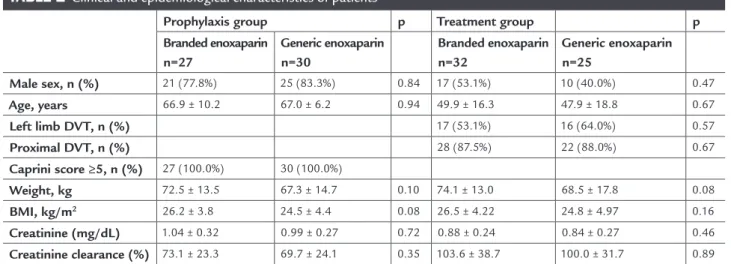
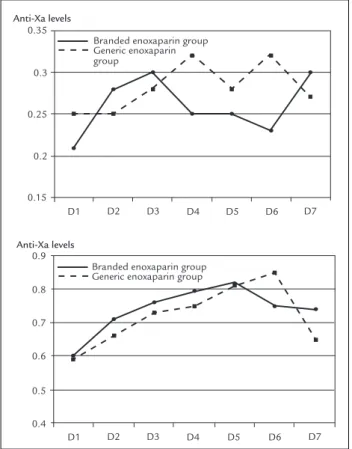
Fifty seven patients received enoxaparin for prophylaxis, with 30 allocated to generic and 27 to branded enoxapa-rin. Sex distribution, age, and clinical characteristics of both subgroups were similar (Table 1). The surgical pro-cedures performed are summarized in Table 2. The mean anti-factor Xa levels were 0.28 ± 0.15 U/mL and 0.26 ± 0.12 U/mL in the generic and branded enoxaparin sub-groups, respectively (p = .83, Table 3). The mean percen-tages of anti-factor Xa levels within the target ranges were 77.9 ± 30.9% and 77.8 ± 32.9%, respectively (p = .009 for non-inferiority, Table 3). As shown in Figure 1, the mean daily variation in anti-factor Xa levels was not significan-tly different between the two subgroups of patients.
None of the patients in either group developed DVT or clinically detectable pulmonary embolism. DU perfor-med before discharge confirperfor-med the absence of DVT in
TABLE 1 Clinical and epidemiological characteristics of patients
Prophylaxis group p Treatment group p
Branded enoxaparin n=27
Generic enoxaparin n=30
Branded enoxaparin n=32
Generic enoxaparin n=25
Male sex, n (%) 21 (77.8%) 25 (83.3%) 0.84 17 (53.1%) 10 (40.0%) 0.47
Age, years 66.9 ± 10.2 67.0 ± 6.2 0.94 49.9 ± 16.3 47.9 ± 18.8 0.67
Left limb DVT, n (%) 17 (53.1%) 16 (64.0%) 0.57
Proximal DVT, n (%) 28 (87.5%) 22 (88.0%) 0.67
Caprini score ≥5, n (%) 27 (100.0%) 30 (100.0%)
Weight, kg 72.5 ± 13.5 67.3 ± 14.7 0.10 74.1 ± 13.0 68.5 ± 17.8 0.08
BMI, kg/m2 26.2 ± 3.8 24.5 ± 4.4 0.08 26.5 ± 4.22 24.8 ± 4.97 0.16
Creatinine (mg/dL) 1.04 ± 0.32 0.99 ± 0.27 0.72 0.88 ± 0.24 0.84 ± 0.27 0.46
Creatinine clearance (%) 73.1 ± 23.3 69.7 ± 24.1 0.35 103.6 ± 38.7 100.0 ± 31.7 0.89
TABLE 2 Surgeries performed in patients from the prophylactic group
N (%) p Overall Frequency (%)
Subgroups Generic Branded
Infrainguinal bypass graft 10 (58.8) 7 (41.2) .74 17 (29.8) Aortoiliac bypass graft 9 (56.3) 7 (43.8) .96 16 (28.1)
EVAR 4 (50.0) 4 (50.0) .82 08 (14.0)
Major amputations 4 (57.1) 3 (42.9) .88 07 (12.3)
Infrainguinal PTA 2 (33.3) 4 (66.7) .56 06 (10.5)
Other 1 (33.3) 2 (66.7) .92 03 (5.3)
EVAR: endovascular aortic aneurism repair; PTA: percutaneous transluminal angioplasty.
TABLE 3 Comparison of the results between generic and branded enoxaparin
Prophylaxis group Treatment group All patients Branded
enoxaparin
Generic enoxaparin
Branded enoxaparin
Generic enoxaparin
Branded enoxaparin
Generic enoxaparin
n 27 30 32 25 59 55
Total number of doses administered 119 141 344 256 463 397
Doses/patient (mean) 4.4 4.7 10.7 10.2 7.8 7.2
p 0.51 0.39
Percent age of anti-f actor Xa measurements within the desired target range
77.8 ± 32.9 77.9 ± 30.9 67.5 ± 24.7 62.0 ± 35.4 72.2 ± 29.0 70.7 ± 33.7
p 0.87 0.87
95% CI for non-inferiority* -14.276 to 14.039 -7.787 to 18.893 p for non-inferiority* 0.009 0.035
Mean anti-factor Xa level, U/mL 0.26 ± 0.12 0.28 ± 0.15 0.74 ± 0.18 0.71 ± 0.23 N/A N/A
p 0.83 0.79
VTE development 0/27 0/30 N/A N/A
DVT progression N/A N/A 0/32 0/35
Clinically detectable PE 0/27 0/30 0/32 0/35
Major bleeding 0/27 0/30 0/32 0/35
Major adverse events (after first dose administration)
3/27 6/30 0/32 0/35
all of the patients. Furthermore, none of the patients ex-perienced major or minor bleeding, or heparin-induced thrombocytopenia.
There were nine SAE after the first dose of any of the enoxaparins was administered, of which four required discontinuation of enoxaparin administration (2 for each subgroup). Only one event, in a patient treated with bran-ded enoxaparin was considered possibly related to the study drug (a fall in hemoglobin levels without clinical or radiological evidence of bleeding). The occurrence of SAEs was not significantly different (p = .57) between the two subgroups.
DVT treatment
Fifty seven patients were enrolled in the treatment group, with 25 randomized to generic and 32 to branded enoxa-parin, respectively. Sex distribution, age, and clinical cha-racteristics were similar in both subgroups (Table 1). The clinical results in both subgroups are presented in Table 3. The mean anti-factor Xa levels were 0.71 ± 0.23 U/mL and 0.74 ± 0.18 U/mL in the generic and branded sub-groups, respectively (p = .79). The mean percentages of anti-factor Xa levels within the target range were 62.0% ±
35.4% and 67.5% ± 24.7%, respectively (p = .035 for non--inferiority). As shown in Figure 1, the mean daily varia-tion in anti-factor Xa levels was not significantly diffe-rent between the two subgroups of patients.
None of the patients in either subgroup showed wor-sening of DVT symptoms or clinically detectable pulmo-nary embolism. DU performed before discharge revealed no evidence of thrombus progression in any patient. The-re weThe-re no cases of major or minor bleeding, or heparin in-duced-thrombocytopenia. Additionally, there were no se-rious adverse events in any patient of the therapeutic group.
DISCUSSION
Many invitro and/or pharmacologic/pharmacokinetic studies have been performed to compare branded and ge-neric enoxaparin preparations. However, very few clini-cal studies have been conducted to compare such drugs. To our knowledge, only two clinical studies have compa-red generic and branded enoxaparin preparations for pre-venting VTE in high-risk patients.
Gomes et al.9 compared branded enoxaparin
(Sano-fi-Aventis) and generic enoxaparin for VTE prophylaxis in 170 patients undergoing abdominal surgery, and re-ported that the two preparations had similar efficacy and safety profiles. Lage et al.10 also compared branded and
generic LMWH for prophylaxis and treatment in inten-sive care unit patients, with clinical efficacy and safety be-ing the main outcomes. Anti-factor Xa levels were also compared as a secondary outcome, but not every day. In the study by Lage et al.,10 VTE prophylaxis was generally
indicated for clinical conditions rather than postopera-tive states. The efficacy and safety profiles of both prepa-rations in that study were similar.
To our knowledge, the present study was the first to determine daily variations in anti-factor Xa levels, and the only one to include individuals using enoxaparin, both for postoperative prophylaxis of VTE and treatment of DVT.
There are many reasons why we chose anti-factor Xa activity as the primary outcome in this study. First, it re-flects the biological response of the coagulation system to enoxaparin, independently of the clinical indication or the patient’s clinical status. Second, it is a more sensi-tive marker for the drug’s biological activity compared with clinical evaluation, particularly because many pa-tients with inappropriate anti-factor Xa levels will not ne-cessarily experience development or progression of VTE, or hemorrhagic events. Anti-factor Xa levels were measu-red 562 times in the present study, providing a solid base for the biological comparisons of drug responses.
Branded enoxaparin group 0.35
0.3
0.25
0.2
0.15
0.4 0.5 0.6 0.7 0.8 0.9
D1 D2 D3 D4 D5 D6 D7
D1 D2 D3 D4 D5 D6 D7
Anti-Xa levels
Generic enoxaparin group
Branded enoxaparin group Generic enoxaparin group
Anti-Xa levels
CONCLUSION
The generic and branded enoxaparin preparations used in the present study exhibited similar values of anti-fac-tor Xa levels along the study period, in patients adminis-tered with prophylactic enoxaparin to prevent postope-rative VTE and in patients administered with enoxaparin to treat DVT.
RESUMO
Enoxaparina genérica versus padrão-ouro na terapia e pro-filaxia de trombose venosa.
Objetivos: comparar a eficácia biológica da enoxapari-na genérica (Heptron™) versus enoxaparina Sanofi-Aven-tis na profilaxia e no tratamento da trombose venosa profunda (TVP) de membros inferiores em ensaio pros-pectivo, randomizado e não cego.
Método: pacientes com diagnóstico de TVP de mem-bros inferiores (grupo terapêutico, n = 57) e pacientes com indicação de profilaxia de tromboembolismo ve-noso (TEV), após cirurgias vasculares de grande porte ou amputações maiores (grupo profilático, n = 57), fo-ram randomizados para receber a enoxaparina sob tes-te (Heptron™) ou a droga padrão-ouro (Sanofi-Aventis). A atividade da enoxaparina foi mensurada pela análise diária da atividade antifator-Xa no pico de concentra-ção plasmática das drogas. Foram coletados dados de ocorrência ou progressão de TVP/TEV, eventos adver-sos graves e sangramentos graves; e foram utilizados para a análise de eficácia e segurança clínica como obje-tivos secundários.
Resultados: grupo terapêutico: 25 pacientes receberam enoxaparina genérica, e 32, a droga padrão-ouro (via subcutânea, 1 mg/kg, a cada 12 horas). Os percentuais médios de atividade antifator-Xa dentro dos limites te-rapêuticos foram de 62 ± 35,4% e 67,5 ± 24,7%, respec-tivamente (p = 0,035, para não inferioridade). Nenhum paciente apresentou progressão da TVP, embolia pul-monar clinicamente detectável ou sangramentos maio-res. Grupo profilático: trinta pacientes receberam eno-xaparina genérica, e 27, a droga padrão-ouro (via subcutânea, 40 mg/dia). Os percentuais médios de ati-vidade antifator-Xa dentro dos limites terapêuticos fo-ram de 77,9 ± 30.9% e 77,8 ± 32,9%, respectivamente (p = 0,009, para não inferioridade). Nenhum paciente de-senvolveu TVP ou apresentou sangramentos maiores.
Conclusão: enoxaparinas genéricas e de marca apresen-taram respostas semelhantes em estudos in vivo, quan-Nevertheless, anti-factor Xa levels should be
con-sidered as a surrogate marker for the clinical response to LMWH therapy. Bara et al.11 found that anti-factor
Xa activity did not predict the development or progres-sion of VTE. It must be kept in mind that the objecti-ve of measuring anti-factor Xa leobjecti-vels is to facilitate dose adjustment and to optimize the risk/benefit of LMWH, since bleeding and VTE are influenced by multiple fac-tors and may occur despite optimal antithrombotic therapy.
Candidates for vascular surgeries generally present with very high risk of VTE12 because they commonly have
multiple risk factors, including poor mobility, lengthy post-operative recovery time, advanced age, chronic obs-tructive pulmonary disease and cardiovascular disease. Even non-arterial procedures with short procedural ti-mes, such as below and above-knee amputations, are as-sociated with a high incidence of DVT in the stump or contralateral limb, with a cumulative rate of 28% in 35 days, in the absence of pharmacological prophylaxis.13 In
the present study, all of the patients in the prophylaxis group had Caprini scores of ≥5, corresponding to high risk of developing VTE.
Once the sample size was estimated for the antifac-tor-Xa comparison, the clinical efficacy and safety outco-mes must be interpreted with caution. None of the pa-tients in the treatment group showed thrombus progression after starting enoxaparin or clinical signs of pulmonary embolism. Furthermore, none of the patients developed major bleeding or SAEs that could be clearly attributed to the treatment received. However, in the prophylaxis group, the short follow-up time (up to 7 days) limited our ability to evaluate the incidence of postoperative VTE in this patient population.
Although no immunologic tests were performed to determine heparin-induced thrombocytopenia, there were no marked decreases in daily platelet counts suggestive of heparin-induced thrombocytopenia in any patient, nor were there any clinical signs or symptoms of this compli-cation.
do medidas pela atividade do anti-fator Xa, assim como eficácia clínica e dados de segurança similares.
Palavras-chave: ensaio clínico controlado, enoxaparina, medicamentos biossimilares.
REFERENCES
1. Leizorovicz A, Simmonneau G, Decousus J, et al. Comparison of efficacy and safety of low molecular weight heparins and unfractionated heparin in initial treatment of deep venous thrombosis: a meta-analysis. BMJ 1994;309:299-304.
2. Lensing AWA, Prins MH, Davidson BL, et al. Treatment of deep venous thrombosis with low-molecular-weight heparins. Arch Intern Med 1995;155:601-607.
3. Fareed J, Leong WL, Hoppensteadt DA, et al. Generic Low-Molecular-Weight Heparins: Some Practical Considerations. Semin Thromb Hemost 2004;(30):703-13.
4. Gehrie E, Laposata M. Test of the month: The chromogenic antifactor Xa assay. Am J Hematol. 2012;(87):194-196.
5. Rowan BO, Kuhl DA, Lee MD, et al. Anti-Xa levels in bariatric surgery patients receiving prophylactic enoxaparin. Obes Surg. 2008;18(2):162-6.
6. Enoxaparin. DRUGDEXTM System. Greenwood Village, CO:Thomson Micromedex, 2006 Feb.http://www.thomsonhc.com.(accessed december 2008) 7. Glauser BF, Vairo BC, Oliveira CPM, et al. Generic versions of enoxaparin available for clinical use in Brazilare similar to the original drug. J Thromb Haemost 2011; 9:1419-22.
8. Lima MA, de Farias EH, Gray A, et al. Structural and pharmacological profile of generic enoxaparins used inBrazil. Clin Appl Thromb Hemost. 2012;18(4):379-86.
9. Gomes M, Ramacciotti E, Henriques AC, et al. Generic versus branded enoxaparin in the prevention of venous thromboembolism following major abdominal surgery: report of an exploratory clinical trial. Clin Appl Thromb Hemost. 2011;17(6):633-9.
10. Lage SG, Carvalho RT, Kopel L, et al. Safety and efficacy of sodium enoxaparin in anti-thrombotic prophylaxis and treatment. Rev Bras Ter Intensiva. 2007;19(1):67-73.
11. Bara L, Planes A, Samama MM. Occurrence of thrombosis and haemorrhage, relationship with anti-Xa, anti-IIa activities, and D-dimer plasma levels in patients receiving a low molecular weight heparin, enoxaparin or tinzaparin, to prevent deep vein thrombosis after hip surgery. Br J Haematol. 1999;104(2):230-40. 12. Mommertz G, Sigala F, Glowka TR, et al. Differences of venous thromboembolic
risks in vascular general and trauma surgery patients. J Cardiovasc Surg (Torino). 2007;48(6):727-33.