Official Journal of the Brazilian Psychiatric Association Volume 34 • Number 4 • December/2012
Psychiatry
Revista Brasileira de Psiquiatria
Abstract
Objective: One of the factors associated with low rates of compliance in the treatment for alcoholism seems to be the intensity of craving for alcohol. This study aimed to evaluate the associations between alcohol craving and biopsychosocial addiction model-related variables and to verify whether these variables could predict treatment retention. Methods: The sample consisted of 257 male alcoholics who were enrolled in two different pharmacological trials conducted at the Universidade de São Paulo in Brazil. Based on four factors measured at baseline – biological (age, race, and family alcoholism), psychiatric (depression symptoms), social (inancial and marital status), and addiction (craving intensity, severity of alcohol dependence, smoking status, drinking history, preferential beverage, daily intake of alcohol before treatment) – direct logistic regression was performed to analyze these factors’ inluence on treatment retention after controlling for medication groups and AA attendance. Results: Increasing age, participation in Alcoholics Anonymous groups, and beer preference among drinkers were independently associated with higher treatment retention. Conversely, higher scores for depression increased dropout rates.
Conclusion: Health services should identify the treatment practices and therapists that improve retention. Information about patients’ characteristics linked to dropouts should be studied to render treatment programs more responsive and attractive, combining pharmacological agents with more intensive and diversiied psychosocial interventions.
Psychosocial and clinical predictors of retention
in outpatient alcoholism treatment
João Maria Corrêa Filho,
1Danilo Antonio Baltieri
1,21Department of Psychiatry of the Universidade de São Paulo, Brazil
2Department of Psychiatry of Faculdade de Medicina do ABC, Santo André, SP, Brazil
Submitted on January 17, 2012; accepted on March 19, 2012
DESCRIPTORS:
Pharmacological Trials; Craving;
Alcoholics Anonymous Groups;
Psychosocial Interventions
ORIGINAL ARTICLE
Corresponding author: Danilo Antonio Baltieri. Avenida Angélica, no. 2100, conjunto 13. CEP: 01228-200. São Paulo, SP, Brazil. Phone: (+55 11) 3120-6896. E-mail: [email protected]
Preditores psicossociais e clínicos de retenção ao tratamento para alcoolismo
Resumo
Objetivo: Um dos fatores associados com baixas taxas de adesão ao tratamento para alcoolismo parece ser a intensidade da issura pelo álcool. Este estudo objetiva avaliar a associação entre a issura pelo álcool e variáveis relacionadas ao modelo biopsicossocial de dependência, bem como veriicar se estas variáveis prevêem retenção ao tratamento. Método: A amostra foi composta por 257 homens dependentes de álcool que participaram de dois diferentes estudos clínicos que foram desenvolvidos na Universidade de São Paulo, Brasil. Baseado em quatro fatores medidos no início do tratamento – biológico (idade, raça e alcoolismo familiar), psiquiátrico (sintomas depressivos), social (condição econômica e status marital) e relacionado à dependência (intensidade da issura, gravidade da dependência do álcool, status de ser fumante, tempo de consumo regular e problemático de bebidas alcoólicas, bebida preferencial, quantidade de etanol consumido ao dia) – um modelo de regressão logística direta foi desenvolvido para analisar o efeito destas variáveis sobre a retenção ao tratamento, controlando para a inluência das medicações utilizadas e da participação em grupos de alcoólicos anônimos. Resultados: Mais idade, participação em grupos de alcoólicos anônimos e preferência por cerveja foram fatores independentemente associados a maior retenção ao tratamento. Maior escore em depressão aumentou a chance de abandono.
Conclusão: Serviços de saúde devem identiicar práticas e proissionais que proporcionem melhora nas taxas de retenção. Informação sobre as características dos pacientes relacionadas ao abandono devem ser usadas para tornar programas de tratamento mais eicientes e atraentes, combinando agentes farmacológicos com mais intensivas e diversiicadas intervenções psicossociais.
DESCRITORES:
Estudos clínicos; Fissura;
Grupos de Alcoólicos Anônimos;
Intervenções Psicossociais.
Introduction
The rates of compliance with treatment for alcoholism are as low as those for other chronic medical disorders. Poor treat-ment adherence represents a reduction in quality of life and a loss of life years for many patients. Over the last 30 years,
researchers have identiied several client-centered factors
associated with early discontinuation of substance abuse treatment, such as youth, single social status, high severity of substance use, family alcoholism, and depression. With regard to treatment-centered factors, negative therapeutic alliance, low clinician experience, and inadequate engage-ment of family members in treatengage-ment have been associated with high rates of treatment abandonment and relapses
during follow-up.1,2
Many of these client-centered factors have been positively correlated with craving intensity. Despite the subjective na-ture of and diverse theories surrounding this theme, craving
has been positively correlated with younger age,3 alcohol
dependence severity,4 family alcoholism,5 and negative
moods or emotional status.6 Other factors, such as stress
exposure,7 preferred beverage,8 history of recurrent
detoxi-ications,9 and smoking status,10 have also been associated
with craving intensity. Hence, craving has been considered a better predictor of relapse than other variables, such as psychosocial functioning, treatment duration, and
alcohol-ism severity levels.5
Alcohol craving is thought to appear either from the desire to have alcohol's positive effects (i.e., positive reinforce-ment) or from the desire to circumvent the negative effects of withdrawal symptoms (i.e., negative reinforcement), but further models have proposed other important dimensions of craving, such as the desire and intention to consume
alcohol, lack of control over alcohol use, preoccupation with drinking-related thoughts and/or behavior among others. Therefore, certain aspects of craving can better characterize the experience of some alcoholics than that of others, which
can render the evaluation of craving extremely dificult.11
In addition, the quality and intensity of craving can vary in accordance with personal characteristics and environmental circumstances.
Treatments for alcoholism have been developed to reduce craving and, consequently, alcohol consumption. Currently, four agents are approved by the Food and Drug Administration
to treat alcoholism: disuliram, acamprosate, oral naltrex
-one, and once-monthly, injectable, extended-release
nal-trexone. Notwithstanding some inconsistent indings, these
agents have demonstrated some ability to reduce craving and
increase abstinence time. Except for disuliram, which has an
aversive mechanism of action, effective pharmacotherapies for alcohol dependence are thought to work by blocking the rewards of alcohol or by stabilizing the systems dysregulated
by chronic alcohol intake, making craving less intense.12
In addition, off-label medications, such as topiramate and ondansetron, have also been shown to reduce craving and
increase abstinence time.13,14 The ability to reduce craving
should then be associated with the likeliness to increase treatment retention, at least to some extent.
A range of studies have demonstrated that longer dura-tions of treatment and treatment completion are associated
with better outcomes in alcoholism-treatment programs.15
We are aware that treatment retention is not an outcome measurement on its own; however, the capacity to retain patients in active participation is a sensible measurement
Additionally, according to the UK’s National Treatment Agency for Substance Misuse, retention in drug treatment is the best
available measurement of treatment effectiveness.16
In this present study, we evaluated the associations between alcohol craving (measured using the Obsessive Compulsive Drinking Scale – OCDS) and diverse previously tested variables in the biopsychosocial addiction model.
Speciically, we investigated the relationship of alcohol
craving with the following factors: (1) biological: age, race, and family alcoholism; (2) addiction: severity of alcohol dependence, smoking status, drinking history, preferred beverage, and daily intake of alcohol before treatment; (3)
psychiatric: depression symptoms; and (4) social: inancial
and marital status. Additionally, we evaluated whether crav-ing intensity and any of the above variables could predict treatment retention, when different pharmacotherapies and participation in Alcoholics Anonymous groups were also taken into account. In addition, given the role of craving intensity on attrition rates, we hypothesized that craving (measured by the OCDS) would be a strong predictive factor of treat-ment, even after controlling for other variables potentially correlated with this variable.
Methods
Databases of two randomized, double-blind, placebo-con-trolled clinical trials were combined for this joint analysis.
These trials were performed to detect the eficacy of active
medications in reducing drinking, promoting abstinence and decreasing cravings in alcohol-dependent outpatients. The pharmacological treatments lasted 12 weeks. Each study was approved by the Ethics Committee of the Clinical Hospital
of the Universidade de São Paulo in Brazil. More speciically,
we combined the databases from the following double-blind studies, which evaluated craving intensity by applying the Obsessive Compulsive Drinking Scale (OCDS): (A) a trial, performed between 2004 and 2007, comparing topiramate
(up to 300 mg/day), naltrexone (50 mg/day) and placebo;14
and (B) a study, conducted between 2008 and 2010, com-paring ondansetron (16 mg/day) with placebo. These trials were coordinated by the same doctor and were developed in the same clinical setting, following the same behavioral approaches and double-blind principle.
Participants
Male patients, 18-60 years of age, with an International
Classiication of Diseases (ICD-10; World Health Organization,
1992) diagnosis of alcohol dependence and who were enrolled as outpatients in the Assistance Sector of the Interdisciplinary Group of Studies on Alcohol and Drugs at the Universidade de São Paulo (GREA) were assessed for each trial. This service (GREA) is dedicated to the treatment of men who abuse or are dependent on alcohol and/or any other type of drug.
The exclusion criteria were (a) younger than 18 years of age or older than 60 years of age; (b) a current diagnosis of dependence or abuse of other substances except for nicotine; (c) patients with serious coexisting clinical diseases (e.g., inadequately controlled diabetes, cardiac failure, alco-holic cirrhosis); (d) previous treatment with any medication to treat alcoholism within six months of randomization; (e)
concomitant psychiatric disorders that might require speciic
drug treatment; (f) inability to provide full informed consent; and (g) a clinical history of mental retardation, as it reduced the accuracy of the information given.
For each study, all of the subjects provided written in-formed consent. They were inin-formed about the objectives of each study, the nature of the treatment offered, and the
proiles of the medications tested and that the medications
they would receive would be chosen at random. All of the
patients were assured about the conidentiality of the data
and were informed that they were free to withdraw their consent and discontinue participation in the studies at any time without prejudice regarding their continued medical care. All of the participants were encouraged to participate in Alcoholics Anonymous groups (AA), but this participation was not an obligatory condition of participating in these trials.
Measurements
In the irst interview for each trial, after a full history and clinical examination, patients who fulilled the inclu -sion criteria were evaluated. Socio-demographic data and lifetime drinking history, such as family antecedents of alcohol problems, daily intake of alcohol in grams, drinking onset age, age at onset of regular alcohol consumption, and problem drinking onset age, were obtained in a standardized semi-structured interview commonly used in the therapeutic setting of the Interdisciplinary Group of Studies on Alcohol and Drugs of the Clinical Hospital of the Universidade de São Paulo in Brazil.
All of the patients were evaluated at the irst inter
-view with the Short Alcohol Dependence Data (SADD),17
the Hamilton Depression Rating Scale (HDRS),18 and the
Obsessive-Compulsive Drinking Scale (OCDS).19 Blood
was taken for a routine full blood count and for liver func-tion tests.
A weighting scale was adopted to evaluate family
alco-holism. The following grade was used: 0.5 points for
irst-degree relatives and 0.25 points for second-irst-degree relatives. A rigorous analysis of the incidence of alcohol dependence
in irst- and second-degree relatives was performed in line
with another study.20
Additionally, the participants were questioned about their current average daily consumption of beer, spirits, and wine, with regard to the duration of use and the time of drinking (morning, afternoon, or night). Beer preference drinkers
were then deined as those who drank more beer than spir
-its or wine and accordingly for spir-its and wine preference
drinkers. For a more precise classiication, we deined a
particular type of alcoholic beverage as “predominant” if the consumption of that type of beverage accounted for two-thirds or more of the total of ethanol consumed during
the last year. This classiication was used in a previous study.4
At each appointment, the participants were also asked about their participation in AA, and those subjected that attended AA at least once a week were considered to be adherent to this self-help group.
Procedure
All of the patients underwent a two-week detoxiication
period prior to initiating active medication or placebo. This
detoxiication period was conducted on an outpatient basis,
up to 6 mg/day and vitamin B1 300 mg/day, in cases of the manifesting of withdrawal symptoms. Laboratory exams, including liver function, were collected during this period. The patients manifested minimal to moderate withdrawal symptoms, which allowed them to be treated on an outpa-tient basis.
At each appointment, all of the patients received standardized and manual brief cognitive behavioral in-terventions. The overall goal of these interventions was to increase the subjects’ ability to cope with high-risk situations that could precipitate relapses. The following topics were standardized and applied to each patient during treatment: management of negative mood, asser-tiveness, drink refusal skills, enhancement of social support networks and relapse prevention.
For each trial, all capsules were adequately manufactured to have identical appearances, thus avoiding any double-blind violation.
Treatment retention was one of the outcome measure-ments used in this joint study. We considered three reasons for dropping out of the trials: (a) “refuses to continue”
(the patient afirmed that he wanted to stop that type of
treatment and to try others, e.g., psychotherapy only); (b) “protocol violation” (the patient used other pharmaco-logic drugs during the studies); and (c) “lost to follow-up” (the patient gave up following the studies and did not mani-fest any desire to be treated differently). The patients who remained in treatment for all 12 weeks were considered completers. The patients who did not attend follow-ups were considered discontinuers.
Data analysis
The Kolmogorov-Smirnov test was used to evaluate whether the variables were normally distributed. The following variables had to be square-root transformed: OCDS and HDRS mean levels and the quantity of ethanol per day. Direct logistic regression analysis (Wald’s method) was performed to investigate associations between treatment outcome (completers versus discontinuers) and the fol-lowing predictive variables measured at baseline: age, race, marital status, depressive symptoms (measured by
HDRS), inancial condition, marital status, time period
since the regular drinking onset age, time period since the problem drinking onset age, preferred beverage, daily intake of alcohol before treatment, medication groups, AA attendance, severity of alcohol dependence (measured by SADD), and craving for alcohol (measured by OCDS). Given that all of the predictors were entered into the equation simultaneously (as long as tolerance was not violated), a predictor that was highly correlated with the outcome by itself might have shown little predictive capability in the presence of other highly correlated predictors. Therefore, we also computed the correlation matrix of the variables
included in logistic regression analysis. Pearson’s r, Φ and
point-biserial correlation coeficients were used to indi
-cate the relationships between two continuous variables, two categorical variables, and between one continuous variable and one categorical variable, respectively. The data were analyzed using SPSS Statistics for Windows, version 18.0.
Results
Our sample was composed of 257 men, aged between 23 and 60 years of age (mean 43.76; SD 8.92). Approximately 56% were married, 56% were white, 53% had not reached high school, and 65% were Christian. One hundred seventy-six (69%) reported being smokers. Out of 257 participants, 136 (52.92%) completed the studies. The baseline characteristics of this study population are displayed in Table 1.
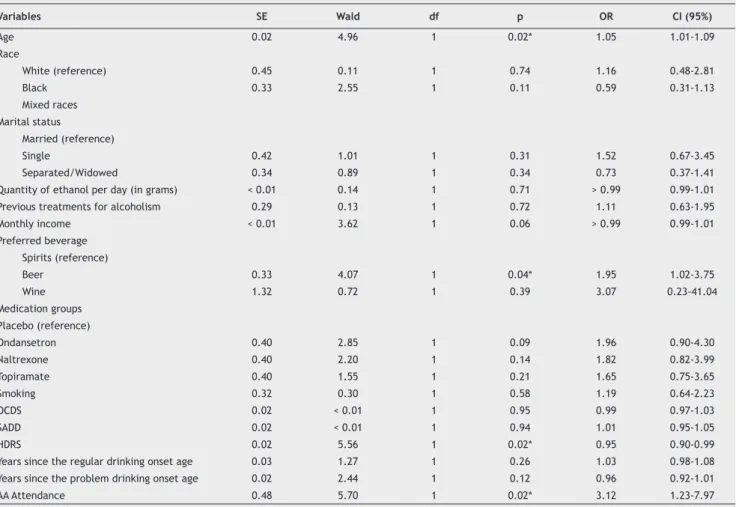
As shown in Table 2, direct logistic regression analysis (Wald’s method) was performed on group status (completers and discontinuers) as an outcome and on the following predic-tors: medication groups and participation in AA as treatment-related variables; and OCDS, SADD, and HDRS mean scores, age at the beginning of current treatment, time since the beginning of regular alcohol use, time since the problem drinking onset age, family alcoholism, preferred beverage, tobacco consumption, quantity of ethanol per day (before the current treatment), history of previous treatment for
alcoholism, race, marital status, and inancial situation were
treated as variables possibly related to craving intensity. We chose this method despite the fact that some predictors could be strongly associated with other ones and, as a result, some of them could mask the effect of others. In this analysis, “age at the beginning of the current treatment”, “participation in AA”, “HDRS mean levels”, and “beer preference drinkers” predicted treatment outcome. The model was statistically
reliable, (χ2 = 44.48, 21 df, p < 0.01). The variance in group
membership accounted for was low, with Nagelkerke R2 =
0.21. The overall prediction success was 65.8%. We checked
the it of our model using Hosmer and Lemeshow’s test (χ2
= 8.15, 8 df, p = 0.42).
We also performed another direct logistic regression
analysis involving only the variables that were signiicantly
associated with treatment retention in the previous analysis. As shown in Table 3, ‘age at the beginning of the current treatment’, ‘participation in AA’, and ‘HDRS mean levels’
remained signiicantly associated with treatment retention.
Conversely, ‘beer preference’ did not predict retention in this latter analysis. This model was statistically reliable,
(χ2 = 24.55, 5 df, p < 0.01). The variance in group
member-ship accounted for was marginal, with Nagelkerke R2 = 0.12.
The overall prediction success was 65.4%. The model it was checked using Hosmer and Lemeshow’s test (χ2 = 8.89, 8 df,
p = 0.35).
Table 4 shows correlation analyses involving variables measured at baseline. Although correlations inferior to 0.50
should be considered non-signiicant, we decided to show
all correlations with p-values of less than 0.05. As shown in Table 4, OCDS was negatively associated with age at the beginning of each trial and with the status of being married but was positively correlated with family alcoholism, severity of alcohol dependence, preferential consumption of spirits, and quantity of ethanol consumed before each trial.
Discussion
Table 1 Baseline characteristics
Characteristic Patients
(n = 257)
Age, mean (SD) 43.76 (8.92) Race, n (%)
White 144 (56.03)
Black 33 (12.84)
Mixed race 80 (31.13)
Marital status, n (%)
Married 144 (56.03)
Single 41 (15.95)
Separated/Widower 72 (28.02) Quantity of ethanol per day (in grams),a mean (SD) 297.77 (178.41) History of having received previous treatment for alcoholism, n (%) 139 (54.09) Monthly income (in R$, the Brazilian currency), mean (SD) 1,085.72 (1002.35) Preferred beverage, n (%)
Spirits 183 (71.20)
Beer 71 (27.63)
Wine 3 (1.17)
Medication groups, n (%)
Placebo 106 (41.24)
Topiramate 52 (20.23)
Naltrexone 49 (19.07)
Ondansetron 50 (19.46)
Smoking, n (%) 177 (68.87) OCDS, mean (SD) 47.99 (12.18) SADD, mean (SD) 27.73 (8.28) HDRS, mean (SD) 9.90 (6.38) Time since the regular drinking onset age (in years) 17.98 (9.63) Time since the problem drinking onset age (in years) 11.19 (9.12) Plasma GGT, U/L; (reference range 8-61), mean (SD) 144.56 (254.71) Plasma ALT, U/L; (reference range < 41), mean (SD) 38.04 (29.16) Plasma AST, U/L; (reference range < 37), mean (SD) 42.04 (35.27) Plasma MCV, f/L; (reference range 80-100), mean (SD) 94.77 (7.22)
a Indicates alcohol usage during the last three months preceding each study.
OCDS: Obsessive Compulsive Drinking Scale; SADD: Short Alcohol Dependence Data; HDRS: Hamilton Depression Rating Scale; GGT: gamma-glutamyl transferase; ALT: alanine aminotransferase; AST: aspartate aminotransferase; MCV: mean cellular volume.
for spirits. Increasing age, lower scores for depression, beer preference, and AA attendance predicted higher treatment retention. Contrary to our initial hypothesis, the variable ‘craving’ (measured by the OCDS at baseline) was not a strong predictive factor of treatment retention.
Other studies on patients with impulsive behaviors have already shown a decrease in impulsive and compulsive symp-toms with increasing age, and this relationship also seems to
be true among alcoholics.3 In fact, a progressive reduction of
daily alcohol intake,21 a decrease in mesolimbic
neurotrans-mission, and changes in the hypothalamic-pituitary-adrenal
(HPA)22 and hypothalamic-pituitary-thyroid23 axes have been
hypothesized to be possible causal mechanisms for craving reduction with increasing age. Parallel to these studies, there has been some evidence that older age can predict better
compliance with alcoholism treatment.24
In our study, higher scores for depression predicted
early discontinuation of treatment. Despite this inding,
research has shown mixed results regarding the relationship
between depression symptoms and treatment retention.25
Nevertheless, it is important to note that depression was positively correlated with longer drinking careers and more frequent histories of being previously treated for alcohol-ism. In fact, negative experiences with previous alcoholism treatment could have a negative impact on the future cli-ent's readiness to accept help for alcohol problems. The awareness that a previous experience was negative can
powerfully change behavior and clinical outcomes.26 It is
also important to stress that no participant was severely
depressed or required speciic treatment for depression in
the present study, given that depression was an exclusion criterion for both trials.
Beer preference drinkers showed higher treatment
reten-tion than spirits and wine preference drinkers. This inding
was already discussed in a previous study published by our
group.4 This inding was different from other studies that re
-ported higher craving among beer preference drinkers, prob-ably due to the greater volume intake of beer compared to
other beverages.27 However, the inluence of different types
Table 2 Effects of clinical and psychosocial variables at baseline on treatment retention (direct logistic regression)
Variables SE Wald df p OR CI (95%)
Age 0.02 4.96 1 0.02* 1.05 1.01-1.09 Race
White (reference) 0.45 0.11 1 0.74 1.16 0.48-2.81 Black 0.33 2.55 1 0.11 0.59 0.31-1.13
Mixed races Marital status
Married (reference)
Single 0.42 1.01 1 0.31 1.52 0.67-3.45 Separated/Widowed 0.34 0.89 1 0.34 0.73 0.37-1.41 Quantity of ethanol per day (in grams) < 0.01 0.14 1 0.71 > 0.99 0.99-1.01 Previous treatments for alcoholism 0.29 0.13 1 0.72 1.11 0.63-1.95 Monthly income < 0.01 3.62 1 0.06 > 0.99 0.99-1.01 Preferred beverage
Spirits (reference)
Beer 0.33 4.07 1 0.04* 1.95 1.02-3.75 Wine 1.32 0.72 1 0.39 3.07 0.23-41.04 Medication groups
Placebo (reference)
Ondansetron 0.40 2.85 1 0.09 1.96 0.90-4.30 Naltrexone 0.40 2.20 1 0.14 1.82 0.82-3.99 Topiramate 0.40 1.55 1 0.21 1.65 0.75-3.65 Smoking 0.32 0.30 1 0.58 1.19 0.64-2.23 OCDS 0.02 < 0.01 1 0.95 0.99 0.97-1.03 SADD 0.02 < 0.01 1 0.94 1.01 0.95-1.05 HDRS 0.02 5.56 1 0.02* 0.95 0.90-0.99 Years since the regular drinking onset age 0.03 1.27 1 0.26 1.03 0.98-1.08 Years since the problem drinking onset age 0.02 2.44 1 0.12 0.96 0.92-1.01 AA Attendance 0.48 5.70 1 0.02* 3.12 1.23-7.97 * p < .05; ** p < .01;
OCDS: Obsessive Compulsive Drinking Scale; SADD: Short Alcohol Dependence Data; HDRS: Hamilton Depression Rating Sacle; AA: Alcoholics Anonymous.
Table 3 Direct logistic regression model including only the variables that were signiicantly associated with treatment
retention in Table 2
Variables SE Wald df p OR CI (95%)
Age 0.02 9.16 1 < 0.01** 1.05 1.02-1.08 Preferred beverage
Spirits (reference)
Beer 0.30 3.52 1 0.06 1.75 0.98-3.15 Wine 1.26 0.17 1 0.68 1.68 0.14-19.89 HDRS 0.02 4.34 1 0.03* 0.96 0.92-0.99 AA Attendance 0.45 5.03 1 0.02* 2.73 1.13-6.55 * p < 0.05; ** p < 0.01;
HDRS, Hamilton Depression Rating Sacle; AA: Alcoholics Anonymous.
be a byproduct of several confounding variables, such as cultural and socioeconomic factors. Although greater volume intake among beer drinkers is related to craving
intensity, mainly due to its inluence on volume-regulating
peptides, spirits drinkers can consume greater quantities of ethanol per day than beer drinkers. Alcohol craving is also associated with the daily amount of ethanol consumed
and with the severity of alcohol dependence.4 In our study,
the correlations between these two variables (alcoholism severity and quantity of ethanol) in spirits drinkers were
positive and signiicant.
Participation in AA was signiicantly correlated with re -tention in treatment. To date, there has been no conclusive
scientiic evidence that participation in AA keeps patients
in treatment longer.28 In general, one of the dificulties in
evaluating the effectiveness of participation in AA is the
self-selection bias of those who participate.29 Because
Table 4 Correlation matrix of the variables included in the multivariate analyses (Pearson’s r, Phi, point-biserial)
Variables (1) (2) (3) (4) (5) (6) (7) (8) (9) (10) (11) (12) (13) (14)
(1) OCDS -(2) Age at the beginning of each trial -0.22** -(3) Race (white) ns ns -(4) Family alcoholism 0.20** ns ns -(5) SADD 0.70** -0.22** ns 0.23** -(6) Smoking ns ns 0.13* ns ns -(7) Time since the regular drinking
onset age (in years) ns 0.60** ns 0.14* ns ns -(8) Time since the problem drinking
onset age (in years) ns 0.40** ns ns ns ns 0.75** -(9) Preferred beverage (spirits) 0.16** ns ns ns 0.23** ns ns ns -(10) Quantity of ethanol per day 0.37** -0.19** ns 0.15* 0.35** ns -0.18** -0.16* 0.15* -(11) HDRS ns ns ns ns ns ns 0.18** 0.14* ns ns -(12) Marital status (married) -0.22** 0.19** ns ns -0.26** ns 0.14* ns ns -0.15* ns -(13) Monthly income ns ns ns ns -0.16** ns ns ns -0.14* ns -0.15* ns -(14) Previous treatments for alcoholism ns ns ns ns ns ns ns ns ns ns 0.16** ns ns
-* p < 0.05; -*-* p < 0.01; ns: not signiicant;
OCDS: Obsessive Compulsive Drinking Scale; SADD: Short Alcohol Dependence Data; HDRS: Hamilton Depression Rating Scale.
sociable and afiliative, more guilty over past behavior,
physically healthier, and more socially stable.30 Conversely,
other authors have afirmed that attendance at AA is more
common among racial and ethnic minority groups, those
with lower incomes, and those with unstable employment.31
Although these generalizations can be problematic and doubtful, some characteristics attributed to AA participants have a certain level of acceptability, given the inherent characteristics of self-help groups. In fact, participating in AA was not an obligatory condition to partake in any of our trials, despite the encouragement given by researchers.
This fact could mean that the most motivated and afilia
-tive patients decide to participate in AA with the goal of improving their coping skills and changing their friendship
networks.32 Other authors suggest that success in AA is
as-sociated with frequent and continued attendance and not
with motivation per se.33
Active medications did not inluence treatment reten
-tion in the present study. Other studies have already shown
that treatment with opioid antagonists,34 topiramate,35 and
ondansetron, alone or in combination with naltrexone,36,37
was not associated with increased retention in treatment, compared with placebo. Furthermore, even combinations of two medications for alcoholism have not shown effects on retention in treatment compared with individual
pharma-cotherapies alone.38
Although craving is an important factor to be measured and investigated at baseline and during treatment, our study was not able to show that it is a strong predictive factor of retention, at least when craving intensity was computed at baseline only. In reality, craving is not a stable state but rather depends on other variables that can be
modiied during treatment, such as mood, stress,
substance-using status, environmental cues, etc. Nevertheless, other
variables signiicantly correlated with craving, such as age and preferred beverage, were signiicantly associated with
treatment retention.
Despite the heterogeneity of our clients, many thera-peutic programs offer only a single type of treatment. With
this “one size its all” model, variations in retention have
been commonly attributed to client factors or character-istics. Although this belief might be true to some extent, health services should broaden the scope of services offered to meet the heterogeneous needs of clients and identify treatment practices and therapies that improve reten-tion. Information about patients’ characteristics linked to noncompliance or dropout should be used to render treat-ment programs more responsive and attractive, combining
pharmacologic agents with more intensive and diversiied
psychosocial interventions. Certain approaches, such as compliance enhancement therapy and motivational inter-views, can be effective options when combining adjunctive
interventions for randomized clinical trials.39 Strategies to
improve motivation are of paramount importance in dif-ferent treatment programs, and they will be taken into account in future research by our group.
There were several weaknesses in this present study, including the following:
(1) There were no other psychotherapeutic procedures associated with the pharmacological treatments, which could have increased the retention of the patients.
(2) The number of dropouts was high in both trials, probably as a result of their designs, which allowed patients to follow the standard community-based programs of treatment, without norms to increase patient retention. Although this approach to trial
de-sign, which allows for normal life events to inluence
trial outcomes, probably enhances external validity,
(3) Additionally, our service is tertiary, and many severe
cases are referred to it. This fact can be veriied by
the enormous quantity of ethanol consumed by our
subjects. It is dificult to generalize our indings to a
less severely alcoholic population.
(4) Our research did not include women. Some studies
have shown that sex differences exert different inlu
-ences on retention treatment and craving.40
(5) The dosage of ondansetron tested (16 mg/day) was higher than the dosages usually investigated by other studies. This fact might have compromised this study’s comparability to other studies.
(6) Our trials limited the examination of AA participa-tion to the frequency and regularity of meeting attendance, which failed to capture the breadth of involvement in the program.
(7) Although OCDS was measured at three time points (at baseline, at the sixth week, and at the twelfth week) in each double-blind study, we only evaluated the effect on treatment retention of OCDS measured at baseline, due to some of the participants having discontinued the treatment before the sixth week. In this study, our aim was to investigate treatment retention in general, without taking into account the different times at which dropouts occurred.
Disclosures
João Maria Corrêa Filho, MD
Employment: Department of Psychiatry of the Universidade de São Paulo, Brazil. Research Grant: Fundação de Amparo à Pesquisa do Estado de São Paulo (The State of São Paulo Research Foundation - FAPESP).
Danilo Antonio Baltieri, MD, PhD
Employment: Department of Psychiatry of the Universidade de São Paulo; Department of Psychiatry of Faculdade de Medicina do ABC, Santo André, SP, Brazil.
This study has received grants from FAPESP (Fundação de Amparo à Pesquisa do Estado de São Paulo - The State of São Paulo Research Foundation).
* Modest
** Signiicant
*** Signiicant. Amounts given to the author’s institution or to a colleague for
research in which the author has participation, not directly to the author.
References
1. Flannery BA, Poole SA, Gallop RJ, Volpicelli JR. Alcohol craving predicts drinking during treatment: an analysis of three assessment instruments. J Stud Alcohol. 2003;64(1):120-6. 2. Graff FS, Morgan TJ, Epstein EE, et al. Engagement and
retention in outpatient alcoholism treatment for women. Am J Addict. 2009;18(4):277-88.
3. Hintzen AK, Cramer J, Karagulle D, et al. Does alcohol craving decrease with increasing age? Results from a cross-sectional study. J Stud Alcohol Drugs. 2011;72(1):158-62.
4. Baltieri DA, Daro FR, Ribeiro PL, De Andrade AG. The role of alcoholic beverage preference in the severity of alcohol dependence and adherence to the treatment. Alcohol 2009;43(3):185-95.
5. Gordon SM, Sterling R, Siatkowski C, Raively K, Weinstein S, Hill PC. Inpatient desire to drink as a predictor of relapse to alcohol use following treatment. Am J Addict. 2006;15(3):242-5. 6. McKay JR. Negative Mood, Craving, and Alcohol Relapse:
Can Treatment Interrupt the Process? Curr Psychiatry Rep. 2011;13(6):431-3.
7. Sinha R, Fox HC, Hong KA, Bergquist K, Bhagwagar Z, Siedlarz KM. Enhanced negative emotion and alcohol craving, and altered physiological responses following stress and cue exposure in alcohol dependent individuals. Neuropsychopharmacology. 2009;34(5):1198-208.
8. Hillemacher T, Bayerlein K, Wilhelm J, et al. Volume intake and craving in alcohol withdrawal. Alcohol Alcohol. 2006;41(1):61-5. 9. Malcolm R, Herron JE, Anton RF, Roberts J, Moore J. Recurrent detoxiication may elevate alcohol craving as measured by the Obsessive Compulsive Drinking scale. Alcohol. 2000;20(2):181-5. 10. Baltieri DA, Daro FR, Ribeiro PL, Andrade AG. Effects of
topiramate or naltrexone on tobacco use among male alcohol-dependent outpatients. Drug Alcohol Depend. 2009;105 (1-2):33-41.
11. Sinha R, O'Malley SS. Craving for alcohol: indings from the clinic and the laboratory. Alcohol Alcohol. 1999;34(2):223-30. 12. Garbutt JC. The state of pharmacotherapy for the treatment of
alcohol dependence. J Subst Abuse Treat. 2009;36(1):S15-23. 13. Johnson BA, Roache JD, Ait-Daoud N, Zanca NA, Velazquez M.
Ondansetron reduces the craving of biologically predisposed alcoholics. Psychopharmacology. 2002;160(4):408-13.
14. Baltieri DA, Daro FR, Ribeiro PL, de Andrade AG. Comparing topiramate with naltrexone in the treatment of alcohol dependence. Addiction. 2008;103(12):2035-44.
15. Gossop M, Marsden J, Stewart D, Rolfe A. Treatment retention and 1 year outcomes for residential programmes in England. Drug Alcohol Depend. 1999;57(2):89-98.
16. National Treatment Agency for Substance Misuse. Business Plan. London: National Treatment Agency for Substance Misuse; 2006. 17. Raistrick D, Dunbar G, Davidson R. Development of a
questionnaire to measure alcohol dependence. Br J Addict. 1983;78(1):89-95.
18. Hamilton M. A rating scale for depression. J Neurol Neurosurg Psychiatry. 1960;23:56-62.
19. Anton RF, Moak DH, Latham P. The Obsessive Compulsive Drinking Scale: a self-rated instrument for the quantiication of thoughts about alcohol and drinking behavior. Alcohol Clin Exp Res. 1995;19(1):92-9.
20. Hauser J, Rybakowski J. Three clusters of male alcoholics. Drug Alcohol Depend. 1997;48(3):243-50.
21. Zhang Y, Guo X, Saitz R, et al. Secular trends in alcohol consumption over 50 years: the Framingham Study. Am J Med. 2008;121(8):695-701.
22. Munro CA, Oswald LM, Weerts EM, McCaul ME, Wand GS. Hormone responses to social stress in abstinent alcohol-dependent subjects and social drinkers with no history of alcohol dependence. Alcohol Clin Exp Res. 2005;29(7):1133-8. 23. Leggio L, Ferrulli A, Cardone S, et al. Relationship between
the hypothalamic-pituitary-thyroid axis and alcohol craving in alcohol-dependent patients: a longitudinal study. Alcohol Clin Exp Res. 2008;32(12):2047-53.
24. Atkinson RM, Misra S, Ryan SC, Turner JA. Referral paths, patient proiles and treatment adherence of older alcoholic men. J Subst Abuse Treat. 2003;25(1):29-35.
25. Charney DA, Paraherakis AM, Negrete JC, Gill KJ. The impact of depression on the outcome of addictions treatment. J Subst Abuse Treat. 1998;15(2):123-30.
26. Porro CA. Open your mind to placebo conditioning. Pain. 2009;145(1-2):2-3.
27. Hillemacher T, Bayerlein K, Reulbach U, et al. Inluence of beer, wine and spirits consumption on craving. Addict Biol. 2005;10(2):181-6.
29. Tonigan JS, Toscova R, Miller WR. Meta-analysis of the literature on Alcoholics Anonymous: sample and study characteristics moderate indings. J Stud Alcohol. 1996;57(1):65-72.
30. Emrick CD. Alcoholics Anonymous: affiliation processes and effectiveness as treatment. Alcohol Clin Exp Res. 1987;11(5):416-23.
31. Humphreys K, Kaskutas LA, Weisner C. The relationship of pre-treatment Alcoholics Anonymous afiliation with problem severity, social resources and treatment history. Drug Alcohol Depend. 1998;49(2):123-31.
32. Humphreys K, Mankowski ES, Moos RH, Finney JW. Do enhanced friendship networks and active coping mediate the effect of self-help groups on substance abuse? Ann Behav Med. 1999;21(1):54-60.
33. Fiorentine R, Hillhouse MP. Exploring the additive effects of drug misuse treatment and Step involvement: does Twelve-Step ideology matter? Subst Use Misuse. 2000;35(3):367-97. 34. Heinala P, Alho H, Kiianmaa K, Lonnqvist J, Kuoppasalmi
K, Sinclair JD. Targeted use of naltrexone without prior detoxification in the treatment of alcohol dependence: a factorial double-blind, placebo-controlled trial. J Clin Psychopharmacol. 2001(3);21:287-92.
35. Johnson BA, Rosenthal N, Capece JA, et al. Topiramate for treating alcohol dependence: a randomized controlled trial. JAMA. 2007;298(14):1641-51.
36. Johnson BA, Roache JD, Javors MA, et al. Ondansetron for reduction of drinking among biologically predisposed alcoholic patients: A randomized controlled trial. JAMA. 2000;284(8):963-71.
37. Ait-Daoud N, Johnson BA, Javors M, Roache JD, Zanca NA. Combining ondansetron and naltrexone treats biological alcoholics: corroboration of self-reported drinking by serum carbohydrate deicient transferrin, a biomarker. Alcohol Clin Exp Res. 2001;25(6):847-9.
38. Anton RF, O'Malley SS, Ciraulo DA, et al. Combined pharmacotherapies and behavioral interventions for alcohol dependence: the COMBINE study: a randomized controlled trial. JAMA. 2006;295(17):2003-17.
39. Heffner JL, Tran GQ, Johnson CS, et al. Combining motivational interviewing with compliance enhancement therapy (MI-CET): development and preliminary evaluation of a new, manual-guided psychosocial adjunct to alcohol-dependence pharmacotherapy. J Stud Alcohol Drugs. 2010;71(1):61-70. 40. Greenield SF, Brooks AJ, Gordon SM, et al. Substance abuse