THE /S/ AND /Z/ AND /E/ AND VOICELESS /E/ RATIOS
Relações entre /s/ e /z/ e entre /e/ e /e/ não vozeado ou áfono
Carla Aparecida Cielo (1), Joziane Padilha de Moraes Lima (2), Bruna Franciele da Trindade Gonçalves (3), Mara Keli Christmann (4)
RESUMO
Objetivo: correlacionar os tempos máximos de fonação (TMF) e as relações entre os fricativos /s/
e /z/ (s/z) e entre /e/ não vozeado e a vogal /e/ (ė/e) de mulheres sem afecções laríngeas. Método:
participaram 60 mulheres com média de 21,56 anos de idade. Coletaram-se os TMF/ė/, /e/, /s/ e /z/ e calcularam-se a relação s/z e a relação ė/e, com padrão de normalidade para as relações de 0,8 a 1,2; para os TMF/s/ e /z/, entre 15,57 e 34,17s; para o TMF/ė/, entre 16 a 18s; e para o TMF/e/, entre 14,04 e 26,96s. Testes de Lilliefords, Spearmann, Binomial e Mann-Whitney com nível de signiicância de
5%. Resultados: correlação positiva entre TMF/s/ e TMF/ė/, TMF/z/ e TMF/e/, TMF/s/ e TMF/z/, e
TMF/ė/ e TMF/e/. Não houve correlação entre as relações s/z e ė/e, nem diferenças entre a relação ė/e, enquanto a relação s/z foi signiicantemente normal. TMF/ė/ e TMF/e/ signiicantemente diminu
-ídos; TMF/s/ e TMF/z/ signiicantemente normais. TMF/ė/ signiicantemente menor do que TMF/s/; TMF/e/ signiicantemente menor do que TMF/z/. Conclusão: os fonemas /s/ e /z/ isolados e sua
rela-ção icaram dentro da normalidade e as relações s/z e ė/e não apresentaram correlarela-ção. Os TMF/ė/ e TMF/e/ mostraram-se diminuídos em relação à normalidade. O TMF/ė/ foi menor do que TMF/s/ e o TMF/e/ foi menor do que TMF/z/, possivelmente devido ao modo articulatório dos fricativos ter aumen
-tado o tempo de emissão, independentemente do controle do nível glótico e respiratório.
DESCRITORES: Voz; Fonação; Qualidade da Voz; Laringe
(1) Speech Language Pathologist; Adjunct Professor of the Undergraduate Program in Speech Language Pathology and Postgraduate Program in Human Communication Disorders, Federal University of Santa Maria – UFSM, Santa Maria, Rio Grande do Sul, Brazil; PhD in Applied Linguistics from the Pontiical Catholic University of Rio Grande do Sul; Productivity Scholarship CNPq.
(2) Speech Language Pathologist; Master’s Graduate Program in Human Communication Disorders, Federal University of Santa Maria – UFSM, Santa Maria, Rio Grande do Sul, Bra
-zil, CAPES scholarship.
(3) Speech Language Pathologist; Resident from the Multidis -ciplinary Integrated Residency Program in Management and Hospital Care in the Public Health System UFSM/ HUSM, Santa Maria, Rio Grande do Sul, Brazil.
(4) Speech Language Pathologist; PhD Student Graduate in
Human Communication Disorders, Federal University of Santa Maria – UFSM, Santa Maria, Rio Grande do Sul, Brazil, Master in Human Communication Disorders by the Federal University of Santa Maria; CAPES/FAPERGS Scholarship.
Funding: CNPq; CAPES; FAPERGS Conlict of interest: non-existent
INTRODUCTION
The pneumophonoarticulatory coordination comes from the balance between the control of respiratory function, glottal eficiency and resonant balance and articulation. Thus, impairment levels
related to voice production can result in overloading
the phonetic apparatus, increased pauses during speech, use of reserve air, changes in vocal quality
and vocal fatigue or1,2.
Eficient vocal production relates to the proper use of respiratory muscles, which gives the amount of air required for phonation, full and irm glottal closure not to allow air leakage. Furthermore, resonance and appropriate articulation also contribute to good voice quality and speech intelligibility2,3.
evaluation data in scientiic research, as long as the secrecy about the identity was maintained.
The inclusion criteria for the selection of records in the database were: complete data of anamnesis, otorhinolaryngological diagnosis without AL; being females due to the dominance of this gender in the database and the largest number of studies in the literature involving women’s voice11-17; being aged
from 18 to 44 years old, considering that in this age group the phonetic apparatus has already passed by the voice change12,13,18 and has not suffered
the inluence of hormonal and structural changes associated with aging12,13 in addition to the full data
to MPT /s/, /z/, /ė/, /e/ and measures of the s/z and ė/e ratios.
The exclusion criteria were: report or diagnosis of neurological, endocrine, psychiatric, gastric and respiratory alterations11-13,19,20, record hearing loss
routine audiological examination of the university clinic 14.20, record of speech therapy and/or singing technique prior to the valuation date, being a voice professional, the possibility that the subject had already trained the voice, being a smoker and/ or alcohol drinker2,14,20.
From the application of the criteria for inclusion and exclusion, we selected 60 subjects aged from 18 to 44 years old (average 21.56), and used measures of the voiceless MPT: fricative /s/ and emission of /ė/; and voiced: fricative /z/ and /e/ vowel to obtain the ė/e and s/z ratios. These were collected by different evaluators in standardized way and at an acoustically treated room.
The voiceless, soundless or deaf emissions are indicated for veriication of respiratory control, as there is vocal fold vibration in its production and voiced phonemes or sounds are given to verify the interaction between the respiratory level and glottal eficiency, as there is participation of vocal fold vibration1-3,8.
To collect the MPT, subjects were instructed to remain in standing position, inhale deeply through your nose and hold emissions in loudness and usual pitch three times, until the end of expiration without entering the expiratory reserve air, considering in this study, the highest value of support obtained
1,3,6,9,11,13,14,18,21-25.
For the emission of /ė/, subjects were instructed to remain in the same articulatory position of the vowel /e/ sustaining the expiration of air in a voiceless/deaf way, without occuring glottal sound or any type of noise4.5. According to the literature, it
would be “producing the emission like a soft blow to
fog a mirror”4.
Normal standards adopted to the ratios compre
-hended values from 0.8 to 1.2, lower values were considered indicative of hyper glottal, and increased glottal sound) and not voiced, voiceless or deaf
(without participation of the glottal source). Two relations between sustained emissions have been used in the evaluation of voice, the s/z and the ratio between voiced /e/ and voiceless /e/ (ė/e), with the objective of verifying the glottal eficiency and respi
-ratory control. According to the literature, the time of sustained voiced emission should be the same as the voiceless, resulting in an equal ratio to one2-7.
The s/z2 ratio consists in sustaining each phoneme for as long as possible and, after performing the calculation of division between the results obtained. The purpose of this assessment is to identify the suitability between the insertion of the glottal source to the frictional source, presence of air leak or the presence of hyper glottal1,2,4,8.
The ė/e4ratio has the same goals of the s/z, which
justiied the use of the vowel /e/ by the intermediate position of the tongue, lips and jaw, among vowels. The emission of this vowel does not present denti
-lingual articulator block as the emission of fricatives /s/ and /z/, and thus, the vowel /e/ evidenced respi
-ratory control associated with the glottis control. The emission of voiceless /e/ held with the same position as the articulatory vowel /e/, but without vibration of the vocal folds, only the sustained output air without any noise, shows respiratory control. Due to /ė/ not showing glottal interference or any type of narrowing or occlusion of the vocal tract, such ratio could provide more reliable results, as the patient controls the phasing of the air through its unique respiratory
support3-5,9 10.
The voiceless fricative /s/ and the emission of the voiceless vowel /e/ enable the veriication of respiratory control, as there is no vibration of the glottal source in their productions and the voiced phonemes, fricative /z/ and vowel /e/, make it possible to verify the glottal eficiency and its inter
-action with the respiratory level1-3,8.
Based on the above, the aim of this study was to correlate the ratio between MPT and the fricative /s/ and /z/ (s/z) and between voiceless /e/ and the vowel /e/ (ė/e) of women without laryngeal disorders
(AL).
METHOD
It is an observational analytical transversal study, quantitative and retrospective character, with information obtained from the database of patients treated at the voice sector from the clinic-school of Speech Language Pathology.
ė/e ratios. The binomial test was used to check the difference between the proportions of the increased, decreased and normal values of all the variables in question. The Mann-Whitney test was used to check the difference between the average MPT phonemes voiced and voiceless. The level of signiicance was 5% (p ≤ .05).
The classiication of correlation values was: very weak correlation (0 to 0.19); weak correlation (0.20 0.39), moderate correlation (0.40 to 0.69), a strong correlation (0.70 to 0.89); very strong correlation (0.90 to 1.00).
RESULTS
We evaluated 60 subjects, aged from 18 to 44 years old (average 21.56 years old), of whom there have been values of MPT/ė/, MPT/e/, MPT/s/ and MPT/z/ and were calculated ė/e e s/z ratios.
Table 1 are averages of studied MPT phonemes and signiicant differences between MPT/ė/ and MPT/s/ and between MPT/e/ and MPT/z/, in which the voiceless phonemes showed signiicantly higher
values.
values were considered suggestive of air leaks during speech1-3, 4.21.
For values of MPT /s/ and MPT /z/ alone, it was considered within normal values between 15.57 and 34.17s2,18.21. For MPT /ė/, normal values were 16 to
18s4, 9. For MPT /e/, it was used as normal standard
values from 14.04 to 26.96 s1, 2.
The decreased MPT /z/ and MPT /e/ were
considered suggestive of air escape during
phonation and were considered suggestive of increased hyper glottis during phonation. The decreased MPT /s/ and MPT /ė/ were considered suggestive of lack of expiratory phonation control and were suggestive of increased expiratory low control better than expected1-3.
This study was approved by the Ethics Committee of this Institution (23081.016945/2010-76) and all subjects had previously signed the Instrument of Free and Informed Consent (IC), authorizing the use of evaluation data in scientiic research, as long as the secrecy about the identity was maintained.
After tabulating the data, we tested the normality of the variables (Lilliefords test), and opted for the Spearman correlation test to verify the correlation
between the results of the MPT and the s/z and
Average (s) p-value
MPT /ė/ 14,35
0,0006*
MPT /s/ 18,04
MPT /e/ 14,10
0,0007*
MPT /z/ 17,20
Table 1 – Average values at each MPT
Mann-Whitney test
* statistically signiicant values
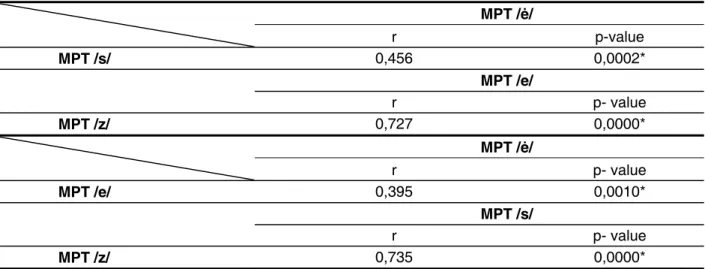
Table 2 shows the correlation among MPT/ė/, MPT/e/, MPT/s/ and MPT/z/, with moderate signif
-icant correlation between MPT/s/ and MPT /ė/; strong between MPT/z/ and MPT/e/, strong between MPT/z/ and MPT/s/, and weak between MPT/e/ and MPT/ė/.
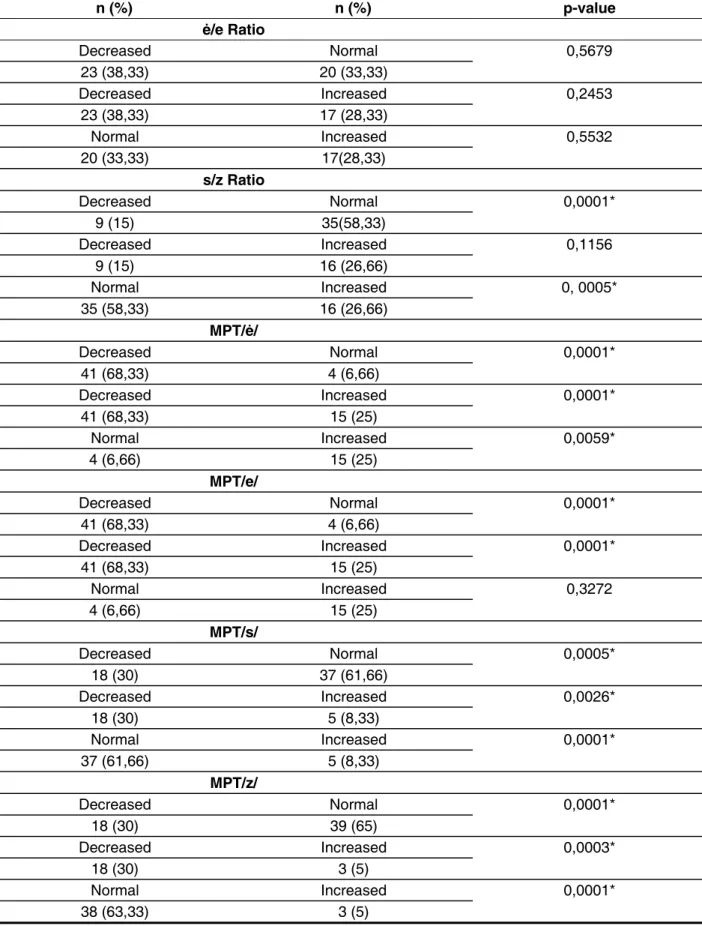
In Table 3, differences between the diminished results are exposed, increased and normal ė/e and s/z ratio, and MPTs themselves, occurring
signiicance to: normal s/z ratio, decreased MPT/ė/ when compared to normal results and increased; MPT/ė/ only increased when compared to normal results; decreased MPT/e/; normal MPT/s/ and MPT/z/ when compared to the diminished and increased results; diminished MPT/s/ and MPT/z/ when compared to the increased results.
MPT /ė/
r p-value
MPT /s/ 0,456 0,0002*
MPT /e/
r p- value
MPT /z/ 0,727 0,0000*
MPT /ė/
r p- value
MPT /e/ 0,395 0,0010*
MPT /s/
r p- value
MPT /z/ 0,735 0,0000*
Table 2 – Correlation between the results of MPT /ė/, /e/, /s/ and /z/
Spearman correlation test
* statistically signiicant values
DISCUSSION
The ratio between emissions both voiced and voiceless plosives have to verify the occurrence of hypercontraction or disability in vocal fold cooptation in patients from the voice area as well as control their respiratory support in interaction with the glottal action. Such ratios contribute to the diagnosis and treatment planning of patients with dysphonia2.3. A single measure of MPT does not provide enough information to differentiate the impairments of respi
-ratory support and laryngeal eficiency2.
The s/z ratio is obtained by dividing the MPT of the phoneme /s/ by /z/ and is widely used in the
literature1,5,6. In the ė/e ratio, the collection of the
MPT/ė/ permits checking how the individual controls the progressive air output exclusively through the respiratory support. Thus, gives evidence of the deiciencies in the respiratory level, if the sustaining time is less than 16s4, 5.9.
Based on the average emissions non voiced in this study (MPT/ė/ of 14.35s and MPT/s/ of 18.04 s), it was observed that although the subjects did not have respiratory training, the value of the MPT/s/ was signiicantly higher than that of the MPT/ė/ (Table 1), agreeing with the indings of another study in which the authors attributed this discrepancy to the presence of blocking articulation of /s/ that prevents a proper assessment of isolated control from the breathing level, as can be seen in /ė/26.
However, there was moderate positive corre
-lation between the MPT of these two emissions (Table 2), result also found in another study26, which justiies the use of both measures for veriication of coordinated use of the expiratory air for emission.
As for voiced phonemes, we observed strong signiicant positive correlation between MPT/e/ and MPT/z/ (Table 2). Nevertheless, we found a signif
-icant difference between the averages from MPT/e/ and MPT/z/ (Table 1), showing the difference between such articulatory phonemes, where the mode of articulation of /z/ prolongs the noise, which does not occur with the vowel /e/ free from any vocal tract obstructions.
It is interesting to note that the articulatory aspect of the emission of a MPT should be taken into consideration by Speech Language Pathologists during clinical evaluation of voice, because at the time that only the control of breathing level the emission was assessed, it required a measure that did not suffer from the inluences from the glottic or articulator levels. For example, in the voiceless spirant phoneme /s/, probably the results are not reliable regarding the assessment of respiratory control, as the time of sustentation of the airlow set to sound by the glottis may be being prolonged by narrowing that occurs in the oral cavity in that phoneme3-5.
In this research, we found a strong positive correlation between MPT/s/ and MPT/z/ and weak positive correlation between MPT/ė/ and MPT/e/ (Table 2), showing that the values of /s/ and /z/ grew closer, reinforced by the result of the s/z ratio also signiicantly normal in the studied group (Table 3), which may be related to the above explanation regarding the control of fricative support through its
mode of articulation.
These results are consistent with research that showed MPT/s/ and MPT/z/ signiicantly reduced in subjects with organofunctional dysphonia but with
n (%) n (%) p-value ė/e Ratio
Decreased Normal 0,5679
23 (38,33) 20 (33,33)
Decreased Increased 0,2453 23 (38,33) 17 (28,33)
Normal Increased 0,5532
20 (33,33) 17(28,33)
s/z Ratio
Decreased Normal 0,0001*
9 (15) 35(58,33)
Decreased Increased 0,1156 9 (15) 16 (26,66)
Normal Increased 0, 0005*
35 (58,33) 16 (26,66)
MPT/ė/
Decreased Normal 0,0001*
41 (68,33) 4 (6,66)
Decreased Increased 0,0001* 41 (68,33) 15 (25)
Normal Increased 0,0059*
4 (6,66) 15 (25)
MPT/e/
Decreased Normal 0,0001*
41 (68,33) 4 (6,66)
Decreased Increased 0,0001* 41 (68,33) 15 (25)
Normal Increased 0,3272
4 (6,66) 15 (25)
MPT/s/
Decreased Normal 0,0005*
18 (30) 37 (61,66)
Decreased Increased 0,0026* 18 (30) 5 (8,33)
Normal Increased 0,0001*
37 (61,66) 5 (8,33)
MPT/z/
Decreased Normal 0,0001*
18 (30) 39 (65)
Decreased Increased 0,0003* 18 (30) 3 (5)
Normal Increased 0,0001*
38 (63,33) 3 (5)
Table 3 – Differences among the decreased, increased and normal results from the ė/e and s/z ratios, and from the MPT/ė/, /e/, /s/ and /z/
Binomial test
phonetically vocal tract posture adopted in each of these emissions. The mode of articulation of the lingual-alveolar fricative /s/ consists of parted lips, teeth slightly apart, apex language supported behind the incisors and lips lightly supported in the region of the upper molars, forming a channel in the central part where the expiratory air will pass. This narrowing of the vocal tract decreases its diameter and can promote the temporal extension of expiratory airlow through the vocal tract narrowed by increasing the MPT/s/, even though the expiratory control is not as eficient. This does not occur with the emission of /é/ that takes the position of the articulatory vowel /e/ in open or narrowing vocal tract without occlusions and therefore no barriers to free low of expiratory air which is subject only to the control eficiency at breathing level1,4,5,9,10,16,21,26.
In the literature21, there is discussion about the validity of using the s/z ratio in diagnosis, as in some
studies3,19,27 there was a decreased of the MPT of
isolated fricatives, but with the s/z ratio within the normal range. In a study of patients with unilateral vocal fold paralysis in abduction, the values of s/z ratio were increased, suggesting glottal incompe
-tence, while with vocal fold paralysis in medium position, the s/z ratio was within the normal28. Another study found that the s/z ration performed within normality in subjects without vocal nodules and in the group nodules the ratio showed a lack of
glottal closure18. Therefore, it is important to analyze the values of MPT/s/ and MPT/z/ alone, airlow, and
loudness during emission, to then determine if the s/z ratio is valid for the evaluated subject3.
This study found signiicant majority of subjects with values MPT/e/ decreased (Table 3), but it was not found in the literature studies that used the MPT vowel /e/ alone for detecting glottal eficiency, coordination of the aerodynamic forces of breathing and myoelastic of the larynx and vocal quality. However, there are studies using MPT of vowels or their average as a way of researching these aspects, given that the normal parameters are the
same18,28,29.
In research on the MPT vowels /a/, /i/ and /u/ in adult women with vocal nodules, it was observed that 30% of the sample had decreased MPT, suggesting another study with subjects who stutter22, showing
that the s/z ratio is greatly inluenced by the articu
-lation of MPT of its phonemes.
The ė/e and s/z ratios showed no correlation (Table 4), showing that their results do not match, contrary to what would be expected, as both measures are proposed to evaluate the same phenomenon, diverging study that found a moderate positive correlation between these ratios27.
Another important aspect that may explain the lack of correlation between both ratios refers to the ė/e ratio to have the same standard of normality of the s/z ratio. The value pointed by the literature for MPT /e/ is the same as the other MPT vowels /a/, /i/ and /u/, between 14.04s and 26.96s1, 2 and the value
of the MPT /ė/ is between 16 and 18s4. Based on
these patterns of normality, the mathematical possi
-bility of the ė/e ratio to have a close value becomes more dificult.
In the present study, the results of MPT/ė/ from most subjects was found to be signiicantly decreased or increased with an average of 14.35s (Tables 1 and 3), below indicated normality by the reference value in the literature4. The only study on
MPT/ė/ also with women, had an average value of 10.43s5 also signiicantly lower than the proposed
16s4. Thus, based on these studies and as there
are insuficient data to establish the pattern of the MPT/ė/, there is the possibility of it being less than
16s.
Reduced values of MPT/ė/ in this research can also be justiied by the fact that the subjects have never done respiratory training, showing inability to control isolated from the respiratory muscles to sustain this emission as occurs with MPT that mimics the articulation of the vowel /e/, but without the glottic control, as it is not voiced1.4.
In regards to the analysis of MPT/s/, the study found an average of 18.04s and most signiicant within the normal range, and most signiicant with decreased results when compared to the increased ones (Table 1 and 3), converging with research found that found medium and median values within the range of 15 to 25s indicated by the literature for adult women5.
The differences between the voiceless MPT/s/ and MPT/é/ could be explained by considering the
s/z ratio
r p-value
ė/e ratio 0,199 0,1260
Table 4 – Correlation between the results of ė/e and s/z ratios
Spearman correlation test
CONCLUSION
The phonemes /s/ and /z/ alone and their ratios remained within normal limits and the s/z and ė/e ratios were not correlated. The MPT/ė/ and MPT/e/ proved decreased when compared to normality. The MPT/ė/ is less than MPT/s/ and MPT/e/ is less than MPT/z/, despite positively correlated, possibly due to the mode of articulation of the fricative phonemes to have increased emission time, regardless of the control of the glottal level and respiratory systems.
The indings show the divergence of the results of the ratios between the MPT and MPT alone, although they propose to measure the same phenomenon of vocal production, requiring further research to isolate the articulation emissions and to deepen the knowledge of the normal values for better assess the patient in the area of voice. transglottic air leak on phonation29. The same was
found in another study with signiicant results18. Study conducted with 86 individuals with unilateral vocal fold paralysis found average MPT vowels /a/, /i/ and /u/ decreased in most subjects, it decreased progressively as the paralyzed fold position became more abducted28. Another research has shown that the AL from the edge of the vocal cords interfere with glottal closure and the use of air during phonation of vowels resulting in MPT signii
-cantly reduced29.
From the results found, we see the need for further studies with a population of normal subjects to conirm the normal range of measures that are commonly used in clinical practice of Speech Language Pathologists who work in the area of Voice. It also emphasizes the importance of joint analysis of all the data of phonoaudiological evalua
-tions for the correct interpretation of results2.
ABSTRACT
Purpose: correlate the maximum phonation time (MPT) and the relations between the fricative /s/ and /z/ (s/z) and between the vowels /ė/ and /e/ (ė/e) of women without laryngeal disorders. Method:
participants were 60 women with a mean of 21.56 years old. Were collected MPT/ė/, /e/, /s/ and /z/ and calculated the relations ė/e and s/z, with normal pattern for the relationship from 0.8 to 1.2; for MPT/s/ and MPT/z/, between 15.57 and 34.17s; for the MPT/ė/, between 16 to 18s; and for the MPT/e/, between 14.04 and 26.96s. Lilliefords, Spearman, Binomial and Mann-Whitney tests with a signiicance level of 5%. Results: positive correlation between MPT/s/ and MPT/ė/, MPT/z/ and MPT/e/, MPT/s/ and MPT/z/, and MPT/ė/ and MPT/e/. There was no correlation between the ratios s/z and ė/e, no differences between the relative ė/e, while the relation s/z was signiicantly normal. MPT/ė/ and MPT/e/ signiicantly reduced; MPT/s/ and MPT/z/ signiicantly normal. MPT/ė/ signiicantly lower than MPT/s/; MPT/e/ signiicantly lower than MPT/z/. Conclusion: the phonemes /s/ and /z/ isolates and its relation were within normal and the relations s/z and ė/e don’t show correlation. The MPT/ė/ and MPT/e/ were decreased relative to normal. The MPT/ė/ was lower than MPT/s/ and MPT/e/ smaller than the MPT/z/, possibly due to the way of articulation fricative have increased transmission time, regardless of the level control glottal and respiratory.
KEYWORDS: Voice; Phonation; Voice Quality; Larynx
REFERENCES
1. Behlau M. O livro do especialista. v. I.Rio de Janeiro: Revinter, 2008.
2. Colton RH, Casper JK, Leonard R. Compreendendo os problemas de voz: uma perspectiva isiológica ao diagnóstico e ao tratamento. Rio de Janeiro: Revinter, 2010.
3. Cielo CA, Conterno G, Carvalho CDM, Finger LS.
Disfonias: relação o s/z e tipos de voz. Rev CEFAC.
2008;10(4):536-47.
4. Pinho SMR. Avaliação e tratamento da voz. In:___. Fundamentos em fonoaudiologia: tratando os distúrbios de voz. Rio de Janeiro: Guanabara Koogan, 2003; 1-40.
5. Miglioranzi SL, Cielo CA, Siqueira MA.
Capacidade vital e tempos máximos de fonação de
/e/ áfono e de /s/ em mulheres adultas. Rev CEFAC. 2012; 14(1):97-103.
20. Kurtz LO, Cielo CA. Tempos máximos de fonação de vogais em mulheres adultas com nódulos vocais. Pró-Fono Rev Atual Cientíica. 2010;22(4):451-4.
21. Gelfer MP, Pazera JF. Maximum duration of sustained /s/ and /z/ and the s/z ratio with controlled intensity. J Voice. 2005;20(3):369-79.
22. Carrasco ER, Oliveira G, Behlau M. Análise perceptivo-auditiva e acústica da voz de indivíduos gagos. Rev CEFAC. Ahead of print, 2010.
23. Grillo EU, Fugowski J. Voice characteristics of female physical education student teachers. J Voice. 2010;25(3):1-9.
24. Speyer R, Bogaardt HCA, Passos VL, Roodenburg NPHD, Zumach A, Heijnen MAM, Baijens LWA, Fleskens SJHM, Brunings JW. Maximum phonation time: variability and reliability. J Voice. 2010;24 (3):281-4.
25. Fabron EMG, Sebastião LT, Oliveira GAG, Motonaga SM. Medidas da dinâmica respiratória
em idosos participantes de grupos de terceira idade.
Rev CEFAC. 2011;13(5):895-901.
26. Miglioranzi SL, Cielo CA, Siqueira MA. Relação entre capacidade vital, tempos máximos de fonação de /e/ emitido de forma áfona, de /s/ e estatura em mulheres adultas. Rev CEFAC. 2011;13(6):1066-72. 27. Christmann MK, Scherer TM, Cielo CA, Hoffmann CF. Tempo máximo de fonação de futuros proissionais da voz. Rev CEFAC. Ahead of print, 2012.
28. Steffen LM, Moschetti MB, Steffen N, Hanayama EM. Paralisia unilateral de prega vocal: associação e correlação entre tempos máximos de fonação, posição e ângulo de afastamento. Rev Bras Otorrinolaringol. 2004;70(4):450-5.
29. Cielo CA, Gonçalves BFT, Lima JPM, Christmann MK. Afecções laríngeas, tempos máximos de fonação e capacidade vital em mulheres com disfonia organofuncional. Rev CEFAC. Ahead of print, 2011.
7. Cielo CA, Lasch SS, Miglioranzi SL, Conterno G.Tempos máximos de fonação e características vocais acústicas de mulheres com nódulos vocais. Rev CEFAC. 2011;13(3):437-43.
8. Boone DR, McFarlane SC. A voz e a terapia vocal. Porto Alegre: Artmed, 1994.
9. Rossi DC, Munhoz DF, Nogueira CR, Oliveira TCM, Britto ATBO. Relação do pico de luxo expiratório com o tempo de fonação em pacientes asmáticos. Rev CEFAC. 2006;2(4):509-17.
10. Cielo CA, Casarin MT. Sons fricativos surdos.
Rev CEFAC. 2008;10(3):352-8.
11. Schwarz K, Cielo CA. Modiicações laríngeas e vocais produzidas pela técnica de vibração sonorizada de língua. Pró-Fono Rev Atual Cientíica. 2009;21(2):161-6.
12. Finger LS, Cielo CA. Modiicações vocais
acústicas produzidas pela fonação reversa. Rev
Soc Bras Fonoaudiol. 2009;14(1):15-21.
13. Finger LS, Cielo CA, Schwarz K. Medidas vocais acústicas de mulheres sem queixas de voz e com laringe normal. Braz J Otorhinolaryngol. 2009;75(3):432-40.
14. Zimmer V, Cielo CA, Finger LS. Modiicações vocais acústicas espectrográicas produzidas pela fonação reversa. Rev CEFAC. 2010;12(4):535-42. 15. Roman-Niehues G, Cielo CA. Modiicações vocais e acústicas produzidas pelo som hiperagudo. Rev CEFAC. 2010;12(3):462-70.
16. D’Ávila H, Cielo CA, Siqueira MA. Som fricativo sonoro /ž/: modiicações vocais. Rev CEFAC. 2010;12 (6):915-24.
17. Brum DM, Cielo CA, Finger LS, Manfrin JA. Considerações sobre modiicações vocais e laríngeas ocasionadas pelo som basal em mulheres sem queixa vocal. Rev Soc Bras Fonoaudiol.
2010;15(2):282-8.
18. Beber BC, Cielo CA, Siqueira MA. Lesões de borda de pregas vocais e tempos máximos de fonação. Rev CEFAC. 2009;11(1):134-41.
19. Cappellari VM, Cielo CA. Características vocais acústicas de crianças pré-escolares. Rev Bras Otorrinolaringol. 2008;74(2):265-72.
Received on: June, 22, 2012 Accepted on: November 13, 2012
Mailing address:
Joziane Padilha de Moraes Lima Rua Alfredo Tonetto, nº404 Santa Maria – RS
CEP: 97110-802