Journal of Stress Physiology & Biochemistry, Vol. 8 No. 2 2012, pp. 193-198 ISSN 1997-0838 Original Text Copyright © 2012 by Kataria and Kataria
ORIGINAL ARTICLE
Heat stress induced changes in metabolic regulators of
donkeys from arid tracts in India
Kataria N.
1*, Kataria A.K.
21 Department of Veterinary physiology, College of Veterinary and Animal Science, Rajasthan
University of Veterinary and Animal Sciences, Bikaner – 334 001, Rajasthan, India
2 Apex Centre for Animal Disease Investigation, Monitoring and Surveillance, College of Veterinary
and Animal Science, Rajasthan University of Veterinary and Animal Sciences, Bikaner – 334001, Rajasthan, India
Phone 0091 – 151- 2546399
*E-mail:
[email protected]
Received April 1 2012
To find out heat stress induced changes in metabolic regulators of donkeys from arid tracts in India, blood samples were collected to harvest the serum during moderate and extreme hot ambiences. The metabolic enzymes determined were sorbitol dehydrogenase, malate dehydrogenase, glucose-6-phosphate dehydrogenase, glutamate dehydrogenase, ornithine carbamoyl transferase, gamma-glutamayl transferase, 5’nucleotidase, glucose-6-phosphatase, arginase, and aldolase. The mean values of all the serum enzymes increased significantly (p≤0.05) during hot ambience as compared to respective values during moderate ambience. It was concluded that increased activity of all the enzymes in the serum was due to modulation of metabolic reactions to combat the effect of hot ambience on the animals. Activation of gluconeogenesis along with hexose monophosphate shunt and urea cycle probably helped the animals to combat the heat stress.
ORIGINAL ARTICLE
Heat stress induced changes in metabolic regulators of
donkeys from arid tracts in India
Kataria N.
1*, Kataria A.K.
21 Department of Veterinary physiology, College of Veterinary and Animal Science, Rajasthan
University of Veterinary and Animal Sciences, Bikaner – 334 001, Rajasthan, India
2 Apex Centre for Animal Disease Investigation, Monitoring and Surveillance, College of Veterinary
and Animal Science, Rajasthan University of Veterinary and Animal Sciences, Bikaner – 334001, Rajasthan, India
Phone 0091 – 151- 2546399
*E-mail:
[email protected]
Received April 1 2012
To find out heat stress induced changes in metabolic regulators of donkeys from arid tracts in India, blood samples were collected to harvest the serum during moderate and extreme hot ambiences. The metabolic enzymes determined were sorbitol dehydrogenase, malate dehydrogenase, glucose-6-phosphate dehydrogenase, glutamate dehydrogenase, ornithine carbamoyl transferase, gamma-glutamayl transferase, 5’nucleotidase, glucose-6-phosphatase, arginase, and aldolase. The mean values of all the serum enzymes increased significantly (p≤0.05) during hot ambience as compared to respective values during moderate ambience. It was concluded that increased activity of all the enzymes in the serum was due to modulation of metabolic reactions to combat the effect of hot ambience on the animals. Activation of gluconeogenesis along with hexose monophosphate shunt and urea cycle probably helped the animals to combat the heat stress.
Key words: Donkeys; heat stress; gluconeogenesis; hexose monophosphate shunt; metabolic enzymes
Metabolic regulators are important in
elucidating a picture of modulation in physiological
mechanisms during stressed conditions and are best
assessed by determining the enzymes governing
various metabolic reactions in blood or serum. The
level of these enzymes reflects the metabolic
activities and commonly used by the researchers to
find out the metabolic responses. Arid tracts
experience the problem of extreme variations in
ambient temperatures which makes it essential to
determine the adaptability level of the animals
living in these areas to increase their sustainability
by taking proper and timely measures (Kataria and
Kataria, 2006).
Although donkeys are important animals of arid
areas but scientific approach in their management is
generally ignored in the name of they being hardy
animals. However, it is important to protect them
from harsh climatic changes. Extreme hot ambience causes significant stress with the disturbance in the physiological functioning (Kataria and Kataria,
2010). The profile of enzymes governing metabolic
Kataria and Kataria
reactions in the serum can help in substantiating the
clinical examination providing an excellent basis
for correctly diagnosing the stress condition. It is
important to note that in addition to the pathological
conditions, various kinds of stressors are able to
make considerable changes in the physiological
reactions related with metabolism. This could either
be due to increased production or by increased
leakage through the cell membranes. Hence, it
becomes important for every laboratory to establish
reference values of the parameters of native
animals. Monitoring of the biochemical
mechanisms during ambient stresses can help in the
health management of the animals.
The diagnosis of disease is mainly dependent
upon deviations from the normal range of
physiological values. However, the absence of
established reference values may lead to
misinterpretation of diagnosis and treatment of
different disease conditions. To determine the
diagnostic value of the blood serum level of the
enzyme, it is necessary to carry out investigations
in stressed animals when affected with various
diseases and then compare them with the normal
range of values given for those animals, preferably
of the same breed, and in similar environmental
conditions. Looking towards the paucity of
literature on the ambience affected changes in
metabolic regulators of donkeys from arid tract, the
present investigation was planned to determine
variations in serum enzymes governing key
metabolic reactions in healthy donkeys and to
provide normal reference values for future use in
disease diagnosis.
MATERIALS AND METHODS
To find out the changes in metabolic regulators
due to heat stress, enzymes of metabolic reactions
in serum were determined in donkeys found in the
arid tracts of Rajasthan state, India. The animals
were maintained in the similar management and
feeding conditions. Blood samples were collected
during moderate ambience (maximum temperature
of 280C- 290C) and hot ambience (maximum
temperature of 440
C- 46.50
C) from 30 same adult
male animals which were free from endo-parasites
as assessed by routine faecal examination.
The enzymes of metabolic reactions in serum
were sorbitol dehydrogenase (SDH), malate
dehydrogenase (MDH), glucose-6-phosphate
dehydrogenase (G6PDH), glutamate dehydrogenase
(GDH), ornithine carbamoyl transferase (OCT),
gamma-glutamayl transferase (γGT), 5’nucleotidase
(5’NT), glucose-6-phosphatase (G-6-Pase),
arginase (ARG) and aldolase (ALD). Serum
enzyme activities were measured according to the
specific reaction of each enzyme by using basic
standard techniques as described by King (1965)
for SDH, MDH, G6PDH, GDH and G-6- Pase; by
Brown and Grisolia (1959) for OCT; by Wolf and
William (1973) for γGT; by Varley (1988) for
5’NT; by Manning and Grisolia (1957) for ARG
andby Sibley and Lehninger (1949) for ALD. All
results of enzyme activities were expressed as per
SI units in Units/litre written as UL-1. Statistical
significance for individual parameter between
healthy and heat stressed group was analysed as per
Snedecor and Cochran (1967).
RESULTS AND DISCUSSION
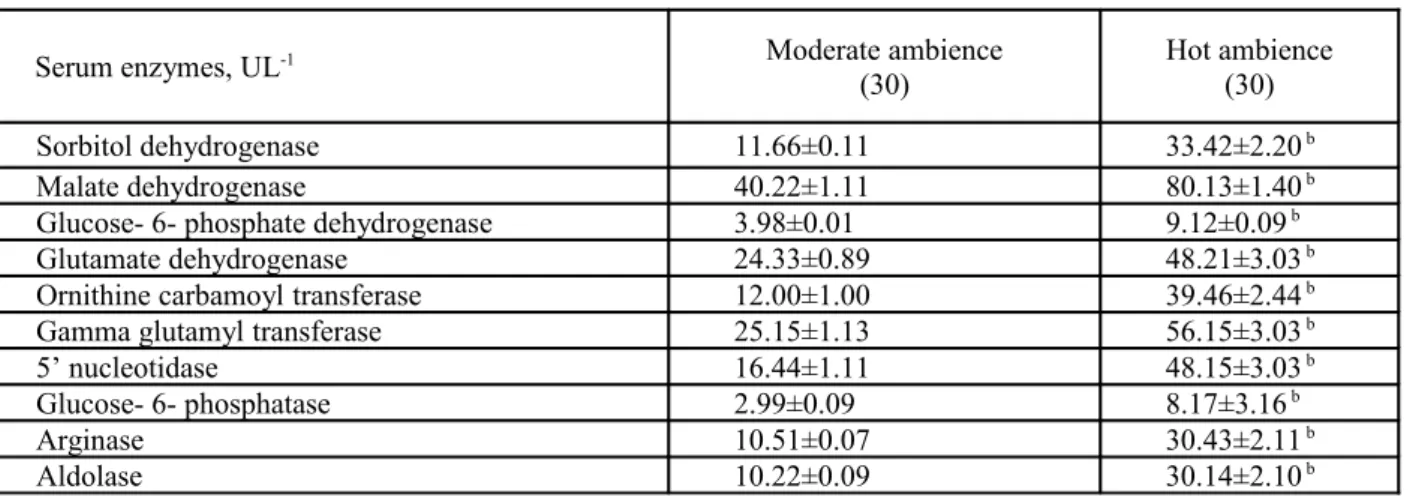
The mean values of enzymes of metabolic
reactions in serum are presented in table 1. In heat
stressed group the mean values of all the enzymes
increased significantly (p≤0.05) as compared to
respective moderate mean value.
Table 1. Mean ± SEM values of serum enzymes in donkeys of arid tract
Serum enzymes, UL-1 Moderate ambience
(30)
Hot ambience (30)
Sorbitol dehydrogenase 11.66±0.11 33.42±2.20 b
Malate dehydrogenase 40.22±1.11 80.13±1.40 b
Glucose- 6- phosphate dehydrogenase 3.98±0.01 9.12±0.09 b
Glutamate dehydrogenase 24.33±0.89 48.21±3.03 b
Ornithine carbamoyl transferase 12.00±1.00 39.46±2.44 b
Gamma glutamyl transferase 25.15±1.13 56.15±3.03 b
5’ nucleotidase 16.44±1.11 48.15±3.03 b
Glucose- 6- phosphatase 2.99±0.09 8.17±3.16 b
Arginase 10.51±0.07 30.43±2.11 b
Aldolase 10.22±0.09 30.14±2.10 b
Figures in the parenthesis indicate number of animals.
Superscript ‘b’ indicates a significant difference (p ≤ 0.05) from respective moderate mean value.
The increased activity of sorbitol dehydrogenase
during hot ambience probably helped in meeting the
demand for glucose (Wolf and Williams,1973) as it
is an enzyme of carbohydrate metabolism converting
sorbitol into fructose and with aldose reductase, it
provides a way for the body to produce fructose
from glucose without using ATP. The higher activity
also suggested stress mediated leakage (Alemu et
al., 1977). Malate dehydrogenase is an enzyme in
the citric acid cycle that catalyzes the conversion of
malate into oxaloacetate and vice versa. It is also
involved in gluconeogenesis. Higher activity of
MDH in hot ambience indicated the strategies of the
animal to modulate the metabolic pathways for
energy generation (Kataria et al., 2011).
Glucose-6-phosphate dehydrogenase is an enzyme of pentose
phosphate pathway, a metabolic pathway which
supplies reducing energy to the cell. Increased
activity of G6PDH during extreme hot ambience
showed the liver stimulation. This enzyme is highly
active in liver than other tissues (Hanson and
Ballard, 1967). Higher activity of this enzyme
reflected that PPP was operative actively in heat
stressed animals.
Higher activity of glutamate dehydrogenase
suggested increased fuelling of TCA cycle as it
plays a central role in amino group metabolism.
Kataria et al. (2010) also assessed the effect of
extreme ambient temperature associated stress on
fuelling of TCA cycle in hepatic cells of Marwari
goat and reported that whenever a hepatocyte needs
fuel for TCA cycle, the activity of enzyme glutamate
dehydrogenase increases making alpha-ketoglutarate
available for TCA cycle. Higher levels of serum
ornithine carbamoyl transferase during hot ambience
suggested higher activity of urea cycle as it is an
important enzyme of urea cycle. Determination of its
serum level is also important for detection of liver
diseases and hepatocellular damage. Increased
activity of arginase enzyme also suggested
activation of urea cycle in heat stressed animals. It
catalyses final step of urea cycle. Serum γGT is
commonly used indicator of hepatobiliary disease in
equines and ruminants (Saeed and Hussain,
2006).The determination of 5’-nucleotidase (5’-NT)
has been most used in the cases where rise in serum
ALP activity is there.
Glucose 6-phosphatase hydrolyzes
glucose-6-phosphate resulting in the creation of a glucose-6-phosphate
group and free glucose.Glucose is then exported
from the cell via glucose transporter membrane
proteins. This catalysis completes the final step in
gluconeogenesis and glycogenolysis and therefore
Kataria and Kataria
blood glucose levels. Hot ambience probably served
as a stressor and in order to maintain the blood
glucose the activity of enzyme was higher. In
present study the higher activity of serum ALD was
related with higher utilisation of glucose through
glycolysis to generate energy and also in the
synthesis of glucose by gluconeogenesis in the stress
period. Further higher ALD activity also helped in
the generation of more glyceraldehydes –3-
phosphate which can also be utilized for the
synthesis of fat in the body (Kour and Kataria,
2011). Aldolase is one of the seven glycolytic
enzymes, which function reversibly for
gluconeogenesis, an important mechanism for
generation of glucose in ruminants (Abdel-Fattah et
al., 2002). Role of aldolase in carbohydrate
metabolism explains its functional significance.
Regulated glycolysis and gluconeogenesis prevent
the futile cycling with accompanying loss of ATP
and energy (Kour and Kataria, 2011).
The present study provided mean values of
metabolic enzymes i.e. SDH, MDH, GD, G-6-PD,
OCT, GGT, 5’NT, G-6-P, ARG, ALD etc. in serum
of healthy donkeys of arid tract in India at one stand
to find out ambience related metabolic changes. The
variations observed in the present study could help
in realistic assessment of the management practice,
nutrition and diagnosis of disease conditions as all
the enzymes investigated in this investigation
belonged to the metabolism. The pattern of variation
showed the activation of gluconeogenesis, hexose
monophosphate shunt and urea cycle during hot
ambience in donkeys of arid tract.
CONCLUSION
It was concluded that higher activity of
metabolic regulators during hot ambience in
otherwise healthy donkeys indicated the modulation
of physiological mechanisms to support the
metabolic pathways in adverse climatic conditions.
Activation of gluconeogenesis probably helped the
animals to combat heat stress. The present study
provides reference values of some serum enzymes
regulating key metabolic reactions at one stand for
use in future research and to help in clinical cases
for disease diagnosis.
REFERENCES
Abdel-Fattah, M., Moussa, S.Z., El-Hindy,
H.M.,Gouda, E.M. (2002). Gluconeogenic
behaviour of camel hepatocytes (Camelus
dromedarius) by using (1-C14) propionate and
(1-C14) lactate as substrates. J Camel Prac
Res. 9 (2), 107-114.
Alemu, P., Forsyth, G.W., Searcy, G.P. (1977). A
comparison of parameters used to assess liver
damage in sheep treated with carbon
tetrachloride. Can J Comp Med. 41, 420- 427.
Brown, A.W., Grisolia, S. (1959). J Lab Clin Med.
54, 417-420. (Cited from King, 1965).
Hanson, R.W., Ballard, F.J. (1967). Lipid Synthesis
in Liver and Adipose Tissue from Ruminants
Biochem J. 105, 529-529.
Kataria, N., Kataria, A.K. (2010). Assessment of
stress due to hot ambience in donkeys from
arid tracts in India. J Stress Physiol Biochem.
6(4), 12-17.
Kataria, N., Kataria, A.K., Chaturvedi, M., Sharma,
A. (2011).Changes in serum enzymes levels
associated with liver functions in stressed
Marwari goat. J Stress Physiol Biochem. 7(1),
13-19.
Kataria, N., Kataria, A. K. (2006). Endocrine and
metabolic responses of Marwari sheep in arid
tract. Slov Vete Res. 43(3), 135-142.
Kataria, N., Kataria, A.K., Joshi, A. (2010). Fuelling
of TCA cycle in hepatic cells of Marwari goat
during ambient temperature associated stress. J
Stress Physiol Biochem6(4), 5-11.
King, J. (1965). In: Practical clinical enzymology.
London: D.Van Nostrand Company Ltd.,
1-301.
Kour, G., Kataria, N. (2011). Ambient temperature
associated variations in serum arginase and
aldolase in Marwari goat. Vet Prac, 12,
124-127.
Manning, R.T., Grisolia, S. (1957). Proc Soc exp
Biol Med. 95, 225-226 (Cited from King,
1965).
Saeed, A., Hussain, M.M. (2006). Influence of age
and sex on various serum enzyme activities of
camels. J Camel Prac Res. 13(2), 149-155.
Sibley, J.A., Lehninger, A.L. (1949). Aldolase in
serum and tissue of tumor bearing animals. J
Nat Cancer Inst. 9, 303-309.(Cited from
King,1965).
Snedecor, G.W., Cochran, W.G. (1967). In:
Statistical Methods. 6th ed. New Delhi:Oxford
& IBH Publishing Co. 45-83.
Varley, H. (1988). Tests in liver and biliary tract
disease. In: Practical Clinical Biochemistry.
New Delhi: CBS publishers. 158-467.
Wolf, P.L., Williams, D. (1973). In: Practical
Clinical Enzymology. New York: Wiley-
Inetrscience Publication, John Wiley & Sons.