Open suprapubic versus retropubic prostatectomy in the
treatment of benign prostatic hyperplasia during resident’s
learning curve: a randomized controlled trial
_______________________________________________
Arie Carneiro
1, 2, Paulo Sakuramoto
2, Marcelo Langer Wroclawski
1, 2, Pedro Herminio Forseto
2, Alexandre
Den Julio
2, Carlos Ricardo Doi Bautzer
2, Leonardo Monte Marques Lins
2, Andre Kataguiri
2, Fernanda
Batistini Yamada
2, Gabriel Kushiyama Teixeira
2, Marcos Tobias-Machado
2, Antonio Carlos Lima Pompeo
21 Hospital Israelita Albert Einstein, SP, Brasil; 2 Departamento de Urologia, Faculdade de Medicina do
ABC, São Paulo, Brasil
ABSTRACT
ARTICLE
INFO
______________________________________________________________ ______________________
Purpose: This study compared the suprapubic (SP) versus retropubic (RP) prostatec-tomy for the treatment of large prostates and evaluated perioperative surgical morbi-dity and improvement of urinary symptoms.
Materials and Methods: In this single centre, prospective, randomised study, 65 con-secutive patients with LUTS and surgical indication with prostate volume greater than 75g underwent open prostatectomy to compare the RP (32 patients) versus SP (33 pa-tients) technique. Results: The SP group exhibited a higher incidence of complications (p=0.002). Regarding voiding pattern analysis (IPSS and flowmetry), both were signi-ficantly effective compared to pre-treatment baseline. The RP group parameters were significantly better, with higher peak urinary flow (SP: 16.77 versus RP: 23.03mL/s, p=0.008) and a trend of lower IPSS score (SP: 6.67 versus RP 4.14, p=0.06). In a sub-group evaluation of patients with prostate volumes larger than 100g, blood loss was lower in those undergoing SP prostatectomy (p=0.003). Patients with prostates smaller than 100g in the SP group exhibited a higher incidence of low grade late complications (p=0.004).
Conclusions: The SP technique was related to a higher incidence of minor compli-cations in the late postoperative period. High volume prostates were associated with increased bleeding when the RP technique was utilized. The RP prostatectomy was associated with higher peak urinary flow and a trend of a lower IPSS Score.
Key words:
Prostatic Hyperplasia; Prostatectomy; Postoperative Complications; Prostate
Int Braz J Urol. 2016; 42: 284-92
_____________________
Submitted for publication: October 13, 2014
_____________________
Accepted after revision: May 21, 2015
INTRODUCTION
Benign prostatic hyperplasia (BPH) is a condition that affects more than 50% of men over 60 years of age (1) and is the most common benign neoplasm in men. This pathology has gained even more notoriety due to the ageing
pulation is expected between the years 2000 and 2050 (2).
4). Surgical treatment is reserved for refractory cases, as well as cases involving recurrent urinary retention, recurrent urinary tract infection, recur-rent haematuria, bladder lithiasis, or upper urina-ry tract involvement (5).
There are several different surgical treat-ments for BPH, including transurethral resection of the prostate (TURP), open prostatectomy, lapa-roscopic and robotic prostatectomy, and other mi-nimally invasive procedures (vaporization, transu-rethral incision, thermotherapy, ethanol ablation, holmium laser, among others). TURP is considered the gold standard surgical treatment for patients with prostate volumes less than 75g. For larger prostates (6) and in places with restricted access to newer technologies, open prostatectomy remains the standard procedure. Two open prostatectomy techniques have been described: the suprapubic (SP) and retropubic (RP) approaches are both wi-dely performed all around the World (5). The ad-vantages and disadad-vantages of these two techni-ques are commonly cited, but these reports have typically been based on case reports and personal experience of surgeons. To our knowledge, a
ran-domised, prospective trial comparing the morbi-dity and functional outcomes between these two classic techniques has not been published.
OBJECTIVE
This study sought to prospectively com-pare perioperative morbidity and improvement of symptoms of the RP and SP open prostatectomy techniques for treatment of BPH related LUTS du-ring the resident’s learning curve.
MATERIALS AND METHODS
We performed a single centre, prospective, randomized study comparing the two most widely performed techniques of open prostatectomy (RP and SP) as surgical treatment for patients with BPH related LUTS. We consecutively included 65 men with surgical indication for the treatment of BPH related LUTS and prostate volumes estimated by transabdominal ultrasound and digital rectal exam to be greater than 75grams (Figure-1). Patients with atonic bladder confi rmed by urodynamic study and
previous pelvic surgery were not eligible for the study. Patients with prostate cancer (elevated PSA or abnormal digital exam) suspicion had to have a negative prostate biopsy to be included. The study was approved by the local Ethics Committee and informed consent was obtained from each subject before inclusion in the study.
The initial assessment was performed using a protocol completed by the surgeon. The following parameters were included: demographic data, clinical examination, laboratory tests [PSA, hemoglobin (Hb)/hematocrit (Ht), urea and creati-nine], imaging exams (abdominal USG), free flow-metry and International Prostate Symptoms Score (IPSS) questionnaire. The Charlson Index combi-ned with age was used to quantify the burden of comorbidities (7). Follow-up visits were scheduled for 1, 3, 6 and 12 months after surgery. Symptom improvement (IPSS and free flowmetry) and com-plications were assessed at each visit.
The surgical technique was defined by sim-ple randomization by sortition. All patients using anticoagulant therapy were informed to stop tre-atment 7 days before the procedure. The type of anaesthesia used was at the discretion of the anaesthesia team. The surgeries were performed by a first or second-year urology resident super-vised by 3 senior surgeons (PS, MLW and PHFJ) with wide experience in both techniques. The te-chniques were previously standardised according to the Campbell-Walsh 10th edition (5). The in-dwelling catheter was scheduled to be removed on the seventh day after surgery in both techniques.
To access surgical morbidity, compli-cations, blood loss estimation and necessity of transfusion were evaluated. Symptom improve-ment was evaluated via the IPSS score and free flowmetry. Blood loss estimation was calculated by the sum of the volume of blood present in the vacuum with the weight of the compresses, given a blood density of 1g/mL (8). The indica-tion for blood transfusion followed the recom-mendations published by Roth et al. in 2010 (9). The Clavien-Dindo method was used to classify the complications (10) which were subdivided into intraoperative, immediate (during hospita-lisation), early (before 1 month) and late (after 1 month) complications.
To achieve a p<0.05 and statistical power of 80%, we had to include at least 60 patients with 30 in each group. The student t-test, Mann--Whitney test, χ2 test, Pearson χ2 test, and
mul-tiple regression analysis were used for statistical analyses, performed with SPSS statistics software, Version 22 (IBM®).
RESULTS
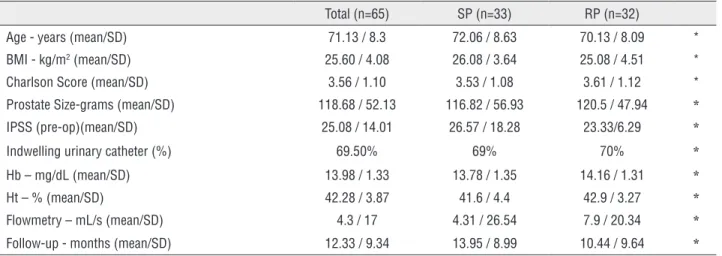
Sixty-five patients were included, 33 derwent surgery with the SP technique and 32 un-derwent surgery with the RP technique. The ave-rage age of the patients was 71 years. The main factors related to the indication for surgery were urinary retention (53.3%) and clinical treatment failure (21.5%). The mean follow-up was 12 mon-ths, and all patients attended at least the 3-month follow-up visit. Preoperatively, the groups were similar with respect to age, BMI, comorbidities (Charlson criteria), prostate size, IPSS and flow-metry (Table-1).
Eleven cases involved bladder calculus (SP: 6 versus RP: 5), all were managed in the same surgical procedure, without any additional in-tercurrence. The mean operating time was 126.5 minutes (SP: 125.65 versus RP: 127.41 minutes; p=0.75), and was not statistically different betwe-en the two techniques. Bladder irrigation (SP: 2.74 versus RP: 2.74 days, p=1), and abdominal drai-nage (SP: 2.96 versus RP: 3.32 days; p=0.64) were also similar between the groups. The indwelling bladder catheter placement time was shorter in the group that underwent RP prostatectomy, however, the difference was not statistically significant (SP: 10 versus RP: 7.92 days; p=0.12) (Table-2).
The haematological parameters were si-milar between the groups before the procedure (Table-1). The peri-operative blood loss estima-tion was similar between the groups, with an average intraoperative blood loss of 1044mL (SP: 927.5 versus RP: 1156mL, p=0.14) and an Hb average after 48 hours of 9.93mg/dL with
both techniques showing a significant decrease from pre-operative (SP: 13.78 to 10.49mg/dL, p<0.001 and RP: 14.16 to 9.9mg/dL, p<0.001), however both groups presented a similar Hb af-ter 48 hours (SP: 10.49 versus RP: 9.9mg/dL, p=0.11). Blood transfusion during surgery was required for three patients treated by SP and
Table 1 - Baseline and Demographic data.
Total (n=65) SP (n=33) RP (n=32)
Age - years (mean/SD) 71.13 / 8.3 72.06 / 8.63 70.13 / 8.09 *
BMI - kg/m2 (mean/SD) 25.60 / 4.08 26.08 / 3.64 25.08 / 4.51 *
Charlson Score (mean/SD) 3.56 / 1.10 3.53 / 1.08 3.61 / 1.12 *
Prostate Size-grams (mean/SD) 118.68 / 52.13 116.82 / 56.93 120.5 / 47.94 *
IPSS (pre-op)(mean/SD) 25.08 / 14.01 26.57 / 18.28 23.33/6.29 *
Indwelling urinary catheter (%) 69.50% 69% 70% *
Hb – mg/dL (mean/SD) 13.98 / 1.33 13.78 / 1.35 14.16 / 1.31 *
Ht – % (mean/SD) 42.28 / 3.87 41.6 / 4.4 42.9 / 3.27 *
Flowmetry – mL/s (mean/SD) 4.3 / 17 4.31 / 26.54 7.9 / 20.34 *
Follow-up - months (mean/SD) 12.33 / 9.34 13.95 / 8.99 10.44 / 9.64 *
*p>0.05
Table 2 - Peri and postoperative assessment and early complications.
Total (n=65) SP (n=33) RP (n=32) p
Time of surgery- minutes (mean/SD) 126.50 / 36.07 125.65 / 40.06 127.41 / 31.95 *
Hospital stay- days (mean/SD) 4.60 / 2.19 4.52 / 1.37 4.67 / 2.76 *
Irrigation - days (mean/SD) 2.74 / 1.54 2.74 / 2.16 2.74 / 1.51 *
Drain - days (mean/SD) 3.15 / 1.32 2.96 / 1.02 3.32 / 1.54 *
IPSS Post-op (mean/SD) 5.56 / 5.43 6.67 / 6.86 4.14 / 2.25 0.06
Flowmetry post-op
Maximal flow - mL/seg (mean/SD) 19.78 / 11.23 16.77 / 11.24 23.03 / 10.73 0.008
Final volume - mL (mean/SD) 192.00 / 100.06 181.15 / 64.05 203.77 / 130.70 *
Blood loss
Hb (48 hours) – mg/dL (mean/SD) 9.93 / 1.47 10.49 / 1.47 9.93 / 1.47 *
Ht (48 hours) - % (mean/SD) 29.95 / 4.3 31.44 / 4.7 29.95 / 4.3 *
Estimative of Bleeding- mL (mean/SD) 1044.25 / 619.74 927.51 / 554.03 1156.82 / 667.68 *
Transfusion
Yes 3.90% 8.30%
No 96.10% 100.00% 91.70% *
one individual treated by the RP technique (Ta-ble-2).
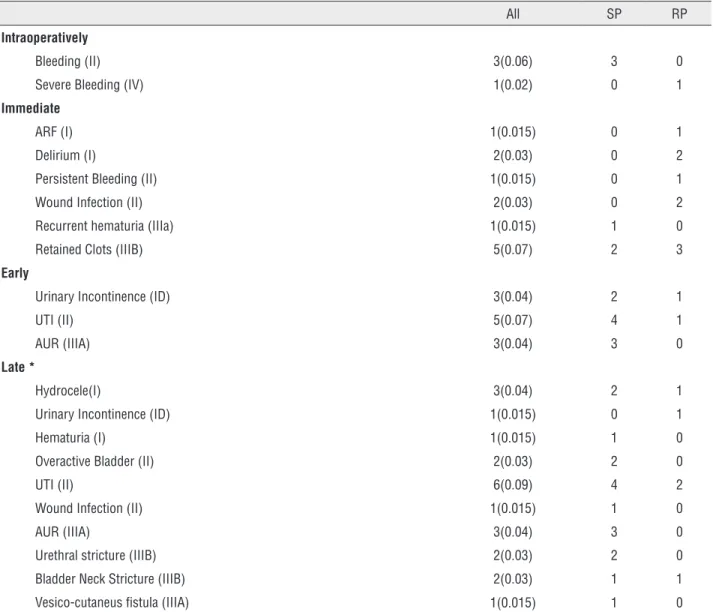
Forty-nine complications were identi-fied, with 4 intraoperative, 12 immediate, 11 early and 22 late complications. Seventeen complications were considered severe (Clavien 3 or 4), and 32 were considered minor (Clavien 1 or 2) (Table-3). Complications were more pre-valent in patients undergoing the SP technique (SP: 32 versus RP: 17, p=0.002). The number of late complications was also higher in the SP
group (SP: 17 versus RP: 5, p=0.004), for late complications, 7 were classified as severe (Cla-vien 3) in the SP group, and 1 was classified as severe in the RP group.
In the analysis of the severity of com-plications, two cases should be highlighted for their severity. The first case involved a patient who underwent SP prostatectomy and develo-ped a vesico-cutaneous fistula requiring pro-longed vesical indwelling catheterisation. The second case underwent RP prostatectomy and
Table 3 - Complications according to Clavien-Dindo classification.
All SP RP
Intraoperatively
Bleeding (II) 3(0.06) 3 0
Severe Bleeding (IV) 1(0.02) 0 1
Immediate
ARF (I) 1(0.015) 0 1
Delirium (I) 2(0.03) 0 2
Persistent Bleeding (II) 1(0.015) 0 1
Wound Infection (II) 2(0.03) 0 2
Recurrent hematuria (IIIa) 1(0.015) 1 0
Retained Clots (IIIB) 5(0.07) 2 3
Early
Urinary Incontinence (ID) 3(0.04) 2 1
UTI (II) 5(0.07) 4 1
AUR (IIIA) 3(0.04) 3 0
Late *
Hydrocele(I) 3(0.04) 2 1
Urinary Incontinence (ID) 1(0.015) 0 1
Hematuria (I) 1(0.015) 1 0
Overactive Bladder (II) 2(0.03) 2 0
UTI (II) 6(0.09) 4 2
Wound Infection (II) 1(0.015) 1 0
AUR (IIIA) 3(0.04) 3 0
Urethral stricture (IIIB) 2(0.03) 2 0
Bladder Neck Stricture (IIIB) 2(0.03) 1 1
Vesico-cutaneus fistula (IIIA) 1(0.015) 1 0
developed significant intraoperative bleeding due to inadvertent injury of the retropubic ves-sel, with hypovolemic shock and the need for a transfusion of 4 units of packed red blood cells.
In the subgroup of patients with prostate volumes estimated to be greater than 100grams, those in the RP group exhibited significantly more bleeding (mean estimated blood loss, SP: 863mL (SD: 462) versus RP: 1313mL (SD: 671), p=0.003) compared to SP group. The incidence and severity of complications were similar be-tween the techniques.
In patients with prostate volumes
esti-mated to be between 75 and 100g, the estima-ted peri-operative bleeding was similar between the groups. However, the SP group exhibited a higher incidence of late complications (SP: 17 versus RP: 5, p=0.004).
We observed that 15.4% of our patients required some re-endoscopic surgical interven-tion, 50% of these for evacuation of clots.
DISCUSSION
Open prostatectomy is the most effective and durable method for controlling symptoms associated with BPH and is widely performed, mainly for patients with bulky prostates and in countries where access to technology is limited. Thus, understanding the details of this proce-dure is of great importance.
The risk of bleeding and the complica-tions of the procedure vary significantly accor-ding to the centre performing the surgery. Cur-rently, due to the expansion of endourological methods, open surgery has been less studied. Thus, there is a lack of studies with adequa-te methodology and standardised reporting of complications as well as analyses of the lear-ning curve.
In our study, we prospectively evaluated a series of patients that underwent open pros-tatectomy during the residents learning curve comparing the surgical morbidity and func-tional outcomes between the two most widely used techniques. To our knowledge, there has been no study in the World literature perfor-ming such a comparison. Both techniques used
in this study are well established and are still performed even in places where TURP is widely used for patients with massive prostates (11).
The RP technique was described by Ter-rance Millin and published in The Lancet in 1945. According to Campbell’s Urology 10th edition, this technique has the advantages of better control of bleeding, better visualisation of remnant adenoma, no effect on the bladder, and good anatomic exposure of the prostate, however, the technique does not allow for di-rect access to the bladder, an important factor in cases with lithiasis and bladder diverticula (5). The SP technique (transvesical) was descri-bed by Eugene Fuller in 1894 and popularised by Peter Freyer in 1900-1912. According to Campbell’s Urology 10th edition, this technique has the advantage of being able to directly vi-sualise the bladder and bladder neck but has a vision deficit of the prostatic apex and difficul-ty in controlling bleeding (5).
Conversely, in our study, the RP techni-que was significantly related to intraoperative bleeding when the prostate volume was gre-ater than 100g. On the other hand, there was no difficulty in treating bladder stones through this approach. The presence of bladder lithiasis does not present a limiting factor for the RP technique, in our series, 5 patients with bladder lithiasis were treated with the RP technique wi-thout increased morbidity.
In the literature, we found several ca-ses of SP prostatectomy and RP prostatectomy and a few studies that compared open prosta-tectomy with fewer invasive procedures. Ou et al. published a randomized series of 80 cases comparing SP prostatectomy with TURP, sug-gesting that the improvement in quality of life and the IPSS of the patients undergoing open prostatectomy were significantly better than of patients who underwent TURP (12).
the-se findings may not reprethe-sent a clinical diffe-rence. However, there are no scientific data to support this finding, one may hypothesize that bladder incision in the SP technique may have impact in the bladder function and therefore be related with the above findings.
A report of a modified Millin technique which compares this approach to the standard SP technique has been previously published by Dall’Oglio et al. (13). The authors concluded that the modified technique can significantly control bleeding during and after surgery, and reduce transfusion rates, when compared to the classic transvesical prostatectomy. However, a modified technique was performed in that stu-dy and the global morbidity and effectiveness were not addressed.
In our study, the blood loss estimation in the total population was 1044mL and was si-milar between the techniques. Although consi-dered high, when compared to series within the World literature, there was no significant drop in the haematocrit and little increase in the transfusion rate, consistent with approximately 5 to 8% of cases reported in the literature (14). Our increased blood loss may be explained by the fact that residents at the beginning of their learning curve performed the procedures.
Although bleeding was similar between the techniques, the transfusion requirements were higher in the SP group, however, in the RP group, the required number of red blood units in the event of transfusion was significantly higher (four units for the RP versus 1 unit in each SP case), indicating greater difficulty in controlling bleeding that occurred in the RP technique.
The analysis of the subgroup of patients with massive prostates (>100g) revealed increa-sed bleeding in the RP group (RP: 1313mL ver-sus SP: 863mL, p=0.04). This increase may also be explained by the technical difficulty in con-trolling the lateral pedicle in larger prostates.
Moslemi et al. reported that open pros-tatectomies offer the advantage of low rates of re-treatment when compared to TURP (15), al-though might be related with more re-interven-tions. In our study, this pattern could be also found, since 15.4% of our patients underwent
re-endoscopic surgical intervention. This may be partially explained by the lack of a specia-lized multi-professional team, that often inad-vertently stops bladder irrigation.
Our study demonstrated that both tech-niques have a high complication rate (75% of patients had some type of complication, whether intraoperative, immediate, early or late). Howe-ver, complications were typically easy to handle (Clavien 1 or 2), and there was only one case of Clavien 4 complication. In the past, given the lack of standardisation of complications, these events would likely not have been counted as complications of TURP and prostatectomy se-ries, and can explain the lower incidence repor-ted in previous publications (16, 17).
The SP technique was related to a hi-gher number of complications (p=0.002). In the analysis of late complications, the incidence was significantly higher in the subgroup un-dergoing the SP technique (p=0.004), and se-vere complications (Clavien 3 or 4) were more frequent in the SP group (SP: 4 versus RP: 1). The incidence and severity of immediate and early complications were similar between the two groups. We suspect that the increase in the number of late complications in the SP techni-que was related to the bladder incision, which does not occur in the RP technique. In patients with bulky prostates, the incidence and seve-rity of complications were similar between the groups.
In developed countries, newer therapies such as laser enucleation, laparoscopic and robotic surgery have been applied with good results, improving the estimated blood loss, surgical morbidity and hospital length of stay. However, these technologies are expensive and require a long learning curve that may limit their feasibility worldwide (18, 19).
with great experience in both techniques. Ano-ther limitation of the study was the absence of data regarding the amount of resected prostatic tissue, although the whole adenoma was suppo-sedly resected during both procedures. Althou-gh the statistical power of 80% was reached, with a population of more than 60 patients, a larger number would be warranted to consoli-date our findings.
CONCLUSIONS
RP and SP techniques are safe and effec-tive in the surgical treatment of BPH related LUTS, even during the learning curve of resi-dents. The choice of technique should be based on the experience and training of each surgeon. The RP technique was associated with higher statistical improvement of urinary symptoms, however, it probably does not represent clinical significance. Although the incidence of com-plications was high, they were typically easy to handle (Clavien 1 or 2). The SP technique was associated with a higher incidence of late com-plications, and the RP technique increased the risk of excessive bleeding in massive prostates (greater than 100grams). A similar study should be conducted in other centres to confirm these results.
CONFLICT OF INTEREST
None declared.
REFERENCES
1. Platz EA, Smit E, Curhan GC, Nyberg LM, Giovannucci E. Prevalence of and racial/ethnic variation in lower urinary tract symptoms and noncancer prostate surgery in U.S. men. Urology. 2002; 59:877-83. Erratum in: Urology. 2003;61:1078.
2. Klotz L, Zhang L, Lam A, Nam R, Mamedov A, Loblaw A. Clinical results of long-term follow-up of a large, active surveillance cohort with localized prostate cancer. J Clin Oncol. 2010;28:126-31.
3. Bushman W. Etiology, epidemiology, and natural history of benign prostatic hyperplasia. Urol Clin North Am. 2009;36:403-15.
4. AUA Practice Guidelines Committee. AUA guideline on management of benign prostatic hyperplasia (2003). Chapter 1: Diagnosis and treatment recommendations. J Urol. 2003;170:530-47.
5. Han MP, Partin AW. Retropubic and suprapubic open prostatectomy. Chapter 94, Walsh-Campbell’s Urology. 10th ed, Elsevier; 2012; pp. 2683-87.
6. Fitzpatrick JM. Minimally invasive and endoscopic management of benign prostatic hyperplasia. Chapter 93. Walsh-Campbell’s Urology 10th ed. Elsevier 2012; pp.2641-67.
7. Charlson ME, Pompei P, Ales KL, MacKenzie CR. A new method of classifying prognostic comorbidity in longitudinal studies: development and validation. J Chronic Dis. 1987;40:373-83.
8. Hinghofer-Szalkay H, Greenleaf JE. Continuous monitoring of blood volume changes in humans. J Appl Physiol (1985). 1987;63:1003-7.
9. Roth JV. Blood transfusion and survival in cardiac surgery. Anesthesiology. 2010;112:761-2.
10. Dindo D, Demartines N, Clavien PA. Classification of surgical complications: a new proposal with evaluation in a cohort of 6336 patients and results of a survey. Ann Surg. 2004; 240:205-13.
11. Oranusi CK, Nwofor A, Oranusi IO. Complication rates of open transvesical prostatectomy according to the Clavien-Dindo classification system. Niger J Clin Pract. 2012;15:34-7.
12. Ou R, You M, Tang P, Chen H, Deng X, Xie K. A randomized trial of transvesical prostatectomy versus transurethral resection of the prostate for prostate greater than 80mL. Urology. 2010;76:958-61.
13. Dall’Oglio MF, Srougi M, Antunes AA, Crippa A, Cury J. An improved technique for controlling bleeding during simple retropubic prostatectomy: a randomized controlled study. BJU Int. 2006;98:384-7.
14. Tuhkanen K, Heino A, Ala-Opas M. Two-year follow-up results of a prospective randomized trial comparing hybrid laser prostatectomy with TURP in the treatment of big benign prostates. Scand J Urol Nephrol. 2001;5:200-4.
15. Moslemi MK, Abedin Zadeh M. A modified technique of simple suprapubic prostatectomy: no bladder drainage and no bladder neck or hemostatic sutures. Urol J. 2010;7:51-5. 16. Varkarakis I, Kyriakakis Z, Delis A, Protogerou V, Deliveliotis
17. Wroclawski ML, Carneiro A, Tristão RA, Sakuramoto PK, Youssef JD, Lopes Neto AC, Santiago LH, Pompeo AC. Giant prostatic hyperplasia: report of a previously asymptomatic man presenting with gross hematuria and hypovolemic shock. Einstein (Sao Paulo). 2015;13:420-2.
18. McCullough TC, Heldwein FL, Soon SJ, Galiano M, Barret E, Cathelineau X, et al. Laparoscopic versus open simple prostatectomy: an evaluation of morbidity. J Endourol. 2009;23:129-33.
19. Wroclawski ML, Carneiro A, Amarante RD, Oliveira CE, Shimanoe V, Bianco BA, Sakuramoto PK, Pompeo AC. ‘Button type’ bipolar plasma vaporisation of the prostate compared with standard transurethral resection: a systematic review and meta-analysis of short-term outcome studies. BJU Int. 2016;117:662-8.