Effect of S-methyl-l-thiocitrulline dihydrochloride on rat
micturition reflex
_______________________________________________
Jeová Nina Rocha
11 Divisão de Urologia, Faculdade de Medicina Ribeirão Preto, Universidade de São Paulo, SP, Brasil
ABSTRACT
ARTICLE
INFO
______________________________________________________________ ______________________
Objective: To evaluate the effect of neuronal nitric oxide synthase on the striated ure-thral sphincter and the urinary bladder.
Materials and Methods: A coaxial catheter was implanted in the proximal urethra and another one in the bladder of female rats, which were anesthetized with subcutane-ous injection of urethane. The urethral pressure with saline continusubcutane-ous infusion and bladder isovolumetric pressure were simultaneously recorded. Two groups of rats were formed. In group I, an intrathecal catheter was implanted on the day of the experiment at the L6-S1 level of the spinal cord; in group II, an intracerebroventricular cannula was placed 5-6 days before the experiment.
Results: It was verified that the group treated with S-methyl-L-thio-citrulline, via in-trathecal pathway, showed complete or partial inhibition of the urethral sphincter re-laxation and total inhibition of the micturition reflexes. The urethral sphincter and the detrusor functions were recovered after L-Arginine administration. When S-methyl-L-thio-citrulline was administered via intracerebroventricular injection, there was a sig-nificant increase of urethral sphincter tonus while preserving the sphincter relaxation and the detrusor contractions, at similar levels as before the use of the drugs. Never-theless there was normalization of the urethral tonus when L-Arginine was applied. Conclusions: The results indicate that, in female rats anaesthetized with urethane, the nNOS inhibitor administrated through the intrathecal route inhibits urethral sphincter relaxation, while intracerebroventricular injection increases the sphincter tonus, with-out changing bladder function. These changes were reverted by L-Arginine administra-tion. These findings suggest that the urethral sphincter and detrusor muscle function is modulated by nitric oxide.
Keywords:
Urethra; Urinary Sphincter, Artificial; Infusions, Intraventricular; Nitric Oxide Synthase
Int Braz J Urol. 2016; 42: 1018-27
_____________________
Submitted for publication: March 20, 2015
_____________________
Accepted after revision: January 19, 2016
INTRODUCTION
The lower urinary tract function, includ-ing bladder, and striated urethral sphincter, fills/ stores and empties/voids urine in two distinct phases. The gradual filling/storage of urine by the bladder (under low pressure) involves a progres-sive increase of the urethral sphincter muscle to-nus, while simultaneously maintaining the urethra closed. The integrity and coordination between
the autonomic and somatic nervous systems is important in order to preserve continence and al-low micturition. Emptying/voiding requires rapid pressure elevation and concomitant relaxation of the urethral sphincter (cross-talk mechanism), fa-cilitating urine drainage (1, 2).
as the pontine micturition center (PMC), provokes micturition due to simultaneous bladder contrac-tion and urethral sphincter motoneuron inhibicontrac-tion, while microinjections with inhibitory drugs in the PMC block the micturition reflex (3). Electric stimu-lation of the nucleus paracoelureus causes contrac-tion of the pelvic floor muscle and, as consequence, increases urethral pressure, whereas injury to the nuclei of this area evokes detrusor hypertonia and urethral relaxation (4). For this relaxation and con-traction mechanism of the detrusor and urethral sphincter to happen, it has been proposed that de-scendent fibers from the PMC project directly onto the preganglionic parasympathetic nuclei, on the dorsal commissure nuclei and on the intermedium-lateralis column nuclei (4). The activation of these preganglionic nuclei stimulates pelvic ganglia and inhibits interneurons that have projections in Onuf’s nuclei. These interneurons release two important
neurotransmitters: γ-aminoglutamic acid (GABA)
and glycine (5-8) that facilitate the urethral sphinc-ter relaxation. Nevertheless, this relaxation is not observed when strychnine, a glycine inhibitor, is administrated before any external stimulation. This strongly suggests the possibility of the involvement of these neurotransmitters in the urethral activity (7, 9, 10). Furthermore, Buss & Shefchyk verified that electric stimulation applied directly on the pre-ganglionic parasympathetic nuclei leads to relax-ation of the striated urethral sphincter with conse-quent reduction of intraurethral pressure (6).
The micturition and storage complex mech-anism has the participation of several neurotrans-mitters, including nitric oxide (NO) at the peripheral and central nervous system (11). There are reports of high densities of nitric oxide synthase (NOS), an enzyme that catalyzes the amino acid L-Arginine [L-ARG] to convert to L-citrulline and NO in the presence of oxygen and nicotinamide adenine di-nucleotide phosphate (NADPH), in the spinal cord dorsal horn, especially in the superficial area, in the dorsal commissure and in the site of the pregangli-onic sympathetic and parasympathetic nuclei (12-14). Therefore, NO induces striated urethral sphinc-ter (SUS) in vitro relaxation (13) and when reflexly induced (15-17).
It has been proposed that NO acts as an important mediator in non-adrenergic
non-cho-linergic neurotransmitters (NANC) in the smooth and striated muscles of the lower urinary tract, since NO synthase (NOS) is present in micturition reflex neuronal fibers. These include primary sen-sitive neurons, spinal interneurons, preganglionic sympathetic and parasympathetic neurons in the spinal cord, postganglionic parasympathetic neu-rons in the peripheral ganglia, in lower urinary tract motoneurons and in afferent fiber dorsal root ganglia (15, 18, 19).
As it is not well established what type of NOS isoform is involved in the bladder out-let function, the aim of this work was to study the effect of the neuronal NOS (nNOS) isoform on the detrusor and SUS during reflexogenic contrac-tions in normal female rats.
MATERIAL AND METHODS
Ethical approval
The protocol applied in this experiment was approved by the Committee of Ethics of the Ribeirão Preto Medical School, University of S. Paulo. All efforts were undertaken to minimize the suffering and reduce the number of animals used in this experimental protocol.
Surgical Procedure
the level of the aortic bifurcation so that diuresis did not change bladder volume during the ex-periment. The distal ends of the ureters were tied, and a PE-10 catheter (id=0.28mm; od=0.61mm; Clay-Adams) was placed in the proximal sec-tion of each ureter for spontaneously draining urine out of the abdominal cavity. All data were collected and stored in the computer by Windaq software (DATAQ Instruments Inc., Akron, OH, USA). At the end of the experiments, the ani-mals were euthanatized by exsanguination. Fol-lowing this procedure, a dye was injected in the subarachnoid space and in the lateral ventricle, and a lumbar laminectomy or craniotomy was performed in every rat to confirm the catheter or cannula position, respectively.
Cystourethrometry
Using a micro-pump (Kd Scientific Infu-sion Pump, Model 780.200, Ser. #201755, USA), a warm saline (37ºC, 0.9%) infusion was inject-ed through the PE-50 catheter, at a flow rate of 0.02mL/min until the bladder contraction
at-tained a pressure higher than 15cmH20, at which
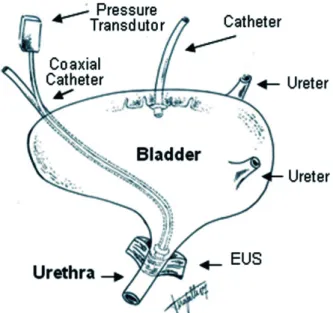
point the infusion was interrupted. The urethra was continually infused (with the micro-pump) with saline solution through the coaxial catheter at a rate of 0.075mL/min to record the urethral perfusion pressure (UPP), and the vesical pres-sure under isovolumetric conditions (Figure-1). The saline infused into the urethra was allowed to drain freely through the urethral meatus.
Implantation of the Intrathecal (i.t.) Catheter The i.t. implantation of a catheter (PE-10) in the rats (n=7) was performed on the same day of the experimental procedure. A special needle
was placed in the vertebral canal through the L5
-L6 intervertebral space. The correct positioning of
this needle in the subarachnoid space was con-firmed by the tail-flick reflex of the rat. Follow-ing this procedure, a PE-10 catheter containFollow-ing 10% heparin was passed through the needle, pro-gressing 2.0cm into the intravertebral canal, and the distal tip of this catheter was placed exactly
between segments L6-S1 of the spinal cord. The
needle was then removed, and the catheter was tied to the subcutaneous tissue with 4-0 silk.
Implantation of the Intracerebroventricular (i.c.v) Cannula
Rats (n=6) were anesthetized with ket-amine (75mg/kg) and xilazine (7.5mg/kg), both administered intramuscularly. The animals were placed in a stereotaxic frame (David Kopf Instru-ment, USA) in a dorsal recumbent position. A small burr hole, 1mm in diameter, was made in the parietal cortex using a dental drill, care being taken to avoid damage to the dura during
drill-ing. A 23G cannula, 10.5mm in length (made in
our laboratory) was implanted in the right lateral ventricle (1.0mm posterior to the bregma, 1.6mm lateral to the midline, and 3.4mm below the sur-face of the skull), according to Paxino’s and Wat-son’s coordinates (20). The cannula was fixed to the skull with autopolimerizant acrylic cement. A metallic mandrill was placed in this cannula to close the system, and fixated with the same acrylic cement. G-Procaine Penicillin (8.000UI, intramus-cular) was administered immediately after surgery. The rats were housed in cages with wood shavings, at a controlled temperature (22±0.2ºC), with a light/dark cycle of 12/12h, and had
free access to food and water. Experimental recordings were performed 5-6 days after cannula implantation.
To evaluate the involvement of NO in the function of the rat’s detrusor and striated urethral sphincter (under normal conditions) we administrated, through either i.t. or i.c.v. spaces the following drugs: (a) S-methyl-L-thio-citrul-line dihydrochloride (L-SMTC), a selective po-tent inhibitor of the NOS isoform enzyme, at a single dose of 1.0µmol (mixed with saline 7µL), followed by flushing with 10µL of artifi-cial cerebrospinal fluid (aCSF) (composition in
g/L: NaCl=8.1; KCl=0.25; Na2HPO4=0.08;
Mg-Cl26H20=0.1; NaHC03=1.72; CaCl22H2O=0.14;
(NH2)2CO=1.3; Glucose=0.6, pH=7.4, gassed
previously with 95% O2/5% CO2) and (b)
L-Argi-nine, a physiological substrate for NOS and the precursor of NO, at single dose of 10µmoL (10µL), with an additional 10µL aCSF for flushing. The
drug administration was performed slowly (5µL/
min), using a Hamilton micro-syringe (10µL).
Catheter volume was approximately 7µL.
Drugs
The drugs used in this experiment were: S-methyl-L-thio-citrulline dihydrochloride (Calbio-chem Inc, USA); L-Arginine and Urethane (Sigma Chemical Co. USA); Xilazine Chloride (Carbier SA, Spain); Ketamine Chloride (Cristália SA, Brazil) and G Procaine Penicillin (Euro-farma Laboratóri-os, Brazil).
Statistical analysis
The results were expressed by mean±the standard error of the mean. The ANOVA test was used for statistical analysis, followed by post hoc Bonferroni’s multiple-comparisons test (multiple-group comparison). The values were considered statistically significant when P<0.05. Graphs were generated using GraphPad 5.0 Prism Program (GraphPad Software, Inc., San Diego, CA, USA).
RESULTS
Cystourethrometry
During the maximal isovolumetric con-traction of the detrusor a nadir urethral pressure occurred, simultaneously exhibiting a coordi-nated reciprocity between the bladder contrac-tion and sphincter relaxacontrac-tion at regular intervals (Figure-2). It was also verified that in all ani-mals the decrease of urethral pressure preceded, by a short period, the increase of intravesical pressure. The maximal amplitude of the detrusor contraction coincided with maximal relaxation of the urethral pressure. Bursting was observed in all records, and these reflexes only occurred during the maximal amplitude of the bladder contractions (Figures 2, 3A-C, and 4A-C). These oscillations were suppressed immediately after restoration of urethral pressure to the baseline, and simultaneous reduction of the detrusor con-traction (Figure-2).
Intrathecal (i.t.) Drug
Figure 2 – Simultaneous and independent recording of both the vesical isovolumetric and urethral pressure in a normal female rat anesthetized with urethane. During the maximal relaxation of the urethral pressure high frequency oscillations occur (amplified square), and they disappear when the bladder pressure decreases and the urethral pressure returns to its baseline.
0 60
V
esical Pressure
(cmH
2
0)
40
0
Urethral Pressure
(cmH
2
0)
Intracerebroventricular (i.c.v.) Drug
After L-SMTC administration (1µmoL i.c.v.), there were no significant changes to bladder pressure, but there was a slight increase in the du-ration of the detrusor contraction. All but one ani-mal, showed an increase of the urethral tonus. At the same time changes in the urethral relaxation were not observed, maintaining a similar record to that noted before the L-SMTC administration (Figures 4B and C, 5C and D, Table-1). After L-ARG administration, mean values of the urethral relaxation amplitude were similar to those before the L-SMTC injection. There was a slight decrease in bladder pressure amplitude, but without statis-tical significance (Figure-5C).
COMMENTS
In this study it was verified that changes to both bladder and striated urethral sphincter of normal rats occurred after using the L-SMTC and L-ARG drugs. The main observation after the
administration of L-SMTC (1µmol, i.t.) was an inhibition of the detrusor contraction and total reduction of the urethral sphincter relaxation am-plitude. We noticed that i.t. delivery maintained the pressure baseline, whereas i.c.v. injection led to a slight increase of the striated urethral sphinc-ter pressure. Afsphinc-ter L-ARG administration (1µmol i.t. and i.c.v.), whole recovery of the bladder and urethral function was observed. It is quite probable that the effect that provoked the relaxation inhibi-tion of the urethral sphincter was due to the inhi-bition of NO production, since the nitrergic neu-rotransmitter is directly involved in smooth muscle relaxation of the urethra of several animal species (15). This interpretation is also consistent with the
observation of in vivo i.t. administration of NG
-Nitro-L-Arginine (L-NA), an NOS inhibitor, which completely suppresses urethral relaxation (19).
In the present study, this effect was ob-served by using the nNOS inhibitor as it hindered the urethral sphincter relaxation (maintaining the pressure on the baseline) as well as on the detrusor
Table 1 – Cistouretromanometry in female Wistar rats after administration of L-SMTC and L-ARG.
Control L-SMTC L-ARG
i.t.
Vesical pressure (cmH2O) 46.4±4.8 1.4±0.2 44.5±3.7
Urethral pressure (cmH2O) 32.5±1.7 41.3±1.7 28.2±2.7
i.c.v.
Vesical pressure (cmH2O) 40.2±3.2 31.5±9.2 36.5±4.8
Urethral pressure (cmH2O) -17.2±-1.3 -4.7±-1.3 -14.9±-1.7
L-SMTC = S-methyl-L-Tiocitrullina; L-ARG = L-Arginine
i.t. = intrathecal; i.c.v. = intracerebroventricular
Figure 3 – (GI) – Simultaneous and independent recordings of the bladder isovolumetric and urethral sphincter pressure of a female rat. Rat anesthetized with urethane in the control phase (A), after administration of L-SMTC (B) and L-Arginine (C). The administration of nNOS (1 µmol, i.t.), a selective inhibitor, and isovolumetric contractions of the detrusor and the relaxation of the urethral sphincter were abolished completely. These functions were restored after the L-ARG (10 µmol, i.t.), a NO precursor, albeit the detrusor contractions were prolonged. This record also shows bursting (high frequency oscillations) during the maximal urethral relaxation and the contraction of the detrusor (A,C). This bursting was significant during the detrusor contraction maximal spike and ended at the return to the baseline of bladder pressure.
A B
C
Pressure (cmH
2
0)
V
esical Urethral
Pressure (cmH
2
0)
V
esical Urethral
35 35
35 80 s
0 0
0
70 70
70
0 0
Figure 4 – (GII) - Simultaneous and independent records of the bladder isovolumetric and urethral sphincter pressure of a female rat. Data was collected in the rat anesthetized with urethane in the control phase (A), after L-SMTC (B) and L-ARG (C) administration. The administration of the nNOS (1 µmol, i.c.v.) did not abolish isovolumetric contractions of the detrusor and the relaxation of the urethral sphincter, but increased the interval and discreet duration of the detrusor contractions. These changes were not restored after the administration of L-ARG, however, the sphincter tonus was reduced and the miccional interval was elongated . This recording also shows that there were no changes in bursting (high frequency oscillations) during the maximal urethral relaxation and in maximal detrusor contractions (A,B,C).
A B
Pressure (cmH
2
0)
V
esical Urethral
Pressure (cmH
2
0)
V
esical Urethral
35 50
50
50
0 50
0 0
0 50
0
0 60 s
C
depression, caused by drug administration directly
in the spinal cord segment (L6-S1). Interestingly,
the same injection, administrated in the supraspi-nal region, produced an increase of the sphincter tonus without modifying its function. This fact suggests that this enzyme has diverse physiologic actions in different intracerebroventricular sites.
The apparent discrepancy between the re-sponses of the L-SMTC administrated via i.t. and i.c.v. has not been well elucidated. It is important to consider that NO is expressed in many nuclei of the PMC such as in the locus coeruleus alpha, periacquecdutal gray, and nucleus
paragiganto-cellularis (21). Indeed, NO may have a modulatory function in the release of the different neurotrans-mitters involved in the micturition reflex. On the other hand, it has been ascribed to the nNOS en-zyme the inhibition in preganglionic parasym-pathetic nuclei found in the spinal cord segment
L6-S1 (22). In this case, it has been also suggested
It has been accepted that responses ob-served in this study, after the administration of L-SMTC and L-ARG, via i.c.v., are the result of the action of these drugs on the PMC or on para-ventricular nuclei found adjacent to the ventricle wall. As the nNOS isoform concentration in the paraventricular region is significant (24), it is con-sistent to attribute that the increased tonus of the urethral sphincter, after the i.c.v. administration of L-SMTC, is due to the high concentration of NOS in the supraspinal central nervous system. Furthermore, the activation and restoration of the urethral sphincter function verified in the present experiment after the L-SMTC and L-ARG
injec-tions in the lateral ventricle is indicative that the PMC or paraventricular nuclei found adjacent to the ventricle wall are influenced by these drugs (24). This possibility has as basis after specific
radioligand injections [14C]-L-NA-(NG
-Nitro-Ar-ginine), [14C]L-Citrulline and 7-Nitro-Indazole
(L-NIO).These drugs were readily detected in the ad-jacent tissue of the ventricle wall, and their action spread quickly from the infusion site (25, 26).
In this case, it is reasonable to accept that responses observed in this study, after the adminis-tration of L-SMTC and L-ARG, via i.c.v., are a result of the action of these drugs on the PMC or on para-ventricular nuclei found adjacent to the ventricle
Figure 5 – Effect of the administration of i.t. (A,B) and i.c.v. (C,D) L-SMTC on intravesical pressure and on urethral sphincter relaxation during the detrusor isovolumetric contraction of female rats anesthetized with urethane. With drug administration (L-SMTC, 1 µmoL, i.t.) an expressive inhibition of the detrusor contraction (A), and urethral sphincter nadir relaxation inhibition (B) occurred. After L-ARG (10 µmol, i.t.) administration bladder and urethral function were restored (A,B). Nevertheless, when the injection was performed via i.c.v. there were no significant changes in the intravesical pressure (C), but a statistically significant inhibition of the urethral tonus that was reversed after the L-ARG administration (D).
A
C D
B
Urethral Pressure
(cmH
2
0)
Intravesical Pressure
(cmH
2
0)
Control
Control
Control
Control L-SMTC
L-SMTC
L-SMTC
L-SMTC L-ARG
L-ARG
L-ARG
L-ARG
Intravesical Pressure
(cmH
2
0)
Urethral Relaxing
(cmH
2
0)
50
50 60
30 25
25 30
10 20 0
0 0
0
wall. Moreover, it is possible that the cerebrospi-nal fluid of the lateral ventricles drains the drugs to the third and fourth ventricles, and through the interventricular aqueduct, they flow to the periaq-ueductal nuclei, and to area close to the tegmentum pontinum dorsomedialis and to the PMC. In this context, one should consider that neurons in the ventrolateral region of the periaqueduct have pro-jections in the Barrington’s nuclei (25-27).
The full or partial suppression of the ure-thral relaxation amplitude, using nNOS enzyme selective inhibitor via i.t. administration is con-sistent with the results found by Pullen and Hum-phreys (27). They identified, through histochemical studies, a high density of nNOS, but not eNOS and iNOS isoforms, in the motor somatic nuclei of the
lumbosacral segment (L6-S1), in the ventrolateral
region, in the ventromedial region and in Onuf’s nuclei. Furthermore, it has been proposed that cholinergic somatic innervations of the sphincter, via pudendal nerve, contain the non-adrenergic non-cholinergic (NANC) neurotransmitter NO that induces urethral sphincter relaxation (28). A study that supports this observation was performed in our laboratory using female rats. It was verified an
increase of the urethral resistance when NG
-Nitro-L-Arginine Methyl Ester (L-NAME) was i.t. or i.c.v. administered, and this resistance was significantly reduced after the injection of L-ARG (unpublished observations).
Another relevant comment was a study performed with knockout mice (targeted dele-tion of the nNOS gene). The authors noted that these animals showed dysfunctional urinary out-lets and hypertrophied and dilated bladders (29, 30). Moreover, they observed that these bladder and sphincter muscles did not relax under electri-cal stimulation. Similar data were observed when rats were treated with aminoguanidine, a selective inhibitor of the iNOS isoform (31). These obser-vations are indicative that the drug used in this study (L-SMTC) can be effective in a similar way, inhibiting the relaxation or increasing the urethral sphincter tonus mediated by NO and, in conse-quence, causing an increase of bladder capacity and compliance.
In summary, results of this research indi-cate that in female rats the effect of nNOS (L-SMTC)
causes inhibition of the detrusor contraction and inhibition of the urethral sphincter relaxation fol-lowing drug injection via i.t.; the urethral sphincter tonus was unaltered, without significant changes in its function or in reflexes of the detrusor when the NOS inhibitor was administered via i.c.v. The SUS tonus was reverted to its normal condition when the L-ARG drug was applied via i.c.v. In this spe-cific situation, the NO can be considered an im-portant neurotransmitter and/or neuromodulator of the functional activity of the lower urinary tract. It is reasonable to speculate that acetylcholine inhibi-tion by L-SMTC via i.t. increases the inhibiinhibi-tion of
preganglionic parasympathetic nuclei (L6-S1 nuclei)
and, indirectly, the inhibition of the intraneuronal segment, deactivating the pudendal nerve. More-over, the results observed in this research suggest that the supraspinal neurons that express NOS can activate the midbrain periaqueductal gray and peri-ventricular neurons that integrate the PMC (Bar-rington’s nucleus).
CONFLICT OF INTEREST
None declared.
REFERENCES
1. Fowler CJ, Griffiths D, de Groat WC. The neural control of micturition. Nat Rev Neurosci.2008;9:453-66.
2. Yoshimura N, Ogawa T, Miyazato M, Kitta T, Furuta A, Chancellor MB, et al. Neural mechanisms underlying lower urinary tract dysfunction. Korean J Urol.2014;55:81-90. 3. Blok BF, van Maarseveen JT, Holstege G. Electrical
stimulation of the sacral dorsal gray commissure evokes relaxation of the external urethral sphincter in the cat. Neurosci Lett.1998;249:68-70.
4. Zermann DH, Ishigooka M, Doggweiler R, Schmidt RA. Central autonomic innervation of the lower urinary tract--a neuroanatomy study. World J Urol.1998;16:417-22. 5. Sugaya K, Roppolo JR, Yoshimura N, Card JP, de Groat WC.
The central neural pathways involved in micturition in the neonatal rat as revealed by the injection of pseudorabies virus into the urinary bladder. Neurosci Lett.1997;223:197-200. 6. Buss RR, Shefchyk SJ. Sacral dorsal horn neurone activity
during micturition in the cat. J Physiol.2003;551:387-96. 7. Shefchyk SJ. Sacral spinal interneurones and the control
8. Fry CH, Meng E, Young JS. The physiological function of lower urinary tract smooth muscle. Auton Neurosci.2010;154:3-13. 9. Miyazato M, Yoshimura N, Nishijima S, Sugaya K.
Roles of Glycinergic and Gamma-aminobutyric-ergic Mechanisms in the Micturition Reflex in Rats. Low Urin Tract Symptoms.2009;1:S70-S73.
10. Liao JM, Yang CH, Cheng CL, Pan SF, Chen MJ, Huang PC, et al. Spinal glutamatergic NMDA-dependent cyclic pelvic nerve-to-external urethra sphincter reflex potentiation in anesthetized rats. Am J Physiol Renal Physiol.2007;293:F790-800.
11. Vizzard MA, Erdman SL, de Groat WC. Localization of NADPH-diaphorase in pelvic afferent and efferent pathways of the rat. Neurosci Lett.1993;152:72-6. 12. Vizzard MA, Erdman SL, Förstermann U, de Groat WC.
Differential distribution of nitric oxide synthase in neural pathways to the urogenital organs (urethra, penis, urinary bladder) of the rat. Brain Res.1994;646:279-91. 13. Burnett AL, Saito S, Maguire MP, Yamaguchi H, Chang TS,
Hanley DF. Localization of nitric oxide synthase in spinal nuclei innervating pelvic ganglia. J Urol.1995;153:212-7. 14. Parlani M, Conte B, Manzini S. Nonadrenergic,
noncholinergic inhibitory control of the rat external urethral sphincter: involvement of nitric oxide. J Pharmacol Exp Ther.1993;265:713-9.
15. Kakizaki H, de Groat WC. Role of spinal nitric oxide in the facilitation of the micturition reflex by bladder irritation. J Urol.1996;155:355-60.
16. Bennett BC, Kruse MN, Roppolo JR, Flood HD, Fraser M, de Groat WC. Neural control of urethral outlet activity in vivo: role of nitric oxide. J Urol.1995;153:2004-9. 17. Valtschanoff JG, Weinberg RJ, Rustioni A. NADPH
diaphorase in the spinal cord of rats. J Comp Neurol.1992;321:209-22.
18. Ho KM, Borja MC, Persson K, Brading AF, Andersson KE. Expression of nitric oxide synthase immunoreactivity in the human female intramural striated urethral sphincter. J Urol.2003;169:2407-11.
19. González-Soriano J, Martín-Palacios S, Rodríguez-Veiga E, Triguero D, Costa G, Garcia-Pascual A. Nitric oxide synthase in the external urethral sphincter of the sheep: immunohistochemical and functional study. J Urol.2003;169:1901-6.
20. Paxinos G, Watson C: The rat brain in stereotaxic coordinates, Fig. 33-40. Fifth Edition. Elsevier Academic Press, London, 2005.
21. Darwinkel A, Stanić D, Booth LC, May CN, Lawrence AJ, Yao ST. Distribution of orexin-1 receptor-green fluorescent protein- (OX1-GFP) expressing neurons in the mouse brain stem and pons: Co-localization with tyrosine hydroxylase and neuronal nitric oxide synthase. Neuroscience.2014;278:253-64.
22. de Groat WC, Fraser MO, Yoshiyama M, Smerin S, Tai C, Chancellor MB, et al. Neural control of the urethra. Scand J Urol Nephrol Suppl.2001;207:35-43.
23. Hashimoto S, Kigoshi S, Muramatsu I. Nitric oxide-dependent and –inoxide-dependent neurogenic relaxation of isolated dog urethra. Eur J Pharmacol.1993;231:209-14. 24. Greenberg JH, Hamada J, Rysman K. Distribution
of N(omega)-nitro-L-arginine following topical and intracerebroventricular administration in the rat. Neurosci Lett.1997;229:1-4.
25. Salter M, Duffy C, Garthwaite J, Strijbos PJ. Substantial regional and hemispheric differences in brain nitric oxide synthase (NOS) inhibition following intracerebroventricular administration of N omega-nitro-L-arginine (L-NA) and its methyl ester (L-NAME). Neuropharmacology.1995;34:639-49.
26. Salter M, Strijbos PJ, Neale S, Duffy C, Follenfant RL, Garthwaite J. The nitric oxide-cyclic GMP pathway is required for nociceptive signalling at specific loci within the somatosensory pathway. Neuroscience.1996;73:649-55. 27. Takasaki A, Hui M, Sasaki M. Is the periaqueductal gray an
essential relay center for the micturition reflex pathway in the cat? Brain Res.2010;1317:108-15.
28. Pullen AH, Humphreys P, Baxter RG. Comparative analysis of nitric oxide synthase immunoreactivity in the sacral spinal cord of the cat, macaque and human. J Anat.1997;191:161-75. 29. Sutherland RS, Kogan BA, Piechota HJ, Bredt DS.
Vesicourethral function in mice with genetic disruption of neuronal nitric oxide synthase. J Urol.1997;157:1109-16. 30. Burnett AL, Calvin DC, Chamness SL, Liu JX, Nelson RJ,
Klein SL, et al. Urinary bladder-urethral sphincter dysfunction in mice with targeted disruption of neuronal nitric oxide synthase models idiopathic voiding disorders in humans. Nat Med.1997;3:571-4.
31. Felsen D, Dardashti K, Ostad M, Lemer ML, Gross SS, Chen J, et al. Inducible nitric oxide synthase promotes pathophysiological consequences of experimental bladder outlet obstruction. J Urol.2003;169:1569-72.
_______________________ Correspondence address: