Prognostic value of urethral mobility and valsalva leak
point pressure for female transobturator sling procedure
Luis Gustavo Morato de Toledo, Pedro Henrique Oliveira Cabral, Mário Luís Casella, Gabriel Elias Politi,
Sandro Nasser Cardoso, Luiz Figueiredo Mello, Sidney Glina
Department of Urology, Section of Urogynecology, Ipiranga Hospital, São Paulo, SP, Brazil
ABSTRACT ARTICLE INFO
_________________________________________________________ ___________________
Key words:
Urinary Incontinence; Suburethral Slings; Outcome Assessment (Health Care)
Int Braz J Urol. 2012; 38: 667-73
__________________
Submitted for publication: January 16, 2012
__________________
Accepted after revision: August 14, 2012 Purpose: To analyze the influence of urethral mobility and Valsalva leak point
pres-sure on postoperative outcomes of transobturator sling (TOT) for female stress urinary incontinence.
Materials and Methods: A prospective cohort was conducted including 66 patients sub-mitted to TOT from March 2006 to May 2009. Urethral hypermobility was defined as mobility ≥ 30º on Q-tip test, and Valsalva leak point pressure (VLPP) was classified as greater than 60 cmH2O or 60 and less on preoperative urodynamics. These parameters were compared through well defined postoperative objective and subjective success criteria. Intensity of urinary leakage and quality of life was analysed by ICIQ-SF. Sta-tistical analysis was accomplished and the results rendered significant if p < 0.05. Results: Mean follow up was 10 months (3 to 28). Mean age was 55 years (33 to 80), 70% were white and 30% African descendent, mean body mass index was 27 (21 to 38), average vaginal and abdominal deliveries were 2.8 and 0.5 respectively. A quarter had prior stress incontinence surgery. Patients with urethral hypermobility had higher objective success rates (98% versus 81.25%, p = 0.04). The subjective success rate was also greater in the hypermobility group (84% versus 62.5%), but statistical significance was not reached (p = 0.07). VLPP had no influence on either objective or subjective postoperative success rates (p = 0.17 and 0.34, respectively). In the subgroup analysis, those with low mobility and high VLPP had worse objective success rates in compari-son to the group with hypermobility and low VLPP (p = 0.04) and also in relation to the remaining of the studied population. Other possible prognostic factors (previous surgery, mixed incontinence, gestational status) had no influence on success rates. Conclusions: High urethral mobility, regardless of the sphincteric status indicated by VLPP, is a favorable prognostic factor for tension-free transobturator tape procedure. No relationship was demonstrated between postoperative success rates and VLPP.
INTRODUCTION
Stress urinary incontinence (SUI) is a sig-nificant health problem worldwide, affecting up to 30% of adult women (1). Despite extensive studies in this field, the exact pathogenesis is still imperfectly comprehended. Nonetheless, recent
evidence-based theories introduced more realis-tic insights about the mechanisms responsible for continence and, more importantly, about how to restore it in incontinent women.
ham-mock-like, supporting layer of connective tissue, and not by assuming truly intra-abdominal posi-tion, as previously thought (2). Base on this hy-pothesis, mid-urethral sling procedures were in-troduced, providing reinforcement of a defective suburethral support rather than correcting hyper-mobility, leading bladder neck procedures to be virtually abandoned (3). While this is true, it’s still debated the prognostic significance of ure-thral mobility and Valsalva leak point pressure (VLPP), which is a marker of intrinsic sphincter function (4-7). So we decided to study the influ-ence of these two determinants on postoperative outcomes of the transobturator sling procedure. This study aims to analyze independent influence of urethral mobility and Valsalva leak point pres-sure on postoperative outcomes of transobturator sling (TOT) for female stress urinary incontinence in the same group of patients.
MATERIALS AND METHODS
The study protocol was approved by the Ethics Committee of the Hospital. All the patients understood and signed the informed consent.
From March 2006 to May 2009, 73 con-secutive patients with urodynamically proved stress or mixed urinary incontinence submitted to tension-free transobturator tape procedure (TOT) were included into a prospective cohort. The operations followed Delorme’s description, using a polypropylene mesh, under spinal anes-thesia (3).
Exclusion criteria included neurogenic bladder, concomitant urogenital prolapsed great-er than POP-Q (Pelvic Organ Prolapse - Quan-tification) stage 1, pregnancy and malignancy. Patients who had received previous surgical treatment, either a sling or a colposuspension operation, were not excluded.
Preoperatively, data including age, body mass index (BMI), previous surgeries and parity were collected. Urethral mobility was measured using Q-tip test in the supine position and VLPP (at maximal cystometric capacity) through mul-tichannel urodynamics following International Continence Society (ICS) standardisation (8).
Hypermobility was defined as mobility ≥ tº and
VLPP was classified as high when > 60 cmH2O
and low when 60 or less, according to previously established criteria (9-11).
For Q-tip tests, a sterile lubricated cot-ton swab was placed into the bladder through the meatus and withdrawn until resistance indicated correct positioning at urethrovesical junction. The angle between the cotton swab at rest and after maximal Valsalva maneuver in degrees was defined as the urethral mobility (measurements were taken using a goniometer placed against the patient’s perineum).
The sling material used was monofila-ment polypropylene mesh (Intracorp™, Venkuri, Brazil) through outside-in technique.
On postoperative visits, 3 and 6 months, and after that every 6 months, patients respond-ed questions about their continence status and were classified as total continence, stress incon-tinence, urgency incontinence or both (mixed incontinence). They also were questioned about the need of using pads and satisfaction with the procedure according to a visual analogic scale from 0 to 10. A full bladder standing Valsalva and cough maneuver completed the evaluation. If the patient did not leak she was asked to repeat the maneuver bending the knees. A post test void of, at least, 200 mL was necessary for the test to be considered valid.
Intensity of urinary leakage and qual-ity of life was assessed before and after surgery using the International Consultation on Inconti-nence Questionnaire - Short Form (ICIQ-SF), as validated in the Portuguese language for Brazil-ian population (12).
Analysis of outcomes
Postoperative objective success was de-fined as absence of any urinary loss during full bladder standing Valsalva/cough maneuver and no need of pads, while subjective success was achieved when patients considered themselves much better or cured (Question: How do you feel today about your bladder problem comparing to before the surgery? Answers: cured, much bet-ter, betbet-ter, unchanged, worse and much worse),
the level of satisfaction was ≥ 8 (visual analogic
stress incontinence after surgery. Objective and subjective success rates were compared between the groups (high versus low mobility, low VLPP versus high VLPP). To analyze independent out-come influence of the two variables (mobility and VLPP), we also divided the patients into four sub-groups: subgroup I, low mobility and high VLPP; subgroup II, low mobility and low VLPP; sub-group III, high mobility and high VLPP; subsub-group IV, high mobility and low VLPP.
All terminology followed that proposed by the ICS (13). Statistical analysis was performed by a professional, applying the Student t-test or Mann-Whitney test for continuous variables, ac-cording to the distribution (parametric or nonpara-metric). The Chi-square test, Fisher’s exact test or its extension were used for categorical variables. The results rendered significant if p < 0.05.
RESULTS
Among the 73 patients submitted to the TOT procedure, seven were excluded due to incom-plete preoperative data (VLPP or urethral mobility) and 66 patients were included for analysis. Mean follow-up was 10 months (3 to 28). Mean age was 55 years (33 to 80), 70% were white and 30% Afri-can descendent, mean body mass index was 27 (21 to 38), average vaginal and abdominal deliveries were 2.8 and 0.5 respectively. A quarter had prior stress incontinence surgery. Overall, 94% and 79% of our patients were considered as a success ac-cording to objective and subjective success criteria, respectively. There were two cases of mesh extru-sion to the vaginal wall and one case of eroextru-sion to the bladder neck. None of them presented local
severe infection and were submitted to the correct-ing surgery electively. They were all healthy and continent on completion of follow-up.
Baseline characteristics (age, BMI, gesta-tional status, preoperative ICIQ-SF, type of incon-tinence and previous inconincon-tinence surgery) had similar distribution when different groups were compared. These possible prognostic factors were individually analysed and had no influence on postoperative outcomes. Mean preoperative ICIQ-SF was 15.5 and 16.7 in patients with low and high mobility (p = 0.2 - Mann-Whitney’s test), re-spectively.
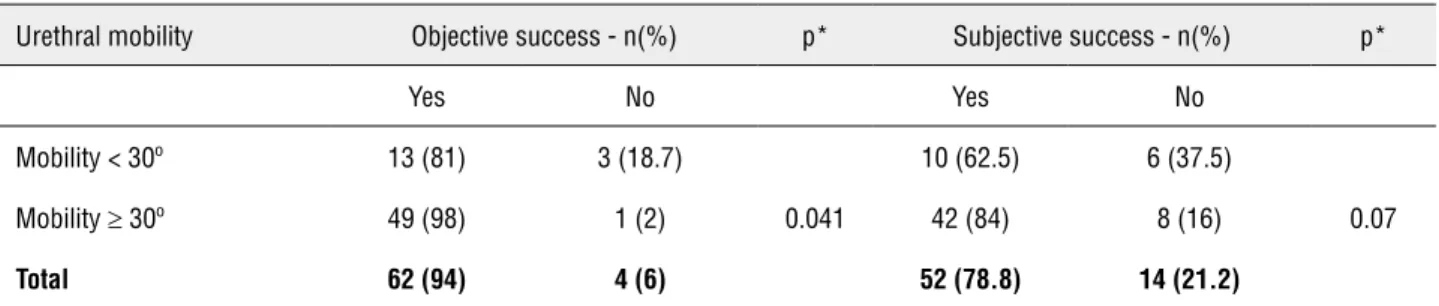
Urethral hypermobility was an important determinant of objective success (p = 0.04), as just
one patient with mobility ≥ 30º failed therapy
(Ta-ble-1). Subjective success rate was also higher in this group, but the difference did not reach statisti-cal significance (p = 0.07). Conversely, VLPP had no role as prognostic factor, either when analysed as categorical variable (Table-2) or when numeric VLPP values were compared. In the objective
suc-cess analysis, mean VLPP was 77 cmH20 and 95
cmH20 in successful and unsuccessful cases,
respec-tively (p = 0.21 - Mann-Whitney’s test). In the sub-jective success analysis, patients who failed therapy had mean VLPP similar to those who succeed (79.3
cmH20 versus 73.6 cmH20, respectively) (p = 0.31 -
Mann-Whitney’s test).
There was no statistical difference be-tween mean postoperative ICIQ-SF in the presence of high and low mobility (mean 3.7 and 2.8, re-spectively) (p = 0.16).
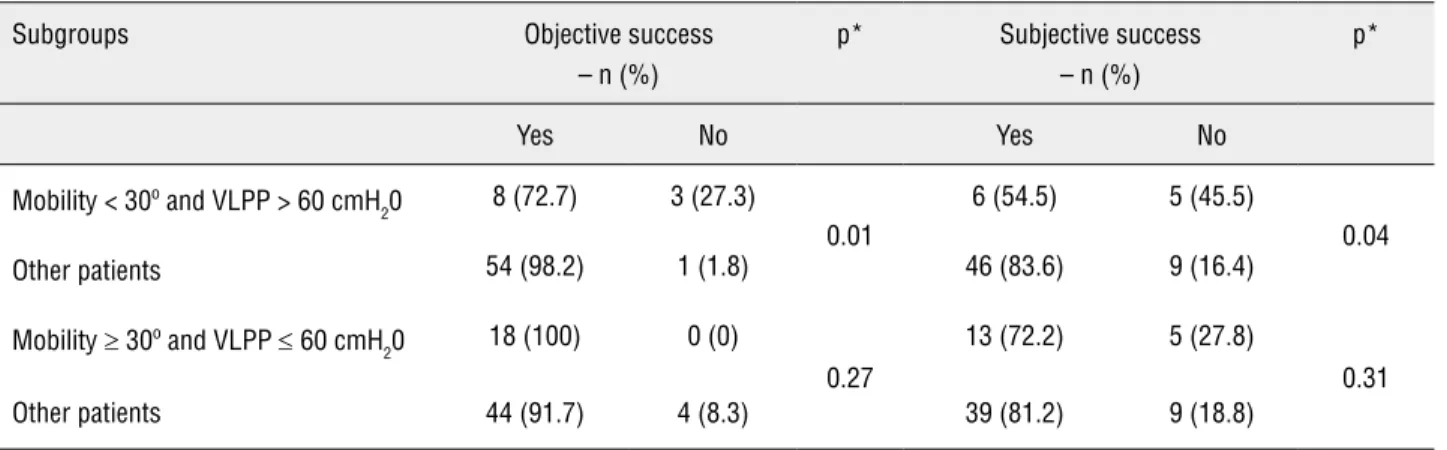
In the subgroup analysis, patients with concomitant low mobility and high VLPP (sub-group I) had worse objective success rates when
Table 1 - Influence of urethral mobility on postoperative success rates.
Urethral mobility Objective success - n(%) p* Subjective success - n(%) p*
Yes No Yes No
Mobility < 30º 13 (81) 3 (18.7)
0.041
10 (62.5) 6 (37.5)
0.07
Mobility ≥ 30º 49 (98) 1 (2) 42 (84) 8 (16)
Total 62 (94) 4 (6) 52 (78.8) 14 (21.2)
compared to subgroup VI, those with hypermo-bility and low VLPP (Table-3). The former also presented lower rates of objective (p = 0.01) and subjective (p = 0.04) success in relation to the remaining of the studied population, subgroups II, III and IV (Table-4).
DISCUSSION
This paper reiterates the effectiveness of TOT for the treatment of SUI and has simi-lar results to previously published data (14,15). Notwithstanding, as the number of surgeries
per-Table 2 - Role of Valsalva leak point pressure on postoperative success rates.
Valsalva leak point pressure
Objective success – n(%) p* Subjective success – n(%) p*
Yes No Yes No
≤ 60 cmH20 23 (100) 0 (0)
0.17
17 (73.9) 6 (26.1)
0.34
> 60 cmH20 39 (90.7) 4 (9.3) 35 (81.4) 8 (18.6)
Total 62 (93.9) 4 (6.1) 52 (78.8) 14 (21.2)
* Fisher’s exact test.
Table 3 - Comparison between specific subgroups.
Subgroups Objective success – n(%) p* Subjective success – n(%) p*
Yes No Yes No
Mobility < 30º and VLPP > 60 cmH20 8 (72.7) 3 (27.3)
0.04
6 (54.5) 5 (45.5)
0.28 Mobility ≥ 30º and VLPP ≤ 60 cmH20 18 (100) 0 (0) 13 (72.2) 5 (27.8)
Total 26 (89.7) 3 (10.3) 19 (65.5) 10 (34.5)
* Fisher’s exact test.
Table 4 - Subgroups compared to the remaining of the studied population.
Subgroups Objective success
– n (%)
p* Subjective success – n (%)
p*
Yes No Yes No
Mobility < 30º and VLPP > 60 cmH20 8 (72.7) 3 (27.3)
0.01
6 (54.5) 5 (45.5)
0.04
Other patients 54 (98.2) 1 (1.8) 46 (83.6) 9 (16.4)
Mobility ≥ 30º and VLPP ≤ 60 cmH20 18 (100) 0 (0)
0.27
13 (72.2) 5 (27.8)
0.31
Other patients 44 (91.7) 4 (8.3) 39 (81.2) 9 (18.8)
formed progressively increases in the contemporary scenario of minimally invasive procedures indicated more indulgently, surgeons frequently faces the dif-ficult situation of a patient, with high expectations, with persisting incontinence after surgery. The need to refine selection criteria for TOT motivated us to conduct a study to shed some light on what are the determinants of postoperative outcomes, consider-ing that they are imperfectly understood for the TOT procedure (introduced in 2001 by Delorme (3)) and that controversy exists about its efficacy in patients with sphincter deficiency. (7,16-19).
There are few prospective series addressing prognostic factors for TOT and results are conflict-ing (16). Minaglia (6) and Karateke (17) found that low urethral mobility was associated with higher rates of postoperative incontinence, while Paick (20) states the cure rate was not significantly lower in the group without a mobile urethra (< 30º). None of them concomitantly analysed the role of VLPP, although the last showed that mean VLPP was simi-lar in patients with and without hypermobility. Two other studies concluded that VLPP was a prognos-tic determinant, but urethral mobility was not dis-cussed (18,19).
To more adequately analyze the interaction between urethral mobility and sphincter
intrin-sic dysfunction (indicated by VLPP ≤ 60 cmH20),
we compared subgroups and demonstrated that high urethral mobility predicts cure, even when VLPP indicates a theoretically more dysfunctional sphincter. Low mobility was a predictor of fail-ure even in women with good intrinsic sphincter function (high VLPP), although cure rates remain acceptable. This type of analysis seeks to circum-vent selection bias, as analyzing urethral mobil-ity or VLPP singly. A contemporary Turkish study had a similar conclusion (21).
Current evidence suggests not only that urethral hypermobility is equally common in women with lower urinary tract symptoms and SUI, but also that intrinsic sphincteric deficiency and urethral hypermobility may coexist and do not define discrete classes of patients with SUI (10). Additionally, previous reports demonstrate that correction of hypermobility is not required to obtain continence either for retropubic or transob-turator sling procedure (14,22).
For all these reasons, urethral hypermobil-ity should be no more considered an etiology of incontinence as leak of urine always implies some degree of sphincteric insufficiency. This expres-sion was elaborated about half-century ago when suspension procedures were the rule, according to the belief that incontinence resulted from exces-sive downward movement of the urethra, leav-ing the abdominal cavity and leadleav-ing abdominal pressure to be transmitted to the bladder and not to the urethra (23,24). The term itself is incorrect because “hypermobility” implies a mobility that exceeds normal values producing disease and, in reality, theses values are unknown (despite classic textbook teaching) and all evidence suggests high mobility does not cause incontinence. Accordingly, patients with SUI should be characterized by VLPP and urethral mobility, but not classified by them (4,10,16). Nonetheless, a general agreement in this issue has not been reached (11).
Theoretically, a successful sling procedure restores continence not by increasing resting ure-thral pressure but by providing a support the holds the mid-urethra in place while the proximal ure-thra descends under stress, allowing better pres-sure transmission and, more importantly, a kinking of urethra during straining (16,25). When urethra doesn’t move well, this kinking does not occur. That’s the advocated mechanism for urethral mo-bility as a prognostic factor. We propose a graphic to illustrate how sphincter dysfunction and urethral mobility interact to determine prognosis following sling procedure (Figure-1). Similar illustration has been presented in lectures and plenary sessions, but note that in this graphic SUI is not possible without some degree of sphincter deficiency.
This study presents several limitations in-cluding the low number of subjects, short follow-up time and lack of multivariable analysis, but it was clearly possible to demonstrate and differ-entiate prognostic influence of urethral mobility from VLPP.
and deeper evaluation of response to treatment as it takes into account patient’s satisfaction and opinions. The lower subjective success rates may be explained by diverse patient’s expectations that would not be accomplished by the sling procedure. Therefore, subjective success depends on how well patients are informed about the goals of surgical treatment. More cases will probably be needed to render differences, according to subjective success criteria, significant.
CONFLICT OF INTEREST
None declared.
REFERENCES
1. Tamanini JT, Lebrao ML, Duarte YA, Santos JL, Laurenti R: Analysis of the prevalence of and factors associated with uri-nary incontinence among elderly people in the Municipality of São Paulo, Brazil: SABE Study (Health, Wellbeing and Ag-ing). Cad Saude Publica. 2009; 25: 1756-62.
2. DeLancey JO: Structural support of the urethra as it relates to stress urinary incontinence: the hammock hypothesis. Am J Obstet Gynecol. 1994; 170: 1713-20; discussion 1720-3. 3. Delorme E: Transobturator urethral suspension:
mini-inva-sive procedure in the treatment of stress urinary inconti-nence in women. Prog Urol. 2001; 11: 1306-13.
4. DeLancey JO, Trowbridge ER, Miller JM, Morgan DM, Guire K, Fenner DE, et al.: Stress urinary incontinence: relative im-portance of urethral support and urethral closure pressure. J Urol. 2008; 179: 2286-90; discussion 2290.
5. Lukacz ES, Luber KM, Nager CW: The effects of the tension-free vaginal tape on proximal urethral position: a prospec-tive, longitudinal evaluation. Int Urogynecol J Pelvic Floor Dysfunct. 2003; 14: 179-84; discussion 184.
6. Minaglia S, Urwitz-Lane R, Wong M, Ozel B: Effectiveness of transobturator tape in women with decreased urethral mo-bility. J Reprod Med. 2009; 54: 15-9.
7. Costantini E, Lazzeri M, Giannantoni A, Bini V, Vianello A, Kocjancic E, et al.: Preoperative Valsalva leak point pressure may not predict outcome of mid-urethral slings. Analysis from a randomized controlled trial of retropubic versus tran-sobturator mid-urethral slings. Int Braz J Urol. 2008; 34: 73-81; discussion 81-3.
8. Schäfer W, Abrams P, Liao L, Mattiasson A, Pesce F, Spang-berg A, et al.: Good urodynamic practices: uroflowmetry, fill-ing cystometry, and pressure-flow studies. Neurourol Uro-dyn. 2002; 21: 261-74.
9. McGuire EJ, Fitzpatrick CC, Wan J, Bloom D, Sanvordenker J, Ritchey M, et al.: Clinical assessment of urethral sphincter function. J Urol. 1993; 150: 1452-4.
10. Fleischmann N, Flisser AJ, Blaivas JG, Panagopoulos G: Sphincteric urinary incontinence: relationship of vesical leak point pressure, urethral mobility and severity of inconti-nence. J Urol. 2003; 169: 999-1002.
11. Schick E, Dupont C, Bertrand PE, Jolivet-Tremblay M, Tes-sier J: Predictive value of maximum urethral closure pres-sure, urethral hypermobility and urethral incompetence in the diagnosis of clinically significant female genuine stress incontinence. J Urol. 2004; 171: 1871-5.
Figure 1 - Prognostic interaction between urethral mobility and sphincter dysfunction in women with SUI after sling procedure. Note that some degree of sphincter dysfunction is required for incontinence to occur.
Patients with Stress Incontinence
Degree of Urethral Mobility x Sphincter Dysfunction
CONCLUSIONS
Urethral mobility was an important prog-nostic factor for TOT surgery. Low urethral mo-bility predicts higher failure rates, but it does not preclude surgery as most of these patients are cured following the procedure. No association was found between postoperative outcomes and preoperative VLPP.
ACKNOWLEDGEMENTS
12. Tamanini JT, Almeida FG, Girotti ME, Riccetto CL, Palma PC, Rios LA: The Portuguese validation of the International Con-sultation on Incontinence Questionnaire-Vaginal Symptoms (ICIQ-VS) for Brazilian women with pelvic organ prolapse. Int Urogynecol J Pelvic Floor Dysfunct. 2008; 19: 1385-91. 13. Abrams P, Cardozo L, Fall M, Griffiths D, Rosier P, Ulmsten
U, et al.: The standardisation of terminology of lower urinary tract function: report from the Standardisation Sub-commit-tee of the International Continence Society. Neurourol Uro-dyn. 2002; 21: 167-78.
14. Minaglia S, Ozel B, Hurtado E, Klutke CG, Klutke JJ: Effect of transobturator tape procedure on proximal urethral mobility. Urology. 2005; 65: 55-9.
15. Wang W, Zhu L, Lang J: Transobturator tape procedure ver-sus tension-free vaginal tape for treatment of stress urinary incontinence. Int J Gynaecol Obstet. 2009; 104: 113-6. 16. Kobashi KC: What is the relationship between the
transob-turator tape procedure and urethral mobility in women with SUI? Nat Clin Pract Urol. 2008; 5: 242-3.
17. Karateke A, Haliloglu B, Cam C, Sakalli M: Comparison of TVT and TVT-O in patients with stress urinary incontinence: short-term cure rates and factors influencing the outcome. A prospective randomised study. Aust N Z J Obstet Gynaecol. 2009; 49: 99-105.
18. Guerette NL, Bena JF, Davila GW: Transobturator slings for stress incontinence: using urodynamic parameters to pre-dict outcomes. Int Urogynecol J Pelvic Floor Dysfunct. 2008; 19: 97-102.
19. O’Connor RC, Nanigian DK, Lyon MB, Ellison LM, Bales GT, Stone AR: Early outcomes of mid-urethral slings for female stress urinary incontinence stratified by valsalva leak point pressure. Neurourol Urodyn. 2006; 25: 685-8.
20. Paick JS, Cho MC, Oh SJ, Kim SW, Ku JH: Is proximal ure-thral mobility important for transobturator tape procedure in management of female patients with stress urinary inconti-nence? Urology. 2007; 70: 246-50; discussion 250-1. 21. Haliloglu B, Karateke A, Coksuer H, Peker H, Cam C: The role
of urethral hypermobility and intrinsic sphincteric deficiency on the outcome of transobturator tape procedure: a prospec-tive study with 2-year follow-up. Int Urogynecol J. 2010; 21: 173-8.
22. Klutke JJ, Carlin BI, Klutke CG: The tension-free vaginal tape procedure: correction of stress incontinence with minimal alteration in proximal urethral mobility. Urology. 2000; 55: 512-4.
23. Enhorning G: Simultaneous recording of intravesical and in-tra-urethral pressure. A study on urethral closure in normal and stress incontinent women. Acta Chir Scand Suppl. 1961; (Suppl 276): 1-68.
24. Henriksson L, Ulmsten U: A urodynamic evaluation of the effects of abdominal urethrocystopexy and vaginal sling ure-throplasty in women with stress incontinence. Am J Obstet Gynecol. 1978; 131: 77-82.
25. Lo TS, Horng SG, Liang CC, Lee SJ, Soong YK: Ultrasound assessment of mid-urethra tape at three-year follow-up af-ter tension-free vaginal tape procedure. Urology. 2004; 63: 671-5.
______________________ Correspondence address: