Can we predict which patients will evolve to chronic kidney
disease after nephrectomy for cortical renal tumors?
Fabio Cesar Miranda Torricelli, Alexandre Danilovic, Giovanni Scala Marchini, Alexandre Crippa Sant’Anna,
Marcos Francisco Dall’Oglio, Miguel Srougi
Division of Urology, Department of Surgery, Hospital das Clinicas, University of Sao Paulo Medical School, Sao Paulo and Instituto do Câncer do Estado de Sao Paulo - ICESP, Sao Paulo, Brazil
ABSTRACT ARTICLE INFO
_________________________________________________________ ___________________
Key words:
Neoplasms; Nephrectomy; Renal Cancer; Renal Insufficiency
Int Braz J Urol. 2012; 38: 637-44
__________________
Submitted for publication: December 13, 2011
__________________
Accepted after revision: May 05, 2012
Introduction: While some studies show that patients submitted to radical nephrectomy have a higher risk of developing chronic kidney disease (CKD), some studies report that carefully selected living kidney donors do not present a higher risk for CKD. Here, we aim to study predictive factors of CKD after radical nephrectomy.
Materials and Methods: Between January 2006 to January 2010, 107 patients submit-ted to radical nephrectomy for cortical renal tumors at our institution were enrolled in this study. Demographic data were recorded, modified Charlson-Romano Index was calculated, and creatinine clearance was estimated using abbreviated Modification of Diet in Renal Disease (MDRD) study equation. Pathological characteristics, surgical ac-cess and surgical complications were also reviewed. The end-point of the current study was new onset estimated glomerular filtration rate (eGFR) less than 60 and less than 45 mL/minute/1.73 m2.
Results: Age, preoperative eGFR, Charlson-Romano Index and hypertension were pre-dictive factors of renal function loss, when the end-point considered was eGFR lower than 60 mL/minute/1.73 m2. Age and preoperative eGFR were predictive factors of renal function loss, when the end-point considered was eGFR lower than 45 mL/min-ute/1.73 m2. Moreover, each year older increased 1.1 times the risk of eGFR lower than 60 and 45 mL/minute/1.73 m2. After multivariate logistic regression, only age remained as an independent predictive factor of eGFR loss.
Conclusion: Age is an independent predictive factor of GFR loss for patients submitted to radical nephrectomy for cortical renal tumors.
INTRODUCTION
Surgical treatment of renal cortical tumors is changing in the last decade. Best management must consider preservation of renal function in order to increase global survival rate. Radical nephrectomy (RN) was considered the gold standard treatment for localized renal cortical tumor (1), however the waste of nephrons causes loss of renal function that is
Advances in imaging exams have led to in-creased detection of incidental, small (< 4cm), lo-calized renal cortical tumors. But some tumors can-not be treated by nephron sparing surgery without compromising safety and oncological efficacy, due to a challenging central localization. Even small tumors in the central region may compromise the renal fat around the hilum and despite the low tu-mor volume, the possibility of a T3 should be con-sidered and therefore RN may still be appropriate in this scenario (6). It has been reported that although experienced surgeons have similar outcomes with radical or partial nephrectomy (7,8), the partial ap-proach can be technically challenging and associ-ated with greater risk of complications, especially if done laparoscopically (9,10).
Huang et al. showed that patients submitted to radical nephrectomy have a higher risk of devel-oping chronic kidney disease (CKD) than patients subjected to partial nephrectomy (11). However, carefully selected living kidney donors do not pres-ent a higher risk for CKD (12). Moreover, it has been shown that long-term mortality rate is not signifi-cantly increased in living kidney donors (13). These findings led us to looking for patients and tumors features that might influence and could predict which patients will evolve to renal function loss.
In this study, we aim to evaluate demo-graphic data, pathological features, surgical ac-cess, and postoperative complications as predic-tors of CKD after radical nephrectomy for cortical renal tumors.
MATERIALS AND METHODS
Between January 2006 and January 2010, 180 patients were submitted to RN for cortical re-nal tumors at our institution. We included only pa-tients treated after 2006 because nephron sparing surgery was already consolidated as the best option for small renal tumors at this time. Patients with end-stage renal disease, bilateral renal tumors or metastases at surgery, and those with less than 12 months of follow-up or incomplete data were ex-cluded from our analysis. Only patients with imag-es of a normal contralateral kidney before surgery were selected. Thus, 107 patients were enrolled in this retrospective study.
Clinical characteristics, including age at surgery, gender, hypertension, cerebrovascular and pulmonary disease, and liver dysfunction were re-corded. Modified Charlson-Romano Index (14,15) was calculated as an objective measure of compar-ing comorbidity among patients. Also, preopera-tive serum creatinine was recorded and Glomeru-lar Filtration Rate (GFR) was estimated using the abbreviated Modification of Diet in Renal Disease (MDRD) study equation (186 x serum creatinine in mg/dL-1.154 x age in years-0.0203 x 0.742 if fe-male). Pathological characteristics, including size and pT stage were also reviewed. Surgical access (laparoscopic versus open) was analyzed as well as Clavien-Dindo classification of surgical complica-tions (16) used to estimate if postoperative period could have influenced the renal function outcome.
The end-point of the current study was new onset eGFR less than 60 and less than 45 mL/min-ute/1.73 m2, which defines chronic kidney disease
more accurately and has been shown to be associ-ated with a significantly higher risk of complica-tions and comorbidity (17-19). Patients had their postoperative eGFR assessed 6 months after surgery and at the end of the follow-up period. Since the main outcome measures were the new onset of GFR lower than 60 or 45 mL/minute/1.73 m2 after
sur-gery, patients with pre-existing GFR values lower than these two thresholds were not included for outcome analysis.
In order to determinate p values, we used Mann-Whitney test or Student t test for continu-ous variables and Chi-square test for categorical variables. Because of the small frequency of post-operative complications, Fisher exact test was used for Clavien-Dindo classification. After univariate analysis, multivariate logistic regression was done to determine the real effect of each hypothesized risk factor. All statistical analysis was performed with p < 0.05 considered significant.
RESULTS
had eGFR lower than 60 mL/minute/1.73 m2 six
months after surgery, while 14 patients had eGFR lower than 45 mL/minute/1.73 m2 at the same
pe-riod. At the end of the follow-up, 29 patients had eGFR lower than 60 mL/minute/1.73 m2, because
three presented a small improvement in the renal function, and 16 patients had eGFR lower than 45 mL/minute/1.73 m2.
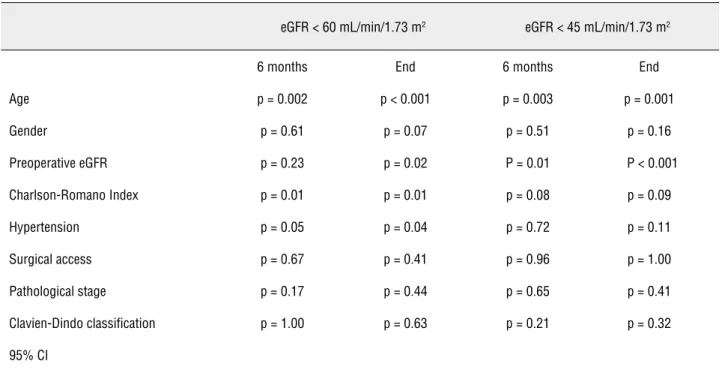
When the end-point considered was eGFR lower than 60 mL/minute/1.73 m2, age (p = 0.002),
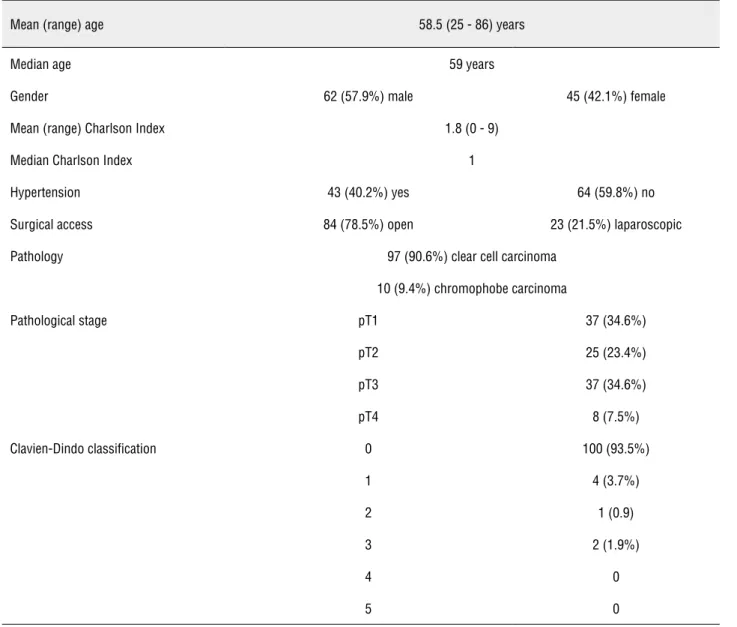
Charlson-Romano Index (p = 0.01) and hyperten-sion (p = 0.04) were significant predictors of renal nephrectomy, while 23 (21.5%) to laparoscopic
ap-proach. Demographic data, surgical access (open vs. laparoscopic), surgical pathology, and Clavien-Dindo classification are summarized in Table-1. Mean (range) operative time was 108 (70 - 210) minutes. Mean (range) estimated blood loss was 180 (50 - 700) mL. Mean (range) preoperative eGFR was 72 (60 - 150) mL/minute/1.73 m2. Mean (range)
follow-up was 32 (18 - 54) months.
After 6 months and at the end of the fol-low-up period mean eGFR was 58.2 and 57.6 mL/ minute/1.73 m2, respectively. Thirty-two patients
Table 1 – Demographic data, surgical access, surgical pathology, and Clavien-Dindo Classification.
Mean (range) age 58.5 (25 - 86) years
Median age 59 years
Gender 62 (57.9%) male 45 (42.1%) female
Mean (range) Charlson Index 1.8 (0 - 9)
Median Charlson Index 1
Hypertension 43 (40.2%) yes 64 (59.8%) no
Surgical access 84 (78.5%) open 23 (21.5%) laparoscopic
Pathology 97 (90.6%) clear cell carcinoma
10 (9.4%) chromophobe carcinoma
Pathological stage pT1 37 (34.6%)
pT2 25 (23.4%)
pT3 37 (34.6%)
pT4 8 (7.5%)
Clavien-Dindo classification 0 100 (93.5%)
1 4 (3.7%)
2 1 (0.9)
3 2 (1.9%)
4 0
function loss at six months of follow-up. At the end of that period, these factors and preoperative eGFR (p = 0.02) were significant predictors of renal func-tion loss (Table-2). Moreover, for each year older, the risk of eGFR lower than 60 mL/minute/1.73 m2
increased 1.1 times, and for each point acquired in the Charlson-Romano Index, the risk of eGFR lower than 60 mL/minute/1.73 m2 increased 1.24
times. However, after multivariate logistic regres-sion, only age (p = 0.005) remained as an indepen-dent predict factor of eGFR loss.
When the end-point considered was eGFR lower than 45 mL/minute/1.73 m2, age (p = 0.003)
and preoperative eGFR (p = 0.01) were predictors of renal function loss at six months of follow-up. Charlson-Romano Index (p = 0.08) appeared to be higher in patients with eGFR loss. All these find-ings persisted until the end of the follow-up period (Table-2). Again, for each year older, the risk of eGFR lower than 45 mL/minute/1.73 m2 increased
1.1 times. After multivariate logistic regression, age remained (p = 0.001) as an independent pre-dictor factor of eGFR loss.
Table 2 – Predictive factors of development of chronic kidney disease following radical nephrectomy (univariate analysis).
eGFR < 60 mL/min/1.73 m2 eGFR < 45 mL/min/1.73 m2
6 months End 6 months End
Age p = 0.002 p < 0.001 p = 0.003 p = 0.001
Gender p = 0.61 p = 0.07 p = 0.51 p = 0.16
Preoperative eGFR p = 0.23 p = 0.02 P = 0.01 P < 0.001
Charlson-Romano Index p = 0.01 p = 0.01 p = 0.08 p = 0.09
Hypertension p = 0.05 p = 0.04 p = 0.72 p = 0.11
Surgical access p = 0.67 p = 0.41 p = 0.96 p = 1.00
Pathological stage p = 0.17 p = 0.44 p = 0.65 p = 0.41
Clavien-Dindo classification p = 1.00 p = 0.63 p = 0.21 p = 0.32
95% CI
DISCUSSION
This study presents original and relevant data. Multivariate logistic regression shows that age is the only predictor related to renal function loss after radical nephrectomy (OR: 1.1, 95% CI 1.04-1.15). Moreover, the risk of eGFR lower than 60 or 45 mL/minute/1.73 m2 after RN increases 10% for each year older.
The 3-year probability of absence of new onset of GRF lower than 60 mL/min per 1.73 m2 is
80% and 35% after partial and radical nephrecto-my, respectively. The corresponding values for GFR lower than 45 mL/min per 1.73 m2 are 95% and
where radical nephrectomy is the only option, it is very beneficial to know the risk of new onset of CKD to prepare patients and medical care team to this unpleasant event.
Outcome data from transplantation studies (20-22) have long supported that CKD after total nephrectomy is not a major concern in patients with two equivalent functioning kidneys and nor-mal preoperative concentration of serum creati-nine, since donors submitted to nephrectomy do not show decrease of their kidney function, kid-ney failure needing dialysis, or death. However, this is not observed in patients submitted to RN for cortical renal tumors. These findings encour-aged us to look for which factors could influence and predict which patients would evolve to renal function loss.
Yokoyama et al. (23) retrospectively stud-ied 416 patients submitted to nephrectomy and after univariate and multivariate analysis radical nephrectomy was an independent risk factor for new onset eGFR less than 60 mL/min per 1.73 m2
(HR 3.19, 95% CI 1.72 - 6.75) but not for new on-set eGFR less than 45 mL/min per 1.73 m2. Age at
surgery and preoperative eGFR were independent risk factors for new onset less than 45 mL/min per 1.73 m2. Barlow et al. (24) presented similar results
in another retrospectively study with 209 patients submitted to nephrectomy and with preopera-tive eGFR higher than 60 mL/min per 1.73 m2. On
multivariate analysis, preoperative CKD and pro-cedure (radical versus partial) were independent predictors of new onset renal insufficiency. In this study, hypertension was an independent predictor of CKD upstage. Suer et al. (25) studied the long-term impact of hypertension and diabetes mellitus on GFR in the long term in 488 patients submitted to nephrectomy and noted that hypertension was associated with new onset of chronic renal failure only in the radical nephrectomy group (HR 1.39, 95% CI 1.02 - 1.89).
In our study, age, preoperative eGFR, and hypertension were related to renal function loss, corroborating literature data. Our study presents an original contribution that may improve the care of patients that suffer from renal tumors and are going to be submitted to RN. We found that for each year older, the risk of eGFR lower than 60
or 45 mL/minute/1.73 m2 after RN increases 10%.
In partial nephrectomy, predicting factors of lower GFR were well studied in a large cohort of 1169 patients by Lane et al. (26). Lower preop-erative GFR, solitary kidney, older age, tumor size and longer ischemic interval were all predicting factors of bad renal function outcome. However, unfortunately, this paper did not study patient’s comorbidities and did not evaluate which of these factors could predict CKD in patients that are not candidate to partial nephrectomy. Santos Arron-tes et al. (27) studied the survival rate after ne-phrectomy for clear cell carcinoma according to the Charlson comorbidity index in 192 patients submitted to nephrectomy. They reported that tu-mor stage and cotu-morbidity (Charlson greater than two) were prognostic factors after one, five and ten years of follow-up. The authors concluded that the comorbidity index should be applied in daily clinical practice to assess the best therapeutic op-tion for patients. In our study, the Charlson-Ro-mano Index was related to renal function loss, and for each point acquired in the Charlson-Romano Index, the risk of eGFR lower than 60 mL/min-ute/1.73 m2 increased 1.24 times. It appears that
Charlson-Romano Index is an important factor that should be used in patients that will be sub-mitted to nephrectomy.
CONCLUSIONS
Age is an independent predicting factor of GFR loss for patients submitted to radical ne-phrectomy for cortical renal tumors. Each year old increases 10% the risk of CKD after radical nephrectomy. Preoperative eGFR and Charlson-Romano Index also should be evaluated before nephrectomy.
ABBREVIATIONS
RN - Radical Nephrectomy CKD - Chronic Kidney Disease GFR - Glomerular Filtration Rate
MDRD - Modification of Diet in Renal Disease
CONFLICT OF INTEREST
None declared.
REFERENCES
1. Robson CJ, Churchill BM, Anderson W: The results of radi-cal nephrectomy for renal cell carcinoma. J Urol. 1969; 101: 297-301.
2. Uzzo RG, Wei JT, Hafez K, Kay R, Novick AC: Comparison of direct hospital costs and length of stay for radical nephrec-tomy versus nephron-sparing surgery in the management of localized renal cell carcinoma. Urology. 1999; 54: 994-8. 3. Russo P: Open partial nephrectomy: an essential
contem-porary operation. Nat Clin Pract Urol. 2006; 3: 2-3. 4. Scherr DS, Ng C, Munver R, Sosa RE, Vaughan ED Jr, Del
Pizzo J: Practice patterns among urologic surgeons treat-ing localized renal cell carcinoma in the laparoscopic age: technology versus oncology. Urology. 2003; 62: 1007-11. 5. Muruganandham K, Mandhani A: Chronic kidney disease
and small renal tumors: What urologists should know? In-dian J Urol. 2009; 25: 543-4.
6. Bertini R, Roscigno M, Freschi M, Strada E, Petralia G, Pasta A, et al.: Renal sinus fat invasion in pT3a clear cell renal cell carcinoma affects outcomes of patients without nodal involvement or distant metastases. J Urol. 2009; 181: 2027-32.
7. Stephenson AJ, Hakimi AA, Snyder ME, Russo P: Compli-cations of radical and partial nephrectomy in a large con-temporary cohort. J Urol. 2004; 171: 130-4.
8. Gill IS, Matin SF, Desai MM, Kaouk JH, Steinberg A, Mas-cha E, et al.: Comparative analysis of laparoscopic versus open partial nephrectomy for renal tumors in 200 patients. J Urol. 2003; 170: 64-8.
9. Ching CB, Li J, Gill IS, Simmons MN: Functional and onco-logic outcomes of bilateral open partial nephrectomy ver-sus bilateral laparoscopic partial nephrectomy. J Endourol. 2011; 25: 1193-7.
10. Chung BI, Lee UJ, Kamoi K, Canes DA, Aron M, Gill IS: Laparoscopic partial nephrectomy for completely intrapa-renchymal tumors. J Urol. 2011; 186: 2182-7.
11. Huang WC, Levey AS, Serio AM, Snyder M, Vickers AJ, Raj GV, et al.: Chronic kidney disease after nephrectomy in pa-tients with renal cortical tumours: a retrospective cohort study. Lancet Oncol. 2006; 7: 735-40.
12. Ibrahim HN, Foley R, Tan L, Rogers T, Bailey RF, Guo H, et al.: Long-term consequences of kidney donation. N Engl J Med. 2009; 360: 459-69.
13. Segev DL, Muzaale AD, Caffo BS, Mehta SH, Singer AL, Taran-to SE, et al.: Perioperative mortality and long-term survival fol-lowing live kidney donation. JAMA. 2010; 303: 959-66. 14. Charlson ME, Pompei P, Ales KL, MacKenzie CR: A new
method of classifying prognostic comorbidity in longitu-dinal studies: development and validation. J Chronic Dis. 1987; 40: 373-83.
15. Romano PS, Roos LL, Jollis JG: Adapting a clinical comor-bidity index for use with ICD-9-CM administrative data: differing perspectives. J Clin Epidemiol. 1993; 46: 1075-9; discussion 1081-90.
16. Clavien PA, Barkun J, de Oliveira ML, Vauthey JN, Dindo D, Schulick RD, et al.: The Clavien-Dindo classification of sur-gical complications: five-year experience. Ann Surg. 2009; 250: 187-96.
17. Go AS, Chertow GM, Fan D, McCulloch CE, Hsu CY: Chronic kidney disease and the risks of death, cardiovas-cular events, and hospitalization. N Engl J Med. 2004; 351: 1296-305. Erratum in: N Engl J Med. 2008;18: 4.
18. Anavekar NS, McMurray JJ, Velazquez EJ, Solomon SD, Kober L, Rouleau JL, et al.: Relation between renal dys-function and cardiovascular outcomes after myocardial infarction. N Engl J Med. 2004; 351: 1285-95.
19. Murthy K, Stevens LA, Stark PC, Levey AS: Variation in the serum creatinine assay calibration: a practical application to glomerular filtration rate estimation. Kidney Int. 2005; 68: 1884-7.
20. Najarian JS, Chavers BM, McHugh LE, Matas AJ: 20 years or more of follow-up of living kidney donors. Lancet. 1992; 340: 807-10.
22. Fehrman-Ekholm I, Elinder CG, Stenbeck M, Tydén G, Groth CG: Kidney donors live longer. Transplantation. 1997; 64: 976-8.
23. Yokoyama M, Fujii Y, Iimura Y, Saito K, Koga F, Masuda H, Kawakami S, Kihara K: Longitudinal change in renal func-tion after radical nephrectomy in Japanese patients with renal cortical tumors. J Urol. 2011; 185: 2066-71. 24. Barlow LJ, Korets R, Laudano M, Benson M, McKiernan
J: Predicting renal functional outcomes after surgery for renal cortical tumours: a multifactorial analysis. BJU Int. 2010; 106: 489-92.
25. Süer E, Burgu B, Gökce MI, Türkölmez K, Bedük Y, Bal-taci S: Comparison of radical and partial nephrectomy in terms of renal function: a retrospective cohort study. Scand J Urol Nephrol. 2011; 45: 24-9.
26. Lane BR, Babineau DC, Poggio ED, Weight CJ, Larson BT, Gill IS, et al.: Factors predicting renal functional outcome after partial nephrectomy. J Urol. 2008; 180: 2363-8; dis-cussion 2368-9.
27. Santos Arrontes D, Fernández Aceñero MJ, García González JI, Martín Muñoz M, Paniagua Andrés P: Surviv-al anSurviv-alysis of clear cell renSurviv-al carcinoma according to the Charlson comorbidity index. J Urol. 2008; 179: 857-61.
____________________
Correspondence address:
Dr. Fábio César Miranda Torricelli Av. Vereador Jose Diniz, 3300 / 208
EDITORIAL COMMENT
This is an interesting retrospective study about possible prediction factors (age, preopera-tive renal function, Charlson-Romano-Index and hypertension) for chronic kidney disease (CKD) in 107 patients submitted to radical nephrectomy (RN). Exclusion criteria were end stage renal dis-ease, bilateral renal tumors, metastases at surgery, less than 12 months of follow-up and an abnor-mal contralateral kidney in imaging studies.
The predictive factors of kidney dystion after RN were age, preoperative renal func-tion, Charlson-Romano-Index and hypertension, when the end point considered estimated was glo-merular filtration rate (eGFR) lower than 60 mL/ min/1.73m2. When the end point considered was eGFR lower than 45 mL/min/1.73m2, only age and preoperative eGFR remained as predictive factors. Age remained as an independent predictor factor of eGFR loss after multivariate logistic regression.
An important limitation of this paper is the short period of follow-up (18-54 months), as the authors mentioned at Discussion. Further-more, 34.6% of the patients had small renal tu-mors (pT1), and missing was information on what
percentage of patients was potentially eligible for partial nephrectomy (PN) but underwent RN in-stead. The under use of PN can easily be found in other studies, despite evidence of equivalent on-cologic outcomes and an increased likelihood of developing CKD and cardiovascular comorbidity associated with RN (1-3).
Hence, RN should still be discouraged for patients with small renal tumors amenable to par-tial nephrectomy, including the elderly. As stated by the paper’s conclusion, age is undoubtedly a predictive factor for CKD after RN. Lowrance et al. (4) evaluated age and procedure type and found no evidence indicating an increased risk of nephron-sparing surgery complications with advancing age. On the other hand, in this group of patients, active surveillance can also be used and safely avoid sur-gery for Stage T1a renal masses (5).
The title is very attractive, but the ques-tion still remained without a definite answer (“Can we predict which patients will evolve to chronic kidney disease after nephrectomy for cortical tu-mors?”). As pointed by the authors, maybe a fu-ture study with a longer follow-up and also with more strict criteria for the indication for RN could contribute even more to this issue.
REFERENCES
1. Russo P, Huang W: The medical and oncological rationale for partial nephrectomy for the treatment of T1 renal cortical tu-mors. Urol Clin North Am. 2008; 35: 635-43.
2. Huang WC, Levey AS, Serio AM, Snyder M, Vickers AJ, Raj GV, et al.: Chronic kidney disease after nephrectomy in pa-tients with renal cortical tumours: a retrospective cohort study. Lancet Oncol. 2006; 7: 735-40.
3. Huang WC, Elkin EB, Levey AS, Jang TL, Russo P: Partial ne-phrectomy versus radical nene-phrectomy in patients with small renal tumors--is there a difference in mortality and cardiovas-cular outcomes? J Urol. 2009; 181: 55-61; discussion 61-2.
4. Lowrance WT, Yee DS, Savage C, Cronin AM, O’Brien MF, Donat SM, et al.: Complications after radical and partial ne-phrectomy as a function of age. J Urol. 2010; 183: 1725-30. 5. Lane BR, Abouassaly R, Gao T, Weight CJ, Hernandez AV,
Larson BT, et al.: Active treatment of localized renal tumors may not impact overall survival in patients aged 75 years or older. Cancer. 2010; 116: 3119-26.
Dr. Daniel Lima Xavier