Psychometric properties of the Brazilian version
of the
Vulnerable Elders Survey-13
(VES-13)
Propriedades psicométricas da versão brasileira do
instrumento
Vulnerable Elders Survey-13
(VES-13)
Propiedades psicométricas de la versión brasileña
del instrumento
Vulnerable Elders Survey-13
(VES-13)
1 Escola Nacional de Saúde Pública Sergio Arouca, Fundação Oswaldo Cruz, Rio de Janeiro, Brasil. 2 Faculdade de Medicina, Universidade Federal do Rio de Janeiro, Rio de Janeiro, Brasil.
3 Faculdade de Medicina, Universidade Federal do Mato Grosso do Sul, Campo Grande, Brasil. Correspondence L. L. Luz
Escola Nacional de Saúde Pública Sergio Arouca, Fundação Oswaldo Cruz. Rua Leopoldo Bulhões 1480, Rio de Janeiro, RJ 21041-210, Brasil [email protected]
Laércio Lima Luz 1
Lívia Maria Santiago 1,2
João Francisco Santos da Silva 3
Inês Echenique Mattos 1
Abstract
This study aims to assess the psychometric prop-erties of the Brazilian version of the Vulnerable Elders Survey-13 (VES-13). Interviews were car-ried out with individuals aged 60 years and over receiving care at an ambulatory cancer centre. Test-retest reliability was assessed using the Spearman correlation coefficient, intraclass correlation coefficients and Cohen’s kappa coef-ficient. Construct validity was assessed by test-ing convergent and discriminant validity us-ing principal component analysis and Varimax rotation. The Spearman correlation coefficient value of the comparison between test and retest scores was 0.98 (p < 0.001). All intraclass corre-lation coefficient values were higher than 0.60 and kappa coefficients varied between 0.33 and 0.94. Three identified factors explained 72.6% of overall sample variance. VES-13 presented good convergent validity and reasonable discrimi-nant validity. The psychometric properties of the adapted version of the VES-13 are consistent and adequate for use with the Brazilian population. Aged; Psychometrics; Vulnerable Groups
Resumo
Este estudo visa a avaliar as propriedades psico-métricas da versão brasileira do Vulnerable Elders Survey-13 (VES-13). Entrevistas com indivíduos de 60 anos ou mais, atendidos em unidade ambula-torial de hospital de câncer. Confiabilidade teste- reteste avaliada com coeficiente de correlação de Spearman, coeficientes de correlação intraclasse e kappa. Análise exploratória para avaliação do constructo por meio da análise de componen-tes principais com rotação varimax. Validade de constructo examinada por validade conver-gente e diverconver-gente. O coeficiente de correlação de Spearman entre os escores de teste e reteste foi 0,98 (p < 0,001). Todos os coeficientes de correlação in-traclasse apresentaram valores maiores que 0,60 e os coeficientes kappa variaram entre 0,33 e 0,94. Três fatores explicaram 72,6% da variância total da amostra. O VES-13 apresentou boa validade convergente e validade divergente razoável. A ver-são brasileira do VES-13 apresentou propriedades psicométricas consistentes.
Introduction
The Vulnerable Elders Survey-13 (VES-13) is a tool developed in the United States for screen-ing individuals aged 65 and older livscreen-ing in the community and Medicare users 1. The purpose
of the tool is to identify elderly people with an increased risk of death or functional decline: the so-called vulnerable elders 1. The tool
con-siders 13 items covering age, self-rated health, functional capacity and physical condition. Us-ing the VES-13 and adoptUs-ing a score greater than or equal to three as a vulnerability cutpoint, the authors detected vulnerability in 32% of older people and observed that the risk of death or functional decline was four times greater in this group than in groups with a score of less than three 1.
A study involving prostate cancer patients conducted in Chicago (United States) assessed the psychometric properties of the VES-13 2.
Test-retest reliability was assessed using Pear-son’s correlation coefficient (r) and criterion validity was tested by comparing VES-13 results with those obtained using a standardized Com-prehensive Geriatric Assessment (CGA), which is considered the gold standard. With respect to reliability, the analysis showed a strong corre-lation (r = 0.92) between the results of the first questionnaire and those of a new questionnaire conducted 30 days later. Separate analyses were undertaken of self-rated health (r = 0.52), phys-ical capacity (r = 0.60) and functional capacity (0.70). With regard to the validity of the VES-13, sensitivity and specificity was 72.7% and 85.7%, respectively, while the positive predictive value was 88.9%, in comparison to the gold standard (CGA) which had an area under the curve (AUC) of 0.90 (95%CI: 0.80-0.99). The tool also proved to be a good predictor of changes in activities of daily living (ADL) and instrumental activities of daily living (IADL), and of comorbidities 2.
The VES-13 has been used in the United States and Europe to assess elderly patients with different types of cancer 3,4,5,6. On the whole,
the results of these studies confirm the validity and feasibility of using the VES-13 as a tool for identifying vulnerable older people with cancer. However, no studies were found that assessed the construct validity of the VES-13.
In light of the above, we decided to create a cross-cultural adaption of the VES-13 for use with the Brazilian population targeting older people with cancer. In the first stage of the pro-cess, an analysis of the referential meaning and general meaning of the items detected strong semantic equivalence, while the pre-test of the synthesised version showed a high rate of
un-derstanding and acceptance of the questions among elderly patients 7.
The aim of this study was to assess the psy-chometric properties of the Brazilian version of the VES-13 in a sample of elderly cancer patients.
Material and methods
Assuming α = 0.05 (two-sided test), 80% power and a prevalence of 0.50, the estimated sample size needed for this analysis was 201 individuals. A sample of 272 cancer patients aged 60 years and over and receiving care at an ambulatory cancer centre in the city of Campo Grande, Mato Grosso State, Brazil, were interviewed between March and April 2012.
Trained interviewers conducted a question-naire containing the Brazilian version of the VES-13 and other similar questions designed to assess construct validity. The first 108 individuals were interviewed again by the same interviewer after a period of seven to 15 days to measure test-retest reliability.
The study was approved by the Ethics Re-search Committee of the Sergio Arouca Nation-al School of Public HeNation-alth at the OswNation-aldo Cruz Foundation (ENSP/Fiocruz) and all participants signed an informed consent form.
The vulnerability cutpoint is a score greater than or equal to three 1.
During the first stage of the cross-cultural ad-aptation of the VES-13 for use with the Brazilian population we analysed the conceptual equiva-lence of the questionnaire and carried out a pre-test of the synthesised version. We found that the concept vulnerable elder had the same meaning in the culture of origin as in the Brazilian culture and that the items which made up the instrument presented similarities in both cultures. The anal-ysis of general and differential meanings showed strong semantic equivalence and pre-test results displayed a good level of understanding and ac-ceptance among the target population 7.
Test-retest reliability was measured using the Spearman correlation coefficient to analyse the correlation between age and self-rated health scores, between the scores for items 3 to 8 and items 9 to 13, and between the total VES-13 scores. Intraclass correlation coefficients with their re-spective 95% confidence intervals (95%CI) were calculated and the response options for items 1 to 13 were then dichotomized in accordance with the scoring criteria established for these items. The test-retest reliability of the answers to the questions of each item given by the respondents at the two points in time was also assessed us-ing the simple percent agreement and Cohen’s kappa coefficient. The kappa coefficient is gen-erally thought to be a more robust measure than the simple percent agreement since it takes into account the agreement occurring by chance. We used the Landis & Koch classification 8 to
eval-uate degree of agreement as follows: absent (< 0.10), weak (0.10-0.20), fair (0.21-0.40), moderate (0.41-0.60), substantial (0.61-0.80), or nearly per-fect agreement (0.81-1.00).
Principal component analysis was undertak-en to evaluate construct validity and explore the dimensions of the tool using Pearson’s correla-tion coefficients. It is important to note that this may lead to an underestimation of the magni-tude of correlation coefficients and the possibil-ity that some items end up in the wrong compo-nents 9. The adequacy of the correlation matrix
was measured using the Bartlett statistical test and the Kaiser-Meyer-Olkin (KMO) measure. Va-rimax rotation was used to identify the factors which best represented the items contained in the tool. The appropriate number of factors was determined based on the proportion of overall variance explained by each variable.
Construct validity was also measured by test-ing convergent and discriminant validity ustest-ing indicators similar to the items contained in the VES-13 taken from tools routinely used to assess elderly patients in health care settings. For the
analysis of convergent validity, we considered the strength and direction of the relationship of each item with its alternative indicator, while for discriminant validity, we examined the relation-ship between VES-13 items and corresponding alternative indicators and the relationship be-tween the functions (physical capacity and func-tional capacity) and corresponding alternative measurements.
Results
The mean and median age of the participants was 71.6 (± 0.4) and 71 years, respectively. The youngest participant was aged 60 years, while the oldest member of the sample was aged 97. The predominant age group was 60 to 74 years (n = 176, or 67.4% of the sample). The majority of the sample were male (n = 157, or 61.6% of the sample). The prevalence of vulnerability based on a cutpoint score of greater than or equal to three was 50.4% (n = 137). No statistically sig-nificant differences were found in relation to gender, age group and vulnerability condition between the overall sample and sub-sample of older people re-interviewed to measure test-retest reliability.
The Spearman correlation coefficient (ρ) for total VES-13 scores in the test-retest was 0.67 (p < 0.001). The scores for the age item (ρ = 0.98; p < 0.001), self-rated health item (ρ = 0.52; p < 0.0001), physical capacity items 3 to 8 (ρ = 0.66; p < 0.001), and functional capacity items 9 to 13 (ρ = 0.48; p < 0.001) showed a strong to moderate statistically significant correlation, demonstrat-ing reasonable test-retest reliability.
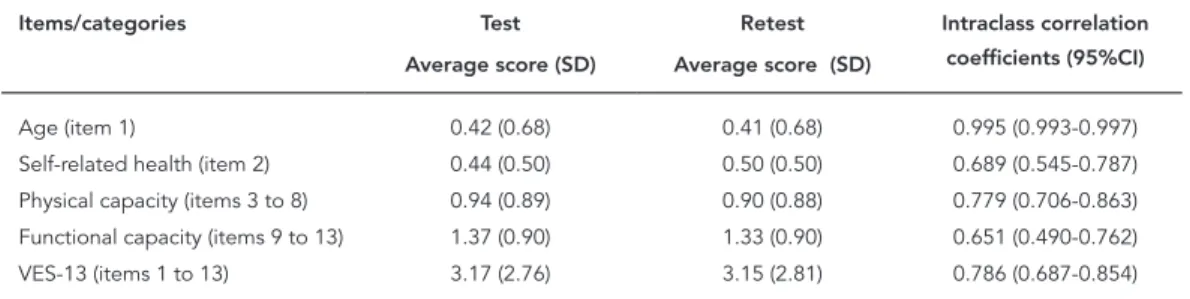
Average scores for the VES-13 varied between 0.42 (age) and 1.37 (functional capacity) in the test, and between 0.41 (age) and 1.33 (functional capacity) in the retest. Estimated average scores and intraclass correlation coefficients are shown in Table 1. All the intraclass correlation coeffi-cients were greater than 0.60.
Simple agreement between the answers giv-en to the VES-13 questions in the two interviews ranged between 0.76 and 0.97. The Landis & Koch classification based on the kappa coefficients 8
showed the following degrees of agreement: nearly perfect agreement (one item), substantial agreement (three items), moderate (four items), and fair agreement (four items). These results are shown in Table 2.
Table 3 presents the results of the analysis after the Varimax rotation. The first component included five functional capacity variables re-lated to activities of daily living, each with pos-itive loads (≥ 0.943). In the second component, five of the six physical capacity items presented high positive loads (≥ 0.667) and the self-rated item presented a moderate negative load. With respect to the third component, age was the on-ly variable to present a high positive load. Low loads were observed for three of the physical capacity variables, two of which were negative (reaching or extending arms above shoulder lev-el, and writing, or handling and grasping small
Table 1
Average scores for the items, categories and overall Vulnerable Elders Survey-13 (VES-13) in the test-retest interviews and respective intraclass correlation coefficients.
Items/categories Test Retest Intraclass correlation
coefficients (95%CI) Average score (SD) Average score (SD)
Age (item 1) 0.42 (0.68) 0.41 (0.68) 0.995 (0.993-0.997) Self-related health (item 2) 0.44 (0.50) 0.50 (0.50) 0.689 (0.545-0.787) Physical capacity (items 3 to 8) 0.94 (0.89) 0.90 (0.88) 0.779 (0.706-0.863) Functional capacity (items 9 to 13) 1.37 (0.90) 1.33 (0.90) 0.651 (0.490-0.762) VES-13 (items 1 to 13) 3.17 (2.76) 3.15 (2.81) 0.786 (0.687-0.854)
95%CI: 95% confidence interval.
Table 2
Simple agreement and chance corrected agreement (kappa coefficient) in the test-retest interviews by Vulnerable Elders Survey-13 (VES-13) item.
VES-13 items Simple
agreement
Kappa
1. Age: 0.97 0.94
2. In general, compared to other people your age, would you say that your health is: 0.76 0.52 3. How much difficulty, on average, do you have with stooping, crouching or kneeling? 0.84 0.62 4. How much difficulty, on average, do you have with lifting or carrying objects as heavy as 10 pounds? 0.81 0.51 5. How much difficulty, on average, do you have with reaching or extending arms above shoulder level? 0.92 0.56 6. How much difficulty, on average, do you have with writing, or handling and grasping small objects? 0.95 0.59 7. How much difficulty, on average do you have with walking a quarter of a mile? 0.85 0.60 8. How much difficulty, on average, do you have with heavy housework such as scrubbing floors or washing windows? 0.83 0.66 9. Because of your health or physical condition, do you have any difficulty shopping for personal items (like toilet
items or medicines)?
0.78 0.43
10. Because of your health or physical condition, do you have any difficulty managing money (like keeping track of expenses or paying bills)?
0.80 0.41
11. Because of your health or a physical condition, do you have any difficulty walking across the room? 0.93 0.43 12. Because of your health or a physical condition, do you have any difficulty doing light housework (like washing
dishes, straightening up, or light cleaning)?
0.90 0.62
13. Because of your health or a physical condition, do you have any difficulty bathing or showering? 0.94 0.33
objects) and one positive (walking a quarter of mile).
Table 3
Principal components and factor loading after Varimax rotation.
VES-13 items Components
1 2 3
Because of your health or a physical condition, do you have any difficulty walking across the room? 0.954 0.262 Because of your health or a physical condition, do you have any difficulty bathing or showering? 0.954 0.262 Because of your health or physical condition, do you have any difficulty managing money (like keeping track
of expenses or paying bills)?
0.953 0.261
Because of your health or a physical condition, do you have any difficulty doing light housework (like washing dishes, straightening up, or light cleaning)?
0.945 0.275
Because of your health or physical condition, do you have any difficulty shopping for personal items (like toilet items or medicines)?
0.943 0.274
How much difficulty, on average, do you have with stooping, crouching or kneeling? 0.169 0.768
How much difficulty, on average, do you have with lifting or carrying objects as heavy as 10 pounds? 0.243 0.747
How much difficulty, on average, do you have with heavy housework such as scrubbing floors or washing windows?
0.335 0.744
How much difficulty, on average, do you have with reaching or extending arms above shoulder level? 0.198 0.682 -0.384 How much difficulty, on average do you have with walking a quarter of a mile? 0.305 0.667 0.225 In general, compared to other people your age, would you say that your health is: -0.154 -0.504
How much difficulty, on average, do you have with writing, or handling and grasping small objects? 0.121 0.499 -0.336
Age: 0.148 0.851
VES-13: Vulnerable Elders Survey-13.
Note: variables that make up each factor are in bold.
The analysis of the correlations between the alternative indicators and VES-13 items also indi-cate reasonable discriminant validity. The analy-sis of alternative indicators for physical capacity showed a strong correlation between the alterna-tive indicators picking up an object from the floor and performing moderate physical activities and the bathing item (functional capacity) of the VES-13. The alternative indicator for the functional capacity item “Do you have problems in your daily life due to difficulty in walking?” showed a strong correlation with the VES-13 functional ca-pacity items “difficulty walking 400 meters” and “difficulty performing heavy housework”. The al-ternative indicator “Can you tidy your house?” presented a strong correlation with the VES-13 physical capacity item “difficulty in performing heavy housework” (Table 5).
Discussion
This study is a continuation of the cross-cultural adaptation of the VES-13 for use with the Bra-zilian population. Adopting a universalist ap-proach 10 it tests the psychometric properties
of the Brazilian version with a sample of cancer patients aged 60 years and over.
Mohile et al. 2 assessed the test-retest
reli-ability of the VES-13 by conducting two inter-views 30 days apart with a convenience sample of 50 individuals aged 70 years and over and us-ing Pearson correlation coefficient to compare the scores of the first and second interviews. The value of r was 0.92, which is higher than the value observed by the present study using the Spearman correlation coefficient. However, a comparison of specific items showed that values were practically the same in both studies, with the exception of the functional capacity items, whose values were higher in the study conduct-ed by Mohile et al. 2. However, these authors did
not calculate intraclass correlation coefficients, simple percent agreement or kappa coefficients, and therefore a direct comparison between the studies’ findings is not possible.
Table 4
Correlations between Vulnerable Elders Survey-13 (VES-13) items and alternative indicators.
VES-13 item Alternative indicator r p-value
Age: What day, month and year were you born? 0.885 < 0.001 In general, compared to other people your age, would you say that
your health is:
How would you describe your health? 0.606 < 0.001
Physical capacity
How much difficulty, on average, do you have with stooping, crouching or kneeling?
Are you able to pick up an object that has fallen on the floor?
0.278 < 0.001
How much difficulty, on average, with lifting or carrying objects as heavy as 10 pounds?
How many days last week did you perform moderate physical activities for at least 10 minutes
continuously?
0.222 < 0.001
How much difficulty, on average, do you have with reaching or extending arms above shoulder level?
Do you have any difficulty reaching objects in a high place, such as a glass on a shelf?
0.452 < 0.001
How much difficulty, on average, do you have with writing, or handling and grasping small objects?
Do you have any difficulty picking up a coin from a table?
0.382 < 0.001
How much difficulty, on average, do you have with walking a quarter of a mile?
Do you have any difficulty going up one flight of stairs?
0.538 < 0.001
How much difficulty, on average, do you have with heavy housework, such as scrubbing floors or washing windows?
How many days last week did you perform vigorous physical activities for at least 10 minutes
continuously?
0.276 < 0.001
Functional capacity
Because of your health or a physical condition, do you have any difficulty shopping for personal items (like toilet items or medicines)?
Are you able to do shopping? 0.287 < 0.001
Because of your health or a physical condition, do you have any difficulty managing money (like keeping track of expenses or paying bills)?
Are you able to look after your money? 0.146 0.008
Because of your health or a physical condition, do you have any difficulty walking across the room?
Do you have any problems in your daily life due to difficulty in walking?
0.513 < 0.001
Because of your health or a physical condition, do you have any difficulty doing light housework (like washing dishes, straightening up, or light cleaning)?
Are you able to tidy your house? 0.140 0.011
Because of your health or a physical condition, do you have any difficulty bathing or showering?
Do you need help to take a bath? 0.971 < 0.001
The VES-13 is a tool for identifying vulner-able older people that considers age, self-rated health, physical capacity and functional capac-ity. Principal component analysis, used to assess construct validity, grouped functional capacity items and physical capacity items into separate components. Although some of these items loaded onto the other component, these loadings were comparatively low, in line with the original proposal of the tool regarding functional capac-ity and physical capaccapac-ity. A study conducted in Japan showed that a loss of function in the elderly was preceded by a reduction in mobility 11.
Re-sults related to self-rated health were as expect-ed, showing negative loadings on the physical capacity and functional capacity components, grouped into the former component. The
sepa-ration of age into a third component highlights the importance of giving greater emphasis to the contribution of this variable in the instrument, as suggested by a study conducted in Ireland 12.
Table 5
Correlations between Vulnerable Elders Survey-13 (VES-13) items and alternative indicators.
Alternative * indicators
Physical capacity VES-13 items **
r (p) 1 2 3 4 5
A 0.200 (< 0.001) 0.075 (0.108) 0.041 (0.157) 0.225 (0.079) 0.018 (0.381) 0.306 (0.050)
B 0.213 (< 0.001) 0.095 (0.058) 0.048 (0.218) 0.015 (0.464) 0.104 (0.043) 0.284 (< 0.001)
C 0.471 (< 0.001) 0.122 (0.022) 0.088 (0.075) 0.144 (0.184) 0.058 (0.171) 0.059 (0.378)
D 0.179 (0.002) 0.012 (0421) 0.068 (0.131) 0.083 (0.302) 0.056 (0.177) 0.059 (0.378)
E 0.550 (< 0.001) 0.091 (0.067) 0.046 (0.225) 0.193 (0.114) 0.046 (0.225) 0.272 (0.073)
F 0.175 (0.002) 0.026 (0.335) 0.036 (0.277) 0.123 (0.022) 0.033 (0.294) 0.096 (0.056)
Alternative * indicators
Functional capacity
6 7 8 9 10 11
r (p)
G 0.677 (< 0.001) 0.392 (< 0.001) 0.467 (< 0.001) 0.247 (< 0.001) 0.245 (< 0.001) 0.473 (< 0.001) 0.512 (0.001)
H 0.616 (< 0.001) 0.297 (< 0.001) 0.360 (< 0.001) 0.227 (< 0.001) 0.268 (< 0.001) 0.345 (< 0.001) 0.424 (< 0.001)
I 0.533 (< 0.001) 0.456 (< 0.001) 0.421 (< 0.001) 0.364 (< 0.001) 0.272 (< 0.001) 0.674 (< 0.001) 0.534 (< 0.001)
J 0.534 (< 0.001) 0.419 (< 0.001) 0.494 (< 0.001) 0.334 (< 0.001) 0.300 (< 0.001) 0.486 (< 0.001) 0.688 (< 0.001)
K 0.295 (< 0.001) 0.162 (0.004) 0.227 (< 0.001) 0.118 (0.026) 0.165 (0.003) 0.159 (0.004) 0.180 (0.001)
* A. Are you able to pick up an object that has fallen on the floor?; B. How many days last week did you perform moderate physical activities for at least 10 minutes continuously?; C. Do you have any difficulty reaching objects in a high place, such as a glass on a shelf?; D. Do you have any difficulty picking up a coin from a table?; E. Do you have any difficulty going up one flight of stairs?; F. How many days last week did you perform vigorous physical activities for at least 10 minutes continuously?; G. Are you able to do shopping?; H. Are you able to look after your money?; I. Do you have any problems in your daily life due to difficulty in walking?; J. Are you able to tidy your house?; K. Do you need help to take a bath?;
** 1. Because of your health or a physical condition, do you have any difficulty shopping for personal items?; 2. Because of your health or a physical condition, do you have any difficulty managing money?; 3. Because of your health or a physical condition, do you have any difficulty walking across the room?; 4. Because of your health or a physical condition, do you have any difficulty doing light housework?; 5.Because of your health or a physical condition, do you have any difficulty bathing or showering?; 6. How much difficulty, on average, do you have with stooping, crouching or kneeling?; 7. How much difficulty, on average, do you have with lifting, or carrying objects as heavy as 10 pounds?; 8. How much difficulty, on average, do you have with reaching or extending arms above shoulder level?; 9. How much difficulty, on average, do you have with writing, or handling and grasping small objects?; 10. How much difficulty, on average, do you have with walking a quarter of a mile?; 11.How much difficulty, on average, do you have with heavy housework, such as scrubbing floors or washing windows?
the alternative indicators are related to only a part of the respective construct and are therefore not fully equivalent, which could have also re-sulted in incorrect responses from the interview-ees. These two questions are more detailed in the VES-13 and even use examples. However, these indicators were maintained since more compre-hensive alternatives were not available.
With respect to discriminant validity, physi-cal capacity and functional capacity items were grouped into separate components. Further-more, the correlation between these VES-13 items and the alternative indicators was general-ly stronger and more statisticalgeneral-ly significant, with only two physical capacity items and one func-tional capacity item showing a weaker correla-tion with the alternative indicators. This may be due to the complex interrelations between these two categories. Walking and mobility in general are related to activities of daily living which are
evaluated within the functional capacity catego-ry and therefore physical difficulties may overlap into functional difficulties 11.
It was not possible to compare our findings since we were unable to find similar studies that analysed the validity of VES-13 in the Brazilian context.
Although we sought to select adequate alter-native indicators from different assessment tools of older people used in Brazil, it is possible that certain indicators were not sufficiently similar to its respective item. However, based on the results obtained, we believe that the Brazilian version of the VES-13 demonstrates good convergent and discriminant validity.
impor-tant to advance the assessment of the Brazilian version of this tool by investigating predictive validity with respect to outcomes such as loss of function, toxicity and death among elderly cancer patients.
Another limitation is the fact that the in-dividuals assessed by this study were part of a convenience sample of patients receiving care at an ambulatory cancer centre in Campo Grande. However, the main objective of adapting the VES-13 was to use the tool with this target group.
The VES-13 is a short tool originally based on a self-reporting questionnaire 1. However,
con-sidering the context of cancer care and the low level of schooling among the target group, it was
decided that the questionnaire would be filled in by an interviewer 7. Despite this, the Brazilian
version of the VES-13 retains its original charac-teristics as an easily applicable and low-cost tool that can be used in different levels of care 2,5,13.
The analyses conducted by this study indi-cate that the psychometric properties of the cross-cultural adaptation of the VES-13 are con-sistent and adequate for use with the Brazilian population. However, we emphasise the need for further research to assess predictive validity and criterion validity in comparison with a consen-sus-based gold standard.
Resumen
Este estudio tiene como objetivo evaluar las propieda-des psicométricas de la versión brasileña del Vulnera-ble Elders Survey-13 (VES-13). Se realizaron entrevis-tas con individuos de 60 o más años, tratados en un ambulatorio de un hospital oncológico. La fiabilidad test-retest fue evaluada con coeficientes de correlación de Spearman, coeficientes de correlación intraclase y kappa. El análisis exploratorio para la evaluación del constructo por análisis de componentes principales se realizó con rotación varimax. La validez del construc-to se examinó a través de la validez convergente y di-vergente. Los coeficientes de correlación de Spearman entre las puntuaciones de la prueba y el retest fueron 0,98 (p < 0,001). Todos los coeficientes de correlación intraclase presentaron valores superiores a 0,60 y los co-eficientes Kappa oscilaron entre 0,33 y 0,94. Tres facto-res explicaron un 72,6% de la varianza total. El VES-13 presentó buena validez convergente y razón divergente. La versión brasileña del VES-13 presenta propiedades psicométricas consistentes.
Anciano; Psicometría; Comunidades Vulnerables
Contributors
L. L. Luz participated in all stages of this study inclu-ding study design, data collection, statistical analysis, data quality control, and the drafting and revision of this manuscript. L. M. Santiago and I. E. Mattos colla-borated with data collection, statistical analysis, and the drafting and revision of this manuscript. J. F. S. Silva contributed towards data collection, data quality con-trol, and the drafting and revision of this manuscript.
Acknowledgments
References
1. Saliba D, Elliott M, Rubenstein LZ, Solomon DH, Young RT, Kamberg CJ, et al. The Vulnerable El-ders Survey: a tool for identifying vulnerable older people in the community. J Am Geriatr Soc 2001; 49:1691-9.
2. Mohile SG, Bylow K, Dale W, Dignam J, Petrylac DP, Stadler WM, et al. A pilot study of the Vulnerable Elders Survey-13 compared with the Comprehen-sive Geriatric Assessment for identifying disability in older patients with prostate cancer who receive androgen ablation. Cancer 2007; 109:802-10. 3. Rodin MB, Mohile SG. A practical approach to
ge-riatric assessment in oncology. J Clin Oncol 2007; 25:1936-44.
4. Kellen E, Bulens P, Deckx L, Schouten H, Van Dijk M, Verdonck I, et al. Identifying an accurate pre-screening tool in geriatric oncology. Crit Rev Oncol Hematol 2010; 75:243-8.
5. Luciani A, Ascione G, Bertuzzi C, Marussi D, Co-decà C, Di Maria G, et al. Detecting disabilities in older patients with cancer: comparison between Comprehensive Geriatric Assessment and Vul-nerable Elders Survey-13. J Clin Oncol 2010; 28: 2046-50.
6. Molina-Garrido MJ, Guillén-Ponce C. Comparison of two frailty screening tools in older women with early breast cancer. Crit Rev Oncol Hematol 2011; 79:51-64.
7. Luz LL, Santiago LM, Silva JFS, Mattos IE. Primeira etapa da adaptação transcultural do instrumento
The Vulnerable Elders Survey (VES-13) para o Por-tuguês. Cad Saúde Pública 2013; 29:621-8.
8. Landis JR, Koch GG. The measurement of observer agreement for categorical data. Biometrics 1977; 33:159-74.
9. Costello AB, Osborne JW. Best practices in explor-atory factor analysis: four recommendations for getting the most from your analysis. Practical As-sessment, Research & Evaluation 2005; 10:1-9.
10. Herdman M, Fox-Rushby J, Badia X. A model of equivalence in the cultural adaptation of HRQol instruments: the universalist approach. Qual Life Res 1998; 7:323-35.
11. Kono K, Katsumata Y, Arai A, Tamashiro H. Func-tional status and active life expectancy among se-nior citizens in a small town in Japan. Arch Geron-tol Geriatr 2004; 38:153-66.
12. McGee HM, O’Hanlon A, Barker M, Hickey A, Montgomery A, Conroy R, et al. Vulnerable older people in the community: relationship between the Vulnerable Elders Survey and health service use. J Am Geriatr Soc 2008; 56:8-15.
13. Min LC, Elliott MN, Wenger NS, Saliba D. Higher vulnerable elders survey scores predict death and functional decline in vulnerable older people. J Am Geriatr Soc 2006; 54:507-11.
14. Min L, Yoon W, Mariano J, Wenger NS, Elliott MN, Kamberg C, et al. The Vulnerable Elders-13 Survey predicts 5-year functional decline and mortality outcomes in older ambulatory care patients. J Am Geriatr Soc 2009; 57:2070-6.
15. Min L, Ubhayakar N, Saliba D, Kelley-Quon L, Morley E, Hiatt J, et al. The Vulnerable Elders Sur-vey-13 predicts hospital complications and mor-tality in older adults with traumatic injury: a pilot study. J Am Geriatr Soc 2011; 59:1470-6.
Submitted on 27/Jan/2014