ON THE EVALUATION OF CODE SMELLS AND
THANIS FERNANDES PAIVA
ON THE EVALUATION OF CODE SMELLS AND
DETECTION TOOLS.
Dissertação apresentada ao Programa de Pós-Graduação em Ciência da Computação do Instituto de Ciências Exatas da Universidade Federal de Minas Gerais como requisito parcial para a obtenção do grau de Mestre em Ciência da Computação.
Orientador: Eduardo Magno Lages Figueiredo
Belo Horizonte
THANIS FERNANDES PAIVA
ON THE EVALUATION OF CODE SMELLS AND
DETECTION TOOLS.
Dissertation presented to the Graduate Program in Departamento de Ciência da Computação of the Universidade Federal de Minas Gerais — Departamento de Ciência da Computação in partial fulfillment of the requirements for the degree of Master in Departamento de Ciência da Computação.
Advisor: Eduardo Magno Lages Figueiredo
Belo Horizonte
Paiva, Thanis Fernandes
P149o On the evaluation of code smells and detection tools. / Thanis Fernandes Paiva. — Belo Horizonte, 2017
xviii, 93 f. : il. ; 29cm
Dissertação (mestrado) — Universidade Federal de Minas Gerais — Departamento de Ciência da Computação
Orientador: Eduardo Magno Lages Figueiredo
1. Computação – Teses. 2. Code smells. 3. Qualidade – software. 4. Ferramentas – Computação. I. Orientador. II. Título.
Acknowledgments
It’s been a long journey, to complete this dissertation. However, regardless of the many challenges and obstacles, this has been a very fulfilling and enriching experience. Therefore, I would like to thank everyone that participated and contributed to the completion of this dissertation.
I cannot thank my family enough for the endless support during all this process. I would also like to give special thanks to my sister Hannah for all the encouragement and patience. This dissertation would not have been possible without her.
I would also like to thank my colleagues at LabSoft for the advices and all other valuable contributions that helped me complete this dissertation. Amanda deserves a special mention for her collaboration, for which I will always be thankful.
I have also been very fortunate that my advisor Eduardo Figueiredo has always encouraged me and this project from the start. I would like to thank for all the support, availability, and guidance during this entire process. I am also grateful to the other professors of UFMG for the challenging and enriching ideas.
Lastly, I am thankful for the contributions of everyone that supported and encouraged me and this work.
Abstract
Code smells are code fragments that can hinder the evolution and maintenance of software systems. Their often informal definitions lead to the implementation of multiple detection techniques and tools. Therefore, this dissertation performs one exploratory study and two experimental evaluations to evaluate four code smell detection tools, namely inFusion, JDeodorant, JSpIRIT, and PMD, considering the detection of God Class, God Method, and Feature Envy. In the first study, we investigated the evolution of code smells by manually identifying instances in all versions of two software systems, namely MobileMedia and Health Watcher. In the second study, we applied the detection tools to all versions of both systems to analyze their recall and precision in detecting the code smells previously identified. We also compared the agreement between tools with multiple measures of agreement. With the third study, we aimed at increasing the confidence of our results to generalize our findings by replicating the evaluation using five open source projects, namely ANTLR, ArgoUML, JFreeChart, JSPWiki, and JUnit. The main differences regarding the previous study were that we analyze only one version of each project and we proposed a semi-automated approach to identify instances of code smells. Our main findings include that, in general, code smells are introduced with the creation of classes or methods in 74.4% of the cases in MobileMedia and 87.5% in Health Watcher. We also found that the tools have different recall and precision values. However, for God Class and Feature Envy, inFusion has the lowest recall and highest precision, while JDeodorant has the lowest precision for God Class and God Method in all target systems. Considering the agreement, we found high averages over 90% for percentage,
AC1, and non-occurrence agreement, confirming that there is high agreement on classes
and methods without code smells, regardless of differences in the detection techniques. On the contrary, we found lower values for occurrence agreement between pairs of tools, ranging from 0% to 71.43%, confirming that regardless of similarities in the detection techniques, each tool reports very different sets of classes and methods as code smells.
Keywords: code smells, software quality, tools
List of Figures
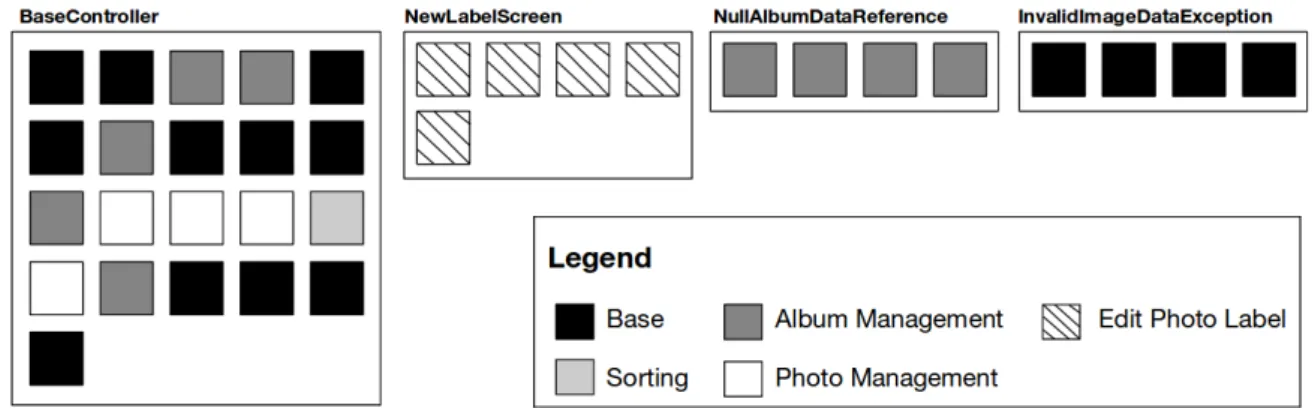
2.1 Distribution map containing the God Class BaseController from the
second version of MobileMedia . . . 9
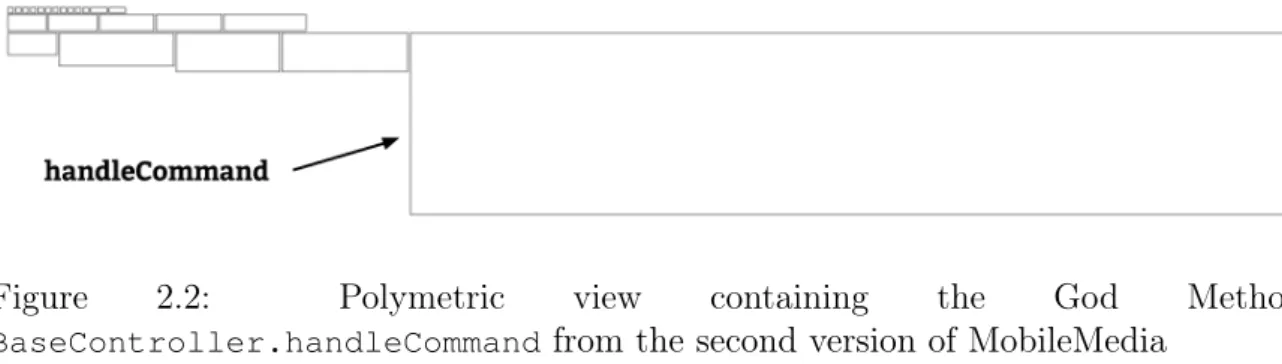
2.2 Polymetric view containing the God Method BaseController.handleCommand from the second version of MobileMedia 9 2.3 Class diagram containing the Feature Envy ImageAccessor.updateImageInfofrom the second version of MobileMedia 10 3.1 Total number of code smells per system version of MobileMedia . . . 28
3.2 Total number of code smells per system version of Health Watcher . . . 29
3.3 Evolution of God Class in MobileMedia . . . 31
3.4 Evolution of God Method in MobileMedia . . . 32
3.5 Evolution of Feature Envy in MobileMedia . . . 33
3.6 Evolution of God Class in Health Watcher . . . 34
3.7 Evolution of God Method in Health Watcher . . . 34
4.1 Summary of the classification of AC1 for MobileMedia and Health Watcher in Altman’s benchmark scale . . . 47
List of Tables
2.1 Selected code smell detection tools. . . 13
2.2 Code smells detected by detection tools. . . 14
2.3 Metrics thresholds for God Class detection strategy by tool. . . 16
2.4 Metrics thresholds for God Method detection strategy by tool. . . 17
2.5 Metrics thresholds for Feature Envy detection strategy by tool. . . 19
2.6 Summary of detection techniques implemented by tools. . . 21
3.1 Size metrics for MobileMedia (MM) and Health Watcher (HW). . . 24
3.2 Code smell reference list of MobileMedia (MM) and Health Watcher (HW). 27 3.3 Number of code smells originated and created in classes and methods. . . . 30
4.1 Total number of code smells detected by each tool. . . 39
4.2 Average recall and precision for MobileMedia. . . 41
4.3 Average recall and precision for Health Watcher. . . 42
4.4 Percentage agreement for MobileMedia (MM) and Health Watcher (HW). . 43
4.5 Percentage agreement for God Class between pairs of tools for MobileMedia (MM) and Health Watcher (HW). . . 44
4.6 Percentage agreement for God Method between pairs of tools for MobileMedia (MM) and Health Watcher (HW). . . 45
4.7 Percentage agreement for Feature Envy between pairs of tools for MobileMedia (MM) and Health Watcher (HW). . . 45
4.8 AC1 Statistics of the analyzed tools for MobileMedia. . . 47
4.9 AC1 Statistics of the analyzed tools for Health Watcher. . . 47
4.10 Non-occurrence agreement (NOA) for God Class between pairs of tools for MobileMedia (MM) and Health Watcher (HW). . . 49
4.11 Non-occurrence agreement (NOA) for God Method between pairs of tools for MobileMedia (MM) and Health Watcher (HW). . . 49
4.13 Occurrence agreement (OA) for God Class between pairs of tools for
MobileMedia (MM) and Health Watcher (HW). . . 50
4.14 Occurrence agreement (OA) for God Method between pairs of tools for MobileMedia (MM) and Health Watcher (HW). . . 51
4.15 Occurrence agreement (OA) for Feature Envy between pairs of tools for MobileMedia (MM) and Health Watcher (HW). . . 51
5.1 Number of projects per domain in Qualitas Corpus 2013. . . 56
5.2 Summary of the selected target systems. . . 57
5.3 Sample of votes for God Classes in ANTLR. . . 59
5.4 Size of the code smell reference list of all five target systems. . . 60
5.5 Total number of God Class detected by each tool. . . 61
5.6 Total number of God Method detected by each tool. . . 62
5.7 Total number of Feature Envy detected by each tool. . . 62
5.8 Recall and precision of God Class for each target system. . . 64
5.9 Recall and precision of God Method for each target system. . . 64
5.10 Recall and precision of Feature Envy for each target systems. . . 65
5.11 Percentage agreement considering inFusion, JDeodorant, JSpIRIT, and PMD. 66 5.12 Percentage agreement for God Class between pairs of tools. . . 67
5.13 Percentage agreement for God Method between pairs of tools. . . 67
5.14 Percentage agreement for Feature Envy between pairs of tools. . . 68
5.15 AC1 statistic considering inFusion, JDeodorant, JSpIRIT, and PMD. . . . 68
5.16 AC1 statistic for God Class between pairs of tools. . . 69
5.17 AC1 statistic for God Method between pairs of tools. . . 69
5.18 AC1 statistic for Feature Envy between pairs of tools. . . 70
5.19 Non-occurrence agreement (NOA) for God Class between pairs of tools. . . 71
5.20 Non-occurrence agreement (NOA) for God Method between pairs of tools. 71 5.21 Non-occurrence agreement (NOA) for Feature Envy between pairs of tools. 71 5.22 Occurrence agreement (OA) for God Class between pairs of tools. . . 72
5.23 Occurrence agreement (OA) for God Method between pairs of tools. . . 73
5.24 Occurrence agreement (OA) for Feature Envy between pairs of tools. . . . 73
6.1 Summary of detection techniques and number of smells detected. . . 80
6.2 Summary of the average recall and precision. . . 80
6.3 Summary of the average occurrence agreement between pairs of tools. . . . 80
Contents
Acknowledgments ix
Abstract xi
List of Figures xiii
List of Tables xv
1 Introduction 1
1.1 Problem Statement . . . 1
1.2 Goal and Research Questions . . . 2
1.3 Empirical Approach . . . 3
1.4 Results . . . 4
1.5 Outline . . . 6
2 Background 7 2.1 Code Smells . . . 7
2.2 Detection Techniques . . . 11
2.3 Detection Tools . . . 12
2.4 Detection Techniques Implemented by Tools . . . 15
2.5 Related Work . . . 19
2.6 Final Remarks . . . 20
3 Code Smell Evolution 23 3.1 Target Systems . . . 23
3.2 Study Settings . . . 25
3.3 Analysis of the Number of Code Smells . . . 27
3.4 Tracking Code Smells . . . 29
3.5 Threats to Validity . . . 35
4 Comparative Study of Code Smell Detection Tools 37
4.1 Study Settings . . . 38
4.2 Summary of Detected Code Smells . . . 38
4.3 Analysis of Recall and Precision . . . 40
4.4 Analysis of Percentage Agreement . . . 42
4.5 Analysis of AC1 Agreement . . . 46
4.6 Analysis of Non-Occurrence and Occurrence Agreements . . . 48
4.6.1 Non-Occurrence Agreement . . . 48
4.6.2 Occurrence Agreement . . . 50
4.7 Threats to Validity . . . 51
4.8 Final Remarks . . . 53
5 Applying Code Smell Detection Tools in Open Source Projects 55 5.1 Target Systems . . . 55
5.2 Study Settings . . . 58
5.3 Summary of Detected Code Smells . . . 61
5.4 Analysis of Recall and Precision . . . 63
5.5 Analysis of Percentage Agreement . . . 65
5.6 Analysis of AC1 Agreement . . . 68
5.7 Analysis of Non-Occurrence and Occurrence Agreements . . . 70
5.7.1 Non-Occurrence Agreement . . . 70
5.7.2 Occurrence Agreement . . . 72
5.8 Threats to Validity . . . 74
5.9 Final Remarks . . . 75
6 Final Considerations 77 6.1 Lessons Learned . . . 79
6.2 Future Work . . . 82
References 85
Chapter 1
Introduction
Software systems are increasingly important to society, making software quality control essential. Software quality is largely dependent on the structural quality of code; that is, structural issues can negatively impact the overall quality of software systems. Structural issues can manifest in a system as code smells. Code smells are symptoms of poor design and implementation choices [Fowler, 1999]. The presence of code smells indicates that there are issues with code quality, such as understandability and changeability, which can lead to a variety of maintenance problems, including the introduction of faults [Fowler, 1999]. For instance, a God Class is a class that concentrates the responsibilities of a system [Riel, 1996]. In other words, more and more responsibilities were added to a single class until it became too complex and harder to understand. Misunderstandings during changes of this class can increase even more code complexity or even introduce faults in the system. Therefore, God Classes
and other code smells can negatively impact the development and maintenance process of software systems.
1.1
Problem Statement
In the last decade, code smells have become an established concept for patterns or aspects of software design that may cause problems for further development and maintenance of software systems [Lanza and Marinescu, 2006]. The presence of code smells can increase change-proneness [Khomh et al., 2009a; Olbrich et al., 2010] or fault-proneness of classes [Khomh et al., 2012; Li and Shatnawi, 2007; D’Ambros et al., 2010]. Code smells can also decrease software understandability [Abbes et al., 2011], impact development effort [Abbes et al., 2011; Sjøberg et al., 2013], and other maintainability aspects [Yamashita and Moonen, 2012, 2013b; Banker et al., 1993].
Considering the negative impact of code smells, their longevity was also investigated [Tufano et al., 2015; Chatzigeorgiou and Manakos, 2010]. Ideally, code smells should be detected and removed from software systems. However, detecting code smells is a challenging task.
Fowler [1999] initially defined code smells by providing high level descriptions followed by lists of refactoring operations, instead of giving instructions on how to detect code smells in source code. Without a formal definition, different interpretations of code smells have led to different detection techniques. The proposed detection techniques include code inspection [Travassos et al., 1999], metrics-based strategies [Lanza and Marinescu, 2006] where code smells are identified by sets of rules composed by software metrics and thresholds, static analysis of code [Tsantalis and Chatzigeorgiou, 2011], or even search-based approaches, such as evolutionary algorithms [Kessentini et al., 2010]. These techniques are an alternative to manual detection of code smells, which is a subjective, time-consuming, and error-prone task.
Some of these detection techniques have been implemented in tools available to the public [Marinescu et al., 2005; Moha et al., 2010; Tsantalis and Chatzigeorgiou, 2009a; Murphy-Hill and Black, 2010]. However, evaluating the effectiveness of these tools to assess the most indicated in a given situation can be difficult. This difficulty is mostly associated with the subjectivity in the definition of code smells, which leads to different detection techniques for the same code smell, and with variations in the set of metrics and/or thresholds implemented. Due to these factors, tools generate different results that can be hard to interpret and compare. Another difficulty is also finding open source systems with validated lists of code smells to serve as a basis for evaluating the techniques and tools, since the manual identification of code smells requires a lot of effort. Therefore, most studies focus on evaluating only one tool or technique using a small number of systems and code smells [Mäntylä, 2005; Moha et al., 2010; Murphy-Hill and Black, 2010]. Comparing multiple detection tools can provide insights into the main similarities and differences between detection tools, assisting developers and researchers in selecting tools that are more adequate to their specific needs.
1.2
Goal and Research Questions
1.3. Empirical Approach 3
software systems. According to the aforementioned goal, we have derived the following four research questions:
RQ1. Does the number of code smells increase over time?
RQ2. How do the code smells evolve with the system evolution?
RQ3. What is the recall and precision of tools in identifying actual instances of code smells?
RQ4. What is the level of agreement between different tools?
1.3
Empirical Approach
In order to evaluate different code smell detection tools, we conducted three different studies: an exploratory study to investigate the presence and evolution of code smells; an experimental evaluation of tools in the context of systems with multiple versions; and a replication of the experimental evaluation in a different context, with systems from different sizes and domains. Each study is detailed in the following.
The first study was an exploratory study to investigate the evolution of code smells in software systems by identifying instances of code smells in multiple versions of two different software systems, namely MobileMedia and Health Watcher. We answer two research questions, one investigating if the number of code smells increases as the system evolves (RQ1), and another that investigates how instances of code smells evolve with the evolution of the system (RQ2). In order to answer both RQs we manually analyzed the source code of all versions of the target systems to identify instances of God Class, God Method, and Feature Envy [Fowler, 1999]. The recovered and validated instances were registered in code smell reference lists. These lists were used to track the presence of code smells, revealing variations in the number of instances and when they were introduced and removed from the systems. The code smell reference lists are also used to evaluate the detection tools in the second study.
the level of agreement between detection tools applied to the same system (RQ4). In order to answer both RQs, we applied the detection tools to multiple versions of two different target systems (the same of the first study) and analyzed their reports. For RQ3, we used the code smell reference lists created in the first study to measure and compare the tools recall and precision. Recall is a measure of coverage, while precision is a measure of relevance. For RQ4, we measured the agreement between the tools using multiple measures of agreement. By measuring the agreement, we can compare how similar or different are the reports of different detection tools.
The third study aims to increase the confidence of our results and to favor generalization of our findings. Therefore, in the third study, we replicate the experimental evaluation in a different context by applying the detection tools to five different open source projects, namely ANTLR, ArgoUML, JFreeChart, JSPWiki, and JUnit, to answer the same research questions (RQ3 and RQ4). The main differences from the second to the third study were that (i) we proposed a semi-automated approach for creating the code smell reference lists as an alternative to the manually generated lists and (ii) we analyzed only one version of the projects that have different sizes and domains.
1.4
Results
In the first study on the evolution of code smells, our results suggest that the number of smells does not necessarily increase as the systems evolve. Only the number of God Classes noticeably increased in MobileMedia. Our results also showed that in MobileMedia and Health Watcher most of the identified code smell instances were already present when the affected class or method was created in the systems. That is the case for74.4% of the smells in MobileMedia and 87.5%in Health Watcher. This result confirms the findings of Tufano et al. [2015] and Chatzigeorgiou and Manakos [2010].
1.4. Results 5
tools, or improving the current ones. Considering the agreement, we found a high agreement between all tools and pairs of tools on non-smelly classes and methods, even though different tools do not follow the same detection technique. On the other hand, the agreement on smelly classes and methods presents more variations and is lower, even for tools based on the same detection technique.
In the third study, we evaluated the detection tools using five systems with different sizes and domains. We also found variations in recall and precision for the same detection tool and for different tools, like in the second study. The main difference was in the average recall. In the second study, inFusion had the lowest average recall and JDeodorant had the highest average recall. However, in the third study, the highest average recall were of PMD for God Class, and JSpIRIT for God Method and Feature Envy. While JDeodorant presented lower average recall for all smells and had the lowest average recall for God Method. Therefore, in the third study, PMD and JSpIRIT detect the highest number of instances from the code smell reference list, while in the second study JDeodorant reported the highest number of instances. Regarding the agreement, the observations made for the second study are valid in the third.
The findings in this dissertation can be used by developers and researchers in the decision of when to apply detection tools in a system and which tool or tools could be selected. For instance, if a developer or researcher believes that higher coverage (recall) is more important, than she could select a tool with a tendency of presenting higher coverage.
The results presented in this dissertation are part of the following papers:
• Paiva, T., Damasceno, A., Padilha, J., Figueiredo, E. and Sant’Anna, C. (2015). Experimental Evaluation of Code Smell Detection Tools. InProceedings of the III Workshop on Software Visualization, Evolution and Maintenance (VEM), pages 17-24.
• Fernandes, E., Oliveira, J., Vale, G., Paiva, T., and Figueiredo, E. (2016). A review-based comparative study of bad smell detection tools. In Proceedings of the 20th International Conference on Evaluation and Assessment in Software Engineering (EASE), Article 8, pages 1-12.
1.5
Outline
In this chapter, we introduced the problem, the proposed research work, and main goal of this dissertation. The rest of the document is organized as follows:
Chapter 2 details the main concepts necessary for understanding this work: code smells and code smell detection techniques. This chapter also discusses related work and provides additional information regarding the selected detection tools.
Chapter 3presents the exploratory study that was conducted to investigate the presence and evolution of code smells in two software systems. This chapter answers the first and second research questions by investigating if the number of code smell increases with the evolution of the system and the presence of code smells as the system evolves.
Chapter 4 presents an experimental evaluation of code smell detection tools in the two target systems of Chapter 3. This chapter details the settings of this evaluation and discusses the results achieved to answer the third and fourth research questions.
The research questions are answered by investigating the precision and recall of tools in detecting the code smells found in Chapter 3 and the level of agreement between tools for these same systems.
Chapter 5 presents a replication of the experimental evaluation on code smell detection tools in five open source projects. This chapter replicates the study in Chapter 4 in a different context, by analyzing the reports of active open source projects from different sizes and domains.
Chapter 2
Background
Code smells are symptoms of poor design and implementation choices [Fowler, 1999], that may cause problems for further development and maintenance tasks of systems [Lanza and Marinescu, 2006; Kruchten et al., 2012; Yamashita and Counsell, 2013]. Once code smells are located in a system they can be removed by refactoring the source code [Fowler, 1999]. However, detecting code smells in large software systems is a very time and resource-consuming, error-prone activity [Travassos et al., 1999], and manual inspection is slow and inaccurate [Langelier et al., 2005]. Tools can assist developers in the identification of affected entities, facilitating the code smell detection task. However, different detection methods generate different results and may be more or less adequate to the detection needs of a developer for a given software system.
This chapter presents background information related to this dissertation. Section 2.1 introduces the concept ofcode smells. Section 2.2 presents the detection techniques available to detect code smells. Section 2.3 introduces four detection tools. Section 2.4 discusses the detection techniques implemented by the tools of Section 2.3. Section 2.5 presents related work. Lastly, final remarks are discussed in Section 2.6.
2.1
Code Smells
Code smells, also called bad smells or code anomalies [Fowler, 1999], anti-patterns [Brown et al., 1998] or design flaws [Marinescu, 2004], are code fragments that suggest the possibility of refactoring, i.e., symptoms of poor design and implementation choices [Fowler, 1999]. Originally, 22 code smells and corresponding refactoring operations were described by Fowler [1999]. Refactoring is the process of changing a software system in such a way that it does not alter the external behavior of the code yet improves its
internal structure [Fowler, 1999; Opdyke, 1992], and its necessity is indicated by the presence of code smells.
Over the last years, several studies have investigated different aspects of code smells, including (i) their relevance according to developers [Palomba et al., 2014; Yamashita and Moonen, 2013a], (ii) their lifespan in software systems [Arcoverde et al., 2011; Chatzigeorgiou and Manakos, 2010; Peters and Zaidman, 2012], (iii) their side effects in non-functional properties, such as their impact on the maintainability [Sjøberg et al., 2013; Yamashita and Moonen, 2012] and increase of change- and fault-proneness [Khomh et al., 2009a, 2012] or decrease of the comprehensibility of software [Abbes et al., 2011]. The potentially negative impact of code smells in the software development prompted the development of several methods and tools for detecting and/or refactoring code smells [Boussaa et al., 2013; Moha et al., 2010; Tsantalis et al., 2008; Marinescu et al., 2005; Murphy-Hill and Black, 2010].
In addition to the 22 code smells in Fowler’s catalog [Fowler, 1999], other smells have been proposed in the literature, such asFunctional Decomposition,Spaghetti Code
[Brown et al., 1998], and Swiss Army Knife [Moha et al., 2010]. In this dissertation, we focus on three of Fowler’s code smells: God Class,God Method, and Feature Envy. We selected these code smells because (i) they are among the most frequent smells detected by code smell detection tools [Fernandes et al., 2016], allowing us to compare the tools recall, precision, and agreement, (ii) they can also be detected without the assistance of tools, which is necessary to compile the code smell reference list of the first study, and (iii) they are the most frequent code smells in the target systems. The following examples were retrieved from the second version of MobileMedia, a software product line (SPL) for applications that manipulate photo, music, and video on mobile devices [Figueiredo et al., 2008].
God Class. This code smell defines a class that centralizes the functionality of the system. That is, "a class that knows or does too much" [Riel, 1996]. In other words, a God Class violates the single responsibility principle [DeMarco, 1978] of object-oriented programming that states that a class should have only a single responsibility. For instance, Figure 2.1 shows a distribution map of a subset of four classes and five concerns from the second version of MobileMedia [Figueiredo et al., 2008]. In this distribution map notation [Ducasse et al., 2006], each rectangle represents one class and each small square represents one method. Colors indicate the main concern of each method. Ideally, in an object-oriented program, all classes follow the single responsibility principle [DeMarco, 1978]. That is, each class should encapsulate only one concern. This principle is followed by the classes
2.1. Code Smells 9
Figure 2.1: Distribution map containing the God Class BaseController from the
second version of MobileMedia
However,BaseControllercontains more methods and implements multiple concerns:
Base, Sorting, Photo Management, and Album Management. In other words,
BaseControllercan be considered a God Class in the second version of MobileMedia.
God Method. This code smell happens when more and more functionality is added to a method until it becomes out of control and difficult to maintain and extend [Fowler, 1999]. Therefore, God Method tends to centralize functionalities of a class in the same way that a God Class tends to centralize the functionality of a subsystem, or even an entire system. Figure 2.2 presents a polymetric view to illustrate this code smell. A polymetric view is a lightweight technique that allows rendering numbers in a simple, yet effective and highly condensed way which is directly interpretable by the viewer [Lanza and Marinescu, 2006]. In this polymetric view, nodes represent entities such as classes or methods. The related metrics and relationships can be represented by the nodes size, color and position, and the edges width and color. In Figure 2.2, the polymetric view represents methods of the classBaseController from the second
version of MobileMedia. Each node represents a method, the height of the node is the McCabe’s Ciclomatic Complexity (CYCLO) [McCabe, 1976] and the width is the method lines of code (MLOC). Clearly, one method stands out when compared to the others. The method BaseController.handleCommand has a CY CLO= 34 and
M LOC = 163, values that are very high when compared to the second highest values of
CY CLO = 7 andM LOC = 23from the methodBaseController.showImageList.
Therefore, BaseController.handleCommand can be considered a God Method in
the second version of MobileMedia.
Figure 2.2: Polymetric view containing the God Method
BaseController.handleCommand from the second version of MobileMedia
For instance, Figure 2.3 presents a class diagram for two classes, ImageAccessor
and ImageData, from the second version of MobileMedia. ImageAccessor has
a method updateImageInfo(ImageData, ImageData) that updates the album
id, the album name and the label of an image file. In order to update these fields, updateImageInfo(ImageData, ImageData) accesses directly the methods getImageLabel(), getParentAlbumName() and getRecordId() from the class ImageData. Therefore, the method updateImageInfo(ImageData, ImageData)
located in the class ImageAccessor is more interested in the functionalities of the
class ImageData than of the ImageAcessor class. In other words, the method ImageAccessor.updateImageInfo(ImageData, ImageData)is a Feature Envy in
the second version of MobileMedia.
Figure 2.3: Class diagram containing the Feature Envy
2.2. Detection Techniques 11
2.2
Detection Techniques
From the perspective of refactoring, code smells are code fragments that suggest the possibility of refactoring. According to Fowler [1999], the refactoring process consists of two distinct steps: (1) detecting where a program should be refactored and (2) identify which refactoring should be applied [Fowler, 1999]. Therefore, detecting code smells is the first step in the refactoring process. In the literature, many studies addressed the problem of detecting code smells and refactoring [Moha et al., 2010; Marinescu, 2004; Tsantalis and Chatzigeorgiou, 2009b; Palomba et al., 2013; Boussaa et al., 2013; Khomh et al., 2009b]. The detection techniques can be classified mainly into [Tufano et al., 2015; Palomba, 2016; Kessentini et al., 2014]: manual approaches,metric-based approaches,static code analysis,analysis of software changes, and search-based approaches.
Manual Approaches. The most reliable way to manually detect smells according to Fowler [1999] is by code reviews, where the code is inspected to identify code fragments with smells. This approach presents many disadvantages, e.g., it is time-consuming, non-repeatable, error-prone, and non-scalable [Mäntylä et al., 2004; Mäntylä and Lassenius, 2006; Marinescu, 2001; Travassos et al., 1999]. Overall, manual approaches require a great human effort to interpret and analyze the source code and, consequently, they are restricted to small systems. Another issue is that the manual detection is highly subjective, relying in the experience of the developer and their knowledge of the system and its domain.
affecting the state of a given object. The idea is to suggest refactorings based on slices whose extraction preserves the program behavior and dependencies, while maintaining cohesion and minimizing code duplication. Another approach by Fokaefs et al. [2012], finds Extract Class opportunities using an agglomerative clustering algorithm. The main idea is that clusters can determine cohesive groups of methods and attributes, i.e., that have a distinctive functionality.
Analysis of Software Changes. For this approach, code smells are characterized by how the source code changes over time, instead of source code metrics or other information extracted from a source code snapshot [Palomba et al., 2013]. For example, Palomba et al. [2013] propose HIST (Historical Information for Smell deTection) to detect code smells. This approach extracts the change history of a system from versioning systems and analyzes co-changes between source code artifacts.
Search-Based Approaches. Search-Based Software Engineering uses search-based approaches to solve optimization problems [Harman, 2007]. Once software engineering problems are modeled as optimization problems, search algorithms can be applied to solve it. Kessentini et al. [2010] formulate code smell detection as an optimization problem, where genetic algorithms detect smells following the assumption that what significantly diverges from good design practices is likely to represent a design problem. Other studies propose machine-learning based approaches [Fontana et al., 2016; Ren et al., 2011] that are able to find code smells by reporting classes similar to the smelly classes from the training data. However, the main challenge for these approaches is the high level of false positives, since they depend on the quality of code smell instances in the training set.
2.3
Detection Tools
2.3. Detection Tools 13
The tools were selected based on the following reasons. Java is the most common language in detection tools and, therefore, we adopted the analysis of Java programs as the first criteria. Similarly, we selected tools able to detect at least two of the code smells God Class, God Method, and Feature Envy. Then, we selected only tools that were available for download and free to use, at least in a trial version. The aforementioned criteria resulted in a set of eight tools from the original 29 reported by Fernandes et al. [2016]: Checkstyle, inFusion, iPlasma, JDeodorant, PMD, JSpIRIT, Stench Blossom, and TrueRefactor. However, Checkstyle, iPlasma, TrueRefactor, and Stench Blossom have been discarded. Checkstyle was discarded because it was not able to detect any instance of the code smells in the selected target systems. iPlasma was discarded because it is the open source version of the inFusion tool and, therefore, implements the same detection technique. TrueRefactor was discarded because the downloaded package did not contain an executable file. Finally, Stench Blossom was discarded for not providing a code smell list, but only a visualization feature, which makes it hard to validate their results and to calculate, for instance, recall and precision. Table 2.1 summarizes the basic information about the selected tools. The column
Tool contains the names of the analyzed tools as reported in their corresponding websites. The column Version is the version of the tools that were used in this dissertation. The column Type indicates if the tool is available as a plugin for the Eclipse IDE or as a standalone tool. The columnLanguages contains the programming languages that can be analyzed by the tools, with Java being the most common one. The column Refactoring indicates whether the tool provides refactoring operations, which is available only in JDeodorant. The column Export indicates if the tool allows exporting the results to a file. This feature is present only in inFusion and JDeodorant, that export the results to an HTML file and to an XML file, respectively. Finally, the column Detection Techniques contains a general description of the techniques used by each tool, as discussed in Section 2.2, with metrics-based techniques being the most common.
Table 2.1: Selected code smell detection tools.
Tool Version Type Languages Refactoring Export Detection Technique
inFusion 1.8.62015 Standalone Java, C, C++ No Yes Software Metrics JDeodorant 5.0.02016 Eclipse Plugin Java Yes Yes Static Code Analysis JSpIRIT 1.0.02014 Eclipse Plugin Java No No Software Metrics PMD 5.5.4(4.0.112017) Eclipse Plugin Java, C, C++ and others No No Software Metrics
to detect code smells. PMD provides code smell detection as one of its multiple functionalities.
Table 2.2: Code smells detected by detection tools.
Code Smell inFusion JDeodorant PMD JSpIRIT
God Class X X X X
God Method X X X X
Feature Envy X X - X
inFusion is a commercial standalone tool for Java, C, and C++ that detects 22 code smells, including the three smells of our interest: God Class, God Method, and Feature Envy. As a commercial product, inFusion is no longer available for download at this moment. However, the open source version of the tool, called iPlasma1, is still
available. The detection techniques for all smells were initially based on the detection strategies defined by Lanza and Marinescu [2006], and then successively refined using source code from multiple open source and commercial systems.
JDeodorant2 [Tsantalis et al., 2008] is an open source Eclipse plugin for
Java that detects four code smells: God Class, God Method, Feature Envy, and Switch Statement [Tsantalis et al., 2008]. The detection techniques are based on the identification of refactoring opportunities of Extract Class for God Class, Extract Method for God Method and Move Method for Feature Envy.
PMD3 is an open source tool for Java and an Eclipse plugin that detects many
problems in Java code, including two of the code smells of our interest: God Class and God Method. The detection techniques are based on metrics. For God Class, it relies on the detection strategies defined by Lanza and Marinescu [2006] and for God Method, a single metric is used: LOC (number of lines of code).
JSpIRIT4 is an Eclipse plugin for Java that identifies and prioritizes ten code
smells, including the three smells of our interest: God Class, God Method, and Feature Envy [Vidal et al., 2015]. The detection techniques consist in the implementation of detection strategies inspired by the work from Lanza and Marinescu [2006].
1
Available at http://loose.upt.ro/iplasma/
2
Available at https://github.com/tsantalis/JDeodorant
3
Available at https://pmd.github.io/
4
2.4. Detection Techniques Implemented by Tools 15
2.4
Detection Techniques Implemented by Tools
This section discusses the detection techniques implemented in the selected code smell detection tools, namely inFusion, JDeodorant, PMD, and JSpIRIT. JDeodorant adopts a static code analysis approach to detect code smells by identifying refactoring opportunities. inFusion, PMD and JSpIRIT adopt metric-based approaches to detect code smells using Marinescu’s detection strategies [Marinescu, 2004] or other software metrics. In this section, we detail the detection techniques implemented by each tool as reported in the documentation or as identified in the tool’s source code.
God Class. The detection strategy proposed by Marinescu [2004], is based on three symptoms: (i) the class uses directly more than a few attributes of other classes, heavily accessing data of other simpler classes directly or through accessor methods, (ii) the functional complexity of the class is very high, since the individual complexities associated with each of the many implemented functionalities are added up and, (iii) the cohesion is low, since the class implements several functionalities that may not be related, their methods access disjoint sets of attributes.
Based on the aforementioned symptoms, Marinescu defined a detection strategy indicated in Equation 2.1 using three software metrics: Access to Foreign Data,
Weighted Method per Class, and Tight Class Cohesion. Access to Foreign Data
(ATFD) [Marinescu, 2001] measures the number of attributes from other classes that are accessed directly or through accessor methods, therefore, high values increase the possibility of a God Class. Weighted Method per Class (WMC) [Chidamber and Kemerer, 1994] measures the complexity of the class as the sum of the weights associated with each method. The weights are the complexity of the method, indicated in this case by McCabe’s Cyclomatic Complexity (CYCLO) [McCabe, 1976]. Class with high values are more complex. Finally,Tight Class Cohesion (TCC) [Bieman and Kang, 1995] defines the relative number of pairs of methods that access at least one attribute in common from the measured class. Low values indicate that the classes methods have low cohesion, i.e., they access less attributes in common.
(AT F D > F EW) ∧ (W M C ≥V ERY HIGH) ∧ (T CC <1/3) (2.1)
used in the tool are defined by the aforementioned values and then refined using source code from multiple open source and commercial systems. Therefore, the reported values for inFusion in Table 2.3 are only an approximation of the actual implemented thresholds.
For ATFD, inFusion indicates a range of values [2,5], while PMD uses the minimumAT F D= 5 and JSpIRIT the minimum AT F D = 2. inFusion and PMD use
W M C = 47, and JSpIRIT uses a lower value of W M C = 43.875. Lastly, the three tools use T CC = 1
/3. However, there might be a difference in the results due to the
number of decimal places used by each tool, inFusion has T CC = 0.33, JSpIRIT uses one more decimal place withT CC = 0.333 and PMD uses the result provided by the division, so has more decimal places than the previous tools.
Table 2.3: Metrics thresholds for God Class detection strategy by tool.
Metric inFusion PMD JSpIRIT
Access to Foreign Data (AT F D) 2-5 5 2 Weighted Method per Class (W M C) 47 47 43.875 Tight Class Cohesion (T CC) 0.33 1
/3 0.333
The other detection technique is used only by JDeodorant and consists in identifying classes in which the refactoring operationExtract Class can be performed. This approach [Fokaefs et al., 2012] finds the refactoring opportunities using an agglomerative clustering algorithm that can form cohesive groups of methods and attributes that are similar, i.e, have the same or similar functionality.
God Method. The detection strategy proposed by Marinescu [2004] is based on four symptoms: (i) the method is excessively large and, therefore, it is harder to understand and consequently, to maintain, (ii) the method has many conditional branches, a sign of non-object design in which the polymorphism is ignored [Lanza and Marinescu, 2006] (iii) the method has deep nesting level, which is a consequence of the implementation of multiple functionalities in the same method and, (iv) the method has many variables, i.e., more variables that a human can store in the short-term memory, increasing the risk of introducing errors in the system [Lanza and Marinescu, 2006].
Based on the aforementioned symptoms, Marinescu defined a detection strategy indicated in Equation 2.2 using four software metrics: Lines of Code, McCabe’s Cyclomatic Complexity, Maximum Nesting Level, and Number of Accessed Variables.
2.4. Detection Techniques Implemented by Tools 17
[McCabe, 1976] measures a methods complexity by determining the number of linearly independent paths in the control flow. The higher the complexity of a method, the higher the possibility of a God Method. Maximum Nesting Level (MAXNESTING) [Lanza and Marinescu, 2006] measures the maximum depth of control structures in a method. Higher values indicate that a method handles many responsibilities. Number of Accessed Variables (NOAV) computes the total number of variables accessed by the method, including local and global variables, parameters and attributes. A higher number also indicates an excess of functionalities in the same method.
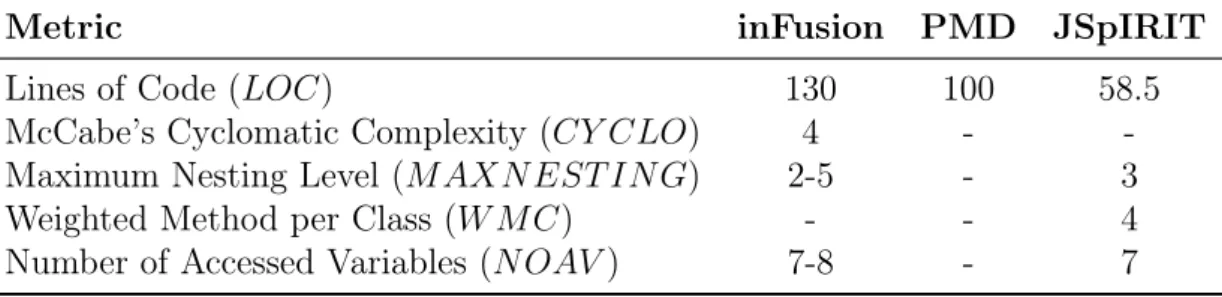
(LOC > HIGH) ∧ (CY CLO≥HIGH) ∧ (M AXN EST IN G≥SEV ERAL) ∧ (N OAV > M AN Y) (2.2) inFusion and JSpIRIT adopt detection strategies inspired by Equation 2.2. Table 2.4 contains in columnMetric the metrics used in the strategy, while the other columns indicate the corresponding thresholds for each tool. The values reported for inFusion, as discussed previously, are an approximation of the actual implemented thresholds.
The metric LOC is the only one adopted by the three tools (with different thresholds) and the only one used by PMD. inFusion has a LOC = 130, a closer value to PMD, with LOC = 100. JSpIRIT has the lowest threshold, with LOC = 58.5. CYCLO is used only by inFusion, with CY CLO = 4. inFusion defines for MAXNESTING a range of values, [2,5]. The threshold of JSpIRIT is inside this range, with M AXN EST IN G = 3. JSpIRIT is the only one that adopts WMC, with
W M C = 4. Finally, inFusion and JSpIRIT have similar thresholds for NOAV. inFusion defines a range of [7,8] and JSpIRIT has N OAV = 7.
Table 2.4: Metrics thresholds for God Method detection strategy by tool.
Metric inFusion PMD JSpIRIT
Lines of Code (LOC) 130 100 58.5
McCabe’s Cyclomatic Complexity (CY CLO) 4 - -Maximum Nesting Level (M AXN EST IN G) 2-5 - 3 Weighted Method per Class (W M C) - - 4 Number of Accessed Variables (N OAV) 7-8 - 7
variable (complete computation slice) or the statements affecting the state of a given object (object state slice) [Tsantalis and Chatzigeorgiou, 2011], which can be expanded into new methods. The quality of the slices is defined by their ability to preserve program behavior and dependencies, while maintaining cohesion of the decomposed and the new methods and minimizing code duplication.
Feature Envy. The detection strategy proposed by Marinescu [2004] is based on three symptoms: (i) the method uses directly more than a few attributes of other classes, i.e., the method accesses data and methods of other classes more frequently than expected, (ii) the method uses far more attributes from other classes than its own, this is an indicator that the method is poorly located, (iii) the method uses "foreign" attributes that belong to very few other classes, i.e., the method depends directly of data or methods from one or two other classes.
Based on the aforementioned symptoms, Marinescu defined a detection strategy indicated in Equation 2.3 using three software metrics: Access to Foreign Data,Locality of Attribute Accesses and Foreign Data Providers. Access to Foreign Data (ATFD) [Lanza and Marinescu, 2006] measures the number of non-local attributes outside the class accessed by the method. Higher values indicate that the method is interested in other classes. Locality of Attribute Accesses (LAA) [Lanza and Marinescu, 2006] computes the number of attributes accessed that belong to the same class as the method. Since the method accesses many attributes outside the class where it was defined, for Feature Envy, the values are lower. Foreign Data Providers (FDP) [Lanza and Marinescu, 2006] measures the total number of classes from which the method accesses data or methods. Lower values indicate a higher frequency of access to data and methods outside the class, increasing the possibility of Feature Envy.
(AT F D > F EW) ∧ (F DP ≤F EW) ∧ (LAA <1
/3) (2.3)
inFusion and JSpIRIT adopt detection strategies inspired by Equation 2.3. Table 2.5 contains in columnMetric the metrics used in the strategy, while the other columns indicate the corresponding thresholds for each tool. The values reported for inFusion, as discussed previously, are an approximation of the implemented thresholds.
2.5. Related Work 19
Table 2.5: Metrics thresholds for Feature Envy detection strategy by tool.
Metric inFusion JSpIRIT
Access to Foreign Data (AT F D) 2-5 2 Foreign Data Providers (F DP) 1-2 2 Locality of Attribute Accesses (LAA) 0.33 0.333
The other detection technique is used only by JDeodorant and consists in identifying methods in which the refactoring operationMove Method can be performed. The identification of Feature Envy bad smells is based on the notion of distance between methods and system classes [Fokaefs et al., 2007]. The distance measures the dissimilarity between the set of entities accessed by a method m and the set that belongs to a class C. For each method, the distances to its own class an other system classes are measured. Move Method opportunities are identified if the distance of a method from a system class is less than the distance of this method from the class that it belongs to [Fokaefs et al., 2007]. These opportunities are ranked based on the Entity Placement metric [Tsantalis and Chatzigeorgiou, 2009b], that measures the impact of moving the method to the given class, considering that cohesion should be maximized and coupling minimized.
2.5
Related Work
In the literature, there are many papers proposing new code smell detection tools [Marinescu et al., 2005; Moha et al., 2010; Murphy-Hill and Black, 2010; Zazworka and Ackermann, 2010; Wettel and Marinescu, 2005]. A list of available detection tools was reported in a systematic literature review by Fernandes et al. [2016]. In general, these tools are presented and evaluated in an isolated way and considering only a few smells. To our knowledge, Fontana et al. [2012] were the first to present a wider evaluation and discussion of several detection tools and code smells simultaneously. They used six versions of a system to evaluate four tools, Checkstyle, inFusion, JDeodorant, and PMD. We also evaluate the tools inFusion, JDeodorant, and PMD, calculating the agreement among tools, similarly to Fontana et al. [2012]. However, we used the AC1
statistic, a more robust measure than the Kappa Coefficient. Unlike Fontana et al. [2012] we also analyzed precision and recall of each tool.
intervention as the system evolves and if they are introduced with the creation of entities. Tufano et al. [2015] focused in identifying when and why smells are introduced in the system in a large empirical study of 200 open source projects. In our work, we also analyze the evolution of code smells, but at a higher level. Furthermore, we do not focus on maintenance activities and refactoring, like Chatzigeorgiou and Manakos [2010], or in the reasons why the smells were introduced, like Tufano et al. [2015].
Some studies focus on investigating the impact of code smells on software maintenance. Sjøberg et al. [2013] investigated the relationship between code smells and maintenance effort in an experiment with six hired developers and found that the maintenance effort did not increased significantly in the presence of smells. Yamashita and Moonen [2012] investigated how the definitions of code smells reflected aspects of maintainability considered important by programmers in an empirical study with developers. Another related study [Yamashita and Moonen, 2013b] investigated how the interactions between code smells affect maintenance.
Other studies proposed different approaches to detect code smells in software. Oizumi et al. [2016] proposed that code smells are related, appearing together in the source code to compose different design problems. In this approach, code smells are detected as agglomerations, unlike our work, where we focus on strategies that identify code smells individually. Another study by Fontana et al. [2016] applied 16 different machine-learning algorithms in 74 software systems to detect four code smells in an attempt to avoid some common problems of code smell detectors.
2.6
Final Remarks
In this chapter, we introduced the concept of code smells and how they can be detected. Code smells are symptoms of poor design and implementation choices [Fowler, 1999] that can impact software maintenance. We presented a detailed description of the studied code smells, God Class, God Method and Feature Envy. In addition, we gave an overview of the available detection techniques. Finally, we introduced four detection tools (inFusion, JDeodorant, PMD, and JSpIRIT) and discussed their implementation of metrics-based approaches and static code analysis to detect code smells.
2.6. Final Remarks 21
own variation by using different sets of metrics or different thresholds. Further details regarding the detection techniques can be found in Section 2.4.
In Table 2.6, Eq. 2.1, Eq. 2.2, and Eq. 2.3 indicate that the tool is based on Marinescu’s detection strategy for God Class, God Method, and Feature Envy [Lanza and Marinescu, 2006], respectively. The other detection technique is Refactoring, indicating the search for refactoring opportunities to detect God Class, God Method, and Feature Envy. The metric LOC indicates lines of code and is used by PMD for God Method detection. Finally, "n/a" indicates that the smell is not detected.
Table 2.6: Summary of detection techniques implemented by tools.
Tool God Class God Method Feature Envy
inFusion Eq. 2.1 Eq. 2.2 Eq. 2.3 JDeodorant Refactoring Refactoring Refactoring JSpIRIT Eq. 2.1 Eq. 2.2 Eq. 2.3
PMD Eq. 2.1 LOC n/a
Chapter 3
Code Smell Evolution
Software systems are continuously changing, growing and increasing in complexity [Lehman, 1984; Lehman et al., 1997]. In other words, during the lifetime of a software system, changes must be made in order to keep the software useful. In this context, the presence of code smells can degrade quality aspects of the software system, such as maintainability and comprehensibility, hindering the software development process by making the code difficult to understand, and, consequently, to maintain [Fowler, 1999; Lanza and Marinescu, 2006]. However, since software is constantly changing, code smells can be introduced or removed at any time during the lifetime of a system. In this chapter, we investigate the evolution of code smells in two target systems, namely MobileMedia and Health Watcher. Section 3.1 introduces the target systems and a summary of their size metrics. Section 3.2 presents the research questions and introduces the concept of code smell reference list. Section 3.3 presents an analysis of the variations in the number of code smells in both target systems. Section 3.4 presents visual representations of the evolution of code smells. Section 3.5 discusses the main threats to the validity of this study. Lastly, Section 3.6 presents this chapters final remarks.
3.1
Target Systems
We selected two Java systems for this study, namely MobileMedia and Health Watcher, with nine and ten object-oriented versions, respectively. They were selected as target systems mainly because the code smell experts responsible for manually analyzing the code to identify code smells were already familiar with these systems. The manual identification of code smells is a difficult task. Therefore, intimate knowledge of the system and its domain facilitates the comprehension of the source code. This allowed
the experts to focus on identifying code smell instances instead of trying to understand the system, its dependencies, and other domain-related specificities. We also had other reasons for choosing the two systems: (i) we have access to their source code, allowing us to manually retrieve code smells, (ii) their code is readable, facilitating for instance, the task of identifying the functionalities implemented by classes and methods, and (iii) these systems were previously used in other maintainability-related studies [Figueiredo et al., 2008; Macia et al., 2012; Soares et al., 2006; Kulesza et al., 2006; Greenwood et al., 2007]. Further details regarding the purpose and size of each system are discussed in the following.
MobileMedia (MM). This system is a software product line (SPL) for applications that manipulate photo, music, and video on mobile devices [Figueiredo et al., 2008]. Our study involved nine object-oriented versions (1 to 9) of MobileMedia, ranging from 1 to over 3 KLOC. Table 3.1 shows for each version of MobileMedia the number of classes, methods, and lines of code. For instance, in the first version of MobileMedia there are 24 classes, 124 methods and a total of 1159 lines of code. We use "n/a" in Table 3.1 to indicate that the 10th version of MobileMedia is not available. We can observe that there was an increase of 2057 lines of code from versions 1 to version 9, with the addition of 31 classes and 166 methods.
Table 3.1: Size metrics for MobileMedia (MM) and Health Watcher (HW).
Version Number of Classes Number of Methods Lines of Code
MM HW MM HW MM HW
1 24 77 124 401 1159 5996
2 25 80 143 424 1316 6369
3 25 80 143 424 1364 6369
4 30 92 161 566 1559 7046
5 37 93 202 581 2056 7231
6 46 97 238 406 2511 7293
7 50 99 269 606 3015 7316
8 50 103 273 611 3167 7355
9 55 115 290 659 3216 8800
10 n/a 118 n/a 671 n/a 8702
3.2. Study Settings 25
version of Health Watcher the number of classes, methods, and lines of code. We can observe that there was an increase of 2706 lines of code from version 1 to version 10, with the addition of 41 classes and 270 methods.
3.2
Study Settings
The purpose of this study is to explore the presence of code smells in the target systems, namely MobileMedia and Health Watcher. We not only identify code smells and calculate the number of times that a code smell was found in the source code, but also track their occurrences as the systems evolved. In order to accomplish these tasks, we manually analyzed the source code of the target systems in search of instances of God Class, God Method, and Feature Envy. All nine versions of MobileMedia and ten versions of Health Watcher were analyzed to answer the following research questions:
• RQ1. Does the number of code smells increase over time?
We aim to investigate if there is a variation on the amount of code smells found in different versions of the same software system. In other words, we want to investigate if extending and adding classes and methods to the systems lead to an increase in the number of code smells.
• RQ2. How do the code smells evolve with the system evolution?
A class or method may become a code smell in any given moment during the software lifetime [Tufano et al., 2015; Ribeiro et al., 2016]. This code smell manifestation can be possible because between systems versions, changes can be made to classes and methods that add code smells to them. For instance, a class without a code smell in the first version of the system may grow too much due to the addition of multiple functionalities, becoming a God Class in the second version. There is also a possibility that a class or a method is already created with a code smell. We identify the versions where any given class or method presents a code smell to investigate how the code smells evolved with the evolution of the systems.
Code Smell Reference Lists. The code smell reference list is a document containing the fully qualified names of classes and methods affected by at least one of the code smells we investigate: God Class, God Method, or Feature Envy. We selected these code smells because (i) they can be detected manually without the assistance of tools, and (ii) they are the most frequent code smells in MobileMedia and Health Watcher, allowing us to identify and track their instances in both target systems. Individual lists were created for each system. One contains code smells from the nine versions of MobileMedia (MM) and another contains code smells from the ten versions of Health Watcher (HW). The code smell reference lists were created in three phases: (i) individual identification of code smells, (ii) resolution of divergences, and (iii) expert validation, described below.
In the first phase, two researchers independently analyzed the source code of each version of the target systems to find code smells. This analysis consisted of manually inspecting the source code to classify each class and method into: non-smelly,
God Class, God Method, or Feature Envy. The classification of classes and methods was solely based in Fowler’s description of code smells [Fowler, 1999]. However, each researcher was instructed to base their classifications on their own interpretation of the descriptions. In the second phase, the two experts discussed every potential code smell identified to resolve divergences. The entities classified by both experts as a code smell were registered in the final reference list for each system. In the third phase, the entities for which the experts still disagreed were analyzed by a more experienced code smell expert that did not participate in the previous two phases. The code smells approved by this expert were registered in the final reference list for each system, along with the entities classified as code smells in the first and second phases.
Table 3.2 contains the number of the system version in the columnVersion. The columnsGod Class, God Method, and Feature Envy show the total number of classes and methods identified in each category for MobileMedia (MM) and Health Watcher (HW). For instance, the number of God Class in the first version of MobileMedia is 3. On the other hand, Health Watcher has only one God Class in its first version. We use "n/a" in Table 3.2 to indicate that the 10th version of MobileMedia is not available. The total of code smells varies more between each system version for MobileMedia than for Health Watcher. The latter has, overall, a more constant number of smells. The fully qualified names of the smelly classes and methods are available at our research group website1.
1
3.3. Analysis of the Number of Code Smells 27
Table 3.2: Code smell reference list of MobileMedia (MM) and Health Watcher (HW).
Version God Class God Method Feature Envy Total
MM HW MM HW MM HW MM HW
1 3 1 9 6 2 0 14 7
2 3 1 7 6 2 0 12 7
3 3 1 6 6 2 0 11 7
4 4 1 8 6 2 0 14 7
5 5 1 8 6 2 0 15 7
6 6 1 9 6 2 0 17 7
7 7 1 7 6 2 0 16 7
8 9 1 7 6 2 0 18 7
9 7 2 6 6 3 0 16 8
10 n/a 2 n/a 6 n/a 0 n/a 8
Total 47 12 67 60 19 0 133 72
3.3
Analysis of the Number of Code Smells
This section aims to answer the first research question (RQ1) by quantifying the code smells present in each version of the target systems, namely MobileMedia and Health Watcher. The goal is to investigate if the number of code smells increase over time. In order to answer RQ1, we analyzed the total number of code smell instances in the code smell reference lists of MobileMedia and Health Watcher. Figures 3.1 and 3.2 present the number of code smell instances in the reference list per release of MobileMedia and Health Watcher, respectively. In the light of these figures, we present further details referring to each target system.
MobileMedia. According to Figure 3.1, only the number of God Class increases with the system evolution. This result was expected, since the evolution of the system includes new functionalities and God Classes tends to centralize them. In version 1, three classes, namely BaseController, ImageAccessor, and ImageUtil, were
created smelly and remain God Classes in all versions. In addition, from versions 4 to 7, one God Class is introduced per version and two are added in version 8. These added God Classes are either new classes already created with the smell, or classes that were created in previous versions but only became smelly in subsequent versions. For instance, the PhotoController class was created in version 2 without any smell, but
it became God Class in version 4 due to the addition of several new functionalities, such as displaying an image on screen and providing the image information. On the other hand, also in version 4, the new AlbumController class has already been created as
or by the removal of the class itself. However, there are more smelly classes created than removed, leading to an increase in God Classes as the system evolves.
For God Method, the number of instances varies across versions, with intervals in which the total of smells increases or decreases. The first version contains the maximum number of God Methods, 9, when compared to any other version of the system, since there were only a few methods that concentrated the functionalities of the system. However, as the system evolved, some of those methods were refactored, contributing to the decrease of God Methods, while others were either created as God Methods or became one with the addition of new functionality. For instance, the method BaseController.handleCommand was a God Method in versions 1 to
3. However, in version 4, the method was broken into other non-smelly methods, contributing to the decrease of smells. On the other hand, the initially non-smelly methodPhotoListController.handleCommandin version 2 to 3 becomes smelly in
version 4 due to the addition of functionalities, such as editing a photo label and sorting photos. Therefore, it contributed to the increase in the number of God Methods in this version. Throughout the versions, the methods are frequently modified. The changes include: breaking a single method into multiple methods, adding functionalities, removing functionalities, and merging methods. All these changes lead to the variations in the number of God Methods in the system, either increasing or decreasing the number of smells without a fixed pattern.
Figure 3.1: Total number of code smells per system version of MobileMedia
Finally, for Feature Envy, the number of instances remained constant from version 1 up to 8. Only the final version has one additional smell instance. The
3.4. Tracking Code Smells 29
already created with the smell, and onlyMediaAccessor.updateMediaInfobecame
smelly after creation. That is, this method became Feature Envy in version 9. All these methods manipulate images and access directly data and methods from one or more classes that also manipulate images, such as the ImageData class. The similar
role of image manipulation might have made it difficult for the developers to identify the correct class where the methods should have been placed and, consequently, they introduced Feature Envy instances in the system.
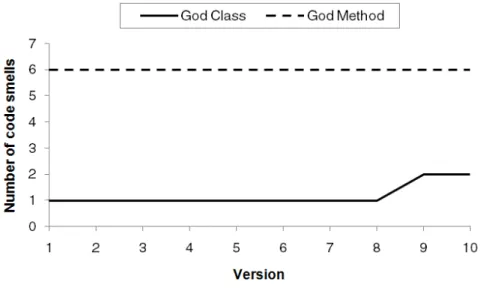
Health Watcher. Figure 3.2 shows that, despite having more lines of code than MobileMedia, Health Watcher does not present more instances of Feature Envy. Actually, it has no instance of this smell. The number of God Classes and God Methods remains constant, with the addition of only one instance of God Class in version 9. Analyzing the system code, we observed that the same God Classes and God Methods are present in all versions of the system. From one version to another, some methods were not changed, while others were changed mostly due to the addition of new functionality. However, no new smelly class or method was introduced. The only exception is the HealthWatcherFacade class that becomes smelly after version
9 with the addition of multiple new functionalities and, consequently, many lines of code.
Figure 3.2: Total number of code smells per system version of Health Watcher
3.4
Tracking Code Smells
evolution of each code smell in two steps. First, we selected the instances of the reference list. That is, classes or methods which at some point presented a code smell. We then tracked their states throughout the versions.
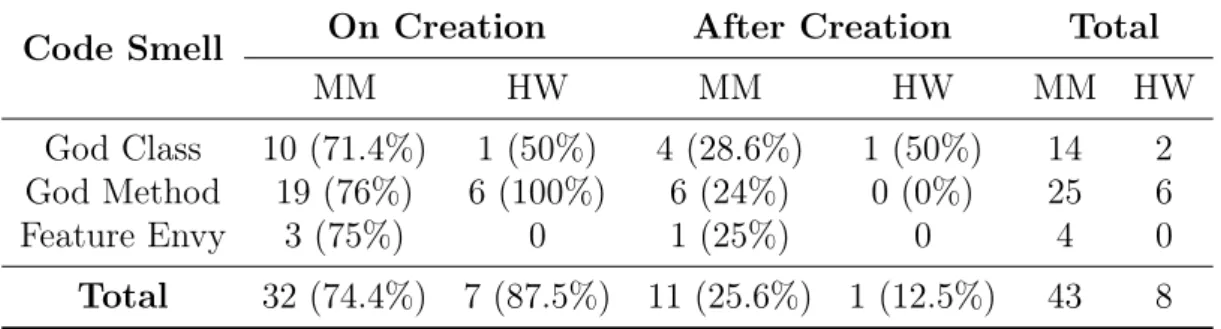
Overall Results. Table 3.3 summarizes quantitatively our findings of the evolution of code smells in MobileMedia (MM) and Health Watcher (HW). The columns grouped as On Creation indicate the number of classes or methods that were already introduced in the system as smelly. The columns grouped as After Creation indicate the number of classes or methods that became smelly in releases other than the one they were created. The columns Total indicate the total number of smelly classes and methods considering all versions of the respective system.
For all three analyzed smells in MobileMedia, 74.4% (32 of 43) of the smelly classes and methods were smelly from the beginning of their lifetime. Only about 25.6% (11 of 43) were initially non-smelly, but then became a smell in later versions. That is, only one fourth of the smells were introduced by changes in existing classes and methods, while the majority was created with a smell. Similarly, Table 3.3 also shows that there is no instance of Feature Envy in Health Watcher. In Health Watcher, for God Class and God Method, 7 out of 8 of the smelly classes and methods were smelly from the beginning of their lifetime. That is, only 1 out of 8 was initially non-smelly, becoming smelly later. Therefore, in Health Watcher almost all smells were introduced at the creation of the class or method. A more in-depth analysis of the evolution of each smelly class and method in MobileMedia and Health Watcher is discussed below using Figures 3.3 to 3.7.
Table 3.3: Number of code smells originated and created in classes and methods.
Code Smell On Creation After Creation Total
MM HW MM HW MM HW
God Class 10 (71.4%) 1 (50%) 4 (28.6%) 1 (50%) 14 2 God Method 19 (76%) 6 (100%) 6 (24%) 0 (0%) 25 6
Feature Envy 3 (75%) 0 1 (25%) 0 4 0
Total 32 (74.4%) 7 (87.5%) 11 (25.6%) 1 (12.5%) 43 8
In Figures 3.3 to 3.7, each smelly class or method is represented by a row and each system version by a column. Each row is labeled with the corresponding class or method name. Each rectangle represents the state of the class or method in the system version given by the column. There are two possible states: white and black. A white
3.4. Tracking Code Smells 31
code smell in that system version. The absence of a rectangle in a version means that the given class or method is not present in the respective version.
MobileMedia. Figure 3.3 shows that for 10 out of 14 God Class instances, the code smells originate with the class. That is, the class is already created as a class that centralizes functionalities of the system. This result is aligned with recent findings [Tufano et al., 2015]. For instance, theImageAccessorandAlbumControllerclasses
were created in versions 1 and 4, respectively, as God Classes and they remained as such for as long as they are present in the system. On the other hand, 4 out of 14 classes were created non-smelly and became a God Class at some point of their lifetime. For instance, thePhotoControllerclass is added in the second version of the system
and it only became smelly in version 4, because of the incorporation of new features, such as showing saved images and updating the image information.
Figure 3.3: Evolution of God Class in MobileMedia
Figure 3.4 shows that some methods are created as God Method (19 of 25) and others become God Method with the evolution of the system (6 of 25). In the first case, the methods are already introduced in the system with many functionalities. In the second case, methods are created with a single purpose, and as the system evolves, more functionality is added until the method becomes smelly. For instance, the method BaseController.handleCommand is introduced in the first version as