Samuel B. Linhart, M.S.;2 Rad Flores Crespo, B.S.;3 and G. Clay Mitchell, Ph.D4
Common vampire bats were mist-netted, topically treated with an anticoagulant paste (chlorophacinone), and released. They returned to their roosts, where they contaminated other vam- pires. Control by this method in caves and on ranches reduced local vampire bat populations by about 97 per cent.
Introduction
It is estimated that one million head of Latin America’s cattle die annually from rabies trans- mitted by vampire bats (Desmodus rotundus, Diaemus your@, and Diphylla ecaudata), whose range extends from northern Argentina to tropi- cal Mexico. Effective and economical methods are needed to reduce vampire bat populations in those areas where bat-borne rabies is a problem. In 1968, a cooperative program to develop such control methods was undertaken jointly by the Mexican Agriculture and Livestock Ministry’s National Institute of Livestock Research and the United States’ Bureau of Sports Fisheries and Wildlife, under a sponsoring agreement with the U.S. Agency for International Development. The program has concentrated on ways of controlling the common vampire bat (Desmodus rotundus),
the principal vector of the disease.
Vampire bats pose unusual control problems. The animals are nocturnal and highly mobile, and their roosts are frequently located in rugged, heavily vegetated terrain. Because they feed ex- clusively on the fresh blood of live vertebrates, conventional control techniques cannot be used; and they rarely concentrate at feeding sites in sufficiently large numbers to make trapping or ‘Also appearing in Spanish in Boletin de la Oficina Sanitaria Panamericana, Vol. LXXII, No. 2 (August,
1972).
2Wildlife Biologist, Denver Wildlife Research Center, Bureau of Sport Fisheries and Wildlife, U.S. Department of the Interior.
3Biologist, Instituto National de Investigaciones Pecuarias, Secretaria de Agricultura y Ganaderi’a, Mbxico, D.F., Mexico.
4Wildlife Biologist, Bureau of Sport Fisheries and Wildlife, U.S. Department of the Interior.
netting effective in large-scale control efforts. They normally roost in numerous scattered sites, most of which are hard to locate and contain relatively few bats (the common vampire’s cave- type sites usually contain between 10 and 200, while tree roosts generally have between 5 and 50). In addition, vampires may frequently move from site to site (1,2) and commonly share their roosts with beneficial bat species. Thus, selective control within the roosts is difficult even when these refuges are found.
However, certain behavioral characteristics of
Desmodus rotundus suggested a new approach to control. These characteristics are as follows:
(a) The bats groom themselves intensively; captive animals spend an average of two to three hours a day in this activity (3,4,5). In grooming, vampires characteristically scratch the body rapidly with a hind foot, inserting the foot into the mouth every S-10 seconds; they also clean their wing membranes and thumbs with the tongue (4,5).
(b) The bats use the same small niches within their roosts (usually a one to three foot crevice or concavity in the ceiling of a cave, mine, etc.) for extended periods of time. They roost very close together, and body contact is normal between vampires sharing the, same roosting site.
(c) Although other bat species may share the same roost, they use different niches. We have neither observed nor seen reported any instance of vampire bats sharing a niche with any other bat species.
32 ENGLISH EDITION-BOLETIN DE LA OSP . Vol. VI, No. 2, I972
sites by placing mist nets around tethered or corralled cattle.
These behavioral characteristics suggested that release of a few mist-netted vampires treated with a slow-acting toxicant could have a signifi- cant impact on the bat population. The topically applied toxicant would not prevent them from returning to their roosts, and would be trans- ferred by contact to other vampires using the same roosting sites. Individual and mutual grooming would then result in ingestion of the toxicant. This technique would not require capturing large numbers of vampires or finding their roosts, and would probably be safe for other bat species using the same refuges, To evaluate the potential of this technique, the labo- ratory and field tests described in the pages that follow were carried out.
Laboratory Tests
The toxicant chosen for evaluation was chlorophacinone (2-[(p-chlorophenyl)phen- ylacetyll-1,3-indandione),-a slow-acting anti- coagulant originally developed in France for con- trolling rats and mice. The chlorophacinone was suspended in 1 per cent gum tragacanth in saline solution and administered by gavage. The median lethal dose (LDse) was determined by the Thompson-Weil method (6, 7). The acute oral LDs ,-, for Desmodus was found to be 3.06 mg/kg (95 per cent confidence limits: 0.97-9.64 mg/kg). The highest dose administered (140 mg/kg) required 1.5 days to kill all bats; the lowest doses (3.7 and 2.5 mg/kg) required 9-16 days and several bats survived.
Observation of Grooming Behavior
Laboratory tests confirmed that material applied to one vampire would be transferred to other vampires with which it roosted. Twenty Desmodus were placed in a simulated roost in the
form of a plywood box measuring 25 in. x 26 in. x 36 in.; the box, lined with plastic sheeting to facilitate cleaning, was provided with a clear plas- tic door for observation. A circular hole in the top was covered with an inverted metal basin 13 inches in diameter and 6 inches deep, to provide a
concavity for roosting. Metal window screen was attached to the basin “roof’ so as to supply a surface from which the bats could hang. The bats were permitted to feed at will on defibrinated bovine blood, provided daily in plastic bird feed- ers attached to the side of the box.
A 25watt red light needed for television transmission was placed in the box; observations by closed-circuit television confirmed that grooming behavior within the colony was similar to that reported by Flores Crespo et al. (4) and Greenhall (5). One night the bats’ activities were recorded at half-hour intervals, from 7:30 p.m. to 12:30 a.m. At each interval during this period, from one-third to one-half of the 20 bats were observed grooming. Despite considerable unoc- cupied space in the inverted metal basin, grooming commonly took place with the bats very close together or touching each other, and body contact was frequent. Several instances were also noted of bats licking each other, and of one bat folding its wings about another. These observations indicated that any material adher- ing to the body of one colony member would promptly spread to the others, who would soon ingest it.
Selection of a Carrier
returned to the cage, and the colony was exam-
ined under ultraviolet light several times a day for
two days.
The flourescent marker in both the petroleum
jelly and the acetone-pigment mixture was trans-
ferred to all or nearly all of the 20 bats in the
colony within 24 hours. Fluorescence was most
noticeable on the forearms, legs, and feet. The
acetone-pigment mixture gradually powdered or
flaked from the back of the treated bat; this
promoted a very uniform distribution of mate-
rial, but also resulted in some losses; considerable
amounts of pigment were found on the floor of
the box. The petroleum jelly, which was not so
uniformly distributed but which adhered very
well to the fur, was therefore selected for use
with the toxicant.
Test with Chlorophacinone
Fifty milligrams of chlorophacinone were
dissolved in 1.5 ml of melted petroleum jelly, and
the solution was permitted to cool until it solid-
ified. A single bat was removed from the 20-bat
colony, and the chlorophacinone paste was
applied to its back between the scapular region
and the uropatagium. The clear plastic door of
the cage was covered with opaque paper to re-
duce external stimuli, and the treated bat was
reintroduced onto the floor of the box. The
colony was then checked daily for 31 days to
record mortality.
The results of this test are summarized in
Table 1. The treated bat was found dead the
TABLE l-Deaths
in captive colony of 20
vampires bats, following
treatmentof one bat
with 50
mgof chlorophacinone dissolved in 1.5
ml of petroleum jelly.
Days after treatment
Number of deaths
Cumulative percentage of dead bats 1 1 (treated bat) 5
2-4 0 5
5 4 25
6 1 30
7 5 55
8 1 60
9 4 80
10 0 80
11 1 85
12-13
0 8514
2 9534
ENGLISH EDITION-BOLETIN DE LA OSP .Vol. VI, No. 2, 2 972
Applying chlorophacinone paste to the back of a Desmodus r.
following morning, and 18 of the remaining 19
bats died in 5-14 days. Blood consumption by
the colony was reduced the first 2 days, but
thereafter stayed about normal for the number
of live bats remaining. Dead bats showed signs of
subcutaneous hemorrhaging, characteristic of
anticoagulant poisoning, on the extremities and
on the body where the patagium5 joins the
trunk. On the basis of these encouraging results,
field investigations were undertaken in Mexico to
test the technique on wild vampires netted at
cave entrances and around cattle corrals.
Field Work
Cave tests
Two caves in the State of Morelos were initial-
ly chosen as study sites. (Annual precipitation in
this area is 20-40 inches.) Cueva de.los Muiiecos,
one of those selected, is a small cave measuring
roughly 85 ft. x 40-50 ft. x 6-10 ft. It is located
on the side of a cliff at about 5,400 feet eleva-
‘Wing
membrane.tion, in a mixed agricultural and forested area
about one mile west of the village of Tepoztlan,
municipality of Tepoztlan. There are two en-
trances but one is inaccessible. The single
roosting site within the cave was estimated to
contain 50-60 common vampire bats; no other
bat species were present.
A six-meter, four-shelf mist net was placed in
front of the cave entrance at 8:35 p.m., about 1
hour after dark, on 18 March 1971. We initially
planned to net and treat vampires as they re-
turned to the roost after feeding, thus simulating
the type of situation anticipated on cattle
ranches. In this instance, however, the net was
erected too early in the night, and all bats cap-
tured were leaving the cave to forage. Since we
felt a minimum of disturbance was desirable, we
removed the net at 9:50 p.m., by which time 16
vampires had been captured. Six were released,
and the remaining ten were left in a cage inside
the entrance until 7:15 the following morning.
At
that time, six of the ten (the former com-
and 50 mg chlorophacinone, as previously de- scribed; all ten were then released back into the cave.
Eight days after treatment we found only 12-15 live vampires in the cave and noted a marked difference in their evasive behavior. Vampires normally attempt to hide by flying, hopping, or crawling to other parts of the cave when a light shines on them. However,all but one of the 12-15 vampires we saw were apparently unable to fly and made no attempt to flee from their original roosting site when a headlamp beam was shone on them for S-10 minutes. Their movements were slow, and they had difficulty climbing. A number ofvampire wings were found on the floor of the cave, but we were unable to identify the predator or scavenger that appar- ently ate dead or dying bats as they fell from the roost. Fourteen days after treatment, only one live vampire was found in the cave. The total wings and intact carcasses recovered from this cave represented at least 27 dead vampires; but since the upper portions of the cave were inacces- sible and rock rubble on the floor made recovery of wings difficult, it was impossible to determine the total number of bats killed.
Cueva de1 Salitre, the other cave selected, is located at about 5,300 feet elevation in the municipality of Emiliano Zapata, about eight miles south of Tezoyuca on the road to Zacate- pet, State of Morelos. It has a single entrance and is a long, very large, Y-shaped cave located be- neath the valley floor, and measuring roughly 870 ft. x 2540 ft. x 13-20 ft. Brush,small trees, and cultivated sugarcane are the dominant vege- tation in this locality. We originally estimated that about 60 common vampire bats were roosting in the cave, but subsequent mortality counts showed this estimate was too low. Sight- ings of bats and presence of fresh excrement beneath roosts indicated the vampires were using five distinct roosting sites within the cave. Up to a thousand or more bats of other species, in- cluding Natalus stramineous, Pteronotus parnellii, and Artibeus jamaicensis, were also roosting throughout the cave.
A 6-meter mist net was placed at the cave entrance at 11:OO p.m. on 19 March 1971. Thirteen vampires were captured by midnight,
nine of which were returning to the cave en- gorged with blood. Six of the engorged bats, or about 10 per cent of the vampires estimated using the cave, were each treated with the chloro- phacinone paste. All 13 bats were then banded and released into the cave.
Eight days after treatment, we found a num- ber of dead vampires on the floor or hanging from the roof and walls of the cave. Some were in or directly beneath the roost sites, and others were up to 56 feet away. We found three dying vampires unable to fly; two were hemorrhaging externally. An aborted fetus was found directly beneath one of the roost sites. Fourteen days after treatment we were able to find only one live and apparently normal vampire, although the size of the cave and the presence of numerous bats of other species made visual estimates difficult.
A total of 94 dead vampires was found in this cave. This is a minimum estimate of mortality, since a few dead bats could have been missed in the rock rubble covering the cave floor, and some may have died while foraging outside the cave. Forty-two of the dead vampires were later exam- ined in the laboratory, and all showed evidence of hemorrhaging on the body, forearms, or wing membranes. A thorough search of the cave failed to reveal dead bats of any other species, other than old skeletons or severely desiccated remains.
In this cave, application of the anticoagulant resulted in the death of at least 15 vampires for each vampire treated. This result, in a large cave with several vampire roosting sites, clearly demonstrated the soundness of our original con- cept. No bats of other species appeared to have been affected, suggesting that the technique is specific for vampires.
36 ENGLISH EDITION-BOLETIN DE LA OSP Vol. VI, No. 2, 1972 ’
P. psilotis, P. rubiginosa, Glossophaga soricina, and Macrotus waterhousii, were present. On 24 July 1971, 90 Desmodus were captured in one 6-meter mist net, treated with chlorophacinone paste, and released back into the cave. The cave was revisited eight days later on 1 August, and an estimated 2,000 dead vampires were recovered. The ratio of treated bats to total dead vampires recovered was therefore approximately 1:22. No dead bats other than Desmodus were found. Ranch tests
Bats attacking livestock at Ranch0 Don Tomas were treated on 15 March 1971. Ranch0 Don Tomas is a 2,500-acre, intensively managed ranch in the eastern foothills of the Sierra Madre Oriental. Situated at about 700 feet elevation,it is near the village of Micas in the municipality of Valles, State of San Luis Potosi. Part of the ranch is situated within a long, narrow, partially cleared valley about 9-13 x 0.6 miles in size, on either side of which are heavily forested hills 650-l ,300 feet high. A fenced pasture in the valley con- tained about 140 Zebu cows and calves that were subjected nightly to moderate vampire attack. This herd was selected for study. Mature cattle located a few kilometers down the valley were attacked very lightly, and a check of other stock in adjacent valleys revealed no fresh vampire bites. We were unable to find vampire roosts in the vicinity of the study area, although radio- telemetry showed that they were located on an adjacent hillside.
The second ranch, Ranch0 San Ricardo, was treated on 24 March 1971. This is a 250-acre dairy ranch in the northern part of the State of Oaxaca; it has less than 660 feet elevation, and is located near the village of Vicente in the munici-
pality of Acatlan de Perez Figueroa. About 60 adult crossbred cattle, subjected nightly to moderate vampire attack, were used for the study (calves were placed in illuminated stalls at night and were not attacked). We made no attempt to find local vampire roosts, since an earlier search by other investigators had been unsuccessful.
ing, two or three observers recorded the location and number of fresh vampire bites on each ani- + mal, and all animals were returned to pasture. . The same animals were corralled again in late ’ afternoon, and the corral was surrounded by about 100 linear meters of mist netting two meters high. All vampires caught during the night were caged, banded, treated with the chloro- .. phacinone p&e, and released at least 45 minutes before dawn. Release well before dawn is impor- tant, as we have observed that vampires released at sunrise or during daylight hours, in addition to being harassed by birds, seek the nearest dark refuge and probably do not return to their +. normal roosting site until dark.
Ranch0 Don Tomis was visited 15 days after ’ treatment and Ranch0 San Ricardo 13 days after treatment. The cattle were again corralled, bite counts were made, mist nets were erected, and all vampires caught were banded and released. 1’
There is evidence that vampires prefer to for- age during the darkest hours of the night when ’ there is no moonlight (I, 8). This factor was considered. At Ranch0 Don Tom&, there were 4 l/4 hours of complete darkness the night of treatment and 8 l/4 hours the night of post- treatment evaluation; at Ranch0 San Ricardo, it was completely dark all night long on both A nights. It would therefore seem unlikely that variations in vampire foraging behavior due to moonlight influenced our results.
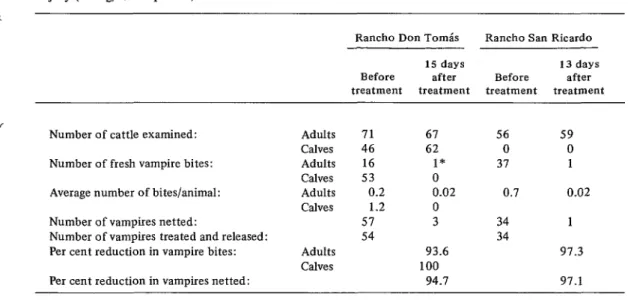
The results of these tests are summarized in Table 2. At both ranches, the number of bites recorded and the number of vampire bats netted rt had decreased by 95 per cent or more two weeks ! after treatment. At Ranch0 Don Tomas, a cow- boy reported finding one dead vampire and a second unable to fly at a corral about two-thirds of a mile from the treatment site. He said that blood was present on both bats, which suggested i hemorrhaging from exposure to the anticoagu- , lant. A letter from the owner of Ranch0 San Ricardo, about a month after the test there ended, stated that vampire attack had been re- duced on several neighboring ranches as well as his own, indicating that such control may extend ’ over a fairly wide area.
TABLE 2-Results of treating vampire bats netted at cattle corrals with chlorophacinone/petroleum jelly (50 mg/1.5 ml per bat).
Ranch0 Don Tomis Rancho San Ricardo
15 days 13 days
Before after Before after treatment treatment treatment treatment
Number of cattle examined: Adults Calves Number of fresh vampire bites: Adults Calves Average number of bites/animal: Adults Calves Number of vampires netted:
Number of vampires treated and released:
Per cent reduction in vampire bites: Adults Calves Per cent reduction in vampires netted:
71 46 16 53 0.2 1.2 51 54
61
62 1* 0 0.02 0 3 93.6 100
94.7
56 59
0 0
37 1
0.7 0.02
34 1
34
97.3 97.1 *One other animal had a wound, but it could not be definitely attributed to vampire attack.
3-indandione), has also been very effective in reducing vampire populations on ranches in Mexico and Brazil. This compound, used in the same manner and at the same concentration as the chlorophacinone, has resulted in 95 to 100 per cent reduction in vampire bat bite counts. Discussion and Recommendations
The concept of controlling vampire bats by mist-netting a few individuals, treating them with anticoagulant, and releasing them to contami- nate other vampires within their roost appears very promising, in view of these preliminary results. Our tests on two ranches resulted in reductions in vampire activity exceeding 95 per cent, following one night’s work by a crew of three men. The technique thus appears both more effective and far less time-consuming than conventional control by roost treatment or mist- netting alone. (Schmidt etal. (9), working at two ranches in Puebla and Oaxaca, Mexico, report that control at roosts and intermittent netting around cattle corrals over a six-month period reduced vampire bites by 70-80 per cent.)
Our tests indicate that chlorophacinone and diphenadione will control vampire bats; theoreti- cally at least, any relatively potent, slow-acting toxicant combined with a suitable carrier would
be effective. Anticoagulants appear ideal for this purpose, but considerations of economy, effec- tiveness, and safety should dictate the final choice. Whatever toxicant is selected, it should be thoroughly tested in the laboratory and under a variety of field conditions; sites tested should also include areas where vampires normally roost in trees. Ideally, such studies should be done on ranches where vampire attack is severe and roosting sites are known. Treatment and release of captured bats near cattle could then be corre- lated with subsequent mortality at roosts. The duration and extent of control should be investi- gated at regular intervals after treatment by bite counts and mist-netting, both at the treatment site and in surrounding areas.
38 ENGLISH EDITION-BOLETIN DE LA OSP . Vol. VI, No. 2, I972
Many toxicants, including anticoagulants, are potentially hazardous to predators and scaven- gers that eat poisoned animals. Our observations in Cueva de 10s Mufiecos showed that one or more species will eat dead or dying vampires. Therefore, attempts should be made to deter- mine the hazards, if any, of secondary poisoning.
Finally, we recommend that this technique not be used for bat control in the few local areas (such as parts of northern Argentina) where vam- pires roost in wells. Because contamination of well water could result in a hazard to human health, other control techniques, such as fumiga- tion of the wells, should be investigated.
Summary
The concept of controlling vampire bats by mist-netting a few individuals, applying a slow- acting toxicant to their backs, and releasing
them to contaminate other vampires within their roost was investigated in kdbOmtOry and
field tests with common vampire bats (Des- modus rotundus). In these tests, a mixture of about 1.5 ml of petroleum jelly and 50 mg of chlorophacinone (2-[(p-chlorophenyl) phenyl- acetyl]-1,3-indandionex an anticoagulant, was applied to each bat. In the laboratory, applying this mixture to 1 of 20 vampires in a captive colony killed 19 of the 20 bats in 14 days. Field tests in Mexico with bats captured, treated, and released at three caves resulted in the death of nearly all vampires in each colony. In two of the caves, at least 15-22 vampires were killed for each one treated; no mortality was observed among other bat species seen roosting in the caves. In tests at two ranches, mist nets were placed around corralled cattle for one night, and every vampire captured was treated and released. At both locations, both the number of vampires netted and the number of vampire bites on cattle had declined by more than 95 per cent two weeks after treatment.0 ACKNOWLEDGEMENTS
The Chempar Chemical Company, Inc., 260 Madison Avenue, New York, New York, 100 16, kindly provided the chlorophdcinone. Diphe- nadione was provided by the Velsicol Chemical
Corporation, 341 East Ohio Street, Chicago, Illinois, 60611. We thank Mr. Malcom Niven and Sr. Miguel Angel Perez, owners of Ranch0 Don Tom& and Ranch0 San Ricardo, respec- tively, who were extremely helpful during the
studies on their ranches. Gilbert Holguin, Luis Huerta, and Antonio Vargas provided labora-
tory and field assistance, and Ann Jones edited
the manuscript.
This research was supported by funds pro- vided to the U.S. Bureau of Sport Fisheries and Wildlife by the U.S. Agency for International Development under PASA RA(ID) l-67.
REFERENCES (1) Villa, R., B. Los murcXagos de MPxico. Institute
de Biologia, Universidad National Autonoma de Mexico (Mexico D. F., Mexico), 1966. (2) Wimsatt, W. A. “Transient Behavior, Nocturnal
Activity Patterns, and Feeding Efficiency of Vampire Bats (Desmodus rotundus) Under Natural Conditions.” JMammal50(2) :233-244, 1969.
(3) Flores Crespo, R., R. J. Burns, and S. B. Linhart. “Comportamiento de1 Vampiro (Desmodus rotundus) durante su alimentacibn en ganado bovino en cautiverio.” Tee Pecuar Mex 18:40-44, 1971.
(4) Flores Crespo, R., S. B. Linhart, and R. J. Burns. “Comportamiento de1 vampiro (Desmodus rotundus) en cautiverio.” The Southwest Natur, 19 72. (in press.)
(5) Greenhall, A. M. “Notes on Behavior of Captive Vampire Bats.” Mammalia 29(4) :44 I-451, 1965.
(6) Thompson, W. R. “Use of Moving Averages and Interpolation to Estimate Median-Effective Dose. I. Fundamental Formulas, Estimation of Error, and Relation to Other Methods.” Bact Rev II: 115145,1947.
(7) Weil, C. S. “Tables for Convenient Calculations of Median-Effective Dose (LD5o or EDso) and Instructions in Their Use.” Biometrics
8:249-252, 1952.
(8) Crespo, J. A., J. M. Vanella, B. D. Blood, and J. M. de Carlo. “Observaciones ecologicas de1 vam- piro (Desmodus rotundus rotundus) (Geoffroy) en el norte de Cordoba.” Revista Museo Argen- tino Ciencias Naturales “Bernardino Rivadavia” e Institute National de Investigation de las Ciencias Naturales. Ciencias Zoologicas 6(4):131-160,1961.
(9) Schmidt, U., A. M. Greenhall, and W. Lopez- Forment. “Vampire Bat Control in Mexico.”