Bull Pan Am Health Organ 13(2), 1979.
INTRAMUSCULAR INOCULATION OF CATTLE WlTH WARFARIN:
A NEW TECHNIQUE FOR CONTROL OF VAMPIRE BATS’
Ratil Flares Crespo,2 Salvador Said FernQndez,3 Donaciano De Anda L6pez,4 Froyb Ibarra Velarde,5 Rosa Maria Anaya D.G.6
Apfiroximately one-half million head of cattle are estimated to die annually in Latin America from rabies transmitted by uamfiire bats. This article describes the develosment and testing
of a new vamfiire bat control method that a@ears to offer
imfiortant advantages ove7 other available techniques.
Introduction
A number of Latin American countries have recently implemented new techniques for controlling blood-drinking vampire bats, the principal transmitters of paralytic rabies to cattle. Developed over the past decade, these techniques use anticoagulants to kill the bats.
One procedure involves capturing a small number of vampires and smearing their backs with some 1.5 cc of Vaseline containing a suspended anticoagulant- either chlorophacinone [Z-(p-phenylacetyl) phenylacetyl-l,S-indandione] or diphena-
*Also appearing in Spanish in the R&tin de la Oficina Sanitaria Punamericana, 1979. Partial results of this work were presented in an address at the First Symposium on Hematophagous Bats and Problems Associated with Paralytic Rabies held at Managua,
Nicaragua, on 28-30 June 1976; and a summary of this work was published in the abstracts of the Sym- posium on Advances in Rabies Research held at the Center for Disease Control in Atlanta, Georgia, on 7-9 September 1976.
2Biologist: Chief of the Vampire Bat Control Pro- gram. National Institute of Livestock Research (INIP), Mexico City, Mexico.
SVeterinarian, INIP Vampire Bat Control Program. Currently engaged in fellowship work at the Division of Advanced Studies of the National Polytechnic Insti- tute in Mexico City.
4Veterinarian; Researcher, INIP Vampire Bat Con- trol Program, Mexico City.
SVeterinarian, INIP Vampire Bat Control Program. Mexico City.
6Chemist: Researcher, INIP Vampire Bat Control Program, Mexico City.
dione (Z-diphenylacetyl-1,3-indandione).
The treated vampires are then released to return to their roosts, where other members of the colony groom them, a process involv- ing licking, and thereby ingest a fatal dose of anticoagulant (I).
Another procedure calls for applying chlorophacinone or warfarin [ %(a-aceto- nylbenzyl)4-hydroxycoumarin] suspended in Vaseline directly to the surface of the niches in the vampires’ roosts (2, 3). A third technique is to apply Vaseline containing warfarin to vampire bite marks on cattle @)-an approach based on the fact that the vampires generally return to reopen pre- viously inflicted wounds (4). Finally, a fourth technique consists of injecting diphenadione suspended in Carbapol 9517 into the rumens of vulnerable cattle (5).
While all of these techniques have proved effective, all of them also have drawbacks
that limit their applicability in the field. For instance, the first procedure described requires deployment of specialized person- nel and equipment. The second has the same requirement and also necessitates en- tering vampire roosts. The third does not demand speciaiized personnel and equip- ment but requires frequent cattle handling, a condition posing a serious constraint. And the fourth procedure, besides demanding
148
PAHO BULLETIN
lvol. 13, no. 2. 1979
Vampire bites on a cow’s neck
(photo: courtesy
of the authors).
enough
technical
and anatomical
knowl-
edge to inject
anticoagulant
into
bovine
rumens
is only effective
for the relatively
short time that adequate levels of anticoagu-
lant are circulating
in the blood; moreover,
because of the risk of intoxication
this pro-
cedure cannot be applied
to cattle under
1
year of age.
In view of these problems,
the vampire
bat control project at the Mexican
Ministry
of Agriculture
and Water
Resources’
Na-
tional Livestock
Institute
has carried
out a
series of studies for the purpose of develop-
ing a control method that would not be sub-
ject to such limitations.
The object of this
article
is to report
the results
of those
studies.
-0
0 0
The active principle
used in this investi-
gation was warfarin,
which
blocks the ac-
tion
of vitamin
K, inhibiting
the mecha-
nism of- coagulation,
and also weakens the
vascular endothelia,
especially
of the capil-
laries, thereby inducing
internal
bleeding.
Since the common vampire
bat (Desmodus
rot~ndus),
like most rodents, has a very low
a very rapid
basal metabolism
relative
to
the body weights and basal metabolisms
of
cattle, it was felt that a small dose of warfa-
rin injected
into cattle and circulating
in
their
blood could
prove sufficient
to kill
feeding vampires
without
endangering
the
cattle’s
health.
The
intramuscularly
in-
jectable
compound
employed
in the studies
was prepared
in an aqueous solution
at a
concentration
of 100 mg/ml
and called
“Vampirinip
I II .” 8
The immediate
goals of the work
de-
scribed were as follows:
(1) to determine
the
vampiricidal
potency
of warfarin
injected
intramuscularly
into cattle under laborato-
ry conditions;
(2) to study the pharmacolo-
gic and toxicologic
effects of the injected
material
on cattle of various
breeds, ages,
and stages of physiologic
development:
and
(3) to evaluate the efficacy
of the proposed
vampire
control
method under field condi-
tions.
Flares Crespo et al.
lINOCULATION
OF CATTLE WITH WARFARIN
149
Potency of Vampirinip
III under
Laboratory
Conditions
For the initial
laboratory
tests the follow-
ing procedure
was adopted:
A corral
was
built indoors.
This corral,
2.5 meters high
and 6 meters on a side, was made vampire-
tight with iron bars and wire netting
and
was divided
into
two equal
but separate
vampire-tight
compartments
designated
A
and B. An artificial
vampire roost with opti-
mum temperature
(24OC) and relative
hu-
midity
(above 50 per cent) was installed
in
the upper part of each compartment.
These
conditions
were maintained
in each roost by
keeping water dripping
there and by install-
ing
thermostatically
regulated
electric
heaters.
A colony
of vampire
bats (Desmodus
rotundus)
was then placed in compartment
A. Each bat was identified
by a numbered
metal tag attached to the leading edge of one
wing.
The door of roost A was opened at
dusk to allow the colony of vampires to feed
on two cattle that were herded into compart-
ment A each afternoon
and kept there over-
night.
Once the vampires
adapted
to these
conditions
and returned
regularly
to the
Treated
cattle in vampire-proof
corral
(photo:
courtesy of the authors).
artificial
roost of their own volition
after
feeding,
the laboratory
tests were begun.
0 0 0
Three
experiments
were carried
out to
test the effects of the warfarin
in Vampiri-
nip III at different
strengths.
Twenty
vampires
were used in the first
test. On the first morning
of this test Vampi-
rinip III was injected
intramuscularly
into
two adult cattle at a concentration
of 2 mg
warfarin
per kg of body
weight.
These
cattle were then led into compartment
B,
and four of the 20 vampires
were placed in
the compartment
B roost. At dusk, 8 hours
after the cattle were treated,
the gate of the
roost was opened and the four
bats were
allowed
to feed on the treated cattle. The
next morning
these vampires were returned
to the compartment
A roost, and another
group
of four vampires
was placed in the
compartment
B roost. This procedure
was
repeated
daily
until
five groups
of four
vampires (20 bats in all) had been exposed.
In this manner
the bats in each lot were
exposed to the treated compartment
B cat-
tle only one night,
before and after which
they fed on the untreated
cattle in compart-
ment A.
The second experiment
followed
the same
pattern,
except that 4 mg/kg
were injected,
16 vampire bats were used instead of 20, and
the test ran 4 instead of 5 days. The third
experiment,
like the first,
ran 5 days; 6
mg/kg
were injected;
and 20 bats were em-
ployed.
150 PAHO BULLETIN l vol. 13. no. 2. 1979
Table 1. Mortality in three colonies of captive vampire bats exposed to cattle treated with Vampirinip III.
Mortality (%) am&g groups of 4 bats exposed Dose of active principle to treated cattle on each of the first 5 received by each injected nights following treatment
bovine, ;zgk5 of body
Night Night Night Night Night
1 2 3 4 5
2mg 100 50 50 50 25
4mg 100 100 75 50 -
6% 100 100 100 100 50
night, and 50 per cent the fourth night. Finally, at a strength of 6 mg/kg, mortality was 100 per cent on the first four nights, declining only on the fifth night to 50 per cent.
Autopsies performed on the dead vam- pires revealed typical symptoms of anticoa- gulant poisoning. External examination showed hemorrhaging along the base of the toenails, in the soft parts of the thumbs, in the nostrils, and in the genital orifices, as well as severe hematomas on the arms and wing membranes and around the interfemo- ral membrane. Internally there was consid- erable congestion of the meninges, spinal bulb, and cerebral cortex, with hemor- rhages and hematomas appearing in various bodily tissues and organs; a pale liver and uncoagulated blood in the ventricles of the heart were observed in all cases.
Effects of Vampirinip III on Cattle
A number of experiments were designed in order to evaluate the pharmacologic and toxicologic effects of Vampirinip III on cattle, giving particular attention to he- matic and physiological indicators-espe- cially prothrombin times; to the safety margins involved; and to the process of anticoagulant elimination.
1. Hematic Testing
ofTreated Cattle
The aim of this test was to determine pos- sible changes in the hematology of animals
treated with Vampirinip III. The animals tested were eight Indobrasil calves of simi- lar weight that were approximately eight months old. The group was divided ran- domly into two lots. An intramuscular in- jection of Vampirinip III (a dose contain- ing 6 mg warfarin per kg of body weight) was administered to the cows in lot 1. Lot 2 served as a control group. Blood was taken daily from the jugular veins of the calves in both lots for 10 days-the five days pre- ceding and following treatment of lot 1. Physiological indicators (rectal tempera- ture, heart rate, and respiration rate) were measured daily. The blood samples ob- tained were subjected to hematic biometry, and determinations were made of hemato- crits, prothrombin times, and whole blood coagulation times.
The results indicated that the treated calves’ rectal temperatures, heart rates, and respiration rates remained within normal limits throughout the experiment, being virtually identical to those of the control group.
Flores Crespo et al.
l INOCULATION OF CATTLE WITH WARFARIN 151Regarding prothrombin times, a lag was observed in the treated groups 24 hours (1 day) after the administration of Vampiri- nip III. The maximum lag-indicating an 84 per cent decline in prothrombim activi- ty-was found at 72 hours (3 days), after which the lag gradually diminished, pro- thrombin times again reaching normal levels after 168 hours (7 days). No change in prothrombin times was observed among cat- tle in the control group.
A similar pattern was observed with res- pect to whole blood coagulation times, the maximum lags occurring at 3 days, with a return to normal levels at 7 days.
2. Vamfiirinip
III
inMilk from Treated
Cows: Effect on Calf Prothrombin Times
This test sought to determine whether dairy cows injected with Vampirinip III would eliminate sufficient warfarin in their milk to alter the prothrombin times of calves drinking that milk. The following procedure was used: Two lots of cattle were selected, one consisting of 10 lactating Holstein cows weighing between 250 and
350 kg, the other composed of 10 Holstein calves approximately 15 days old. All the milk obtained from the cows was used to feed the calves, and all the milk from a particular cow was given daily in a pail to the same calf for the whole duration of the experiment. Blood was taken daily from the jugular veins of all cows and calves in order to measure prothrombin times. On the fifth day of the test, after the taking of blood samples, Vampirinip III (5 mg war- farin per kg of body weight) was injected into each of the 10 adult cows. The taking of daily blood samples continued, and pro- thrombin times were measured using the Sera Tek (Ames Laboratories) reaction chambers technique.
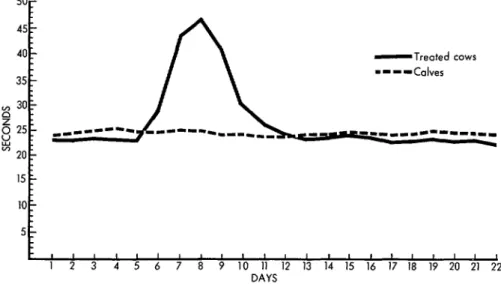
Figure 1 shows the average prothrombin times of both cows and calves over the course of the 22-day experiment. The cows’ average prothrombin times were 23.3 rt 2.1 seconds before treatment, 29.1 seconds the day following treatment, and 46.3 seconds the third day following treatment. After reaching this latter peak the average prothrombin time declined, returning to its initial value on the seventh day follow-
Figure 1. Prothmmbin times of cows treated with Vampirinip III (5 mg warfarin per kg body weight) and of calves fed on their milk. 50-
-Treated cows ----C&e5
I I I , I I I , 0 I I I I t I I1 I I I I , I 2 3 4 5 6 7 8 9 10 11 12 13 14 15 16 17 18 19 20 21 22
152 PAHO BULLETIN l
vol. 13, no. 2, 1979
ing treatment. The maximum value re- corded (46.3 seconds) represented a 61.3 per cent reduction in prothrombin activity. For the calves being fed on these cows’ milk, the average prothrombin time before the cows were treated was 24.8 ZIZ 3.1 seconds. As indicated in Figure 1, treat- ment of the cows produced no significant change in this value.
3. Vampirinip III Administered to Preg-
nant Cows and Calves: kffect on
Prothrombin Times
To provide a basis for deciding which cattle should or should not be treated, an experiment designed to assess changes in physiological inclicators and prothrombin times of treated calves and pregnant cows was carried out. As in the forementioned test, prothrombin times were determined using the Sera Tek reaction chambers tech- nique.
Four lots of cattle were selected. Lot 1 consisted of four cows in the last third of gestation; lot 2 consisted of four cows in the first third of gestation; lot 3 consisted of four cows approximately 1 year old that had never been inseminated; and lot 4 con- sisted of calves approximately 40 days old. A sample of blood was taken daily
from the jugular vein of each animal for determination of prothrombin times. On the fifth day, after taking blood, Vampi- rinip III (containing a dose of 5 mg warfa- rin per kg body weight) was injected into all the animals. The taking of daily blood samples continued; rectal temperatures, heart rates, and respiration rates were re- corded daily throughout the experiment.
The physiological indicators showed no significant changes, either in the five days before treatment or on subsequent days, remaining at virtually the same levels throughout the test. The average respective values for lots 1, 2, 3, and 4 were as follows:
70-
60 -
50 -
iii 40- 5 - M 30- v)
20 -
10 -
Figure 2. Prothrombin times of pregnant cows, yearling heifers, and 40-day-old calves injected with Vampirinip III (5 mg warfarin per kg body weight).
-///Al Lot 1: Cows in 3/3 of gestation 1~0mm~~m~mu~m Lot 2: Cows in l/3 of gestation - Lot 3: Yearling heifers - = = = Lot 4: 40-day-old calves
O I I , I 1 I I I 1 1 I 1 I , ‘ I
Flores Cremo et al.
l INOCULATION OF CATTLE WITH WARFARIN 153temperatures-38.7“C, 38.5%, 38.6OC, and 39.2%; heart rates--Z, 71, 69, and 123; and respiration rates-33, 31, 36, and 43. These values are within the normal limits reported by Dukes (9). With regard to indi- vidual cattle, none of the values recorded exceeded normal limits.
level indicated by Goodman and Gilman (10) as adequate in anticoagulant therapy.
4. Physiological
Indicators inCattle
Treated witfi
Vampirinip IIIRegarding prothrombin times, the aver- age values obtained for each lot of cattle are shown in Figure 2. As may be observed, these values remained constant for all the lots during the five days preceding treat- ment. Subsequently, beginning on the sixth day (i.e., 24 hours after treatment), each lot showed a delay in prothrombin time that reached a maximum value on the third day after treatment. This was followed by a gradual decline, initial levels being reached on the ninth or tenth days after treatment (days 14 or 15 on the chart). As indicated, the smallest prothrombin time changes were experienced by the pregnant cows in lots 1 and 2, the observed changes being similar for both lots, Prothrombin times for lot 3 (l-year-old heifers) yielded a curve whose values were within acceptable limits for anticoagulant therapy. Lot 4 (40-day-old calves) showed marked prothrombin time lags, probably because young calves nor- mally have a physiological vitamin K deficiency resulting from scanty or slight development of intestinal and ruminal flora at this age. However, the level of prothrom- bin activity only declined to 75 per cent below normal, which is still higher than the
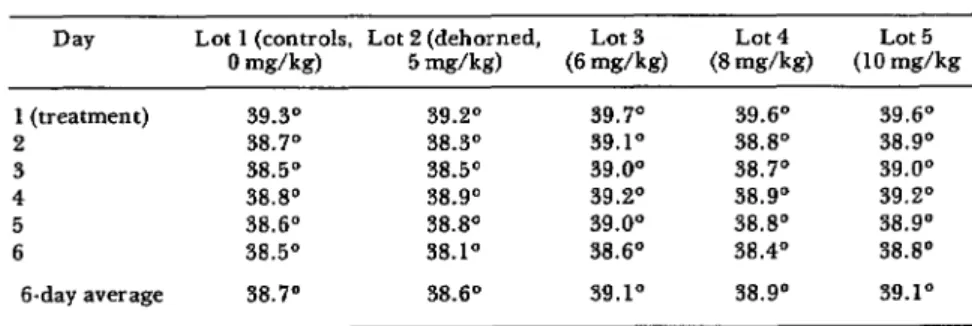
Another experiment sought to assess changes in physiological indicators (rectal temperature, heart rate, and respiration rate) among adult cattle injected with pro- gressively larger doses of Vampirinip III. For this purpose 30 male animals ranging from 1 to 3 years old and weighing any- where from 100 to 400 kg were selected. (The group included Brahman, Hereford, Indobrasil, Brown Swiss, and Zebu x Brown Swiss crosses.) The animals were divided at random into six lots of five. Lot 1 served as a control group. The lot 2 animals received a dose (5 mg warfarin per kg) shown to be appropriate by previous studies; then, 24 hours later, their horns were removed to see whether trauma of this kind would cause hemorrhage problems. The cattle in lots 3, 4, and 5 received 6, 8, and 10 mg of warfa- rin per kg, respectively. All the cattle were brought in twice daily, in the morning and afternoon, for the purpose of determining their temperatures, heart rates, and respira- tion rates.
The results of this test-with regard to average daily values and overall averages for each lot-are shown in Tables 2, 3, and 4. As may be seen, the values obtained for lot 1 were similar to those obtained for the
Table 2. Average daily rectal temperature (“0 of 5 groups of cattle, following treatment with Vampirinip III.
Day
Lot 1 (controls, Lot 2 (dehorned, Lot 3 Lot 4 Lot 5 0 m&d 5 mdkd (6 mg/kg) (8 mg/kg) (10 mg/kg1 (treatment) 39.30 39.20 39.70 39.6.’ 39.6”
2 38.70 38.30 39.10 38.8’= 38.9’
3 38.50 38.5O 39.00 38.70 39.0”
4 38.80 38.9O 39.20 38.9” 39.20
5 38.6” 38.8O 39.00 38.8’ 38.90
6 38.50 38.10 38.6’ 38.4” 38.8’
154 PAHO BULLETIN l vol. 13, no. 2, I979
Table 3. Average respiration rates among 5 groups of cattle, following treatment with Vampirinip III.
Lot 1 (controls, Lot 2 (dehorned, Lot 3 Lot 4 Lot 5 0 mdk) 5 w/kg) (f-7 wkd (8 w/kg) (10 m&x)
1 (treatment) 44.4 40.0 51.9 48.8 48.3
2 39.2 41.6 47.6 46.6 41.6
3 38.8 40.6 45.3 45.3 45.3
4 37.2 36.8 40.3 39.3 40.0
5 34.0 33.9 35.6 36.3 36.0
6 38.0 29.6 36.3 32.9 34.3
6-day average 38.6 37.1 42.8 41.5 40.9
Table 4. Average heart rates among 5 groups of cattle, following treatment with Vampirinip III.
Day Lot 1 (controls, Lot 2 (dehorned, Lot 3 Lot 4 Lot 5 0 mdk) 5 w/kg) (6 mdkd (8 mdkg) (10 mdkg)
1 (treatment) 111.9 100.3 113.9 118.0
2 96.4 101.3 112.0 98.0
3 85.6 91.6 99.6 93.3
4 79.6 86.0 85.6 88.3
5 73.6 75.9 77.6 81.6
6 69.2 72.4 81.3 75.9
6-day average 86.1 87.9 95.0 92.5
120.1 100.6 100.3 84.8 79.9 79.9 94.3
other lots. Specifically, no significant dif- ference was observed between the indicator values obtained for lot 1 (the control group), lot 2 (the dehorned animals), or lot 5 (animals receiving twice the recommended dose). Heart and respiration rates tended to be somewhat high, even in the control group, especially in the first days of the ex- periment. This was probably because the test animals in the experiment had just been brought in from pasture and werenot accus- tomed to handling. However, in all cases the values shown in the tables are within the normal limits cited by Duke (9).
5. Warfarin Levels in Milk and Tissues
of Treated Cattle
Another experiment employed radioac- tive warfarin (containing carbon 14) in order to quantitatively assess the possible
risk to people consuming meat or milk from Vampirinip-treated cattle.
Flares Crespo et al.
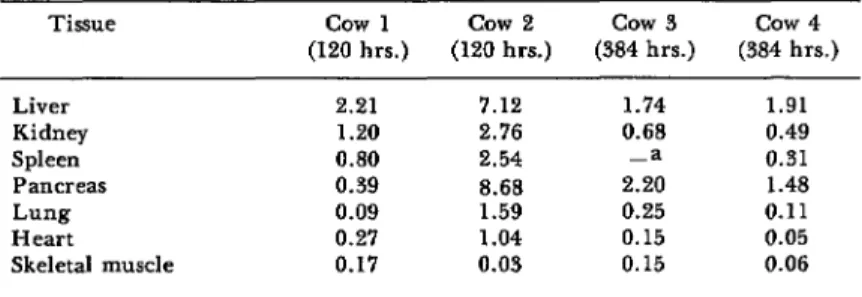
l INOCULATION OF CATTLE WITH WARFARIN 15.5The results showed that the radioactive material was primarily excreted in urine and feces: In the two cows slaughtered at 120 hours after treatment, excretion in urine was 68.0 and 60.5 per cent andin feces 18.3 and 10.8 per cent. In the two cows slaughtered at 384 hours, excretion in urine was 63.5 and 67.0 per cent and in feces 18.3 and 17.8 per cent. Only 0.1 per cent of the radioactive material injected was eliminated in milk. We assume, moreover, that this 0.1 per cent did not emerge in the form of war- farin but as two more polar compounds-as indicated by low paper chromatography values (obtained in tests using Whatman No. 1 paper) measured against a warfarin standard. Even if the warfarin had re- mained unchanged, however, the highest levels found in the milk of cows 1, 2, 3, and 4, respectively (see Table 5) would have been 0.15, 0.05, 0.098, and 0.125 parts of warfarin, by weight, per million parts of milk.
The radioactivity of each tissue exam- ined, in terms of parts of warfarin, by weight, per million parts of sample, assum- ing no metabolic breakdown, is shown in Table 5. As may be seen, the levels of radio- activity varied considerably-presumably because the cows were sacrificed at different times and also because the injected solu- tion’s variable pH -which was not con- trolled in this study-permitted variable absorption. In the case of the second cow,
the time required to eliminate half the absorbed material was very long. This is reflected in the levels of radioactivity found in the tissues-levels far higher than those observed in the first cow’s tissues even though both animals were slaughtered at 120 hours. Smaller differences were ob- served in the radioactivity levels of tissues from cows 3 and 4 sacrificed at 384 hours. These radioactivity levels were also lower than those found in the tissues of cows 1 and 2, because cows 3 and 4 were able to elimi- nate the drug for a much longer time. As Table 5 indicates, values cited are overall radioactivity levels, the minimal levels found making it impractical to try and dis- tinguish between warfarin and its metabolic by-products. One of the highest radioactivi- ty levels found, 7.12 ppm, was detected in the liver of cow 2. In contrast, the highest level detected in milk was 0.15 ppm in cow 1.
Field Tests
The encouraging results of the foregoing tests prompted a decision to evaluate the proposed bat control method under field conditions. The following ranches were selected for this purpose: “San Carlos” and “San Pedro,” both in the common border area of Tixkocob and Tixpeual, two town- ships in the state of Yucatan; “Kanto” in the Yucatan township of Valladolid; and
Table 5. Radioactivity (expressed as parts per million of warfarin, assuming no metabolic breakdown) observed in tissues of cattle
treated with warfarin containing carbon 14.
Tissue cow 1 cow 2 cow 3 cow 4
(120 hrs.) (120 hrs.) (384 hrs.) (384 hrs.)
Liver 2.21 7.12 1.74 1.91
Kidney 1.20 2.76 0.68 0.49
Spleen 0.80 2.54 -a 0.31
Pancreas 0.39 8.68 2.20 1.48
Lung 0.09 1.59 0.25 0.11
Heart 0.27 1.04 0.15 0.05
Skeletal muscle 0.17 0.03 0.15 0.06
156 PAHO BULLETIN l
vol. 13. no. 2, 1979
“Ojo de Agua” of Huichihuayan, a township in the state of San Luis Potosi. For many years the cattle at all four ranches had been subjected to high rates of vampire bat attack.
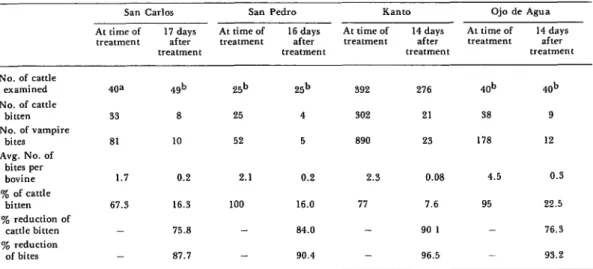
The same procedure was followed at each ranch. Early in the morning the cattle were examined, and a record was made of each animal’s weight, breed, and number of visible bites inflicted by vampire bats. At San Carlos 49 Brahman cattle were rounded up, but 9 escaped from the chute and could not be examined. Of the 40 examined, 7 appeared free of vampire wounds while the remaining 33 exhibited evidence of 81 recent bites. At San Pedro 25 Holstein cat- tle were examined. All had been bitten by vampires, there being evidence of 52 recent bites. At Kanto, where there were about 500 head of Zebu-crossed native cattle, only 392 could be delivered to the chute for exami- nation. All but 90 of these showed evidence of recent bites, the total bite count being 890. At Ojo de Agua 40 Swiss and Zebu- crossed Swiss cattle were examined. Only two were found free of bite marks, 178 recent bites being counted on the other 38.
The treatment applied at all the ranches
was to inject Vampirinip III (5 mg/kg) into each animal showing evidence of recent vampire bites. This was done at the time the bites were counted. The weights of the treated animals varied widely-from 80-100 kg for the smallest to over 400 kg for the largest. In all cases the examined and treated cattle were marked in order to avoid errors during subsequent reexami- nation,
Somewhere between 14 and 17 days after treatment, a second visit was made to each ranch and the vampire bite marks were re- counted. In all cases the evaluation was made the day after a night with several dark and moonless hours-a condition known to favor vampire bat attacks (II,
12).
Sun Carlos
The data collected 17 days after treat- ment at San Carlos are shown in Table 6. It was found that only eight cattle showed evidence of recent bites, a reduction of 75.5 ner cent. It is also important to recall
Table 6. Results of treating cattle at four ranches with Vampirinip III.
San Carlos San Pedro Kant.3 Ojo de Agua At time of 17 days At time of 16 days At time of 14 days At time of 14 days treatment after treatment after treatment after treatment after
treatment treatment treatment treatment
No. of cattle examined No. of cattle
bitten No. of vampire
bites Avg. No. of
bites per
bovine
70 of cattle bitten y. reduction of
cattle bitten y. reduction
of bites
40= 49b 25b 25b 392 276 40b 4ob
33 8 25 4 302 21 38 9
81 10 52 5 890 23 178 12
1.7 0.2 2.1 0.2 2.3 0.08 4.5 0.3
67.3 16.3 100 16.0 77 7.6 95 22.5
- 75.8 - 84.0 - 90 1 - 76.3
- 87.7 - 90.4 - 96.5 - 93.2
=There were 49 cattle in the San Carlos herd, but 9 escaped from the chute at the time of the first visit and could not be examined or treated.
F/ores Crespo et al.
l INOCULATION OF CATTLE WITH WAFZFARIN 157that nine animals had previously escaped from the chute at San Carlos, making it impossible to treat them or to determine whether or not they had been bitten.
The total number of recent vampire bites counted at the second evaluation was 10,
compared with the 81 counted before treat- ment-indicating an 87.5 per cent reduc- tion. The average number of bites per ani- mal, originally 1.7, was thus reduced to
0.2.
San Pedro
The reexamination (see Table 6) was carried out 16 days after treatment. Only four recently bitten animals and five bites were observed, indicating respective reduc- tions of 84.0 and 90.4 per cent. The aver- age number of bites per animal fell from 2.1 to 0.2.
Kanto
Reexamination data for Kanto, shown in Table 6, were collected 14 days after treat- ment. Out of 276 cattle reexamined, recent bites were observed on 21, the total number of recent bites observed being 23. Hence the apparent number of cattle attacked dropped 90.2 per cent, and the apparent incidence of recent bites fell 96.4 per cent. The average number of bites per animal examined was 2.3 before treatment and 0.08 after treatment.
Ojo de Agua
On this ranch reexamination data (Table 6) were collected 14 days after treatment. A total of 12 recent bites were found on nine cattle, indicating respective reductions of 93.2 and 76.3 per cent. The average num- ber of bites per animal dropped from 4.5 to
0.3.
Discussion ‘and Conclusions
If we assume that the most practical tech- nique for controlling a pest is apt to be one allowing large numbers of people to par- ticipate without special training, then it follows that systemic treatment of cattle is the most suitable method for controlling vampire bats. This method, which can be applied by the rancher himself, makes it unnecessary to train personnel in bat iden- tification and handling, to engage in the risky work of entering bat roosts, or to em- ploy special equipment such as mist nets, traps, gloves, lanterns, and so forth. More- over, the vampires’ special feeding habits ensure that the method can selectively and effectively control vampire bats without inflicting any harm whatever on beneficial non-vampire bat populations.
The results obtained from our studies in- dicate that warfarin, when used under con- trolled laboratory conditions, can produce 100 per cent mortality in vampires exposed one night to treated cattle for four consecu- tive nights after treatment. In this field, treatment was found to reduce the number of cattle bitten by 75.8 per cent at San Car-
los, 76.3
per cent at Ojo de Agua, 84.0 per cent at San Pedro, and 90.1 per cent at Kanto when the animals were reexamined 14 to 17 days after treatment. It should be recalled, however, that these tests were con- ducted at small ranches with precise terri- torial boundaries that were obviously not respected by vampire bats. In fact, studies of banded vampires by Villa (13) and Forment, Schmidt, and Greenhall (14) have revealed a considerable change in individual roost populations, even when the size of the vampire colony in the roost studied remained stable. Wimsatt (15), in an earlier work, concluded that vampires in a colony represent part of a large mobile vampire bat community.158 - PAHO BULLETIN . vol.
13,
no.2. 1979
Vampirinip III. Nevertheless, the available information on the bats’ mobility suggests it would be advisable to treat cattle within the context of a well-established program that operates in clearly-defined zones that take account of natural barriers and the vampires’ established areas of activity, so as to obtain the optimum degree of control.
Regarding the pharmacologic and toxi- cologic tests, results of the first experiment indicated clearly that leukocyte, erythro- cyte, and hemoglobin values were similar for the treated and control cattle, and were within the normal ranges defined by Ben- jamin (6), Miller (7), and Albritton (8).
The physiological indicators (rectal tem- perature, heart rate, and respiration rate) that were measured in experiment 1, ex- periment 3 (in pregnant cows and calves), and experiment 4 (using progressively larger doses of anticoagulant) consistently remained the normal ranges cited by Dukes
(9).
Lags in prothrombin times (evaluated in experiments 1, 2, and 3) were invariably ob- served 24 hours after the cattle had been treated. These lags reached a maximum some 72 hours after treatment and then gradually declined, with prothrombin times returning to normal between 7 and 10 days after treatment. These results may be ex- plained by the fact that the warfarin in Vampirinip III acts on the liver, competing with vitamin K in the formation of pro- thrombin and producing hypothrombine- mia that delays the coagulation process.
In this regard, Goodman and Gilman (IO) have reported that therapeutic doses of warfarin in humans cause a 75 to 85 per cent reduction in prothrombin activity, and that this reduced level of activity can be maintained for over a year by continued drug treatment without ill effect. Also, McGirr and Papworth (16) report that a yearling heifer fed warfarin in doses of 50 mg/kg for 10 days showed no symptoms except reduced coagulation time. In exper- iment 2, where calves were given milk from
treated cows, average prothrombin times remained at their initial levels, indicating that the active principle in Vampirinip III was either not eliminated in milk suffi- ciently to produce changes in the calves’ coagulation times, or else it reached the milk in an inactive form.
Experiment 3, which evaluated changes in the prothrombin times of calves and pregnant cows, showed that of the animals tested only the 40-day-old calves showed any really marked prothrombin time de- lays. As previously noted, this can be at- tributed to the fact that cattle at this age normally have a vitamin K deficiency; however, even in such animals the reduced level of prothrombin activity was found to be within a range regarded as adequate for humans receiving anticoagulant therapy. Accordingly, it may be concluded that treat- ment with Vampirinip III can be recom- mended for cattle at any stage of physiologi- cal development. Where problems may arise, and even this remains to be deter- mined, is in treatment of cows going through the last days of pregnancy, just before calving, when the period of maxi- mum prothrombin time reduction could coincide with delivery. Though it is of course true that under field conditions no rancher treats cows at this time, it should also be pointed out that in experiment 4 the cattle in one group receiving the usual dose of warfarin (5 mg/kg) were dehorned 24 hours after treatment. These cattle experi- enced no hemorrhage problems, despite the fact that no countermeasures were taken at the time.
Fiores Crespo et al.
l INOCULATION OF CATTLE WITH WARFARIN159
level does not create any problem for human consumers, since one would have to eat 3.5 kg of this liver in order to ingest a minimum therapeutic dose (25 mg)-thera- peutic treatment generally entailing an ini- tial dose of 25-75 mg followed by mainte- nance doses of 5-10 mg per day. It should also be recalled that these levels of anticoa- gulant were detected in animals sacrificed 120 hours after treatment, because in prac- tice no rancher would be likely to treat an animal scheduled for slaughter 5 days hence. The highest level of warfarin found in milk (discounting strong evidence of metabolic breakdown) was 0.15 ppm-indi- eating that people could not ingest a minimum therapeutic dose even by drink- ing many times the entire amount of milk produced at this milking.
In sum, these experiments strongly sug- gest that the treatment described poses no danger to human health. Despite this fact, however, we believe it important that further studies designed to provide complete assurance of safety be carried out.
In concluding, we also wish to note some of the special advantages of the method we have described. For one thing, all previous vampiricides were insoluble and so could not be administered parenterally. The only systemic method available was the one devel- oped by Thompson (5), in which diphena- dione was suspended in carbapol, an agglu- tinin, at 0.05 per cent and was injected into the rumens of the cattle. Since the active principal in Vampirinip III will dissolve in solvents innocuous to cattle, it can therefore be administered by routine intramuscular injection -a feature offering considerable practical and economic benefits.
It should be added that warfarin injected intramuscularly, as in this study, has been found to have longer-lasting vampiricidal effects than diphenadiones injected into the rumen. Under practical field conditions the longer period of effectiveness is a great advantage; for it assures that virtually all
local vampires will feed at least once during this period, and overcomes the problem posed by occasional rainy or moonlit nights that discourage bat attacks.
Regarding possible toxic effects of diphe- nadione on cattle and humans, Thompson et al. (5) and Bullard et al. (17) both reported injection of vampiricidal amounts into cattle rumens posed no problems of this kind. It is well to emphasize, however, that these conclusions were based on residue levels found in samples of various cattle tissues examined 30, 60, and 90 days after treatment, and on biological tests employ- ing rats fed on those samples.
Additional information was reported by the Nicaraguan delegation to the First Sym- posium on Hematophagous Bats and Prob- lems Associated with Paralytic Rabies held at Managua, Nicaragua, on 28-30 June 1976. The delegation reported that prob- lems had been encountered with intoxica- tion of young cattle given intrarumenal in- jections of diphenadione, and that nine of these animals had died. As a result of this experience, the Nicaraguans stated that they neither practiced nor recommended this treatment for cattle under 1 year of age.
160
PAHO BULLETIN lvol. 13, no. 2. 1979
This article describes development and testing of a new method for control of vampire bats. The method involves intramuscular injection of cattle subject to vampire attacks with a warfarin- containing preparation named “Vampirinip III.”
Laboratory tests of this procedure showed 100 per cent mortality among bats feeding once on appropriately treated cattle for 4 days after treatment. Field tests at four ranches achieved substantial reductions of 87.7, 90.4, 93.2, and 96.5 per cent in the incidence of vampire bites.
Pharmacologic and toxicologic tests indicated that the rectal temperatures, heart rates, and res- piration rates of treated cattle invariably re- mained within normal ranges. Hematic testing also showed that leukocyte, erythrocyte, and hemoglobin levels remained similar for treated and untreated cattle. The only change observed
among treated cattle was a lag in prothrombin times, beginning the first day after treatment. This lag reached a maximum level 3 days after
treatment and then gradually abated, prothrom- bin times returning to pretreatment levels 7 to 10 days after treatment.
Warfarin residue levels in cattle milk and tis- sues were investigated by injecting cattle with warfarin containing carbon 14. It was found that these residue levels were very low and ap- peared to pose no public health problem of any kind.
Overall, these test results strongly suggest that the procedure described is both safe and effec- tive, a significant finding in view of the fact that this procedure has important advantages over other available techniques for controlling vam- pire bats.
REFERENCES
(1) Linhart, S. B., R. Flores Crespo, and G. C. Mitchell. Control of vampire bats by topical application of an anticoagulant, chlorophaci- none. Bull Pan Am Health Organ 6(2):31-38, 1972.
(2) Flares Crespo, R., R. J, Burns, and P. S. Said. Evaluacibn de una tecnica para combatir 10s vampiros en sus refugios. BoE Of Sanit Panam 76(5):427-432, 1974.
(3) Flores Crespo, R., F. Ibarra V., and D. De Anda L. Vampirinip II: Un product0 uti- lizable en tres metodos para el combate de1 mur- cielago hematbfago. Tknica Pectsaria en Mexi- co 30:67-75, 1976.
(4) De Verteuil, E. and F. W. Urich. The study and control of paralytic rabies transmitted by bats in Trinidad, British West Indies. Trans R Sot Trap Med Hyg 29:317-354, 1936.
(5) Thompson, R. D., G. C. Mitchell, and R. J. Burns. Vampire bat control by systemic treat-
ment of livestock with an anticoagulant. Science 177:806-808, 1972.
(6) Benjamin, M. M. Blood cytology of ship- ping fever in beef cattle. J Am Vet Med Assoc 123:209-212, 1953.
(7) Miller, W. T. Erythrocyte, Leukocyte and Hemoglobin Determination in the Blood of Cattle with a Note on the Blood in Johne’s Disease. In: Annual Refiort, 1932. New York State Veterinary College, Cornell University.
(8) Albritton, E. C. Standard Values in Blood. W. B. Saunders, Philadelphia, 1952.
(9) Dukes, H. N. Fisiologia de 10s animales domtfsticos. Editorial Aguilar, Madrid, Spain, 1967, pp. 133, 230, and 601.
(10) Goodman, L. S., and A. Gilman. The Pharmacological Basis
of
Thera#eutics. McMil- lan, New York, 1958, p. 1151.(II) Flores Crespo, R., S. B. Linhart, R. J. Burns, and G. C. Mitchell. Foraging behavior of the common vampire bat related to moon- light. J Mammal 53(2):366-368, 1972.
(12) Mitchell, G. C., R. J. Burns, and K. A. Laurence. Rastreo de1 comportamiento noctur- no de 10s murcielagos vampiros por radioteleme- tria. Ttknica Pecuaria en MLxico 24:47-56, 1973.
(13) Villa, R. B. Los murcielagos de Mexico. Instituto de Biolog1a, Universidad National Autonoma de Mexico. Editorial Libros de MCxico, Mexico, D.F., 1966.
(14) L. Formet W., U. Schmidt, and A. M. Greenhall. Movement and population studies of the vampire bat (Desmodns rotundus) in Mexi- co. J Mammal 52~227-228, 1971.
Flores Crespo et al.
l INOCULATION OF CATTLE WITH WARFARIN 161(Id) McGirr, J. L., and D. S. Papworth. The G. Holguin. Diphenadione residues in tissues of toxicity of rodenticides: I. Sodium fluoracetate, catt1e.j A.&c Food Chem 24(2):261-263, 1976. Antu and Warfarin. Feet Ret 71:124-130, 1955. (18) Barrenechea, 0. E. Personal communi-
(17) Bullard, R. W., R. D. Thompson, and cation, 1977.
The Durable ArmadiUo and Its Importance to Medical Research
Some general considerations would suggest that immunologically the armadillo is a highly competent animal in its natural environment and in the laboratory environment. Autopsy of several hundred animals
at the Pan American Center for Research and Training in Leprosy and Tropical Diseases (CEPIALET) in Caracas, Venezuela, has revealed an extremely low incidence of animals with naturally occurring tumors; ulcers, mycotic infections, and other signs of chronic infection are infrequent. After successful adaptation to laboratory conditions, many animals
remain in good health for a number of years. The evolutionary history of this animal, largely unchanged for centuries, suggests its highly successful adaptation, and one must consider immunological competence as one aspect of successful adaptation, even if it were to be achieved by mechanisms of which little is known.
***
The fact that Dasy$us sabanicola presents at least two types of responses-systemic lesions similar to those described in D. novemcinctus and lesions which have an epithelioid structure, without acid-fast bacilli-enhances the interest in this species as a model for the study of leprosy. The potential of D. sabanicola as an experimental animal for laboratory purposes makes all the more urgent the study of its physiological and ecological characteristics,
especially its breeding patterns in captivity. Observation of breeding on four different occasions in the CEPIALET laboratory
has led to the conclusion that this problem could eventually be solved and that a research project directed to this end would be most desirable.