SOCIOECONOMIC AND HEALTH CONDITIONS ASSOCIATED WITH
QUALITY OF LIFE OF ELDERLY QUILOMBOLAS
1Vanessa Cruz Santos2, Eduardo Nagib Boery3, Rafael Pereira4, Darci de Oliveira Santa Rosa5, Alba Benemérita Alves Vilela6, Karla Ferraz dos Anjos7, Rita Narriman Silva de Oliveira Boery8
1 Paper taken from the thesis – Quality of life and associated factors among elderly quilombolas, presented to the Programa de
Pós-Graduação em Enfermagem e Saúde (PPGES), Universidade Estadual do Sudoeste da Bahia (UESB), in 2014.
2 Doctoral student in Public Health, Instituto de Saúde Coletiva (ISC), Universidade Federal da Bahia (UFBA). Salvador, Bahia, Brazil.
E-mail: [email protected]
3 Ph.D. in Nursing. Professor, Health Department and PPGES/UESB. Jequié, Bahia, Brazil. E-mail: [email protected]
4 Ph.D. in Biomedical Engineering. Professor, Health Department, PPGES/UESB. Jequié, Bahia, Brazil. E-mail: rafaelppaula@
gmail.com
5 Ph.D. in Nursing. Professor, Undergraduate Program and Programa de Pós-Graduação em Enfermagem (PPGENF), UFBA. Salvador,
Bahia, Brazil. E-mail: [email protected]
6 Ph.D. in Nursing. Professor, Departamento de Saúde and PPGES/UESB. Jequié, Bahia, Brazil. E-mail: [email protected] 7 Doctoral student, PPGENF/UFBA. Salvador, Bahia, Brazil. E-mail: [email protected]
8 Ph.D. in Nursing. Professor, Health Department and PPGES/UESB. Jequié, Bahia, Brazil. E-mail: [email protected]
ABSTRACT: This study aimed to identify the socioeconomic and health conditions associated with quality of life of elderly quilombolas. Cross-sectional, epidemiological and census study, conducted with 427 elderly individuals of a quilombola population enrolled in Family Health Strategies of 17 quilombas communities in Vitória da Conquista, Bahia, four districts of the region. Data collection was performed using tools and analyzed based on descriptive statistics and Spearman correlation (rsp). The factors associated with some areas of Quality of Life and the General Quality of Life Index included the per capita income, the self-assessment of health status and the classiication of depression cases, which most strongly affected the quality of life of the elderly quilombolas investigated. The expanded access to health services and the integrality of health care for this group are essential, particularly involving Family Health Teams.
DESCRIPTORS: Quality of life. Health conditions. Mental health. Access to health services. Elderly. Vulnerable communities.
CONDIÇÕES SOCIOECONÔMICAS E DE SAÚDE ASSOCIADAS À
QUALIDADE DE VIDA DE IDOSOS QUILOMBOLAS
RESUMO: Este estudo objetivou identiicar as condições socioeconômicas e de saúde associadas à qualidade de vida de idosos quilombolas. Estudo epidemiológico, censitário e transversal, realizado com 427 idosos quilombolas, cadastrados na Estratégia Saúde da Família de
17 comunidades quilombolas de Vitória da Conquista - Bahia, em quatro distritos da região. A coleta de dados foi realizada com os dois
instrumentos, analisados a partir da estatística descritiva e de correlação de Spearman(rsp). Entre os fatores associados com alguns domínios da Qualidade de Vida e com o Índice Geral de Qualidade de Vida, estiveram a renda per capita, a autoavaliação do estado de saúde e a
classiicação dos casos de depressão, que mais impactou na qualidade de vida dos idosos quilombolas pesquisados. É essencial a ampliação do acesso aos serviços de saúde e integralidade da assistência oferecida a esse grupo, em especial pelas Equipes de Saúde da Família. DESCRITORES: Qualidade de vida. Condições de saúde. Saúde mental. Acesso aos serviços de saúde. Idoso. Comunidades vulneráveis.
CONDICIONES SOCIOECONÓMICAS Y DE SALUD ASOCIADAS CON LA
CALIDAD DE VIDA DE ANCIANOS QUILOMBOLAS
RESUMEN: Este estudio tuvo como objetivo identiicar las condiciones socioeconómicas y de salud relacionadas con la calidad de vida de
ancianos quilombolas. Estudio epidemiológico, con censo, y transversal, efectuado con 427 ancianos quilombolas, registrados en Estrategias
Salud de la Familia de 17 comunidades quilombolas de Vitória da Conquista, Bahía, cuatro distritos de la región. La recogida de datos se realizó con los instrumentos, analizados por estadística descriptiva y correlación de Spearman (rsp). Entre los factores asociados con algunas
áreas de la Calidad de Vida y con el Índice General de la Calidad de Vida, se encontraron renta per capita, autoevaluación del estado de
salud y clasiicación de los casos de depresión, que más afectó a la calidad de vida de los ancianos quilombolas investigados, por lo que
se hace imprescindible ampliar el acceso a servicios de salud y haber integralidad en la asistencia ofrecida a este grupo, especialmente por los Equipos de Salud de la Familia.
DESCRIPTORES: Calidad de vida. Condiciones de salud. Salud mental. Acceso a los servicios de salud. Anciano. Comunidades vulnerables.
INTRODUCTION
According to law 12.288, about the Statute of Racial Equality, the black population comprises the set of people who, concerning the aspect of color or race, self-declare to be black and/or brown, in ac-cordance with the Brazilian Institute of Geography and Statistics (IBGE), or who adopt an analogue
self-deinition.1
The historical trajectory of the black popula-tion in Brazil shows that these individuals have been
ighting for better health and quality of life (QoL)
conditions. Several rights have been achieved in favor of these improvements, including the universal right to health and social participation. Nevertheless, to re-duce the health inequalities black people experience in the country, the social inequalities and poverty level need to be at least minimized and greater equity needs to be possible in the distribution of goods and health services offered to this population.
Between the 1930’s and 1980’s, different social movements emerged around the world that mani-fested the black people’s dissatisfaction with their QoL to the heads of States. In view of the different manifestations and racial inequalities in Brazil, the National Policy for Integral Health of the Black Population (PNSIPN) was created. Its objectives include the expanded access of the black population, particularly the quilombas communities, to health actions and services.2
The quilombas communities consist of black people, descendants of former slaves who got or-ganized in quilombos, settlements that allow them to express their values and traditional practices, based on their slave and African ancestry. These communities are one of the expressions of resistance to the history of social exclusion the black people were victims of in Brazil.3
The economic dissatisfaction, as well as the health condition and QoL of a quilombola elderly
were veriied in an earlier recent study. The dificult
access to the health services the Family Health Strat-egy (FHS) located in the community offers was one of the main complaints, mainly due to the repressed demand and delay to schedule appointments and exams.4 This study, involving a person from such
a speciic population (i.e. a quilombola elderly) also appoints a concerning reality and reveals the need for further and larger studies to better understand the needs of that population.4
In Brazil, in accordance with the Health Care Program for Elderly People and Aging, any person aged 60 years or older is called elderly.5 Each year,
about 650 thousand new elderly are incorporated in the population in the country, most of whom pres-ent one or more non-transmissible chronic illnesses (NTCI), besides functional limitations, which can interfere in the QoL. Hence, the evolution of these limitations needs to be postponed to guarantee an autonomous and independent long life with a bet-ter QoL.6
In view of the above, studies are justified to identify the QoL and associated factors among
quilombola elderly, individuals who are part of vul-nerable communities, which can support managers and health professionals in their need to create ac-tions that can favor the promotion of these elderly people’s health and QoL.
In that perspective, the objective in this study is to identify the socioeconomic and health condi-tions associated with the quality of life of quilombas
elderly.
METHOD
Epidemiological census study with a cross-sectional design, undertaken in the city of Vitória da Conquista-BA and in four rural districts in that region, involving 427 quilombas elderly from 17 com-munities, remainders of quilombos, located in rural areas covered by the FHS: Boqueirão (José
Gon-çalves), Quatís dos Fernandes and Furadinho (Iguá),
Corta Lote, Cachoeira do Rio Pardo (Inhobim), Baixa
Seca, Lagoa de Melquíades, Velame (Veredinha) and Lagoa de Maria Clemência (Pradoso), located
in the headquarters. This territory is divided among
the communities Oiteiro, Riacho de Téoilo, Baixão, Tábua, Manoel Antonio, Poço de Aninha, Muritiba
and Caldeirão.
The city Vitória da Conquista is located in the Southwest of Bahia - Brazil, with a territory of 3,405.580 km² and a population of 306,866 inhabit-ants. In the urban area, there are 274,739 inhabitants, 27,098 of whom are elderly. In the rural people, there are 32,127 inhabitants, with 3,651 elderly. Since 1840, the colonizers and the black slaves have participated in the city, contributing and being responsible for
the main workforce on the ields. The heritage of
the black people is present in different aspects of the city’s culture and in the quilombas communities.7
The data were collected between January and April 2014, after applying the research tools through a pretest (pilot), applied in a quilombola community
that had applied for certiication from the Fundação Cultural Palmares (FCP)8 and which presented
this study. The pilot was also used to train the team of interviewers and to check the applicability of the
research tools. As a result, the need was identiied
to exclude the World Health Organization Quality of Life instrument for older adults (WHOQOL-old), due to the predominance of elderly people who felt uncomfortable about answering questions on the facet Death and Dying of that tool.
The inclusion criteria adopted in this study were: age 60 years or older, self-declare to live in
quilombos, brown or black, living in communities remainders of acknowledged quilombos certiied by FCP, having a FHS within the territory and being enrolled at one of the services; having preserved cognitive functions, according to the Mini-Mental State Examination (MMSE). The exclusion criterion was: elderly people who were not found for the in-terview, after three visits on distinct days and times. To survey the elderly registered in the FHS of the quilombas communities, a search was undertaken in Forms A of each strategy, revealed 449 registered elderly. Next, through home visits, they were se-lected at home.
The interview technique was chosen to ap-ply the tools, starting with the MMSE, elaborated for cognitive functional assessment,9 validated in
Brazil,10 and divided in several domains, including
orientation to time and place, immediate and recall memory, calculation, language-naming, repetition, understanding, writing and copying of a drawing.9-10
This tool was assessed by means of the suggested cut-off points, according to the person’s education level: illiterate – 20 points; between one and four
years - 25; between ive and eight years – 26.5; be -tween nine and 11 years - 28; for individuals with >11 years of education - 29.11
Based on the assessment of the MMSE, 22 elderly were excluded due to non intact cognitive functioning, as indicated by the minimum MMSE score, one of the inclusion criteria established in this study. Thus, in total, 427 quilombola elderly were investigated.
Next, to assess the independent study vari-ables, the questionnaire Brazil Old Age Schedule (BOAS) was applied, which assessed the socioeco-nomic and health characteristics of the elderly. This tool was elaborated in England in 1986 and trans-lated in Brazil by Veras and Dutra in 2008. The tool is considered functional, multidimensional and appro-priate for community-based studies in the elderly population. It contains 81 questions, 75 focused on the study participants and six on the interviewer, distributed in IX sections: I – general information,
II – physical health, III – use of medical and dental services, IV – Activities of daily living (ADLs), V – social resources, VI – economic resources, VII – mental health, VIII – needs and problems affecting the interviewee, IX- interviewer’s assessment.12
The section on the ADLs is divided in two
blocs, the irst of which refers to the activities the
elderly person is able to accomplish alone, while the second relates to the leisure activities that person participates in. Each activity accomplished
corresponds to one point. In the irst bloc, the score
varies between 0 and 15, and the second between 0 and 17, without any cut-off point.12
The following ADLs which the elderly are able to perform alone were assessed: going out using transportation; going out driving one’s own car; going out for short distances; preparing one’s meal; eating one’s meal; arranging the house, one’s bed; taking one’s medicines; dressing; combing one’s hair; walking on a level surface; climbing up/down the stairs; getting in/out of bed; showering; cutting one’s toenails; getting to the bathroom in time. The ADLs the elderly participate in during their free time were: listening to the radio; watching televi-sion; reading the newspaper; reading magazines and books; getting visitors; going to the movies, theater etc.; walking around one’s neighborhood; going to church; attending sports games; practicing sports; buying groceries; going out to visit friends; going out to visit relatives; going out on excursions; going out for social or community meetings; sow-ing, embroidersow-ing, knitting; doing anything for distraction.12
To assess the mental health section of the
BOAS, speciically the classiication of depression
cases, the Short-Care scale was applied, using the scoring system validated in Brazil. Elderly scoring
between eight and 12 were classiied as cases of
minor depression, while scores between 13 and
28, which is the maximum score, were classiied as
major depression.13
The higher the score on this questionnaire, ranging from zero to 100, the better the QoL. Nevertheless, there are no established cut-off points.14
The collected data were processed in the Statistical Package for the Social Sciences (SPSS) software, version 21.0. The analysis was based on descriptive statistics, using the mean, median, range and standard deviation (±). In addition, Spearman’s correlation between the dependent variables was used, which were the domains of the WHOQOL-bref (Physical, Psychological, Environmental and Social Relationships) and the GQoL, and the inde-pendent variables, which were the variables related to the socioeconomic (education, monthly individ-ual income, monthly family income and per capita income) and health conditions (self-assessed health status, number of health problems, self-assessment of dental conditions, number of medicines taken, satisfaction with health service, number of activities accomplished alone, number of leisure activities and
classiication of depression cases). Signiicance was set at ive percent in this study.
This research complies the Resolution 466/2012 of Conselho Nacional de Saúde. Approval was obtained from the Research Ethics Committee of Universidade Estadual do Sudoeste da Bahia, Jequié campus, under protocol 509.987 and CAAE 24568313.4.0000.0055.
RESULTS
Among the 427 quilombola elderly, 53.6% were female, 82.2% illiterate, 53.2% brown (Table 1).
Table 1 - Socioeconomic characteristics of
quilombola elderly. Vitória da Conquista-BA, Brazil, 2014. (n=427)
Categorical variables n % Sex
Male 198 46.4
Female 229 53.6
Education
None/Illiterate 351 82.2
Primary 68 15.9
Secondary 8 1.9
Race/color
Black 200 46.8
Brown 227 53.2
The mean age was 71 years (±8.09), the mean monthly individual income R$ 806.46 (±304.81), the mean monthly family income R$ 1,166.05(±397.27), and the mean per capita incomeR$ 417.32(±231.81). The minimum wage valid at the time of the study was R$ 724.00 (Table 2).
Table 2 - Socioeconomic characteristics of quilombola elderly. Vitória da Conquista-BA, Brazil, 2014. (n=427)
Continuous variables Mean Standard deviation Minimum Maximum
Age (in years) 71 8.09 60 102
Monthly individual income (R$)* 806.46 304.81 0.00 1,448.00
Family income (R$)* 1,166.05 397.27 0.00 2,172
Per capita income (R$)* 417.32 231.81 0.00 1,448.00
*(R$)= Reais
Concerning the self-assessed health status, the most prevalent answer was bad (48.9%). Among the elderly who indicated health
prob-lems, 82.6% had between one and ive probprob-lems,
the most frequent of which were: systemic arterial hypertension (73.86%), back problems (17.86%), diabetes mellitus (15.46%) and hypercholester-olemia (13.06%). In the assessment of the dental conditions, the most prevalent assessment (39.1%) was bad, keeping in mind that the edentulous elderly referred to the conditions of their pros-thesis (Table 3).
Regarding the use of medicines, 76.3% of the elderly mentioned taking 2.63 (±1.62) medicines
on average, ranging between one and 13 types per day. As regards the satisfaction with the health
service, dissatisied individuals prevailed (57.8%),
followed by individuals who do not take or do not need medicines (25.1%) (Table 3).
to the radio (83.6%) and going out to visit friends (80.1%) (Table 3).
In the assessment of the elderly’s mental health using the Short-Care scale, the prevalence rate of de-pression among the elderly corresponded to 29.5%, 26.2% presenting minor depression or depression and 3.3% major depression (Table 3).
Table 3 – Health characteristics of quilombola
elderly. Vitória da Conquista-BA, Brazil, 2014. (n=427)
Variables n %
Self-assessed health status
Excellent 14 3.3
Good 173 40.5
Bad 209 48.9
Very bad 31 7.3
Number of main self-referred health problems
Between one and ive 353 82.7
Between six and eleven 22 5.1 No self-referred health problems 52 12.2 Main self-referred health problems
Systemic Arterial Hypertension 277 73.8
Back problems 67 17.8
Diabetes Mellitus 58 15.4
Hypercholesterolemia 49 13.0 No self-referred health problems 52 12.2 Self-assessed dental conditions
Excellent 2 0.5
Good 111 26.0
Bad 167 39.1
Very bad 147 34.4
Use of medicines
Yes 326 76.3
No 101 23.7
Satisfaction with health service
Does not use or does not need 107 25.1
Yes 71 16.6
No 247 57.8
N.A./U.A. * 2 0.5
Number of activities able to accomplish alone
Between one and seven 28 6.6
Between eight and ifteen 399 93.4
Number of leisure activities participating
Between one and eight 350 82.0
Variables n %
Between nine and 17 77 18.0
Classiication of depression cases
No case of depression 301 70.5 Minor depression/depressed 112 26.2
Major depression 14 3.3
*N.A./U.A. =Did not answer or was unable to answer.
In the WHOQOL-bref, the mean GQoL was 48.00 (±19.93). The domains with the highest scores were Social (mean 71.09; median 75.00; ±8.97) and Psychological (mean 56.06; median 54.16; ±11.71). The Physical (mean 50.83; median 53.57; ±11.75) and Environmental domains (mean 44.63; median 43.75; ±8.94) presented the lowest scores.
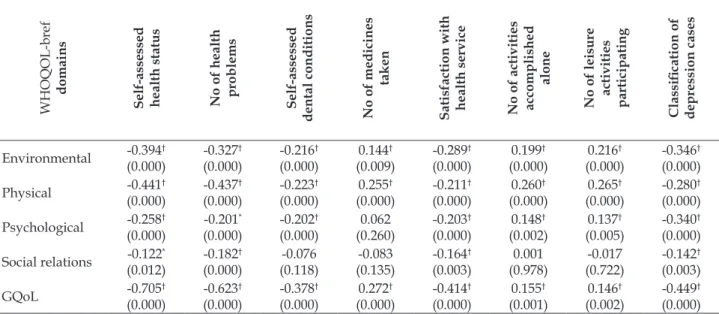
Tables 4 and 5 present the correlations between the WHOQOL-brefdomains and some variables in the BOAS sections, related to: social and economic resources; health conditions; use of medical and
den-tal services; ADLs. Among the indings, the variable per capita income showed a strong and signiicant
negative correlation with all domains and the GQoL,
also found in the mental health section, speciically
concerning the variable depression.
Table 4 – Socioeconomic factors associated with the quality of life of elderly quilombolas based on
Spearman’s correlation coeficients (rsp) between
the domains and the GQoL of the WHOQOL-bref and BOAS variables, Vitória da Conquista-BA, Brazil, 2014. (n=427)
WHOQOL-bref
do-mains
Educa-tion
Monthly individu-al income
Family income
Per capita income
Environ-mental
-0.066 (0.174)
0.132†
(0.006)
0.112*
(0.021)
0.146†
(0.003)
Physical -0.039 (0.425)
-0.010 (0.840)
0.051 (0.292)
0.131†
(0.007)
Psychologi-cal
-0.157†
(0.001)
-0.043 (0.374)
0.043 (0.374)
0.156†
(0.001) Social
Rela-tionships
0.045 (0.355)
0.104*
(0.032)
0.128†
(0.008)
0.158†
(0.001)
GQoL -0.060
(0.213)
0.109*
(0.024)
0.083 (0.086)
0.131†
(0.007)
Table 5 – Health factors associated with quality of life of elderly quilombolas based on Spearman’s
correlation coeficients (rsp) between the domains and the GQoL of the WHOQOL-bref and BOAS
variables, Vitória da Conquista-BA, Brazil, 2014. (N=427)
WHOQOL-bref
domains
Self-assessed health status No of health problems Self-assessed
dental conditions No of medicines
taken
Satisfaction with health service No of activities accomplished
alone
No of leisure activities participating
Classiication of depression cases
Environmental -0.394 † (0.000) -0.327† (0.000) -0.216† (0.000) 0.144† (0.009) -0.289† (0.000) 0.199† (0.000) 0.216† (0.000) -0.346† (0.000)
Physical -0.441† (0.000) -0.437† (0.000) -0.223† (0.000) 0.255† (0.000) -0.211† (0.000) 0.260† (0.000) 0.265† (0.000) -0.280† (0.000) Psychological -0.258 † (0.000) -0.201* (0.000) -0.202† (0.000) 0.062 (0.260) -0.203† (0.000) 0.148† (0.002) 0.137† (0.005) -0.340† (0.000)
Social relations -0.122* (0.012) -0.182† (0.000) -0.076 (0.118) -0.083 (0.135) -0.164† (0.003) 0.001 (0.978) -0.017 (0.722) -0.142† (0.003)
GQoL -0.705† (0.000) -0.623† (0.000) -0.378† (0.000) 0.272† (0.000) -0.414† (0.000) 0.155† (0.001) 0.146† (0.002) -0.449† (0.000)
* Statistically signiicant correlation (p<0.05); † Statistically signiicant correlation (p<0.01).
DISCUSSION
In this study, the factors associated with the QoL of elderly quilombolas were analyzed individu-ally for the four domains of the WHOQOL-bref (Environmental, Physical, Psychological and Social Relations) as well as the GQoL.
The Social Relations domains revealed the highest mean score among the QoL domains assessed in this study, followed by the Psychological domain. Nevertheless, the Environmental domain, followed by the Physical domain, presented the lowest mean scores among the QoL domains. These results diverge from an international study involving rural elderly,15
showing higher mean scores for the Environmental domain and worse scores for the Physical domain, similar to a study involving Brazilian urban elderly,16
showing higher scores for the Social Relations do-main and lower scores for the Physical dodo-main.
Considering that the Environmental domain
most strongly inluenced the QoL of the elderly quilombolas, differently from other studies cited
above, these indings may be related to the envi -ronmental aspects of the places where people in
quilombola settlements live. That is so because several of these communities are characterized by a lack of basic sanitation, inappropriate hygiene and absence
of treated water, besides deicient health care and
lack of transportation.17
Education was strongly associated with the mean score in the Psychological domain. These
results differ from the indings in a study18 that
identiied a positive QoL in elderly people with low
education levels, mainly in the Social and Physical domains. In another study19, however, it was
iden-tiied that elderly people with a higher education
level perceived a better QoL in the Social Relations domain.
Concerning the economic resources, the par-ticipants’ monthly individual income showed a negative relation with the Environmental and Social Relations domains and the GQoL. These results differ from a study20 in which the elderly’s income
positively inluenced the perceived QoL. What the
monthly family income of the elderly quilombolas
is concerned, an association was found with the Environmental and Social Relations domains of
QoL. These results are partially similar to the ind -ings in a study21 that showed associations with the
Environmental and Physical domains.
In addition, the analysis of the elderly’s per capita income in this study showed a relation with
all domains and with the GQoL. These indings may
be related with the high rate of low-income elderly people (less than one minimum wage). This
hypoth-esis can be ratiied based on the study results20, in
which people with an individual monthly income
of more than ive minimum wages performed better
on the Environmental domain of QoL.
The economic condition is a relevant
quilombas families. On several occasions, as they
do not gain a suficiently high family income, the
families do not get an appropriate diet, resulting in dietary shortages and low nutritional quality,
which can negatively inluence their health condi -tion.17 Thus, the economic conditions can negatively
inluence the QoL of quilombas elderly who, besides these factors, experience other conditions that are unfavorable to healthy aging.
The self-assessed health status was strongly associated with the QoL and GQoL, except for the Social Relations domain, which was also associated but less intensely. These results are similar to the as-sociated with the Social Relations domain of elderly people’s QoL found in another study.22 In addition,
in a study that assessed the QoL of elderly people, it was evidenced that the elderly’s background health
conditions are one of the factors that most inluenced
the perceived QoL.19
The number of main health problems in the elderly was strongly associated with the QoL and GQoL, except for the Psychological domain that, although less intense, interfered negatively in the QoL. In an international study on QoL and ADLs of elderly people in rural areas, developed in Turkey,
based on the WHOQOL-bref, it was veriied that the
presence of diseases was associated with lower scores in the Physical, Psychological and Social domains.15
The self-assessment of the dental conditions
showed no signiicant association, except with the
Social Relations domain. As the study involved brown and black elderly, these results may be
related with the access dificulties to dental ser -vices as, according to a study about race and use of oral health services among elderly people, it was evidenced that the chance of a black elderly person never having been attended by a dentist is more than twice as high as for white elderly.23
The number of medicines negatively inluenc -es the Environmental and Physical domains of the
studied elderly’s QoL and GQoL. These indings are
similar to the study22 in which a negative inluence
was found in the Physical domain. Nevertheless, a positive relation was found between medication use and the Psychological and Social Relations do-mains of the elderly quilombolas’ QoL, which may be related with the positive response the medicine may have provided to these elderly people’s health conditions. Nevertheless, not all medicines and the way they are being used can represent positive ef-fects on these people’s QoL.
In a study developed in quilombas communities,
it was identiied that the number of self-referred mor
-bidities, which appointed chronic health problems among the participants, was related to medication use, which elderly people are more prone to. There-fore, elderly people are preferential targets of health promotion strategies that can contribute to rational medication use,24 thus minimizing the occurrence of
negative impacts in this population group.
The variable satisfaction with health services showed a strong association with all domains of QoL and with the GQoL. These results may be related
with the indings of the study developed in a quilom-bola community in Southwestern Bahia, in which the
underuse of health services was identiied, thus sug
-gesting greater dificulty and dissatisfaction with
the access in the quilombola population.25
In the analysis of the ADLs, the smaller the number of activities the elderly was unable to ac-complish alone, the lesser the contribution to the QoL, except for the social relations domain. This was hardly similar to a study on the functional ability, morbidities and QoL of elderly people16, in which an
association was found in the Physical domain only. Concerning the number of leisure activities the elderly participated in, the lower the number, the worse the contribution to the QoL, except for the social relations domain. Elderly participants in a study26 referred to the importance of leisure
activi-ties and occupation to maintain their QoL.
Based on the assessment of the classiication of
depression cases (no case of depression, minor de-pression/depressed or major depression), a strong association was evidenced with all QoL domains
assessed and with the GQoL. These indings are
similar to a study developed in rural China, in which mental health was the factor that most compromised the QoL of the elderly studied.27
Based on a study about depression in quilombas
communities, the authors suggest investments in infrastructure, sanitation, education and access to health services, as well as training health profession-als to screen for depression cases in this population, which can contribute to improve the living
condi-tions, as well as the identiication and early treat -ment of several health problems like depression.28
In view of the elderly population, the identii -cation of depression cases in this social segment is fundamental in clinical practice, considering that it can contribute to the development of appropriate interventions and the prevention of possible disease-related risk factors.29 In addition, it can contribute
In view of the results, it is highlighted that this study comes with limitations related to the use of a cross-sectional design to indicate associations between the variables, considering that the possi-bility of reverse causality is a characteristic of this
design. In addition, some elderly found it dificult to
understand some questions in the WHOQOL-bref.
CONCLUSION
As identified, the variables related to the health conditions contributed less to the elderly people’s quality of life than the socioeconomic variables, mainly the variable depression case. Therefore, it is suggested that the development of implementation of actions to improve these indi-viduals’ health conditions should be prioritized, emphasizing mental health promotion, prevention of resulting implications and specialized treatment. In addition, the access to health services needs to be expanded and integral health care and care continuity needs to be offered to the elderly, especially by the FHS located in the quilombas com-munities they live in, besides improvements in the socioeconomic conditions, considering that these can modulate the elderly’s health conditions and, consequently, their QoL.
Thus, the researchers hope that the health services and professionals will be able to recognize the most evident problems on the quilombola ter-ritory and try to respond to the demands of the investigated elderly, contributing to the concrete transformation of the reality found in this study and thus supporting the legitimation of the right to better health conditions for these elderly people.
REFERENCES
1. Brasil. Lei nº 12.288, de 20 julho de 2010. Institui sobre
a Igualdade Racial. Presidência da República Casa Civil Subcheia para Assuntos Jurídicos, 20 julho de
2010.
2. Ministério da Saúde (BR).Política Nacional de Saúde
Integral da População Negra. Secretaria Especial de Políticas de Promoção da Igualdade Racial – SEPPIR. Brasília (DF): MS; 2007.
3. Bennett M. Os quilombolas e a resistência. Rev Palmares: Cultura Afro-Brasielira [online]. 2010 mar [cited 2015 Out 01]; 6(6):29-36. Available from: http://www.palmares.gov.br/wp-content/ uploads/2011/02/revista06.pdf
4. Santos VC, Boery EN, Boery RNSO, Anjos KF. Conditions of health and quality of life of the quilombola elderly black. J Nurs UFPE on line [online]. 2014 ago [cited 2015 Out 01]; 8(8):321-7.
Available from: file:///C:/Users/Pontocom%20 Informatica/Downloads/6300-60379-1-PB%20(3).pdf
5. Ministério da Saúde (BR). Atenção à saúde da pessoa
idosa e envelhecimento. Secretaria de Atenção à
Saúde, Departamento de Ações Programáticas e Estratégicas. Brasília (DF): MS; 2010.
6. Veras R. Population aging today: demands, challenges and innovations. Rev Saúde Pública [online]. 2009 [cited 2015 Out 01]; 43(3):1-7. Available from: http:// www.scielo.br/pdf/rsp/v43n3/en_224.pdf
7. Instituto Brasileiro de Geograia e Estatística. Censo
Demográico 2010 [Internet]. Brasília (DF): IBGE; 2010
[cited 2015 Out 01]. Available from: http://cidades.
ibge.gov.br/xtras/peril.php?codmun=292740
8. Fundação Cultural Palmares [Internet]. Brasília (DF); 2015 [cited 2015 Out 01]. Available from: http://www. palmares.gov.br/
9. Folstein MF, Folstein SE, McHugh PR. Mini-mental state: a practical method for grading the cognitive state of patients for the clinicians. J Psychiatr Res. 1975;12: 189-98
10. Bertolucci PHF, Brucki MDS, Campacci SR, JulianoY.
O Mini Exame do Estado Mental em uma população
geral: impacto da escolaridade. Arq Neuro-Psiquiatr [online]. 1994 [cited 2015 Out 01]; 52:1-7. Available from: http://www.scielo.br/pdf/anp/v52n1/01.pdf 11. Brucki SMD, Nitrini R, Caramelli P, Bertolucci PHF,
Okamoto IH. Sugestões para o uso do Mini-Exame do
estado mental no Brasil. Arq Neuro-Psiquiatr [online]. 2003 [cited 2015 Out 01]; 61: 777-81. Available from: http://www.scielo.br/pdf/anp/v61n3B/17294.pdf 12. Veras RP, Dutra S. Perfil do idoso brasileiro:
Questionário Boas. Rio de Janeiro (RJ): UERJ, UnATI, 2008.
13. Veras RP. País jovem com cabelos brancos: a saúde do idoso no Brasil. Rio de Janeiro (RJ): Relume Dumará; 1994.
14. Fleck MPA, Louzada S, Xavier M, Chachamovich
E, Vieira G, Santos L, et al. Aplicação da versão em português do instrumento abreviado de avaliação da qualidade de vida “WHOQOL-bref”. Rev Saúde Pública [online]. 2000 [cited 2015 Out 01];
34(2):178-83. Available from: http://www.scielo.br/pdf/rsp/ v34n2/1954.pdf
15. Arslantas D, Unsal A, Metintas S, Koc F, Arslantas A. Life quality and daily life activities of elderly people in rural areas, Eskisehir (Turkey). Arch Gerontol Geriatr. 2009; 48:127-31
16. Tavares DMS, Dias FA. Functional capactiy, morbidities and quality of life of the elderly. Texto Contexto Enferm [online]. 2012 [cited 2015 Out 01]; 21(1):112-20. Available from: http://www.scielo.br/ pdf/tce/v21n1/en_a13v21n1.pdf
17. Freitas DA, Caballero AD, Marques AS, Hernández
CIV, Antunes SLNO. Saúde e comunidades
[online]. 2011 set-out [cited 2015 Out 01]; 13(5):937-943. Available from: http://www.scielo.br/pdf/rcefac/ v13n5/151-10.pdf
18. Braga MCP, Casella MA, Campos MLN, Paiva SP. Qualidade de vida medida pelo whoqol-bref: estudo com idosos residentes em Juiz de Fora/MG. Rev APS [online]. 2011 [cited 2015 Out 01]; 14(1):93-100. Available from: http://aps.ufjf.emnuvens.com.br/ aps/article/view/965/450
19. Vitorino LM, Paskulin LMG, Vianna LAC. Quality of life of seniors living in the community and in long term care facilities: a comparative study. Rev Latino-am Enfermagem [online]. 2013 [cited 2015 Out 01]; 21(Spec):3-11. Available from: http://www.scielo. br/pdf/rlae/v21nspe/02.pdf
20. Alexandre TS, Cordeiro RC, Ramos LR. Factors
associated to quality of life in active elderly. Rev Saúde Pública [online]. 2009 [cited 2015 Out 01];
43(4):613-21. Available from: http://www.scielo.br/pdf/rsp/ v43n4/58.pdf
21. Pereira KCR, Angela MA, Jefferson LT. Contribuição
das condições sociodemográicas para a percepção
da qualidade de vida em idosos. Rev Bras Geriatr Gerontol [online]. 2011 [cited 2015 Out 01]; 14(1):85-95. Available from: http://www.scielo.br/pdf/rbgg/ v14n1/a10v14n1.pdf
22. Nóbrega TCM, Jaluul O, Machado AN, Paschoal SMP, Jacob Filho W. Quality of Life and multimorbidity of elderly outpatients. Clinics. 2009; 64: 45-50
23. Souza EA, Oliveira PAP, Paegle AC, Goes PSA. Raça
e o uso dos serviços de saúde bucal por idosos. Ciênc Saúde Coletiva [online]. 2012 [cited 2015 Out 01];
17(8):2063-70. Available from: http://www.scielosp. org/pdf/csc/v17n8/17.pdf
24. Medeiros DS, Moura CS, Guimarães MDC, Acurcio FA. Medication use by the “quilombola” population:
a survey in Southwestern Bahia, Brazil. Rev Saúde Pública [online]. 2013 [cited 2015 Out 01]; 47(5):905-13.
Available from: http://www.scielosp.org/pdf/rsp/ v47n5/en_0034-8910-rsp-47-05-0905.pdf
25. Gomes KO, Edna AR, Mark DCG, Mariângela LC.
Utilização de serviços de saúde por população
quilombola do Sudoeste da Bahia, Brasil. Cad
Saúde Pública [online]. 2013 Set [cited 2015 Out 01];
29(9):1829-42. Available from: http://www.scielosp. org/pdf/csp/v29n9/a22v29n9.pdf
26. Teston EF, Marcon SS. Quality of life and living conditions from the viewpoint of residents in
a seniors condominium. Rev Gaúcha Enferm
[online]. 2014 Mar [cited 2015 Out 01]; 35(1):124-30. Available from: http://seer.ufrgs.br/index. php/RevistaGauchadeEnfermagem/article/ view/37032/28950
27. Xie JF, Ding SQ, Zhong ZQ, Yi QF, Zeng SN, Hu JH. Mental health is the most important factor
inluencing quality of life in elderly left behind when
families migrate out of rural China. Rev Latino-Am Enfermagem [online]. 2014 Mai-Jun [cited 2015 Out 01]; 22(3): 364-70. Available from: http://www.ncbi. nlm.nih.gov/pmc/articles/PMC4292632/pdf/rlae-22-03-0364.pdf
28. Barroso SM, Melo APS, Guimarães MDC. Depressão em comunidades quilombolas no Brasil: triagem e fatores associad. Rev Panam Salud Publica [online]. 2014 Abr [cited 2015 Out 01]; 35(4):256-63. Available from: http://www.scielosp.org/pdf/rpsp/v35n4/04. pdf
29. Carreira L, Botelho MR, Matos PCB, Torres MM,
Salci MA. Prevalência de depressão em idosos
institucionalizados. Rev Enferm UERJ [online]. 2011 Abr-Jun [cited 2015 Out 01]; 19:268-73. Available from: http://www.facenf.uerj.br/v19n2/v19n2a16.pdf
Correspondence: Vanessa Cruz Santos
Instituto de Saúde Coletiva
Universidade Federal da Bahia
Rua Basílio da Gama, s/n
40110-040- Canela, Salvador, BA, Brasil E-mail: [email protected]