DOI: http://dx.doi.org/10.5007/1980-0037.2017v19n5p535
Inluence of functional and traditional training
on muscle power, quality of movement and
quality of life in the elderly: a randomized
and controlled clinical trial
Inluência dos treinamentos funcional e tradicional na
potência muscular, qualidade de movimento e qualidade
de vida em idosas: um ensaio clínico randomizado
e controlado
Leury Max Da Silva Chaves1 Antônio Gomes De Rezende-Neto1 Albernon Costa Nogueira1 José Carlos Aragão-Santos1
Leandro Henrique Albuquerque Brandão1 Marzo Edir Da Silva-Grigoletto1,2
Abstract – Aging causes a reduction in the adaptive capacity of the organism. herefore, there is a decrease in physical itness, making it diicult to perform basic movements and the development of muscular power. hus, to minimize this reduction, functional and traditional training can both be used; however there is no clarity about which is most efective. he aim of this study was to identify the inluence of functional and traditional training on muscle power, quality of movement and quality of life in the elderly. Forty-four older women were randomly divided into functional group (FG n=18), traditional group (TG n=15) and control group (CG n=11). hirty-six sessions lasting 50 minutes were performed. Quality of life (WHOQOL-bref ), quality of movement (FMS) and muscular power were evaluated. FG and TG increased signiicantly in relation to control group and to the initial FMS values. In FG and TG, muscle power signiicantly improved compared to pre-test, but not in relation to the control group. Regarding quality of life, only FG presented signiicant improvement. Both applied methods demonstrate the ability to improve the quality of movement and muscle power. However, functional training achieved better results in quality of life and movement.
Key words: Activities of daily living; Aging; Exercise.
Resumo – O envelhecimento ocasiona uma redução na capacidade adaptativa do organismo. Por conseguinte, há uma diminuição na aptidão física diicultando a realização de movimentos básicos e o desenvolvimento de potência muscular. Desse modo, entre a formas de minimizar essa redução tanto treinamento funcional quanto o tradicional podem ser utilizado, contudo não há clareza sobre qual o mais eicaz. Objetivou-se identiicar a inluência dos treinamentos funcional e tradicional na potência muscular, qualidade de movimento e de vida em idosas. Quarenta e quatro idosas foram randomicamente divididas em grupo funcional (GF n=18), tradicional (GT n=15) e controle (GC n=11). Foram realizadas 36 sessões com duração de 50 minutos. Foram avaliadas a qualidade de vida (WHOQOL-bref ), qualidade de movimento (FMS) e potência muscular. O GF e GT aumentaram signiicativamente em relação ao grupo controle e aos valores iniciais no FMS. Na potência muscular os grupos GF e GT melhoraram signiicativamente comparado ao pré-teste, mas não em relação ao controle. Na qualidade de vida apenas o GF apresentou melhora signiicativa. Ambos os métodos aplicados demostram a capacidade de melhorar a qualidade de movimento e potência muscular. Contudo o treinamento
1 Federal University of Sergipe. Center for Biological and Health Sciences. Department of Physical Education. Graduate Program in Physical Education. São Cristovão, SE. Brazil.
2 Scientific Sport. Aracaju, SE. Brazil.
Received: September 20, 2017
Functional training versus traditional training in the elderly Chaves et al.
INTRODUCTION
In the aging process, a series of physiological, psychological and structural events occur, impairing the quality of movement, functional capacity and autonomy1. Consequently, aspects such as decreased strength (dynapenia),
muscle mass (sarcopenia), muscular power and joint mobility, directly re-lect in the incidence of falls and the performance of activities of the daily living (ADL) in this population2-4.
he main functional movements performed in everyday activities are a combination of strength, balance, resistance, power among other capabilities that at satisfactory levels allow safety and eiciency5,6. In addition, factors
such as mobility and joint stability are fundamental to provide better per-formance in movements such as squatting, carrying some external load and overcoming obstacles. An example is the functional walking action, in which there is a relationship among ankle mobility, hip mobility and knee stability7.
In this context, functional training (FT) appears as an option to im-prove the quality of movement used in ADLs and to stimulate the diferent components of physical itness in the elderly5,8. his method consists in the
application of integrated, multi-joint and multiplanar exercises aimed at improving movements, core strength gains and neuromuscular eiciency to the speciic needs of each individual9.
Milton4 applied functional exercises in four weeks of intervention and
showed a 43% improvement in shoulder mobility, 13% in agility / dynamic balance, 14% and 13% in upper and lower limb strength and 7% in cardiore-spiratory capacity in comparison with a group that performed conventional activity. However, it is not clear in the current literature the inluence of FT on the mobility and stability required for better quality of movement, as well as its efects on muscle power and quality of life in older adults.
Other studies have analyzed traditional training - here understood as classic bodybuilding, commonly performed in gyms – and found improve-ments in physical itness and health of the general population, being also widely used in the elderly population. he gains in physical conditioning associated with this method are very broad; however, we can highlight the development of muscular power as one of the main beneits for older adults10,11. Muscle power is directly related to functional parameters, and
should be stimulated in diferent types of interventions, including func-tional training, but due to the greater control of load and safety provided by itness equipment, traditional strength training, despite the lower speciicity of exercises, can interestingly develop this capacity, relecting in other aspects related to elderly people such as quality of life2,3. hus, the
METHODOLOGICAL PROCEDURES
his is a study with experimental design for applying speciic training in groups of individuals, aiming to control the action of intervening factors and to investigate the efects on dependent variables12.
Sample and sampling procedure
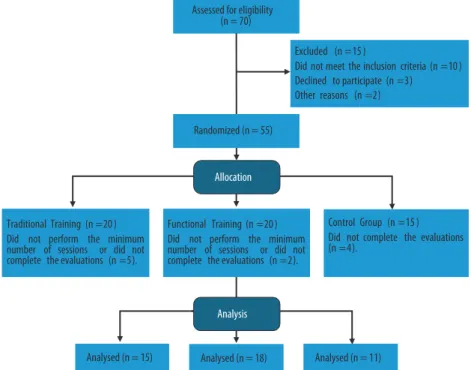
he sample size was calculated using GPOWER 2.0 software according to Pacheco1, with variable movement quality. hus, 44 older women were
ran-domly assigned to: Functional Group (FT n = 18, BMI = 29.0 ± 4.9 kg / m²), Traditional Group (TT n = 15, BMI = 28.5 ± 5.5 kg / m²), and control group (CG n = 11, BMI = 30.4 ± 5.9 kg / m²). Baseline data are shown in table 1.
he methodological procedures of the study were verbally explained and participants agreed to voluntarily participate in the research by signing the free and informed consent form. he study lowchart is presented in igure 1.
Figure 1. Study flowchart.
Inclusion and exclusion criteria
Functional training versus traditional training in the elderly Chaves et al.
Intervention
All groups performed training three times a week for 12 weeks, the time for interval between sessions was 48 hours and each session lasted 50 minutes. In TG and FG groups, the OMNI-GSE13 scale was used to control and
normalize the overall training intensity between groups.
After evaluations, participants went through two weeks of familiariza-tion, in which 60% of the volume planned for the irst session was applied, and then they completed 36 sessions of progressive training.
Box 1. Activities applied in block 2 of the functional training group, and activities performed in block 3 of the functional and traditional training groups.
Exercises Block 2 – Functional Training
Phase 1 (1-18 sessions) Phase 2 (18-36 sessions)
Up and down the step Jump under the step
Rope training linear Rope training linear
Vertical Throwing Ground Throwing
Displacement between cones Run and jump between cones
Ladder of linear agility Ladder of lateral agility
5 activities, 3 passages, 1’ per station, density of 1/1. OMI-NI-GSE: 6 to 7 at 60-70% of HRmax
5 activities, 3 passages, 1’ per station, density of 2/1. OMINI-GSE: 6 to 7 at 60-70% of HRmax
Exercises Block 3 – Functional (FG) and traditional training (TG)
FG (1-18) TG (1-18) FG (18-36) TG (18-36)
Ground lifting (ketlebells) Squatting (Smith) Shouldering (bulgarian bag) Squatting (free)
Horizontal pull (Suspension strap, OW)
Vertical pull (Articulated row) Horizontal pull (Suspension strap, OW)
Vertical pull (Articulated row)
Sit and stand up from bench Knee extension (Leg press 45 °)
Goblet Squats (Ketlebells) Knee extension (Extension
chair) Vertical push up (elastic) Vertical push up (Vertical
supine)
Push-ups (40 cm bench, OW) Horizontal push up
Farmers walk (ketlebells) Knee flexion (Flexor table) Farmers walk (ketlebells) Knee flexion unilateral (ankle weight)
Vertical row (elastic) Front row Vertical row with knee lift (elastic)
Front row with neutral grip
Pelvic elevation (OW) Bilateral standing calf (OW) Pelvic elevation (OW) Calf (leg press 45 °) Front plate (40 cm bench) Stiff (bar and weights) Front plate (step) Abdominal (curl up)
* The Anglo-Saxon name of some exercises described above is due to the frequent in the training area in Brazil, own weight (OW).
Functional Group (FG)
(2) 15’ of continuous walking, with OMINI-GSE from 6 to 7; (3) 18’ of traditional exercises in predominantly analytical machines with more iso-lated neuromuscular work composed of 8 exercises, with 2 series of 08-12 maximum repetitions at 70-85% of 1 RM and OMINI-GSE scale between 7 to 8, also performed in circuit; (4) 5’ of high-intensity cardiometabolic work (HIIT), also performed in the same way as for FG.
Both groups performed exercises at maximum concentric velocity and the training progression occurred according to the level of ability and comfort of the volunteer, for maintenance of 8 to 12 maximal repetitions performed at density of 1/1 (30’’: 30’’), with load readjustment whenever the range of repetitions was exceeded.
Control group
Participants performed stretches with submaximal joint amplitude levels and relaxation practices, with frequency of three weekly sessions and du-ration of approximately 50 min / session in order to maintain the sample.
Data collection procedures
Initially, anamnesis was carried out with questions regarding the charac-terization of the level of health and physical activity (report of activities of daily living and work). Afterwards, nutritional assessment was made through a usual dietary recall14, to control and monitor feeding during the
training period.
he test battery was performed in three moments: pre-test (M1); retest after two weeks of familiarization (M2); and after 12 weeks of interven-tion (M3). Tests were performed in the following order: anthropometric measurements, Questionnaires (Mini Mental State Examination and WHOQOL-Bref), Functional movement screen and muscle power.
Tests
For the anthropometric characterization, body weight (kg) was measured through a scale (Lider®, P150C, São Paulo, Brazil), with maximum capac-ity of 150 kg. Height (cm) was determined through a stadiometer (Sanny, ES2030, São Paulo, Brazil).
For better distribution of participants in the training programs, the Mini Mental State Examination (MMSE) was used, which consists of a score ranging from zero to 30 points that aims to provide data on various cognitive parameters of any geriatric population15.
Quality of life was assessed based on the WHOQOL-Bref structured questionnaire16, which values individual perception in diferent groups and
situations. he test consists of 26 questions including four domains of life: physical, psychological, social and environmental. Responses follow the Likert scale (from 1 to 5; the higher the score, the better the quality of life).
Functional training versus traditional training in the elderly Chaves et al.
Movement Screen™, which involves seven movement patterns that quali-tatively evaluate mobility, stability and strength and assign a numerical score to each pattern. he score of each test varies from 0 (pain during the execution of the movement), 1 (non-execution of the movement), 2 (execution of the movement with some compensation) and 3 (perfect execution of the movement). Each movement pattern was performed three times, including bilateral ones, in order to obtain the best result. he inal score recorded will be the best judgment on each side and the inal result will be the worst score between the two sides for each standard (in the case of tests that are bilaterally performed). he FMS ™ total score is the sum of all separate scores and the highest possible score is 21 points17,18.
Muscle power was evaluated from two basic movement patterns, push (vertical bench press and 45º leg press) and pull (articulated row). he load established to evaluate muscle power was 50% of the value of a maximum repetition for each standard and to quantify this value, the Muscle LabTR
software connected to a linear encoder was used. Ten repetitions were performed with a standardized load for each standard (Supine - 15 kg, Row - 10 kg, Leg press - 70 kg), then ive repetitions were performed at maximum concentric speed and only the highest value obtained for analysis was considered.
Data analysis
Data were expressed through descriptive statistics (mean and standard deviation) for all variables obtained. hen, 3x2 ANOVA with post hoc Bonferroni test was performed to compare means and detect diferences among interventions. Data normality was measured by the Shapiro-Wilk test and homogeneity by the Levene test.
Data were tabulated and analyzed using Statistical Package for Social Sciences (SPSS), version 22, adopting signiicance level of 5% (p≤0.05). All tests were two-tailed and the Efect Size (ES) was calculated according to methodological procedures deined by Cohen19.
RESULTS
FG and TG increased signiicantly in relation to the control group and to the initial values in the FMSTM (FG = 24.4% / ES: 1.1 / p: 0.004; TG =
FG n=18 TG n=15 CG n=11
Age (years) 65.6±5.44 65.6±5.10 62.5±2.98
Weight (kg) 68.9±12.60 65.8±12.82 72.5 ±14.43
Height (cm) 154.0±5.28 152.0±6.98 154.4 ±7.84
BMI (kg/m²) 29.0±4.95 28.5±5.51 30.4 ±5.91
MMSE (points) 25.2±2.90 25.7±3.63 24.1±2.84
BMI: Body mass index; MMSE: Mini mental state examination. Significant difference between groups *.
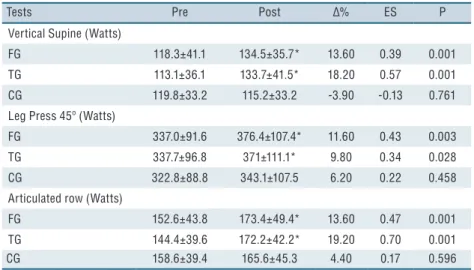
Table 2. Changes in muscle power after 12 weeks of functional, traditional and control training in pre-frail elderly women.
Tests Pre Post ∆% ES P
Vertical Supine (Watts)
FG 118.3±41.1 134.5±35.7* 13.60 0.39 0.001
TG 113.1±36.1 133.7±41.5* 18.20 0.57 0.001
CG 119.8±33.2 115.2±33.2 -3.90 -0.13 0.761
Leg Press 45º (Watts)
FG 337.0±91.6 376.4±107.4* 11.60 0.43 0.003
TG 337.7±96.8 371±111.1* 9.80 0.34 0.028
CG 322.8±88.8 343.1±107.5 6.20 0.22 0.458
Articulated row (Watts)
FG 152.6±43.8 173.4±49.4* 13.60 0.47 0.001
TG 144.4±39.6 172.2±42.2* 19.20 0.70 0.001
CG 158.6±39.4 165.6±45.3 4.40 0.17 0.596
Functional training (FG), traditional (TG) and control group (CG), Effect Size (ES). Statistical difference from pre to post *, statistical difference in relation to GC A.
Figure 1. A - Changes in movement quality after 12 weeks of functional (FG) and traditional (TG) training. B - Changes in quality of life after 12 weeks of functional (FG) and traditional (TG) training. Statistical difference from pre to post *, statistical difference in relation to CG A.
DISCUSSION
he main inding of the present study was that in muscle power, both training methods were eicient. However, only FG achieved signiicant improvements in quality of movement and quality of life. hus, physical exercises performed at maximum concentric speed in more functional actions have greater inlu-ence on measures related to the performance of daily activities in the elderly.
Functional training versus traditional training in the elderly Chaves et al.
Regarding the quality of movement, of studies analyzed, only Pacheco1
applied FMSTM in this population and did not ind signiicant diferences
between functional and traditional exercises in active and independ-ent older adults. A possible explanation for this result is the evaluation method used. It may not be sensitive enough to evaluate individuals who do not have common dysfunctions of this age group. he physiological adaptations in this variable are mainly at the level of motor control5, thus,
it seems that a multi-component, multi-joint and multiplanar training, as applied in the present study can provide better results due to the greater neuromotor complexity when compared to training performed on guided machines. his is because such machines do not provide the motor and neural readjustments during exercises, which are necessary in daily and highly developed functional movements in FT.
In this way, for FMSTM, which qualitatively evaluates motor control
through joint mobility and stability, the training that most provided these characteristics obtained higher results.
Comparing similar functional components, Krebs20 found that the
group that performed exercises within the TF proposal presented higher maximal torque in the knee, better dynamic balance and coordination during the execution of daily activities, in relation to the group that per-formed strength training with elastics. In another study, Vreed 7 showed
that functional exercises produce greater gains in functional capacity when compared to traditional exercises.
Muscle power is considered a better predictor of functionality for the elderly population21. Byrne22 reported that a good intervention with physical
training should develop strength and muscle power for better performance in the ADLs. In this variable, both types of training presented signii-cant increases in relation to pretest, since they emphasize the maximum concentric velocity in the performance of movements. Corroborating the results of this manuscript, Cadore2 using a combination of force exercises
performed at maximum concentric speed, balance and gait, also veriied signiicant increases in the muscle power of 24 fragile elderly women. It is worth mentioning that in the present study, FG performed two blocks of exercises with emphasis on the maximum execution speed (blocks 2 and 3) and although TG performed only one (block 3), it is possible to visualize the speciicity of training performed by TG with the tests applied, that is, the same exercises used in the evaluation were trained during intervention and may have contributed to the results found.
he quality of life of the elderly population is directly related to the ability to perform daily tasks safely and efectively23. he practice of physical
activity in general has a positive efect on quality of life24; however, training
programs focusing on multicomponent work, muscle power and functional movement patterns have been eicient in this variable5. In the present study,
only FG demonstrated signiicant improvement in relation to pretest and high Efect Size. hese results are consistent with Whitehurst25, which
tional exercises. After 25 weeks of functional balance training, Karóczi26
did not ind signiicant improvement in this variable, since there was no improvement in the physical itness components that are important for the daily life of subjects and, consequently, for quality of life. he quality-of-life questionnaire applied in the present study was the WHOQOL-Bref, which includes four domains (physical, environmental, psychological and social) even with global movements and focusing on the muscle power of the FT, both methods inluence physical domain, the other evaluated components can be inluenced by questions such as group cohesion and practice space, for example, TG performed most of the training in an enclosed space (bodybuilding room), while FG performed training in a more open space, and these conditions may have contributed to afect the perception of participants on the environment and how they feel about it.
he present research aimed at comparing the adaptive responses to training protocols considered functional, due to diferences among the char-acteristics of each intervention and the test applied. Although the present study has provided important information about the beneits of FT and TT in muscle power, quality of movement and life, future studies should apply longer interventions with greater number of volunteers by adding speciic test battery for the analysis of performance in ADLs. We believe that this study may stimulate further research to conirm these indings.
CONCLUSIONS
Both methods demonstrate the ability to improve the quality of movement and muscle power. However, functional training presented better results regarding quality of life and movement. he present research shows that a physical training program aimed at promoting multi-system adaptations favorable to the health of older adults should focus on the improvement of physical itness components in speciic exercises for the activities of the daily living performed at maximum concentric speed, respecting the of safety and functionality criteria.
REFERENCES
1. Pacheco MM, Teixeira LA, Franchini E, Takito MY. Functional vs. Strength training in adults: speciic needs deine the best intervention. Int J Sports Phys her 2013;8(1):34-43.
2. Cadore EL, Casas-Herrero A, Zambom-Ferraresi F, Idoate F, Millor N, Gomez M, et al. Multicomponent exercises including muscle power training enhance muscle mass, power output, and functional outcomes in institutionalized frail nonagenarians. Age 2014;36(2):773-85.
3. Milton D, Porcari JP, Foster C, Gibson M, Udermann B. he efect of functional exercise training on functional itness levels of older adults. Gund Lutheran Med J 2008;5(1):4–8.
Functional training versus traditional training in the elderly Chaves et al.
CORRESPONDING AUTHOR
Marzo Edir Da Silva Grigoletto Rua Napoleão Dórea, 165, Apt 03 Residencial Ana Carolina, Bairro Atalaia, Aracaju, Brasil CEP: 49037-460
E-mail: [email protected]
5. Liu CJ, Latham NK. Progressive resistance strength training for improving physical function in older adults. Cochrane Database Syst Rev 2009(3):Cd002759.
6. Beijersbergen CM, Granacher U, Vandervoort AA, DeVita P, Hortobagyi T. he biomechanical mechanism of how strength and power training improves walking speed in old adults remains unknown. Ageing Res Rev 2013;12(2):618-27.
7. de Vreede PL, Samson MM, van Meeteren NL, van der Bom JG, Duursma SA, Verhaar HJ. Functional tasks exercise versus resistance exercise to improve daily function in older women: a feasibility study. Arch Phys Med Rehabil 2004;85(12):1952-61.
8. Minick KI, Kiesel KB, Burton L, Taylor A, Plisky P, Butler RJ. Interrater reli-ability of the functional movement screen. J Strength Cond Res 2010;24(2):479-86.
9. Da-Silva Grigoletto ME, Brito CJ, Heredia JR. Functional training: functional for what and for whom? Rev Bras Cineantropom Desempenho Hum 2014;16(6):714-9.
10. Reid KF, Fielding RA. Skeletal muscle power: a critical determinant of physical functioning in older adults. Exerc Sport Sci Rev 2012;40(1):4-12.
11. Sayers SP, Guralnik JM, hombs LA, Fielding RA. Efect of leg muscle contrac-tion velocity on funccontrac-tional performance in older men and women. J Am Geriatr Soc 2005;53(3):467-71.
12. homas JR, Nelson JK, Silverman SJ. Métodos de pesquisa em atividade física, 5ª Ed. Porto Alegre: ArtMed, 2007.
13. Da-Silva Grigoletto ME, Viana-Montaner B, Heredia J, Mata Ordóñez F, Peña G, Brito C, et al. Validación de la escala de valoración subjetiva del esfuerzo OMNI-GSE para el control de la intensidad global en sesiones de objetivos múltiples en personas mayores. Kronos 2013;12(1): 32-40.
14. Ribeiro AC, Oliveira KES, Rodrigues ML, Costa TH, Schmitz BA. Validação de um questionário de freqüência de consumo alimentar para população adulta. Rev Nutr 2006;19(5): 553-62.
15. Folstein MF, Folstein SE, McHugh PR. “Mini-mental state”. A practical method for grading the cognitive state of patients for the clinician. J Psychiatr Res 1975;12(3):189-98.
16. Fleck MP, Louzada S, Xavier M, Chachamovich E, Vieira G, Santos L, et al. Apli-cação da versão em português do instrumento abreviado de avaliação da qualidade de vida” WHOQOL-bref”. Rev Saude Publica 2000;34(2):178-83.
17. Cook G, Burton L, Hoogenboom BJ, Voight M. Functional movement screen-ing: the use of fundamental movements as an assessment of function - part 1. Int J Sports Phys her 2006;9(3):396-409.
18. Cook G, Burton L, Hoogenboom BJ, Voight M. Functional movement screening: the use of fundamental movements as an assessment of function-part 2. Int J Sports Phys her 2014;9(4):549-63.
19. Cohen J. hings I have learned (so far). Am psychol 1990;45(12):1304.
20. Krebs DE, Scarborough DM, McGibbon CA. Functional vs. strength training in disabled elderly outpatients. Am J Phys Med Rehabil 2007;86(2):93-103.
21. Bassey EJ, Fiatarone MA, O’Neill EF, Kelly M, Evans WJ, Lipsitz LA. Leg extensor power and functional performance in very old men and women. Clin Sci 1992;82(3):321-7.
22. Byrne C, Faure C, Keene DJ, Lamb SE. Ageing, Muscle Power and Physical Func-tion: A Systematic Review and Implications for Pragmatic Training Interventions. Sports Med 2016;46(9):1311-32.
23. Pucci GCMF, Rech CR, Fermino RC, Reis RS. Associação entre atividade física e qualidade de vida em adultos. Rev Saude Publica 2012;46(1):166-79.
24. De Oliveira Leal SM, da Silva Borges EG, Fonseca MA, Junior EDA, Cader S, Dantas EHM. Efeitos do treinamento funcional na autonomia funcional, equilíbrio e qualidade de vida de idosas. Rev Bras Cienc Mov 2010;17(3):61-9.
25. Whitehurst MA, Johnson BL, Parker CM, Brown LE, Ford AM. he beneits of a functional exercise circuit for older adults. J Strength Cond Res 2005;19(3):647-51.