Article/Artigo
INTRODUCTION
1. Hospital das Clínicas, Universidade Federal de Minas Gerais, Belo Horizonte, MG.2. Faculdade de Medicina, Universidade Federal de Minas Gerais, Belo Horizonte, MG. 3. Escola de Enfermagem, Universidade Federal de Minas Gerais, Belo Horizonte, MG.
Address to: Dra. Bruna Guimarães Oliveira. HC/UFMG. Rua Ana de Carvalho da Silveira 269/802, 31140-440 Belo Horizonte, MG, Brasil.
Phone/Fax.: 55 31 3423-8485 e-mail: [email protected] Received in 04/07/2010 Accepted in 18/10/2010
Health-related quality of life in patients with Chagas disease
Qualidade de vida relacionada à saúde na doença de Chagas
Bruna Guimarães Oliveira
1,2, Mery Natali Silva Abreu
2,3, Claudia Drummond Guimarães Abreu
1,2,
Manoel Otavio da Costa Rocha
1,2and Antonio Luiz Ribeiro
1,2ABSTACT
Introduction: Chagas disease (ChD) is a chronic illness related to signiicant morbidity and mortality that can afect the quality of life (QoL) of infected patients. However, there are few studies regarding QoL in ChD. he objectives of this study are to construct a health-related QoL (HRQoL) proile of ChD patients and compare this with a non-ChD (NChD) group to identify factors associated with the worst HRQoL scores in ChD patients. Methods: HRQoL was investigated in 125 patients with ChD and 21 NChD individuals using the Medical Outcomes Study 36-item Short-Form (SF-36) and the Minnesota Living with Heart Failure Questionnaire (MLWHFQ). Patients were submited to a standard protocol that included clinical examination, ECG, Holter monitoring, Doppler echocardiogram and autonomic function tests. Results:
HRQoL scores were signiicantly worse among the ChD group compared to the NChD group in the SF-36 domains of physical functioning and role-emotional and in the MLWHFQ scale. For the ChD group, univariate analysis showed that HRQoL score quartiles were associated with level of education, sex, marital status, use of medication, functional classiication and cardiovascular and gastrointestinal symptoms. In the multivariate analysis, female sex, fewer years of education, single status, worst functional classiication, presence of cardiovascular and gastrointestinal symptoms, associated illnesses, Doppler echocardiographic abnormalities and ventricular arrhythmia detected during Holter monitoring were predictors of lower HRQoL scores. Conclusions: ChD patients showed worse HRQoL scores compared to NChD. For the ChD group, sociodemographic and clinical variables were associated with worst scores.
Keywords: Quality of life. Chagas disease. SF-36. Minnesota Living with Heart Failure
Questionnaire.
RESUMO
Introdução: A doença de Chagas (DCh) é associada à morbidade e mortalidade signiicativas e que pode afetar a qualidade de vida (QV) dos pacientes infectados. Entretanto, encontramos poucos estudos sobre a QV na DCh. Os objetivos deste estudo são deinir o peril de qualidade de vida relacionada à saúde (QVRS) em pacientes com DCh, compará-lo com indivíduos sem a doença de Chagas (NDCh) e encontrar os fatores associados com os piores escores de QV para aqueles com DCh. Métodos: A QVRS foi investigada em 125 pacientes com DCh e 21 NDCh aplicando-se os questionários Medical Outcomes Study 36-item short-Form
(SF36) e Minnesota Living With Heart Failure Questionanaire (MLWHFQ). Os pacientes foram submetidos a exame clínico, ECG, monitorização por Holter, Doppler ecocardiograma e testes de função autonômicas. Resultados: Os escores de QVRS nos domínios capacidade física e aspecto emocional do SF36 e na escala de MLWHFQ foram signiicativamente piores entre os pacientes com DCh. A análise univariada mostrou associação dos escores QVRS e nível de formação, gênero, situação conjugal, uso de medicamentos, classe funcional e sintomas cardiovasculares e gastrointestinais. Na análise multivariada, sexo feminino, poucos anos de estudos, situação conjugal de solteiro, pior classiicação funcional, presença de sintomas cardiovasculares e gastrointestinais, doenças associadas, alteração ao Doppler ecocardiograma e arritmia ventricular ao Holter foram preditores de pior QVRS. Conclusões: Pacientes com DCh apresentaram piores escores de QVRS quando comparados com NDCh. Para o grupo com DCh, variáveis sociodemográicas e clínicas se associaram aos piores escores.
Palavras-chaves: Qualidade de vida. Doença de Chagas. SF-36. Minnesota Living with Heart FailureQuestionnaire.
Evaluation of quality of life (QoL) has been increasingly used to monitor and manage care strategies, clinical investigations, allocation of resources and to monitor the integration of new technologies1-3. Focusing on clinical outcomes that
have an impact on the patient's life is one of the principles of evidence-based medicine. Hence, QoL is not only a concern for patients, their families and doctors, but also for the health policy makers and the healthcare industry. Knowledge concerning the impact of diseases on the QoL of patients can improve planning and allocation of resources for research, training and health care4.
he deinition and scope of the term quality of life requires a thorough discussion. In this article, health-related QoL (HRQoL) is taken to be a measure that quantiies the patient's perception of the functional effects of the illness and treatment on different aspects of life, considering the subjectivity of the physical, emotional and social dimensions5,6.
Generic and speciic measurement instruments can be used to evaluate HRQoL. The generic instruments, such as health profiles and utility measurements, are applicable to a large variety of populations and pathologies, allowing for comparison of different groups. They are most appropriate to epidemiological studies and to planning and evaluation in the healthcare system. he utility measurements are most widely used for cost analysis. In contrast, speciic instruments are directed at evaluating individual and speciic aspects of HRQoL following illness, injury or medical intervention7.
he generic Short-Form Health Survey (SF-36) was developed in the early 1990s8 and has been
translated into Portuguese and validated9. he SF-36
has proven to be very useful with general populations and speciic subgroups for comparing the impact of diverse diseases and treatments. It is currently the most commonly used generic instrument in Brazilian and international studies. The MLWHFQ is a speciic instrument for evaluating patients with heart failure developed byRector et al10 and translated into
METHODS
Despite the recognized importance of using HRQoL instruments when evaluating the effects of diseases and their treatments, particularly chronic diseases4, very few studies exist in research
databases involving HRQoL proiles of the ChD group.
Deined as the presence of infection from Trypanosoma cruzi, ChD is part of a group of diseases that afect vulnerable populations and is associated with underdevelopment and poverty. According to the report of the WHO Scientific Work Group, ChD still represented a health threat in Latin America in 2006. Considering the information from 21 countries where the disease is endemic, it is estimated that 7.7 million people are infected, presenting varying degrees of complications of medico-social signiicance13. ChD is one
of the principal causes of death from infectious disease, with 10,000 deaths in 200814.
In recent decades in Brazil, it is estimated that about 6,000 patients have died each year due to ChD-related causes, despite the efectiveness of public policy measures. his means that it is still a signiicant public health problem, with about 3.5 million chronic patients remaining, of which about 20% to 30% present cardiac impairment15. It is a chronic disease that mainly afects individuals
of productive age and can be incapacitating and debilitating. It is one of the main causes of early retirement and has had a large social, economic and cultural impact16. he great variation in the clinical
development of ChD, the lack of understanding of the mechanisms responsible for its progression and the wide spectrum of clinical, emotional and social manifestations17,18 add to the importance of
investigating the impact of ChD on the QoL of the patients. he objectives of this study were evaluate the HRQoL proile of ChD patients and compare it with a control group without Chagas disease (NChD) to identify the factors associated with the worst scores and, consequently, poorer QoL.
This transversal study was conducted between 2004 and 2006 at the Clinical Hospital of the Federal University of Minas Gerais and the Infectious and Orestes Diniz Parasitic Disease Training and Reference Center (CTR-DIP). he patients studied were participants in a longitudinal prospective study begun in 1998 entitled: Autonomic dysfunction in ChD: mechanisms and prognostic implications, which primarily involves patients without systemic illnesses who are or have been treated at the above-mentioned health facility. During the follow-up evaluation, 165 patients, of which 139 were ChD and 26 NChD, were invited and agreed to participate. No additional exclusion criteria were used. The group was composed of those who provided free, informed consent. Nineteen patients were excluded because of incomplete exams. The group evaluated consisted of 146 patients, 125 with ChD and 21 healthy controls (NChD group). A deinite serological status for ChD was deined by the presence of two or more diferent positive reactions to Tripanossoma cruzi (indirect immunoluorescence, ELISA, indirect haemagglutination or complement fixation) in patients at risk of infection. Patients were subjected to an initial standardized consultation that was conducted by experienced cardiologists and trained personnel. he following information was gathered: I) demographic characteristics: sex, age, skin color, marital status and educational level; II) clinical features: systolic and diastolic arterial pressure,
heart rate, weight, height and calculated body mass index, associated illnesses, use of continuous medication, the presence of cardiovascular and gastrointestinal ChD-related symptoms; III) functional classiication: using the Goldman scale, from Class I (no limitation to physical activities and absence of symptoms) to Class IV (incapacity in physical activities with symptoms even at rest)19; IV) level of physical activity: subjects were classiied
into two groups according to the International Physical Activity Questionnaire (IPAQ) as insufficiently active (sedentary + irregularly active) and suiciently active (regularly active + active, very active)20,21;
Complementary tests included: ECG, 24-hour Holter monitoring, Doppler echocardiogram and autonomic function evaluation, including short tests (Valsalva maneuver and respiratory sinus arrhythmia) and 24-hour heart rate variability analysis. he methodology used for these tests has been previously described by our research group22,23. he examinations were conducted and analyzed
by experienced cardiologists who were blind to the serological proile of the patients and used the following classiication parameters: I) electrocardiogram: abnormal in accordance with the ChD-speciic Buenos Aires criterion24,25; II) ventricular arrhythmia detected
during Holter monitoring: presence of nonsustained ventricular tachycardia or more than ten ventricular extrasystoles per hour25;
III) abnormal Doppler echocardiogram considering the presence of one of the following abnormalities: let ventricular ejection fraction (LVEF) < 0.50, right ventricle (RV) > 56mm, let atrium (LA) > 40mm, presence of apical aneurysm or alteration in contractility; IV) abnormal autonomic function tests, considering the presence of one of the following abnormalities: heart rate variability with a standard deviation for normal cardiac intervals (SDNN) < 75ms on the 24h recordings, Valsalva ratio < 1.5 or respiratory sinus arrhythmia with a ratio of the greatest expiratory interval over the smallest inspiratory interval (mean of six respiratory cycles) < 1.122,23.
To evaluate HRQoL, interviews were conducted by trained professionals using the SF-36 generic multidimensional questionnaire8
and the speciic questionnaire MLWHFQ10.
he SF-36 is divided into eight domains: physical functioning, role-physical, bodily pain, general health, vitality, social functioning, role-emotional and mental health, as well as into two summary components: physical component summary (physical functioning, role-physical, bodily pain, general health, vitality) and mental component summary (mental health, role-emotional, social functioning, vitality, and general health). he result is expressed as a score varying from 0 (the most impaired) to 100 (no impairment)9.
The MLWHFQ consists of 21 questions covering physical, socioeconomic and psychological dimensions of life relative to the limitations frequently associated with the proile of cardiac insuiciency. he inal score is the sum of the responses and varies from 0 (no impairment) to 105 (total impairment). he higher the score, the worse the quality of life12,26,27.
Statistical analysis
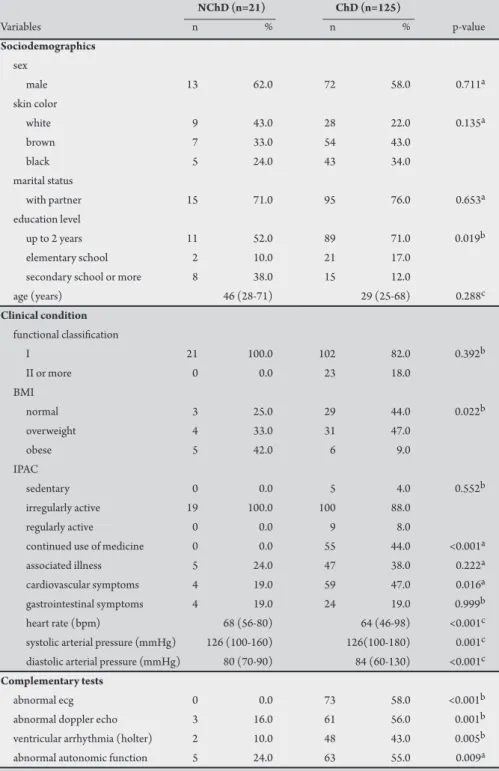
RESULTS TABLE 1 - Sociodemographic and clinical features and complementary test characteristics of non-Chagas
disease (NChD) and Chagas disease (ChD) patients.
NChD (n=21) ChD (n=125)
Variables n % n % p-value
Sociodemographics sex
male 13 62.0 72 58.0 0.711a
skin color
white 9 43.0 28 22.0 0.135a
brown 7 33.0 54 43.0
black 5 24.0 43 34.0
marital status
with partner 15 71.0 95 76.0 0.653a
education level
up to 2 years 11 52.0 89 71.0 0.019b
elementary school 2 10.0 21 17.0
secondary school or more 8 38.0 15 12.0
age (years) 46 (28-71) 29 (25-68) 0.288c
Clinical condition functional classiication
I 21 100.0 102 82.0 0.392b
II or more 0 0.0 23 18.0
BMI
normal 3 25.0 29 44.0 0.022b
overweight 4 33.0 31 47.0
obese 5 42.0 6 9.0
IPAC
sedentary 0 0.0 5 4.0 0.552b
irregularly active 19 100.0 100 88.0
regularly active 0 0.0 9 8.0
continued use of medicine 0 0.0 55 44.0 <0.001a
associated illness 5 24.0 47 38.0 0.222a
cardiovascular symptoms 4 19.0 59 47.0 0.016a gastrointestinal symptoms 4 19.0 24 19.0 0.999b heart rate (bpm) 68 (56-80) 64 (46-98) <0.001c systolic arterial pressure (mmHg) 126 (100-160) 126(100-180) 0.001c diastolic arterial pressure (mmHg) 80 (70-90) 84 (60-130) <0.001c Complementary tests
abnormal ecg 0 0.0 73 58.0 <0.001b
abnormal doppler echo 3 16.0 61 56.0 0.001b
ventricular arrhythmia (holter) 2 10.0 48 43.0 0.005b abnormal autonomic function 5 24.0 63 55.0 0.009a Data are absolute numbers (percentage) or median values (minimum-maximum). NChD: non-Chagas disease, ChD: Chagas disease, BMI: body mass index, IPAC:International Physical Activity Questionnaire, ECG: electrocardiogram, Doppler Echo: Doppler echocardiogram. aChi square test, bFisher test, cMann-Whitney test.
To evaluate the factors associated with QoL in the ChD group, ive diferent outcome variables were used: physical and mental component summary and domains which showed significant diferences in QoL between the ChD and NChD groups, the physical functioning and role-emotional from the SF-36 scale, and the MLWHFQ. For all of the variables, except the SF-36 role-emotional scale, the Qol scores were coded with an ordinal variable with four categories, which used the quartiles as cutoff points. The role-emotional scale was not recoded because it always produces a variable with four categories: scores 0, 33, 67, and 100. he explanatory
variables were the clinical, sociodemographic and complementary examination characteristics.
he ordinal logistic regression model was used for the univariate and multivariate analysis and the proportional odds model was chosen. In the model for the role-emotional domain, due to the discrete distribution of data (scores of 0, 33, 66, and 100), the stereotype ordinal logistic regression model was also performed, but the results were similar to those of the proportional odds model, which was the one chosen28.
he logistic regression procedure began with the selection of
Demographic, clinical, and com-plementary examination characteristics
he sociodemographic and clinical features and complementary test results of the ChD and NChD subjects are presented in Table 1. Significant differences were observed in the level of education, percentage of obese participants, frequency of use of medication, reports of cardiovascular symptoms, median cardiac frequency, systolic and diastolic arterial pressure, abnormal ECG, abnormal Doppler echocardiogram, ventricular arrhythmia detected during Holter monitoring and abnormality in the autonomic function tests.
variables that had a p-value of ≤ 0.20 in the univariate analysis and later was adjusted by eliminating individual variables. he criterion for the variables to remain in the inal model was a p value ≤ 0.05 (Wald test). he odds ratio (OR) and conidence interval (CI) was estimated for each covariable. This model provides a single OR estimate for all of the categories compared, due to the proportional odds assumption, which was tested for all of the variables individually and for the inal model. A deviance test was used to evaluate the model’s goodness-of-it29.
Ethical considerations
his study involved reciprocal agreement between the researcher and the research line coordinator and was assessed and approved by the COEP UFMG (Research Ethics Commitee of the Federal University of Minas Gerais). All of the study participants signed the informed consent forms and received writen examination results, as well as the recommendations and appropriate referrals, while being treated as usual in the specialized health unit.
Quality of life
Table 2 shows that the QoL scores were signiicantly worse amongst the ChD group compared to the NChD group in the SF-36 domains of physical functioning and role-emotional. Poor QoL was also observed in the ChD group with the MLWHFQ scale. he SF-36 item evaluating the patient's perception of the development of their state of health over the past year did not show statistically signiicant diferences between the groups, 9.6% of the ChD group considered that their state of health was worse or much worse compared to 0% of the NChD group. About 30% of the NChD considered that their health was beter or much beter, in contrast to 21.6% in the ChD group. In the two groups, the most common response was no change, as reported by 68.8% of the ChD and 61.9% of the NChD group.
Multivariate analyses using the ordinal logistic regression model are presented in Table 3. he models were well ited, considering the Deviance test and the supposition of proportional odds; i.e., the single OR for all of the QoL categories compared were valid for all of the constructed models. The abnormal echo variable (p = 0.063) was kept in the model for the SF-36 physical summary score because of its clinical importance. he covariables associated with a poor QoL according to the inal logistic regression model were:I)Medical Outcomes Study 36-item Short-Form (SF-36): a) physical component summary: poorer functional classiication (OR = 8.02, 95% CI = 2.63–24.41), presence of cardiovascular symptoms (OR = 4.12, 95%CI = 1.78–9.55), and Doppler echocardiogram examination abnormalities (OR = 2.05, 95% CI = 0.96–4.36); b) mental component summary: presence of cardiovascular symptoms (OR = 2.69, 95%CI = 1.26–5.78), female sex (OR = 2.49, 95%CI = 4.31–20.66) poorer physical functioning (OR = 2.49, 95%CI = 1.12-5.52); c) physical functioning: less than two years of education (OR = 16.82, 95%CI = 4.10–
TABLE 2 - Quality of life scores of non-Chagas disease (NChD) and Chagas disease (ChD) groups.
Quality of life variables NChD (n=21) ChD (n=125) p-valuea SF-36
physical summary 52 (48 - 55) 48 (38 - 54) 0.078 mental summary 55 (51 - 57) 53 (43 - 58) 0.446 physical functioning 95 (85 - 100) 85 (65 - 95) 0.011 role-physical 100 (63 - 100) 100 (50 - 100) 0.249 bodily pain 72 (57 - 100) 62 (42 - 96) 0.154 general health 72 (62 - 85) 67 (50 - 82) 0.108 vitality 80 (60 - 83) 75 (55 - 85) 0.490 social functioning 100 (75 - 100) 88 (63 - 100) 0.596 role-emotional 100 (100 - 100) 100 (33 - 100) 0.020 mental health 80 (66 - 88) 76 (60 - 88) 0.454 MLWHFQ scale 0 (0 - 10) 5 (0 - 14) 0.028 NChD: non-Chagas disease, ChD: Chagas disease, SF-36: Medical Outcomes Study 36-item Short-Form,MLWHFQ: Minnesota Living with Heart Failure Questionnaire. Data are median (Q1-Q3). aMann-Whitney test.
TABLE 3 - Model of multivariate analyses: associated factors with quality of life domain: physical and mental summaries, physical functioning and role-emotional of the SF-36 and Minnesota Living with Heart Failure Questionnaire (MLWHFQ) scales.
Physical Mental summary SF-36 SF-36 Role- MLWHFQ
Variables summary SF-36 SF-36 physical function emotional
Female —- 9.43[4.31-0.66] 3.63 [1.51-8.72] 7.04 [3.4-16.32]
—-Marital status (single) —- —- —- —- 2.30 [1.02-.15]
Education —- —- 16.82 [4.10-68.97] —- 4.39 [1.37-14.13]
<2 years
Poorest functional classiication 8.02 [2.63-24.41] 2.49 [1.12-5.52] —- —- 3.30 [1.54-7.05] CVS 4.12 [1.78-9.55] 2.69 [1.26-5.78] 4.67 [1.93-11.30] 8.61 [3.60-20.59] 9.11 [3.93-21.12]
GIS —- —- 3.76 [1.17-12.11] —-
—-Associated illnesses —- 2.75 [1.19-6.37] —-
—-Abnormal Doppler Echo 2.05 [0.96-4.36] —- —- —-
—-Ventricular arrhythmias (Holter) —- —- 2.47 [1.12-5.45] —-
—-Goodness-of-it test 0.74 0.73 0.99 0.10 0.93
Supposition proportional odds 0.55 0.44 0.99 0.20 0.44
Data are odds ratio with 95% conidence interval. MLWHFQ: Minnesota Living with Heart Failure Questionnaire, SF-36: Medical Outcomes Study 36-item Short-Form, CVS: cardiovascular symptoms, GIS: gastrointestinal symptoms, Doppler Echo: Doppler echocardiogram, OR: odds ratio,
CI: conidence interval. A p-value deviance score.
DISCUSSION
Diferences in the clinical, demographic and complementary examination characteristics of the Chagas disease and non-Chagas disease groups and their association with quality of life
Considering the demographic and clinical diferences found between the ChD and NChD groups and the results of complementary tests, a lower level of education, lower percentage of obesity and lower median functional class was veriied in the ChD group. he same group showed greater rates of continuous use of medication, presence of cardiovascular symptoms, abnormalities in ECG and Doppler echocardiogram tests and autonomic function tests, greater ventricular arrhythmia detected during Holter monitoring, as well as greater median systolic and diastolic pressure. According to the relevant literature, the diferences observed are related, either directly or indirectly, to the ChD proile and the potential development of cardiac disease. An exception was the smaller percentage of obesity in the group, since no speciic data exists in the literature regarding this condition in Ch16,18,30-34.
he known vulnerability associated with underdevelopment and poverty, observed in the majority of the population afected by ChD35,
was expressed in this study by the lower level of education veriied in the ChD group. In the literature, this condition is highlighted as predictive of mortality from cardiovascular diseases26,36, and in this
study, it was predictive of poorer HRQoL in the ChD group for the SF-36 physical functioning domain and the MLWHFQ scale.
Features identiied in the ChD group, including a lower level of education, greater frequency of continuous medication use and greater presence of cardiovascular symptoms, were associated with poorer HRQoL scores. Such indings suggest that, in addition to the relevance of further study, a multidisciplinary health team is important in the development of a care model, as highlighted in the literature for patients sufering from chronic diseases4.
Health-related quality of life of Chagas disease
Reports in the literature indicate poorer HRQoL scores for individuals with chronic diseases, mainly in the case of diseases that are more symptomatic and cause greater incapacity3. Studies
concerning QoL in ChD are scarce and most articles addressed this QoL issue in a generic sense, without using validated instruments. Some papers deal with speciic conditions, such as those of pacemaker users, heart failure, or pre- and postreatment evaluations, and do not describe the proile of QoL in ChD patients. Furthermore, some authors suggest that the putative relation between ChD and depression deserves to be elucidated37.
Four studies evaluated ChD patients using a validated QoL instrument (WHOQoL-bref ), although with different methodologies. Hueb, using self-evaluations, reported that ChD subjects were significantly dissatisfied with their QoL, general health and daily activity performance in general38. Ozaki
demonstrated that worse QoL scores correlated with a greater intensity of depression symptoms39. Dias veriied the lowest score
in the environment domain in ChD. he worst perception of QoL in the physical domain was related to a greater number of associated diseases and cardiac and gastric forms of ChD. he psychological and social relation domains were related to cardiac and gastric forms of ChD, while the environment domain correlated with women40.
Gontijo et al41 analyzed the QoL in ChD and veriied that the cardiac
form of the disease is associated with greater psychological sufering compared to the absence of cardiopathy and that faith helped to deal with the day-to-day diiculties.
In this study, the ChD group presented signiicantly worse scores for the SF-36 physical functioning and role-emotional domains and for the MLWHFQ. Studying pacemaker patients, Oliveira also reported that the SF-36 physical functioning scores were lower in the ChD group compared to a NChD group42. Hidden fear of
the impossibility of stopping the disease and its possible malign development43 are perhaps expressed by the worse role-emotional
score veriied for the ChD group in this study.
Signiicant diferences were observed in the HRQoL scores between the ChD and NChD groups only in the SF-36 domains of physical functionality and role-emotional and in the MLWHFQ. However, Table 2 shows that the medians of the scores in the ChD group were lower in all of the valid aspects, as also reported by Hueb38.
Factors associated with the worst scores
In the present study, it is noteworthy that being female appears to be a risk for over nine-fold poorer QoL for the mental components summary, seven-fold for the role-emotional domain and over three-fold for the physical functioning domain, in agreement with data in the literature for other clinical conditions. It is interesting that the ChD literature indicates being male as a risk factor for more severe myocardial damage44. In addition, an abnormal ECG, which
is recognized as a factor associated with an increased risk of events amongst ChD patients, did not correlate with poorer QoL. Such indings demonstrate the complementary nature of the HRQoL evaluation and that it adds valuable information to routine clinical methods by considering other aspects related to patient well-being.
It is also noteworthy that the presence of factors subject to intervention, such as associated illness and gastrointestinal and cardiovascular symptoms, negatively inluenced the QoL of ChD. he presence of cardiovascular symptoms, for example, impacted on ive of the HRQoL aspects evaluated and the MLWHFQ score, indicating the great efect of this factor on the well-being of patients.
An abnormal Doppler echocardiogram, the presence of ventricular arrhythmia and poorer functional classiication, indicated by Rassi et al32 as risk factors for sudden cardiac death due to cardiovascular
causes, also appeared in this study as risk factors for poorer HRQoL in the ChD group. It is noteworthy that poorer functional classiication increased the odds of poorer QoL eight-fold in the physical components summary and 17-fold in the physical functioning domain.
Limitations
Some limitations of this study should be considered. he main limitation is the small available sample of NChD subjects. his study was conducted in patients followed in a longitudinal prospective study and it was not possible to recruit new patients, since all of them had been selected almost ten years before. It was not possible to retrieve some potentially signiicant information, because of the duration of residence in the rural area and of exposure to reinfection. he absence of SF-36 reference scores for the Brazilian population is also an important issue, since it prevents further comparison between ChD patients and other populations.
Conclusions
generic questionnaire and the MLWHFQ speciic questionnaire. he factors which stand out among those related to the worst scores in the ChD are being female, cardiovascular symptoms and poor functional classiication. Although further studies are required in order to deine SF-36 reference values for the Brazilian population, the data strongly suggest that the evaluation of HRQoL should be incorporated into clinical studies involving ChD.
he authors declare that there is no conlict of interest. CONFLICT OF INTEREST
FINANCIAL SUPPORT
REFERENCES CNPq and FAPEMIG.
1. Badia X, Carne X. Evaluation of quality of life in clinical trials. Med Clin (Barc) 1998; 110:550-556.
2. Alonso J. he measurement of health related-quality of life in clinical research and practice. Gac Sanit 2000;14:163-167.
3. Alonso J, Ferrer M, Gandek B, Ware Jr JE, Aaronson NK, Mosconi P, et al. Health-related quality of life associated with chronic conditions in eight countries: results from the International Quality of Life Assessment (IQOLA) Project. Qual Life Res 2004; 13:283-298.
4. Sprangers MA, de Regt EB, Andries F, van Agt HM, Bijl RV, de Boer JB, et al. Which chronic conditions are associated with beter or poorer quality of life? J Clin Epidemiol 2000; 53:895-907.
5. Fitzpatrick R, Fletcher A, Gore S, Jones D, Spiegelhalter D, Cox D. Quality of life measures in health care. I: Applications and issues in assessment. Bmj 1992; 305:1074-1077.
6. Seidl EM, Zannon CM. Quality of life and health: conceptual and methodological issues. Cad Saude Publica 2004; 20:580-588.
7. Minayo MCS, Hartz ZMA, Buss PM. Qualidade de vida em saúde: um debate necessário. Cien Saude Colet 2000; 5:7-18.
8. Ware Jr JE, Sherbourne CD. he MOS 36-item short-form health survey (SF-36). I. Conceptual framework and item selection. Med Care 1992; 30:473-483. 9. Ciconelli RM, Ferraz MB, Santos W, Meinao I, Quaresma MR. Tradução para a
língua portuguesa e validação do questionário genérico de avaliação de qualidade de vida SF-36 (Brasil SF-36). Rev Bras Reumatol1999; 39:143-150. 10. Rector TS, Kubo SH, Cohn JN. Patients self-assessment of their congestive heart
failure, part 2: content, reliability and validation of a new measure, the Minnesota Living With Heart Failure Questionnaire. Heart Fail 1987; 3:198-219. 11. Carrara DE. Avaliação prospectiva da qualidade de vida em pacientes com
miocardiopatia dilatada submetidos à ventriculectomia parcial esquerda. [Mestrado]. [São Paulo]: Universidade de São Paulo; 2001. 85p.
12. Carvalho VO, Guimarães GV, Carrara D, Bacal F, Bocchi A. Validação da versão em português do Minnesota Living With Heart Failure Questionnaire. Arq Bras Cardiol 2009; 93:39-44
13. World Health Organization. Programa Especial de Investigaciones y Ensenanzas sobre Enfermedades Tropicales. Report del grupo de trabajo cientiico sobre la enfermedad de Chagas [Internet]. Buenos Aires. Argentina: World Health Organization; 2007. [Cited 2009 June]. Available from: htp://who.int/tdr/ publications/publications/pdf/swg_chagas.pdf/ .
14. Organizacion Panamericana de la Salud. World Health Organization. Neglected Tropical Diseases. Intensiied Disease Management Estimación cuantitativa de la enfermedad de Chagas en las Américas. Vigilancia Santaria Y Atención de las Enfermidades Transmisibles. [cited 2009 feb] Available from: htp://who.int/ tdrold/publications/publications/pdf/swg_chagas.pdf/.
15. World Health Organization. New global effort to eliminate Chagas disease [Internet]. Genebra: World Health Organization; 2007. [cited 2010 June]. Available from htp://www.who.int/mediacentre/factsheets/fs340/en/index.html/.
16. Ribeiro AL, Rocha MO. Indeterminate form of Chagas disease: considerations about diagnosis and prognosis. Rev Soc Bras Med Trop 1998; 31:301-314. 17. Hueb MFD, Loureiro SR. Revisão: aspectos cognitivos e psicossociais associados
a doença de Chagas. Psicol Estud 2005; 10:137-142.
18. Rocha MO, Teixeira MM, Ribeiro AL. An update on the management of Chagas cardiomyopathy. Expert Rev Anti Infect her 2007; 5:727-743.
19. Goldman L, Hashimoto B, Cook EF, Loscalzo A. Comparative reproducibility and validity of systems for assessing cardiovascular functional class: advantages of a new speciic activity scale. Circulation 1981; 64:1227-1334.
20. Matsudo S, Araujo T, Marsudo V, Andrade D, Andrade E, Oliveira LC, et al. Questionário internacional de atividade física (IPAC): estudo de validade e reprodutibilidade no Brasil. Rev Bras Ativ Fís Saude2001; 6:5-18.
21. Hallal PC, Matsudo SM, Matsudo VKR, Araujo TL, Andrade DR, Bertoldi AD. Physical activity in adults from two Brazilian areas: similarities and diferences. Cad Saude Publica 2005; 21:573-580.
22. Ribeiro AL, Moraes RS, Ribeiro JP, Ferlin EL, Torres RM, Oliveira E, et al. Parasympathetic dysautonomia precedes let ventricular systolic dysfunction in Chagas disease. Am Heart J 2001; 141:260-265.
23. Oliveira E, Ribeiro AL, Assis Silva F, Torres RM, Rocha MO. he Valsalva maneuver in Chagas disease patients without cardiopathy. Int J Cardiol 2002; 82:49-54.
24. Lazzari JO, Pereira M, Antunes CM, Guimaraes A , Moncayo A , Chavez Dominguez R, et al. Diagnostic electrocardiography in epidemiological studies of Chagas’ disease: multicenter evaluation of a standardized method. Rev Panam Salud Publica 1998; 4:317-330.
25. Goncalves JG, Prata A. A comparison of three electrocardiogram coding systems for chronic Chagas’ disease. Rev Panam Salud Publica 2003; 14:201-208. 26. Liu K, Cedres LB, Stamler J, Dyer A, Stamler R, Nanas S, et al. Relationship
of education to major risk factors and death from coronary heart disease, cardiovascular deseases and all causes. Findings of three Chicago epidemiologic studies. Circulation 1982; 66:1308-1314.
27. Scatolin FA, Diogo MJ, Colombo RC. Correlation between instruments for measuring health-related quality of life and functional independence in elderly with heart failure. Cad Saude Publica 2007; 23:2705-2715.
28. Abreu MNS, Siqueira AL, Cardoso CS, Caiafa WT. Ordinal logistic regression models: application in quality of life studies. Cad Saude Publica 2008; 24: 5581-5591.
29. Abreu MNS, Siqueira AL, Caiaffa WT. Ordinal logistic regression in epidemiological studies. Rev Saude Publica 2009, 43:183-194.
30. Prata A. Clinical and epidemiological aspects of Chagas disease. Lancet Infect Dis 2001;1:92-100.
31. Silva AS. Estudo caso controle de fatores associados à cardiopatia chagásica em pacientes com mais de 50 anos. [Mestrado]. [Belo Horizonte]: Faculdade de Medicina. Universidade Federal de Minas Gerais; 2006. 110p.
32. Rassi Jr A, Rassi A, Rassi SG. Predictors of mortality in chronic Chagas disease: a systematic review of observational studies. Circulation 2007; 115:1101-1108. 33. Ribeiro AL, Cavalvanti PS, Lombardi F, Nunes MC, Barros MV, Rocha MO.
Prognostic value of signal-averaged electrocardiogram in Chagas disease. J Cardiovasc Electrophysiol 2008; 19:502-509.
34. Ianni B. Diagnostico e prognostico da forma indeterminada da doença de Chagas: o que há de novo? Rev Soc Cardiol Estado São Paulo 2009; 19:6-15. 35. Fundação Oswaldo Cruz. Doença de Chagas [Internet]. Seção importância
social. [cited 2008 June]. Available from: htp://www.iocruz.br?chagas/cgi/ cgilua.exe/sus/start.htm?sid=1 .
36. Lopes CC, Yamada A, Araujo F, Barreto AP, Mansur A. Socioeconomic factors in the prognosis of heart failure in a Brazilian cohort. Int J Cardiol 2005; 113: 181-187.
37. Mosovich SA, Mady C, Lopes N, Ianni B, Dias JC, Correia D, et al. Chagas disease as a mechanistic model for testing a novel hypothesis. Rev Soc Bras Med Trop 2008; 41:70-72.
39. Ozaki Y. Qualidade de vida e sintomas depressivos em portadores da doença de Chagas em atendimento no ambulatório do grupo de estudos em doenças de Chagas. [Mestrado]. [Campinas]: Faculdade de Ciências Medicas. Universidade Estadual de Campinas; 2008. 112p.
40. Dias ELF. Qualidade de vida de adultos e idosos portadores da Doença de Chagas. [Mestrado]. [Campinas]: Faculdade de Ciências Medicas. Universidade Estadual de Campinas; 2009. 136p.
41. Gontijo ED, Guimarães TN, Magnani C, Paixão GM, Dupin S, Paixão LM. Qualidade de vida dos portadores de doença de Chagas. Rev Med Minas Gerais 2009; 19:281-285.
42. Oliveira BG. Medida da qualidade de vida em portadores de marcapasso: tradução e validação de instrumento especiico. [Mestrado]. [Belo Horizonte]: Escola de Enfermagem, Universidade Federal de Minas Gerais; 2003.116p.
43. Jorg M, Storino R, Sapino RV. Participacion encefalopatica en la enfermedad de Chagas cronica. Relexiones derivadas de experiencia personal. Rev Soc Bras Med Trop 1994; 27:31-37.