Inse ct juve nile ho rm o ne : fro m
“status quo ” to high so cie ty
Departamento de Biologia, Faculdade de Filosofia,
Ciências e Letras de Ribeirão Preto, Universidade de São Paulo, Ribeirão Preto, SP, Brasil
K. Hartfelder
Abstract
Juvenile hormone (JH) exerts pleiotropic functions during insect life cycles. The regulation of JH biosynthesis by neuropeptides and bio-genic amines, as well as the transport of JH by specific binding proteins is now well understood. In contrast, comprehending its mode of action on target organs is still hampered by the difficulties in isolating specific receptors. In concert with ecdysteroids, JH orches-trates molting and metamorphosis, and its modulatory function in molting processes has gained it the attribute status quo hormone. Whereas the metamorphic role of JH appears to have been widely conserved, its role in reproduction has been subject to many modifica-tions. In many species, JH stimulates vitellogenin synthesis and uptake. In mosquitoes, however, this function has been transferred to ecdysteroids, and JH primes the ecdysteroid response of developing follicles. As reproduction includes a variety of specific behaviors, including migration and diapause, JH has come to function as a master regulator in insect reproduction. The peak of pleiotropy was definitely reached in insects exhibiting facultative polymorphisms. In wing-dimorphic crickets, differential activation of JH esterase determines wing length. The evolution of sociality in Isoptera and Hymenoptera has also extensively relied on JH. In primitively social wasps and bumble bees, JH integrates dominance position with reproductive status. In highly social insects, such as the honey bee, JH has lost its gonadotropic role and now regulates division of labor in the worker caste. Its metamorphic role has been extensively explored in the morphological differentiation of queens and workers, and in the generation of worker polymorphism, such as observed in ants.
Co rre spo nde nce
K. Hartfelder
Departamento de Biologia FFCLRP, USP
Av. Bandeirantes, 3900 14040-901 Ribeirão Preto, SP Brasil
E-mail: khartfel@ rgm.fmrp.usp.br
Presented at the XIII Annual Meeting of the Federação de Sociedades de Biologia Experimental, Caxambu, MG, Brasil, August 26-29, 1998.
Research supported in part by a DFG grant (Ha 1625/3-1) and a CAPES-DAAD fellowship. Publication supported by FAPESP.
Received July 7, 1999 Accepted November 19, 1999
Ke y wo rds ·Juvenile hormone
·Corpora allata
·Metamorphosis
·Insect reproduction
·Polymorphism
·Honey bee
Intro ductio n
Few hormones have puzzled and fasci-nated entomologists more than juvenile hor-mone (JH). This is obviously due to the hormones pleiotropic functions, from a) or-chestrating metamorphosis in concert with the molt-inducing ecdysteroid hormones, b)
decisive life history parameters during their entire life cycles. JH has been considered to be an exclusive insect hormone and thus has attracted much attention also in plant and grain protection-oriented research. Recent studies, however, provide evidence that ma-rine annelids can detect compounds with juvenoid activity and can use these as meta-morphosis signals (1). In crustaceans, the JH precursor methyl farnesoate, which is pro-duced in the mandibular organ, assumes many roles attributed to JH in insects (2). If com-parative endocrinology and neuroendocri-nology is understood as being more than just the compilation of endocrine physiology of non-mammalian animals, i.e., of approxi-mately 99% of the animal kingdom, then a closer look at such master regulators should contribute to our understanding of the evolu-tion of hormones and of their receptors. Furthermore, we may come to a broader comprehension of how each class of animals has dealt during its evolution with such basic problems as homeostasis, as well as coordi-nated development and reproduction in vari-able environmental conditions.
The purpose of the present review is not to go into all the details and intricacies of JH function(s). Excellent recent reviews (3,4) have covered this field extensively. Instead, the in-tention of this review is to present, as briefly as possible, the basic paradigms of this hormones function and physiology in insects, and to concentrate more on its wide-ranging ecologi-cal implications, i.e., to show how profoundly it can shape and even modify life histories. The most dramatic changes in life histories can be encountered in social insects, where most individuals of a colony bestow most of their reproductive potential upon a dominant queen (in Hymenoptera) or a royal pair (in termites). Emerging views from studies on social insects now clearly indicate that JH also is deeply entrenched in practically all aspects of social life, affecting the genera-tion not only of different morphs, but also of neural and resulting behavioral plasticity.
Juve nile ho rm o ne s: che m istry, bio synthe sis, and mo de s o f actio n
By grafting different life stages of the
blood-sucking bug, Rhodnius prolixus,
Wigglesworth (see Refs. 3,4) discovered in 1936 that JH has two major roles in an insects physiology and life history, namely to prevent metamorphosis and to regulate reproduction. Its function to prevent the pre-cocious metamorphosis of an insect larva into an adult when passing through frequent molts, gained it the title status quo hor-mone. The small quantities of JH present either in the site of synthesis, the corpora allata (CA) in the retrocerebral endocrine complex, or circulating in insect hemolymph, however, considerably delayed the elucida-tion of the chemical structure of JH.
The serendipitious discovery of a copi-ous source of JH in abdomens of male satur-niid silkmoths, Hyalophora cecropia made possible the chemical identification of JH (then designated as JH I) as a sesquiterpenoid epoxide methyl ester. Subsequently, a small number of closely related compounds was isolated and identified (for structures, see Ref. 3). JH I and occasionally also JH II are principally found in lepidopterans, whereas the JH homolog detected throughout all in-sect orders is JH III, the trimethyl homolog. JH 0, the triethyl homolog, has only been found in lepidopteran embryos. JH acids, the non-methylated derivatives of JH, also con-stitute a relevant fraction of JH compounds circulating in hemolymph of moths and may have hormonal functions that cannot be per-formed by JH itself. The cyclorraphan dipter-ans and some hemipterdipter-ans possess a special type of JH, namely a bisepoxide version of JH III. A new class of juvenile hormones, the hydroxy juvenile hormones, have recently been identified as biosynthesis products of locust corpora allata (5), apparently as by-products of JH III synthesis.
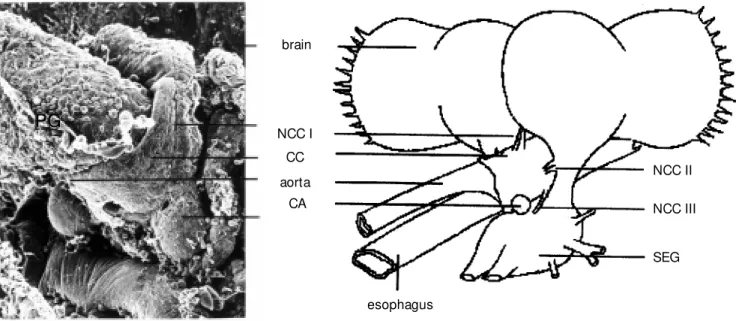
the retrocerebral complex (Figure 1) attached to the brain via two or three pairs of nerves.
De novo synthesis of JH starts from acetyl CoA and/or propionyl CoA subunits and follows the mevalonate pathway to farnesoic acid (for a review of JH biosynthesis, see Ref. 6). The last two steps are the methylester formation, leading to methyl farnesoate, and the introduction of an epoxide group in posi-tion 10,11 of the carbon skeleton. Tobe and Pratt (7) took advantage of the exclusive utilization of S-adenosyl-methionine as do-nor of the methyl group in the esterification step in JH biosynthesis and developed a highly sensitive radiochemical in vitro assay for the determination of rates of JH synthe-sis. This assay was crucial to the elucidation of regulatory pathways and for the identifi-cation of neurohormones stimulating or in-hibiting CA activity.
An inhibitory regulation of the CA via the descending nerves has been proposed several decades ago, but the principal play-ers, the allatostatic neuropeptides, have only
been identified ten years ago in the vivipa-rous cockroach, Diploptera punctata. The
Diploptera allatostatins are a family of amidated peptides with a conserved C-ter-minus (FGLamide), which differ from known peptides in other organisms. These FGLamides are a widespread class of pep-tides in insects and include the allatostatins of cockroaches and crickets, as well as struc-turally related peptides of locusts and blow-flies. Regulation of JH synthesis appears to be only one of the many functions of these peptides. As expected, allatostatin immu-noreactive neurons could be detected in lat-eral neurosecretory cells innervating the CA of D. punctata (8), but were also found in other regions throughout the central nervous system, including thoracic motoneurons and nerves innervating the gut. In the tobacco hornworm, Manduca sexta, they appear to have neuromodulatory and myotropic func-tions, but do not exhibit allatoregulatory ac-tivity. The authentic allatostatin of Manduca sexta, however, does not resemble the
brain
NCC I CC aorta
CA
NCC II
NCC III
SEG
esophagus
PG
Diploptera allatostatins. The only peptide stimulating JH synthesis has been identified in M. sexta (9). It stimulates JH synthesis in CA of adults only, and appears to be re-stricted to lepidopterans in its activity.
The mode of action of allatostatins on CA cells is principally mediated via calcium signalling involving protein kinase C (10). The enzymes affected by allatostatins ap-pear to be situated at both ends of the biosyn-thesis pathway. Sutherland and Feyereisen (11) propose an inhibitory action on the transfer of the initial C2 units from mito-chondria to the cytoplasm, but, interestingly, not on the much speculated HMG-CoA re-ductase, which is a rate-limiting enzyme in vertebrate steroid synthesis. In some insects, such as D. punctata, allatostatins also affect the terminal steps of JH biosynthesis in the CA (12). In addition to these specific neu-ropeptides, some biogenic amines, octopa-mine, serotonin, and dopaoctopa-mine, also turned out to be potent modulators of CA activity, apparently being coupled to cAMP as sec-ond messenger system (13,14). Their activ-ity, however, strongly varies between spe-cies, and even between different develop-mental stages in the same species.
Being highly lipophilic, the insect JHs are transported from their site of synthesis to target tissues via specific high affinity bind-ing proteins that aid their transport in the hemolymph. Most insects use lipophorins or hexameric proteins (Orthoptera) as high-molecular-weight high-affinity JH-transport proteins, except for the lepidopterans which have specific low-molecular-weight JH car-riers (15). Detailed simultaneous analyses of JH titer and of JH-binding proteins in hemo-lymph revealed that practically all JH is bound to these carriers, which appear to be always present in excess. In conjunction with their transport role, these proteins also protect JH from degradation by general esterases. Meta-bolic inactivation of JH occurs by two major pathways, by specific JH esterases in the hemolymph and by tissue bound epoxide
hydrolases. JH esterases clear JH from the hemolymph during critical developmental phases (16), apparently acting in synergism with JH-binding proteins.
Crucial to the isolation and identification of these JH-binding and -metabolizing pro-teins was the synthesis of highly specific JH analogs for photoaffinity labeling (17). This strategy was also employed in the search for the most interesting of all JH-binding pro-teins, the JH receptor(s). Based on the chem-ical nature of JH and on analogy to ecdyster-oids, most research concentrated on nuclear receptors. The most promising candidate, however, a 29-kDa protein isolated from larval epidermis of M. sexta, has since turned out to be artifactual. Putative JH receptors
isolated from the cockroach Leucophaea
maderae and from Locusta migratoria also appear to be cellular JH-binding proteins (18), possibly involved in the transport of this hydrophobic ligand to its actual recep-tor. These proteins are present far in excess of the 104 copies/cell estimated for steroid and thyroid hormone receptors. Due to the structural similarity of JH to retinoids, ho-mologs of RXR have been proposed as pos-sible candidates for a JH receptor. The RXR homolog of insects, however, turned out to be the product of the ultraspiracle gene, which is the heterodimer partner of the ecdy-sone receptor.
many substrates and by the apparent abun-dance and variety of specific JH-binding proteins. Taking a genetic approach, such as the methoprene selection screen in Drosoph-ila, has led to the identification of the methoprene-tolerant (Met) mutation.
Clon-ing and sequencClon-ing of the Met(+)-gene
showed homology to the basic helix-loop-helix-PAS family of transcription factors, implicating Met protein in a gene regulatory function of JH (20). Met(+) could now be linked to the ecdysone-inducible Broad-Com-plex transcription factors (21), suggesting that it is an early downstream element in the JH response cascade. Looking for gene prod-ucts that interact with Met(+) may turn out to be an interesting alternative in the search strategies for the JH receptor.
Juve nile ho rm o ne : the “status quo ” facto r in m o lting and m e tam o rpho sis
During larval development, the presence of JH in the hemolymph prevents an insect from precociously turning into an adult, thus explaining the nomenclature juvenile hor-mone and status quo factor. Early models proposed a gradual decline of JH titers asso-ciated with cyclic surges of ecdysone, the molt-inducing hormone. Actual quantifica-tions of JH and ecdysteroid titers, however, revealed a much more complicated and intri-cate regulation of the premetamorphic and metamorphic molts, particularly in holo-metabolous insects which have to pass through a complete reorganization of body structure during the pupal stage. Meticulous titer analyses, together with surgical experi-ments and application of synthetic hormones, were carried out mainly on the tobacco horn-worm, Manduca sexta, making this moth the preferred model system for studies on insect metamorphosis. In each larval stage, a JH-sensitive period was detected which usually occurs concomitantly with the molt-induc-ing ecdysone peak. In the last (fifth) larval instar of M. sexta, two such JH-sensitive
periods could be found, together with marked differences in hormone titer profiles when compared to the earlier instars (for review, see Ref. 3). In the fifth instar, the JH titer declines when the larva has reached a criti-cal weight. This decline stimulates the lat-eral neurosecretory cells of the brain to re-lease prothoracicotropic hormone (PTTH), which in turn elicits ecdysone synthesis and release from the prothoracic glands. Thus, for the first time in the life cycle, a surge of ecdysone occurs in the absence of JH. This surge of ecdysone has been termed the com-mitment peak since it has a profound effect on the larval epidermis, essentially erasing the program of larval cuticle synthesis. Two days later, another surge of PTTH, now ac-companied by a high JH titer, results in a much higher ecdysone peak, which elicits the next molt. The presence of JH during the JH-sensitive period early in this second ec-dysone peak ensures that the epidermis syn-thesizes a pupal cuticle and not precociously an adult cuticle. Thus, JH preserves the sta-tus quo in terms of the program triggered by the ecdysteroid peak, and it does so, appar-ently universally, in all insects. The only difference between hemimetabolous and hol-ometabolous insects seems to lie in the com-plexity of interactions between the molt-inducing ecdysteroids, in particular 20-hydroxyecdysone (20E), and the molt-di-recting JH.
stages of a species, but may also be quite different between insect orders. Whereas in lepidopterans JH affects prothoracic gland activity primarily through the PTTH path-way (22), incubation of isolated prothoracic glands of honey bee larvae in the presence of the JH analog methoprene directly stimulat-ed ecdysteroid production in vitro (23).
In-depth studies on the premetamorphic and metamorphic effects of JH on peripheral target tissues have mainly focussed on the larval epidermis and prolegs of M. sexta. The model of coordinated switches from a larval to a pupal and then to an imaginal program of cuticle synthesis, proposed from macroscopic analyses of cuticle types pro-duced during the molting cycles, however, has not yet been validated at the molecular level. Temporal expression patterns of indi-vidual genes coding for different larval cu-ticle proteins of M. sexta, as well as for pigmentation factors (larval insecticyanin and the melanization-triggering enzyme dopade-carboxylase) were studied extensively (see Ref. 3). These genes exhibit many appar-ently idiosyncratic temporal expression pat-terns, suggesting that JH and probably even more directly ecdysteroids interact or com-pete for binding sites in the upstream control region of the respective genes. A putative model for the interaction of 20E and JH based on studies of dopadecarboxylase gene expression proposes that JH in conjunction with 20E induces a long-lived positive tran-scription factor A, whereas 20E alone in-duces a short-lived negative-effect factor (3). In this scenario, degradation of the 20E-induced factor is expected to result in a burst of dopadecarboxylase expression which should last until the JH/20E-coregulated fac-tor is also degraded.
Whereas most of these studies on JH-regulated gene expression were looking at target genes at the end of a JH-induced sponse cascade, a more recent line of re-search is trying to decipher the putative ele-ments within such a cascade. Just as the
Broad-Complex mentioned above, the ex-pression pattern of a M. sexta homolog of the 20E-induced transcription factor E75A of
Drosophila melanogaster exhibited respon-siveness also to JH (24). Drosophila-E75
encodes an orphan member of the nuclear hormone receptor superfamily. In Manduca, the rapid, transient induction of E75 mRNA by 20E turned out to be much attenuated in epidermis of fourth-instar larvae, which typi-cally have a high endogenous JH titer. These findings show for the first time that JH plays a role in 20E-induced early gene expression and suggest that the higher levels of E75A may be required for maintenance of larval commitment of this epidermis. It is not yet clear whether JH acts directly on the E75
gene to influence its transcription rate, or whether it affects the stability of E75 mRNA. Evidence for a modulatory role of JH in the expression of 20E-regulated genes comes from studies on larval storage proteins syn-thesized in the fat body of the cabbage looper,
Trichoplusia ni, strongly supporting the idea that JH affects both transcription rates and mRNA stability. With the exception of arylphorin, most of the larval storage pro-teins of T. ni turned out to be regulated (suppressed) by JH at the transcriptional level. DNase-I hypersensitive site mapping suggested conformational changes in a re-gion 50-100 bp 5 upstream of the TATA box (25). Nuclear run-on assays presented evidence that poly(A) tail length of storage protein mRNAs was modulated by exposure to JH. These storage proteins belong to the class of hexamerins which are synthesized by the larval fat body. They serve as reserves for the reconstruction processes occurring during the pupal phase. Additionally, they may serve as metabolic reserves for insects that are not feeding in the adult stages.
The go nado tro pic ro le s o f juve nile ho rm o ne
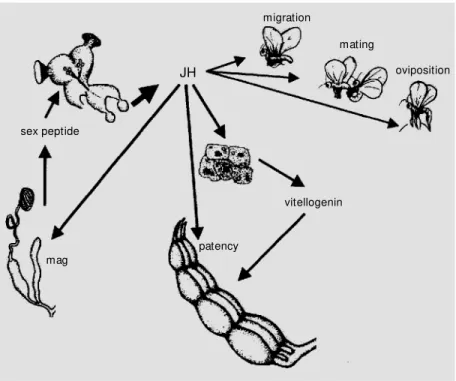
reproduction that it can justly be called a master regulator of the female reproduction syndrome. In addition to its central role in oogenesis, JH affects dispersal and flight activity, calling behavior, postcopulatory changes in female behavior, and oviposition behavior. The diversity of life history strate-gies in insects and a myriad of adaptations that enabled them to colonize practically every terrestrial habitat, however, generated a plethora of twists and turns that preclude the proposal of a unifying JH hypothesis for hormonal regulation of insect reproduction. Quite different from the more conserved role of JH as a modulator of ecdysteroid action in larval-pupal development, the roles of JH in adult insects are, at first sight, rather confus-ing. However, once the roles and implica-tions of JH action in the different aspects of the reproduction syndrome are carefully evaluated with respect to timing of repro-duction and trade-offs between different re-productive strategies, some general principles may emerge. In many aspects, the role of JH in insect reproduction - schematically com-piled in Figure 2 - could, therefore, be con-sidered as that of a conserved integrator which provides a platform for flexibility in life history strategies.
Vite llo ge ne sis
The gonadotropic role of JH was estab-lished by ingenuous transplantation and ligation experiments carried out by Wiggles-worth on females and males of the blood-sucking bug, Rhodnius prolixus (see Ref. 4). Vitellogenesis in females and synthetic activity of the male accessory gland were blocked by ligation and could be reinstalled in this species by transfer of active CA. Due to their larger size and ease of rearing, most subsequent experiments on vitellogenin synthesis by the female fat body and uptake of this protein by the growing oocytes were performed on cockroaches and locusts as model systems. Insect vitellogenins
are members of a large family of lipid-bind-ing proteins that exhibit conserved domains between protostome and deuterostome phyla (26). The titer of these proteins secreted by the fat body of adult female insects can account for up to 50% of their total hemo-lymph proteins. Particularly in long-lived adult insects with distinct reproductive cycles, synthesis of this major hemolymph protein must be correlated with oocyte development. The regulation of vitellogenin synthesis, its dependence on JH, and the mode of action of JH in vitellogenin gene expression has been, and continues to be, most extensively
stud-ied in the migratory locust, Locusta
migratoria, and in the viviparous cockroach
Leucophaea maderae (for review, see Ref. 4). Vitellogenin transcription rates and JH III titers are fairly well correlated throughout
Figure 2 - Schematic representation of the principal functions of juvenile hormone (JH) in reproduction of adult insects. JH released by the corpora allata (CA) modulates behavior associated w ith dispersal and female reproduction. In the female fat body, JH stimulates vitellogenin synthesis, and in the ovary it facilitates vitellogenin uptake by increasing patency of the follicular epithelium. In males, JH stimulates protein synthesis in the male accessory glands (mag). In some species, a sex peptide produced by these glands is transmitted to the female during mating. This peptide subsequently acts on the CA and modifies postcopulatory behavior in the females and stimulates oogenesis. Obviously, many of these aspects are species-specific and subject to considerable variation.
oviposition
sex peptide
migration
mating
vitellogenin
patency mag
the oogenesis cycles, and vitellogenin tran-scription could be selectively activated after application of JH analogs to chemically allatectomized (precocene-treated) locusts. The regulation of such gene expression is currently best understood for a low MW protein (JHP21) synthesized and secreted by the locust fat body in close coordination with the vitellogenin gene products VgA and VgB. The upstream control region of jhp21 has been shown to contain a palindromic 15-nucleotide motif (27) which resembles a canonical element recognized by the ecdy-sone receptor.
Regulation of vitellogenin gene transcrip-tion is clearly one of the prominent roles exerted by JH in reproductive cycles of female insects, and in this context the mode of action can be expected to involve a nuclear receptor. The second and not less important role of JH in oogenesis, however, appears to rely on an entirely different mechanism. In most insects, vitellogenin circulating in the hemolymph reaches the oocyte surface by passing through large spaces that appear between follicular epithelial cells in compe-tent follicles. In Rhodnius prolixus, enlarge-ment of these intercellular spaces in a pro-cess termed patency is entirely dependent on JH and is the result of a reduction in volume of the follicular epithelium cells. In vitro studies of this process in follicular epithelium membranes of R. prolixus and photoaffinity labeling with JH analogs of such membrane preparations in L. migratoria
(19) have provided evidence for a trans-membrane JH receptor. Binding of JH to this putative transmembrane receptor results in protein kinase C-mediated phosphoryla-tion of a 100-kDa protein which is thought to represent the a-subunit of Na+/K+ ATPase.
But to what extent can these aspects of the gonadotropic role of JH be generalized? The early and convincing results on the cen-tral role of JH in the control of female repro-ductive cycles in dictyopterans, hemipterans
and orthopterans established the JH para-digm in insect reproduction, but also clearly impaired the interpretation of negative evi-dence obtained in other insect species and orders. In the autogenous mosquito Aedes aegypti, induction of vitellogenin synthesis in the fat body requires 20E (28), which is synthesized by the ovary in response to a blood meal-dependent release of ovarian ecdysteroidogenic hormone (OEH, also termed EDNH) from the brain (29). In addi-tion to ecdysteroids, which regulate fat body activity in mosquito reproduction, JH also plays an important but different role in mos-quito oogenesis by preparing resting stage follicles to become competent for vitello-genesis after a blood meal. Furthermore, JH primes the fat body of newly emerged fe-male mosquitoes to respond to 20E. This priming function of JH in mosquitoes is similar to the one observed in newly emerged locusts and cockroaches, where it also con-fers competence on the fat body to respond with vitellogenin synthesis at full blast to subsequent peaks of the JH titer. A minimal model suggests that JH acts on the fat body of adult insects in two steps, requiring induc-tion of one or more transcripinduc-tion factors which then induce enhanced transcription of vitellogenin genes (30).
Male re pro ductio n and e ffe cts o f m ale se x
pe ptide s o n fe male re pro ductio n
tract of many insect species turned out to be targets for JH (4). Synthesis of specific pro-teins in the male accessory gland of the
migratory grasshopper, Melanoplus
sanguinipes, is highly JH sensitive. A high-affinity binding protein for JH has been iden-tified from nuclear extracts of this gland, and levels of this JH-binding protein increase during sexual maturation in close correla-tion with general protein synthesis in the male accessory glands of this grasshopper (31).
The products of the male accessory glands are not merely physical constituents of sper-matophores and seminal fluid, but some of their products turned out to have pronounced effects on female reproduction. Less than 1 picomol of a 36-amino acid peptide, a so-called sex peptide produced by the
acces-sory gland of Drosophila melanogaster
males, has been shown to elicit characteris-tic postmating behavior in females, i.e., loss of receptivity for males and induction of oviposition behavior (32). Interestingly, though not totally surprising in the context of regulatory circuits in female reproduc-tion, the female CA turned out to be targets of this sex peptide after its transfer to the female genital tract during copulation. In vitro assays with CA dissected from Dro-sophila virgin females showed that femtomolar concentrations of synthetic sex peptide resulted in strongly enhanced rates of JH biosynthesis (33). Interestingly, the
Drosophila sex peptide is not a species-specific bioactive compound, but exhibits activity beyond species and even genus level. Recently, the synthetic Drosophila peptide has been shown to stimulate JH synthesis and to depress pheromone production in the noctuid moth Helicoverpa armigera (34). Male influence on female reproductive be-havior by sperm fluid substances that modu-late JH synthesis is probably the most re-cently discovered facet of JH as an endo-crine master regulator of female reproduc-tion.
JH ple io tro py in fe m ale re pro ductive
be havio r, migratio n, and re pro ductive
diapause
In its simplest and clearest form, the role of JH as a pleiotropic master regulator of female reproductive physiology and behav-ior is expressed in cockroaches, where vitel-logenesis and cyclic maturation of oocytes is dependent on JH and occurs in coordination with sexual behavior. This has led to the proposal that JH is the common regulator of reproduction. Sexual behavior, however, is more variable than reproductive physiology, and doubts have been raised whether JH acts as a true regulator for all aspects of female sexual behavior, or whether, at least in some cases, it merely plays a permissive role. In
Blattella germanica, production and release (calling) of sex pheromone by the females occurs in close correlation with an increase in JH synthesis (35). However, a further increase in CA activity, as was observed after transfer of male factors during copula-tion, curtailed calling behavior and sexual receptivity. Other aspects of reproduction in female cockroaches, such as changes in feed-ing activity in relation to gonocycle and faster sexual maturation of females kept under crowded conditions in comparison to soli-tary females, are less well understood. A role for the CA has been proposed for both these aspects (35) but signal transduction path-ways for social effects and feeding stimuli have not been worked out definitively.
the proposal of an oogenesis-flight syn-drome, meaning that migration and repro-duction should be mutually exclusive and could not occur at the same time. Even though this formula is probably oversimplifying and may not fit all systems it has a considerable heuristic value. Strong evidence for a role of JH as a master regulator for the oogenesis-migration syndrome comes from studies on
the true armyworm, Pseudaletia
unipunc-tata, a noctuid moth which exhibits migra-tory behavior in Northern populations and is non-migratory in the South. Comparison of onset of female calling behavior, progress in oogenesis, and rates of JH biosynthesis by CA of females during the first days after emergence revealed a time shift for these two populations, with the non-migratory Southern population being more advanced (36). In this context, JH has been proposed to regulate the synthesis of a pheromonotropic brain factor (PBAN-like factor) in specific peptidergic neurons, but in this respect P. unipunctata appears to be a rather excep-tional case. Studies on another noctuid moth,
Agrotis ipsilon, have shown that JH does not modulate PBAN synthesis but rather stimu-lates its release from the CNS (37).
The hormonal regulation of diapause, which is a physiological and not a behavioral response to unfavorable environmental con-ditions, is much better understood (for re-view, see Ref. 38). According to the posi-tioning of diapause in an insects life cycle, JH acts as a regulator in two distinct phases, i.e., in the larva and the adult. High JH titers, in some cases in conjunction with low ecdy-steroid titers, prevent the pupal molt. In adults, low JH titers prevent reproduction and may induce searching behavior for suitable over-wintering sites. Low JH titers during dia-pause are maintained either by repression of CA activity or by elevated levels of JH es-terase. Diapause in other developmental stages is generally under the control of ecdy-steroids, or, as in bivoltine strains of the
silkworm, Bombyx mori, is induced by a
maternal peptide that is released from the subesophageal ganglion during oogenesis and blocks embryonic development after ovipo-sition.
migra-tory flights, and reproductive activities such as pheromone synthesis, calling, and oocyte maturation are closely linked and are JH dependent. Most of these species are polyan-drous, and every additional mating results in further stimulation of egg production.
Juve nile ho rmo ne and
de ve lo pme ntal po lymo rphism
Upholding the option to migrate or to reproduce right away clearly implies costs for building and maintaining a flight appara-tus, and natural selection should act to re-duce the cost of such flight-reproductive offs. Strong support for a fitness trade-off between flight capability and reproduc-tion is provided by comparative studies across a wide range of wing-polymorphic insects (40). Primary evidence for such a trade-off comes from a strong negative correlation between flight-muscle mass and ovarian mass, a relationship which suggests that con-struction and maintenance of the insect flight apparatus competes with egg production for a limited general pool of available nutrients. Various environmental cues such as crowd-ing, host plant condition, temperature, and photoperiod have an influence on wing form. Wing dimorphism is well exemplified in gryllids and is even more pronounced in aphids. It is only in these two groups that questions of hormonal control of wing poly-morphism have been pursued persistently (41).
Wing dimo rphism in cricke ts
Early proposals have suggested that JH might play a prominent role in such develop-mental polymorphisms, i.e., in the evolution of correlated traits of flight and reproductive potential, but obviously, such traits are de-termined in different phases of the insect life cycle. In most of the above discussion I addressed the role of JH in metamorphosis as rather distinct from its later role in female
reproduction. The fact that it is a pleiotropic master regulator for both programs, how-ever, makes it at the same time a prime candidate to act as an integrative element in the evolution of wing and consequent repro-ductive polymorphic systems. In the cricket
Gryllus rubens, application of JH III to lar-vae destined to mature into long-winged in-sects resulted in the formation of brachypter-ous adults, corresponding to the higher JH titer in the last larval instars of the brachyp-terous as compared to the macropbrachyp-terous morph. Interestingly, it is not an enhanced rate of JH biosynthesis which maintains the elevated JH titer in brachypters but rather decreased rates of JH metabolism due to a lower activity of JH esterase (41). When elevated JH titers persist in the last larval instar they are thought to inhibit metamor-phosis of the wing anlagen and development of flight muscles.
Phase po lymo rphism in aphids
surgical experiments and has also hampered the determination of morphogenetic hormone titers. The most convincing evidence for a role of JH in morph determination has been obtained for photoperiod-mediated wing polymorphism in Aphis fabae where JH ap-plication during a critical phase sensitive to photoperiod strongly redirected development from the winged (alate) to the flightless (apter-ous) form. Numerous aphid species, how-ever, are not apterized by JH application during critical phases of morph determina-tion. Instead, products of neurosecretory cells of the brain have been suggested as potential candidates for inducing aphid wing poly-morphism (42). The pest status of many aphids has promoted intense research on the effects of precocenes which act as cytotox-ins in CA cells of many cytotox-insect species. In aphids these compounds should have the advantage of destroying not only the CA of adult females but also of their nascent prog-eny telescoped within the ovaries. Screening the activity of different precocene compounds in the pea aphid, Aphis pisum, has shown that some compounds inhibit wing produc-tion, whereas others promote wing forma-tion (43). Such equivocal results for just one species, together with equally diverse results on effects of application of JH or JH analogs obtained in other aphid species, indicate that JH is only one amongst several factors in the determination of aphid wing polymorphism.
The o ve re stim ate d ro le o f JH in lo cust phase
po lym o rphism
Another characteristic developmental poly-morphism related to migration and reproduc-tion is the phase polymorphism of migratory locusts, Locusta migratoria and Schistocerca gregaria. Depending on population density and habitat quality, locusts appear in two forms, termed phases, with a continuous range of intermediates between the extreme phases. These morphs differ in behavior, coloration (solitary green versus gregarious brown),
of JH on uptake and incorporation of hemo-lymph insecticyanins during the molting cycle and by interference with the melanization program during preimaginal development (3). Secondly, JH may be stimulating oogenesis in general and vitellogenesis in particular in adult females. The shifts between solitary and gregarious phase characteristics, on the other hand, appear to depend on a variety of other factors (46), including corpora car-diaca peptides, which may or may not ex-hibit interaction with JH-regulated programs. Synergism and antagonism of such factors with JH-regulated programs and the timing of such interactions may well be one of the reasons why locusts exhibit a continuous phase polymorphism with shifts extending over generations.
JH and high so cie ty: caste
po lymo rphism and divisio n o f labo r in so cial inse cts
The ecological significance of social in-sects is reflected in their shear biomass in which they are represented in the most var-ied ecosystems, from boreal climates where single ant species often represent the largest share of the biomass of soil arthropods, to the Amazonian rain forest, where social in-sects (bees, wasp, ants and termites) can account for up to 30% of the entire animal biomass. The answer to why they occupy such a dominant position is thought to reside in their social mode of life. Insect societies have frequently been compared to vertebrate and especially human societies, and there may even be lots of parallels regarding ulti-mate reasons. The proxiulti-mate mechanisms generating the systems of division of labor observed in social insects, however, are ob-viously completely different from those in vertebrates, and in this regard, social insects are insects. The haplodiploid genetic system of sex determination in the Hymenoptera (including wasps, bees, and ants), and high genetic relatedness combined with
depend-ence on endosymbionts in termites are con-sidered to constitute the driving forces of social evolution in these groups which re-sulted in complex division of labor based on caste polymorphism and elaborate commu-nication systems.
Members of the worker caste(s) have more or less given up on reproduction and have developed special structures making them more efficient foragers and defenders of their colonies, whereas reproduction has become the monopoly of one or few indi-viduals, generally referred to as queens. As such, the system of division of labor is pri-marily a decision about who is to reproduce and who is not, and ultimately this is reduced to the problem of developing a functional reproductive tract. In addition, the imaginal disks for wings degenerate in the late larval stages in ant workers, and in termites, wing development in the workers is either blocked or does not start. Development of the gonads and of the ducts of the reproductive system, as well as wing differentiation obviously are aspects of metamorphosis. The differentia-tion of polymorphic castes can thus be ex-pected to be controlled by the endocrine system, which itself responds to external cues. Such external cues are differential feed-ing of the larvae and/or inhibitory signals released by the functional reproductives. With few exceptions, caste determination does not result from a genetic bias.
The ke y ro le o f JH in ho ne y be e caste
diffe re ntiatio n
labor (for a recent review, see Ref. 23). Detailed analyses of JH titers during embry-onic, larval and pupal development of queen and worker honey bees have revealed dra-matic differences in the third to early fifth larval instars, concurrently with a switch in the feeding program for queen and worker larvae. While nurse workers continuously feed copious amounts of royal jelly to queen larvae, worker larvae are reared on a mixed diet (royal jelly diluted with pollen and nec-tar). It is not yet clear how this trophic infor-mation is processed, but it eventually results in high rates of JH synthesis by the CA of queen larvae and low rates of JH synthesis in workers. One of the possibilities is that in-formation on food quality and quantity is transmitted via the stomatogastric nervous system of honey bee larvae (48) which di-rectly connects to the retrocerebral endo-crine system via a hypocerebral nerve tract. The fact that a) this pathway ends near sero-tonergic cells located in the proximity of the CA, and b) serotonin and octopamine stimu-late CA activity in honey bee larvae makes this pathway a plausible route for transmis-sion of a nutritional switch signal.
The mode of action of JH in honey bee caste differentiation is highly pleiotropic. In the developing ovaries, JH affects cell pro-liferation during a critical phase in the last larval instar, and coincidently inhibits in-duction of programmed cell death in germ cells and somatic cells in the developing female gonad (49). Slightly later in the fifth instar, JH appears to stimulate the protho-racic glands, resulting in an earlier increase in ecdysteroid titers in queen larvae. Ecdy-steroids in turn direct the caste-specific pro-gram of protein synthesis in the larval ova-ries.
Ho ne y be e re pro ductio n: JH is no t a re
gula-to r o f re pro ductive physio lo gy but o f
re pro ductive be havio r
The early recognized prominent
integra-tive role of JH in the morphological differen-tiation of the queen and worker caste and the paradigm of JH as a regulator of female fertility in insects in general has strongly influenced the direction of research activi-ties on reproduction and division of labor in social insects, and particularly in honey bees. The reproductive physiology of adult honey bee queens differs from that of workers in two important respects, the rate and amount of vitellogenin synthesis and the production of queen pheromone. At egg laying rates up to 2,000 eggs per day it is not surprising that vitellogenin synthesis is consistently high and that its titer represents more than 50% of the hemolymph proteins of adult queens. Vitellogenin titers in workers reach elevated levels (25-30% of total hemolymph proteins) only during the nurse bee phase. Workers are thus principally capable of producing and laying eggs (haploid eggs giving rise to males) as well, but are repressed to do so in the presence of a dominant queen. The queen inhibits ovary activation and follicle devel-opment in workers by her pheromones (prin-cipally (E)-9-oxo-2-decenoic acid). Under queenless conditions and in the absence of young larvae, however, egg laying by work-ers can frequently be observed.
(51,52). In the case of workers, the onset of flight activity for foraging is controlled by age and colony conditions, and stands within the context of division of labor and age-dependent performance of different tasks (age polyethism).
D ivisio n o f labo r in highly so cial inse cts: a
ne w ro le fo r an o ld ho rmo ne
Recent studies have shown that the tran-sition from intranidal activities to foraging is accompanied by a significant increase in CA activity, and that this modulation of CA ac-tivity depends on the age structure of a colony, i.e., the frequency at which a young bee encounters older bees affects its CA activity (53). Modulation of CA activity appears to require full physical contact and the possi-bility for exchange of age-characteristic sig-nals in such worker-worker encounters (54). This JH-mediated transition to foraging ac-tivity does not only involve behavioral changes, but rather has, once more, pleiotro-pic effects. It results in degeneration and functional changes in the larval food-pro-ducing hypopharyngeal glands, a decrease in vitellogenin synthesis, and in restructuring of the protocerebral mushroom bodies (re-viewed in Ref. 23). These latter changes are a prime example of JH-mediated neuronal plasticity occurring in concert with changes in behavior. The transition from a nurse bee to a forager, thus evidently involves struc-tural changes as the bee expands its learning capacity (55). When foraging, a bee has to know the location of the hive, learn the location of the food source, and has to com-municate the latter via an elaborate dance language.
Behavioral integration of a honey bee colony does not only depend on encounters of workers of different age cohorts, but also involves genetic predisposition to certain tasks (56) and the signal of presence of a functional queen. As mentioned above, the queen suppresses worker fertility via a queen
pheromone, but this queen pheromone is also a relevant indicator that colony repro-duction is running at full speed. In this sense, the repressor action of queen pheromone components on CA activity in young bees can be interpreted as a regulator of colony demography guaranteeing an adequate co-hort of nurse bees in colony reproduction. This primer effect of queen pheromone on workers apparently delays their behavioral ontogeny without affecting typical behav-ioral responses of workers to queen phero-mone, such as retinue formation (57). Inter-estingly, biogenic amines appear to play a transmitter role in this context. Octopamine stimulates JH biosynthesis (58) and seroto-nin injections reduce the vitellogeseroto-nin titer in nurse bees (Simões ZLP, personal informa-tion). These results are in accordance with the general view that external and colony conditions affect the levels of biogenic amines in the CNS of honey bee workers, and that these levels, in turn, may adjust task performance of individual workers by mod-ulating their JH titers.
The changing ro le s o f JH in so cio e vo lutio n
strongly based on and established by aggres-sive behavioral interactions, especially oophagy.
In the subfamily Polistini, colonies are founded by single females which are soon joined by cofoundresses. Caste differences are virtually absent in the paper wasps (ge-nus Polistes) of temperate climates. All fe-males present in such incipient colonies are mated and capable of egg laying. A single female, however, will eventually become dominant and monopolize reproduction. She signals her status of dominance to subordi-nate females by antennal tapping, and when-ever she encounters eggs laid by other fe-males on the comb she removes them. At the endocrine level, this hierarchy is reflected by elevated JH titers in the dominant fe-males, and by low titers and low CA activity in the subordinate females (for review, see Ref. 59). High JH titers in these wasps are associated with activated ovaries and pro-gressing oogenesis, and ovariectomy often leads to a reduction in JH titer and domi-nance status. Colony organization in the sub-tropical and sub-tropical subfamilies Ropalidini and Polybiini is more complex. Incipient morphological caste characteristics have been postulated for Ropalidia marginata. Hor-monal control mechanisms, however, have not yet been investigated. The advanced so-cial polybiines already exhibit a system of age polyethism in their large colonies. In
Polybia occidentalis, this age polyethism could be accelerated by JH application with effects strongly reminiscent of JH effects in honey bees (60).
The interactions of JH titers, progressing follicle development, and reproductive domi-nance appear to have been extensively ex-ploited in social evolution, as exemplified by the bumble bees. The colony cycle in these predominantly temperate climate spe-cies initiates with colony foundation by a single queen. Once the first brood is reared and workers emerge, these aid the queen in the next brood cycles until the queen starts to
lay haploid eggs giving rise to males (switch point). Subsequently, queens are frequently challenged by workers over the production of unfertilized, male-producing eggs (com-petition point), and soon afterwards the colo-nies disintegrate. Thus, at the end of the colony cycle the dominant queen appears to lose her dominant status which she had pre-viously maintained by dominant behavior and a pheromone, and some of the workers of an elite group become egg layers as well (for review, see Ref. 61). Egg laying and the establishment of dominance hierarchies are also observed under conditions of queen loss. Thus, in the bumble bees, oogenesis and egg laying have apparently become dis-sociated within the context of social organi-zation. Follicle development initiates in ova-ries of workers, both in the presence and absence of the queen, but in the presence of the queen and dominant workers, these fol-licles are resorbed in the subdominant work-ers. Follicle development in workers gener-ally starts 5 days after emergence and may be observed during much of their life span, quite different from the narrow temporal window for egg development in honey bee workers. Late stages of follicle development, however, were mainly observed in bumble bee workers belonging to the elite group after the competition point of the colony cycle. Ovary activation was also observed in experimental groups of queenless workers which were put together before their respec-tive colonies had reached the competition point (62).
af-fect CA activity in dominant workers, indi-cating that the dominance status, which ap-pears to be established by aggressive inter-actions with fellow workers and possibly also by the production of a dominance-indi-cating pheromone in these workers at the competition point of the colony cycle, can be dissociated from their egg-laying capacity (61). The existence of a worker-produced dominance pheromone was also hypoth-esized from analyses of JH synthesis in young workers introduced into queenless groups established from colonies before and after the competition point (64).
The role of JH in colony organization of the more primitively social bumble bees ex-hibits striking differences from the role it plays in the highly social honey bees: a) JH is associated with dominance and reproduc-tion (vitellogenesis) in the former but not the latter, b) age polyethism and division of labor among workers is not affected by JH in bumble bees (65), c) foraging workers in bumble bee colonies have lower JH titers than workers that perform tasks within the nest, and d) mating flight activity of virgin queens is not affected by JH in bumble bees (61). An interesting parallel for JH function in primitively and highly social bees, though, becomes apparent when JH titers during the larval stages of prospective queens and work-ers are compared. Even though bumble bees do not have morphologically but only physi-ologically differentiated castes, CA activity in penultimate-instar queen larvae of Bombus terrestris is much higher than that detected in prospective workers (66). These incipient differences in levels of hormone synthesis, however, appear to be suppressed again dur-ing the prepupal phase (67), and thus appar-ently do not permit the development of mor-phological caste differences.
From these observations we can propose a dichotomy for the role of JH in social organization of hymenopteran colonies. In the primitively social wasps and bumble bees, JH still exerts a gonadotropic function and,
in addition, becomes associated with the dominance status of individual females. The dominance status evidently is still tightly connected with reproduction. In the highly social honey bees, and possibly also in the stingless bees and in highly social wasps, the fixation of morphological caste differences has liberated JH from these functions. Egg production by queens in such colonies reaches levels far beyond the capacities of a bumble bee queen and requires very high and constant levels of vitellogenin synthesis by the fat body. This eliminates the need for cyclic regulation of oogenesis by JH, so that egg production can now also occur at low JH titers. Evidently, in at least some of the highly social Hymenoptera this old hormone has been coopted for a fundamentally new func-tion, which can only become apparent in a highly social context, namely division of labor based on age polyethism. In this con-text, JH even affects the organization of elementary brain structures. In highly social insects, the originally gonadotropic function of JH has thus been transformed into an integrator of colony function (colony repro-duction), whereas its metamorphic function has been preserved and even been expanded to generate polymorphic castes.
This metamorphic function of JH has reached its summit in the ants, where JH orchestrates not only the differentiation of the queen and worker castes, but also guides the formation of morphologically distinct worker morphs. This role of JH has been investigated in detail in the genus Pheidole
gonadotropic role of JH, and rather equivo-cal results were obtained. Whereas JH treat-ment stimulates shedding of the wings and oogenesis in newly emerged virgin queens of the fire ant, Solenopsis invicta (70), JH titers in reproductives of the ponerine ant
Diacamma sp were consistently low (71). In
Diacamma, JH titers were found to be posi-tively correlated with worker age, suggest-ing a role for JH in division of labor, much like the picture emerging in the honey bee.
The evolution of insect polymorphisms, including the complex caste systems of social insects, has been reviewed under premises of phenotypic plasticity (23,72). The driving forces towards sociality in the Hymenoptera appear to have been a) the haplodiploid system of sex determination generating asymmetries in the relatedness among offspring, and b) the tendency of females to return and reuse the parental nest. The subsequent chain of effects probably did not require genetic change. It included the formation of groups, establish-ment of reproductive dominance by aggres-sive interactions between nestmates, and care for larvae by non-ovipositing females. All these traits can be seen as derived from species that do not nest socially and are interpretable as behavioral trait amplification. Adaptive phe-notypes could then have originated by minor genetic changes via correlated shifts in the expression of phenotypically plastic traits. The pleiotropic functions of JH in insect develop-ment and reproductive physiology in general made this hormone system an ideal integrator for caste development and social organization. During social evolution, the gonadotropic role of JH has apparently suffered a striking trans-formation from its original function in egg production and dominance rank to a behavior-al pacemaker in division of labor among work-ers (70).
Co ncluding re marks
Methylfarnesoate derivatives made their appearance in arthropod evolution as
sup-porting actors in the ecdysteroid-regulated molting process. In the larval and pupal stages of insect life cycles, JH is now known to modify the expression patterns of ecdyster-oid-regulated genes, creating the possibility for an insect to express different types of cuticles, and in particular to develop from a larval form to an adult form through a com-plex metamorphosis. Complete metamorpho-sis, as observed in the holometabolous in-sects, is the key to the intraspecific separa-tion of ecological niches occupied by larvae and adults, and undoubtedly has played a major role in the tremendous ecological and evolutionary radiation of holometabolous insects.
The multiple functions of JH during preimaginal development may have been a preadaptation for its implication in the regu-lation of reproductive processes, where the primary functions appear to have been the synchronization of vitellogenin synthesis by the fat body and vitellogenin uptake by de-veloping oocytes during distinct reproduc-tive cycles. Diversification of life and repro-ductive cycles, together with the necessity to avoid conditions unfavorable for reproduc-tion, have added ever more facets to JH function. One of the most intriguing new facets is the recent discovery that sex pep-tides produced by the male accessory glands cause a complex behavioral switch in mated females, from mate-seeking to mate-rejec-tion and oviposimate-rejec-tion behavior. A synthetic
Drosophila sex peptide has now been shown to modulate JH biosynthesis levels in the CA of different insect species.
by the joining of sisters or unrelated females. All of these females are mated and thus can function as potential egg layers, but in gen-eral one of these will effectively monopolize reproduction and suppress oviposition by the others, mainly by antagonistic behavior. In these primitively social insects, high JH titers generally exhibit a high correlation with dominance status and follicle develop-ment in the ovaries. In the populous colonies of highly social insects, one or more repro-ductively dominant females reign by means of pheromones. These elicit behavioral re-sponses in the workers, guaranteeing colony cohesion and suppressing follicle develop-ment in the ovaries of workers. JH is in-volved in several aspects of the life cycle in such highly social species, and its multiple roles are currently best understood in the honey bee. First of all, JH titers exhibit caste-specific modulation during critical develop-mental periods in the larval instars. These titer differences eventually lead to the ex-pression of different (alternative)
develop-mental programs in the ovaries and in other target tissues. JH has thus gained a key func-tion in the generafunc-tion of polymorphic castes. Secondly, JH has lost its association with oogenesis, and thus, could be coopted into other functions in adult bees. It now coordi-nates mating flight activities in newly emerged queens and drones, and serves as a behavioral pacemaker in workers. This latter function represents a new and fascinating facet in JH pleiotropy which allows to inte-grate colony demography and colony needs with the age-related performance of specific tasks by each individual worker bee.
Ackno wle dgm e nts
I would like to thank Zilá Luz Paulino Simões (USP, Ribeirão Preto), Anna Rachinsky (Kansas State University, Man-hattan) and Isabel Boleli (UNESP, Jabotica-bal) for comments on a previous version of this manuscript and for sharing with me unpublished results.
Re fe re nce s
1. Biggers WJ & Laufer H (1996). Detection of juvenile hormone-active compounds by larvae of the marine annelid Capitella sp.
Archives of Insect Biochemistry and Phys-iology,32: 475-484.
2. Homola E & Chang ES (1997). M ethyl farnesoate: Crustacean juvenile hormone in search of functions. Comparative Bio-chemistry and Physiology. B, Biochemis-try and M olecular Biology,117: 347-356. 3. Riddiford LM (1994). Cellular and
molecu-lar actions of juvenile hormone. I. General considerations and premetamorphic ac-tions. Advances in Insect Physiology,24: 213-274.
4. Wyatt GR & Davey KG (1996). Cellular and molecular actions of juvenile hormone. II. Roles of juvenile hormone in adult insects.
Advances in Insect Physiology,26: 1-155. 5. Darrouzet E, M auchamp B, Prestw ich GD, Kerhoas L, Ujvary I & Couillaud F (1997). Hydroxy juvenile hormones: New puta-tive juvenile hormones biosynthesized by locust corpora allata in vitro. Biochemical and Biophysical Research
Communica-tions,240: 752-758.
6. Tobe SS & Stay B (1985). Structure and regulation of the corpus allatum. Ad-vances in Insect Physiology,18: 305-432. 7. Tobe SS & Pratt GE (1974). The influence of substrate concentrations on the rate of juvenile hormone biosynthesis by corpora allata of the desert locust in vitro. Bio-chemical Journal,144: 107-113. 8. Stay B, Fairbairn S & Yu CG (1996). Role
of allatostatins in the regulation of juve-nile hormone synthesis. Archives of In-sect Biochemistry and Physiology, 32: 287-297.
9. Kataoka H, Toschi A, Li JP, Carney RL, Schooley DL & Kramer S (1989). Identifi-cation of an allatotropin from adult M an-duca sexta. Science,243: 1481-1483. 10. Rachinsky A & Tobe SS (1996). Role of
second messengers in the regulation of juvenile hormone production in insects, w ith particular emphasis on calcium and phosphoinositide signaling. Archives of In-sect Biochemistry and Physiology, 33: 259-282.
11. Sutherland TD & Feyereisen R (1996). Tar-get of cockroach allatostatin in the path-w ay of juvenile hormone biosynthesis.
M olecular and Cellular Endocrinology, 120: 115-123.
12. Wang ZW, Ding Q, Yagi KJ & Tobe SS (1994). Terminal stages in juvenile hor-mone biosynthesis in corpora allata of
Diplopt era punct at a - Developm ent al changes in enzyme activity and regulation by allatostatins. Journal of Insect Physiol-ogy,40: 217-223.
13. Thompson CS, Yagi KJ, Chen ZF & Tobe SS (1990). The effects of octopamine on juvenile hormone biosynthesis, electro-physiology, and cAM P content of the cor-pora allata of the cockroach Diploptera punctata.Journal of Comparative Physiol-ogy. B, Biochemical Systemic and Envi-ronmental Physiology,160: 241-249. 14. Rachinsky A (1994). Octopamine and
regulation, and transport of juvenile hor-mones. In: Gupta AP (Editor), M orphoge-netic Hormones of Arthropods. Vol. 1. Rutgers University Press, New Bruns-w ick, 83-124.
16. deKort CAD & Granger NA (1996). Regu-lation of JH titers: The relevance of degra-dative enzymes and binding proteins. Ar-chives of Insect Biochemistry and Physi-ology,33: 1-26.
17. Prestw ich GD, Wojtasek H, Lentz AJ & Rabinovich JM (1996). Biochemistry of proteins that bind juvenile hormones. Ar-chives of Insect Biochemistry and Physi-ology,32: 407-419.
18. Wyatt GR (1997). Juvenile hormone in insect reproduction - a paradox? European Journal of Entomology,94: 323-333. 19. Sevala VL, Davey KG & Prestw ich GD
(1995). Photoaffinity labeling and charac-terization of a juvenile hormone binding protein in the membranes of follicle cells of Locusta migratoria. Insect Biochemis-try and M olecular Biology,25: 267-273. 20. Ashok M , Turner C & Wilson TG (1998).
Insect juvenile hormone resistance gene homology w ith the bHLH-PAS family of transcriptional regulators. Proceedings of the National Academy of Sciences, USA, 95: 2761-2766.
21. Restifo LL & Wilson TG (1998). A juvenile hormone agonist reveals distinct develop-mental pathw ays mediated by ecdysone-inducible Broad Complex transcription fac-tors. Developmental Genetics, 22: 141-159.
22. Gruetzmacher M C, Gilbert LI, Granger NA, Goodman W & Bollenbacher WE (1984). The effect of juvenile hormone on protho-racic gland function during the larval-pu-pal development of M anduca sexta: An in situ and in vitro analysis. Journal of Insect Physiology,30: 331-340.
23. Hartfelder K & Engels W (1998). Social insect polymorphism: Hormonal regula-tion of plasticity in development and re-production in the honeybee. Current Top-ics in Developmental Biology,40: 45-77. 24. Zhou BH, Hiruma K, Jindra M , Shinoda T,
Segraves WA, M alone F & Riddiford LM (1998). Regulation of the transcription fac-tor E75 by 20-hydroxyecdysone and juve-nile hormone in the epidermis of the to-bacco hornw orm, M anduca sexta, during larval molting and metamorphosis. Devel-opmental Biology,193: 127-138. 25. Jones G, Schelling D & Chokar V (1996).
Overview of the regulation of metamor-phosis-associated genes in Trichoplusia ni. Archives of Insect Biochemistry and Physiology,32: 429-437.
26. Hagedorn HH, M addison DR & Tu ZJ (1998). The evolution of vitellogenins, cyclorrhaphan yolk proteins and related molecules. Advances in Insect Physiolo-gy,27: 335-384.
27. Zhang JZ, Saleh DS & Wyatt GR (1996). Juvenile hormone regulation of an insect gene: A specific transcription factor and a DNA response element. M olecular and Cellular Endocrinology,122: 15-20. 28. Hagedorn HH, O’Connor JD, Fuchs M S,
Sage B, Schlaeger DA & Bohm M K (1975). The ovary as a source of a-ecdysone in an adult mosquito. Proceedings of the Na-tional Academy of Sciences, USA, 72: 3255-3259.
29. Klow den M J (1997). Endocrine control of mosquito reproduction. Archives of Insect Biochemistry and Physiology, 35: 491-512.
30. Wyatt GR, Braun RP & Zhang J (1996). Priming effect on gene activation by juve-nile hormone in locust fat body. Archives of Insect Biochemistry and Physiology, 32: 633-640.
31. Ismail SM & Gillot C (1996). Identification of a nuclear juvenile hormone-binding pro-tein in the long hyaline tube of male M ela-noplus sanguinipes. Archives of Insect Biochemistry and Physiology, 32: 623-631.
32. Schmidt T, Choffat Y, Klauser S & Kubli E (1993). The Drosophila melanogaster sex peptide - a molecular analysis of struc-ture-function relationships. Journal of In-sect Physiology,39: 361-368.
33. M oshitzky P, Fleischmann I, Chaimov N, Saudan P, Klauser S, Kubli E & Applebaum SW (1996). Sex peptide activates juvenile hormone biosynthesis in Drosophila me-lanogaster corpus allatum. Archives of In-sect Biochemistry and Physiology, 32: 363-374.
34. Fan YL, Rafaeli A, Gileadi C, Kubli E & Applebaum SW (1999). Drosophila mela-nogaster sex peptide stimulates juvenile hormone synthesis and depresses sex pherom one production in Helicoverpa armigera. Journal of Insect Physiology,45: 127-133.
35. Schal C, Holbrook GL, Bahmann JAS & Sevala VL (1997). Reproductive biology of the German cockroach, Blatella germa-nica: Juvenile hormone as a pleiotropic master regulator. Archives of Insect Bio-chemistry and Physiology,35: 405-426. 36. M cNeil JN, Laf orge M , Bédard C &
Cusson M (1996). Juvenile hormone pro-duction and sexual maturation in true ar-myw orm, Pseudaletia unipunctata (HAW.) (Lepidoptera: Noctuidea): A comparison
of migratory and non-migratory popula-tions. Archives of Insect Biochemistry and Physiology,32: 575-584.
37. Picimbon JF, Becard JM , Sreng L, Clem-ent JL & Gadenne C (1995). Juvenile hor-mone stimulates pheromonotropic brain factor release in the female black cut-w orm, Agrotis ipsilon. Journal of Insect Physiology,41: 377-382.
38. Denlinger DL (1985). Hormonal control of diapause. In: Kerkut GA & Gilbert LI (Edi-tors), Comprehensive Insect Physiology, Biochemistry and Pharmacology. Vol. 8. Pergamon Press, Oxford, 353-412. 39. Ramasw amy SB, Shu S, Park YI & Zeng F
(1997). Dynamics of juvenile hormone-m ediated gonadotropishormone-m in the Lepi-doptera. Archives of Insect Biochemistry and Physiology,35: 539-558.
40. Roff DA (1986). The evolution of w ing dimorphism in insects. Evolution,40: 30-37.
41. Zera AJ & Denno RF (1997). Physiology and ecology of dispersal polymorphism in insects. Annual Review of Entomology, 42: 207-231.
42. Hardie J & Lees AD (1985). Endocrine control of polymorphism and polyphen-ism. In: Kerkut GA & Gilbert LI (Editors),
Comprehensive Insect Physiology, Bio-chem istry and Pharm acology. Vol. 8. Pergamon Press, Oxford, 441-490. 43. Hardie J, Gao N, Timár T, Sebök P &
Honda K-I (1996). Precocene derivatives and aphid morphogenesis. Archives of In-sect Biochemistry and Physiology, 32: 493-501.
44. Pener M P (1991). Locust phase polymor-phism and its endocrine relations. Ad-vances in Insect Physiology,23: 1-79. 45. Injeyan HS & Tobe SS (1981). Phase
poly-morphism in Schistocerca gregaria: as-sessment of juvenile hormone synthesis in relation to vitellogenesis. Journal of In-sect Physiology,27: 203-210.
46. Pener M P & Yerushalmi Y (1998). The physiology of locust phase polymorphism: An update. Journal of Insect Physiology, 44: 365-377.
47. Noirot C & Bordereau C (1991). Termite polymorphism and morphogenetic hor-mones. In: Gupta AP (Editor), M orphoge-netic Hormones of Arthropods. Vol. 3. Rutgers University Press, New Bruns-w ick, 295-324.
Juvenile hormone effect on DNA synthe-sis and apoptosynthe-sis in caste-specific differ-entiation of the larval honey bee (Apis mellifera L.) ovary. Journal of Insect Phys-iology,44: 385-391.
50. Robinson GE, Strambi C, Strambi A & Feldlaufer M F (1991). Comparison of ju-venile hormone and ecdysteroid hemo-lymph titers in adult w orker and queen honey bees (Apis mellifera). Journal of Insect Physiology,37: 929-935. 51. Giray T & Robinson GE (1996). Common
endocrine and genetic mechanisms of behavioral developm ent in m ale and w orker honey bees and the evolution of division of labor. Proceedings of the Na-tional Academy of Sciences, USA, 93: 11718-11722.
52. Tozetto SO, Rachinsky A & Engels W (1997). Juvenile hormone promotes flight activity in drones (Apis mellifera carnica).
Apidologie,28: 77-84.
53. Huang ZY & Robinson GE (1992). Honey-bee colony integration - w orker-w orker in-teractions mediate hormonally regulated plasticity in division of labor. Proceedings of the National Academy of Sciences, USA,89: 11726-11729.
54. Huang ZY, Plettner E & Robinson GE (1998). Effects of social environment and w orker mandibular glands on endocrine-m ediat ed behavioral developendocrine-m ent in honey bees. Journal of Comparative Phys-iology. A, Sensory Neural and Behavioral Physiology,183: 143-152.
55. Fahrbach SE (1997). Regulation of age polyethism in bees and w asps by juvenile hormone. Advances in the Study of Be-havior,26: 285-316.
56. Page RE & Robinson GE (1991). The ge-netics of division of labor in honey bee colonies. Advances in Insect Physiology, 23: 117-169.
57. Pankiw T, Huang ZY, Winston M L & Robinson GE (1998). Queen mandibular gland pherom one inf luences w orker honey bee (Apis mellifera L.) foraging on-togeny and juvenile hormone titers. Jour-nal of Insect Physiology,44: 685-692. 58. Kaatz H-H, Eichmüller S & Kreissl S (1994).
Stimulatory effect of octopamine on juve-nile hormone biosynthesis in honey bees
(Apis mellifera): Physiological and immu-nocytochemical evidence. Journal of In-sect Physiology,40: 865-872.
59. Strambi A (1990). Physiology and repro-duction in social w asps. In: Engels W (Edi-tor), Social Insects - an Evolutionary Ap-proach t o Cast es and Reproduct ion.
Springer, Berlin, 59-75.
60. O’ Donnell S & Jeanne RL (1993). M ethoprene accelerates age polyethism in w orkers of a social w asp (Polybia occi-dentalis). Physiological Entomology, 18: 189-194.
61. Röseler P-F & van Honk CGJ (1990). Castes and reproduction in bumblebees. In: Engels W (Editor), Social Insects - an Evolutionary Approach to Castes and Re-production. Springer, Berlin, 147-166. 62. Bloch G & Hefetz A (1999). Regulation of
reproduction by dom inant w orkers in bumblebee (Bombus terrestris) queen-right colonies. Behavioral Ecology and So-ciobiology,45: 125-135.
63. Bloch G, Borst DW, Huang ZY, Robinson GE, Cnaani J & Hefetz A (2000). Juvenile hormone titers, juvenile hormone biosyn-thesis, ovarian development and social environment in Bombus terrestris. Jour-nal of Insect Physiology,46: 47-57. 64. Bloch G, Borst DW, Huang ZY, Robinson
GE & Hefetz A (1996). Effects of social conditions on juvenile hormone mediated reproductive development in Bom bus terrestris w orkers. Physiological
Entomol-ogy,21: 257-267.
65. Cameron SA & Robinson GE (1990). Juve-nile hormone does not affect division of labor in bumble bee colonies. Annals of the Entomological Society of America,83: 626-631.
66. Cnaani J, Borst DW, Huang ZY, Robinson GE & Hefetz A (1997). Caste determina-tion in Bombus terrestris: Differences in development and rates of JH biosynthe-sis betw een queen and w orker larvae.
Journal of Insect Physiology,43: 373-381. 67. Strambi A, Strambi C, Röseler P-F & Röseler I (1984). Simultaneous determi-nation of juvenile hormone and ecdyster-oid titers in the hemolymph of bumble-bee prepupae (Bombus hypnorum and B. terrestris). General and Comparative En-docrinology,55: 83-88.
68. Wheeler DE & Nijhout HF (1983). Soldier determination in the ant, Pheidole bicari-nata: Hormonal control of caste and size w ithin castes. Journal of Insect Physiolo-gy,29: 847-854.
69. Nijhout HF & Wheeler DE (1996). Grow th models of complex allometries in holo-metabolous insects. American Naturalist, 148: 40-56.
70. Robinson GE & Vargo EL (1997). Juvenile hormone in adult eusocial Hymenoptera: Gonadotropin and behavioral pacemaker.
Archives of Insect Biochemistry and Phys-iology,35: 559-583.
71. Sommer K, Hölldobler B & Rembold H (1993). Behavioral and physiological as-pects of reproductive control in a Dia-camma species from M alaysia (Formici-dae, Ponerinae). Ethology,94: 162-170. 72. West-Eberhard M J (1989). Phenotypic