Increased expression of p38
mitogen-activated protein kinase is related to the
acute renal lesions induced by gentamicin
1Departamento de Fisiologia, 2Departamento de Patologia,
Faculdade de Medicina, Universidade de São Paulo, Ribeirão Preto, SP, Brasil
R.A. Volpini1,A.P.C. Balbi1,
R.S. Costa2 and
T.M. Coimbra1
Abstract
Mitogen-activated protein kinases (MAPK) may be involved in the pathogenesis of acute renal failure. This study investigated the expres-sion of p-p38 MAPK and nuclear factor kappa B (NF-κB) in the renal
cortex of rats treated with gentamicin. Twenty rats were injected with gentamicin, 40 mg/kg, im, twice a day for 9 days, 20 with gentamicin + pyrrolidine dithiocarbamate (PDTC, an NF-κB inhibitor), 14 with
0.15 M NaCl, im, twice a day for 9 days, and 14 with 0.15 M NaCl , im, twice a day for 9 days and PDTC, 50 mg kg-1 day-1, ip, twice a day for 15 days. The animals were killed 5 and 30 days after the last of the injections and the kidneys were removed for histological, immunohis-tochemical and Western blot analysis and for nitrate determination. The results of the immunohistochemical study were evaluated by counting the p-p38 MAPK-positive cells per area of renal cortex measuring 0.05 mm2. Creatinine was measured by the Jaffé method in blood samples collected 5 and 30 days after the end of the treatments. Gentamicin-treated rats presented a transitory increase in plasma creatinine levels. In addition, animals killed 5 days after the end of gentamicin treatment presented acute tubular necrosis and increased nitrate levels in the renal cortex. Increased expression of p-p38 MAPK and NF-κB was also observed in the kidneys from these animals. The
animals killed 30 days after gentamicin treatment showed residual areas of interstitial fibrosis in the renal cortex, although the expression of p-p38 MAPK in their kidneys did not differ from control. Treatment with PDTC reduced the functional and structural changes induced by gentamicin as well as the expression of p-p38 MAPK and NF-κB. The
increased expression of p-p38 MAPK and NF-κB observed in these
rats suggests that these signaling molecules may be involved in the pathogenesis of tubulointerstitial nephritis induced by gentamicin.
Correspondence
T.M. Coimbra
Departamento de Fisiologia FMRP, USP
Av. Bandeirantes, 3900 14049-900 Ribeirão Preto, SP Brasil
Fax: +55-16-3633-0017 E-mail: [email protected]
Research supported by FAPESP. R.S. Costa and T.M. Coimbra are recipients of CNPq fellowships.
Received July 26, 2005 Accepted February 22, 2006
Key words
•p38 mitogen-activated protein kinase •Nuclear factor-κB
•Inflammation
•Renal fibrosis •Gentamicin-induced
acute tubular necrosis •Nitric oxide
Cell growth, differentiation and apopto-sis are regulated by a variety of extracellular signals. The type, duration and magnitude of these signals are efficiently transmitted to the inside of the cells, where signaling com-plexes are assembled for appropriate
been described in mammalian cells: extra-cellular signal-regulated kinase, c-Jun-N-ter-minal kinase, and p38 MAPK (4).
p38 MAPK is a ubiquitous, highly con-served protein kinase that plays an important role in the inflammatory response and in the apoptosis process (2,5). p38 MAPK is acti-vated by cytokines and cellular stress, and its activation results in increased production of inflammatory cytokine genes including
interleukin-1ß and tumor necrosis factor-α
(TNF-α) (5,6). There is also evidence that
p38 MAPK may be involved in nuclear
fac-tor kappa B (NF-κB) activation (7). NF-κB
is an important transcription factor which is present in the cytoplasm of every cell type in an inactive form and, upon stimulation, is
released from an inhibitory subunit (IκB)
and translocates into the nucleus, promoting the transcriptional activation of target genes related to the inflammatory process such as
interleukin-1ß and TNF-α (8).
Gentamicin treatment provokes acute tu-bular necrosis and acute renal failure in about
20% of high-risk patients (9).Animal
mod-els of aminoglycoside nephrotoxicity also present residual areas of interstitial fibrosis in the renal cortex and progressive tubular injury (10,11). Therefore, since there is
evi-dence that both the MAPK and NF-κB
sys-tems can be activated by oxidative stress in gentamicin-treated animals, we investigated
the expression of p-p38 MAPK and NF-κB
in the kidney during the evolution of tubulo-interstitial nephritis and its relationship with histological features and renal function in gentamicin- or gentamicin + pyrrolidine
dithiocarbamate (PDTC, an NF-κB
inhibi-tor)-treated rats.
Sixty-eight female Wistar rats (180-200 g) were used. The animals were divided into four groups: group 1 (N = 20), rats injected with gentamicin (Schering-Plough S/A, Rio
de Janeiro, RJ, Brazil), 40 mg/kg, im, twice a
day for 9 days; group 2 (N = 20) rats injected
with gentamicin, im, twice a day for 9 days
and PDTC, 50 mg kg-1 day-1, ip, twice a day
for 15 days, starting one day before the first gentamicin injection; group 3 (N = 14),
con-trol, rats injected with 0.15 M NaCl, im,
twice a day for 9 days; group 4 (N = 14),
control PDTC, rats injected with 0.15 M
NaCl, im, twice a day for 9 days and PDTC,
50 mg kg-1 day-1, ip, twice a day for 15 days,
starting 1 day before the first gentamicin injection.
Blood samples were collected 5 and 30 days after the end of treatment with gentami-cin or NaCl to quantify creatinine (12). The animals were killed on the same days as blood collection, 32 rats at day 5: 8 injected with gentamicin, 10 with gentamicin + PDTC, 7 with NaCl and 7 with NaCl + PDTC and 36 rats at day 30: 12 injected with gentamicin, 10 with gentamicin + PDTC, 7 with NaCl and 7 with NaCl + PDTC. The organs were perfused with PBS (0.15 M NaCl containing 10 mM sodium phosphate buffer, pH 7.4) and the kidneys were re-moved for histological and immunohisto-chemical analysis, for nitrate determination, and for Western blot studies.
Whole kidney cortical tissue from ani-mals killed 5 days after the end of gentami-cin or saline treatment was homogenized in 2 mL Triton X-100 lysis buffer (50 mM Tris-HCl, pH 7.4, 150 mM NaCl, 1% Triton X-100, 1% deoxycholate, 0.1% SDS, 1 µg/mL aprotinin, 1 µg/mL leupeptin, and 1 mM phenylmethylsulfonyl fluoride) at 4ºC. Af-ter incubation for 5 min, the lysate was
cen-trifuged at 4ºC for 15 min at 10,000 g and
stored frozen at -70ºC. Lysate samples were thawed and deproteinized with 95% cold ethanol (4ºC) for 30 min and centrifuged. The supernatant solution was used for ni-trate determination by the nitric oxide (NO)/ ozone chemiluminescence technique as de-scribed by Hampl et al. (13), using a Sievers Analyzer (Sievers 280 NOA, Sievers, Boul-der, CO, USA).
10% SDS-PAGE gel. Gels were electroblot-ted onto a nitrocellulose membrane, incu-bated for 4 h in 30 mL blocking buffer (PBS, 5% skim milk), washed in buffer (PBS, 0.1% Tween 20, pH 7.6) and incubated with anti-p-p38 MAPK (Sigma-Aldrich, St. Louis,
MO, USA; 1/800) or anti-NF-κB p65 (Santa
Cruz Biotechnology, Santa Cruz, CA, USA; 1/200) overnight at 4ºC. To determine the equivalence of protein loading the
mem-branes were also incubated with anti-α1
-tubulin (Sigma; 1/2000) in 5% bovine serum albumin overnight at 4ºC. Blots were washed and incubated with horseradish peroxidase-conjugated goat 1/10000 anti-mouse or 1/5000 anti-rabbit IgG (Dako, Glostrup, Denmark) for 1 h at room temperature. Membranes were washed and the membrane-bound anti-body was detected using the Supersignal West Pico Chemiluminescent substrate (Pierce, Rockford, IL, USA) and captured on X-ray film. The intensity of the identified lanes was quantified by densitometry using ImageJ NIH image software and is reported in arbitrary units.
The kidneys from control animals and from animals killed 5 and 30 days after gentamicin or gentamicin + PDTC treatment were fixed in 4% paraformaldehyde, post-fixed in Bouin’s solution for 4-6 h, and processed for paraffin embedding. Four-mi-crometer histological sections were stained with Masson’s trichrome and examined un-der the light microscope. In addition, the kidneys from control animals (N = 7) and from animals killed 5 days or 30 days after gentamicin or gentamicin + PDTC treatment (N = 8 per group) were subjected to immu-nohistochemical staining (14). The sections were incubated overnight at 4ºC with 1/ 1,000 p-p38 MAPK monoclonal antibody and the reaction product was detected with an avidin-biotin-peroxidase complex (Vec-tor Labora(Vec-tories, Burlingame, CA, USA). The color reaction was developed with 3,3'-diaminobenzidine (Sigma) and 8% nickel chloride and the material was then
counter-stained with methylgreen, dehydrated and mounted. To obtain the mean number of p-p38MAPK-positive cells in the renal corti-cal tubulointerstitium, 30 grid fields
meas-uring 0.05 mm2 each were evaluated, and
mean counts per kidney were calculated. All data were submitted to analysis of variance with multiple comparisons by the Tukey test, with the level of significance set at P < 0.05.
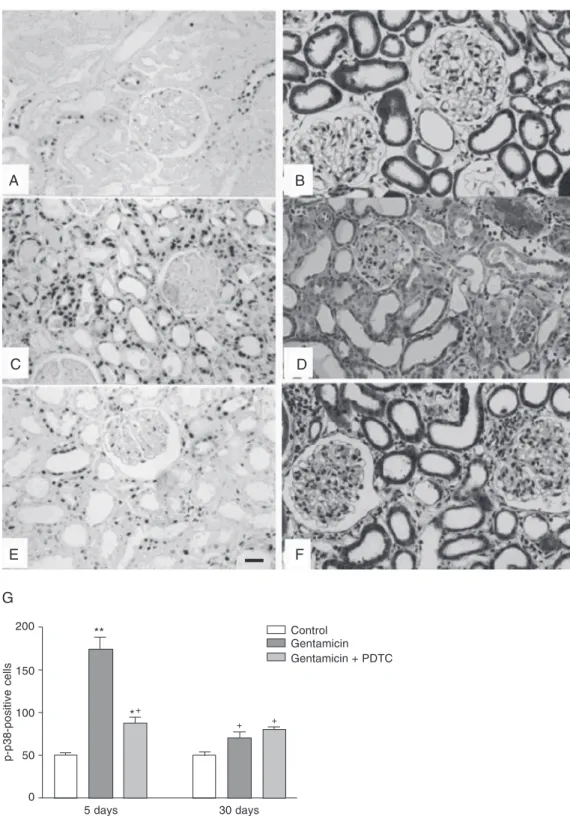
Figure 1. Immunolocalization of p-p38 MAPK in the renal cortex (A, C and E) and in Masson’s trichrome-stained histological sections (B, D and F) from rats killed 5 days after treatment with NaCl (A and B), gentamicin (C and D) or gentamicin + PDTC (E and F). Note that the number of p-p38 MAPK-positive cells is higher in C than in A and E and that the acute tubular necrosis, flattening of proximal cells and increase in interstitial area are more intense in D than in F. G, Number of p-p38-positive cells per grid field of renal cortex measuring 0.05 mm2. MAPK =
mitogen-activated protein kinases; PDTC = pyrrolidine dithiocarbamate. Original magnification X280 (G). Bar = 24.94 µm for all panels. *P < 0.05 vs control; **P < 0.001 vs control; +P < 0.001 vs gentamicin 5 days (Tukey test).
A B
C D
E F
p-p38-positive cells
200
150
100
50
0
5 days 30 days
**
*+
+ +
levels and the histological changes observed in gentamicin-injected animals. PDTC ad-ministered alone did not affect the param-eters of renal function and structure investi-gated (data not shown).
Our studies regarding the levels of tissue nitrate, a final product of NO reaction, showed that rats killed 5 days after gentami-cin treatment presented significantly (P < 0.05) increased renal nitrate levels (0.660 ± 0.220 µM/mg protein) when compared to control animals (0.032 ± 0.006 µM/mg pro-tein). Numerous effects of reactive oxygen species (ROS) in the regulation of cellular functions are mediated by NO (16). Although endothelial NO may have a beneficial role as a vasodilator by inducing an increase in renal blood flow and in glomerular filtration in these animals, excessive NO production can lead to cytotoxic injury. Peroxynitrite anion formation, protein tyrosine nitration, and hydroxyl radical production may contri-bute to the evolution of the renal lesions induced by gentamicin (17).
The immunohistochemical studies showed a significantly increased number of p-p38 MAPK-positive cells (P < 0.001) in the renal cortex from gentamicin-treated ani-mals killed 5 days after treatment (174.0 ±
14.63 per 0.05 mm2) when compared to
control (50.0 ± 2.65 per 0.05 mm2). Most
cells from the proximal tubules of animals treated only with gentamicin expressed p-p38. This alteration was reduced by treat-ment with PDTC and was not observed in the animals killed 30 days after gentamicin treatment. These data show that p38 MAPK is more activated in the tubulointerstitial cells during the early stages of this disease when the inflammatory process is more in-tense and diffuse. The p-p38 MAPK immu-noreaction was localized in the tubular and interstitial cells, showing a diffuse distribu-tion pattern in the renal cortex from gen-tamicin-treated animals killed 5 days after treatment (Figure 1C) and a focal distribu-tion primarily in the damaged areas on day
30 (data not shown).
Western blot analysis performed with
antibodies against p-p38 MAPK or NF-κB
demonstrated the presence of 43-kDa
(p-p38 MAPK) and 65-kDa (NF-κB) protein
lanes in the renal cortex from all groups studied. The corresponding lanes from gen-tamicin-treated animals killed 5 days after treatment were more prominent than those obtained for control and PDTC + gentami-cin-treated animals (Figure 2). There was no
Figure 2. Western blot analysis of p38 MAPK (A), NF-κB (B) and α1-tubulin (C) in renal cortex from control rats (lanes 1-3), from rats killed 5 days after treatment with gentamicin (lanes 4-6), or gentamicin + PDTC (lanes 7-9). Note that the corresponding lanes from gentamicin-treated rats (4-6) are more prominent than those corresponding to the control or PDTC + gentamicin groups and that there was no difference in the intensity of the signal between the different groups for α1-tubulin (C). D, Densitometry of p-p38 MAPK and NF-κB lanes in the renal cortex from control rats (N = 3) and from rats killed 5 days after treatment with gentamicin (N = 3) or PDTC + gentamicin (N = 3). Data are reported as mean ± SEM. MAPK = mitogen-activated protein kinases; NF-κB = nuclear factor kappa B; PDTC = pyrrolidine dithiocarbamate. *P < 0.01 vs control; **P < 0.001 vs control; +P < 0.001 vs
gentamicin 5 days (Tukey test).
Arbitrary units
300
D
1 2 3 4 5 6 7 8 9
p-p38
NF-κB
α-tubulin
A
B
C
200
100
0
p-p38 NF-κB
Control
Gentamicin 5 days Gentamicin + PDTC 5 days
**
**+
**
rylation of Ras, which in turn initiates the protein kinase cascade which ultimately leads to activation of the MAPK family of protein kinases. Activation of p38 MAPK can also
induce NF-κB activation and subsequent
transcription of inflammatory cytokines (7). In addition, these inflammatory cytokines and ROS can act as a positive feedback loop, amplifying the inflammatory process ob-served in acute tubular necrosis.
Our data show that p-p38 MAPK expres-sion is increased during the development of gentamicin-induced interstitial nephritis and that such alteration is associated with
en-hancement of NF-κB expression and of the
inflammatory process in the renal cortex, suggesting that the p38 MAPK pathway may be involved in the renal lesions induced by gentamicin.
Acknowledgments
The authors thank Cleonice G.A. da Silva, Erika Delloiagono, Adriana L.G. de Almeida, and Rubens Fernando de Melo for expert technical assistance.
difference in the intensity of the lanes for α1
-tubulin between the different groups, show-ing the equivalence of protein loadshow-ing (Fig-ure 2C). Several studies have shown that
both the MAPK and NF-κB systems can be
activated by oxidative stress (18), with con-sequent changes in gene expression that can progress to cell survival or cell death (19). PDTC as an antioxidant can reduce the ROS present in the gentamicin-induced inflam-matory process (18,20). PDTC also has a
direct effect on NF-κB activation by
block-ing IκB degradation (20). It has been
re-ported that specific and selective p38 MAPK inhibitors can block the production of in-flammatory molecules, reducing the apopto-tic cell death and ameliorating the acute renal injury observed in some animal mod-els of renal disease such as anti-GBM glo-merulonephritis and ischemia/reperfusion (2,4). Furthermore, there is evidence that the production of TNF post-renal injury is trig-gered by the locally produced ROS, which
activate NF-κB through p38 MAPK (7). The
signaling cascade leading to inflammatory cytokine production includes the
phospho-References
1. di Mari JF, Davis R, Safirstein RL. MAPK activation determines renal epithelial cell survival during oxidative injury. Am J Physiol
1999; 277: F195-F203.
2. Stambe C, Atkins RC, Tesch GH, Kapoun AM, Hill PA, Schreiner GF, et al. Blockade of p38 alpha MAPK ameliorates acute inflamma-tory renal injury in rat anti-GBM glomerulonephritis. J Am Soc Nephrol 2003; 14: 338-351.
3. Bokemeyer D, Ostendorf T, Kunter U, Lindemann M, Kramer HJ, Floege J. Differential activation of mitogen-activated protein kinases in experimental mesangioproliferative glomerulonephritis. J Am Soc Nephrol 2000; 11: 232-240.
4. Kumar S, Boehm J, Lee JC. p38 MAP kinases: key signalling molecules as therapeutic targets for inflammatory diseases. Nat Rev Drug Discov 2003; 2: 717-726.
5. Ohashi R, Nakagawa T, Watanabe S, Kanellis J, Almirez RG, Schreiner GF, et al. Inhibition of p38 mitogen-activated protein ki-nase augments progression of remnant kidney model by activating the ERK pathway. Am J Pathol 2004; 164: 477-485.
6. Bokemeyer D, Sorokin A, Dunn MJ. Multiple intracellular MAP ki-nase signaling cascades. Kidney Int 1996; 49: 1187-1198.
7. Donnahoo KK, Shames BD, Harken AH, Meldrum DR. Review article: the role of tumor necrosis factor in renal ischemia-reperfu-sion injury. J Urol 1999; 162: 196-203.
8. Guijarro C, Egido J. Transcription factor-kappa B (NF-kappa B) and renal disease. Kidney Int 2001; 59: 415-424.
9. Cronin RE, Henrich WL. Toxic nephropathies. In: Brenner BM (Edi-tor), Brenner and Rector’sThe Kidney. Philadelphia: Saunders Com-pany; 2000. p 1563-1596.
10. Houghton DC, Lee D, Gilbert DN, Bennett WM. Chronic gentamicin nephrotoxicity. Continued tubular injury with preserved glomerular filtration function. Am J Pathol 1986; 123: 183-194.
11. Houghton DC, English J, Bennett WM. Chronic tubulointerstitial nephritis and renal insufficiency associated with long-term “subther-apeutic” gentamicin. J Lab Clin Med 1988; 112: 694-703.
14. Coimbra TM, Janssen U, Grone HJ, Ostendorf T, Kunter U, Schmidt H, et al. Early events leading to renal injury in obese Zucker (fatty) rats with type II diabetes. Kidney Int 2000; 57: 167-182.
15. Geleilete TJ, Melo GC, Costa RS, Volpini RA, Soares TJ, Coimbra TM. Role of myofibroblasts, macrophages, transforming growth fac-tor-beta endothelin, angiotensin-II, and fibronectin in the progres-sion of tubulointerstitial nephritis induced by gentamicin. J Nephrol
2002; 15: 633-642.
16. Rodrigo R, Rivera G. Renal damage mediated by oxidative stress: a hypothesis of protective effects of red wine. Free Radic Biol Med
2002; 33: 409-422.
17. Klahr S. The role of L-arginine in hypertension and nephrotoxicity.
Curr Opin Nephrol Hypertens 1998; 7: 547-550.
18. Martindale JL, Holbrook NJ. Cellular response to oxidative stress: signaling for suicide and survival. J Cell Physiol 2002; 192: 1-15. 19. Koul HK. Role of p38 MAP kinase signal transduction in apoptosis
and survival of renal epithelial cells. Ann N Y Acad Sci 2003; 1010: 62-65.