J. Evolution Med. Dent. Sci./eISSN- 2278-4802, pISSN- 2278-4748/ Vol. 05/ Issue 38/ May 12, 2016 Page 2340
EFFECTIVENESS OF PROGRAMMED DEEP BREATHING EXERCISES ON REDUCING THE LEVEL OF
FATIGUE DURING EXTERNAL RADIATION THERAPY
Rajita Devi1, Hiranya Kumar Saharia2
1Lecturer (Medical Surgical Nursing), Department of Oncology, Hayat Institute of Nursing Education, Hayat Hospital, Guwahati. 2Assistant Professor (Anaesthesiology and Critical Care), Department of Emergency Medicine, Gauhati Medical College and Hospital, Guwahati.
ABSTRACT
CONTEXT
Cancer related fatigue is the most common symptom described by cancer patients receiving radiation therapy.
AIM
To assess the effectiveness of programmed deep breathing exercises on reducing the level of fatigue during external radiation therapy in cancer patients in some selected hospitals of Guwahati, Assam.
SETTINGS AND DESIGN
Experimental, pretest- post-test control group designed to select cancer patients in Dr. B. Barooah Cancer )nstitute and North East Cancer (ospital and Research )nstitute, Guwahati.
MATERIALS AND METHODS
Simple random sampling to select patients in experimental and in control group, the experimental group was given deep breathing exercises for days and level of fatigue was assessed by Cancer Fatigue Scale for both the groups.
STATISTICAL ANALYSIS USED
SPSS Version . Frequency, percentage, mean, standard deviation, paired t test, Chi-square test.
RESULTS
Results suggested that irrespective of age, sex, marital status, education, occupation, religion, diagnosis, stage of cancer, duration of radiation therapy, all cancer patients developed fatigue and significant difference was found between the control group and the experimental group after the implementation of deep breathing exercises in all the three subscales of radiation induced fatigue,
physical p= . , affective p= . and cognitive p= . . Age p= . , stage of cancer p= . and duration of radiation therapy
p= . were significantly associated with the level of fatigue.
CONCLUSION
Deep breathing exercises are an effective intervention in reducing fatigue among cancer patients and can be effectively utilized by oncology nurses to improve quality of life.
KEYWORDS
Cancer, Fatigue, Radiation )nduced Fatigue, Radiation Therapy, Cancer Fatigue Scale, Deep Breathing Exercises.
HOW TO CITE THIS ARTICLE:DeviR, Saharia HK. Effectiveness of programmed deep breathing exercises on reducing the level of fatigue during external radiation therapy in cancer patients. J. Evolution Med. Dent. Sci. 2016;5(38):2340-2344, DOI: 10.14260/jemds/2016/543
INTRODUCTION
Non-communicable diseases including cancer are emerging as major public health problems in )ndia. These diseases being lifestyle related have a long latent period and needs specialized infrastructure and human resources for management.
Financial or Other, Competing Interest: None. Submission 13-03-2016, Peer Review 20-04-2016, Acceptance 28-04-2016, Published 12-05-2016. Corresponding Author:
Dr. Hiranya Kumar Saharia, Assistant Professor,
Anaesthesiology and Critical Care, Department of Emergency Medicine, Gauhati Medical College and Hospital, Guwahati.
E-mail: [email protected] DOI: 10.14260/jemds/2016/543
A high burden of preventable non-communicable diseases on )ndia make it a movable competition for the resources allocation based on the cancer registry data; it is
estimated that there is about new cancer cases and
there is likely to be times this load that is about , cases at any point in )ndia.[ ]
American Cancer Society reported that fatigue is the most common symptom described by patients with cancer, with reports of prevalence ranging from % to more than %. Studies of side effects of cancer therapy have noted that % to % of patients receiving chemotherapy experienced fatigue. Reports concerning radiation treatment have also found fatigue to be present in - % of patients.[ ]
J. Evolution Med. Dent. Sci./eISSN- 2278-4802, pISSN- 2278-4748/ Vol. 05/ Issue 38/ May 12, 2016 Page 2341
As a result, many health care providers are encouraging their patients to be as physically active as possible during cancer treatment.[ ]
So, the investigator has undertaken this study in selected cancer hospitals of Guwahati, Assam, to assess the effectiveness of programmed deep breathing exercises in reducing the level of fatigue in patients receiving external radiation therapy and the investigator believes that this study will give evidence based practice to health professionals working in radiation oncology units of cancer hospitals to improve the quality of life of cancer patients.
AIMS AND OBJECTIVES OF THE STUDY
To assess the level of fatigue in cancer patients during external radiation therapy in the experimental group and control group.
To analyse the effectiveness of programmed deep
breathing exercises on reducing level of fatigue in cancer patients during external radiation therapy.
To determine the association between the level of fatigue
with selected variables such as age, gender, marital status, religion, diagnosis, stage of cancer, mode of treatment, duration of radiation therapy, educational qualification and occupation.
MATERIALS AND METHODS
This was an evaluative study with pretest- post-test control
group design conducted in patients samples in the
experimental group and in the control group in radiation unit of Dr. B. Barooah Cancer )nstitute and North East Cancer (ospital and Research )nstitute, Guwahati, Assam, by using simple random sampling. All patients aged between and years who were diagnosed with cancer of head and neck region, breast and chest area and who have been receiving external radiation therapy for at least days and are scheduled for another days were included in the study. The exclusion criteria were: patients who are critically ill and who are getting radiation therapy along with chemotherapy.
The investigator used both structured Section A and standardized Section B and C tools for data collection. The tools were self-administered and the respondents were given proper instructions before they computed their responses.
Section A
This section consists of an interview schedule for collecting selected variables for research study. )t includes items to collect selected variables for the present study namely; age, gender, marital status, religion, diagnosis, stage of cancer, mode of treatment, duration of radiation therapy, educational qualification and occupation.
Section B
)t consists of standardised Cancer Fatigue Scale CFS to assess radiation induced fatigue by. )t is a self-administered questionnaire, three-dimensional, self-rating scale for assessment of fatigue in cancer patients. )t covers three subjective dimensions Physical, cognitive and affective and has items to measure the level of fatigue. CFS is a brief, valid and feasible scale for assessing the three dimensions of fatigue experienced by cancer patients. The CFS had good stability
Average test–retest reliability r= . , p< . and good
internal consistency Cronbach s alpha coefficient for all
items = . .
Section C: )t consists of techniques of deep breathing exercises to the experimental group that is administered times in a day for days. The deep breathing exercises used in the study were x technique, pursed lip breathing and diaphragmatic breathing.
After formal permission was obtained from concerned authorities of both the institutes, the main study was conducted in the radiation unit of both the hospitals from
January to February by the investigator itself;
samples for the study were selected by simple random sampling and were randomly assigned into experimental
group and control group . Purpose of the study was
explained and confidentiality of the responses was assured. )nformed written consent was taken from participants and pretest was taken by using the self-rating questionnaire from both experimental group and control group in Assamese version. Deep breathing exercises were administered to the experimental group times in a day for days for minutes each and control group was administered standard care. Post-test was taken from both experimental group and control group at the end of days.
RESULTS
Results were reported as mean±standard deviation. P value of < . was considered statistically significant. Distribution of subjects according to selected variables in the control and experimental group.
Age and Sex
Majority of the patients in control group % and
experimental group % were in the age group of -
years, were males in both the control group . % and
experimental group . % respectively.
Marital Status
As regards to marital status, majority of patients in both
control group % and experimental group % were
married.
Religion
Majority of the clients were (indu in both in control . %
and experimental % groups.
Diagnosis
As regards to diagnosis of patients, majority of patients in the
control group . % and experimental group % were
diagnosed with cancer of oesophagus, followed by cancer of
tongue, . % in the control group and . % in the
experimental group. The types of cancer that were found to be low incidence were cancer of alveolar ridge, cancer of hard palate, cancer of larynx, cancer of mandible, cancer of maxilla, cancer of parotid gland, cancer of thyroid and astrocytoma.
Stage of Cancer
)n stage of cancer, majority of patients in both control group
% and experimental group . % had stage )) cancer.
Duration of Radiation Therapy
Regarding the duration of radiation therapy, majority of the patients had - days of radiation therapy in both the control
J. Evolution Med. Dent. Sci./eISSN- 2278-4802, pISSN- 2278-4748/ Vol. 05/ Issue 38/ May 12, 2016 Page 2342
Educational Qualification
Majority of the patients in both control group . % and
experimental group % had primary level education.
Occupation
)n occupation of the patients, majority of the clients in both the
control group % and experimental group % were
unemployed/home maker, followed by self-employed % in the control group and % in the experimental group.
Assessment of Level of Fatigue in Cancer Patients Receiving External Radiation Therapy
Majority of the patients had mild fatigue in both the control
group . % and experimental group . % . Patients
reported to have similar levels of fatigue in both the control and experimental group and mostly patients were reported to have mild fatigue at the beginning of the external radiation therapy [Table ].
)n the post-test score majority of the patients in the
control group had moderate level of fatigue . % , % of
the patients reported to have severe fatigue and only . % of the patients had mild fatigue. Whereas, in the experimental
group majority of the patients had mild fatigue . % ,
. % had moderate fatigue and only . % had severe fatigue. At the beginning of radiation therapy majority of the patients had mild fatigue, but as the duration of radiation
therapy increased the level of fatigue also increased significantly [Table ].
Effectiveness of Programmed Deep Breathing Exercises in Reducing the Level of Fatigue in Cancer Patients Receiving External Radiation Therapy
Statistically, it reveals that there was significant reduction in
physical subscale p= . , affective subscale p= . and
cognitive subscale p= . of fatigue after the intervention of
deep breathing exercises [Table ].
So it can be interpreted from the study findings that deep breathing exercises were effective intervention in reducing the level of fatigue in cancer patients receiving external radiation therapy and can be incorporated in oncology practice to improve the quality of life of cancer patients.
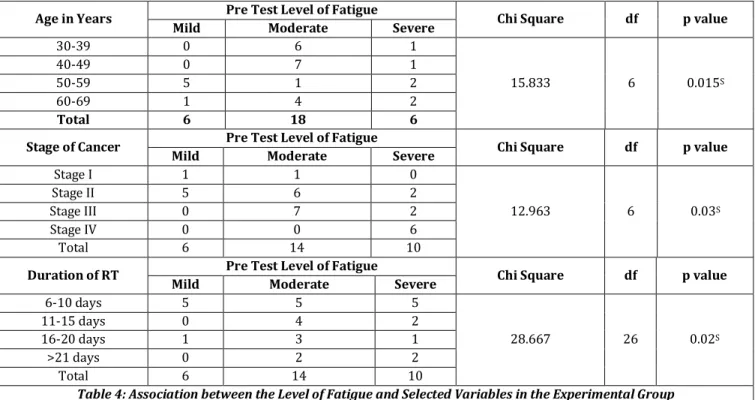
Association between the Level of Fatigue and Selected Variables
)n analysing data on association between level of fatigue and selected variables such as gender, marital status, religion, diagnosis, mode of treatment, educational qualification and occupation showed no statistically significant association but there was significant association between level of fatigue and
age Chi square= . , p= . , stage of cancer chi
square= . , p= . and duration of radiation therapy chi
square= . , p= . [Table ].
Pretest Level of Fatigue Score Range Control Experimental
Frequency % Frequency %
Mild 15-35 14 46.66 11 43.33
Moderate 36-49 10 33.33 13 36.66
Severe 50-75 6 20 6 20
Table 1: Assessment of Pre-Test Score of Level of Fatigue in the Control Group and Experimental Group, n=60
Post-test Level of Fatigue Score Range Control Experimental
Frequency % Frequency %
Mild 15-35 1 3.33 20 66.66
Moderate 36-49 20 66.66 8 26.66
Severe 50-75 9 30.00 2 6.66
Table 2: Assessment of Post-Test Score of Level of Fatigue in the Control and Experimental Group, n=60
Level of Fatigue Control Group Experimental Group t value df p value
Mean SD Mean SD
1.19 58 0.03
S
Physical Fatigue
Pre test 22.90 4.25 21.63 4.00
Post test 24.57 3.77 18.37 3.03
Affective Fatigue
1.42 58 0.01S
Pre test 9.63 2.48 10.13 1.78
Post test 10.40 2.54 8.87 1.78
Cognitive Fatigue
2.44 58 0.02S
Pre test 10.27 2.59 11.33 3.19
Post test 11.00 2.44 9.50 2.33
Table 3: Effectiveness of Deep Breathing Exercises on Physical Subscale of Level of Fatigue in Control Group and Experimental Group, n=60
J. Evolution Med. Dent. Sci./eISSN- 2278-4802, pISSN- 2278-4748/ Vol. 05/ Issue 38/ May 12, 2016 Page 2343
Age in Years Pre Test Level of Fatigue Chi Square df p value
Mild Moderate Severe
30-39 0 6 1
15.833 6 0.015S
40-49 0 7 1
50-59 5 1 2
60-69 1 4 2
Total 6 18 6
Stage of Cancer Pre Test Level of Fatigue Chi Square df p value
Mild Moderate Severe
Stage I 1 1 0
12.963 6 0.03S
Stage II 5 6 2
Stage III 0 7 2
Stage IV 0 0 6
Total 6 14 10
Duration of RT Pre Test Level of Fatigue Chi Square df p value
Mild Moderate Severe
6-10 days 5 5 5
28.667 26 0.02S
11-15 days 0 4 2
16-20 days 1 3 1
>21 days 0 2 2
Total 6 14 10
Table 4: Association between the Level of Fatigue and Selected Variables in the Experimental Group
Significant level < . , S-Significance, NS-Non Significance.
DISCUSSION
Cancer related fatigue is a distressing, persistent, subjective
sense of tiredness or exhaustion that occurs in - % of
cancer patients receiving radiotherapy or chemotherapy. )ts severity increases to a very high extent. )t affects the quality of life, interferes with ability to work, relationship with others, physical and emotional well-being. Now-a-days there has been growing interest in managing these symptoms with non-pharmacological treatments.
The present study aims to assess the effectiveness of deep breathing exercises in reducing level of fatigue in cancer patients receiving external radiation therapy.
The study reflected that highest number of the patients
were males % , married % , belonged to (indu religion
. % , were diagnosed with cancer of oesophagus . %
had stage )) cancer . % and had undergone radiation
therapy only as the mode of treatment . % .
)t has been observed that deep breathing exercises reduced level of fatigue significantly in cancer patients receiving external radiation therapy in all the three subscales
of radiation induced fatigue, physical subscale p= . ,
affective subscale p= . and cognitive subscale p= . . )t
is probably due to the reason that deep breathing exercises expand the alveoli, allows for more oxygenation of tissues and also aids in relaxation of body and mind. Similar findings were reported byMock Victoria and Pickett Mary.[ ]that fatigue
levels were approximately - % lower in exercising
subjects.
The present study revealed a significant association
between level of fatigue and age of the patient p = . , stage
of cancer p= . and duration of radiation therapy p = . .
There was no significant association found between gender, marital status, religion, diagnosis, mode of treatment, educational qualification and occupation.
Association between age of the patient and level of fatigue may be attributed to cellular breakdown in aging adults, emotional instability and lack of support system in
family as higher levels of fatigue was found in the age group of - years.
The findings corroborate with the findings of many scholars who revealed that selected factors such as age, duration of radiation therapy have significant association with
level of fatigue. A study conducted by Goedendorp MM et al[ ]
also revealed that fatigue has significant association with age
p = . , stage of cancer p = . , lower physical activity
p = . .
The present study reported a significant association
between duration of radiation therapy p = . with level of
fatigue. This may be attributed to physical and psychological exhaustion caused by cancer treatment and distressing side
effects. Similar findings were reported by AlbuquerqueKevin
et al[ ] in a prospective longitudinal study to examine the effect
of radiation therapy on fatigue and it were reported that higher duration of radiation therapy was significantly associated with
level of fatigue p= . .
This study is also supported by finding of Mulrooney DA and et al[ ] that patients with a history of higher duration of
radiation therapy were more likely to be fatigued odds ratio . , % confidence interval . – . .
The present study reported significant association of
stage of cancer p= . with the level of fatigue. Advanced
stage of cancer was associated with higher levels of fatigue, probably due to advancing disease, distressing side effects of cancer treatment as well as the disease itself and unpredictable future events.
This finding is supported by studies conducted by Goedendorp MM et al[ ], Singer S et al[ ], Kurz K et al[ ] where
they reported that increasing higher stage of cancer is associated with increased inflammatory biomarkers that in turn produces more fatigue.
J. Evolution Med. Dent. Sci./eISSN- 2278-4802, pISSN- 2278-4748/ Vol. 05/ Issue 38/ May 12, 2016 Page 2344
CONCLUSION
)t has been observed from the study findings that level of fatigue of cancer patients receiving external radiation therapy is independent of gender, marital status, education, occupation, diagnosis of patients, etc. So, all patients need to be assessed for fatigue severity and managed accordingly. Fatigue is the most distressing side effect of radiation therapy and use of medications has a little impact on managing fatigue. Moreover, non-pharmacological methods for management of problems are preferred over pharmacological methods. Deep breathing exercises being one of the invasive and non-pharmacological techniques can be of great help and it should be incorporated in radiation oncology units of cancer hospitals to help cancer patients overcome this distressing feeling and improve their quality of life.
REFERENCES
1. Ahmedin Jemus, Siegel Rebecca, Ward Elizabeth. Cancer
Statistics . A Can Jour for Clinicians ; : - .
2. American cancer society. Physical activity and the cancer
patient . Available from http: //www.cancer.org.com.
3. Aghili M. Effectiveness of programmed exercises on level of
fatigue in cancer patients during external radiation
therapy. European jour of onco nurs ; : - .
4. Victoria mock and mary pickett. Fatigue and quality of life
outcomes of exercise during cancer treatment . Clin J
Oncol Nurs ; : - . available from: http //
www.medicinenet.com/aerobic_exercise/.
5. Goedendorp MM, Gielissen MF, Verhagen CA, et al. Severe
fatigue and related factors in cancer patients before the
initiation of treatment. Brtsh Jour of Cancer ; :
-. Available at:
http://www.ncbi.nlm.nih.gov/pmc/articles/PMC2579682/.
6. Albuquerque K, Dina T, Philip L. )mpact of partial versus
whole breast radiation therapy on fatigue, perceived stress, quality of life and natural killer cell activity in women with
breast cancer. Bio Med Central Cancer ; : .
7. Mulrooney DA, Ness KK, Neglia JP, et al. Fatigue and sleep
disturbance in adult survivors of childhood cancer after
radiation therapy. SLEEP ; : - . Available on:
http://www.ncbi.nlm.nih.gov/pmc/articles/PMC2225565/.
8. Singer S, Kuhnt S, Zwerenz R. Age- and sex-standardised
prevalence rates of fatigue in a large hospital-based sample of cancer patients. British Journal of Cancer
; : - . Available at:
http://www.ncbi.nlm.nih.gov/pmc/articles/PMC3172908/.
9. Kurz K, Fiegl M, Bernhard (. Fatigue in patients with lung
cancer is related with accelerated tryptophan breakdown.
Peer Reviewed Open access Journal ; : - . available
from:http://www.ncbi.nlm.nih.gov/pmc/articles/PMC33539