IN FLU ENCE OF THE SCIN TIL LA TION CRYS TAL OP TION
ON THE DE TEC TOR RE SPONSE OF PET DE VICES
by
Vojislav M. ANTI], Koviljka Dj. STANKOVI]*, Miloš Lj. VUJISI], and Predrag V. OSMOKROVI]
Fac ulty of Elec tri cal En gi neer ing, Uni ver sity of Bel grade, Bel grade, Ser bia
Scientific pa per DOI: 10.2298/NTRP1401040A
Pos i tron emis sion to mog ra phy is a tech nol ogy that pro vides unique and ex qui site pos si bil i ties in func tional di ag nos tics, in the sense that it is the most ef fi cient and most re li able method for ob tain ing in for ma tion about bio chem i cal ac tiv ity and cel lu lar me tab o lism in the body, by de -ter min ing ex act lo cal iza tion and per form ing semi-quan ti ta tive as sess ment of the dis tri bu tion of a ra dio ac tive tracer. This pa per com pares the char ac ter is tics of re cently in tro duced lutetium based crys tals to those of con ven tion ally used bis muthorthogermanate scin til la tors; both op tions are used as scin til la tion de tec tors within the pos i tron emis sion to mog ra phy sys tems. En ergy res o lu tion and scin til la tion de cay time of lutetium based crys tals and bis -muth-ortho-germanate crys tals was ex per i men tally tested. Main scin til la tion de tec tor pa ram e ters which af fect the re sult ing de tec tor re sponse are con sid ered and an a lyzed, since they serve as the ba sis for a pos i tron emis sion to mog ra phy med i cal im age.
Key words: pos i tron emis sion to mog ra phy, scin til la tion crys tal, de tec tor re sponse
IN TRO DUC TION
Pos i tron emis sion to mog ra phy (PET) is a tech -nol ogy that pro vides unique and ex qui site pos si bil i ties in func tional di ag nos tics, pri mar ily of oncological, but also neu ro log i cal, cor o nary, in fec tive and in flam ma -tory dis eases, in the sense that it is the most ef fi cient and most re li able method for ob tain ing in for ma tion about bio chem i cal ac tiv ity, cel lu lar me tab o lism, and po ten tial physiopatological pro cesses in the body, by de ter min ing ex act lo cal iza tion and per form ing semi-quan ti ta tive as sess ment of the dis tri bu tion of a ra dio ac tive tracer. PET trac ers con tain short-lived b+ emit ters, the en ergy of which gets de graded through
Coulombic in ter ac tions, from ini tial en er gies (in the range from 0.63 MeV (18F) to 3.35 MeV (82Rb)) to
511 keV, when pos i trons “cap ture” elec trons and un -dergo pos i tron-elec tron an ni hi la tion, which pro duces pairs of gamma pho tons. The two pho tons in an an ni -hi la tion gamma pair are emit ted at an an gle of ~180° (180 ± 0.5°, due to re sid ual pos i tron mo men tum). Co -in ci dent de tec tion of these pho tons, with-in a lim ited time win dow, by scin til la tion de tec tors placed op po site one an other, along the line of re sponse (LOR), rep re sents the ba sic di ag nos tic in for ma tion. Mod ern de -tec tion sys tems are con cep tu ally built up of 140-300
blocks, with over 30000 in di vid ual crys tals, in a ring-shaped gan try. Dur ing a di ag nos tic pro ce dure, the pa tient is po si tioned on the pa tient's ta ble, which is moved in steps of cer tain length (the so called bed po si tions), and data is ac quired dur ing a pre set time in ter -val, from the re gion of in ter est (ROI) which is within de tec tor's field of view (FOV). Dis tri bu tion of ra dio -ac tiv ity is re con structed from sev eral hun dred mil lion ba sic data. In ad di tion to true co in ci den tal events, there are the un de sired events that need to be sup pressed: scat ter co in ci dences (when one or both an ni -hi la tion g-pho tons are scat tered be fore de tec tion) and ran dom co in ci dences (when two pho tons from two dif fer ent events are de tected within the co in ci dence re solv ing time). At the macro level, con se quences of de tec tor in trin sic and geo met ri cal im per fec tions need to be re duced (e. g., intercrystal scat ter ing, par al lax ef -fect, etc.), along with the im pact of any pa tient move -ment dur ing the im ag ing pro ce dure.
ag nos tic method drives the tech no log i cal prog ress for ward, which re sults in new de tec tor crys tals be ing de -vel oped and im ple mented. Com mer cial suc cesses on the road to an “ideal” scintillator have been based on lutetium, with ce rium (Ce) as an ac ti va tor. There are pres ently two com mer cial ver sions – LSO (lutetium oxyothosilicate, Lu2SiO5:Ce) and LYSO (lutetiumyt -trium oxyorthosilicate, Lu0.6Y1.4Si0.5:Ce) [1, 2].
This pa per com pares the char ac ter is tics of LYSO crys tals to those of BGO scin til la tors, fo cus ing on par tic u lar phys i cal and op er at ing con di tions that ex ist dur ing im ag ing pro ce dures, as well as on the ex -plicit ef fect on the re sult ing de tec tor re sponse, which serves as the ba sis for a PET med i cal im age. The ac cent is on the roles and im por tance of all rel e vant crys tal fea tures, which pro vides guid ance to the pos si bil i -ties of fur ther de vel op ment of PET scin til la tion crys tals and con se quently PET de tec tion.
PET SCINTILLATOR PA RAM E TERS
A scintillator crys tal has to be me chan i cally hard and ro bust, non-hy gro scopic, ther mally sta ble, sta ble in color and trans par ency and ra di a tion hard. From the per spec tive of de tec tion, its most sig nif i cant prop er ties are sen si tiv ity, en ergy res o lu tion, light yield, scin -til la tion de cay time and melt ing point [2].
Sen si tiv ity is ex pressed as the frac tion of in ci -dent pho tons that cause scin til la tions. Den sity r [gcm–3] and ef fec tive atomic num ber Z
eff of the
scintillator are re spon si ble for ra di a tion ab sorp tion and pho to elec tric ef fect prob a bil ity, which re sults in better at ten u a tion and en ergy dis crim i na tion.
Higher en ergy res o lu tion (ER) means more re -fined dif fer en ti a tion height of reg is tered pulses, i. e., better func tion of the re sponse of the de tec tor at par tic -u lar ra di a tion en ergy. This means that the sys tem can dis crim i nate better be tween true and scat ter events, and that nar rower en ergy win dows can be set, which re sults in lower noise in the im age. ER mostly de pends on light yield and in trin sic en ergy res o lu tion.
Light yield is the con ver sion ef fi ciency of ra di a -tion en ergy into light (pho ton/MeV). Higher light yield makes the value of en ergy de duced from the mea sured sig nal more pre cise (i. e., mea sure ment un cer tainty of in ci dent PET pho ton en ergy is lower [3, 4]).
In trin sic en ergy res o lu tion of the crys tal is re -lated to crys tal's di men sions and how the crys tal has been cut, how this has been per formed, and how light guid ance has been im ple mented for each de tec tor unit. Smaller de tec tor crys tals en able a larger ac qui si tion ma trix to be used, and there fore pro vide a better spec -tral res o lu tion. On the other hand, if de tec tors are too small, inter-crys tal scat ter ing de creases the pre ci sion of de ter min ing event po si tions or it could lead to par al lax ef fect: when an in ci dent pho ton in ter act with de -tec tor el e ment at the an gle which is not per pen dic u lar,
the pho ton can pen e trate and it could be de tected by the an other de tec tor el e ment [5]. In trin sic en ergy res o lu tion also de pends both on the inhomogeneity pres -ence or im pu ri ties in the crys tal struc tures.
Scin til la tion de cay time tD (DT) is de fined as the time needed for the pulse am pli tude to de crease to the frac tion of 1/e of its max i mum ini tial value. DT cor re -sponds to the in ter ac tion of a quan tum of ra di a tion with an atom in the de tec tor ma te rial, which brings the atom into an ex cited en ergy state, from which it sub se -quently re laxes to the ground state by emit ting vis i ble light. A shorter cur rent pulse is, nat u rally, de sired, be -cause it per mits shorter co in ci dence tim ing (mit i gates the in flu ence of ran dom ef fects, which makes the noise lower), en hances de tec tor ef fi ciency at higher pho ton fluence [6].
At high pho ton en er gies, elec tro mag netic show -ers ap pear when ra di a tion goes through mat ter. The Moliere ra dius is a ra dius of a cyl in der that on av er age con tains at least 90% of elec tro mag netic shower's en ergy de po si tion. It de pends lin early on ra di a tion wave -length, as well as on the atomic num ber [7]. A smaller Moliere ra dius means better shower res o lu tion and better shower sep a ra tion, due to less over lap ping.
Phys i cal ax ial FOV rep re sents the size of the body seg ment scanned within one time frame. With a larger FOV, a re gion be ing scanned can be seg mented into smaller parts, which then makes the scan time shorter.
METH ODS AND MA TE RI ALS
Com par i son of BGO and LYSO crys tal pa ram e -ters has been per formed through the ex per i men tal anal y sis of the crys tal en ergy res o lu tion and scin til la -tion de cay time.
En ergy spec trum (pulse height spec trum) has been ob tained by the sin gle light pulses in te gra tion so the en ergy res o lu tion is ob tained ac cord ing to the well known equation
ER E E
=D FWHM×
max
%
100 (1)
where DEFWHM is full width at half max i mum of the en -ergy Emax [1, 2].
In or der to mea sure scin til la tion de cay time the meth od ol ogy based on the prin ci ple pre sented by Bol -linger and Thomas [8] has been adopted, since the method (also known as de layed co in ci dence method) es ti mates the real shape of the light pulse, with out the sig nal dis tor tion caused by the sig nal tra vers ing the photomultiplier tube.
The mea sur ing equip ment con sisted of: (1) 10 BGO and 8 LYSO scin til la tion crys tals (all
with same di men sions of 5 mm ´ 5 mm ´ 20 mm), (2) photodetectors, with an in ter nal high volt age cir
(3) ex ter nal volt age sup ply of 15 V, (4) av a lanche photodiodes,
(5) ra dio ac tive source 137Cs with ac tiv ity of 160 kBq, and
(6) ra dio ac tive source 22Na with ac tiv ity of 40 kBq. In or der to de tect as much scin til la tion light as pos si ble the crys tals were wrapped in a tef lon tape on all sides ex cept the one cou pled with the photodetectors. Op ti cal grease (with re frac tive in dex of 1.465) was used in or der to cou ple the crys tal to photodetector.
Ra dio ac tive source 137Cs was used since it emits
gamma pho tons with an en ergy of 662 keV which is close to the pho ton en ergy of 511 keV de tected in PET sys tems. Ra dio ac tive source 22Na un der goes the beta
plus de cay, so it emits pho tons of 511 keV from the pos i tron-elec tron an ni hi la tion. This source also emits pho tons of 1275 keV. It was used for the mea sure -ments of en ergy spec trum lin ear ity.
RE SULTS
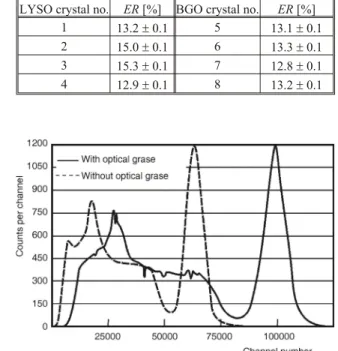
Ex per i men tal re sults ob tained from mea sure -ments of BGO crys tals en ergy res o lu tion per formed with out op ti cal grease are shown in tab. 1. En ergy spec trum of BGO crys tals is shown in fig. 1. With out op ti cal grease, the en ergy res o lu tion was in the range of 20.1-22.1%, with mean value and cor re spond ing stan dard de vi a tion of 21.2 ± 0.6%. En ergy res o lu tion mea sured for LYSO crys tals was in the range of 12.915.3% with mean value and cor re spond ing stan -dard de vi a tion of 13.6 ± 0.1%, as it is shown in tab. 2.
Two ran domly cho sen BGO crys tals were op ti cally cou pled to photodetector and mea sure ments showed that the en ergy res o lu tion was 16.5% and 16.3%. In case of LYSO crys tals, the 4-th crys tal shown in tab. 2 was cho sen for en ergy res o lu tion mea sure ments with op ti cal grease and the ob tained value was 11.4%. Fig -ure 2 shows the en ergy spec trum of LYSO crys tals both with and with out op ti cal grease. All mea sure -ments were based on the chan nels which cor re spond to the en ergy of 662 keV (137Cs). Stan dard de vi a tion was
less than 1% for BGO and less then 2% for LYSO crys -tals, for the en ergy peaks of 511 keV and 1275 keV, in re spect to en ergy of 662 keV.
Ex per i men tal re sults of scin til la tion de cay time ob tained for BGO crys tals are shown in tab. 3. Ob tained mean value and cor re spond ing stan dard de vi a -tion was 301 ± 3 ns. Fig ure 3 shows scin til la tion de cay time ob tained by the ex per i ment along with the ex po -nen tial fit of the ob tained re sults. Start ing point for the re sults fit ting was 100 ns while the end ing point was 600 ns. Scin til la tion de cay time of BGO crys tal has biexponential be hav ior, i. e., there is one fast com po
-Ta ble 1. En ergy res o lu tion of BGO crys tals ob tained with out op ti cal grease
BGO crys tal no. ER [%] BGO crys tal no. ER [%]
1 21.5 ± 0.1 6 21.3 ± 0.1
2 21.8 ± 0.1 7 22.1 ± 0.1
3 21.7 ± 0.1 8 21.1 ± 0.1
4 20.9 ± 0.1 9 21.1 ± 0.1
5 20.1 ± 0.1 10 20.4 ± 0.1
Fig ure 1. En ergy spec trum of BGO crys tals ob tained with out op ti cal grease
Ta ble 2. En ergy res o lu tion of LYSO crys tals ob tained with out op ti cal grease
LYSO crys tal no. ER [%] BGO crys tal no. ER [%] 1 13.2 ± 0.1 5 13.1 ± 0.1 2 15.0 ± 0.1 6 13.3 ± 0.1 3 15.3 ± 0.1 7 12.8 ± 0.1 4 12.9 ± 0.1 8 13.2 ± 0.1
Fig ure 2. En ergy spec trum of LYSO crys tals, ob tained with out op ti cal grease and with op ti cal grease
Ta ble 3. Scin til la tion de cay time for BGO crys tals BGO crys tal no. DT [ns] BGO crys tal no. DT [ns]
1 303 ± 3 6 301 ± 3
2 307 ± 3 7 298 ± 3
3 303 ± 3 8 318 ± 3
4 300 ± 3 9 309 ± 3
nent of the de cay time with du ra tion of about 60 ns and its value is re duced e–5/3 times af ter 100 ns, so its in flu -ence can be ne glected. This com po nent con tains 10% of over all light yield.
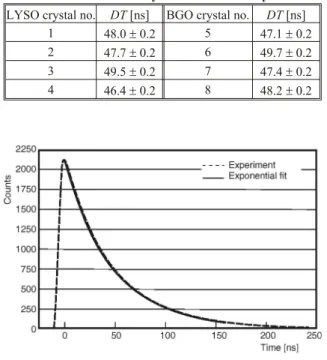
Ob tained mean value with cor re spond ing stan -dard de vi a tion for LYSO crys tals was 48.0 ± 0.2 ns, ac cord ing to the re sults shown in tab. 4. Scin til la tion de -cay time curve is shown in fig. 4. Since the LYSO crys tal has the only one com po nent of de cay time the start ing point for ex po nen tial fit is not of great sig nif i cance. Time used for the end ing point dur ing the re -sults fit ting was 160 ns.
DIS CUS SIONS
Ob tained re sults of mea sur ing the en ergy res o lu tion and scin til la tion de cay time (con sid er ing mea
sure ment un cer tainty [911]), showed that LYSO crys tals took ad van tage over BGO crys tals in both in ves ti gated do mains. It is im por tant to no tice that in both in -ves ti gated types of scin til la tion crys tals the better en ergy res o lu tion is achieved by us ing the op ti cal grease. Ex per i ments also showed a higher fluc tu a tion of the en ergy res o lu tion with LYSO crys tals. This could be ex plained as a con se quence of the op ti cal trans port [12, 13]. It is proved that BGO crys tals have lon ger scin til la tion de cay time.
In ad di tion to ex per i men tally tested pa ram e ters of scin til la tion crys tals there are more im por tant pa -ram e ters to com pare which are be ing con sid ered and cur rently in ves ti gated in or der to find the op ti mal scin -til la tion crys tal for PET ap pli ca tions.
BGO crys tal is a pure in or ganic crys tal that needs no ac ti va tors. Its most sig nif i cant ad van tage over lutetium crys tals is its much higher ef fi ciency for 511 keV pho tons [14]. De tec tor ef fi ciency de pends not only on ma te rial prop er ties, but also on the width of the crys tal. Cur rently em ployed BGO crys tals are typ i -cally 3 cm wide, while LSO al ter na tives are 2 cm in width. Based on the ra tio of cor re spond ing ef fi cien cies (90% : 65%), ob tained at 511 keV pho ton en ergy and for spe cific ac tiv ity of 37 MBq per 10 kg of body mass, which is an av er age ac tiv ity in to day's prac tice, the ef -fi ciency is found to be 38% higher in the -first vari ant [15].
Ac cord ing to a Monte Carlo study [5], BGO de -tec tor has a better de tec tion pre ci sion and lower inter-crys tal scat ter com pared to lutetium al ter na tives. This is in ac cor dance with the fact that its ef fec tive atomic num ber is al most 14% higher than that of LSO, which makes a higher prob a bil ity for the pho to elec tric ef fect. As a re sult, the pho to elec tric (to tal ab sorp tion) cross-sec tion at 511 keV is al most 60% higher in BGO crys tals than in LSO al ter na tives [14].
Short com ings of BGO crys tals also in clude low light yield (about four times lower than that of lutetium crys tals), larger phys i cal ax ial FOV and more strin gent en vi ron men tal con di tions (flu o res cent in ten sity). The Moliere ra dius is also lower for both lutetium de tec tor vari ants than for BGO [16].
Un even sen si tiv ity along de tec tor's pro file, caused by lower sen si tiv ity around crys tal edges is also con sid ered. Re gard ing this is sue, a min i mum ax ial over lap of FOV with the next bed po si tion is de -fined, with the ef fec tive ax ial FOV de ter mined as the phys i cal ax ial FOV mi nus the over lap. Smaller over -lap is pres ently achieved in BGO de tec tor sys tems [17].
In ves ti ga tions are also di rected to the find ing the op ti mal scin til la tion de tec tor size as well as its tech ni -cal pro cess ing so that a smaller cross-sec tional area is achieved, and thereby a larger ac qui si tion ma trix and better spa tial res o lu tion. Spe cial at ten tion is de voted to the man u fac tur ing, growth, fin ish ing and pol ish ing of crys tals and im ple men ta tion of spe cial re flec tive ma -te ri als be tween crys tal el e ments [2].
Fig ure 3. Scin til la tion de cay time curves for BGO crys tal
Ta ble 4. Scin til la tion de cay time for LYSO crys tals LYSO crys tal no. DT [ns] BGO crys tal no. DT [ns]
1 48.0 ± 0.2 5 47.1 ± 0.2
2 47.7 ± 0.2 6 49.7 ± 0.2
3 49.5 ± 0.2 7 47.4 ± 0.2
4 46.4 ± 0.2 8 48.2 ± 0.2
Al ter na tive lutetium-based so lu tions have now reached ex per i men tal phase (as Lu1.8Gd0.2SiO5:Ce, LGSO) as well as crys tals based on other el e ments, es -pe cially LaBr3 (with 5% Ce) [18] and Ce: Gd3Al2Ga3O12(Ce:GAGG) [19]. In ad di tion to the de vel op ment of de tec tor block ge om e try (in clud ing in -ves ti ga tions which com bine var i ous crys tals within blocks, such as the GSO/LSO/BGO/CsI(Tl) struc ture with lay ers of scin til la tors with dif fer ent de cay times and dual-sided read out [19]), much work is ded i cated to elim i na tion of col lec tion vari abil ity around de tec tor edges, de tec tor sys tem de sign (in clud ing ways of en larg ing the FOV size), im ple men ta tion and im prove -ment of sil i con photomultipliers [18, 20] and other tech ni cal en hance ments that con trib ute to the de vel op -ment of PET.
In com par i son to al ter na tive com mer cially avail able vari ants with lutetium crys tals, BGO PET de vices are much cheaper, es pe cially when all the op tion ally of fered as sets of lutetium crys tals are im ple mented, such as the hard ware up grade of the ba sic ver -sion which en hances the FOV and short ens scan time per bed po si tion.
Lutetium car ries the is sue of nat u ral ra dio ac tiv ity, with 176Lu iso tope (2.6% nat u ral abun dance) be ing ra
-dio ac tive (half-life of (3.56 ± 0.07)×1010 years). The de
-cay of 176Lu emits b– par ti cles and g-rays in the en ergy
range from 88 keV to 400 keV, which do not pres ent a prob lem for stan dard PET im ag ing, but af fect low count rate mea sure ments con ducted in spe cific QC pro ce -dures for at ten u a tion cor rec tion, when Ge-68 phan toms are used, with ac tiv i ties of the or der of 5 kBq [21-23].
CON CLU SIONS
Ex per i ments showed that LYSO crys tals took ad van tage over BGO crys tals in both in ves ti gated pa -ram e ters, es pe cially in de cay time, which is about 5 times less with LYSO, com pared both with and with -out op ti cal grease. More over, 4 times higher light yield of LYSO crys tals over BGO pro vides much higher po ten tial in re ject ing the spu ri ous events. En ergy res o lu -tion and scintillator de cay time di rectly af fect the noise equiv a lent count rate and PET im age noise.
From the other hand, de tec tor sen si tiv ity is one of the main de tec tor char ac ter is tics, since good im age qual ity re quires as many pho tons to be de tected as pos -si ble, and, fur ther more, higher sen -si tiv ity makes the im ag ing pro ce dure quicker and the ad min is tered ac tiv ity lower. In com mer cially avail able de vices, max i -mum PET sys tem sen si tiv ity of 10 cps/kBq has been achieved with BGO crys tals (and through op ti mi za tion of de tec tors and of the frontend elec tronic de -sign).
Work with stan dard radionuclides (18F or 11C)
and ad min is tered ac tiv i ties, with mod ern smart soft ware so lu tions and smaller ba sic voxel cells for re con
-struc tion make ar gu ments in fa vor of lutetium crys tals not con vinc ing enough to dis card cheaper and re li able BGO PET de tec tor de vices for rou tine PET im ag ing.
AC KNOWL EDG EMENT
The Min is try of Ed u ca tion, Sci ence and Tech no log i cal De vel op ment of the Re pub lic of Ser bia sup -ported this work un der con tract 171007.
AU THOR CON TRI BU TIONS
The o ret i cal anal y sis was car ried out by V. M. Anti} and P. V. Osmokrovi}. All of the au thors have per formed the anal y ses and dis cus sion. The manu -script was writ ten by V. M. Anti} and K. Dj. Stankovi}. The fig ures and ta bles were pre pared by V. M. Anti}.
REF ER ENCES
[1] Mo ses, W. W., et al., De sign of a High-Res o lu tion, High-Sen si tiv ity PET Cam era for Hu man Brains and Small An i mals, IEEE Trans Nucl Sci, NS-44 (1997), 4, pp. 1487-1491
[2] Lewellen, T. K., The Chal lenge of De tec tor De signs for PET, Amer i can J. of Roent gen ol ogy, 195 (2010), 2, pp. 301-309
[3] Vujisi}, M., et al., A Sta tis ti cal Anal y sis of Mea sure -ment Re sults Ob tained from Non lin ear Phys i cal Laws, Ap plied Math e mat i cal Mod el ing, 35 (2011), 7, pp. 3128-3135
[4] Stankovi}, K., et al., Sta tis ti cal Anal y sis of the Char -ac ter is tics of Some Ba sic Mass-Pro duced Pas sive Elec tri cal Cir cuits Used in Mea sure ments, Mea sure -ment, 44 (2011), 9, pp. 1713-1722
[5] Lashkari, S., et al., The In flu ence of Crys tal Ma te rial on Intercrystal Scat ter ing and the Par al lax Ef fect in PET Block De tec tors: A Monte Carlo Study, Pro ceed -ings, 4th Kuala Lumpur In ter na tional Con fer ence on Bio med i cal En gi neer ing, IFBME, 21, 2008, pp. 633-636
[6] Chang, T., et al., Ef fects of In jected Dose, BMI and Scan ner Type on NECR and Im age Noise in PET im -ag ing, Physic in Med i cine and Bi ol ogy, 56 (2011), 16, pp. 5275-5285
[7] Wigmans, R., Cal o rim e try – En ergy Mea sure ment in Par ti cle Phys ics, Clar en don Press, Ox ford, 2000
[8] Bol linger, M., et al., Mea sure ment of the Time De pend ence of Scin til la tion In ten sity by a De layedCo -in ci dence Method, Rev. Sci. Instrum.. 32 (1961), 9, pp. 1044-1050
[9] Kova~evi}, A. M., et al., Un cer tainty Eval u a tion of the Con ducted Emis sion Mea sure ments, Nucl Technol Radiat, 28 (2013), 2, pp. 182-190
[10] Stankovi}, K. D. In flu ence of the PlainPar al lel Elec trode Sur face Di men sions on the Type a Mea sure -ment Un cer tainty of GM Coun ter, Nucl Technol Radiat, 26 (2011), 1, pp. 39-44
[12] Foudray, A., et al., Po si tion ing An ni hi la tion Pho ton In ter ac tions in a Thin LSO Crys tal Sheet With a Po si -tion-Sen si tive Av a lanche Photodiode, IEEE Trans. Nucl. Sci., 53 (2006), 5, pp. 2549-2556
[13] Xin, Y., et al., Study of Light Trans port In side Scin til -la tion Crys tals for PET De tec tors, Phys ics in Med i -cine and Bi ol ogy, 58 (2013), 7, pp. 2143-2161
[14] Humm, J. L., et al., From PET De tec tors to PET Scan -ners, Eur. J. Nucl. Med. Mol. Im ag ing, 30 (2003), 11, pp. 1574-1597
[15] Wang, Y., et al., Im proved Sta tis tics Based Po si tion ing Scheme for Con tin u ous Thick Crys tal PET De tec
-tors, IEEE Trans. Nucl. Sci., 60 (2012), 3, pp.
1527-1532
[16] Wat son, C. C., et al., NEMA NU2 Per for mance Tests for Scan ners with In trin sic Ra dio ac tiv ity, J. of Nucl. Med., 45 (2004), 5, pp. 822-826
[17] Scheuermann, J. S., et al., Qual i fi ca tion of PET Scan -ners for Use in Multicenter Can cer Clin i cal Tri als, J. Nucl. Med., 50 (2009), 7, pp. 1187-1193
[18] Shimizu, S., et al., Char ac ter is tics of Lu1.8Gd0.2SiO5:Ce
(LGSO) for APDBased PET De tec tor, Nu clear Sci -ence Sym po sium, Con fer ence Re cord, Dresden, Ger -many, 2008, pp. 4938-4944
[19] Kishimoto, A., et al., De vel op ment of a Dual-Sided Read out DOIPET Mod ule Us ing LargeArea Mono -lithic MPPC-Ar rays, IEEE Trans ac tions on Nu clear Science, 60 (2013), 1, pp. 38-43
[20] Del Guerra, A., et al., Sil i con Photomultipliers (SiPM) as Novel Photodetectors for PET, Nu clear In -stru ments and Meth ods in Phys ics Re search, A 648
(2011), Suppl. 1, pp. S232-S235
[21] ***, IAEA Hu man Health Se ries No. 1 – Qual ity As -sur ance for PET and PET/CT Sys tems, IAEA, 2009
[22] Anti}, V., et al., Com par i son of Var i ous Meth ods for De sign ing the Shield ing from Ion iz ing Ra di a tion at PET-CT In stal la tions, Ra di a tion Pro tec tion Do sim e -try, 154 (2013), 2, pp. 245-249
[23] Lazarevi}, D. R., Ra di a tion Hard ness of In dium Ox -ide Films in the Coo per-Pair In su la tor State, Nucl Technol Radiat, 27 (2012), 1, pp. 40-43
Re ceived on March 25, 2013 Ac cepted on March 21, 2014
Vojislav M. ANTI], Koviqka \. STANKOVI], Milo{ Q. VUJISI], Predrag V. OSMOKROVI]
UTICAJ IZBORA SCINTILACIONOG KRISTALA NA ODZIV DETEKTORA PET URE\AJA
Pozitronska emisiona tomografija je tehnologija koja pru`a jedinstvene i izuzetne mogu}nosti u funkcionalnoj dijagnostici. Naime, pomo}u do sada najefikasnije i najpouzdanije metode dolazi se do informacije o biohemijskoj aktivnosti i }elijskom metabolizmu u telu, odre|ivawem ta~ne lokalizacije i vr{ewem semikvantitativne procene distribucije radioaktivne supstancije. U ovom radu upore|ene su karakteristike nedavno uvedenih kristala na bazi lutecijuma sa karakteristikama konvencionalnih bizmut-orto-germanat scintilatora; obe varijante se koriste kao scintilacioni detektori kod PET ure|aja. Eksperimentalno je testirana energetska rezolucija i vreme ga{ewa svetlosnog impulsa u kristalu za LYSO i BGO scintilatore. Razmatrani su i analizirani glavni parametri scintilacionih detektora koji uti~u na rezultuju}i odziv detektora, koji slu`e kao osnova za PET medicinsku sliku.