http://dx.doi.org/10.1590/1413-70542016403036315
Identification of
Pm
24,
Pm
35 and
Pm
37 in thirteen Egyptian
bread wheat cultivars using SSR markers
Identificação de Pm24, Pm35 e Pm37 em treze egípcios cultivares de trigo utilizando marcadores microssatélites
Hassan Mahmoud Emara1*, Ayman Feisal Omar2, Moustafa Mahmoud El-Shamy3, Mona Elsaid Mohamed3
1Botany Department, Faculty of Science, Benha University, Egypt
2Department of Botany, Plant Pathology & Biotechnology Laboratory, Faculty of Agriculture, Kafrelsheikh University, Egypt
3Wheat Diseases Research Department, Plant Diseases Research Institute, ARC, Giza, Egypt
*Corresponding author: [email protected]
Received in october 6, 2015 and approved in january 8, 2016
ABSTRACT
Powdery mildew of wheat (Triticum spp.) caused byBlumeria graminis f.sp. tritici (DC) E.O. Speer Em. Marchal is one of the most important bread wheat diseases in Egypt. All the Egyptian common bread wheat cultivars are susceptible to that disease at seedling and adult stages. Breeding of resistant cultivars is the most economical and environmentally safe method to eliminate the disease and reduce crop losses.
Combinations of two or more effective resistance genes may lead to better, more durable resistance to that disease. Eight Pm genes i.e. Pm2, Pm6, Pm12, Pm16, Pm24, Pm35, Pm36 and Pm37 out of 21 powdery mildew monogenic wheat lines (Pm) were resistant to 42
individual isolates of powdery mildew collected from different governorates in the Nile Delta area, Egypt, at seedling and adult stages. Only four DNA specific SSR markers (Xgwm337, Xcfd7 linked to Pm24, Pm35and Xgwm332, Xwmc790) linked to Pm37 resistance genes were selected to detect these genes in 13 Egyptian common bread wheat cultivars. This study reveals the absence of Pm24, Pm35 and Pm37 in all the 13 Egyptian bread wheat cultivars. These results gave evidence that the Egyptian cultivars are not having resistance genes and need to further incorporate one, two or more resistant genes in a single genotype as all commercial cultivars defeated by the pathogen. Index terms: Powdery mildew; genetic control; DNA; molecular markers.
RESUMO
O oídio causado por Blumeria graminis f.sp. tritici (DC) E.O. Speer Em. Marchal é uma das doenças mais importantes do trigo (Triticum spp.) no Egito. Todos os cultivares de trigo egípcios são suscetíveis a essa doença tanto na fase jovem quanto em plantas adultas. O melhoramento genético de cultivares resistentes é o método mais econômico e ambientalmente seguro para eliminar a doença e reduzir as perdas de colheita. As combinações de dois ou mais genes de resistência podem conduzir a uma maior resistência a essa doença. Oito Pm genes (Pm2, Pm6, Pm12, Pm16, Pm24, Pm35, Pm36 e Pm37) entre 21 linhagens monogênicas de trigo foram resistentes
a 42 isolados individuais de oídio coletados em diferentes províncias na área do Delta do Nilo, no Egito, em plantas jovens e adultas. Quatro marcadores microssatélites de DNA específicos, (Xgwm337, Xcfd7 ligada a Pm24, Pm35 e Xgwm332, Xwmc790) ligados a genes de resistência Pm37 foram selecionados para detectar esses genes em 13 cultivares de trigo egípcios. Nosso estudo revela a ausência de Pm24, Pm35 e Pm37 em todos os 13 cultivares de trigo egípcios. Estes resultados demonstram que os cultivares egípcios não possuem genes de resistência e necessitam incorporar um, dois ou mais genes resistentes num genótipo e nos cultivares comerciais suscetíveis ao patógeno.
Termos para indexação: Oídio; controle genético; DNA; marcadores moleculares.
INTRODUCTION
Powdery mildew of wheat, caused by the fungus (Blumeria graminis f. sp. tritici Marchal), is a common disease that spread all over the world. In Egypt, the disease appeared in the last few years with high disease severities on most of the common wheat cultivars especially in the Gharbia governorate, Nile Delta, Egypt. Powdery mildew can lead to reduction of wheat spike and grain number resulting in a yield loss e.g. 10% - 62% in Brazil (Costamilan, 2005),
48% in Canada (Everts; Leath, 1992; Maxwell et al., 2009), 10-18% in Egypt (El-Shamy et al., 2012) and 10-30% in China (Huang et al., 2013). Utilization of resistant cultivars is the most economical and environmental-friendly approach to control the disease, enabling reductions in fungicide
use. A diversified and effective resistant gene sources must
be the basis of breeding wheat cultivars with powdery mildew resistance. Development of resistant germplasm to
powdery mildew is based on interspecific hybridization and
al., 2000). To date, 61 powdery mildew resistance genes, mapped to 43 loci (McIntosh; Yamazaki; Dubcovsky, 2008; He et al., 2009; Hua et al., 2009; Li; Fang; Zhang, 2009; Luo
et al., 2009) have been identified and formally catalogued
in wheat. However, some of the genes, derived from wild
relatives, are difficult to use in wheat breeding because of
linkage drag (Hospital, 2001). Consequently, there are only
a limited numbers of effective race-specific resistance genes
available for use by breeders. The following genes have been primarily used in development of powdery mildew resistant cultivars i.e. Pm2, Pm3, Pm4a, Pm4b, Pm6 and Pm8. More recently described resistance genes including Pm13, Pm21, and Pm24 were introduced in breeding programs in order to provide more diversity (Cheng et al., 2003; Sang
et al., 2006). Molecular identification of specific DNA
sequences can be used to identify the presence or absence of wheat powdery mildew (Pm) genes in wheat cultivars, their chromosomal location, the number of genes, and the way in which they are transmitted to progeny (Chen and Chelkowski, 1999).
The availability of molecular markers, used for identifying, mapping, and cloning powdery mildew resistance genes, has greatly enhanced the development of molecular breeding. Currently, microsatellites [simple sequence repeats (SSR)] are the preferred type of molecular marker for marker-assisted selection (MAS) in wheat breeding. Molecular markers are known to be useful in the process of detection of the disease
resistance genes, especially in genotypes where the
genetic back ground has not been clarified as is the
case for most commercial cultivars. The genes Pm24, Pm35, and Pm37 were approved to be effective genes against the disease in the regions with similar ecological condition as Egypt in the world (Huang et al., 2000; Langridge et al., 2001; Miranda et al., 2007; Perugini et al., 2008). Therefore, this study was conducted to identify those powdery mildew resistance genes i.e. Pm24, Pm35 and Pm37 in 13 registered Egyptian bread wheat cultivars using SSR markers under the Egyptian conditions.
MATERIAL AND METHODS
Plant materials
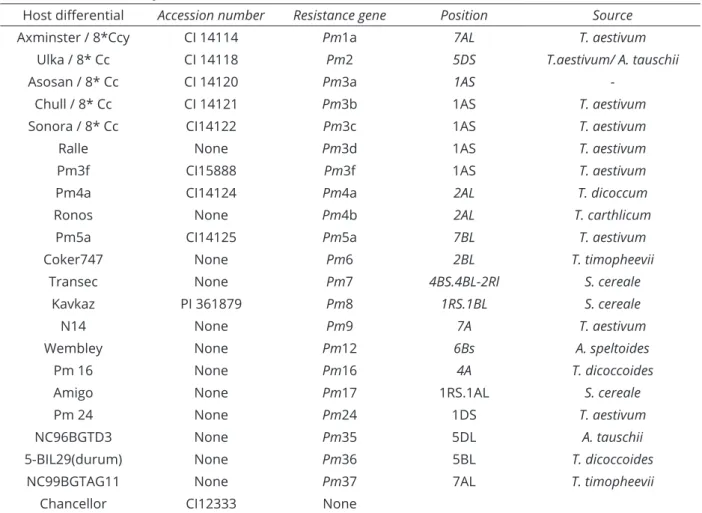
Thirteen Egyptian bread wheat cultivars common in Egypt obtained from the National Wheat Program, Crop Research Institute, ARC, Giza (Table 1) and twenty-one powdery mildew host differentials resistant to the powdery mildew and the susceptible check cultivar chancellor were used in this study (Table 2). The monogenic wheat lines were kindly provided by Dr. Christina Cowger (USDA-ARS, North Carolina State University). Seeds of each line were sown in individual plastic pots (10 cm diameter) containing soil mixed with peat moss (1:1 w:w) under greenhouse conditions.
Table 1: Bread wheat cultivars and their pedigree used in this study. Cultivars/ Pm
genes Pedigree
Gemmeiza-7 CMH74A.360/5x//Seri82/3/Agent CGM4611-2GM-3GM-1GM-0GM. Gemmeiza-10 Maya 74’’S’’/ On// 1160-174/3/ Bb/4/ Chal ‘’S’’/5/Ctow.
Gemmeiza-11 BUC’’S’’/ Kvz’’S’’// 7c/ Seri 82 /3/Giza 168/ Sakha 61 GM7892-2GM-1GM- 0 GM.
Gemmeizas-12 OTS/3/ SARA/ THB// vee-CMss97Y0027S-5Y-010M-010Y-010M-2Y-1M-0Y-06M-06M-0GM.
Sids-12 BUC// 7c/ Ald/5/ Maya 74/ On/ 1160.147/3/ BB/ G11/4/ Chat’’S’’ /6/ Maya/ vu1 // Cmh 74A.630/4* sx, SD7096- 4SD- 1SD-0SD.
Sids-13 ALmaz 19= Kauz ‘’S’’ // Tsi /snb’’S’’ ICW 94-0375- 4AP- 2AP-030AP-) APS- 2AP- 0APS- 050AP- 0AP- 0SD. Sids-14 SW8488*2/ KUKUNA- CGSS01Y00081T-099M-099Y-099M-099B-9Y-0B-0SD.
Giza-168 MIL/BUC// Seri CM93046-8M-0Y-0M-2Y-0M Giza-171 Gemmeiza-9 / Sakha-93
Misr-1 Oasis/skauz//4* BCN/3/2* Pastor CMss 00Y01881T-050M-030Y-030M-030WGY-33M- 0Y-0S. Misr-2 SKAUZ/ BAV 92. CMss 96 M03611S- 1M- 0105Y-010M-010SY- 8M- 0Y-0S.
Sahka-93 Sakha 92TR81032 S8871-1S-2S-1S-0S.
No. of resistant genes
Efficacy % of Pm-gene = x 100
Total No. of the tested genes
Table 2: Designated names, source, and chromosomal positions of identified resistance genes to powdery
mildew used in this study.
Host differential Accession number Resistance gene Position Source
Axminster / 8*Ccy CI 14114 Pm1a 7AL T. aestivum
Ulka / 8* Cc CI 14118 Pm2 5DS T.aestivum/ A. tauschii
Asosan / 8* Cc CI 14120 Pm3a 1AS
-Chull / 8* Cc CI 14121 Pm3b 1AS T. aestivum
Sonora / 8* Cc CI14122 Pm3c 1AS T. aestivum
Ralle None Pm3d 1AS T. aestivum
Pm3f CI15888 Pm3f 1AS T. aestivum
Pm4a CI14124 Pm4a 2AL T. dicoccum
Ronos None Pm4b 2AL T. carthlicum
Pm5a CI14125 Pm5a 7BL T. aestivum
Coker747 None Pm6 2BL T. timopheevii
Transec None Pm7 4BS.4BL-2Rl S. cereale
Kavkaz PI 361879 Pm8 1RS.1BL S. cereale
N14 None Pm9 7A T. aestivum
Wembley None Pm12 6Bs A. speltoides
Pm 16 None Pm16 4A T. dicoccoides
Amigo None Pm17 1RS.1AL S. cereale
Pm 24 None Pm24 1DS T. aestivum
NC96BGTD3 None Pm35 5DL A. tauschii
5-BIL29(durum) None Pm36 5BL T. dicoccoides
NC99BGTAG11 None Pm37 7AL T. timopheevii
Chancellor CI12333 None
Disease assessments
Seedlings of each cultivar per line were inoculated 10 days after emergence by shaking conidia of the fungus from infected plants onto their leaves. The inoculum
source originated from field grown plants infected with the
fungus collected from different locations and multiplied on Morocco plants under controlled green house at Gemmeiza Research Station, Gharbya Governorate in 2013 and 2014 growing seasons. Disease response was recorded 8 days after inoculation according the scale used by Leath and Heun (1990). In this scale; 0 = immune, 1 - 3 = resistant reaction, 4 - 6 = intermediate reaction, 7 - 9 susceptible
reaction. Efficacy % of Pm gene resistance was calculated
according to the following according to Samborsky and Dyck (1976) as follow:
DNA extraction
Total DNA of each wheat cultivar and 3 monogenic line designated in Table 3 was extracted from 200 mg leaf fresh leaf tissue was ground in liquid nitrogen with a mortar and pestle and subsequently DNA extraction accomplished using the Invisorb® Spin
Plant Mini Kit (STRATEC Molecular, Germany) for
purification for the DNA, according to manufacturer’s
instructions.
PCR amplification conditions
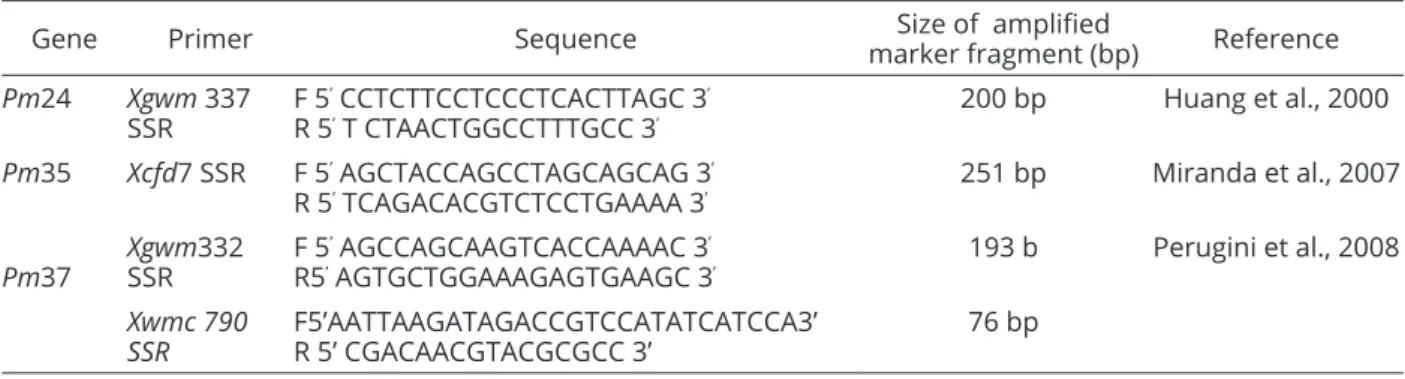
Four specific microsatellite (SSR) markers were
screened in order to detect the Pm24, Pm35 and Pm37 genes in 13 common bread wheat cultivars grown in Egypt. These markers were Xgwm 337 SSR (Pm24), Xcfd7 SSR (Pm35) and Xgwm332, Xwmc 790 (Pm37)
monogenic linesregion was conducted in an automated thermal cycler (C1000TM Thermal Cycler, Bio-RAD)
using the primers and conditions listed in Tables 4 and 5 with one pre-denaturation cycle at 94 ºC for 3 min. Each PCR mixture was 25 µl with the following composition; 1 µl of 25 ng nucleic acid, 1 µl of each primer (10 pmol), 12.5 µl of GoTag® Colorless
Master Mix (Promega Corporation, USA) and 9.5 µl of Nuclease free water (Promega). PCR products (15 µl) were analyzed by electrophoresis in a 1.5% agarose gel, stained with ethidium bromide (7.0 µg/50 ml) and DNA bands were visualized using a UV trans- illuminator and photographed.
RESULTS AND DISCUSSION
Disease assessment of powdery mildew
Data in Table 6 reveal the efficacy percentage
of 21 Pm-genes for resistance against 42 isolates of pathotypes of B. graminis tritici. However, the genes Pm2, Pm6, Pm12, Pm16, Pm24, Pm35, Pm36 and Pm37 have remained completely effective for all isolates (100%
efficacy). However, the genes Pm3b, Pm4b and Pm17
were completely effective in 2013 only and showed
intermediate efficacy in 2014. The genes Pm1a, Pm3a,
Pm3c, Pm3d, Pm3f, Pm4a, Pm5a, Pm7, Pm8 and Pm9
showed fluctuated efficacy, which ranged from 25.00 to
87.50% in 2013 season and from 38.23 to 97.05% in 2014 season. It could be recorded that the variety Chancellor showed 0.00 efficacy over the two seasons. All the Egyptian bread wheat cultivars showed susceptible responses ranged from 7 - 8 when tested to the 52 isolates of powdery mildew.
Microsatellite markers
Four SSR diagnostic markers which linked with resistance genes of Pm24, 35 and 37 were used in this study. The diagnostic marker Xgwm337 linked with Pm24
amplified fragment of 200 bp in the control Pm24 and
wasabsent in all13 Egyptian cultivars tested (Figure 1).
Data in Figure 2 shows the fragment profile of the PCR
amplifications of the SSR locus Xcfd7 (251 bp) in the
control Pm35 and indicates the absence of Pm35 in all 13 Egyptian bread wheat cultivars. For detection of Pm37, two primers Xgwm332 and Xwmc790 linked to resistance
gene were used. The two primers amplified fragments
of 193 bp (Xgwm332) and 76 bp for (Xwmc790) in the control Pm37 and were absent in the Egyptian bread wheat cultivars (Figures 3 and 4).
Molecular identification of specific DNA sequences can be used to identify the presence or absence of wheat powdery mildew (Pm) genes in wheat cultivars, (Chen and Chelkowski, 1999).
Molecular marker techniques used for identification
Table 3: Designated names, source, and chromosomal positions of identified resistance genes to powdery
mildew used in this study.
Pm genes Cultivar/line Source Position Reference
Pm24 Pm24 T. aestivum 1DS Huang et al., 2000
Pm35 NC96NGTD3-Ab A. tauschii 5DL Miranda et al., 2007
Pm37 NC96NGTAG11-Ab T. timopheevii 7AL Perugini et al., 2008
Table 4: Powdery mildew genes, primers, their sequence and size of amplified fragment used in this study.
Gene Primer Sequence marker fragment (bp)Size of amplified Reference
Pm24 Xgwm 337 SSR
F 5’ CCTCTTCCTCCCTCACTTAGC 3’
R 5’ T CTAACTGGCCTTTGCC 3’ 200 bp Huang et al., 2000 Pm35 Xcfd7 SSR F 5’ AGCTACCAGCCTAGCAGCAG 3’
R 5’ TCAGACACGTCTCCTGAAAA 3’
251 bp Miranda et al., 2007
Pm37
Xgwm332 SSR
F 5’ AGCCAGCAAGTCACCAAAAC 3’
R5’ AGTGCTGGAAAGAGTGAAGC 3’
193 b Perugini et al., 2008
Xwmc 790 SSR
F5’AATTAAGATAGACCGTCCATATCATCCA3’ R 5’ CGACAACGTACGCGCC 3’
and confirmation of Pm genes to powdery mildew include Simple Sequence Repeats (SSR) known as microsatellite. It remains one of the most popular markers to-date and the latest designated powdery mildew resistant genes; Pm46 (Gao et al., 2012), Pm47 (Xiao et al., 2013), Pm49 (Piarulli et al., 2012) and Pm50 (Mohler et al., 2013)
have been identified and mapped using this technique.
Several other genes including Pm 1e, Pm5e, Pm24a, Pm24b, Pm27, Pm30, Pm31, Pm36, Pm40, Pm42, Pm43 and Pm45 were also located and mapped using microsatellite or Simple Sequence Repeat (SSR) markers.
Table 5: Cycle conditions of the used primers.
Pm gene Conditions
Pm24 1 cycle of 3 min at 95 °C, followed by 35 cycles of 30 sec. at 95 °C, 20 sec at 55 °C, and 30 sec. at
72 °C, and finishing with 10 min incubation at 72 °C.
Pm35 1 cycle of 5 min at 94 °C, followed by 34 cycles of 1 min at 94 °C, 30 sec. at 56 °C, and 1 min at
72 °C, and finishing with 10 min incubation at 72 °C.
Pm37 1 cycle of 3 min at 94 °C, followed by 40 cycles of 1 min at 94 °C, 1 min at 54 °C, and 2 min at
72 °C, and finishing with 10 min incubation at 72 °C.
Pm37 1 cycle of 3 min at 95 °C, followed by 40 cycles of 45 sec at 94 °C, 45 sec at 55 °C, and 1 min at
72 °C, and finishing with 10 min incubation at 72 °C.
Table 6: Gene efficacy percentage of 21 Pm genes to 8 and 34 isolates of powdery mildew at seedling stage and mean disease response of 13 Egyptian bread wheat cultivars in 2013 and 2014 seasons.
Pm gene
Gene efficacy percentage in
Mean disease response
2013 2014
*S **R Efficacy% *S *R Efficacy% Cultivar Disease
response 1a 5 3 37.50 22 12 35.29 Gemmeiza-7 8***
2 0 8 100 0 34 100 Gemmeiza-10 7 3a 1 7 87.50 19 15 44.11 Gemmeiza-11 8 3b 0 8 100 13 21 61.76 Gemmeiza-12 8 3c 1 7 87.50 22 12 35.29 Sids-12 6 3d 1 7 87.50 1 33 97.05 Sids-13 9 3f 5 3 37.50 13 21 61.76 Sids-14 9 4a 3 5 62.50 10 24 70.58 Giza-168 8 4b 0 8 100 6 28 82.35 Giza-171 8 5a 1 7 87.50 21 13 38.23 Misr-1 8
6 0 8 100 0 34 100 Misr-2 8
7 4 4 50 21 13 38.23 Sahka-93 7
8 6 2 25 18 16 47.58
9 6 2 25 19 15 44.11
12 0 8 100 0 34 100
16 0 8 100 0 34 100
17 0 8 100 21 13 38.23
24 0 8 100 0 34 100
The obtained data reveals that out of twenty-one Pm lines of wheat evaluated to 42 individual powdery mildew isolates, Pm genes Pm2, Pm6, Pm12, Pm16, Pm24, Pm35, Pm36 and Pm37 were resistant at seedling stage and also,
at adult stage. Only four DNA specific SSR markers i.e.
Xgwm337, Xcfd7 linked to Pm24, Pm35and Xgwm332, Xwmc790 linked to Pm37 resistance geneswere selected to detect these genes in 13 Egyptian common bread wheat cultivars, while all the tested Egyptian wheat cultivars showed susceptible responses at the both stages. This is
first time to evaluate Pm genes in Egypt either at seedling or adult stages. The four SSR markers used in this study
confirmed the absence of Pm24, Pm35 and Pm37 in the
Egyptian bread wheat cultivars. SSR markers amplification
products of the tested cultivars showed alleles to each resistance gene with different sizes. For detection of Pm24, Pm35 and Pm37 in Egyptian cultivars showed alleles with smaller size than in monogenic line. The results of
35 0 8 100 0 34 100
36 0 8 100 0 34 100
37 0 8 100 0 34 100
Chancellor 8 0 0.00 34 0 0.00
*S: Susceptible; **R: Resistance; ***7-9: Susceptible response.
Table 6: Continuation.
Figure 1: Fragment profile of the PCR amplifications of SSR Xgwm337 locus (200 bp) in Pm24 and13 Egyptian
cultivars. M: 100bp DNA ladder RTU (Gene Direx). 1: Pm24 gene, 2: Gemmeiza-7, 3: Gemmeiza-10, 4: Gemmeiza-11, 5: Gemmeiza-12, 6: sids-12, 7: Sids-13, 8: Sids-14, 9: Giza-168, 10: Giza-171, 11: Misr-1, 12: Misr-2, 13: Sahka93.
our study are in agreement with the work of Mirinda et al. (2007). They found that when Xcfd7 microsatellite marker tested in the F2 progeny, a 251 bp fragment was associated with the resistant NCD3 (Pm35) allele and a 240 bp band was associated with the susceptible allele. Also, similar results were obtained by Blanco et al. (2008). In their study, the EST-SSR BJ261635 primer linked to
Pm36 amplified two co-migrating bands (236 and 244bp)
plants of interest are referred to as polymorphisms. The use of resistant cultivars has proven to be an effective and environmentally safe strategy for controlling wheat fungal pathogens and eliminating or reducing the use of fungicides. Molecular markers tightly linked to disease
Figure 3: Fragment profile of the PCR amplification of SSR xgwm 332 locus (193 bp) in Pm37 and 13 Egyptian
cultivars. M: 100bp DNA ladder RTU (Gene Direx). 1: Pm37gene, 2: Gemmeiza-7, 3: Gemmeiza-10, 4: Gemmeiza-11, 5: Gemmeiza-12, 6: sids-12, 7: Sids-13, 8: Sids-14, 9: Giza-168, 10: Giza-171, 11: Misr-1, 12: Misr-2, 13: Sahka93.
Figure 2: Fragment profile of the PCR amplification of SSR loci Xcfd7 (251 bp) in Pm 35 and 13 Egyptian cultivars.
M.: 100bp DNA ladder RTU (Gene Direx). 1: Pm35 gene, 2: Gemmeiza-7, 3: Gemmeiza-10, 4: Gemmeiza-11, 5: Gemmeiza-12, 6: sids-12, 7: Sids-13, 8: Sids-14, 9: Giza-168, 10: Giza-171, 11: Misr-1, 12: Misr-2, 13:Gemmeiza9.
CONCLUSIONS
This study shows that Pm24, Pm35 and Pm37 are absent in the 13 tested Egyptian bread wheat cultivars. So, incorporating these resistance genes through wheat breeding program may lead to powdery mildew resistance genotypes with more durable resistance to the disease.
ACKNOWLEDGEMENTS
The authors would like to express their thanks to Prof. Dr. Christina Cowger, Small Grains Pathologist, USDA-ARS, Department of Plant Pathology, North Carolina State University for providing us with wheat powdery mildew differentials.
REFERENCES
BLANCO, A. et al. Molecular mapping of the novel powdery
mildew resistance gene Pm36 introgressed from Triticum
turgidum var. dicoccoides in durum wheat. Theoretical &
Applied Genetics, 11:417-425, 2008.
CHEN, Y.; CHELKOWSKI, J. Genes for resistance to wheat
powdery mildew. Journal of Applied Genetics,
40:317-334, 1999.
CHENG, S. et al. Genetic improvement of wheat powdery
mildew resistance and construction of multi-lines. Journal
of Triticeae Crops, 23:34-38, 2003.
COSTAMILAN, M. L. Variability of the wheat powdery mildew
pathogen Blumeria graminis f. sp. tritici in the 2003 crop
season. Fitopatologia Brasileira, 30:420-422, 2005.
EL-SHAMY, M. M. et al. Powdery mildew infection on some Egyptian bread wheat cultivars in related to environmental
conditions. Journal of Agriculture Sciences,3(4):363-372,
2012.
EVERTS, K. L.; LEATH, S. Effect of early season powdery
mildew on development, survival, and yield contribution
of tillers of winter wheat. Phytopathology,
82:1273-1278, 1992.
GAO, H. et al. Genetic analysis and molecular mapping of a
new powdery mildew resistant gene Pm46 in common
wheat. Theoretical & Applied Genetics, 125(5):967-973,
2012.
HE, R. et al. Inheritance and mapping of powdery mildew
resistance gene Pm43 introgressed from Thinopyrum
intermedium into wheat. Theoretical & Applied Genetics, 118:1173-1180, 2009.
HOSPITAL, F. Size of donor chromosome segments around
introgressed loci and reduction of linkage drag in
marker-assisted backcross programs. Genetics, 158:1363-1379,
2001.
HUA, W. et al. Identification and molecular mapping of
Pm42, a new recessive wheat powdery mildew resistant
gene derived from wild emmer (Triticium turgidum var.
dicoccoides). Theoretical & Applied Genetics, 119:223-230, 2009.
HUANG, L. S. et al. Continuous wavelet analysis for diagnosing
stress characteristics of leaf powdery mildew. International
Journal of Agriculture & Biology, 15:34-40, 2013. Figure 4: Shows the fragment profile of the PCR amplifications of SSR Xwmc790 locus (76 bp) in Pm37 and 13
HUANG, X. Q. et al. Molecular mapping of the wheat powdery
mildew resistance gene Pm24 and marker validation for
molecular breeding. Theoretical & Applied Genetics,
101:407-414, 2000.
LANGRIDGE, P. et al. Trends in genetics and genome analyses
in wheat: a review. Australian Journal of Agriculture
Research, 52:1043-1077, 2001.
LAWRENCE, G. J. et al. Plant resistance to rusts and mildews:
genetic control and possible mechanisms. Trends in
Microbiology, 2(8):263-270, 1994.
LEATH, S.; HEUN, M. Identification of powdery mildew
resistance genes in cultivars of soft red winter wheat. Plant
Diseases, 74:747-752, 1990.
LI, G.; FANG, T.; ZHANG, H. Molecular identification of a new
powdery mildew resistance gene Pm41 on chromosome
3 BL derived from wild emmer (Triticum turgidum var.
dicoccoides). Theoretical & Applied Genetics, 119: 531-539, 2009.
LUO, P. G. et al. Characterization and chromosomal location
of Pm40 in common wheat: a new gene for resistance
to powdery mildew derives from Elytrigia intermedium.
Theoretical & Applied Genetics,18:1059-1064, 2009.
MAXWELL, J. J. et al. MlAG12: a Triticum timopheevii-derived powdery mildew resistance gene in common wheat on
chromosome 7AL. Theoretical & Applied Genetics,
119:1489-1495, 2009.
MCINTOSH, R. A.; YAMAZAKI, Y.; DUBCOVSKY, J. Catalogue of gene symbols for wheat. 2008. Available in: <http:// wheat.pw.usda.gov/GG2/Triticum/wgc/2008/>. Access in: 17 March, 2010.
MIRANDA, L. M. et al. Chromosomal location of Pm35, a novel
Aegilops tauschii derived from powdery mildew resistance
gene introgressed into common wheat (Triticum aestivum
L.). Theoretical & Applied Genetics, 114:1451-1456, 2007.
MOHLER, V. et al. Pm50: a new powdery mildew resistance
gene in common wheat derived from cultivated emmer.
Journal of Applied Genetic, 54(3):259-263, 2013.
MURPHY, J. P.; NAVARRO, R. A.; LEATH, S. Registration of NC99BGTAG11 wheat germplasm resistant to powdery
mildew. Crop Science, 42:1382, 2002.
NAVARRO, R. A. et al. Registration of NC97BGTAB9 and NC97BGTAB10 wheat germplasm lines resistant to
powdery mildew. Crop Science, 40:1508-1509, 2000.
PERUGINI, L. D. et al. Pm37, a new broadly effective powdery
mildew resistance gene from Triticum timopheevii.
Theoretical & Applied Genetics, 116:417-425, 2008.
PIARULLI, L. et al. Molecular identification of a new powdery
mildew resistance gene on chromosome 2BS from Triticum
turgidum ssp. dicoccum. Plant Science, 196:101-106, 2012.
SAMBORSKY, D. J.; DYCK, P. L. Inheritance of virulence in Puccinia reconditaon six back cross lines of wheat with
single genes for resistance to leaf rust. Canadian Journal
of Botany, 54:1666-1671, 1976.
SANG, D. et al. The molecular identification of powdery mildew
resistance genes in the cultivars in Henan Province and
application of molecular marker-assisted breeding. Acta
Agriculturae Boreali-Sinica, 21:86-89, 2006.
TANKSLEY, S. D. et al. RFLP mapping in plant breeding: new
tools for an old science. Biotechnology, 7:257-264, 1989.
XIAO, M. et al. Identification of the gene Pm47 on chromosome 7BS conferring resistance to powdery mildew in the
Chinese wheat landrace Hongyanglazi. Theoretical and