Engineering
ISSN: 1809-4430 (on-line)
_________________________
2 Centro Universitário da Fundação Educacional de Barretos (UNIFEB)/ Barretos - SP, Brasil. 3 Universidade Federal de São João del-Rei (UFSJ)/ São João del-Rei - MG, Brasil.
4 Universidade Estadual do Centro-Oeste (UNICENTRO)/ Irati - PR, Brasil.
5 Escola de Engenharia de São Carlos, Universidade de São Paulo (EESC/USP)/ São Carlos - SP, Brasil. TECHNICAL PAPER
PHYSICO-MECHANICAL CHARACTERIZATION OF THE Anadenanthera colubrina WOOD SPECIE
Doi:http://dx.doi.org/10.1590/1809-4430-Eng.Agric.v37n2p376-384/2017
ANDRÉ L. CHRISTOFORO1*, BRUNO H. C. AFTIMUS2, TULIO H. PANZERA3,
GILMARA DE O. MACHADO4, FRANCISCO A. R. LAHR5
1*Corresponding author. Universidade Federal de São Carlos (UFScar)/ São Carlos - SP, Brasil.
E-mail: [email protected]
ABSTRACT: In Brazil, the characterization of wood is carried out in accordance with the premises established by ABNT NBR 7190standard; however, the determination of wood properties requires the use of equipment, which hinders the wood characterization for the construction professional. To circumvent this problem, the properties of wood strength and stiffness can be estimated through regression models using the apparent density as estimator, being the density a physical property of easy determination. This study aimed to determine 4 physical and 13 mechanical properties of
“Angico Branco” wood (Anadenanthera colubrina), and with the aid of regression models based on analysis of variance, estimate the strength and stiffness properties as a function of apparent density. Twelve samples were produced for each test, resulting in a total of 204 experimental determinations. The results of mechanical properties showed consistent performance with other wood species studied, demonstrating their potential use in various applications. From the regression models, only the longitudinal modulus of elasticity in parallel compression to the grain showed a significant result, and the best were obtained with the linear model, which provided determination coefficient (R2) equal to 56.32%.
KEYWORDS: Anadenanthera colubrina, physico-mechanical characterization, apparent density, regression models, analysis of variance (ANOVA).
INTRODUCTION
With the growing awareness of the population to use materials that cause the least damage to the environment, wood from planted forests is a potential material for several sectors of the economy, especially construction, where it is used as a structural element for making forms and other purposes (ALMEIDA et al., 2013; LAHR et al., 2016).
Popularly known as “angico-branco”, the Anadenanthera colubrina (Vell.) species Brenan of
the Mimosaceae family can be found in several regions of Brazil (CARVALHO, 2002), as in the
Atlantic slope of the States of Rio de Janeiro and São Paulo (LORENZI, 2002), Minas Gerais, Mato Grosso, Mato Grosso do Sul, Bahia, Paraná, Espírito Santo and the Federal District (CARVALHO, 2002).
The Anadenanthera colubrina can reach a height of 10 to 20 m, it is widely used in the
However, to be used in the construction of wood structures, as in the case of other materials, it is necessary to have adequate knowledge of the physical and mechanical properties of the species, thus allowing a more rational use of the material, which contributes to a structural sizing with greater security and economy.
In Brazil, the design of wood structures is developed using the resistance classes defined by the Brazilian standard ABNT NBR7190 (1997) or through the results of physical-mechanical characterization tests, which are also specified by this standard. The use of test results is more appropriate because strength class values are generally overestimated and do not exhibit the characteristics of all species available in nature (LOGSDON et al., 2008a, LOGSDON et al., 2008b).
However, due to the difficulties in carrying out the tests for the determination of the various physical and mechanical properties of the wood of interest, alternatives are proposed, such as the use of other properties as an estimation factor (CHRISTOFORO et al., 2014; LAHR et al., 2016), and since density is a basic physical property and easy to determine, it is a possible estimator of the mechanical properties of the wood (DIAS & LAHR, 2004), highlighting that the Brazilian standard itself establishes relations between properties with the purpose of estimating values for a pre-sizing.
The aim of this study was to characterize the wood species of Anadenanthera colubrina, and also, for a more precise structural pre-sizing to estimate, with the use of regression models, the possibility of estimating the strength and stiffness properties investigated according to the density, since the density can be easily determined by the construction professional interested in the use of this kind of wood.
MATERIAL AND METHODS
The wood of the Anadenanthera colubrina species came from timber companies located in the city of São Carlos (SP).The wood pieces were properly stocked, with moisture content close to 12%, consisting of equilibrium moisture for wood established by the Brazilian standard.
All the tests were carried out at the Laboratory of Wood and Wood Structures (LaMEM), at the School of Engineering of São Carlos (EESC), University of São Paulo (USP).The carried out experiments followed all the assumptions and methods indicated by the Brazilian Standard ABNT NBR 7190 (1997), provided in its Annex B, “Determination of wood properties for structural projects”.
TABLE 1.Physical and mechanical properties of Anadenanthera colubrina wood specie.
Properties Abbreviation
Apparent density ρ12
Total radial retraction TRR
Total tangential retraction TTR
Strength to the parallel compressive to fibres fc0
Strength to the normal compressive to fibres fc90
Strength to the parallel traction to fibres ft0
Strength to the normal traction to fibres ft90
Strength to the parallel shearing to fibres fv0
Strength to the cracking fs0
Conventional strength in the static bending test fm
Parallel hardness to fibres fH0
Normal hardness to fibres fH90
Modulus of longitudinal elasticity in parallel compression to fibres Ec0
Modulus of elasticity in normal compression to fibres Ec90
Modulus of longitudinal elasticity in parallel traction to fibres Et0
Modulus of conventional elasticity in the static bending test Em
Tenacity W
The classification of Anadenanthera colubrina wood in the wood strength classes of the hardwood group was done using Equation 1, where fk consists of the strength characteristic value
and n is the number of test pieces used. From [eq. (1)], the strength results should be placed in ascending order f1≤f2≤...≤fn, neglecting the highest value if the number of pieces is odd, and not
taking fk values less than f1 and nor at 0.70 of the average value.
(1)
The [eq. (1)] was also used to investigate the accuracy of relations: fc0,k/ft0,k=0.77;
fc90,k/fc0,k=0.25 and fv0,k/fc0,k=0.12, expressions established by the Brazilian standard.
For the estimation of the wood strength and stiffness properties according to the apparent
density (ρ12), regression models (Equations 2 to 5) based on analysis of variance (ANOVA) were
used in order to establish the best fit between the apparent density and each one of the 14 mechanical properties (Y) investigated, which resulted in the generation of 56 mathematical models.
[Lin - linear] (2)
[Exp - exponential] (3)
[Log - logarithmic] (4)
[Geo - geometric] (5)
By the ANOVA of the regression models, considered at the 5% level of significance (α), the null hypothesis formulated consisted in the non-representativeness of the tested models (H0: β=0),
and in the representativeness as an alternative hypothesis (H1: β≠0).
RESULTS AND DISCUSSION
TABLE 2. Results of physical properties of Anadenanthera colubrina wood specie.
Estat. ρ12 (kg/m3) TRR (%) TTR (%)
x 710 3.12 5.14
CV 0,03 0.14 0.33
Min 670 2.56 4.67
Max 750 4.00 6.31
TABLE 3. Results of mechanical properties of Anadenanthera colubrina wood specie.
fc0 (MPa) ft0 (MPa) ft90 (MPa) fv0 (MPa) fs0 (MPa) fm (MPa) Ec0 (MPa) Et0 (MPa)
x 44 89 6.1 15 1.1 89 14962 14745
CV 0.09 0.12 0.21 0.15 0.16 0.09 0.19 0.16
Min 35 54 3.1 8 0.9 77 11683 10437
Max 48 85 8.9 17 1.5 105 19016 19451
Em (MPa) fH0 (MPa) fH90 (MPa) W (J) fc90 (MPa) Ec90
(MPa)
x 15776 70 61 38.50 8 948
CV 0.18 0.10 0.09 0.17 0.11 0.12
Min 11941 56 52 28.50 6 826
Max 19859 79 70 53.42 9 1151
The coefficients of variation (Cv) values obtained from the strength and stiffness properties of
Anadenanthera colubrina were lower than the limits established by the Brazilian standard (18% for
strength for normal stresses and 28% for tangential stresses), highlighting the good representativeness of the properties by their average values.
The results of the apparent density (710 kg/m³) for Anadenanthera colubrina classify it as a dense wood (CARVALHO, 2002), resembling to the density of the Angelim Araroba wood (CHRISTOFO et al., 2016; ALMEIDA et al., 2016) and higher than the “Cedro Doce” (CHRISTOFO et al., 2016), but much lower than the density of Pariri wood (ALMEIDA et al., 2015) and other species already researched (LOGSDON et al., 2008a; CHRISTOFO et al., 2016; ALMEIDA et al., 2016).
The radial retraction is smaller than the tangential retraction, results that are in agreement with affirmations made by some authors such as MELO et al. (2010); DURLO & MARCHIORI (1992) and DEL MENEZZI (2006).Comparing the results obtained with other species (LAHR et al., 2016; CHRISTOFORO et al., 2016; MELO et al., 2010), it is possible to verify that denser wood species have greater dimensional variation, as affirmed in the researches of CHRISTOFORO et al. (2016), VITAL & TRUGILHO (1997) and TSOUMIS (1991).
The strength in the parallel compression to the fibers obtained of 44MPa for the
Anadenanthera colubrina wood is very close to the strength in the parallel compression (42.98MPa)
of Araucaria angustifolia (MELO et al., 2010), values that are reasonable when compared with
those coming from species reported in the researches of ALMEIDA et al. (2013) and CAVALHEIRO et al. (2016), but very low when considering species such as Vatairea sp and Pariri showed in the studies of ALMEIDA et al. (2015) and LAHR et al. (2016).
The results of the tensile strength in the parallel direction (89MPa) to the fibres of the
Anadenanthera colubrina wood are close to the values of the tensile strength in the parallel
direction to the wood fibres of Vatairea sp [96MPa] (LAHR et al., 2016), “Cedro marinheiro”
[111.18MPa] (LOGSDON et al., 2008b) and “Peroba-mica” [87.63MPa] (LOGSDON et al.,
2008a).
The average value of the strength to the shear in the parallel direction to the fibres (15MPa) of
the Anadenanthera colubrina wood is equal to fv0 of the “Pariri” and Vatairea sp species
“Peroba-mica”, “Cedro marinheiro” and “Paricá” species (LOGSDON et al., 2008a; LOGSDON et al., 2008b; CAVALHEIRO et al., 2016).
Table 4 shows the characteristics values of the strength properties determined using [eq. (1)].
TABLE 4. Characteristic values of the strength properties for Anadenanthera colubrina wood specie.
Properties Unit (MPa)
Characteristic resistance to parallel compression to fibres 41.36 Characteristic resistance to parallel traction to fibres 53.24 Characteristic resistance to normal compression to fibres 6.16
Characteristic strength to parallel shear to fibres 13.20
The characteristic value of the strength in parallel compression in Table 4 fits the
Anadenanthera colubrina wood belonging to the strength class C40 for the hardwood group
according to the Brazilian standard.
The relation obtained between fc0,k/ft0,k was equal to 0.78, a value very close to the relation
established by the Brazilian standard (0.77).However, the investigated relations fc90,k/fc0,k and
fv0,k/fc0,k resulted in coefficients equal to 0.12 and 0.32, respectively, values very different from
those indicated by the standard (fc90,k/fc0,k=0.25; fv0,k/fc0,k=0.12), as well as obtained by other authors
(LOGSDON et al., 2008a; LOGSDON et al., 2008b), which indicates the need to revise ABNT NBR 7190 standard in these relations.
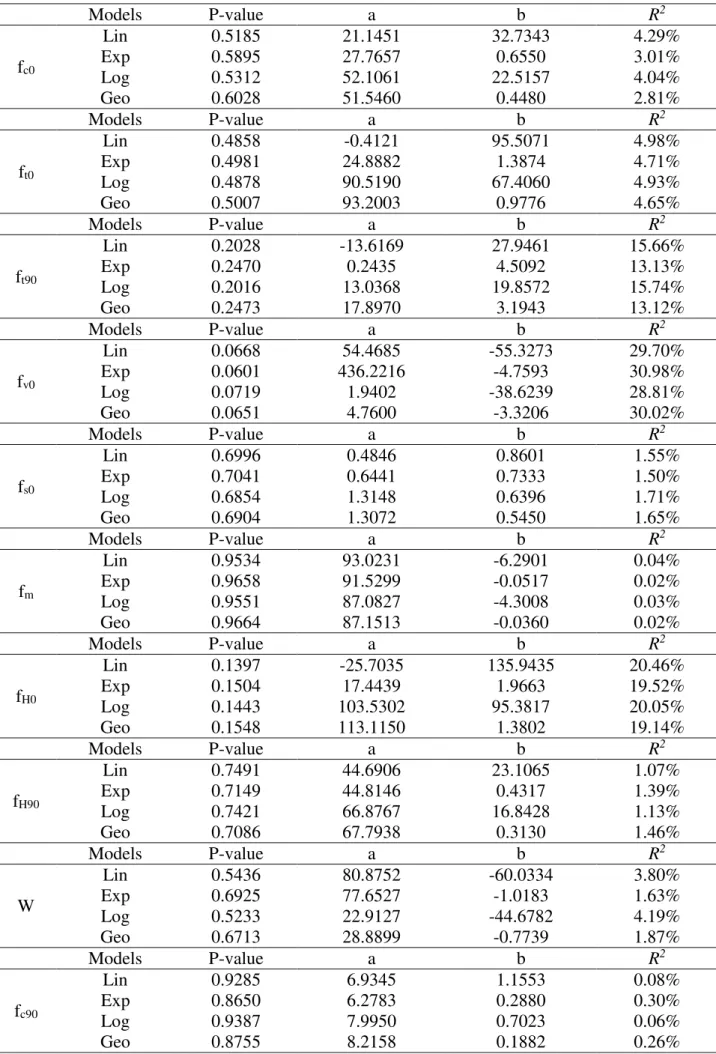
TABLE 5. Regression models for estimating the strength properties of Anadenanthera colubrina wood specie.
Models P-value a b R2
fc0
Lin 0.5185 21.1451 32.7343 4.29%
Exp 0.5895 27.7657 0.6550 3.01%
Log 0.5312 52.1061 22.5157 4.04%
Geo 0.6028 51.5460 0.4480 2.81%
Models P-value a b R2
ft0
Lin 0.4858 -0.4121 95.5071 4.98%
Exp 0.4981 24.8882 1.3874 4.71%
Log 0.4878 90.5190 67.4060 4.93%
Geo 0.5007 93.2003 0.9776 4.65%
Models P-value a b R2
ft90
Lin 0.2028 -13.6169 27.9461 15.66%
Exp 0.2470 0.2435 4.5092 13.13%
Log 0.2016 13.0368 19.8572 15.74%
Geo 0.2473 17.8970 3.1943 13.12%
Models P-value a b R2
fv0
Lin 0.0668 54.4685 -55.3273 29.70%
Exp 0.0601 436.2216 -4.7593 30.98%
Log 0.0719 1.9402 -38.6239 28.81%
Geo 0.0651 4.7600 -3.3206 30.02%
Models P-value a b R2
fs0
Lin 0.6996 0.4846 0.8601 1.55%
Exp 0.7041 0.6441 0.7333 1.50%
Log 0.6854 1.3148 0.6396 1.71%
Geo 0.6904 1.3072 0.5450 1.65%
Models P-value a b R2
fm
Lin 0.9534 93.0231 -6.2901 0.04%
Exp 0.9658 91.5299 -0.0517 0.02%
Log 0.9551 87.0827 -4.3008 0.03%
Geo 0.9664 87.1513 -0.0360 0.02%
Models P-value a b R2
fH0
Lin 0.1397 -25.7035 135.9435 20.46%
Exp 0.1504 17.4439 1.9663 19.52%
Log 0.1443 103.5302 95.3817 20.05%
Geo 0.1548 113.1150 1.3802 19.14%
Models P-value a b R2
fH90
Lin 0.7491 44.6906 23.1065 1.07%
Exp 0.7149 44.8146 0.4317 1.39%
Log 0.7421 66.8767 16.8428 1.13%
Geo 0.7086 67.7938 0.3130 1.46%
Models P-value a b R2
W
Lin 0.5436 80.8752 -60.0334 3.80%
Exp 0.6925 77.6527 -1.0183 1.63%
Log 0.5233 22.9127 -44.6782 4.19%
Geo 0.6713 28.8899 -0.7739 1.87%
Models P-value a b R2
fc90
Lin 0.9285 6.9345 1.1553 0.08%
Exp 0.8650 6.2783 0.2880 0.30%
Log 0.9387 7.9950 0.7023 0.06%
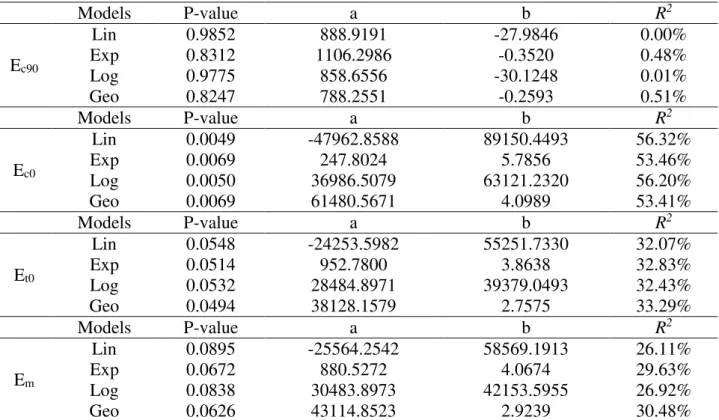
TABLE 6. Regression models for estimating the stiffness properties of Anadenanthera colubrina wood specie.
Models P-value a b R2
Ec90
Lin 0.9852 888.9191 -27.9846 0.00%
Exp 0.8312 1106.2986 -0.3520 0.48%
Log 0.9775 858.6556 -30.1248 0.01%
Geo 0.8247 788.2551 -0.2593 0.51%
Models P-value a b R2
Ec0
Lin 0.0049 -47962.8588 89150.4493 56.32%
Exp 0.0069 247.8024 5.7856 53.46%
Log 0.0050 36986.5079 63121.2320 56.20%
Geo 0.0069 61480.5671 4.0989 53.41%
Models P-value a b R2
Et0
Lin 0.0548 -24253.5982 55251.7330 32.07%
Exp 0.0514 952.7800 3.8638 32.83%
Log 0.0532 28484.8971 39379.0493 32.43%
Geo 0.0494 38128.1579 2.7575 33.29%
Models P-value a b R2
Em
Lin 0.0895 -25564.2542 58569.1913 26.11%
Exp 0.0672 880.5272 4.0674 29.63%
Log 0.0838 30483.8973 42153.5955 26.92%
Geo 0.0626 43114.8523 2.9239 30.48%
Analysing the results from Tables 5 and 6, we observed that among the 14 mechanical properties estimated by the apparent density with the use of the regression models, only the elastic modulus estimation in the parallel compression to the fibres (Ec0) was significant (P-value <0.05),
consisting in the linear model (Ec0 = -47962.8588 + 89150.4493·ρap) as the best fit (R² =
56.32%).This implies the low representativeness of the apparent density as estimator of the strength and stiffness properties of Anadenanthera colubrina wood.
Some authors have found significant relations between the apparent density and the strength to compression in the parallel direction to the fibres for some wood species such as Canafístula [R²=48.57%] and Castelo [R² = 52,84%] (ALMEIDA et al.,2016) and Vatairea sp (LAHR et al., 2016), and non-significant relations between the apparent density and the strength in parallel compression to the fibres for the Angelim Araroba wood (ALMEIDA et al., 2016), as well as obtained with the Anadenanthera colubrina of this research. As well as the Anadenanthera
colubrina, the Vatairea sp (LAHR et al., 2016) also provided a significant adjustment for the
longitudinal elastic modulus in parallel compression to the fibres, with a determination coefficient around 50%.
CONCLUSIONS
From the results of this research, the following can be concluded:
- From the coefficient of variation values obtained, the characterization of the Anadenanthera
colubrina species can be considered according to the requirements of the Brazilian standard, and the
averages of the physical and mechanical properties obtained can be accepted as representative values of the sample sets by property:
- According to the assumptions of the Brazilian standard, the Anadenanthera colubrina wood is categorized as belonging to resistance class C40, because it presents a characteristic value of compressive strength (fc0,k) equal to 41.36MPa, indicating a good performance for using in wood
- From the 3 relationships explored between the characteristic resistance values, only the relation between the compressive strength (fc0) and the tensile strength (ft0) in the parallel direction to the
fibres provided a result (0.78) close to that established by the Brazilian standard (fc0,k/ft0,k =0.77);
- The regression models used in the estimation of the 14 strength and stiffness properties in function of the apparent density were significant only in the estimation of the modulus of elasticity values in the parallel compression to the fibres, consisting the linear model as the one that provided the best adjustment (Ec0=-47962.8588+89150.4493·ρap; R2=56.32%).
ACKNOWLEDGEMENTS
The authors thank for all the support provided during the production of this study, the Coordination of Improvement of Higher Education (CAPES) and the National Council of Scientific and Technological Development (CNPq).
REFERENCES
ALMEIDA, D. H.; CHAHUD, E.; ALMEIDA, T. H.; CHRISTOFORO, A. L.; BRANCO, L. A. M. N.; LAHR, F. A. R. Determination of Density, Shear and Compression Parallel to the Grain
Strengths of Pariri (Pouteria sp.), Brazilian Native Wood Specie. International Journal of Materials Engineering, Rosemead, v. 5, n. 5, p. 109-112, 2015.
ALMEIDA, D. H.; SCALIANTE, R. M.; MACEDO, L. B.; MACÊDO, A. N.; DIAS, A. A.;
CHRISTOFORO, A. L.; JUNIOR, C. A. Caracterização completa da madeira da espécie amazônica Paricá (Schizolobium amazonicum HERB) em peças de dimensões estruturais. Revista Árvore, Viçosa, MG, v.37, n.6, p.1175-1181, 2013.
ALMEIDA, T. H.; ALMEIDA, D. H.; CHRISTOFORO, A. L.; CHAHUD, E.; BRANCO, L. A. M. N.; LAHR, F. A. R. Density as Estimator of Strength in Compression Parallel to the Grain in Wood, International Journal of Materials Engineering, Rosemead, v. 6, n.3, p. 67-71, 2016.
ABNT - ASSOCIAÇÃO BRASILEIRA DE NORMAS TÉCNICAS. NBR7190. Projeto de
estruturas de madeira. Rio de Janeiro: ABNT, 1997.
CARVALHO, P. E. R. Angico-branco: taxonomia e nomenclatura. Colombo: Embrapa Florestas, 2002. (Circular técnica, 56).
CAVALHEIRO, R. S.; ALMEIDA, D. H.; ALMEIDA, T. H,; ARAÚJO, V. A.; CHRISTOFORO, A. L.; LAHR, F. A. R. Mechanical Properties of Paricá Wood Using Structural Members and Clear Specimens. International Journal of Materials Engineering, Rosemead, v. 6, n. 2, p. 56-59, 2016.
CHRISTOFORO, A. L.; ALMEIDA, T. H.; ALMEIDA, D. H.; SANTOS, J. C.; PANZERA, T. H.; LAHR, F. A. R. Shrinkage for Some Wood Species Estimated by Density, International Journal of Materials Engineering, Rosemead, v. 6, n.2, p. 23-27, 2016.
CHRISTOFORO, A. L.; SILVA, S. A. M.; PANZERA, T. H.; LAHR, F. A. R. Estimative of Wooden Toughness by the Apparent Density and Bending Strength, International Journal of Materials Engineering, Rosemead, v. 4. n. 2, p. 49-55, 2014.
DEL MENEZZI, C. H. S. Instabilidade dimensional da madeira e de seus subprodutos: causas, consequências e prevenção. Comunicações Técnicas Florestais, Brasília, DF, v.8, n.2, 37 p., 2006. DIAS, F. M.; LAHR, F. A. R. Strength and stiffness properties of wood esteemed trough the specific gravity. Scientia Forestalis, Piracicaba, v. 65, p. 102-113, 2004.
GOMES, K. C. O.; PAIVA, H. N.; NEVES, J. C. L.; BARROS, N. F.; SILVA, S. R. Influência da saturação por bases e de fósforo no crescimento de mudas de Angico-Branco. Revista Árvore, Viçosa, MG, v.28, n.6, p.785-792, 2004.
LAHR, F. A. R.; AFTIMUS, B. H. C.; ARROYO, F. N.; ALMEIDA, D. H.; CHRISTOFORO, A. L.; CHAHUD, E.; BRANCO, L. A. M. N. Full Characterization of Vatairea sp Wood Specie, International Journal of Materials Engineering, Rosemead, v. 6, n. 3, p. 92-96, 2016.
LOGSDON, N. B.; FINGER, Z.; BORGES, C. G. A. Caracterização físico-mecânica da madeira de Peroba-mica, Aspidosperma populifolium A. DC. (Apocynaceae). Floresta, Curitiba, v. 38, n. 1, jan./mar. 2008.
LOGSDON, N. B.; FINGER, Z.; PENNA, E. S. Caracterização físico-mecânica da madeira de Cedro-marinheiro, Guarea trichilioides L. (Meliaceae). Scienta Forestalis, Piracicaba, v.36, n.77, p. 43-51, 2008.
LORENZI, H. Árvores brasileiras: manual de identificação e cultivo de plantas arbóreas nativas do Brasil. 4. ed. Nova Odessa: Instituto Plantarium, 2002. v.1.
MELO, R. R.; STANGERLIN, D. M.; DEL MENEZZI, C. H. S.; GATTO, D. A.; CALEGARI, L. Caracterização física e mecânica da madeira de Araucaria angustifolia (Bertol.) Kuntze, Revista Brasileira de Ciência Agrária. Recife, v.5, n.1, p.67-73, 2010.
ORTOLANI, F. A.; MELLONI, M. N. G.; MARIOTTO, C. F. G.; MORO, J. R. Caracterização citogenética em Anadenanthera colubrina (Vell.) Brenan (Mimosoideae) e Guazuma ulmifolia Lam. (Sterculiaceae), Acta Botanica Brasilica, São Paulo, v. 24, n. 2, p. 299-303, 2010. SANTOS, E. Nossas madeiras. Belo Horizonte: Itatiaia, 1987. 313p.
TSOUMIS, G. Science and technology of wood: structure, properties and utilization. New York: Van. NastrndReinold, 1991.