Repositório ISCTE-IUL
Deposited in Repositório ISCTE-IUL: 2019-04-02
Deposited version: Post-print
Peer-review status of attached file: Peer-reviewed
Citation for published item:
Vicente, C., Laureano, R. M. S. & Machado, M. J. C. V. (2017). The image of and the interest in the accounting profession: an empirical study in three social groups. International Journal of Business Excellence. 12 (4), 433-449
Further information on publisher's website: 10.1504/IJBEX.2017.10005582
Publisher's copyright statement:
This is the peer reviewed version of the following article: Vicente, C., Laureano, R. M. S. & Machado, M. J. C. V. (2017). The image of and the interest in the accounting profession: an empirical study in three social groups. International Journal of Business Excellence. 12 (4), 433-449, which has been published in final form at https://dx.doi.org/10.1504/IJBEX.2017.10005582. This article may be used for non-commercial purposes in accordance with the Publisher's Terms and Conditions for
self-archiving.
Use policy
Creative Commons CC BY 4.0
The full-text may be used and/or reproduced, and given to third parties in any format or medium, without prior permission or charge, for personal research or study, educational, or not-for-profit purposes provided that:
• a full bibliographic reference is made to the original source • a link is made to the metadata record in the Repository • the full-text is not changed in any way
The full-text must not be sold in any format or medium without the formal permission of the copyright holders.
Serviços de Informação e Documentação, Instituto Universitário de Lisboa (ISCTE-IUL) Av. das Forças Armadas, Edifício II, 1649-026 Lisboa Portugal
Phone: +(351) 217 903 024 | e-mail: [email protected] https://repositorio.iscte-iul.pt
1
THE IMAGE OF AND THE INTEREST IN THE ACCOUNTING PROFESSION: AN EMPIRICAL STUDY IN THREE SOCIAL GROUPS
Célia Cristina da Silva Vicente
Instituto Superior de Contabilidade e Administração de Lisboa (ISCAL) Av. Miguel Bombarda, 20
1069 - 035 Lisboa Portugal
Email: [email protected],
Raul Manuel da Silva Laureano and Maria João Cardoso Vieira Machado*
Instituto Universitário de Lisboa (ISCTE-IUL) Business Research Unit (BRU-IUL)
Avenida Forças Armadas, 1649-026 Lisboa Portugal
Email: [email protected]
Email: [email protected] *Corresponding author
Biographical notes: Célia Cristina da Silva Vicente (PhD in accounting) is an Associate Professor of the Instituto Superior de Contabilidade e Administração de Lisboa (ISCAL), Portugal, with research interests in management accounting. She is also a co-author of a book about management accounting.
Raul M. S. Laureano (PhD in Management - Quantitative Methods for Management) is a researcher at the Business Research Unit (BRU-IUL) at the Instituto Universitário de Lisboa (ISCTE-IUL), in Portugal, with interests in the fields of business analytics, financial literacy, fundraising and tourism. He is also an Assistant Professor at the Business School of the Instituto Universitário de Lisboa (ISCTE-IUL), where he teaches undergraduate and graduate classes of Statistics and Data Analysis, and Director of the Executive Master in Applied Business Analytics at INDEG-ISCTE. He is coauthor of books about Financial Mathematics and Statistics with IBM SPSS Statistics and of more than forty publications in proceedings and journals (see https://ciencia.iscte-iul.pt/public/person/rml).
Maria João Cardoso Vieira Machado (PhD in accounting) is an Assistant Professor of Accounting Department, at the Business School of the Instituto Universitário de Lisboa (ISCTE–IUL). She is also researcher at the Business Research Unit (BRU-IUL), with research interests in management accounting and tourism (see https://ciencia.iscte-iul.pt/public/person/mjcvm).
ABSTRACT
This study has the following goals: to analyse the image of and the interest in the accounting profession; to identify any possible differences in perception among the respondent groups; to identify the individual characteristics influencing the perception; to propose an explanatory model of the interest in the profession. The respondents were the members of three social groups composing the profession’s value chain: 105 financial officers of the biggest 500 Portuguese companies; 412 chartered accountants;
2
235 students majoring in Accounting. The data collected show that there are not any significant differences in perception regarding the image of and the interest in the accounting profession. Regarding the influence of the individual characteristics, the results obtained lead to the following conclusion: the third-year students with a higher average perceive a higher level of interest in the profession; the professionals with a higher academic degree and college graduated perceive a lower level of interest in the profession.
Keywords: image; interest; accounting profession; company officers; students.
1 – INTRODUCTION
The accounting profession's image continues to be a concern for researchers, but there are, however, contradictory results in the different studies already conducted (Carnegie and Napier, 2010; Enis, 2010; Jeacle, 2008; Parker, 2000; Pekdemir et al., 2013; Stivers and Onifade, 2014). So Pekdemir et al. (2013) suggest to perform similar studies in other countries in order to obtain a comparison on a global scale. To measure the perceptions about the accounting profession an instrument called Perceptions of Accounting Profession Instrument (PAPI) can be used. It was developed by Saemann and Crooker (1999), and subsequently used by other authors, but only on research work with student populations (Byrne and Willis, 2005; Sugahara et al., 2008; Worthington and Higgs, 2003; 2004). The research carried out suggests that the image of the accounting profession may vary depending on the group being surveyed (Dimnik and Felton, 2006), being particularly important the studies reporting the existence of conflicting perceptions between managers and accountants (Johnston et al. 2002; O'Callaghan et al., 2010; Pierce and O'Dea 2003; Rajesh and Suganthi, 2014). Prior research also suggests the influence of the respondents’ individual characteristics in the perception of the profession (Askary et al., 2014; Flynn et al., 2015; Genç and Çal, 2015; Linnhoff et al., 2015; Murugesan and Dominic, 2013; Özkürkçüler et al., 2014; Pekdemir et al., 2013; Qasem and Abdullatif, 2014; Stivers and Onifade, 2014).
The studies already conducted suggesting that the image of the profession may vary depending on the group surveyed, justify conducting a broader research that analyses the perception convergence about the accounting profession in three social groups composing the profession’s value chain: the students who are being trained for that profession; the accountants themselves; and the managers of the organizations benefiting from these professionals’ work. Considering also that the literature suggests an influence of the individual characteristics on the accounting profession’s perceptions, the following objectives were defined: to analyse the image of and the interest in the profession; to identify any differences in perception between the three selected groups; to identify the individual characteristics influencing the image of and the interest in the profession; to propose an explanatory model for the interest in the profession, according to its image.
The data collection method used was the distribution of a questionnaire to three social groups: students majoring in Accounting at a college education institute, chartered accountants (CA), and the financial officers for the top 500 companies. With regard to professionals, we received 105 replies from the universe of financial officers, and 412 replies from the CA universe of more than 70,000 professionals. With regard to
3
students, the sample consists of 235 students, of which 157 are first year students, and 78 third year students.
2 – LITERATURE REVIEW
The perception the individuals have on the accounting profession's image continues to be a concern for researchers (Carnegie and Napier, 2010; Enis, 2010; Jeacle, 2008; Parker, 2000; Pekdemir et al., 2013; Stivers and Onifade, 2014). The results obtained do not generate consensus regarding the profession’s image. Some studies, such as the one from Parker (2000), suggest the existence of a negative image for the profession. Other authors consider that the current image of the profession is no longer negative, due to the efforts by various organizations to promote a better integration of the accountants within the organizations (Jeacle, 2008). More recent studies, conducted after important financial scandals in the US with world level impact, point out that the profession’s image is conditioned by the complex interaction of various social, cultural, and historical phenomena, difficult to predict and to regulate (Carnegie and Napier, 2010; Enis, 2010). In a more recent study, performed through two comparative studies with a time interval of five years Pekdemir et al. (2013) conclude that the negative perception about the accounting profession in Turkey has increased, in particular because it is considered more boring. This conclusion is convergent with the results of Stivers and Onifade (2014), obtained in a study involving American students. Pekdemir et al. (2013) also suggest to perform similar studies in other countries in order to obtain a comparison on a global scale.
Saemann and Crooker (1999) developed a questionnaire to measure the perception of the accounting profession, called Perceptions of Accounting Profession Instrument (PAPI), which has 36 pairs of terms, where each pair comprises a term and its antonym. The questionnaire was applied to students by Saemann and Crooker (1999), at the beginning and at the end of a financial accounting course. The authors conducted a principal component analysis (PCA), which reduced the number of pairs of terms to 28, and allowed the identification of four perception dimensions regarding the profession. The first three dimensions measure the image perception of the profession, and are the following: level of structuring; level of precision; level of isolation. The last dimension measures the perception of the interest in the profession, and is called level of interest. Saemann and Crooker (1999) concluded that the students have a traditional perception of accounting, considering it structured, precise and lonely. Saemann and Crooker (1999) have also shown that a traditional perception of the profession, with a high level of structuring and isolation, reduces the interest in the profession.
This instrument developed by Saemann and Crooker (1999) was later used by other authors, but only in research work aimed at students (Byrne and Willis, 2005; Sugahara et al., 2008; Worthington and Higgs, 2003; 2004).
Worthington and Higgs (2003, 2004) used the PAPI tool to measure the perceptions of Australian college students regarding professions linked with the financial area. The results obtained suggest that the choice of a course in finances depends on the overall interest of the students for the profession, and on their perceptions about the way the profession is carried out. Worthington and Higgs (2003, 2004) have also analysed the influence of some personal characteristics of the students in their perceptions of the profession, and concluded that gender influences these perceptions. The female students
4
consider the financial profession as being more boring than exciting, more extroverted than introverted, more superficial than deep, implementing more creative solutions than repeated solutions, and more unexpected than routine, when compared to the male gender students.
Byrne and Willis (2005) examined the perceptions of Irish high school students about the accounting profession using the PAPI, and concluded that the students have a traditional image of the profession, considering it boring, precise, and rule oriented. Regarding the factors influencing the perceptions of the students about the profession, the authors conclude that the female gender sees the profession as being more precise and rule compliant, when compared to the male gender.
Sugahara et al. (2008) analysed the perception of the accounting profession in multicultural students from Australian universities, applying the PAPI questionnaire to 114 students of different nationalities. The authors concluded that the Australian students present a high level of creativity, and a strong unlikelihood of majoring in Accounting. In the opposite extreme stood the Chinese students analysed, who showed a low level of creativity, and a strong likelihood of majoring in Accounting.
The research already conducted suggests that the accounting profession's image may vary depending on the group being surveyed (Dimnik and Felton, 2006), being particularly important those studies reporting the existence of conflicting perceptions between managers and accountants (Johnston et al., 2002; O'Callaghan et al., 2010; Pierce and O'Dea 2003). Johnston et al. (2002) suggest that there is a natural tension between managers and accountants, because of their different perspectives regarding the organizations. While managers focus simultaneously on the daily and future decisions, accountants are traditionally concerned with the information about past events. Pierce and O'Dea (2003) report that the cause for the difference in perception between accountants and managers lies in the expectations concerning financial information. The accountants are focused on the technical validity or on the compliance with the legal requirements, while managers are interested in the organizational validity, or in other words, that the information will help improve the organization's performance. O'Callaghan et al. (2010) consider that to resolve these differences between accountants and managers the organizations should recruit more accountants so that they can devote more time to business development.
Previous studies suggest the influence of individual characteristics in the perception of the accounting profession, namely age, gender and the way how the profession is carried out. Regarding age, studies suggest that older people consider accounting the profession more boring (Pekdemir et al., 2013; Stivers and Onifade, 2014). Regarding gender, studies performed suggest that the male and female genders have different perceptions about the profession (Almer et al., 2010; Byrne and Willis, 2005; Genç and Çal, 2015; Johnson et al., 2008; Lightbody, 2009; Özkürkçüler et al., 2014; Pekdemir et al., 2013; Stivers and Onifade, 2014), with perceptions of inequality, in terms of gender, in how the profession is carried out (Almer et al., 2010; Flynn et al., 2015; Johnson et al., 2008; Qasem and Abdullatif, 2014). Regarding how the accounting profession is carried out Friedman and Lyne (2001) suggest that the remaining company employee groups have a more negative image of the internal accountant than of the external or freelancer accountant. This fact seems to be due to the existing competition within the
5
organizations between accountants and other functional areas, such as the production and the commercial departments.
3 – RESEARCH AND METHODOLOGY ISSUES
Given the literature reviewed that implements the PAPI questionnaire to different groups of students (Byrne and Wills, 2005; Saemann and Crooker, 1999; Sugahara et al., 2008; Worthington and Higgs, 2003; 2004) and that suggests that the image of the accounting profession may vary depending on the group being surveyed (Dimnik and Felton, 2006), this study aims to conduct a more thorough research that examines the perception convergence on the accounting profession among three social groups that make up its value chain: the students being trained for the profession; the accountants themselves; and the managers of the organizations benefiting from the work of these professionals. Considering also that the literature reviewed also suggests the influence of individual characteristics in the perception of the accounting profession (Almer et al., 2010; Friedman and Lyne, 2001), four specific objectives were defined: to analyse the image of and the interest in the profession; to identify any differences in perception between the three selected groups; to identify the individual characteristics influencing the image of and the interest in the profession; to propose an explanatory model for the interest in the profession, according to its image.
To achieve the proposed objectives, the following research questions were formulated:
Research question 1 - What is the perception associated with the image of and the interest in the accounting profession?
Research question 2 - Are there differences in the profession perceptions among the different social groups?
Research question 3 - What are the individual characteristics influencing the perception of the image of and the interest in the accounting profession?
Research question 4 - Is it possible to explain the interest in the profession by the perception of its image?
Given the size and the geographical dispersion of the population,the data was collected through the distribution of a questionnaire to three social groups: the financial officers of the top 500 Portuguese companies; chartered accountants (CA); and students majoring in Accounting at a college education institute.
Considering the CA population we requested the collaboration of the Chamber of Chartered Accountants (CCA). For this group of respondents we chose to use a non-causal sample for convenience, because despite losing representation it is the more suitable solution for this study, due to the high costs and the difficulties of using a random sampling process. The CA questionnaire was delivered during four training sessions of their respective professional body, and 412 replies were received.
The same questionnaire was distributed to the financial officers’ population of the top 500 Portuguese companies, via email, with a link to access the website where the questionnaire was hosted. This procedure was repeated at 15 day intervals during five
6
months. During the fifth month of the questionnaire distribution, there were also some phone calls made, as a way to encourage the companies to collaborate with the study, in order to increase the number of replies. We received 105 replies in the universe of the top 500 Portuguese companies, which corresponds to 21% of that universe.
In order to analyse any possible differences in perception when starting and finishing the accounting degree, the student questionnaire was distributed in the classroom to two groups of students: 157 students enrolled in the first year; and 78 students enrolled in the third year.
Thus, the study includes the participation of 752 subjects, divided into three social groups.
The central question in the questionnaire was based on the PAPI by Saemann and Crooker (1999), which is composed by the 28 pairs of terms retained after the PCA analysis, where each pair comprises a term and its antonym. The respondents had to define their opinion using a four-point scale, at the ends of which a term and its antonym are located. The respondents, using the numbers 1 or 2, directed their opinion towards the term on the left; and selecting the numbers 3 or 4 directed their opinion towards the term on the right. Both options for each term intended to ascertain the intensity of the conviction: the numbers 1 and 4 represented a strong conviction, while the numbers 2 and 3 showed a weak conviction. Approximately half of the pairs of terms was presented in reverse in the questionnaire, to avoid a bias of the replies.
Regarding data analysis we used univariate and bivariate descriptive techniques and also a multivariate linear regression model estimated by Ordinary Least Squares method. Moreover we used PCA and Cronbach’s alpha to analyse the PAPI scale’s psychometric properties.
4 – RESULTS ANALYSIS AND DISCUSSION 4.1 – Image of and interest in the profession
Based on the replies to the questionnaire with the 28 terms characterizing the image of and the interest in the profession, we identified the four dimensions proposed by Saemann and Crooker (1999). The first three measure the perception of the profession’s image regarding the level of structuring, the level of accuracy, and the level of isolation. The last dimension measures the perception of the interest in the profession (level of interest).
The level of structuring of the profession, which includes eleven terms, is measured from level 1, meaning a flexible profession, up to level 4, characterizing a structured profession. The level of precision associated with the profession, which includes 10 terms, is measured from level 1, signalling a creative profession, up to level 4, characterizing a precise profession. The level of isolation in which the profession is carried out is based on 3 terms, measured from level 1, characterizing a collaborative profession, up to level 4, indicating a lonely profession. The level of interest, which includes 4 terms, is measured from level 1, signalling a boring profession, up to level 4, meaning an interesting profession.
7
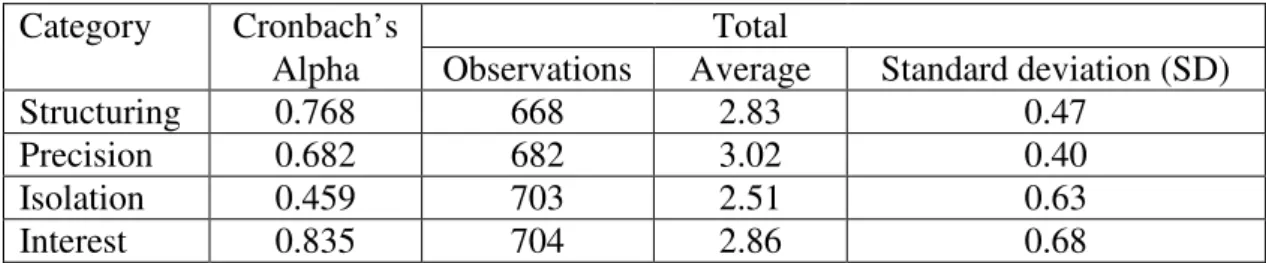
The descriptive measures for each dimension and their internal consistency, measured by Cronbach's Alpha, are presented in Table 1. The new variables correspond to the average of the respondent’s replies regarding the terms that make up each dimension. Table 1 – Perception of the image of and interest in the profession
Category Cronbach’s Total
Alpha Observations Average Standard deviation (SD)
Structuring 0.768 668 2.83 0.47
Precision 0.682 682 3.02 0.40
Isolation 0.459 703 2.51 0.63
Interest 0.835 704 2.86 0.68
The structuring of the profession presents a good internal consistency (Cronbach's alpha = 0.768), and the results suggest that the profession is considered to be structured (average = 2.83). The precision of the profession also presents a good internal consistency (Cronbach's alpha = 0.682), with the results suggesting that the profession is considered to be precise (average = 3.02). The isolation, which is a measure of the trend for the profession be carried out in a lonely way, presents a low internal consistency (Cronbach's alpha = 0.459). However, as this dimension is defined by Saemann and Crooker (1999), and because the terms composing it have a direct interpretation of the dimension, which concurs with the dimensionality criterion of the consistency analysis (Hair et al., 2010; Vicente and Reis, 2007), we chose to consider this dimension as valid to characterize the profession. The results suggest that the profession is considered neither as isolated nor collaborative (average = 2.51). The interest in the profession has a good internal consistency (Cronbach's alpha = 0.835), with the results suggesting that the profession is considered to be interesting (average = 2.86).
These results allow us to know, in general, the image of and the interest in the profession in the three social groups surveyed, and allow us to characterize the profession’s image in terms of hierarchy of the three image categories. The profession is perceived firstly as precise (average = 3.02), secondly as interesting (average = 2.86), thirdly as structured (average = 2.83), and finally as neither isolated nor collaborative (average = 2.51).
As for the image of the profession, the results are convergent with those from other studies concluding that the profession’s perception is directed towards rule compliance, is precise, and interested in the business details (Byrne and Willis, 2005; Saemann and Crooker, 1999). Regarding the interest in the profession, the results contradict those reported by other authors, who claim that the profession is boring, the antonym of interesting (Byrne and Willis, 2005; Parker, 2000; Pekdemir et al., 2013; Stivers and Onifade, 2014).
4.2 – The effect of the social group in the image of and in the interest in the profession
Table 2 presents the perceptions of image of and interest in the accounting profession, for each of the surveyed groups. The averages obtained tend to be similar in the various dimensions. All groups consider the profession as structured, with the averages ranging
8
between 2.80 for the CA, and 2.90 for the financial officers. Also, all groups consider the profession as interesting, with the averages ranging between 2.82 for the 3rd year students and for the CA, and 2.97 for the financial officers. There are only some differences between the averages in the dimensions precision and isolation. The financial officers consider the profession to be more precise (average = 3.20), and less isolated (average of 2.37) than the other groups.
Table 2 – Perception of the profession by social group
Group Obs Average SD Minimum Median Maximum
Structuring 1st year students 133 2.85 0.41 1.64 2.82 3.91 3rd year students 73 2.86 0.39 2.00 2.91 3.82 CA 372 2.80 0.47 1.27 2.82 4.00 Officers 90 2.90 0.58 1.27 3.00 4.00 Precision 1st year students 134 3.03 0.39 2.10 3.00 4.00 3rd year students 73 3.00 0.31 2.30 3.00 3.80 CA 370 2.97 0.41 1.70 3.00 4.00 Officers 105 3.20 0.37 1.80 3.20 4.00 Isolation 1st year students 142 2.48 0.55 1.00 2.67 3.67 3rd year students 73 2.54 0.60 1.33 2.33 4.00 CA 383 2.56 0.65 1.00 2.67 4.00 Officers 105 2.37 0.66 1.00 2.33 4.00 Interest 1st year students 142 2.91 0.55 1.00 3.00 4.00 3rd year students 74 2.82 0.65 1.00 3.00 4.00 CA 383 2.82 0.69 1.00 3.00 4.00 Officers 105 2.97 0.77 1.00 3.00 4.00
In terms of the dimensions’ ranking of importance in the three groups (Table 3), it stands out that all groups consider the profession as precise – the category with the highest averages. Only the 3rd year students place structuring in second place, and interest in the third place, unlike the remaining groups which assign a second place in importance to interest, and only then to structuring. However, the differences between the averages are not relevant.
Table 3 – Hierarchy of image and interest perception by social group Rank 1st year students Average 3rd year students Average Chartered accountants Average Financial officers Average 1 Precision 3.03 Precision 3.00 Precision 2.97 Precision 3.20
2 Interest 2.91 Structuring 2.86 Interest 2.82 Interest 2.97
3 Structuring 2.85 Interest 2.82 Structuring 2.80 Structuring 2.90
4 Isolation 2.48 Isolation 2.54 Isolation 2.56 Isolation 2.37
Isolation is the dimension where the groups are closer to the neutral value (2.5), being the financial officers the ones considering the profession as less isolated (average = 2.37), while the CA consider it as more isolated (average = 2.56).
9
The results contradict those of other studies, namely Dimnik and Felton (2006), who suggest the accounting profession’s image may vary depending on the group being surveyed, and also other studies reporting the existence of conflicting perceptions between managers and accountants (Johnston et al., 2002; O'Callaghan et al., 2010; Pierce and O'Dea 2003;).
4.3 – Effect of the individual characteristics on the image of and interest in the profession
The individual characteristic analysed simultaneously in the three social groups was gender. With regard to the students, it was also analysed the grade of entry in the university for the first-year students, and the expected final grade for the third-year students. For both professional groups we have also analysed the academic degree, the institution where the degree was taken, and the way how the accounting profession is carried out.
Regarding gender, most students belong to the female gender – 71% of the first-year students, and 62% of third-year students. The CA are the group with a more balanced gender distribution, where 46% of its members belong to the male gender. It is in the financial officials’ group that the positions are reversed, when compared to the students, since two-thirds of the respondents belong to the male gender. The gender differences among the three social groups are obvious: a majority of female students, a balanced gender distribution among the CA, and a majority of male gender financial officers. Analysing the three social groups together (Table 4), we can see that the female gender has the highest averages in all the perception dimensions of the profession, with the exception of precision, where it has an equal average to the male gender, being the highest difference in the interest in the profession. However the gender differences are not significant. These findings are different from those of other studies suggesting the influence of gender on the accounting profession’s perception (Almer et al., 2010; Byrne and Willis, 2005; Genç and Çal, 2015; Johnson et al., 2008; Özkürkçüler et al., 2014; Pekdemir et al., 2013; Stivers and Onifade, 2014).
Table 4 – Perception of the profession depending on the gender
Gender Structuring Precision Isolation Interest
Obs Average SD Obs Average SD Obs Average SD Obs Average SD Male 299 2.82 0.48 308 3.02 0.36 314 2.50 0.63 312 2.80 0.72
Female 363 2.84 0.45 368 3.02 0.42 383 2.52 0.63 386 2.90 0.64
ETA 0.025 0.006 0.012 0.071
With regard to the academic characteristics of the students, we analysed the students’ perception about the profession depending on the entry grade in the first year, and the expected final grade for the third-year students. Most students (55%) started college with a grade of good (between 13.5 and 16.4 points), 40% started with a grade of sufficient (between 10 and 13.4 points), and only 5% with a grade of very good (16.5 points or higher). Regarding the expected final college graduation grade, most students (61%) estimate a grade of sufficient (between 10 and 13.4 points), 36% estimate a grade of good (between 13.5 and 16.4 points), and the remaining students predict a final grade of very good (16.5 points or higher).
10
Table 5 allows the analysis of the effect of the entry grade in the first year, making it clear that the students with better grades are the ones who see the profession as being more structured (average = 3.09), more precise (average = 3.05), and more interesting (average = 3.11), but less isolated (average = 2.38). The results showed a tendency, albeit weak, towards an increase in the structuring perception of the profession (Spearman = 0.157), and a decrease in the isolation perception (Spearman = -0.138) when there is an increase in the college entry grade.
Table 5 – Perception of the profession according to the entry grade
Entry Structuring Precision Isolation Interest
grade Obs Average SD Obs Average SD Obs Average SD Obs Average SD
Sufficient 49 2.80 0.41 50 3.03 0.35 53 2.53 0.54 51 2.96 0.53
Good 63 2.86 0.39 65 3.00 0.39 67 2.40 0.54 69 2.84 0.57
Very Good 7 3.09 0.41 6 3.05 0.52 7 2.38 0.85 7 3.11 0.43
Spearman 0.157 -0.037 -0.138 -0.050
Table 6 allows an analysis of the effect of the expected final third year grade, making obvious the relationships already found for the first year students: the students with the best probable final grades are those who see the profession as being more structured (average = 3.05), more precise (average = 3.35), and more interesting (average = 3.63), but less isolated (average = 2.33). The results, however, suggest a tendency, although weak, towards an increase in the perception of structuring, and in the interest in the profession when the expected final college grade increases (Spearman = -0.145).
Table 6 – Perception of the profession according to the expected final grade
Final Structuring Precision Isolation Interest
Grade Obs Average SD Obs Average SD Obs Average SD Obs Average SD
Sufficient 33 2.80 0.40 34 3.01 0.34 34 2.54 0.59 34 2.76 0.62 Good 21 2.87 0.37 21 2.96 0.22 21 2.56 0.66 21 2.80 0.71 Very Good 2 3.05 0.32 2 3.35 0.07 2 2.33 0.47 2 3.63 0.18 Spearman 0.145 0.024 0.000 0.145
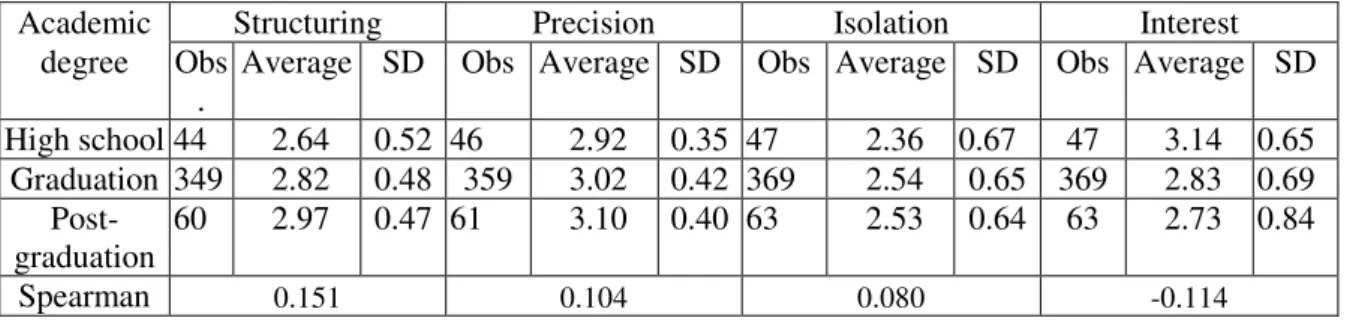
With regard to the professionals’ academic characteristics, we analysed the perception of the CA and of the financial officers regarding the accounting profession, depending on the academic degree and the institution in which the degree was obtained. Most CA are graduated (77%) with a licentiate’s or a bachelor's degree; only 12% of the CA have a secondary or equivalent education level. Regarding the institution that conferred the degree, almost half of the CA are university graduates (49%), while 43% earned their degree in a polytechnic institution. With regard to the financial officers, the majority of them are graduated (79%), having mostly obtained their degree in universities (72%). Table 7 allows us to analyse the effect of the academic degree, making it clear that the professionals with the higher degree are the ones who see the profession as being more structured (average = 2.97), more precise (average = 3.10), but less interesting (average = 2.73). On the other hand, the professionals with a lower degree are the ones considering the profession as being less structured (average = 2.64), less precise (average = 2.92), but more interesting (average = 3.14). The results suggest a tendency,
11
although weak, towards an increase in the perception of structuring and precision (Spearman = 0.151 and Spearman = 0.104, respectively) and a decrease in the interest in the profession (Spearman = -0.114), when the academic degree increases.
Table 7 – Perception of the profession according to the professionals’ academic degree
Academic Structuring Precision Isolation Interest
degree Obs .
Average SD Obs Average SD Obs Average SD Obs Average SD High school 44 2.64 0.52 46 2.92 0.35 47 2.36 0.67 47 3.14 0.65 Graduation 349 2.82 0.48 359 3.02 0.42 369 2.54 0.65 369 2.83 0.69 Post-graduation 60 2.97 0.47 61 3.10 0.40 63 2.53 0.64 63 2.73 0.84 Spearman 0.151 0.104 0.080 -0.114
Table 8 allows us to analyse the effect of the institution where the degree was taken, making clear that those graduated from universities are the ones who see the profession as being more structured (average = 2.87), more precise (average = 3.06), more isolated (average = 2.55), but less interesting (average = 2.77). In contrast, those graduated from high schools are the ones considering the profession as being less structured (average = 2.59), less precise (average = 2.97), less isolated (average = 2.32), but more interesting (average = 3.04). The results suggest a tendency, although weak, towards those graduated from universities to perceive a higher level of profession structuring (Eta = 0.148), and a lower level of interest in it (Eta = 0.111).
Table 8 – Perception of the profession according to the institution where the degree was taken
Institution issuing
Structuring Precision Isolation Interest
the degree Obs Average SD Obs Average SD Obs Average SD Obs Average SD High School 26 2.59 0.54 27 2.97 0.31 28 2.32 0.66 28 3.04 0.68 Polytechnic Institute 169 2.78 0.46 169 2.99 0.45 175 2.50 0.62 177 2.90 0.69 Universities 230 2.87 0.50 240 3.06 0.38 246 2.55 0.67 244 2.77 0.73 Eta 0.148 0.090 0.084 0.111
Regarding as to how the accounting profession is carried out, most CA are freelancers or external to the organizations (61%). Most financial officers reported results contrary to previous ones, in that in most companies (94%) the CA is an internal employee. This difference in results may be explained by the fact that the companies surveyed are large. Looking first at the opinions of the CA themselves, the results in Table 9 make it clear that the external CAs see the profession as being more structured (average = 2.83), more precise (average = 3.02), and more isolated (average = 2.64) than the internal CA. Regarding the interest in the profession, the results are reversed as the level of interest is higher in the internal CA (average = 2.86). The results suggest a tendency, although weak, towards the external CA perceiving a higher level of precision and isolation in the profession (Eta = 0.112 and Eta = 0.102, respectively).
12
Profession Structuring Precision Isolation Interest Chartered
Accountants
Obs Average SD Obs Average SD Obs Average SD Obs Average SD External 145 2.83 0.51 145 3.02 0.38 149 2.64 0.66 149 2.77 0.74 Internal 227 2.78 0.44 225 2.93 0.42 234 2.50 0.63 234 2.86 0.66
ETA 0.051 0.112 0.102 0.063
Analysing the opinion of the financial officials, the results in Table 10 show that, in the organizations where accounting is performed by an external CA, those officials see the profession as being more structured (average = 3.24), and more isolated (average = 2.39), but less precise (average = 2.93). Regarding the interest in the profession, this is higher for the officers of organizations with an internal CA (average = 3.02). The results suggest a tendency, although weak, towards those officers perceiving a higher level of structuring and a lower level of precision in the profession (Eta = 0.140 and Eta = 0.178, respectively) when it is carried out by an external CA. However, the most intense association occurs in the interest in the profession, which increases when the organization has an internal CA (Eta = 0.283).
Table 10 – Perception of the officers depending on how the profession of CA is carried out
Chartered accountants
Structuring Precision Isolation Interest
Performance Obs Average SD Obs Average SD Obs Average SD Obs Average SD External 5 3.24 0.40 6 2.93 0.40 6 2.39 1.06 6 2.08 1.03 Internal 85 2.88 0.59 99 3.21 0.36 99 2.37 0.64 99 3.02 0.73
ETA 0.140 0.178 0.008 0.283
These results show that carrying out the profession as an internal CA is more interesting for both professional groups of respondents, which differs from the study of Friedman and Lyne (2001) that suggests the remaining company employee groups have a more negative perception of the internal accountant than of the external of freelance accountant.
4.4 – Interest in the profession through the perception of its image
While studying the relationship between the dimensions of image of and interest in the profession, we analysed the linear correlation coefficients (Table 11) and estimated a multiple linear regression model. All its assumptions were checked in order to explain the interest in the profession from the three image dimensions (Table 12). The functional formula of the estimated model is as follows (Hair et al., 2010):
Interesti = β0 + β1Structuringi + β2 Precisioni + β3 Isolationi +
ε
iWhere
β
i(i=0,1,2,3) are the parameter to be estimated andε
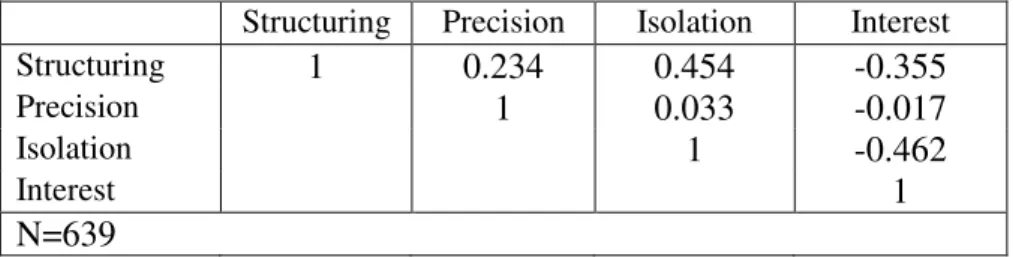
the errors (random).Table 11 results allowed us to check the existence of inverse and moderate relationships between the level of interest, and the levels of structuring (Pearson = -0.355) and isolation (Pearson = -0.462), which indicates that the higher the perceived level of structuring and isolation the lower tends to be the interest in the profession. There is no
13
relationship between the level of interest of the profession and its precision level (Pearson=-0.017). Also, between the level of precision and the isolation level there is no correlation (Pearson=0.033). However, there was a moderate and direct connection between the latter and the level of structure (Pearson=0.454), indicating that greater perception of isolation is associated with greater perception of the profession structure. Finally, between the level of structure and precision there is a weak and direct relationship (Pearson=0.234).
Table 11 – Pearson correlation between the image dimensions and interest Structuring Precision Isolation Interest
Structuring 1 0.234 0.454 -0.355
Precision 1 0.033 -0.017
Isolation 1 -0.462
Interest 1
N=639
Next we estimated a linear model to explain the level of interest in the profession using as determinants the three dimensions of image. The results, reported in Table 12, allow us to note that the linear regression model is significant overall (F(3;635) = 67.527; p<0.001), which accounts for the 23.8% in variance of the level of interest in the profession (adjusted coefficient of determination = 0.238). Of the image dimensions only two were significant, i.e., only the level of structuring and the level of isolation contribute significantly to explain the variation in the level of interest. In fact, it turns out that when the perception of the level of structuring varies a standard deviation, the level of interest in the profession varies, on average, in the opposite direction in 0.194 standard deviations, with the other explanatory factors remaining constant (Beta = -0.194; t = -4.844; p <0.001). Also, when the perception of the level of isolation varies a standard deviation, the level of interest in the profession varies, on average, and in the opposite direction, in 0.376 standard deviations, with everything else remaining constant (Beta = -0.376; t = -9.658, p <0.001). Thus, the level of isolation is the most important dimension to explain the level of interest in the profession (higher standardized coefficient, in absolute terms).
Table 12 – Results of the regression model to explain the interest in the profession Model Independent variable Standardized coefficient Statistics t p-value Adjusted R2 Statistics f p-value Structuring -0.194 -4.844 0.000 0.238 67.527 <0.001 1 Precision 0.041 1.149 0.251 (gl:3;635) Isolation -0.376 -9.658 0.000 Dependent variable: interest; n=639
It was thus concluded that the higher the level of structuring and isolation, the lower tends to be the interest in the profession. The results of this study are therefore consistent with those of Saemann and Crooker (1999), in that the authors have also found that the more traditional the image of accounting in terms of structuring and isolating, the lower is the probability of it being considered interesting.
14
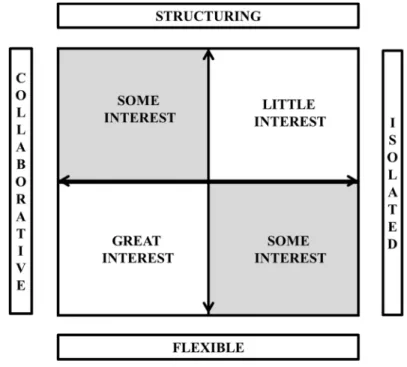
In summary, Figure 1 aims to explain the interest in the profession according to the two image dimensions, which proved to be predictive of the interest: structuring and isolation. The quadrant referring to the little interest in the profession represents an image of the profession approaching isolation and structuring. The quadrant referring to the great interest represents an image of the profession as collaborative and flexible. Both quadrants of some interest reflect situations in which the image is collaborative but structured, or flexible but isolated.
Figure 1 – Explanatory model of the interest in the profession according to its image
5 – CONCLUSION
This study was operationalized by formulating three research questions that aim to meet the following objectives: to analyse the perception of the image of and the interest in the profession; to identify any perception differences among the respondent groups; to identify the individual characteristics influencing the perception of the profession; to propose an explanatory model of the interest in the profession, depending on its image. To answer the first formulated research question, we analysed the replies to the 28 terms survey characterizing the image of and the interest in the profession. Through a PCA analysis the four categories proposed by Saemann and Crooker (1999) to characterize the profession were created: level of structuring; level of precision; level of isolation; level of interest. The results from the overall respondents support the conclusion that the profession is perceived firstly as precise, secondly as interesting, thirdly as structured, and not isolated nor collaborative. The results are in line with the reviewed studies regarding the image of the profession, but differ from the studies reporting a low level of interest associated with the profession.
Regarding the second research question, the results showed no significant differences in the perception of the image of and interest in the profession among the three social groups surveyed. The results found contradict other reviewed studies, namely those suggesting that the image of the profession varies depending on the respondent group,
15
as well as other studies reporting the existence of conflicting perceptions between managers and accountants.
Additionally, and with regard to the third research question, no association was found between gender and the perception of the profession, which goes against the existing literature on the influence of this individual characteristic. Two academic student characteristics were analysed: the entry grade in the first year; and the expected final grade of the third year students. The results suggest that the first year students with higher entry grade perceive a higher level of structuring and a lower level of isolation of the profession; and that the third-year students with the higher final grade perceive a higher level of structuring and of interest in the profession. Two academic characteristics of the professionals were also analysed: the academic degree, and the institution in which it was obtained. The results suggest that the professionals with a higher academic degree perceive a higher level of structuring and precision in the profession, and a lower level of interest in it; and that the graduates from universities perceive a higher level of structuring in the professional and a lower level of interest in it. As to how the accounting profession is carried out, the results show that exercising the profession as an internal CA is more interesting for both professional groups surveyed, which is divergent from the literature reviewed.
Regarding the last research question, the results showed that the higher the perception of the level of structuring and isolation, the lower tends to be the interest in the profession. These findings are consistent with another study preciously conducted on students, while contributing to the generalization of these results to the professionals. Based on these findings, we suggest an explanatory matrix model of the interest in the profession.
This study presents theoretical and managerial implications, since it contributes to the understanding of the image of and the interest in the accounting profession for three reasons. Firstly, because it concludes that there is convergence regarding the perception of the profession among the three social groups that constitute the profession's value chain. Secondly, because the reviewed studies do not analyse the influence of the academic characteristics on the perception of the profession, so the conclusions now obtained about the student’s grades, and the academic background of the professionals are a contribution of this study. Thirdly, because it allows the generalization that the interest in the profession results from the perception the professionals have regarding the image of the profession.
As the main limitation of this study we recognize the existence of factors that do not guarantee the representativeness of the student sample, since it is not random, as well as the fact that students of only one higher education institution were surveyed.
For future research, we suggest the application of this study to other professional groups, such as Statutory Auditors, and to students from other higher education institutions. We also suggest the replication of this study in a way that overcomes the representativeness limitation of the identified sample, in order to confirm or refute the findings of this research.
16
REFERENCES
Almer, E., Lightbody, M., Single, L. and Vigilante, B. (2010) ‘New leadership tracks in accounting firms: An alternative to the partnership’, Current Issues in Auditing, Vol. 5, No. 1, pp. A39-A53.
Askary, S., Kukunuru, S. and Pech, R. (2014) ‘An assessment of employee commitment to work among UAE nationals’, International Journal of Business Excellence, Vol. 7, No. 1, pp. 1-15.
Byrne, M. and Willis, P. (2005) ‘Irish secondary student’s perceptions of the work of an accountant and the accounting profession’, Accounting Education: an international Journal, Vol. 14, No. 4, pp. 367-381.
Carnegie, G. and Napier, C. (2010) ‘Traditional Accountants and Business Professionals: Portraying the Accounting Profession after Enron’, Accounting, Organizations and Society, Vol. 35, No. 3, pp. 360-376.
Dimnick, T. and Felton, S. (2006) ‘Accountant stereotypes in movies distributed in North America in the twentieth century’, Accounting, Organizations and Society, Vol. 31, No. 2, pp. 129-155.
Enis, C. (2010) ‘Role Perceptions of Accountants: Ten More Years Through the Looking Glass’, in Cheryl, R. (ed.), Ethics, Equity, and Regulation (Advances in Public Interest Accounting, Volume 15) Emerald Group Publishing Limited, pp.23 – 59.
Flynn, A., Earlie, E. and Cross, C. (2015) ‘Gender equality in the accounting profession: on size fits all’, Gender in Management: An International Journal, Vol. 30, No. 6, pp. 479-499.
Friedman, A. and Lyne, S. (2001) ‘The Beancounter Stereotype: Towards a General Model of Stereotype Generation’, Critical Perspectives on Accounting, Vol. 12, No. 4, pp. 423-451.
Genç, K. and Çal, B. (2015) ‘Environmentalism as a stakeholder issue and a research for the environmental awareness of university students’, International Journal of Business and Management, Vol. 10, No. 6, pp. 113-133.
Hair, J., Black, W., Babin, J. and Anderson, R. (2010) Multivariate Data Analysis, 7ª edition, Pearson Prentice Hall, New Jersey.
Jeacle, I. (2008) ‘Beyond the Boring Grey: The Construction of the Colourful Accountant’, Critical Perspectives on Accounting, Vol. 19, No. 8, pp. 1296-1320.
Johnson, E., Lowe, D. and Reckers, P. (2008) ‘Alternative work arrangements and perceived career success: Evidence from international public accounting firms’, Accounting, Organizations and Society, Vol. 33, No. 1, pp. 48-72.
Johnston, R., Brignall, S. and Fitzgerald, L. (2002) ‘The Involvement of Management Accountants in Operational Process Change: Results from Field Research’, International Journal of Operations & Production Management, Vol. 22, No. 12, pp. 1325-1338.
Lightbody, M. (2009) ‘Turnover decisions of women accountants: using oral histories to understand the relative influence of domestic obligations’, Accounting History, Vol. 14, No 1-2, pp. 55-78.
Linnhoff, S., Smith, K. and Smith, L. (2015) ‘A longitudinal analysis of work-life balance perspectives of future business professionals’, International Journal of Business Excellence, Vol. 8, No 5, pp. 601-631.
17
Murugesan, R. and Dominic, D. (2013) ‘Influencing entrepreneurial intentions: The role of attitudes and personality constructs’, International Journal of Business Excellence, Vol. 6, No. 6, pp. 687-701.
O’Callaghan, S., Elson, R., Walker, J., Rao, A. and Rechtman, Y. (2010) ‘Help Staff Pass the CPA Exam’, The CPA Journal, Vol. 80, No. 12, pp. 62-64.
Özkürkçüler, H., Ceran, M. and Ortakarpuz, M. (2014) ‘A research on the university students’ viewpoints on accounting courses and profession’, Economics, Management and Financial Markets, Vol. 9, No. 4, pp. 201-212.
Parker, L. (2000) ‘Goodbye, number cruncher!’, Australian CPA, Vol. 77, No 2, pp. 50-52.
Pekdemir, I., Pekdemir, R. and Sen, Y. (2013) ‘A comparative study on the business school students’ perceptions on the professional accountancy of turkey’, Accounting and Management Information Systems, Vol. 12, No 1, pp. 39-60. Pierce, B. and O’Dea, T. (2003) ‘Management Accounting Information and the needs of
Managers: Perceptions of Managers and Accountants Compared’, The British Accounting Review, Vol. 35, No. 3, pp. 257-290.
Qasem, R. and Abdullatif, M. (2014) ‘The status of women in the accounting profession in Jordan: an exploratory study’, International Business Research, Vol. 7, No. 8, pp. 257-290.
Rajesh, J. and Suganthi, L. (2014) ‘The relationship between transformational leadership and followers’ interpersonal communication satisfaction in Indian organisations’, International Journal of Business Excellence, Vol. 7, No. 1, pp. 28-51.
Saemann, G. and Crooker, K. (1999) ‘Student perceptions of the profession and it its effect on decisions to major in accounting’, Journal of Accounting Education, Vol. 17, No. 1, pp. 1-22.
Stivers, B. and Onifade, E. (2014) ‘Student perceptions of introductory accounting and the accounting profession’, Academy of educational Leadership Journal, Vol. 18, No. 3, pp. 49-59.
Sugahara, S., Boland, G. and Cilloni, A. (2008) ‘Factors Influencing Students’ Choice of Accounting Major in Australia’, Accounting Education: an international journal, Vol. 17, No. Supplement 1, pp. S37-S54.
Vicente, P. and Reis, E. (2007) ‘Determinantes da adesão das empresas a programas de separação e deposição selectiva de resíduos’, Revista Portuguesa e Brasileira de Gestão, Vol. 6, No. 2, pp. 20-30.
Worthington, A. and Higgs, H. (2003) ‘Factors explaining the choice of a financial major: the role of student’s characteristics, personality and perception of the profession’, Accounting Education: an international journal, Vol. 2, No. 3, pp. 261-281.
Worthington, A. and Higgs, H. (2004) ‘Factors explaining the choice of an economics major: the role of student’s characteristics, personality and perception of the profession’, International Journal of Social Economics, Vol. 13, No. 5-6, pp. 593-592.