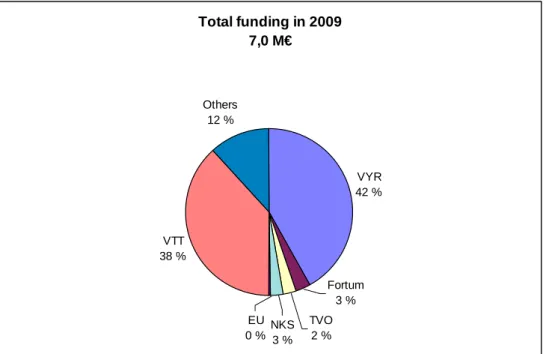
The objective is "to ensure that, should such new factors arise relating to the safe operation of nuclear facilities as could not be foreseen, the authorities have at their disposal such sufficient and comprehensive nuclear engineering expertise and other facilities as may be used , when necessary, to analyze without delay the importance of such factors." High scientific quality is required of the research projects in the program and their results are distributed to the organizations involved in the Steering Group. The research needs and challenges, as well as the organization of the program were presented in the Framework Plan of SAFIR2010 [1]. In addition to the State's Nuclear Waste Management Fund (NWMF), other key organizations working in the field of nuclear safety also fund the program.
After this, a brief summary is given about the research plans of the individual projects (Chapter 2) and overall financial (Chapter 3) and administrative (Chapter 4) matters. The detailed research plans of the projects are given in Appendix 1, their budgets in Appendix 2, and Appendix 3 contains lists of persons involved in the research program in the Steering Group, Reference Groups of the research areas and in the research projects. The objective of SAFIR2010 is realized in the research work carried out and in the training of experts in these research projects.
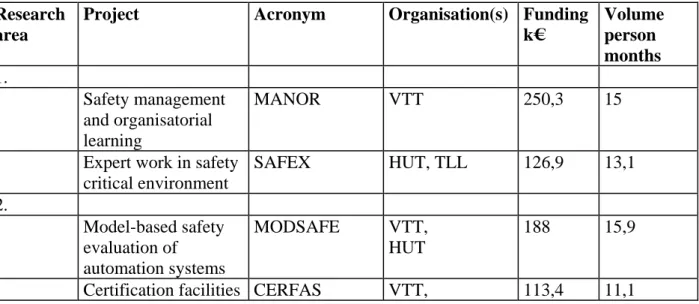
The research areas with their research challenges and needs for the period 2007-2010 are described in detail in the Framework Plan [1]. Research projects in different fields with their volumes according to funding decisions taken by VYR in March 2009 are given in table 2.1.

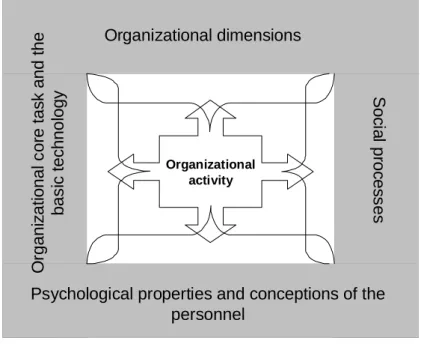
Organisation and human factors research area
Safety management and organizational learning (ManOr)
Expert Work in Safety Critical Environment (SafeExpertNet)
Defining and developing the exchange of knowledge and expertise and their application throughout the nuclear energy community.
Automation and control room research area
Model-based safety evaluation of automation systems (MODSAFE)
Certification facilities for software (CERFAS)
Conditions for high-level services are the systematic use of diverse expertise and effective evaluation tools dedicated to the task. Certifiers must have competitive products and services with unique features that are desired by customers and that other certification bodies cannot deliver in the foreseeable future. The strategic primary objective of CERFAS is to develop facilities for flexible, supported, commercially exploitable, high-quality software certification services capable of certifying security-critical and security-related software.
Operator practices and human-system interfaces in computer-based control
Fuel and reactor physics
Development and Validation of Fuel Performance Codes (POKEVA)
In the project, development will be carried out to meet the requirements for the availability of methods for assessing nuclear fuel. A permanent goal is to create and maintain computational tools, that is, systems of computer codes for steady-state and accident conditions that can be used independently of those possessed by power plant designers and fuel suppliers. Some of the existing codes are based on outdated modeling and architecture, and renewal of the system consisting of new parts or completely new codes is one of the long-term goals.
Tri-dimensional core transient analysis methods (TRICOT)
Total reactor Physics Analysis System (TOPAS)
Thermal Hydraulics research area
- Numerical modeling of condensation pool (NUMPOOL)
- Improved Thermal Hydraulic Analysis of Nuclear Reactor and Containment (THARE) 14
- Improvement of PACTEL Facility Simulation Environment (PACSIM)
- Condensation experiments with PPOOLEX facility (CONDEX)
- Passive safety system simulation (PASSIMU)
Another goal is to improve the understanding of the thermal hydraulic phenomena in the dry well and in the wet well spaces in the containment. The main objective of the project is to develop and validate calculation methods for the safety assessment of nuclear power plants. The aim of the project is to develop a simulation methodology and tool for modeling horizontal and vertical steam generators of nuclear power plants, taking into account the multidimensional effects and the two-phase flow phenomena.
The PWR-PACTEL experiment is used as a test case for the vertical steam generator model. The main objectives of the PACSIM project are to improve the use of the thermal hydraulic code TRACE and to improve the simulation environment of the PACTEL facility. TRACE code calculations with this model will provide valuable analysis and comparison support for APROS calculations of future PWR PACTEL experiments.
The main objective of the project is to improve the understanding and increase the fidelity in the quantification of various phenomena in the dry well and condensation pool of a boiling water reactor (BWR) during steam discharge. Pool wall stresses at precisely defined locations should be measured to verify the structural analysis.

Severe Accidents research area
- Release of radioactive materials from a degrading core (RADECO)
- Primary circuit chemistry of fission products (CHEMPC)
- Core Melt Stabilization (COMESTA2009)
- Hydrogen, debris coolability and SFP accidents (HYBCIS)
First, a study of the extent of the integral effects of a severe accident that begins at a stop should be conducted. The aim of the study at VTT is to determine the iodine compounds released as a result of reactions on the surface of the tubes of the primary circuit. VTT will continue to monitor the Phebus FP and International Source Term Programs (ISTP) and participate in the interpretation of the results.
The aim of the project is to investigate the phenomena of molten core – concrete interactions, coolability of nuclear melt and steam explosions, and to develop competence for computational modeling of severe accidents. The interaction of the special sacrificial FeSi concrete in the EPR reactor well with oxidic corium will be investigated in the FESICO experiment. Through the CSARP agreement, the latest versions of the severe accident simulation program MELCOR will be put into use.
The project is divided into three different topics within severe accident research: particle bed cooling, hydrogen risk analysis within the framework of the OECD THAI program and accidents with loss of coolant in spent fuel pools. The purpose of the first sub-project is to investigate the coolability of the waste bed consisting of core melt from the container.
Structural safety of reactor circuit research area
- Risk-Informed Inspections of Piping (PURISTA)
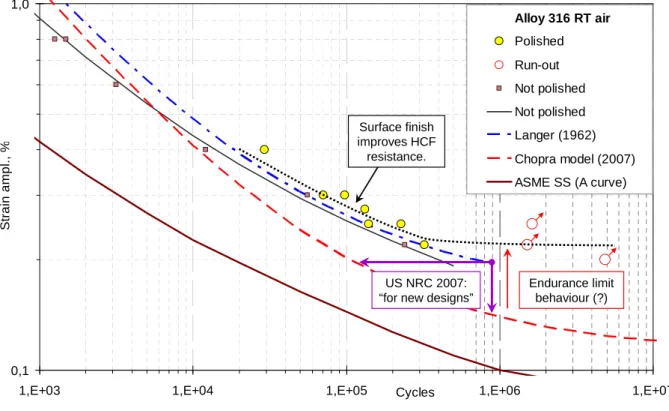
- Fatigue endurance of critical equipment (FATE)
- Water chemistry and oxidation in the primary circuit (WATCHEM)
- Monitoring of the structural integrity of reactor circuit (RAKEMON)
- Fracture assessment for reactor circuit (FRAS)
- Influence of material, environment and strain rate on environmentally assisted
- Renewal of active materials research infrastructure (AKTUS)
The overall aim of the project is to support the implementation of in-service inspection (RI-ISI) in Finnish nuclear power plants by studying relevant issues related to RI-ISI. The results will be used in modeling to obtain estimates for relevant parameters of oxidation processes. This assignment consists of a thorough review of the literature on the subject along with experimental tests under appropriate conditions in which various decontamination procedures are tested.
With this approach, a high enough level of competence can be achieved to select the best plant-specific commercial decontamination practice. The fourth objective (Task 4) is to evaluate the effect of dissolved H2 on the stability of the oxide films on nickel-base alloys and their welds during cooling of a PWR. The goal of this project is to develop techniques and monitoring systems that can be used to monitor the structural integrity of the primary circuit components.
More advanced monitoring system inspection methods will be studied and an advanced version of the monitoring system will be built. The investigation is urgent due to the renovation works and needs at the current location at VTT Espoo (Otakaari 3). The current infrastructure and most of the facilities were built in the 1970s and are therefore not technically up to date and the infrastructure does not fully meet all the requirements necessary to enable the fulfillment of the current tasks.
Construction safety research area
Service Life Management System of Concrete Structures in Nuclear Power Plants
IMPACT 2010
Structures under Soft Impact (SUSI)
Probabilistic safety analysis (PSA) research area
Challenges in Risk-Informed Safety Management (CHARISMA)
Challenges in risk-informed safety management relate to the use of probabilistic safety assessment (PSA) to support decision-making and to internal and practical problems in PSA techniques. In general, the project deals with the entire field of risk-informed methods and application areas related to the safety of nuclear power plants.
Implementation of Quantititive Fire Risk Assessment in PSA (FIRAS)
The fire spread will be modeled by implementing the flame spread models developed during previous projects into the FDS fire simulation program. The input will be obtained from TGA DTA data and the validity of the models and simulation results will be confirmed by comparison and examination with the data obtained by the new flame-spreading test setup that allows measurements with 2 meter long preheated samples. The work will be carried out in close cooperation with the personnel involved in the safety and PRA work of the nuclear power plants.
This task constitutes a learning process that will assist in the next step, i.e. in the classification of the large number of rooms in nuclear power plants into about twenty general fire risk-relevant rooms, which will then be subjected to a detailed investigation. PRA analysis by NPP staff. As a new development, probabilistic simulation of fire development will be combined with systemic modeling of personnel actions in collaboration with the CHARISMA/SAFIR2010 project. This work paves the way for the development of a holistic fire risk assessment methodology that combines the science-based characterization of the fire and its consequences (FIRAS) with the risk-informed (CHARISMA) management of fire situations by nuclear power plant personnel and fire brigades.
To assess the capabilities and efficiency of operational firefighting measures in nuclear power plant fires, a model based on data from statistics and fire exercises will be developed as a spreadsheet tool that can be easily linked to VTT PFS (Probabilistic Fire Simulator). 3) Carrying out fire simulations related to, but outside the OECD PRISME project, aimed at (i) guidance in the design of experiments and (ii) validation of the developed fire models.
Extreme weather and nuclear power plants (EXWE)
1 Chapter in the work report: description of the modeled systems and the results of model checking. Bachelor's, master's and doctoral theses are written based on the results of the research project.
![Figure 2.3. Vertical velocities at outlet [m/s]: mixture velocity (upper left), slip velocity (upper right), vapor velocity (lower left) and liquid velocity (lower right).(TRICOT project 2008)](https://thumb-eu.123doks.com/thumbv2/9pdfco/19403612.0/13.892.104.654.162.594/figure-vertical-velocities-mixture-velocity-velocity-velocity-velocity.webp)